© 2014, IJCSMC All Rights Reserved 860
Available Online atwww.ijcsmc.com
International Journal of Computer Science and Mobile Computing
A Monthly Journal of Computer Science and Information Technology
ISSN 2320–088X
IJCSMC, Vol. 3, Issue. 7, July 2014, pg.860 – 865
RESEARCH ARTICLE
A Survey on Different QoS Parameters to
Optimize Sensor Network Communication
Kritica Bhargava
Student, M.Tech (CSE)
RN College of Engineering & Management, Rohtak, Haryana [email protected]
Vikram Nandal
Assistant Professor, CSE Department
RN College of Engineering & Management, Rohtak, Haryana
Abstract: A Sensor network is a limited area network defined under energy constraints. This kind of network is adaptive under energy parameters. As the communication performed, some energy loss occurs on each node. To optimize the network communication and to improve the network life, it is required to optimize the QoS for different operations associated with sensor network. Routing is one of such common operation in sensor network. There are number of characteristics and limitations of sensor network that affects the communication quality and puts its impact on network life. In this present work, some of these associated sensor network components and properties are discussed.
Keywords – WSN, Characteristics, Network Life, QoS, Limitations
1.
INTRODUCTION
© 2014, IJCSMC All Rights Reserved 861
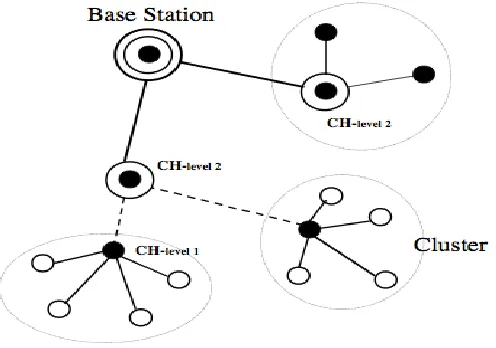
head. As the cluster head receives data from cluster nodes, it performs an aggregative communication via other cluster heads to deliver this data to base station.
Figure 1 : Network Architecture
A) Network Architecture
It is a process in which the network is divided in smaller segments called clusters and each segment is controlled by a controller node called cluster head. The cluster head collects the data from all the cluster nodes and pass it to the base station. Clustered network is the most common network scenario defined in many sensor networks to perform the effective communication over the network. These kinds of networks are controlled under different protocol specification. These protocols include the clustering as well as aggregation based protocols. These protocols include the LEACH, PEGASIS and ESPDA protocols. The clustering is explored by these protocols to improve the network by reducing the network communication and by reducing the energy consumption over the network. The localization of nodes in the network also reduce the communication as well as the energy consumption over the network [11][12]. Such network architecture is shown in figure 1.
B) QoS Parameters
The QoS in sensor network depends on number of associated vectors. Distance is one of such parameter, that affects the network communication. The QoS in network is directly proportional to the distance covered to perform the communication. To optimize the communication, it is required to perform it over the shortest path. But such kind of route is generally unsafe and congested; because of this some alternate shortest paths are also selected for network communication. Another parameter in route optimization is the HopCount. HopCount in a communication network represents the number of intermediate nodes over the path. Each intermediate node over the path gives some data loss. Because of this, as the number of intermediate nodes increases in a communication path, the network life also decreases.
In this paper, a work is defined to explore the QoS constraints in communication sensor network. In this section, the exploration to the sensor network is defined along with the network architecture and the communication parameters. In section II, the work defined by earlier researchers is discussed. In section III, the QoS constraints in sensor network architecture are explored. In section IV, the conclusion obtained from the work is presented.
2.
RELATED WORK
© 2014, IJCSMC All Rights Reserved 862
work to improve the secure routing in sensor network. The defined model has analyzed different routing protocols under security capabilities. Author defined the formal model for secure route generation in communication network. Author analyzes the network under privacy characteristics assessments and to provide the effective data transfer over the network. Author has analyzed two main routing protocol classes called flooding and single path routing protocols. Author analyzed the network route generation under privacy and energy constraints. Author compared the network under energy specification and security assessment. Jobin[2] has defined a effective data transmission scheme to handle communication in sensor network. Author defined a work to provide effective communication while analyzing the communication bandwidth and the energy specification. Author has defined the sensor network specification under timeline specification and communication delivery over the network. Author defined the information collection over the sensor network to improve the communication. Author has defined an effective lightweight communication framework to improve the routing over the network. Author has defined the communication under two main objectives to integrate the framework under three main elements called complex data communication, effective communication route generation and MAC layer supported routing. Author defined work for self configuration network. Ataul Bari[3] has defined an effective route communication so that the network life will be improved. Author defined the communication network to handle the communication over the network. Author has defined the effective balanced data gathering to perform data transmission under range, connectivity, fault effectiveness and power aware communication. Author defined the communication over clustered network so that the cluster head based communication will be performed. Author defined the relay node based communication to generate effective route in sensor network. Author defined the scheduling over the network to improve the communication. Author has defined an effective communication approach to improve the network life and to improve the network communication. Yean-Fu Wen[4] has defined an effective data aggregation specific routing in communication network. Author has defined a effective scheduled routing in clustered sensor network. Author defined the battery capacity analysis and energy effective communication in sensor network. Author has defined the energy effective communication for power range communication. Author has estimated the energy consumption over the network. Author has defined the effective cluster construction and data construction for effective aggregative routing. Yu Gu[5] has defined effective scheduling mechanism to improve the routing in survelance based communication network. Author defined the routing to improve the network lifetime and coverage so that network effectiveness will be improved. Author has defined the effective communication network under energy effectiveness. Author has improve the network under the connectivity requirement. Author has presented a Q-coverage based requirement approach to provide communication under effective sample rate based communication. Author has defined the NP complete problem effective optimized routing under the sensing range based communication. Author has defined the column effective route optimization with the specification of speed and convergence rate. Author provides the priority specification communication over the network.
Saeyoung Ahn[6] has defined a scheduling specification routing for Zigbee effective slotted network. Author defined an effective communication routing scheme under power consumption so that the network communication issues will be resolved. Author has defined an effective clustered routing under multi-hop communication network. Author has defined the zigbee effective communication in restricted communication network. The work is here defined to achieve the stability and synchronization. The zigbee based communication is multihop short distance communication so that the network communication over the network will be improved. Author defined the scheduling scheme under low power consumption and communication analysis so that the network life is improved. Author has defined a tree topology specification communication effective network has improved the communication over the network.
© 2014, IJCSMC All Rights Reserved 863
Author has defined the work to reduce the energy consumption and to improve the network life. Author has defined a fault tolerance specific routing under energy efficient communication. Author has defined the scalability, latency specific communication so that the effective network communication will be drawn. Jiann-Liang Chen[11] has defined an adaptive route generation for sensor network. Author has improved the communication under proactive, reactive and hybrid routing. Author defined the routing under communication network and to improve the communication over the network. Author has defined an adaptive routing protocol for redundancy communication with effective route generation for network. Author improved the simulation by effective communication route generation. Amulya Ratna Swain[12] has defined an energy effective route generation in sensor network. Author has defined the battery effective communication in sensor network. Author defined work under restrictions of node deployment. Author has defined the energy limited routing to conserve the energy and to improve network life. Author has defined two main energy effective scheduling approach called random communication and synchronized communication. Author has defined a sleep scheduling scheme to generate route between two ends.
3.
QoS CHARACTERISTICS
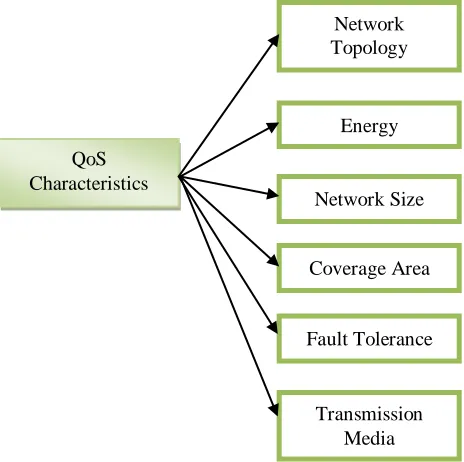
In sensor network, one of the challenges is to optimize the communication and to improve the network life. There are number of dependable characteristics for such kind of network. In this section these all characteristics that affect the network communication are explored. These all parameters are shown in figure 2.
Figure 2 : QoS Characteristics
A) Network Topology
A sensor network is generally a static communication network in which nodes are placed at fixed location. The physical location of nodes in the network affects the network communication. The node distribution over the network is defined as the topology. The sensor network is hybrid communication network in which nodes differ under the criticality vector. Because of this, the nodes placement must be defined under the same criticality vector. The uniformity over the network nodes is required so that the effective network communication will be performed over the network. The network topology itself affects the network congestion, resource utilization, sensing range etc.
B) Energy
A sensor network is energy adaptive network. With each transmission, each communicating node release some amount of energy. According to the role of the node, the energy consumption over the node differs. Such as the node working as
QoS Characteristics
Network Topology
Energy
Network Size
Coverage Area
Fault Tolerance
© 2014, IJCSMC All Rights Reserved 864
transmission or receiving nodes gives higher energy loss whereas then nodes work as intermediate nodes gives lesser energy loss. To optimize the QoS in such network, it is required to define an energy balanced network. The equalize energy consumption reduces the network criticality and the network life is improved.
C) Network Size
The size of network also affects the network QoS. The network size itself affects the network density and the distance between a node pair. As the distance between the node pair increases, there are higher chances of data loss over the route. To optimize the network, it is required to optimize the communication over the network. Network size itself represents the scalability vector that affects the network utilization.
D) Coverage Area
Coverage is defined as the sensing range that decides the communication reach of a node. Higher the range, more accurate the communication will be. The coverage is also limited to the physical area of the network. The sensing node also identifies the maximum connectivity over the network. Higher the connectivity level, more effective the routing decision will be.
E) Fault Effectiveness
As the size of the network, the criticality of network communication and route identification also increases. The distance communication is performed using multi-hop routing and in such case, the identification of route with minimum number of intermediate nodes is also a challenge. As the number of intermediate nodes increases, the energy consumption over the route also increases. The scalability also need to identify the node state so that effective utilization of each node over th e network will be performed.
F) Transmission Media
A sensor network performs the communication over the wireless channel under different vectors associated with communication channel. Some such vectors includes fading rate, error rate etc. Communication bandwidth, communication rate, MAC protocol design are also the integrated vectors with transmission media that affects the efficiency and reliability of communication over the sensor network.
4.
CONCLUSION
In this paper, the QoS characteristics of sensor network are explored. These all characteristics improve the network communication and network life. The paper has discussed the effect of these all communication characteristics over the network.
References
[1] Pandurang Kamat," Enhancing Source-Location Privacy in Sensor Network Routing", Proceedings of the 25th
IEEE International Conference on Distributed Computing Systems (ICSCS’05) 1063-6927/05 © 2005 IEEE
[2] J. Jobin," A Lightweight Framework for Source-to-Sink Data Transfer in Wireless Sensor Networks",
0-7803-9277-9/05©2005 IEEE
[3] Ataul Bari," Maximizing the Lifetime of Two-Tiered Sensor Networks".
[4] Yean-Fu Wen," Energy-Efficient Data Aggregation Routing and Duty-Cycle Scheduling in Cluster-based Sensor
Networks", 1-4244-0667-6/07 © 2007 IEEE
[5] Yu Gu," Joint Scheduling and Routing for Lifetime Elongation in Surveillance Sensor Networks", 2007 IEEE
Asia-Pacific Services Computing Conference 0-7695-3051-6/07 © 2007 IEEE
[6] Saeyoung Ahn," Slotted Beacon Scheduling Using ZigBee Cskip Mechanism", The Second International
Conference on Sensor Technologies and Applications 978-0-7695-3330-8/08 © 2008 IEEE
[7] Yavuz Bogaç Turkogullari," An Ef_cient Heuristic for Placement, Scheduling and Routing in Wireless Sensor
© 2014, IJCSMC All Rights Reserved 865
[8] Yawen Dai," MEBRS: Energy Balancing Route Scheduling in Centralized Wireless Sensor Networks", 1st Int'l
Symposium on Quality Electronic Design-Asia 978-1-4244-4952-1/09 ©2009 IEEE
[9] Vinay Joseph," Joint Power Control, Scheduling and Routing for Multicast in Multihop Energy Harvesting Sensor
Networks", 9781-4244-3941-6/09@2009 IEEE
[10] D.Baghyalakshmi," LOW LATENCY AND ENERGY EFFICIENT ROUTING PROTOCOLS FOR WIRELESS
SENSOR NETWORKS", ICWCSC 2010X 978-1-4244-5137-1/10 ©2010 IEEE
[11] Jiann-Liang Chen," Adaptive Routing Protocol for Reliable Wireless Sensor Networking", ICACT 2010 ISBN
978-89-5519-146-2
[12] Amulya Ratna Swain," An Energy Aware Routing Protocol with Sleep Scheduling for Wireless Sensor Networks",