Available Online atwww.ijcsmc.com
International Journal of Computer Science and Mobile Computing
A Monthly Journal of Computer Science and Information Technology
ISSN 2320–088X
IJCSMC, Vol. 3, Issue. 5, May 2014, pg.83 – 88
RESEARCH ARTICLE
Host-Based Intrusion Detection and
Attack Graph Selection in VNS
B.Manikandan
1, S.Balaji
2Department of Information Technology, V.S.B.Engineering College, Karur, Tamilnadu, India Department of Information Technology, V.S.B.Engineering College, Karur, Tamilnadu, India
Email:[email protected] Email: [email protected]
Abstract— Cloud Computing has several major issues and concerns, such as expectations regulations, performance, trust, and data security issues. DDOS is a multiple hosts attacks made simultaneously in all network. DDoS attacks performed some vulnerable action in early stage such as low-frequency vulnerability scanning, multistep exploitation, and identifying the compromised vulnerable virtual machines as zombies. In cloud environment we can’t find the zombies easily in infrastructure structure as a service (IaaS) clouds. This is happen by installing the vulnerable activities in virtual machines. The aim of this research is to examine the major security issues affecting Cloud Systems and the solutions available. And to prevent the countermeasures, zombies and further vulnerable activities we proposed a system called NICE. It is built on attack graph-based analytical models and reconfigurable virtual network-based countermeasures. The implementation of lightweight mirroring-based network intrusion detection agent (NICE-A) on each cloud server is to capture and analyze cloud traffic. The VM enter into inspection state, virtual network reconfigurations can be deployed to the inspecting VM to make the potential attack behaviors prominent.
Keywords - Performance of Systems, Computer Systems Organization, Network-Level Security and Protection, Attack analyzing, Communication Networking
I.
INTRODUCTION
Cloud security is responsible to a familiar set of security challenges that manifest differently in the cloud. New technologies and surrounding the data center require a different approach. A set of polices, technologies, and controls designed to protect data and infrastructure from attack and enable regulatory compliance. A recent Cloud Security Alliance (CSA) survey shows that among all security issues, neglect and wicked use of cloud computing is considered as the top security threat [1], in which attackers can develop vulnerabilities in clouds and utilize cloud system resources to deploy attacks. Layered technologies that create a durable security net or grid. Security is more effective when layered at each level of the stack and integrated into a common management framework.
II.
RELATED
WORK
III.
NICE
MODEL
A. Threat Model
We assume that an attacker can be located either outer or within of the virtual networking system. The attacker’s first goal is to abuse susceptible VMs and compromise them as zombies. Our security model focuses on virtual-network-based attack finding and reconfiguration solution to develop the resiliency to zombie investigation. Our work does not involve host-based IDS and does not deal with how to switch encrypted traffic for attack detections. Our upcoming solution can be organized in an Infrastructure-as-a-Service cloud networking model, and we assume that the Cloud Service Provider (CSP) is compassionate.
B. Attack Graph Model
An attack graph is a model tool to demonstrate all possible multistage, multi host attack paths that are crucial to understand threats and then to choose proper countermeasures [8]. In an attack graph, each node represents either precondition or consequence of an exploit. The events are not essentially an active attack because normal protocol interactions can also be used for attack. Assault graph is helpful in identifying latent threats, feasible attack, and identified vulnerabilities in a cloud system.
Definition 1 (SAG). An SAG is a tuple SAG ¼ ðV; EÞ, where
1. V ¼ NC [ND [NR denotes a set of vertices that include three types namely conjunction node NC to represent exploit,
disjunction node ND to denote result of exploit, and root node NR for showing initial step of an attack scenario.
2. E ¼ Epre [Epost denotes the set of directed edges. An edge e 2 Epre _ ND _ NC represents that ND must be satisfied
to achieve NC. An edge e 2 Epost _ NC _ ND means that the consequence shown by ND can be obtained if NC is satisfied.
Definition 2 (Alert Correlation Graph). An ACG is a three tuple ACG = (A; E; P), where
1. A is a set of aggregated alerts. An alert a 2 A is a data structure (src; dst; cls; ts) representing source IP address, destination IP address, type of the alert and timestamp of the alert respectively.
2. Each alert a maps to a pair of vertices (VC; VD) in SAG using map (a) function,
3. E is a set of directed edges representing correlation between two alerts 4. P is set of paths in ACG.
Algorithm 1.Alert_Correlation Require: Alert ac, SAG, ACG
1: if (ac is a new alert) then
2: Create node ac in ACG 3: n1vc € map (ac)
4: for all n2€ parent (n1)do
5: Create edge (n2,alert,ac)
6: for all Si containing a do
7: if a is the last element in si then
8: append ac to Si
9: else
10: Create path Si+1═ {subset (Si, a), ac}
11: end if 12: end for
13: add ac to ni .alert
14: end for 15: end if 16: return S
Definition 3 (VM State) Based o n t h e i n f o r m a t i o n gathered fr o m t he n e t w o r k controller, VM states can be distinct as following:
1. Stable. There does not exist any known vulnerability on the VM.
2. Vulnerable. Presence of one or more vulnerabilities on a VM, which remains idle.
IV.
NICE
S
YSTEMD
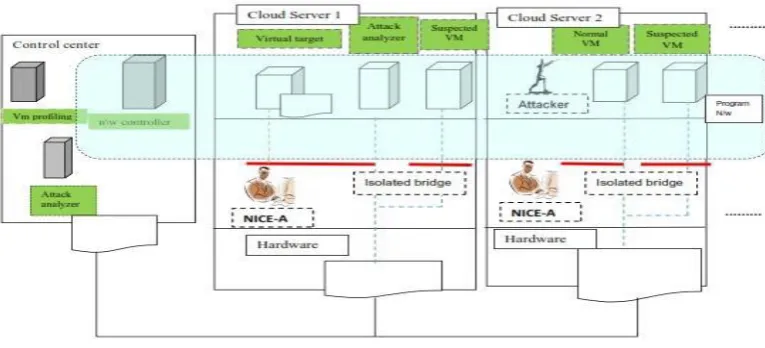
ESIGNThe proposed NICE framework is illustrated in Fig. 1. It shows the NICE skeleton within one cloud server cluster. Major components in this skeleton are distributed and light- weighted NICE-A on each physical cloud server, a network organizer, a VM profiling server, and an attack analyzer. The later three components are located in a centralized control center connected to software switches on each cloud server (i.e., virtual switches built on one or multiple Linux software bridge). NICE-A is a software mediator implement in each cloud server connected to the control center through a dedicated and isolated protected channel, which is divided from the normal data packets using Open Flow tunneling or VLAN approach. The network organizer is answerable for deploying attack countermeasures based on decisions made by the attack analyzer.
A. System Components
The NICE-A i s a Network-based Intrusion Detection System (NIDS) agent installed in either Dom0 or DomU in each cloud server. It scans the traffic going during Linux bridges that control all the traffic among VMs and in/out from the physical cloud servers. In our research, sniff i s used to implement NICE-A in Dom0. It will sniff a mirror p o r t on each vi r t ua l bridge in the Open v Switch ( OVS).
B. VM Profilling
Virtual machines in the cloud can be profiled to get precise information about their state, service organization, open ports, and so on. One major factor that counts toward a VM profile is its connectivity with other VMs. Any VM that is associated to more number of machines is more crucial than the one connected to fewer VMs because the effect of compromise of a highly connected VM can cause more damage.
C. Attack Analyzer
The m a i n functions o f N I C E system a r e performed by attack analyzer, which includes procedures such as attack graph construction and update, alert correlation, and countermeasure selection. The process of construct and utilize the SAG consists of three phases: Information gathering, attack graph creation, and possible exploit path scrutiny. With this information, attack path can be modeled using SAG. Every node in the attack model represents an exploit by the attacker. Every path from an initial node to a goal node represents a successful attack.
D. Network Controller
The network controller is a key module to support the programmable networking capability to realize the virtual network reconfiguration aspect based on Open-Flow protocol [13]. In NICE, within each cloud server there is a software switch, for example, Open v Switch (OVS), which is used as the border switch for VMs to handle traffic in & out from VMs. The network manager is dependable for collect network information of present Open Flow network and provides input to the attack analyzer to construct attack graphs.
V.
M
ITIGATION AND COUNTERMEASURESIn this level, we present the methods for choosing the solution for a given attack scenario. The countermeasure serves the reason of
1) Defending the target VMs from being compromised; and
2) Making a t t a c k b e h a v i o r s t a n d i m p o r t a n t s o t h a t t h e attackers’ actions can be identified.
A. Mitigation Strategies
Subsection, NICE is able to construct the improvement strategies in response to detected alert. First, we define the term countermeasure pool as follows:
Definition 4
A countermeasure pool CM = (cm1; cm2; cmn) is a set of countermeasures. Where Cost is the unit that describes the fixed cost required to apply the countermeasure in terms of property and operational difficulty, and it is defined in a range from 1 to 5, and high metric means upper cost; Intrusiveness is the unconstructive effect that a countermeasure bring to the examination Level Agreement (SLA) and its value ranges from the least intrusive (1) to the most intrusive (5), and the importance of intrusiveness is 0 if the countermeasure has no impacts on the SLA;Condition is the requirement for the equivalent countermeasure; Efficiency is the percentage of probability changes of the join, for which this countermeasure is applied.
B. Countermeasure Selection
Algorithm 2 presents how to select the best countermeasure for a given attack situation. Input to the algorithm is an alert, attack chart G, and a pool of countermeasures CM. The algorithm starts by select the join v Alert that correspond to the alert generated by a NICE-A. The countermeasure which when functional on a node gives the least charge of ROI, is regarded as the optimal countermeasure. At last, SAG and ACG are also efficient before terminating the algorithm.
Algorithm 2. Countermeasure Selection Require:Alert,G (E, V), CM
1: Let vAlert= Source node of the Alert
2: if Distance to _Target (valert)>threshold then 3: Update _ACG
4: return 5: end if
6: Let T =Descendant (valert)UvAlert 7: Set Pr (valert)=1
8: Calculate_Risk_Prob (T) 9: Let benefit [|Tj|, |CM|] =0 10: for each t € T do 11: for each cm € CM do 12: if cm.condition (t) then
13: Pr (t) =Pr (t)*(1 _ cm, effectiveness) 14: Calculate_Risk_Prob (Descendant (t)) 15: benefit [t, cm] =Pr (target-node) 16: end if
17: end for 18: end for
19: Let ROI [|T|, |CM|]=0 20: for each t € T do 21: for each cm € CM do
22: ROI [t, cm] = (Benefit [t,cm])/(cost.cm+intrusiveness.cm) 23: end for
24: end for
25: UpdateSAG and Update _ACG 26: return SelectOptimal CM (ROI)
VI.
P
ERFORMANCEE
VOLUTIONIn this segment we present the performance evaluation of
NICE. Our evaluation is conducted in two directions: the security performance and the system computing and network reconfiguration transparency due to introduced security mechanism.
6.1 Security Performance Analysis
Definition 5 (VM SI).VSI for a virtual machine k is defined as V SIk = (Vk + Ek) =2, where Vk is vulnerability score for VM k.
Ek is exploitability gain for VM k.
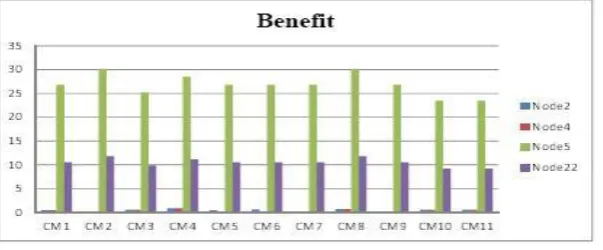
Apart from calculating the benefit measurements, we also present the estimation based on Return of Investment (ROI) using and represent a comprehensive evaluation.
A.Attack Graph and Alert Correlation
The attack chart can be generated by utilizing network topology and the exposure information, and it is shown in Figure 3. As the attack progresses, the cloud system generates the various alerts that can be related to the nodes in the attack model. Developing a new attack graph requires knowledge of network configuration, running services and their liability information. This information is provided to the attack graph creator as the input.
Fig 2.Benefit evaluation chart
B. NICE System Performance
We estimate system performance to provide supervision on how much traffic NICE can hold for one cloud server and use the assessment metric to scale up to a large cloud system. In real cloud system, traffic plan is needed to run NICE but it’s not available in the current system and as a result space limitation exists. We will investigate the research involving several cloud clusters in the upcoming.
VII.
C
ONCLUSION ANDF
UTURE WORKREFERENCES
[1] Chun-Jen Jung, Pankaj Khatkar, Tianyi Xing, Jeongkeun Lee, Dijiang Huang,NICE-Network Intrusion Detection and Countermeasure Selection in Virtual Network System, IEEE Transactions on Dependable and Secure Computing, Issue Vol 10 No 4 2013.
[2] Joshi, B. Vijayan, A.S. ; Joshi, B.K. Securing cloud computing environment against DDoS attacks Computer Communication and Informatics (ICCCI), 2012
[3] Takabi, H. Joshi, J.B.D. ; Gail-Joon Ahn, Security and Privacy Challenges in Cloud Computing Environments Security & Privacy, IEEE(Volume:8 ,Issue: 6) 2010.
[4] Duan, Z. Peng Chen ; Sanchez, F. ; Yingfei Dong ; Stephenson, M. ; Barker, J.M. Detecting spam zombies by monitoring outgoing messages Dependable and Secure Computing, IEEE Transactions on (Volume:9 , Issue: 2)2012. [5] Ammann, Paul; Wijesekera, Duminda; Kaushik, Saket Scalable, graph-based network vulnerability analysis 2002. [6] Sebastian Roschke, Feng Cheng, Christoph Meinel A New Alert Correlationalgorithm Based On Attack Graph,CISIS 2011.
[7] K. Kwon, S. Ahn, and J. Chung, “Network Security Management Using ARP Spoofing,” Proc. Int’l Conf. Computational Science and Its Applications (ICCSA ’04), pp. 142-149, 2004.
[8] M.Armbrust, A. Fox, R. Griffith, A.D. Joseph, R. Katz, A. Konwinski, G. Lee, D. Patterson, A. Rabkin, I. Stoica, and M. Zaharia, “A View of Cloud Computing,” ACM Comm., vol. 53, no. 4, pp. 50-58, Apr. 2010.
[9] G.gu p. Porras, V.Yegneswaran,M.Fong,and `W.Lee,”BotHunter:Detecting Malware Infection through IDS-driven Dialog Correlation,”Proc.16th USENIX Security Symp.(SS,07),pp,12:1-12:16,Aug, 2007.
[10] N. Gude, T. Koponen, J. Pettit, B. Pfaff, M. Casado, N. McKeown, and S. Shenker, “NOX: Towards an Operating System for Networks,” SIGCOMM Computer Comm. Rev., vol. 38, no. 3, pp. 105-110, July 2008.
[11] N. Poolsappasit, R. Dewri, and I. Ray, “Dynamic Security Risk Management Using Bayesian Attack Graphs,” IEEE Trans. Dependable and Secure Computing, vol. 9, no. 1, pp. 61-74, Feb. 2012.
[12] O. Sheyner, J. Haines, S. Jha, R. Lippmann, and J.M.Wing, “Automated Generation and analysis of Attack Graphs,” Proc. IEEE Symp. Security and Privacy, pp. 273-284, 2002.
[13] P. Mell, K. Scarfone, and S. Romanosky, “Common Vulnerability Scoring System (CVSS),” http://www.first.org/cvss/cvss-guide. html, May 2010.
ABOUT THE AUTHORS
B.Manikandan received the B.E (CSE) from Indus College of Engineering in 2012 and M.Tech in Information Technology in VSB Engineering College in 2012 under Anna University, Chennai. His Area of Interest includes Network Security, Cloud Computing.