180 |
P a g e
COMPARISON BETWEEN GOOGLE’S PAGERANK
ALGORITHM AND PAGE RANKING BASED ON LINK
VISITS (PRLV)
Amar Singh
1, Gyanendra Kumar
2, Pushpneel Verma
31,2
M.tech Scholar,
3Associate Professor, Department of Computer Science,
Bhagwant Institute of Technology, Uttar Pradesh Technical University, Lucknow, (India)
ABSTRACT
This paper analyzes the PageRank algorithm in brief and puts forward Page Ranking based on Link Visits (PRLV) algorithm. The PRLV algorithm takes into account the probability of user visits on a page with the motive to determine the importance and relevance score of web pages. The main aim of the paper is to compare the PageRank algorithm with the PRLV and show how PRLV could be the successor of PageRank.
Keywords: Search Engine, PageRank algorithm, PRLV (Page Ranking based on Link Visits), Rank of
pages, Web Structure Mining, Web Usage Mining.
1. INTRODUCTION
The web creates new challenges for information retrieval. The amount of information on the web is growing rapidly, as well as the number of new users inexperienced in the art of web research.
The problem in locating the correct information on the internet led to the creation of search technology, known as the internet search engine. Search engines are the foundation of the Internet. Most users will turn to a search engine as the quickest way of finding the information, or product that they want.
A search engine receives uses query, it processes the query, it search into its index for relevant documents (documents that are likely related to their query and supposed to be interesting to them), then the search engine ranks the documents found relevant and it shows them the results.
The problems with this approach are:
The present approaches use text matching as a solution to define the relevance between documents. However, these approaches have many disadvantages. For example, if a person searches for information about C, how would the engine know whether to search about the alphabet C or the programming language “C”?
181 |
P a g e
For example, if we know that the user search for information related to the computer science field we can infer that with “C”, he is probably referring to the programming language.
Each search engine does the same functions of collecting, organizing, indexing and serving results in its own unique ways, thus employing various algorithms and techniques, which are their trade secrets. The functions of a search engine can be categorized into the following:
1. Crawling the internet for web content. 2. Indexing the web content.
3. Storing the website contents. 4. Search algorithms and results.
The amount of information on the internet on any topic is very large; a large number of pages related to any query are available. But the user usually requires a small amount of the information. Hence, the search engines incorporate ranking algorithms in order to sort the results, so that the user will have the most important results first.
II PAGERANK ALGORITHM
Within the past few years, Google[1] has become the far most utilized search engine worldwide. The Google search engine has two important features that help it produce high precision results.
It makes use of the link structure of the Web to calculate a quality ranking for each Web page.
Google utilizes links to improve search results.
PageRank[2] is an algorithm used by Google Search to rank websites in their search engine results. Sergey Brin[3] and Larry Page[4] developed PageRank, named after Larry Page (cofounder of Google search engine), that uses the link structure of the web to determine the importance of web pages.
According to Google:
“PageRank works by counting the number and quality of links to a page to determine a rough estimate of how important the website is. The underlying assumption is that the more important websites are likely to receive more links from other websites -Facts about Google and Competition.”
The idea behind PageRank is that pages with many backlinks are more important that pages with only a few backlinks. The concept is really simple; let us think of each link from page q to page p as a vote or recommendation. It means that highly linked pages are more “important” (voted or recommended).
Imagine a person creates a new important page. So, he/she wants it to be visible in the top results. The only thing to be done is to create many other pages that point to the particular page or if the page has only two backlinks, but they are Netscape and Yahoo!, the page will have a
greater rank. We can state the PageRank as “a page has
182 |
P a g e
Therefore, the main disadvantage with PageRank is that it favors old pages, because a new page, even an important one will not have many links unless it is a part of an existing multi-connected site. A simplified version of page rank is defined as follows:
(2.1)
A factor c is used for normalization. {Note that 0<c < 1.}
III PAGE RANKING BASED ON LINK VISITS (PRLV)
PRLV (Page Ranking based on Link Visits) is based on Web Structure Mining and Usage Mining. It
takes into account the user visits with the motive to determine the importance and relevance score of web
pages. The various subtasks to be performed from gathering the usage characterization till final rank is
determined are:
Saving user’s access information (hits) on an outgoing link of a page in related server log files.
Fetching the pages and access information by the targeted web crawler.
Compute weights based on the probabilities of the link being visited by the users for each page
link.
Final rank computation of pages based on the weights of their incoming links.
Retrieval of ranked pages corresponding to user queries.
The weights are determined for out-links of pages (inner-document structure mining) and ranks are
computed by taking back-links into account (inter-document structure mining).
3.1 Features of PRLV
As PRLV method uses link structure of pages and their browsing information, the top returned pages in the result list are supposed to be highly relevant to the user information needs. In the PageRank method, the rank value of any page will be same regardless of whether the user sees it or not as it is totally dependent upon link structure of Web graph whereas the ordering of pages using PRLV is more target-oriented.
In PRLV, the rank depends on the probability and not number of visits. Therefore, a user can not deliberately increase the rank by visiting the page multiple times.
There is an extra request to store the number of hits of a particular page. Hence, congestion over network will increase.
183 |
P a g e
Outbound link
Suppose we have a page p, with n hyperlinks embedded. The outbound link set is:
O(p)= {o1, o2,…on | each oi is a URL (page) which can be accessed from page p}. (3.1) Inbound Link
A page p is said to have a set B of m inbound links:
B= {b1, b2,…bm | each bi is a URL (page) from which p can be accessed }. (3.2) Probability-Weight of Link
If p is a page with outbound-link set O(p) and each outbound link is associated with a numerical integer indicating visit-count (VC), then the weight of each outbound link connecting p and o is calculated by:
) ( ')
'
,
(
)
,
(
)
,
(
p O o linko
p
VC
o
p
VC
o
p
Weight
(3.3)
Page Rank based on Link Visits (PRLV)
If p is a page having inbound-linked pages in set B(p), then the rank (PRLV) is given by:
)
)
,
(
).
(
(
)
1
(
)
(
) (
p B blink
b
p
Weight
b
PRLV
d
d
p
PRLV
(3.4)
Where d is the damping factor as is used in PageRank; Weightlink() is the weight of the link calculated as above..
3.3 Retrieval of Ranked Pages by PRLV
The crawler passes the downloaded pages and their links visit data to the indexer and PRLV Calculator. The indexing of pages is done and their rank score is calculated. The index repository maintained by the search engine holds the necessary information about the crawled pages.
When a user submits query to the search engine interface, query processor matches the keywords and then finds the set of pages with the rank values. These pages along with their respective rank values are shown to the user in list-form. As soon as the user clicks on a page, the same process is repeated.
IV COMPARISON OF PRLV WITH PAGERANK
[5]
4.1 Definition and Basic Principles
The idea behind PageRank is that pages with many backlinks are more important that pages with only a few backlinks. PageRankcomputes scores at indexing time. Results are sorted according to importance of pages.
PRLV takes into accounts the user visits with the motive to determine the importance and relevance score of web pages. It computes scores at indexing time. Pages are sorted according to importance and relevance.
184 |
P a g e
PageRank uses Web Structure Mining (WSM) to generate structural summary about the Web sites and Web pages. The structure of a typical Web graph consists of Web pages as nodes and hyperlinks as edges connecting two related pages. In technical terms, WSM aims to find the link structure of the hyperlinks at the inter-document level.
PRLV uses both Web Structure Mining (WSM) and Web Usage Mining (WUM). Web Structure Mining is used to find the link structure of the hyperlinks and Web Usage Mining (WUM) tries to discover user navigation patterns from web data and the useful information from the secondary data derived from the interactions of the users while surfing on the Web. It focuses on the techniques that could predict user behavior while the user interacts with Web.
4.3 Rank Score of Pages and Its Nature
In PageRank, all the outgoing links from the page have same ranks, irrespective of the page they are leading to. Also the rank values are less dynamic as the rank changes with link structure.
In PRLV, the rank of each page is decided by the probability of visit to that page. So, ranks are unequally distributed among outgoing links according to their probabilities of visit. Thus the rank values are more dynamic as the rank changes with visit counts & structure of links.
4.4 Parameters to be considered
Only the inbound links of pages, i.e. the pages linked to a particular page are the deciding parameters for the rank calculation of the page in PageRank.
In PRLV, inbound links i.e. links leading to a particular page, outbound links i.e. links from that page and Visit Counts of links i.e. the probability of the visits to the link, all are used in rank calculation.
4.5 Relevancy & Importance of Pages
PageRank focuses only on the incoming links into a page to calculate rank. Thus the relevance of pages is lost. But PRLV considers the user feedback, i.e. the probability of a user using a particular page. Hence, the pages displayed have more relevance in a particular concept.
Though the pages in PRLV are more relevant, the PageRank and PRLV, both display important pages.
4.6 Complexity
The complexity of PageRank is O(log n) and that of PRLV is > O(log n).
4.7 Advantages
Advantages of Page Rank algorithm
Computation of ranks with minimum effort
185 |
P a g e
Advantages of PRLV
Pages returned are of high quality and relevancy as user feedbacks are taken into account.
Search space can be very much pruned as pages are sorted according to users’
information needs.
4.8 Limitations
The limitations of PageRank are
No relevancy of pages is considered in rank computation.
All links are considered equally important.
The limitations of PRLV are
Extra effort on crawlers to fetch the visit counts of pages from web servers.
Extra calculations to find the weights of links.
186 |
P a g e
V COMPARISON WITH EXAMPLE
A web graph as shown above in Fig 1: and the link structure in the graph was considered. Firstly, the original page rank algorithm, PageRank was applied on this graph to calculate rank value of each webpage and then PRLV was applied to calculate rank scores. In this graph each node is abbreviated with name of page.
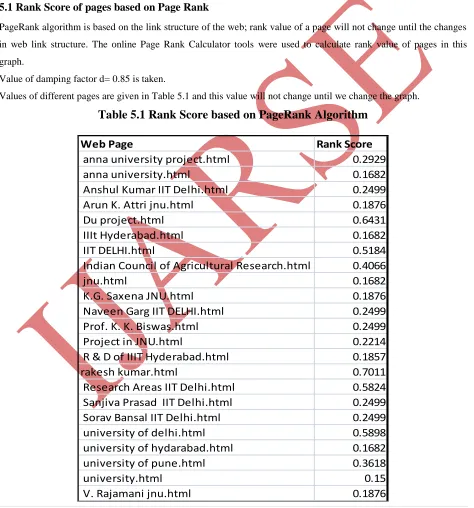
5.1 Rank Score of pages based on Page Rank
PageRank algorithm is based on the link structure of the web; rank value of a page will not change until the changes in web link structure. The online Page Rank Calculator tools were used to calculate rank value of pages in this graph.
Value of damping factor d= 0.85 is taken.
Values of different pages are given in Table 5.1 and this value will not change until we change the graph.
Table 5.1 Rank Score based on PageRank Algorithm
Web Page
Rank Score
187 |
P a g e
5.2 Rank Score of pages based on PRLV
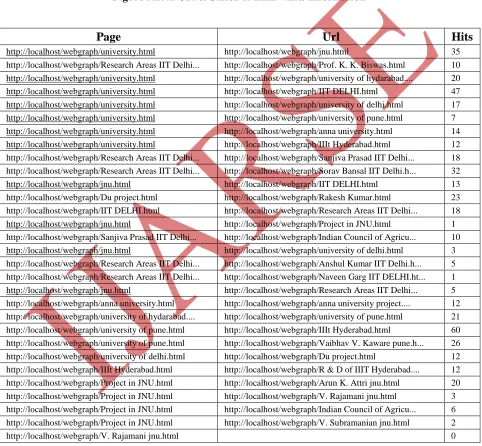
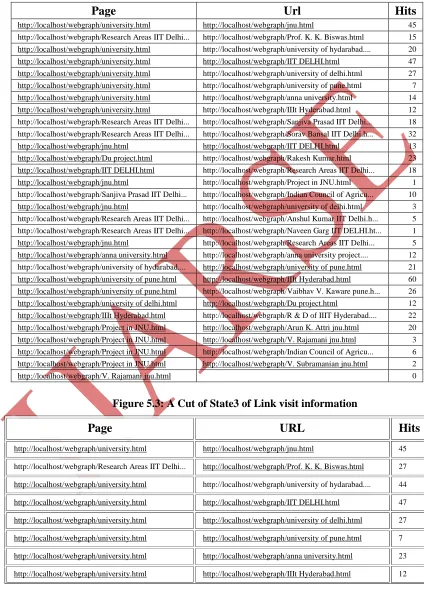
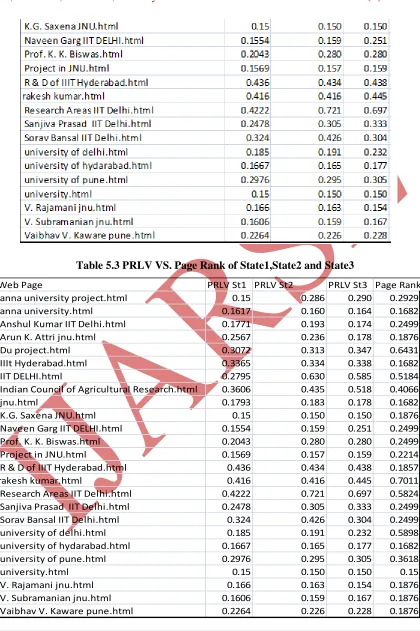
PRLV is based on number of visits of links and this link visit information is so dynamic that is why we calculate the rank score for three different state of link visit information.
Figures 5.1, 5.2 and 5.3 show the state1, state2 and state3 of link visits information. Table 5.2 shows the PRLV rank scores for all the three states, viz. state1, state2 and state3.
Figure 5.1: A Cut of State1 of Link Visits Information
Page
Url
Hits
188 |
P a g e
Figure 5.2: A Cut of State2 of Link visit information
Page
Url
Hits
http://localhost/webgraph/university.html http://localhost/webgraph/jnu.html 45 http://localhost/webgraph/Research Areas IIT Delhi... http://localhost/webgraph/Prof. K. K. Biswas.html 15 http://localhost/webgraph/university.html http://localhost/webgraph/university of hydarabad.... 20 http://localhost/webgraph/university.html http://localhost/webgraph/IIT DELHI.html 47 http://localhost/webgraph/university.html http://localhost/webgraph/university of delhi.html 27 http://localhost/webgraph/university.html http://localhost/webgraph/university of pune.html 7 http://localhost/webgraph/university.html http://localhost/webgraph/anna university.html 14 http://localhost/webgraph/university.html http://localhost/webgraph/IIIt Hyderabad.html 12 http://localhost/webgraph/Research Areas IIT Delhi... http://localhost/webgraph/Sanjiva Prasad IIT Delhi... 18 http://localhost/webgraph/Research Areas IIT Delhi... http://localhost/webgraph/Sorav Bansal IIT Delhi.h... 32 http://localhost/webgraph/jnu.html http://localhost/webgraph/IIT DELHI.html 13 http://localhost/webgraph/Du project.html http://localhost/webgraph/Rakesh Kumar.html 23 http://localhost/webgraph/IIT DELHI.html http://localhost/webgraph/Research Areas IIT Delhi... 18 http://localhost/webgraph/jnu.html http://localhost/webgraph/Project in JNU.html 1 http://localhost/webgraph/Sanjiva Prasad IIT Delhi... http://localhost/webgraph/Indian Council of Agricu... 10 http://localhost/webgraph/jnu.html http://localhost/webgraph/university of delhi.html 3 http://localhost/webgraph/Research Areas IIT Delhi... http://localhost/webgraph/Anshul Kumar IIT Delhi.h... 5 http://localhost/webgraph/Research Areas IIT Delhi... http://localhost/webgraph/Naveen Garg IIT DELHI.ht... 1 http://localhost/webgraph/jnu.html http://localhost/webgraph/Research Areas IIT Delhi... 5 http://localhost/webgraph/anna university.html http://localhost/webgraph/anna university project.... 12 http://localhost/webgraph/university of hydarabad.... http://localhost/webgraph/university of pune.html 21 http://localhost/webgraph/university of pune.html http://localhost/webgraph/IIIt Hyderabad.html 60 http://localhost/webgraph/university of pune.html http://localhost/webgraph/Vaibhav V. Kaware pune.h... 26 http://localhost/webgraph/university of delhi.html http://localhost/webgraph/Du project.html 12 http://localhost/webgraph/IIIt Hyderabad.html http://localhost/webgraph/R & D of IIIT Hyderabad.... 22 http://localhost/webgraph/Project in JNU.html http://localhost/webgraph/Arun K. Attri jnu.html 20 http://localhost/webgraph/Project in JNU.html http://localhost/webgraph/V. Rajamani jnu.html 3 http://localhost/webgraph/Project in JNU.html http://localhost/webgraph/Indian Council of Agricu... 6 http://localhost/webgraph/Project in JNU.html http://localhost/webgraph/V. Subramanian jnu.html 2
http://localhost/webgraph/V. Rajamani jnu.html 0
Figure 5.3: A Cut of State3 of Link visit information
Page
URL
Hits
189 |
P a g e
http://localhost/webgraph/Research Areas IIT Delhi... http://localhost/webgraph/Sanjiva Prasad IIT Delhi... 38 http://localhost/webgraph/Research Areas IIT Delhi... http://localhost/webgraph/Sorav Bansal IIT Delhi.h... 32 http://localhost/webgraph/jnu.html http://localhost/webgraph/IIT DELHI.html 13 http://localhost/webgraph/Du project.html http://localhost/webgraph/Rakesh Kumar.html 23 http://localhost/webgraph/IIT DELHI.html http://localhost/webgraph/Research Areas IIT Delhi... 18 http://localhost/webgraph/jnu.html http://localhost/webgraph/Project in JNU.html 4 http://localhost/webgraph/Sanjiva Prasad IIT Delhi... http://localhost/webgraph/Indian Council of Agricu... 10 http://localhost/webgraph/jnu.html http://localhost/webgraph/university of delhi.html 30 http://localhost/webgraph/Research Areas IIT Delhi... http://localhost/webgraph/Anshul Kumar IIT Delhi.h... 5 http://localhost/webgraph/Research Areas IIT Delhi... http://localhost/webgraph/Naveen Garg IIT DELHI.ht... 21 http://localhost/webgraph/jnu.html http://localhost/webgraph/Research Areas IIT Delhi... 23 http://localhost/webgraph/anna university.html http://localhost/webgraph/anna university project.... 15 http://localhost/webgraph/university of hydarabad.... http://localhost/webgraph/university of pune.html 21 http://localhost/webgraph/university of pune.html http://localhost/webgraph/IIIt Hyderabad.html 60 http://localhost/webgraph/university of pune.html http://localhost/webgraph/Vaibhav V. Kaware pune.h... 26 http://localhost/webgraph/university of delhi.html http://localhost/webgraph/Du project.html 12 http://localhost/webgraph/IIIt Hyderabad.html http://localhost/webgraph/R & D of IIIT Hyderabad.... 22 http://localhost/webgraph/Project in JNU.html http://localhost/webgraph/Arun K. Attri jnu.html 20 http://localhost/webgraph/Project in JNU.html http://localhost/webgraph/V. Rajamani jnu.html 3 http://localhost/webgraph/Project in JNU.html http://localhost/webgraph/Indian Council of Agricu... 60 http://localhost/webgraph/Project in JNU.html http://localhost/webgraph/V. Subramanian jnu.html 12
http://localhost/webgraph/V. Rajamani jnu.html 0
190 |
P a g e
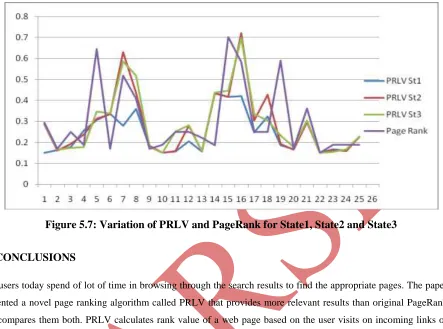
Table 5.3 PRLV VS. Page Rank of State1,State2 and State3
Web Page PRLV St1 PRLV St2 PRLV St3 Page Rank
anna university project.html 0.15 0.286 0.290 0.2929
anna university.html 0.1617 0.160 0.164 0.1682
Anshul Kumar IIT Delhi.html 0.1771 0.193 0.174 0.2499
Arun K. Attri jnu.html 0.2567 0.236 0.178 0.1876
Du project.html 0.3072 0.313 0.347 0.6431
IIIt Hyderabad.html 0.3365 0.334 0.338 0.1682
IIT DELHI.html 0.2795 0.630 0.585 0.5184
Indian Council of Agricultural Research.html 0.3606 0.435 0.518 0.4066
jnu.html 0.1793 0.183 0.178 0.1682
K.G. Saxena JNU.html 0.15 0.150 0.150 0.1876
Naveen Garg IIT DELHI.html 0.1554 0.159 0.251 0.2499
Prof. K. K. Biswas.html 0.2043 0.280 0.280 0.2499
Project in JNU.html 0.1569 0.157 0.159 0.2214
R & D of IIIT Hyderabad.html 0.436 0.434 0.438 0.1857
rakesh kumar.html 0.416 0.416 0.445 0.7011
Research Areas IIT Delhi.html 0.4222 0.721 0.697 0.5824
Sanjiva Prasad IIT Delhi.html 0.2478 0.305 0.333 0.2499
Sorav Bansal IIT Delhi.html 0.324 0.426 0.304 0.2499
university of delhi.html 0.185 0.191 0.232 0.5898
university of hydarabad.html 0.1667 0.165 0.177 0.1682
university of pune.html 0.2976 0.295 0.305 0.3618
university.html 0.15 0.150 0.150 0.15
V. Rajamani jnu.html 0.166 0.163 0.154 0.1876
V. Subramanian jnu.html 0.1606 0.159 0.167 0.1876
191 |
P a g e
Figure 5.4: Variation of PRLV and PageRank for State1
Figure 5.5: Variation of PRLV and PageRank for State2
192 |
P a g e
Figure 5.7: Variation of PRLV and PageRank for State1, State2 and State3
VI CONCLUSIONS
The users today spend of lot of time in browsing through the search results to find the appropriate pages. The paper presented a novel page ranking algorithm called PRLV that provides more relevant results than original PageRank and compares them both. PRLV calculates rank value of a web page based on the user visits on incoming links of that page. So, the results frequently used by the user are shown first. The ordering of pages in this way increases the relevancy of pages and thereof provides the user with quality search results.
Therefore, the user finds the desired output in the few top pages and search space is diminished to a very large scale.
REFERENCES
[1] Google, Inside Search. http://www.google.co.in/insidesearch/
[2] Sergey Brin and Lawrence Page. “The Anatomy of a Large-Scale Hypertextual Web Search Engine.” Computer
Science Department, Stanford University, Stanford, CA. http://infolab.stanford.edu/~backrub/google.html
[3] Sergey Brin and Larry Page. Google search engine. http://google.stanford.edu