Aggelos Kiayias1, Annabell Kuldmaa2, Helger Lipmaa2,3, Janno Siim2,4, and Thomas
Zacharias1 1
University of Edinburgh, UK
2
University of Tartu, Estonia
3
Cybernetica-Smartmatic CCEIV, Estonia
4 STACC, Estonia
[email protected],[email protected],[email protected], [email protected],[email protected]
Abstract. In state-of-the-art e-voting systems, a bulletin board (BB) is a critical component for preserving election integrity and availability. Although it is common in the literature to assume that a BB is a centralized entity that is trusted, in the recent works of Culnane and Schneider [CSF 2014] and Chondroset al.[ICDCS 2016], the importance of removing BB as a single point of failure has been extensively discussed. Motivated by these works, we introduce a framework for the formal security analysis of the BB functionality modeled as a distributed system that comprises (i) a subsystem ofitem collection (IC)peers that receive and store the submitted items, and (ii) a subsystem of audit board (AB) peers, where the IC subsystem publishes the stored items for verification. Our framework treats a secure BB as a robust public transaction ledger, defined by Garayet al.[Eurocrypt 2015], that additionally supports the generation of receipts for successful posting. Namely, in our model, a secure BB system achieves Persistence and Liveness that are
confirmable, in the sense that any malicious behavior of the BB system can be detected via a verification mechanism.
As a case study for our framework, we analyze the BB system of Culnane and Schneider and point out its weaknesses. We demonstrate an attack revealing that the said system does not achieve Confirmable Liveness, even in the case where the adversary is computationally bounded and covert, i.e., it may deviate from the protocol specification but does not want to be detected. In addition, we show that special care should be taken for the choice of the underlying cryptographic primitives, so that the claimed fault tolerance threshold ofN/3 out-ofN corrupted IC peers is preserved. Next, based on our analysis, we introduce a new BB protocol that upgrades the [CSF 2014] pro-tocol. We prove that it tolerates any number less thanN/3 out-of N corrupted IC peers both for Persistence and Confirmable Liveness, against a computationally bounded general Byzantine adversary. Furthermore, Persistence can also be Confirmable, if we distribute the AB (originally a centralized entity in [CSF 2014]) as a replicated service with honest majority.
1 Introduction
An electronic voting (e-voting) system is a salient instance of a network protocol where verifying the correctness of the execution is of critical importance. One can argue that if the concerned parties can not agree on the election transcript, then the voting process itself is meaningless. Furthermore, besides e-voting, verifiability of the execution is a desired feature in several other cases, such as auctions and blockchain transactions, to name a few.
It becomes apparent that in any protocol where consensus on the outcome is essential, the protocol infrastructure must guarantee a consistent view to all involved parties as far as auditing is concerned. Consistency here informally suggests that any two auditors engaging in the verification process on the same input but from possibly different network locations, should agree on their verdict, i.e. they both accept or reject the execution outcome. If this guarantee cannot be provided, then an adversary controlling the network traffic could easily partition the parties into small “islands”, such that each island has access to a partial, and possibly (partially) fake, view of the execution. By doing this, the adversary can undermine the auditors’ consensus on the outcome. This matter has been extensively studied by Barak et al. [5], where it is shown that parties communicating via non-authenticated channels are unavoidably prone to such “isolation” attacks.
When it comes to voting, consistency may be realized in various ways depending on the election setting. For instance, in small-scale elections (e.g. board elections) a consistent view can be achieved by executing a consensus protocol by the voters themselves, even without encrypting the votes if privacy is not a concern. However, when considering the large scale setting (e.g., national elections) where complete connectivity among the participants is unrealistic, a publicly accessible and reliable method is required for posting and reading all necessary election information. This is provided by an electronicbulletin board (BB)which, abstractly, encompasses two types of operations: 1) apostingoperation involvingusers who make post requests for items of their choice, potentially subject to some access policy, and a subsystem ofitem collectors (ICs) that receive and store the submitted items. 2) A publishing operation, where the IC subsystem publishes the stored items on an audit board (AB) from where any party can read. Depending on the implementation, the IC and the AB could be distributed or centralized, or even managed by the same physical entity. Nonetheless, the above generic description typifies the way BB’s are treated in the e-voting literature.
By the discussion so far, it is of high importance that the BB functionality implemented by the IC and AB should function as an immutable database, so that once submitted, items could not be erased or changed. The desired features of such a database include: (a) the ability to authenticate item contributors, (b) distributed operation so as to protect against attacks on availability, (c) a predetermined time-span where item submission is enabled, (d) resilience to any modification so as to facilitate verifiability.
The necessity of a consistent BB has been stressed many times in e-voting literature. In his PhD thesis, Benaloh [6] assumes BBs with append-only write operations for auditing, also stressing out that “implementing such bulletin boards may be a problem unto itself.” Subse-quently, most verifiable e-voting systems proposed (e.g. [22,16,12,31,14,2,13,9,7,32]) refer to the notion of BB as a fundamental component of their infrastructure without explicitly realizing it. Despite the widely accepted critical importance of building reliable BBs for e-voting, the literature on proposals of secure and efficient BB constructions is scarce. Outside a limited number of early works [40,20,39,29,33], the most concrete examples include the BB applied in the vVote e-voting system [19] (cf. [17,10]) and the BB of the D-DEMOS Internet-voting (i-voting) system [15]. In all these cases, the introduced BB was either an integral part of a specific e-voting system [20,15], or, even though modular, lacked formal treatment under a comprehensive security model [40,39,33,29,19].
is needed. We aim to establish a complete formal treatment of a BB and propose an efficient and provably secure construction that can be deployed in a wide class of e-voting designs.
Initially, we are motivated by the security requirements proposed by Culnane and Schnei-der [19], suggesting that a secure BB should prevent data injection and removal, while allowing only the publishing of non-clashing items. On top of these properties, [19] prescribes a liveness guarantee of the eventual publishing of all submitted items for which areceipt of correct record-ing has been generated. Takrecord-ing a step further, we introduce a framework for the formal study of the BB concept and its security. Our framework is inspired by (i) the notion of a robust public transaction ledger (RPTL) defined by Garay et al. [23] and (ii) the security model presented by Chondroset al. [15], thereby utilizing the connection between blockchain and BB systems, which, albeit being folklore, was never formally exploited. We formalize a secure BB system in a way that it can be seen as an RPTL that additionally supports the generation of receipts for successful posting. Expanding the security model for blockchain protocols of [23], we divide security into two properties named Persistence and Confirmable Liveness. Confirmability in liveness captures the receipt generation capability. Persistence can also be Confirmable, mean-ing that dishonest AB behavior is detectable via verification of published data.
Next, we apply our framework for the security analysis of the BB system of [19], which we refer to as theCSBB system, that utilizes standard signature and threshold signature schemes (TSS) as cryptographic building blocks. In the threat model of [19], an adversary may corrupt less thanNc/3 out-of the totalNcIC peers, hence we also assume this fault-tolerance threshold.
Our findings reveal thatCSis not secure in our framework for the< Nc/3 threshold.
Specif-ically, we demonstrate an explicit attack showing that CS with Nc IC peers does not achieve
Confirmable Liveness. Our attack falls outside the threat model [19] but raises an interesting discussion about its plausibility. In particular, the threat model of [19] relies on a presumed “fear of detection” (cf. the full version of [19], [18, Section 8]), to exclude certain adversarial protocol deviations in the IC subsystem. Nevertheless, such covert type of security reasoning, cf. [3], is never formalized or implemented in [18] and in fact, as our attack demonstrates, the detection of protocol deviation is impossible by the IC peers themselves given their local protocol view.
A second, though less crucial, finding for the security of CSconcerns its Confirmable Persis-tence guarantees. Namely, we show that in order forCSto achieve Confirmable Persistence under the< Nc/3 fault tolerance threshold, the underlying TSS should not be applied as ‘black-box’
and that care should be taken for the choice of the TSS construction. By describing a specific attack, we show that when the TSS robustness condition analyzed in [26] is invoked for liveness, then a smaller fault threshold of < Nc/4 must be assumed. On the positive side, we show that
there are constructions (e.g. the TSS in [42], or the “trivial” TSS consisting of Nc standard
signatures) suitable for CSthat respect the < Nc/3 threshold for Confirmable Persistence.
Based on our analysis, we modify CSby designing a new Publishing protocol that achieves consensus among the honest IC peers on the posted items that should be published. Combined with the CS Posting protocol, we obtain a new BB system that achieves both Persistence and Confirmable Liveness for < Nc/3 corrupted IC peers. Persistence can also be Confirmable, if
we distribute the AB as a replicated service, where data posting is done by broadcasting to all AB peers and data reading is done by honest majority. The new BB system is secure against (i) a general computationally bounded Byzantine adversary, (ii) in a partially synchronous setting (cf. [21]), where the message delivery delay and the synchronization loss among the entities’ clocks are bounded, but the bounds need not to be known for the entities’ engagement in the BB system.
Summary of Contributions.Our contributions are as follows:
– Analysis of theCS BB system [19] in our security framework that reveals two vulnerabilities. In particular, one of the vulnerabilities challenges the reasoning of liveness in the threat model provided in [18, Sec. 8].
– A suitably modified variant of the CS protocol that restores Confirmable Liveness and we prove secure in our framework with anNc/3 threshold for the IC subsystem against
compu-tationally bounded Byzantine adversaries. In particular, (i) Persistence holds in the asyn-chronous model and can be also Confirmable assuming honest majority between AB peers, while (ii) Confirmable Liveness holds in the partially synchronous model.
2 Related work
The BB functionality as component of e-voting systems.In a wide range of state-of-the-art e-voting systems (e.g., [31,14,2,13,9,43,32]), the BB is a centralized single point of failure for security analysis. Dini [20] proposed a distributed e-voting service based on [22], focusing on the service in general rather on the BB system. Several works on distributed e-voting BB solu-tions lacked formal security analysis, providing only construcsolu-tions without proof [39,41,29,33], a study of requirements [28] or being applicable only to the kiosk-voting based setting [7]. D-DEMOS [15] is a distributed internet-voting system which adopts [32] to the distributed setting. The security in [15] is studied in a model that is a stepping stone for our framework, yet secu-rity argumentation targets specifically the D-DEMOS requirements. The CSBB system [19] is a reference point for our work, and will be analyzed in Section 5.
Robust public transaction ledgers. In a recently emerged line of research, transaction ledgers used in blockchain applications have been studied under formal cryptographic models. Garayet al.[23] formalizerobust public transaction ledgers (RPTLs)that satisfy (i)Persistence, i.e., honest parties agree on their report of transactions published in the ledger in an append-only manner and (ii)Liveness, i.e., all transactions in the local view of the honest parties will be eventually reported. Moreover, they prove that Nakamoto’s Bitcoin blockchain protocol [36] is an RPTL in a synchronous setting. Taking a step further, Passet al.[37] prove the robustness of Bitcoin blockchain protocol, even when the network is semi-synchronous, i.e., the adversary can impose bounded delays. Very recently, Garay et al. [24] introduce a dynamic setting that reflects most real-world scenarios where the number of involved parties may vary over time, while Badertscher et al.[4] prove the security of Bitcoin as an RPTL in the universal composability framework [11]. A responsive consensus protocol is one that achieves “instant” confirmation of transactions (i.e., dependent only on network delay), and it is shown in [38], that such protocols exist only assuming a 1/3 bound on the adversary. As a side observation, our protocol matches this bound and this level of responsiveness in the permissioned setting (while [38] is in the permissionless setting) and can be seen as a responsive permissioned distributed ledger. We note that the permissionless setting is not immediately relevant to e-voting, since in e-voting, we need to explicitly permission write access so that it is consistent with the e-voting semantics (e.g., the one voter - one vote principle).
3 Preliminaries
We use κ as the security parameter. We write f(κ) = negl(κ) if function f is negligible in κ, and PPT for probabilistic polynomial-time. We denote [N] :={1,2, . . . , N} for any N ∈N.
3.1 Signature schemes
A signature scheme DS= (KGen,Sig,Vf) consists of the following PPT algorithms:
(ii). Thesigning algorithmSigreturns, on input a messagemand a signing keysk, a signature σ ←Sigsk(m).
(iii). The verification algorithm Vf returns, given pk, a message m and signature σ, a bit b←Vfpk(m, σ).
The correctness of DSrequires that for each (pk,sk) ∈KGen(1κ) and a valid messagem, it must hold thatVfpk(m,Sigsk(m)) = 1.
The security of DS is formalized via the notion of existential unforgeability against cho-sen message attacks (EUFCMA, [27]). We recall the definition of EUFCMA security via the EUFCMA security game GDSA (1κ) in Fig. 1.
The EUFCMA security gameGA
DS(1
κ
).
1. The challengerCDS runsKGento generate a keypair (pk,sk). The adversaryAreceivespkas input.
2. The adversary may ask theCDS to sign a number of messages. To query thei-th signature,Asubmits
a messagemi toCDS, which returnsσi←Sig(sk, m).
3. Aoutputs a messagem∗and a signatureσ∗.
The game outputs 1 (Awins) iff (i)Vf(pk, m∗, σ∗) = 1, and (ii) for everyi, it holds that (m∗, σ∗)6= (mi, σi).
Fig. 1.The EUFCMA security gameGA
DS(1
κ
) between the challengerCDSand the adversaryA.
Definition 1 (Security signature schemes).LetDS= (KGen,Sig,Vf)be a signature scheme. We say that DS is EUFCMA-secure if for every PPT adversaryA, it holds that
Pr[GDSA (1κ) = 1] =negl(κ).
3.2 Threshold signature schemes
Letts< N be two positive integers andP1, . . . , PN a set of peers. A (non-interactive)threshold
signature scheme (TSS) TSS = (DistKeygen,ShareSig,ShareVerify,Combine,TVf) is a tuple of the following five efficient algorithms:
(i). Thedistributed key generation algorithmDistKeygen(1κ, ts, N) generates a keypair (tski,pki)
for each peer Pi and a public keypk, such that exactlyts+ 1 secret keystski are required
to recover the secret key tsk corresponding to pk. The public output is pk together with a tuple of verification keys (pk1, . . . ,pkN).
(ii). Thesigning algorithm ShareSigtski(m) returns a signature share σi of the message m.
(iii). Theshare verification algorithm ShareVerify(pk,pk1, . . . ,pkN, m,(i, σi)) outputs 1 iffσi is
the valid ith signature share ofm.
(iv). Theshare combining algorithm Combine(pk,pk1, . . . ,pkN, m,(i, σi)i∈S), given a subset of
ts+ 1 valid signature shares on m, outputs a full signature σ←TSign(tsk, m) on m.
(v). Theverification algorithm TVfpk(m, σ) outputs 0 or 1, depending on whether σ is a valid signature of m.
ThecorrectnessofTSSrequires that for a vector (tsk,pk,tsk1, . . . ,tskN,pk1, . . . ,pkN) output
by DistKeygen(1κ, ts, N), if S ⊆[N] s.t. |S|=ts+ 1, it holds that (i) σi =ShareSigtski(m), and
(ii) ifσ=Combine(pk,pk1, . . . ,pkN, m,(i, σi)i∈S), thenShareVerify(pk,pk1, . . . ,pkN, m,(i, σi)) =
1 for i∈ S and TVfpk(m, σ) = 1.
TSS is existentially (ts, N)-unforgeable against chosen-message attacks ((ts, N
The(ts, N)-EUFCMA security gameGTSSA (1
κ
, ts, N).
1. First,Adecides on the setLcorr⊂ {1, . . . , N}of corrupted players, and sends it to the challengerCTSS. A is allowed to act on behalf of eachPi ∈Lcorr. ThenDistKeygen(1κ, ts, N) is executed. During this,
CTSSplays the role of all honest playersPi. At the end of this step,Agets access topk.
2. Acan make up to polynomial number of signing queries as follows: fori∈ {1, . . . , N} \Lcorr,Asubmits
pair (i, m) toCTSS. Then,CTSSreturnsσi←ShareSig(tski, m) toA.
3. A outputs a messagem∗and a signature σ∗. Let V=Lcorr∪ S, whereS is the subset of players for
whichAmade a signing query (i, m∗).
The game outputs 1 (Awins) iff (i)TVf(pk, m∗, σ∗) = 1, and (ii)|V| ≤ts.
Fig. 2.The (ts, N)-EUFCMA security gameGATSS(1κ, ts, N) between the challengerCTSS and the adversaryA.
In the following, we provide a more detailed description of (ts, N)-EUFCMA security via
the (ts, N)-EUFCMA security game GTSSA (1κ, ts, N) in Fig. 2.
Definition 2 (Security of threshold signature schemes). Let ts, N be values polynomial
in the security parameter κ. Let TSS = (DistKeygen,ShareSig,ShareVerify,TVf,Combine) be a threshold signature scheme. We say that TSS is (ts, N)-EUFCMA-secure if for every PPT
adversaryA, it holds that
Pr[GTSSA (1κ, ts, N) = 1] =negl(κ).
We defineA’s advantageAdvtssA(κ, ts, N)as the probability thatAwins the gameGTSSA (1κ, ts, N),
taken over all coin tosses, i.e.
AdvtssA (κ, ts, N) := Pr[GTSSA (1κ, ts, N)] = 1.
Robust TSS schemes. TSS is said to be (tc, N)-robust, ifAcontrollingtcpeers cannot prevent
honest peers from creating a valid signature. Robustness can only be achieved fortc< N/2, see
Gennaro et al.[26].
Note that usually TSS is studied in the setting where the same parametertsis used both for
(ts, N)-EUFCMA-security and (ts, N)-robustness. This does not necessarily need to be the case.
We use different parameters ts and tc such that TSS is (ts, N)-EUFCMA-secure and (tc, N
)-robust, i.e., there are tc malicious peers, but it takes ts+ 1 shares to combine the signature
(see [42] and Section 5.3 for further discussion). In some TSS constructions this allows us to taketc< N/2≤ts as can be seen in the following.
Trivial TSS scheme. In our work, we refer to the followingtrivial (ts, N)-TSS, where ts< N
can be any non-negative integer: given an EUFCMA-secure signature schemeDS, each partyPi
has an independently generated public and secret key. The signature share ofPi onmis equal to
her signature onmand signature shares are combined by concatenation. The TSS verification on (σ1, . . . , σt) succeeds only if each individual signature verification succeeds andt > ts. Clearly,
trivial TSS is (ts, N)-EUFCMA-secure. It is also (tc, N)-robust fortc≤N−(ts+ 1) since then
there areN−tc=ts+ 1 honest parties that can easily create signature. We note that the trivial
TSS slightly deviates from the previous definition of TSS, as there is no secret key tsk shared between the parties.
3.3 Collision Resistant Hash Function Families
Definition 3. A function familyH=
Hκ :{0,1}d(κ) −→ {0,1}r(κ) κ∈Nis a collision resistant
hash function (CRHF) family, if r(κ) < d(κ) for every κ, and for every PPT adversary A it holds that
Prx, x0 ← A(1κ) : x6=x0∧ Hκ(x) =Hκ(x0)
=negl(κ).
We note that Definition 3 is consistent for any d(·), r(·) that is polynomial in κ, as long as r(κ)< d(κ) for everyκ.
3.4 Binary Consensus
In a (t, N)-Binary Consensus (BC) protocol, a number of N peers such that no more than t of them are malicious, engage to agree on some decision bit value b ∈ {0,1}. A BC protocol satisfies the following properties:
1. Termination: all honest peers will decide some value. 2. Agreement: all honest peers decide the same value.
3. Integrity: if an honest peer decides some value b, thenbwas an input of at least one honest peer.
4. Validity: if all honest peers engage in the protocol with inputb, then they all decide b.
In [21], it is shown that for t < N/3, BC protocols exist in the partially synchronous model.
4 Framework
We introduce a formal framework for secure e-voting BB systems. First, we provide an abstract description of the consisting entities and protocols. Then, building upon the requirements stated in [19] and the modeling approach of [15] and [23], we formalize BB security via the notions of (Confirmable) Persistence andConfirmable Liveness.
4.1 Syntax of a bulletin board system
Entities. A BB system involves the following entities: 1) asetup authority SAthat generates the setup information and initializes all other entities with their private inputs; 2) the users that submit post requests for items of their choice. An item can be any data the user intends to be published, e.g., the voters’ ballots, the election results or any necessary audit information.; 3) a subsystem of item collection (IC) peers P1, . . . , PNc that are responsible for (i) interacting
with the users for posting all submitted items, and (ii) interacting with the AB (see below) to publish the recorded items; 4) a subsystem ofaudit board (AB) peers AB1, . . . , ABNw where all
the posted items are published.
Setup.At the preparation period, SAspecifies aposting policy P = (Accept,Select(·)), where 1) Accept ={(U, x)} is a binary relation over pairs of user IDs and items. For a user U that wants to post itemx, (U, x)∈Acceptis a check the IC peers execute to initiate interaction with U for posting x. E.g., a user that is authenticated as a voter may be accepted to post a vote but not some public data (e.g., public encryption key).
2) Select(·) is a selection function over sets of items defined as follows: let XU be the set
of published items associated with posts from user U. Then, Select(XU) ⊆ XU contains all
valid published items posted by U, resolving any conflict among clashing items. E.g., in Esto-nian e-voting [30], if a voter U submitted multiple votes then only the last one must count. Thus, if the votes were submitted in time ascending order as x1, x2, . . . , xm, then we set
The SAinitializes the other entities with the description of P. Next, all entities engage in a setup interaction such that when finalized, each entity has a private input (e.g., a signing key or an authentication password) and some public parametersparams.
BB protocols. The BB functionality comprises the Posting and Publishing protocols, ac-companied by two verification algorithms: (i)VerifyRec, run by the users to verify the successful posting of their items, and (ii)VerifyPub, run by any party for auditing the validity of the data on the AB.
The Posting protocol is initiated by a user U that on private input sU submits a post
request for item x. Namely, U uses sU to generate a credential crU 5. Then, the user and the
IC peers engage in an interaction that results inU obtaining a receiptrec[x] for the successful posting of x. Upon receiving rec[x], and using public election parameters params, U may run the algorithm VerifyRecon input (rec[x], x, sU,params), that either accepts or rejects.
In the Publishing protocol, the IC peers upload their local records of posted items to the AB subsystem. The protocol may encompass a consensus protocol among the AB peers to agree whether a local record is admissible. In addition, any auditor may runVerifyPubon inputparams
and (a subset of the) published data to check AB consistency.
4.2 Introducing our security framework
In [19], Culnane and Schneider propose a list of four properties that a secure BB must satisfy: (bb.1).Only items that have been posted may appear on the AB. This property expresses safety against illegitimate data injection.
(bb.2).Any item that has a valid receipt must appear on the AB. (bb.3).No clashing items must both appear on the AB.
(bb.4).Once published, no items can be removed from the AB. According to this property, the AB subsystem is anappend-only posting site.
In this section, we integrate the above four properties into a formal security framework. At a high level, our framework conflates the formal approach in distributed e-voting security of Chondros et al.[15] with the notion of arobust public transaction ledger (RPTL) proposed by Garayet al. [23]. Namely, we view a secure BB as an RPTL that additionally providesreceipts of successful posting for honestly submitted items. The security properties of an RPTL stated in [23] are informally expressed as follows:
•Persistence: once an honest peer reports an itemxas posted, then all honest peers will either (i) agree on the AB position that xshould be published, or (ii) not report x.
•θ-Liveness: honest peers will report honestly submitted items within some delay boundθ. Introducing Confirmable θ-Liveness. In the e-voting scenario, we require that the honest users will eventually get a receipt when engaging at the Posting protocol. Consequently, we introduce the Confirmable θ-Liveness property, suggesting that any honest user that submits an item x, will obtain a valid receipt for x within time θ, and x will be published on the AB.
The conflict between Confirmable Liveness and property (bb.3).An important obser-vation is that Confirmable Liveness and (bb.3) cannot be satisfied concurrently if we assume that honest users may submit post requests for clashing items (e.g., in Estonian e-voting [30], as a coercion countermeasure, voters may vote multiple times and only the last counts). To resolve this conflict, we make the following relaxation: we do not require that (bb.3) holds, by allowing every successfully posted item to be published. Then, we specify the subset of valid published items for each user via the selection functionSelect(·) over the set of published items; the description ofSelect(·) depends on the election setting. Note that in the special case where
5
E.g., ifsUis a signing key, thencrU could be a valid signature undersU; ifsU is a password, thencrUcan be
we restrict the honest users from submitting clashing items, we can match (bb.3) by fixing
Select(·) to be the identity function.
Introducing (Confirmable) Persistence.Given the above, to encompass (bb.1) and (bb.4), we introduce the notion ofPersistence where conflict resolution is achieved by applyingSelect(·) on the AB view. Persistence as defined in [23] captures the “unremovability” property (bb.4). To also capture (bb.1), we require that in a setting wheretc out-of Nc IC peers are corrupted,
an item x posted by U will not be reported as valid, if at least tc+ 1 honest IC peers did not
recordx at somePosting protocol execution. Note that if we require a threshold of less than tc+ 1 honest IC peers to be unaware of item x, then (bb.1) becomes unrealistic, as in most
distributed systems, an adversary that corruptstcpeers can blocktchonest peers, and run the
execution jointly with the rest Nc−2tc honest peers.
Furthermore, we extend Persistence by taking into account a AB subsystem that is fully controlled by the adversary. This is formalized by theConfirmable Persistence property, where we require that any malicious AB behavior will be detected via theVerifyPub algorithm. System clocks.Like in [15], we assume that there exists aglobal clock variableClock∈N, and that every system entityX is equipped with aninternal clock variableClock[X]∈N. We define
the following two events:
• The event Init(X): Clock[X] ← Clock, that initializes X by synchronizing its internal clock with the global clock.
•The eventInc(Clock[X]):Clock[X]←Clock[X]+1, that causes some clockClock[X] to advance by one time unit.
Synchronicity and message delay.We parameterize our threat model by (i) an upper bound δ on the delay of message delivery, and (ii) an upper bound∆on the synchronization loss of the nodes’ internal clocks w.r.t. the global clock. By convention, we set ∆=∞ to denote the fully asynchronous setting. andδ=∞, to denote that the adversary may drop messages. Any values δ, ∆∈[0,∞) refer to asemi-synchronous model, if δ, ∆ are known to the system’s entities, or a partially synchronous model, ifδ, ∆ are unknown.
Notation. We use κ as the security parameter and denote by Nc, Nw the number of IC and
AB peers, respectively, and by n (an upper bound) on the number of users. In our security analysis, the parameters Nc, Nw, n are assumed polynomial in κ. Let E := {SA} ∪ {U`}`∈[n]∪
{Pi}i∈[Nc]∪ {ABj}j∈[Nw] be the set of all involved BB system entities. We denote by tc (resp.
tw) the number of peers that the adversary may statically corrupt out of the Nc (resp. Nw)
total peers of the IC (resp. AB) subsystem. We denote the local record of IC peer Pi at global
time Clock=T as the set of accepted and confirmed items Lpost,i,T :=
x1, . . . , xKi,T , where
Ki,T ∈N. Similarly, the AB view of peerABj at global timeClock=T is denoted as the set of
items Lpub,j,T :=
x1, . . . , xMj,T , where Mj,T ∈N.
4.3 (Confirmable) Persistence definition
We define Persistence via a security game GA,δ,∆,tc,tw
Prst 1κ,E
between the challenger C and an adversary A. The game is also parameterized by the eventual message delivery and synchro-nization loss upper boundsδand ∆. The adversaryAmay statically corrupt up totcout-of the
Nc total IC peers andtw out-of theNw total AB peers, and may also choose to corrupt users.
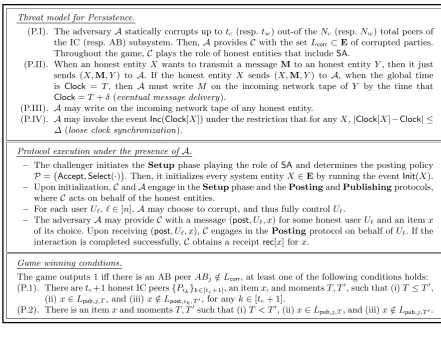
C initializes the BB system on behalf of the SA. Then, C and A engage in the Setup phase and thePostingandPublishing protocols, whereC acts on behalf of the honest entities. The game is described in detail in Fig. 3. Intuitively, the goal ofAis to successfully attack the (bb.1) property (winning condition (P.1)) or the (bb.4) property (winning condition (P.2)).
Threat model for Persistence.
(P.I). The adversaryAstatically corrupts up totc (resp.tw) out-of theNc (resp.Nw) total peers of
the IC (resp. AB) subsystem. Then,AprovidesC with the setLcorr⊂Eof corrupted parties.
Throughout the game,Cplays the role of honest entities that includeSA.
(P.II). When an honest entityX wants to transmit a messageMto an honest entityY, then it just sends (X,M, Y) to A. If the honest entityX sends (X,M, Y) to A, when the global time is Clock = T, then A must writeM on the incoming network tape of Y by the time that
Clock=T+δ(eventual message delivery).
(P.III). Amay write on the incoming network tape of any honest entity.
(P.IV). Amay invoke the eventInc(Clock[X]) under the restriction that for anyX,|Clock[X]−Clock| ≤
∆(loose clock synchronization).
Protocol execution under the presence ofA.
– The challenger initiates theSetupphase playing the role of SAand determines the posting policy
P= Accept,Select(·)
. Then, it initializes every system entityX ∈Eby running the eventInit(X).
– Upon initialization,CandAengage in theSetupphase and thePostingandPublishingprotocols, whereCacts on behalf of the honest entities.
– For each userU`,`∈[n],Amay choose to corrupt, and thus fully controlU`.
– The adversaryAmay provideCwith a message (post, U`, x) for some honest userU`and an itemx
of its choice. Upon receiving (post, U`, x),C engages in thePostingprotocol on behalf ofU`. If the
interaction is completed successfully,C obtains a receiptrec[x] forx.
Game winning conditions.
The game outputs 1 iff there is an AB peerABj∈/Lcorr, at least one of the following conditions holds:
(P.1). There aretc+1 honest IC peers{Pik}k∈[tc+1], an itemx, and momentsT, T0, such that (i)T ≤T0,
(ii)x∈Lpub,j,T, and (iii)x /∈Lpost,ik,T0, for anyk∈[tc+ 1].
(P.2). There is an itemxand momentsT, T0such that (i)T < T0, (ii)x∈Lpub,j,T, and (iii)x /∈Lpub,j,T0.
Fig. 3.The BB Persistence security gameGA,δ,∆,tc,tw
Prst (1
κ
,E), betweenC andA.
Game winning conditions.
The game outputs 1 iff for every momentT, we have thatVerifyPub hLpub,k,Tik∈[Nw],params
=accept
and there is a (not necessarily honest) AB peerABj, such that at least one of the following conditions
holds:
(P.1). There are tc+ 1 honest IC peers{Pik}k∈[tc+1], an item x, and moments T0, T00, such that (i)
T0≤T00, (ii)x∈Lpub,j,T0, and (iii)x /∈Lpost,i
k,T00, for anyk∈[tc+ 1].
(P.2). There is an item x and moments T0, T00 such that (i) T0 < T00, (ii) x ∈ Lpub,j,T0, and (iii) x /∈Lpub,j,T00.
Fig. 4.Game winning conditions for the BB Confirmable Persistence security gameGA,δ,∆,tc
C.Prst (1
κ,E).
Formally, Confirmable Persistence is defined via the gameGA,δ,∆,tc
C.Prst (1κ,E) that follows the same steps asGA,δ,∆,tc,tw
Prst (1κ,E), for the special casetw =Nw, except the following differences in the
winning conditions for A, that are presented in detail in Fig. 4: (1) for every k ∈ [Nw], the
published data onABk should always verify successfully, and (2) the inconsistentABj referred
in either of (P.1) or (P.2) conditions may be any (malicious) AB peer. We define Persistence and Confirmable Persistence as follows.
Definition 4 ((Confirmable) Persistence).Letκbe the security parameter,Nc, Nw, tc, tw ∈ N, δ, ∆ ∈ [0,+∞], and BB be a BB system with Nc IC peers and Nw AB peers. We say
that BBachieves Persistence for fault-tolerance thresholds (tc, tw), delay message boundδ and
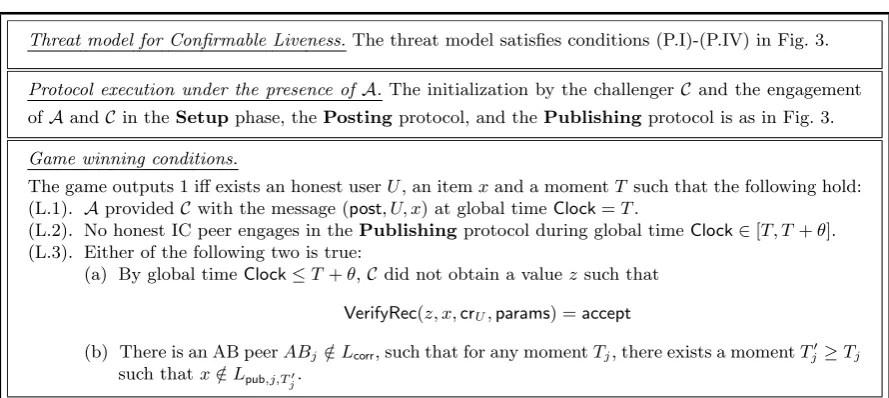
Threat model for Confirmable Liveness.The threat model satisfies conditions (P.I)-(P.IV) in Fig. 3.
Protocol execution under the presence of A.The initialization by the challenger C and the engagement
ofAandCin theSetupphase, thePostingprotocol, and thePublishingprotocol is as in Fig. 3.
Game winning conditions.
The game outputs 1 iff exists an honest userU, an itemxand a momentT such that the following hold: (L.1). AprovidedC with the message (post, U, x) at global timeClock=T.
(L.2). No honest IC peer engages in thePublishingprotocol during global timeClock∈[T, T+θ]. (L.3). Either of the following two is true:
(a) By global timeClock≤T+θ,C did not obtain a valuez such that
VerifyRec(z, x,crU,params) =accept
(b) There is an AB peerABj∈/Lcorr, such that for any momentTj, there exists a momentTj0≥Tj
such thatx /∈Lpub,j,Tj0.
Fig. 5.The BB Liveness security gameGA,δ,∆,tc,tw
θ−C.Live (1
κ
,E) betweenC andA.
PrGA,δ,∆,tc,tw
Prst (1κ,E) = 1
=negl(κ).
We say that BB achieves Confirmable Persistence for fault tolerance threshold tc, delay
message bound δ and synchronization loss bound ∆, if for every PPT adversaryA, it holds that
PrGA,δ,∆,tc
C.Prst (1κ,E) = 1
=negl(κ).
4.4 Confirmable θ-Liveness definition
We defineθ-Confirmable Liveness via a security gameGA,δ,∆,tc,tw
θ−C.Live (1κ,E) between the challenger C and an adversaryA, where Astatically corrupts up totc (resp.tw) out-of theNc (resp.Nw)
total IC (resp. AB) peers, while C plays the role ofSAand all peers and users that Adoes not corrupt. The adversary wins if it manages to prevent the generation of a valid receipt for an itemxor the eventual publishing ofx, given thatxhas been submitted at least θtime prior to the nearest Publishing protocol execution. The game is described in detail in Fig. 5.
Definition 5 (Confirmable θ-Liveness). Let κ be the security parameter,Nc, Nw, tc, tw, θ∈ N,δ, ∆∈[0,+∞]and letBBbe a BB system with with NcIC peers and Nw AB peers. We say
that BB achieves Confirmable θ-Liveness for fault-tolerance thresholds (tc, tw), delay message
bound δ, and synchronization loss bound ∆, if for every PPT adversaryA, it holds that
PrGA,δ,∆,tc,tw
θ−C.Live (1κ,E) = 1
=negl(κ).
5 The Culnane-Schneider (CS) BB system
In this section, we provide an outline of CS BB system as presented in [19] adopted in our terminology, and analyze its security guarantees and weaknesses under the framework intro-duced in Sec. 4. TheCS BB system comprises the setup authoritySA, the users, the IC peers P1, . . . , PNc and a single trusted AB (called WBB in [19]), i.e., Nw = 1. The fault-tolerance
threshold on the number of corrupted IC peers, tc, thatCS requires is
The Posting Protocol.
U →Pi: UserU broadcasts itemxwith credentialcrU to all peersPi,i∈[Nc].
Pi→Pj: Upon receiving (x,crU) fromU, each IC peerPichecks that (i)crU is valid forU (i.e (U, x)∈
Accept), and (ii)xdoes not clash with any previously posted itemx0 duringpor previous periods. If both checks are successful, then it broadcasts (p, x,crU),Sigski(p, x,crU)
to all other IC peers. Pi: Pi waits for messages (p, x,crU),Sigskj(p, x,crU)
from peersPj,j6=i, and appends them to the
dataset of received signed itemsDi,p. Upon receivingNc−tcvalid signatures on (p, x,crU) (including
its own),Piadds (p, x) to its local BB recordBi,pfor periodp.
Pi→U: Pisends its TSS share ((p, x),ShareSigtski(p, x)) toU. U: The userU waits for valid signatures (p, x),ShareSigtskj(p, x)
fromNc−tc≥ts+ 1 peersPj. When
this happens, letSU be a set ofts+ 1 peers from whichU can combine the share. The receipt forx
thatU obtains is set as
rec[x] :=TSigntsk(p, x)←Combine pk,pk1, . . . ,pkNc,(p, x),(j, σj)j∈SU
.
Fig. 6. The Posting protocol of the CS BB system during period p w.r.t. the posting policy P =
Accept,Select(·)
, for fault tolerance threshold of tc out-ofNc IC peers P1, . . . , PNc, and a (ts, Nc)-TSS.
Se-lection functionSelect(·) is the identity function.
5.1 Description of the CS BB system
Setup. Upon specifying the posting policy P = Accept,Select(·)
, the SA provides all enti-ties with the description of an EUFCMA-secure signature scheme DS = (KGen,Sig,Vf) and a (ts, Nc)-EUFCMA-secure TSS TSS = (DistKeygen,ShareSig,ShareVerify, TVf, Combine) (cf.
Sec. 3). Then, each IC peerPirunsKGen(1κ) to obtain a signing keyskiand a verification keyvki,
while all IC peers jointly executeDistKeygen(1κ, ts, Nc) to produce a secret keys (tsk1, . . . ,tskNc),
implicitly definingtsk, and the corresponding public output pk,(pk1, . . . ,pkNc).
Upon key generation, the IC peers broadcast pk:={pk,(pk1, . . . ,pkNc),(vk1, . . . ,vkNc)}to
all other entities. The public parameters params include the description of DS,TSS,P, as well aspk. Finally, every userU engages with SA in an interaction to obtain her private input crU. As mentioned in Sec. 4.1,crU could be a singing key, or an authentication password.
From a timing aspect, the CS BB system runs in consecutive periods. Namely, each period p is a time interval [Tbegin,p, Tend,p] between two fixed global time valuesTbegin,p and Tend,p, and
the end of a period matches the beginning of the next one. For each IC peerPi, we denote by
Bi,p the local record of Pi including all itemsx recorded as posted and by Di,p the database of
received itemsxtogether with other peers’ signatures on them, for the periodp. In the beginning of p,Pi setsBi,p, Di,p ← ∅.
Posting. If a user U wants to post item x during period p, then she broadcasts x to all IC peers, along with her credentialcrU. Upon receiving and verifying the validity of (x,crU), each peerPi broadcasts a signature on (p, x,crU) under its singing keyski. WhenPi receivesNc−tc
valid signatures on (p, x,crU) (including its own) fromNc−tcdifferent peers, it threshold signs
(p, x) and sends it toU. Finally, whenU receivesNc−tc≥ts+ 1 valid TSS shares fromNc−tc
different peers, it combines them to obtain a threshold signature on (p, x), as her receipt. We defineVerifyRec(rec[x], x,crU,params) :=TVfpk((p, x),TSign(tsk,(p, x))). ThePostingprotocol is presented in more detail in Fig. 6.
Publishing. Given a period p = [Tbegin,p, Tend,p], all IC peers stop item recording and begin
publishing their local records at a specified time Tbarrier,p ∈ (Tbegin,p, Tend,p). The Publishing
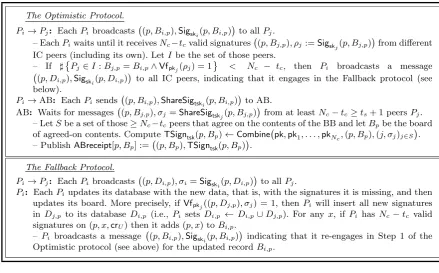
protocol includes two subprotocols: initially, the IC peers run anOptimistic protocol that results in the publishing of a BB record, if at least Nc−tc local BB records agree. We note that the
The Optimistic Protocol.
Pi→Pj: EachPibroadcasts (p, Bi,p),Sigski(p, Bi,p)
to all Pj.
– EachPiwaits until it receivesNc−tcvalid signatures (p, Bj,p), ρj:=Sigskj(p, Bj,p)
from different IC peers (including its own). LetI be the set of those peers.
– If ]
Pj∈I:Bj,p=Bi,p∧Vfpkj(ρj) = 1 < Nc − tc, then Pi broadcasts a message (p, Di,p),Sigski(p, Di,p)
to all IC peers, indicating that it engages in the Fallback protocol (see below).
Pi→AB: EachPi sends (p, Bi,p),ShareSigtski(p, Bi,p)
to AB. AB: Waits for messages (p, Bj,p), σj=ShareSigtskj(p, Bj,p)
from at leastNc−tc≥ts+ 1 peersPj.
– LetSbe a set of those≥Nc−tcpeers that agree on the contents of the BB and letBpbe the board
of agreed-on contents. ComputeTSigntsk(p, Bp)←Combine pk,pk1, . . . ,pkNc,(p, Bp),(j, σj)j∈S
. – PublishABreceipt[p, Bp] := (p, Bp),TSigntsk(p, Bp).
The Fallback Protocol.
Pi→Pj: EachPibroadcasts (p, Di,p), σi=Sigski(p, Di,p)
to all Pj.
Pi: EachPiupdates its database with the new data, that is, with the signatures it is missing, and then
updates its board. More precisely, ifVfpkj((p, Dj,p), σj) = 1, then Pi will insert all new signatures
inDj,p to its databaseDi,p (i.e., Pi sets Di,p ← Di,p∪Dj,p). For any x, ifPi has Nc−tc valid
signatures on (p, x,crU) then it adds (p, x) toBi,p.
–Pi broadcasts a message (p, Bi,p),Sigski(p, Bi,p)
indicating that it re-engages in Step 1 of the Optimistic protocol (see above) for the updated recordBi,p.
Fig. 7.ThePublishingprotocol of theCS BB system during periodp, for fault tolerance threshold oftcout-of
NcIC peersP1, . . . , PNc, and a (ts, Nc)-TSS.
protocol check fails, then IC peers engage in the Fallback protocol, where they exchange their databases of collected signatures for posted items. The Fallback protocol is essentially one round of the Floodset agreement algorithm [34, Section 6.2] with the following characteristic: if all users posted their items honestly, then Fallback need to run only once. Otherwise, as in standard Floodset, it needs to be executed up to Nc−tc+ 1 times in the synchronous setting.
When consensus is reached, the IC peers provide the AB with their records along with corresponding TSS shares. The AB sets the agreed record as its view for periodpalong with the reconstructed TSS signature from the collected shares. The total view of AB at some momentT, denoted byLpub,T, is the union of the agreed and published BB records for all periods preceding
momentT. The Publishing protocol is presented in more detail in Fig. 7.
5.2 Attacking the liveness of the CS BB system
As informally argued in [18, Sec. 8] (the full version of [19]), the liveness inCS can be achieved if one of the following conditions hold: 1) all the peers are following the protocol honestly and are online, 2) a threshold of tc < Nc/3 peers is malicious, but all users are honest, or 3) the
more general condition that not all users are honest and the malicious peers may choose any database in their capability, but do not change their database once it has been fixed, and will not send different databases to different peers. The argument is that one can easily detect in practice if malicious peers send different databases to different peers.
guidelines and their local views. As a result, our attack points out that the original description of CSmust be enhanced with an explicit detection mechanism against any deviation from the IC consensus protocol specifications, in order for the threat model in [19] to be properly justified. On the other hand, as we describe in Section 6 and prove in Section 7, enhancing CS with our novel Publishing protocol completely overcomes such issues, by achieving Confirmable Liveness even against a general Byzantine adversary.
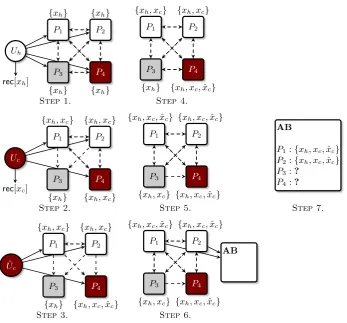
Description of the liveness attack.Our attack works under fault tolerance thresholdNc>
3tc, as required in [19], and consists of seven steps described below. The steps are illustrated in
Fig. 8 for the simple case whereNc= 4 and tc= 1:
Step1: Let p be a period where the set of honestly posted items is non-empty. For
sim-plicity, we assume that there is a single honest user Uh who broadcasts xh to all IC peers Pi,
i∈[Nc], and obtains a valid receiptrec[xh].
Step2: A malicious user Uc deviates from broadcasting and sends xc to all tc corrupted
peers and Nc−2tc honest peers. Denote the latter set of honest Nc−2tc peers by Hin. The malicious peers engage in the Postingprotocol by interacting only with the peers inHin. Ob-serve that even iftchonest peers do not participate in the post request ofxc, the collaboration
of tc+ (Nc−2tc) = Nc−tc peers is enough so that Uc obtains a valid receipt rec[xc], yet
(p, xc)∈Bi,p only for honest peersPi ∈ Hin. Denote by Hout thetc honest peers s.t. xc6∈Bi,p.
Step3: Another malicious user ˆUc deviates from broadcasting and, likeUc, sends item ˆxc
to alltccorrupted peers and theNc−2tchonest peers inHin. However, now the malicious peers do not engage in the Postingprotocol, so the peers inHin do not suffice for a receipt for ˆxc.
Step4: When Publishing protocol starts, the honest peers in Hin and Hout engage in the Optimistic protocol by sending their signed local records Rc
h := {(p, xh),(p, xc)} and
Rh := {(p, xh)} respectively. From their side, the malicious peers sign their records as Rc,ˆhc := {(p, xh),(p, xc),(p,xˆc)}. As a result, none of the three records Rh,Rch and R
c,ˆc
h is signed by at
leastNc−tc peers (recall that|Hin|=Nc−2tcand |Hout|=tc). Therefore, the malicious peers
force all honest peers to engage in the Fallback protocol.
Step5: During Fallback, all honest peers exchange their collection of signatures. At this
step, each peer inHin sends to each peer in Hout (i) its signature on (p, xc),(p, xh) and (p,xˆc)
and (ii) the tc signatures on (p, xc) that it received from the malicious peers. This way, each
peer inHout receives (Nc−2tc) +tc=Nc−tc signatures on (p, xc) but only Nc−2tcsignatures
on (p,xˆc), so it updates its local record toRch. On the other hand, the malicious peers send their
signatures on (p, xc),(p, xh) and (p,xˆc) only to the peers inHin. Therefore, each peer collects (Nc−2tc) +tc=Nc−tcsignatures on (p,xˆc) and updates its local record to Rc,ˆhc.
Step6: When the Fallback round above is completed, all peers restart the Optimistic
protocol. However, now the peers in Hin and Hout send their signed local recordsRc,ˆhc and Rc h
respectively. The malicious peers resend their recordsRc,ˆhc only to the peers inHin, which now have Nc−tc signatures on Rc,ˆhc. Thus, they finalize their engagement in thePublishing
pro-tocol for periodp by sending their TSS shares for Rc,ˆhc to the AB.
Step7: After forcing the peers in Hin to termination, the malicious peers become inert. This causes the peers inHout to remain pending for a new Fallback round that no other peer will follow. Moreover, the AB can not obtain Nc−tc TSS shares on some agreed record, and thus
it can not publish anything. This violates the property (bb.2) in [19] (expressed via condition (L.3) in Fig. 5), which dictates that since xh is an honestly posted item that has a receipt, it
Uh
P4
{xh}
P3
{xh}
P2 {xh}
P1 {xh}
rec[xh]
Step 1.
P4
{xh, xc,xˆc}
P3
{xh}
P2 {xh, xc}
P1 {xh, xc}
Step 4.
Uc
P4
{xh, xc}
P3
{xh}
P2 {xh, xc}
P1 {xh, xc}
rec[xc]
Step 2.
P4
{xh, xc,xˆc}
P3
{xh, xc}
P2 {xh, xc,xˆc}
P1 {xh, xc,xˆc}
Step 5.
AB
P1:{xh, xc,xˆc}
P2:{xh, xc,xˆc}
P3:?
P4:?
Step 7.
ˆ
Uc
P4
{xh, xc,xˆc}
P3
{xh}
P2 {xh, xc}
P1 {xh, xc}
Step 3.
AB
P4
{xh, xc,xˆc}
P3
{xh, xc}
P1 {xh, xc,xˆc}
P2 {xh, xc,xˆc}
Step 6.
Fig. 8.Attacking the liveness ofCS forNc= 4 andtc= 1, whereHin={P1, P2}andHout={P3}. The malicious
entities are colored in red. The elements in{·}denote the local records of each IC peer of publishable items for periodpat the end of the given step.
The strength of our liveness attack.The attack described above requires the collaboration of malicious users and corrupted IC peers. Nonetheless, it is important to note that during the Publishing protocol, the tc malicious peers behave consistently towards theNc−2tc peers in
Hinby providing the same records and signature databases. In addition, the fact that they send no information to the peers inHout is a malicious behavior that the peerscannot prove to the peers inHin, i.e., the peers inHincannot tell whether the peers in Hout are (i) honest and they did not receive anything, or (ii) malicious and claim some false denial of service. As a result, the peers in Hin can not distinguish whether (i) the tc malicious peers, or (ii) thetc peers in
Hout, are the ones that deviate from the protocol guidelines. This shows that the attacker can deviate from the guidelines and still not be detected, within the context of theCSIC consensus.
5.3 TSS Fault-Tolerance Requirements for Confirmable Persistence
As we mentioned already in Section 3.2, most TSS constructions [25,8,35,26] are proposed in the setting where the number of corrupted parties tc and threshold ts for combining shares to
a signature are the same, i.e., tc=ts. In order to achieve liveness, TSS needs to be robust and
therefore ts=tc< Nc/26.
Hence, we study the security of CS in the case of ts < Nc/2 and prove the CSBB system
to achieve Confirmable Persistence, but for a smaller bound oftc< Nc/4. Moreover, this bound
is tight, in the sense that if ts < Nc/2 and tc ≥ Nc/4, then there exists an attack against
6
Clearly, if ts=tc≥Nc/2, then honest peers need to involve at least one malicious peer to construct a valid
Confirmable Persistence. Specifically, the attack achieves winning condition (P.1) in Fig. 4 (property (bb.1)). Finally, we discuss ways to overcome this limitation and point out that some TSS constructions (like the trivial TSS) still allow to achieve tc < Nc/3. Same limitations in
the choice of TSS apply to our new BB protocol.
Description of the Confirmable Persistence attack. Assume that Nc ≥4, the threshold
Nc/4 ≤ tc < Nc/3 and a (ts, Nc)-EUFCMA-secure TSS, where tc ≤ ts < Nc/2. Our attack
consists of the three steps described below and illustrated in Fig. 9, for the case of Nc = 10,
tc= 3 andts = 4:
Step1: Let th =ts−tc. Assume that in period p a user U posts an item (p, x) but does
not obtain a receipt. More precisely, assume that the adversary blocked the communication so that at the end of the posting protocol, (p, x)∈Bi,p for only one honest peer Pi.
Step2: During the Optimistic protocol, the adversary blocks messages so that all tc =
ts−th corrupted peers and exactly (ts+ 1)−tc=th+ 1 honest peers (thus, in totalts+ 1 peers)
threshold sign a record Bp such that (p, x) 6∈Bp and send it to the AB. More precisely, only
the said ts+ 1 peers will obtainNc−tc signatures onBp. Thus, a malicious AB can construct
a receipt onBp.
Step3: The remaining Nc−tc−(th + 1) honest peers together with tc corrupted peers
execute the Fallback and the Optimistic protocol, and agree on a Bp0 s.t. (x, p) ∈ Bp0. Since Nc≥4 and Nc/4≤tc≤ts< Nc/2, we have that
Nc≥2ts−tc+ 2⇒Nc−(th+ 1)≥ts+ 1.
Thus, a malicious AB can construct a receipt onB0p. By the above, a malicious AB can output two valid threshold signatures for a period p, i.e.,
w=ABreceipt[p, Bp] = (p, Bp), σ=TSigntsk((p, Bp))
∧
w0 =ABreceipt[p, Bp0] = (p, B0p), σ0 =TSigntsk((p, Bp0)) ∧w6=w0∧TVf(pk,(p, Bp), σ) =TVf(pk,(p, Bp0), σ0) = 1,
hence, Confirmable Persistence is violated.
Proving CS Confirmable Persistence. We show that even with ts < Nc/2, CS BB can
still tolerate a threshold of tc < Nc/4 malicious peers. More generally, if we forget about the
robustness bound (which is only for liveness), then CS BB has Confirmable Persistence for tc<(ts+ 1)/2.
To prove this claim, we make use of Lemma 1 showing that if an adversary A wins the Confirmable Persistence game GA,δ,∆,tc
C.Prst (1κ,E), then for every period p, at least th+ 1 honest peers have contributed their signature share for the TSS of the published record forp.
Lemma 1. Let Nc, tc, tc0, ts ∈ N such that tc ≤ ts, t0c ≤ tc, and let δ = ∆ = ∞. Let TSS =
(DistKeygen,ShareSig,ShareVerify,TVf,Combine) be a (ts, Nc)-EUFCMA-secure TSS. Let A be
an arbitrary PPT adversary that corrupts t0c IC peers and th :=ts−t0c. If G
A,δ,∆,tc
C.Prst (1κ,E) = 1 for the CS BB system then for any period p, with probability 1−negl(κ) there is a set H := {Pik}k∈[t
h+1] of honest IC peers that output ((p, Bp),ShareSig(tskik,(p, Bp))) for k ∈ [th + 1],
where Bp is the published record forp.
Proof. We prove the Lemma in Appendix A.1.
Given Lemma 1, we prove CSConfirmable Persistence in the following Theorem.
Theorem 1. LetNc, tc, ts∈N, such thatts≤Nc and letδ=∆=∞. Let DS= (KGen,Sig,Vf)
be an EUFCMA-secure signature scheme and TSS = (DistKeygen,ShareSig,ShareVerify,TVf,
Combine) be a (ts, Nc)-EUFCMA-secure TSS. For all tc <(ts+ 1)/2 the CSBB system, with
P1 P2 P3
P4 P5 P6
P7 P8 P9
P10
Step 1. During the Posting protocol, P10 is the only
hon-est peer that received the post request for x. The honest peers P1, . . . , P6 colored in gray are
unaware ofx.
P1 P2 P3
P4 P5 P6
P7 P8 P9
P10
Step 2. During the Optimistic protocol only the ts + 1 =
5 peers P1, P4, P7, P8, P9 obtain
Nc−tc= 7 signatures and send
their TSS shares forBi,p63(x, p)
to the malicious AB.
P1 P2 P3
P4 P5 P6
P7 P8 P9
P10
Step 3. The Nc −tc+ 1 =
8 peers P2, P3, P5, . . . , P10 start
Fallback and Optimistic proto-cols, and after that send their TSS shares onB0ip3(x, p) to the
malicious AB.
Fig. 9.Attack against Confirmable Persistence forNc= 10,tc= 3 and ts= 4. The corrupted nodesP7, P8, P9
are colored in red.
Proof. We prove the Theorem in Appendix A.2.
Discussion. Theorem 1 implies that
1. If ts < Nc/2 (robustness bound), then we can show the bound tc < Nc/4 + 1/2. Together
with the attack in beginning of this Section, we get that tc< Nc/4 and this bound is tight.
2. Ifts= 2Nc/3 (originalCS bound), thentc< Nc/3 which is exactly the bound that Culnane
and Schneider claim.
The Confirmable Persistence attack depends on the bound ts< Nc/2. We argue that there
are simple (but perhaps not ideal) ways to bypassts< Nc/2 bound and hence possible to avoid
Confirmable Persistence attack. However, it can be seen as a warning that a TSS scheme can not be utilized as a black-box tool in order to realizeCS BB system.
The analysis w.r.t. the robustness bound tc< Nc/2, is due to the fact that typically TSS is
studied in the case whentc=ts. Hence, ifts≥Nc/2, then signing is only possible with the help
from malicious peers and robustness cannot be achieved because they can block the signature creation.
In [42], Shoup proposes a more general definition of (k, ts, Nc)−TSS (with a construction)
where ts is the number of malicious peers and k ≥ ts+ 1 is the number of signature shares
needed to combine a valid signature. This scheme also assumes that ts < Nc/2 but k can be
larger thants+ 1. Such definition seems to be more appropriate for theCS BB setting since we
may takek=b2Nc/3c+ 1, ts=dNc/3e −1 and still maintain robustness. Besides [42], we are
aware of only [1] that proposes a (k, ts, Nc)−TSS. Both schemes however use a trusted dealer
Another possibility is to use the trivial (ts, Nc)-TSS scheme defined in Subsec. 3.2. The
trivial scheme has robustness for any ts such that ts < Nc/2, since key generation is done
locally and there are enough honest peers to produce a valid signature. Of course, this TSS construction loses the main advantage of TSS, which is to achieve lower communication and verification complexity than sending and verifyingNc signatures individually.
We do not claim that it is impossible to construct a (k, ts, Nc)-TSS which would avoid the
issues mentioned above. However, care must be taken when instantiating CS BB, since most TSS schemes in the literature are not proved secure as (k, t, Nc)−TSS. Setting the parameter
ts greater than Nc/2 in case of (ts, Nc)−TSS might not be secure even if tc< Nc/2.
6 A New Publishing Protocol for the CS BB System
We present a new Publishing protocol that, when combined with the CS Posting protocol, results in a BB system that achieves Confirmable Liveness in partially synchronous model, and Persistence in asynchronous model, against a general Byzantine adversary, assuming a threshold of tc < Nc/3 corrupted IC peers. Persistence can be also be Confirmable, if we consider a
distributed AB system of Nw peers such that no more than tw < Nw/2 of the AB peers are
corrupted, similar to [15]. Namely, the distributed AB runs as a replication service; data posting is done by broadcasting to all AB peers, while data reading is done by honest majority.
6.1 Protocol overview
ThePublishingprotocol is executed by the peers of the IC subsystemP1, . . . , PNc and the AB
subsystem AB1, . . . , ABNw. The cryptographic tools that we apply are (a) a signature scheme
DS = (KGen,Sig,Vf), (b) a robust threshold signature scheme TSS = (DistKeygen,ShareSig,
ShareVerify,Combine,TVf), and (c) a CRHF family H=Hκ :{0,1}d(κ)−→ {0,1}r(κ) κ∈
N, as
described in Sections 3.1, 3.2, and 3.3, respectively.
In addition, we require (i) eventual message delivery and (ii) the existence of a Binary Consensus (BC) protocol BC with tc < Nc/3 Byzantine fault tolerance (cf. Section 3.4). Both
these conditions are met in the partially synchronous model (cf. [21]). As in CS, all peers are aware of consecutive periods p = [Tbegin,p, Tend,p]. In each period p, there is (a) a moment
Tbarrier,p∈(Tbegin,p, Tend,p) where item collection stops and thePublishingprotocol is initiated,
and (b) a momentTpublish,p∈(Tbarrier,p, Tend,p), where the AB peers publish their records of valid
items for the periodp. During the time interval (Tpublish,p, Tend,p], the AB peers publish hashes of
each others’ records which, as we will show in Section 7.1, is necessary to support Confirmable Persistence. We stress that the above “hardcoded” time values do not affect the execution steps of the Protocol in terms of synchronicity, that is, the protocol guidelines do not impose some agreement among the peers for synchronization of the valuesTbegin,p, Tbarrier,p, Tpublish,p, Tend,p.
During each periodp, the protocol consists of the following phases:
The Initialization phase, where each IC peer Pi, i ∈ [Nc] sets a table with Nc columns
(andNc+ 3 rows), where each columnjcontains the information that will eventually lead to
the opinion of Pi about the local record ofPj. Naturally, only thei-th column is initialized
with meaningful information, reflecting that in the beginning, Pi is assured only of its own
local record.
The Collection phase, where all IC peers exchange (i) their local records created during thePostingprotocol (direct views), as well as (ii) their opinion on the records they receive for other peers by rebroadcasting (indirect views). By the end of the Collection phase, all (honest) peers will have updated their local records so that these include all the honestly posted items for periodp.
When all BC executions are completed, the (honest) peers will have discarded their views about any peer which record they decided for 0.
The Finalization phase, where each peer Pi reaches to a final decision on what items to
include in its local record. Namely, these will be the (signed) items (p, x) that exist in at least≥tc+ 1 distinct views of Pi about IC peers’ records, including its own. In addition,Pi
threshold signs every item that adds in its final record. Note that since there are ≥Nc−tc
honest peers, at least Nc−2tc≥tc+ 1 of them are needed for the generation of the users’
receipts. The latter implies that in all honest peers’ final records (i) all honestly posted items will be included, and (ii) only maliciously posted items will be removed. Observe that there may be maliciously posted items that will be included in an honest peer’s final record, however this does not violate any liveness or persistence requirement.
The Publication phase, where the IC peers broadcast their finalized local records to all AB peers. Each peer ABj, j ∈ [Nw], will include only all TSS-signed items (p, x) that are
in at least Nc−tc records provided by the IC peers. In addition, ABj will reconstruct and
publish a combined TSS signature for (p, x), from the respectiveNc−tc shares. The time of
publishing for ABj is when its local clock reachesTpublish,p. Again, since there are≥Nc−tc
honest IC peers, all honestly posted items for periodpwill be included in the published data of all Nw−tw > tw honest AB peers.
Next, by the time its local time reaches the period’s end,ABj reads the published data from
every other AB peer and publishes a hash of each peer’s data. This way, there is an implicit public transcript of the AB peers’ agreement (by honest majority) on each others’ published data, that prevents any malicious peer from deleting items that it has once posted in its record.
Verification of published data.At any given time, any auditor can confirm the consistency of the published data by verifying the hash history and all the TSS signatures published by each AB peer. If all verifications are successful, then the auditor reads as published data the set of items that appear consistently on at least > Nw/2 of the AB peers.
6.2 Protocol description
The public parametersparamsinclude the identities of the IC and AB peers, the description of
DS,TSS,H, as well as the TSS public keypk. For each periodp, the phases of thePublishing protocol are as follows:
Initializationphase: each IC peerPi initializes the following vectors:
(i). Its direct view of local records, denoted byViewi,p :=hB˜i,1,p, . . . ,B˜i,Nc,pi: namely, it sets
˜
Bi,j,p ← ⊥, forj 6=i, and ˜Bi,i,p←Bi,p.
(ii). For every j∈[Nc]\ {i}, itsindirect view of local records as provided byPj, denoted by Viewi,j,p :=hB˜j,1,pi , . . . ,B˜j,Ni c,pi: namely, it sets Viewi,j,p← h⊥, . . . ,⊥i.
(iii). A variable vector hbi,1, . . . , bi,Nci, where bi,j is a value in {?,0,1} that expresses the
opinion of Pi on the validity ofPj’s behavior. Initially, only bi,i is fixed to 1, while forj6=i,bi,j
is set to the “pending” value ‘?’. WhenPi fixesbi,j to some value 1/0 for allj ∈[Nc] (which we
prove it happens, cf. Lemma 3), it engages in theConsensus phase, that we describe shortly. (iv). An integer variable vectorhdi,1, . . . , di,Nci, wheredi,j denotesthe number of Pi’s (direct
or indirect) views that agree regarding Pj’s record. Initially,di,j = 0, forj 6=i, anddi,i= 1.
Collectionphase: upon initialization,Pisigns its local recordBi,p, followed by a tag denoted
by record, and broadcasts (record, Bi,p),Sigski(record, Bi,p)
to all IC peers. During this phase, Pi updates its direct and indirect views of other IC peers’ records and fixes its opinion
– When Pi receives a message (record, Ri,j,p),Sigskj(record, Ri,j,p)
signed by peer Pj
that was never received before, then it acts as follows: if Ri,j,p is formatted as a non-⊥ record
and the “opinion” bitbi,j is not fixed (i.e.bi,j = ‘?’), then it verifies the validity of the message
by checking if Vfpkj (record, Ri,j,p),Sigskj(record, Ri,j,p)
= 1. If the latter holds, then Pi
operates according to either of the following two cases:
1. If ˜Bi,j,p 6=⊥, then it marks Pj as malicious, that is, it sets ˜Bi,j,p ← ⊥ and fixesbi,j to 0.
Observe that sincePj is authenticated (except from somenegl(κ) error), it is safe forPi to mark
Pj as malicious, as an honest peer would never send two different versions of its local records.
2. If ˜Bi,j,p =⊥, thenPi updatesViewi,p as ˜Bi,j,p←Ri,j,p, and Viewi,j,p as ˜Bj,j,pi ←Ri,j,p and
increases thedi,j by 1. Next, it signs and re-broadcasts to all IC peers the received message in the
format Vi,j,Sigski(Vi,j)
, whereVi,j := (view, j),((record,B˜i,j,p),Sigskj(record,B˜i,j,p))
. Upon fixing bi,j to 1/0,Pi ignores any further message for the record of Pj.
–WhenPireceives a message Vk,j,Sigskk(Vk,j)
signed by peerPk for some peerPj different
than Pi and Pk, where Vk,j = (view, j),((record, Rk,j,p),Sigskj(record, Rk,j,p))
, and the message was never received before, then it acts as follows: ifRk,j,pis formatted as a non-⊥record
and bi,j = ‘?’, then it executes verificationVfpkk(Vk,j,Sigskk(Vk,j)). IfVfpkk(Vk,j,Sigskk(Vk,j)) =
1, thenPi operates according to either of the following two cases:
1. IfVfpkj (record, Ri,j,p),Sigskj(record, Ri,j,p)
= 0 or ˜Bik,j,p6=⊥, thenPi sets ˜Bi,k,p← ⊥,
fixes the bit bi,k to 07.
2. If Vfpkj (record, Ri,j,p),Sigskj(record, Ri,j,p)
= 1 and ˜Bk,j,pi = ⊥, then Pi updates Viewi,k,p by setting ˜Bk,j,pi ←Rk,j,p. Then,Pi updatesViewi,p according to the cases below:
(C.1).If for everyk0∈[Nc]\ {i}such that ˜Bki0,j,p=6 ⊥, it holds that ˜Bki0,j,p= ˜Bk,j,pi := ˜Bij,p(i.e. all non-⊥
records forjagree on some record ˜Bi
j,p), then it increases the value ofdi,j by 1. Moreover, ifdi,j=tc+ 1,
(i.e., there aretc+ 1 matching non-⊥records) and ˜Bi,j,p =⊥, then it updates as ˜Bi,j,p ←B˜ij,pand fixes
the bitbi,j to 1.
(C.2).If there is ak0 ∈[Nc] such that ˜Bik0,j,p6=⊥and ˜Bk,j,pi 6= ˜Bki0,j,p, then it updates as ˜Bi,j,p← ⊥and
fixes the bitbi,j to 0.
In either case, upon fixingbi,j,Pi ignores any further message for the record ofPj8.
–WhenPi has fixedNc−tcopinion bits, it broadcasts a request message (request view, j),
Sigski(request view, j), for every Pj that it has not yet fixed the opinion bitbi,j. This step
is executed to ensure thatPi will eventually fix its opinion bits for all IC peers. Upon receiving
Pi’s request, Pk replies with a signature for a response message Wk,j,Sigskk(Wk,j)
, where Wk,j := (response view, j),((record, Rk,j,p),Sigskj(record, Rk,j,p))
. Note that hereRk,j,p
may be ⊥, reflecting the Pk’s lack of direct view for Pj’s record untilPk receivedPi’s request.
For everyPj thatPihas broadcast a request (request view, j),Sigski(request view, j)
, Piwaits until it collectsNc−tc−1 distinct signed responses that verify successfully. During this
wait, it ignores any message in a format other than Wk,j,Sigskk(Wk,j)
or (request view, j),
Sigskk(request view, j)
. WhenNc−tc−1 distinct valid responses are received, it parses the
collection of theNc−tc−1 responses and its current direct view ofPj’s record, ˜Bi,j,p, to update
˜
Bi,j,p and fixbi,j as follows:
(R.1).If ˜Bi,j,p6=⊥, and all responses for non-⊥records are at leasttc and all match ˜Bi,j,p, thenPi fixes
bi,j to 1.
(R.2).If ˜Bi,j,p=⊥, and all responses for non-⊥records are at leasttc+ 1 and all refer to the same record
denoted as ˜Bj,pi , thenPi sets ˜Bi,j,p←B˜j,pi and fixesbi,j to 1.
7Observe that it is safe for P
i to markPk as a malicious, since an honestPk would neither send two non-⊥
views forPj, nor accept an invalid signature fromPjin the first place.
8
The security ofDSascertainsPithat with 1−negl(κ) probability, only ifPjis malicious, two non-equal records