ADAPTIVE EDGE DETECTION ALGORITHM FOR
FLAME AND FIRE IMAGES
1
K.Jayaram ,
2G.Ramachandran,
3L.Vasanth,
4R.Nagarajan
1
Assistant Professor, Dept of ECE, Madurai Institute of Engg & Tech, Tamilnadu (India).
2
Assistant Professor, Dept of ECE, VMKV Engg College, Tamilnadu (India).
3
Assistant Professor, Dept of ECE, Tejaa Shakthi Institute of Tech, Tamilnadu (India).
4
Assistant Professor, Dept of ECE, Annapoorana Engg College, Tamilnadu (India).
ABSTRACT
Conventional fire detection systems are generally limited to indoors and they usually fail when detection in open
area needed. A system that is able to detect fire by processing real-time video images would both work in open area
and it doesn't need a high budget. It can also be used in accordance with surveillance cameras for better
performance. This type of detection systems can provide improved detection and fewer false alarms since they detect
the combustion itself instead of its byproducts. Additional descriptive information about fire location and size is
possible, and these can be useful for preventing fire scattering efficiency and success of those methods. With
increasing emphasis on security, the automated flame detection using edge analysis has extensive usage. In general,
an algorithm of edge detection finds the sharp intensity variation of an image and in this way it obtains the edges of
the objects contained on the image. Through the pictures obtained by the experiment, we can see very clearly that,
compared to the traditional edge detection methods, the method proposed in this paper has a more obvious effect on
edge detection.
1 INTRODUCTION
Automatic flame or fire detection systems play a major role in the early detection and response of an unexpected fire
hazard. Most sensor based fire alarms are designed for indoor use and are not applicable in outdoor scenarios,
forests and in large infrastructure settings such as aircraft hangers, large tunnels and exhibition building etc. The
determination of flame or fire edges is the process of identifying a boundary between the area where there is thermo
chemical reaction and those without. It is a pre-cursor to image-based flame monitoring, early fire detection, fire
evaluation, and the determination of flame and fire parameters.
1.1 Fire & its properties
Fire is the rapid oxidation of a material in the exothermic chemical process of combustion, releasing heat, light, and
various reaction products. The flame is the visible portion of the fire. If hot enough, the gases may become ionized
to produce plasma. Depending on the substances alight, and any impurities outside, the color of the flame and the
an oxidizer such as oxygen gas or another oxygen-rich, is exposed to a source of heat or ambient temperature above
the flash point for the fuel mix, and is able to sustain a rate of rapid oxidation that produces a chain reaction. Fire
cannot exist without all of these elements in place and in the right proportions. Once ignited, a chain reaction must
take place whereby fires can sustain their own heat by the further release of heat energy in the process of
combustion and may propagate, provided there is a continuous supply of an oxidizer and fuel.
1.2 Flame Edges
During the process of heat up, the rising carbon atoms emit light. This heat produces light effect is called
incandescence which causes the visible flame. Flame colour varies depending on what is being burned and how hot
it is. Color variation within in a flame is caused by uneven temperature. The hottest part of a flame glows blue, and
the cooler parts at the top glow orange or yellow.
Earth gravity determines how the flame burns. All the hot gases in the flame are much hotter and less dense than the
surrounding air, so they move upward toward lower pressure. This is why fire typically spreads upward, and it's also
why flames are always pointed at the top.
1.3 Flame Edge Detection
The determination of flame or fire edges is the process of identifying a boundary between the area where there is
thermo chemical reaction and those without. It is a pre-cursor to image-based flame monitoring, early detection, fire
evaluation, and the determination of flame and fire parameters.
A computing algorithm is thus proposed to define flame and fire edges clearly and continuously. The algorithm
detects the coarse
and superfluous edges in a flame image first and then identifies the edges of the flame fire andremoves the irrelevant artifacts. The auto-adaptive feature of the algorithm ensures that the primary symbolic flame
edges are identified for different scenarios. The methods do not emphasize the continuity and clarity of the flame
and fire edges.
1.4 Importance of Flame Edge Detection
To meet the stringent standards on combustion efficiency and pollutant emissions, quantitative flame monitoring is
becoming increasingly important. This has led to a wave of research on advanced flame imaging technologies, both
in industry and laboratory research. In fire safety engineering, flame image processing is also emphasized as
image-based flame detectors are increasingly applied in fire detection systems. Compared to conventional flame detectors
such as those based on optical sensing, ionization current detection, and thermocouple, image-based flame detectors
are deemed more appropriate in fire detection because of their capability for remote detection of a small-sized fire,
as well as having other advantages. As one of the important steps in flame and fire image processing, edge detection
is often the precursor and lays a foundation for other processing.
The flame edges form a basis for the quantitative determination of a range of flame characteristic parameters such as
shape, size, location, and stability. The definition of flame edges can reduce the amount of data processing and filter
structural properties of the flame and meanwhile shorten the processing time. Edge detection can be used to segment
a group of flames. This is helpful for multiple flames monitoring in some industrial furnaces where a multi-burner
system is used. Timely determination of flame edges can trigger a fire alarm and provide the fire fighters with
information on fire type, combustible substances, exterior of the flame, etc. The movement of a detected flame edge
can be used to distinguish real and false fire alarms.
II ANALYSIS OF EXPERIMENTAL RESULTS
This project is demonstrated using the low-cost sensors which are commonly used as indoor and outdoor motion
detectors. It can be utilized as fire sensors when coupled with appropriate processing. The main advantage of image
based fire detection system over conventional sensors is its ability to detect the presence of fire from a distance
which results in a faster response time.
2.1 Experimental conditions
In the first step of the proposed method moving object boundaries are estimated. The method does not require very
accurate boundaries of moving regions. After a post-processing stage comprising of connecting the pixels, moving
regions are encapsulated with their minimum bounding rectangles. To evaluate the performance of the system, a
series of experiments were conducted on a candle light, serving to create a desirable and safe experimental
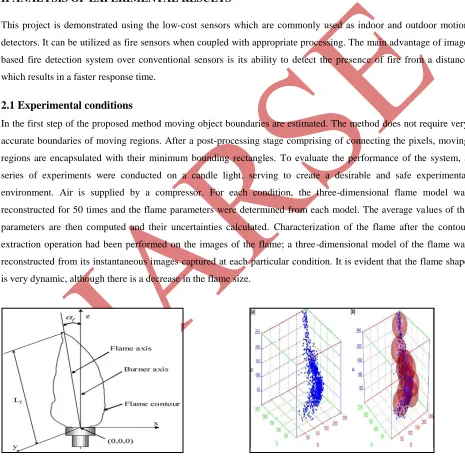
environment. Air is supplied by a compressor. For each condition, the three-dimensional flame model was
reconstructed for 50 times and the flame parameters were determined from each model. The average values of the
parameters are then computed and their uncertainties calculated. Characterization of the flame after the contour
extraction operation had been performed on the images of the flame; a three-dimensional model of the flame was
reconstructed from its instantaneous images captured at each particular condition. It is evident that the flame shape
is very dynamic, although there is a decrease in the flame size.
Fig 2.1 Definition of Flame Parameters Fig. 2.2 Moving Pixels in Video and Their Minimum Bounding Box
During the recognition phase the state history of length 20 image frames are determined for the moving object
yielding higher probability is determined as the result of the analysis for video track data. Edges extracted from
non-trivial images are often hampered by fragmentation, meaning that the edge curves are not connected, edge segments
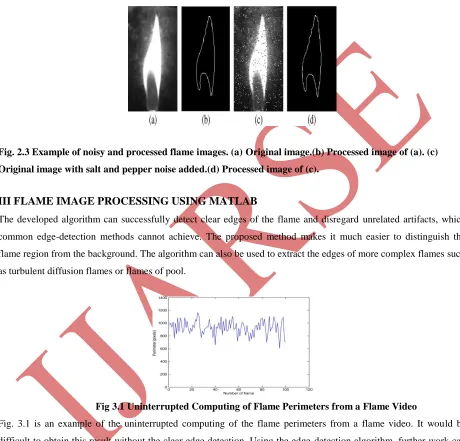
are melted, or false edges that do not correspond to significant phenomena in the images shown in fig. 5.3. Hence a
dedicated edge detection method for flame image processing is developed.
Fig. 2.3 Example of noisy and processed flame images. (a) Original image.(b) Processed image of (a). (c)
Original image with salt and pepper noise added.(d) Processed image of (c).
III FLAME IMAGE PROCESSING USING MATLAB
The developed algorithm can successfully detect clear edges of the flame and disregard unrelated artifacts, which
common edge-detection methods cannot achieve. The proposed method makes it much easier to distinguish the
flame region from the background. The algorithm can also be used to extract the edges of more complex flames such
as turbulent diffusion flames or flames of pool.
Fig 3.1 Uninterrupted Computing of Flame Perimeters from a Flame Video
Fig. 3.1 is an example of the uninterrupted computing of the flame perimeters from a flame video. It would be
difficult to obtain this result without the clear edge detection. Using the edge-detection algorithm, further work can
be done to characterize the geometric features of flames and, consequently, establish their relationship with
combustion conditions such as air/fuel inputs and emissions. The clearly defined flame edges will form a basis for
subsequent processing of the flame images. Many flame videos are also tested for continuous edge detection so as to
evaluate the robustness of the system. In Fig 2: Flame image processing for luminance image, adjusting grey level,
smoothened image, horizontal edge, vertical edge, pre-threshold image, and final edge. It is clear that the flame
edges detected using the Canny edge-detection method are unclear and discontinuous, while the results obtained
Fig 3. 2 Flame Image Processing. Fig 3.3Flame Image Processing – Output.
With a clearly defined flame edge, as shown in Fig 5.6, various flame parameters can be easily computed for the
shape description. For instance, the flame area can be counted by the number of pixels inside the flame edge; the
chain coding of a flame edge can be used to describe a 2-D flame/fire shape; the perimeter of a flame can be
achieved by the total number of pixels of the detected flame edge boundary.
IV APPLICATIONS OF FLAME EDGE DETECTION
In modern technology, flame analysis has various applications in industrial, medical, environmental engineering,
automation of plants etc.
4.1 Industrial Applications
In new generation industries automation plays a big role for increasing production and efficiency. The safety level is
improved using surveillance camera. The same images obtained from camera can be processed for analysing any fire
accident using this algorithm and a 24 hour monitoring is obtained without additional expense. Real-time video
codec component integrates the proposed fast and real-time monitoring video compression and decompression
technique. Isotropic property of gradient magnitude. The magnitude of gradient is an isotropic operator which
detects edges in any direction.
V CONCLUSION
Nowadays fire detection and control in industrial sectors and commercial buildings are becoming a more important
requirement due to the increased and intensive use of resources. The project on flame detection using edge search
helps in identifying the flame image in video using Matlab software. After the flame characteristics are analyzed, a
new flame edge-detection method has been developed and evaluated in comparison with conventional methods.
Experimental results have demonstrated that the algorithm developed is effective in identifying the edges of
irregular flames. The advantage of this method is that the flame edges in images detected are clear and continuous.
Furthermore, with the change of scenarios, the parameters in the algorithm can be automatically adjusted. The
clearly defined combustion region lays a good foundation for subsequent quantification of flame parameters, such as
algorithm can contribute to the in-depth understanding and advanced monitoring of combustion flames. The
algorithm provides a useful addition to fire image processing and analysis in fire safety engineering.
VI FUTURE ENHANCEMENT
The project can be extended to handle different flame videos simultaneously. The system implemented was able to
perform accurately, however there are some issues to be addressed. An optimization whose feasibility could be
analyzed using the videos recorded at different climatic condition will give a better result for the program used.
Further work is required to evaluate the performance of the algorithm in real-life flame detection scenarios. No fire
detection experiments were carried out using other sensing modalities such as ultra-violet (UV) sensors, near
infrared (NIR) or middle wave-length infrared (MWIR) cameras, in this project.
REFERENCES
[1] Grant Martin - Image Processing & Computer Vision with Matlab. Mathworks Inc, 2001. Mathworks Inc, 2001.
[2]A. El-Sayed Mohamed - Algorithm Based Entropic Threshold for Edge Detection in Images.
[3]Andrew Knight - Basics of Matlab and Beyond.CRC Press, 2000.
[4]B. Ugur Toreyin, A. Enis C¸ Etin, Yigithan Dedeo Glu -Flame Detection in Video Using Hidden Markov Models.
Bilkent’2008, IEEE ICIP,pp1230-1236.
[5]B.Ugur Toreyin, A Enis C, Etin,Yigithan Dedeo Glu, UgUr GuDu Kbay B, - Computer Vision Based Method
For Real-Time Fire And Flame Detection. Pattern Recognit. Lett., vol. 27, no. 1, pp. 49–58, Jan. 1, 2006.
[6]B.Ugur Toreyin, A. Enis C¸ Etin - Online Detection of Fire in Video. Bilkent’2007, pp2-7.
[7]B.Ugur Toreyin, Beh Cet U - Fire Detection Algorithms Using Multimodal Signal and Image Analysis.
[8]B.Ugur Toreyin, Enis C, Osman Gunay, Kasım Tas¸ Demir - Video Based Wild Fire Detection at Night. Bilkent’2009, pp2-21
[9]Brian D.Hahn, D.T. Valentine - Essential Matlab for Engineers and Scientists.Elsevier Books, 2007
[10]Charles K Mc mahon - Combustion Processes in Wild Land Fuels.
[11]Christos Xenophontos - A Beginner’s Guide to Matlab.Loyola Press, 2002.
[12]Elif Aybar - Sobel Edge Detection Method for Matlab.
[13]Fa-Xin Yu, Jing-Yong Su, Zhe-Ming Lu, Ping-He Huang, Jeng-Shyang Pan - Multi-Feature Based Fire
Detection in Video.
[14]G.Yan Yong - Three-Dimensional Visualization and Quantitative Characterisation of Fossil Fuel Flames using
Digital Imaging Techniques.
[15]Gonzalez - Digital Image Processing Using Matlab. PHI,2005.
[16]Grant Martin - Image Processing & Computer Vision with Matlab. Mathworks Inc, 2002. Mathworks Inc, 2002.
[17]HC Bheemul, G Lu, Y Yan - Three Dimensional Visualization and Quantitative Characterization of Gaseous
Flames. Pattern. Recog., 40, 2007, pp. 609-618.
[19]J.R. Martinez - De Dios A,1, B.C. Arrue A, A. Ollero A, L. Merino B, F. GoMez-Rodrı Guez A. - Computer
Vision Techniques For Forest Fire Perception.
[20]Jayavardhana Gubbi, Slavenmarusic, Marimuthu Palaniswami - Smoke Detection in video using wavelets and
support vector machines.
[21]John Canny - A Computational Approach to Edge Detection.
[22]John W. Woods - Multidimensional Signal, Image, and Video Processing and Coding. Wiley 2011.
[23]Junmo Kim - A Nonparametric Statistical Method for Image Segmentation Using Information Theory and
Curve Evolution.
[24]Kosmas Dimitropoulos A, K Vanc Koseb, Nikos Grammalidisa, Enis Cetinb - Fire Detection and Fire
Propagation Estimation for the Protection Of Cultural Heritage Areas.