Available Online atwww.ijcsmc.com
International Journal of Computer Science and Mobile Computing
A Monthly Journal of Computer Science and Information Technology
ISSN 2320–088X
IMPACT FACTOR: 5.258IJCSMC, Vol. 5, Issue. 4, April 2016, pg.22 – 32
iLoon: Data Encryption
with Data Auto-Deletion
Scheme in Cloud Database
Ashwini Zanzad1, Anjali Selokar2, Nandini Jain3, Sneha Godbole4, Kalyani Gajbhiye5
12345
CSE & DBACER, INDIA
1
[email protected]; [email protected]; [email protected];
4
[email protected]; [email protected]
Abstract— iLoon is an application for a group of people or an organization where user can send their confidential data to other user. Using this application user can share and access data. The data can be shared with multiple authorized users at same instance of time. The data encrypts before sending to other users. The unused and secure data gets deleted after user specific time. The user can specify the TTL for any document, text or image. TTL for document will provide the expiration time for any document. This project focuses on maintenance of cloud database as it will delete data after user specified TTL and it will refresh the cloud database storage. The application uses a combination of symmetric key (AES) and asymmetric key (MCP- ABE) scheme with time specific attribute. It is a secure encryption technique with data auto-deletion. In this scheme the cipher text contains the time interval generated from the time server. The cipher text can only decrypted if it is in the allowed time interval. If the time expires then cipher text gets automatically deleted from the cloud database. This scheme reduces manual deletion of data from the cloud database.
A SQL cloud database is used for storing the data. Admin can access the database anywhere over internet. This document is a template. An electronic copy can be downloaded from the conference website. For questions on paper guidelines, please contact the conference publications committee as indicated on the conference website. Information about final paper submission is available from the conference website.
Keywords— TTL, AES, MCP-ABE, Integrity, Confidentiality
I. INTRODUCTION
want to sends his ATM pin to other user. The data is sent using only encryption technique. The sender reads that data but not delete it after viewing .then after some days if someone hacks his account then all private data including ATM pin would be known by the hacker. So to avoid such situation the encryption method with TTL for document is used.
This application is limited for small group of users, organization, or institution. It is not the social networking site. After the user registration, User can not directly access the application. First the registration goes to the admin. Admin will verify that user is actually belongs to that organization or group .user can only use this application, after he is verified by admin. Admin has right to grant the access or deny the access. With this application, user can share text, pdf and images to different users. The art of protecting information by transforming it (encrypting it) into an unreadable format, called cipher text. Only those who possess a secret key can decipher (or decrypt) the message into plain text. Encrypted messages can sometimes be broken by cryptanalysis, also called code breaking, although modern cryptography techniques are virtually unbreakable. As the Internet and other forms of electronic communication become more prevalent, electronic security is becoming increasingly important. Cryptography is used to protect e- mail messages, credit card information, and corporate data. Cryptography systems can be broadly classified into symmetric-key systems that use a single key that both the sender and recipient have, and public-key systems that use two keys, a public key known to everyone and a private key that only the recipient of messages uses. The project uses a combination of symmetric and asymmetric key encryption based technique. Symmetric key is private key encryption technique which uses single private key for encryption as well as decryption. Asymmetric key encryption technique uses pub- lic attributes for encryption, which takes the public data attributes of the user for encryp- tion. The data is encrypted from the different combination of public attributes. After the encryption process is performed, the data is sent to that user whose attributes are used. The data is sent only to those users whose attributes are used for encryption. Other users belonging to this group receives only cipher text. This attributes based encryption technique combines with the auto deletion scheme. In this technique, the cipher text is assigned with an time interval. The time instance is generated from the time server which is present at the host computer. The cipher text is present in the cloud database only till the Time-to-live for the document is valid. This encryption technique with TTL solves the problem of security by providing authorized time interval to the document. After the time expires, the data gets self deleted, which maintains the memory. it reduces human efforts to delete the data. This project will aim at combining private and public key encryption methods.
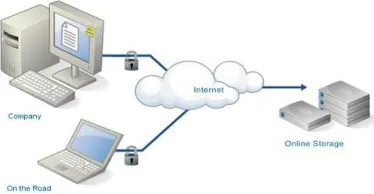
Figure 1.1: Online Cloud Database
database as a service, without physically launching a virtual machine instance for the database.In such a configuration, application owners do not have to install and maintain the database themselves. Instead, the database service provider takes responsibility for in- stalling and maintaining the database, and application owners pay according to their age. For example, Amazon Web Services provides three database services as part of its cloud offering: SimpleDB, a NoSQL key-value store; Amazon Relational Database Ser- vice, a SQL-based database service with a MySQL interface; and DynamoDB. Similarly, Microsoft offers the Azure
SQL Database service as part of its cloud offering
.
II. LITERATURE REVIEW
As there is need to share data with other user through cloud. So the cloud should consider security which is main issue in cloud computing. In this paper the confidential data which uploaded in the cloud use key-policy attribute-based encryption with time-specified attributes (KP-TSABE) scheme. In this scheme cipher text is labeled with time interval proposed by data owner and only decrypt if it is within time interval. The data can be access, store, downloaded within time instant but after time interval expired the data is securely self deleted and it will refresh the memory. Timed-specific encryption (TSE) provides an interesting encryption service where an encryption key is associated with a predefined release time, and a receiver can only construct the corresponding decryption key in this time instance applying the ABE to the shared data will intro- duce several problems with regard to time-specific constraint and self-destruction. [1]
In this paper they present attribute based access scheme for scalable media. The data which user wants to deliver on that data they apply attribute like age, gender, or nationality. The combination of both data and attribute can send to other user. Without using list of user names it uses attribute which provide data privacy by attribute based encryption. For this purpose they introduced multi message cipher text policy attribute based encryption technique. By using this it efficiently use attribute on that data so user whose attribute get match then only that user can decrypt that data so these attribute scheme [2]
The data can be shared in cloud so there is requirement to handle that data with security. This security is provided through encryption process. In this paper they describe AES encryption algorithm to implement security. AES is symmetric encryption algorithm. It is based on substitution and permutation network. AES perform all its computation on bytes rather than bits. So it uses 10 rounds for 128 bit key, 12 rounds for 192 bit key, and 14 rounds for 256 bit key. [3]
The confidential data when uploading in cloud then there is need of security. For maintaining that security we apply encryption. In this paper it uses mediated certificate less public key encryption (MCL-PKE) scheme without pairing operation which uses to give practical solution of shearing sensitive data. In this paper data owner encrypt that data using cloud generated public key then that data get uploaded into cloud .After successful authorization the data get partially decrypted and then user uses private key to fully de- crypt that data . Here cloud is work as storage and key generation center. [4]
III. PROBLEM STATEMENT
In today’s computing environment there is a great need of security data need of security, data integrity and confidentiality for securing data over the internet .Data transmission need secured way to protected.
IV. PROPOSED SYSTEM
The proposed application is used to share the confidential data over the network. The application has user friendly graphical user interface. This application is for the group of people, organization, small scale company or institution. User can only use the application after the verification from the admin. Admin can grant the access or deny the access. The combination of public key and private key algorithm is used here. For encryption AES is used. AES is symmetric key encryption algorithm which uses single key for encryption and decryption. The cipher text is then transmitted using key MCP-ABE algorithm which uses public attribute for the transmission. The cipher text goes to the user whose attribute are selected. User can specify TTL for data before sending. As TTL expire data automatically get deleted. Thus TTL we are using time specified attribute scheme. Proposed application is using cloud database, online database make the database plat- form independent and location independent. Admin can anytime access the data.
Modules
These are the various modules of project. The first module is registration form in which the user will register him. The second module is admin verification form to verify the user. The third module is login form to get access to homepage. The fourth module is Homepage.
Registration Form
The first step in the system is to register the user. It is only after registration process the user can login into the system and can use it.
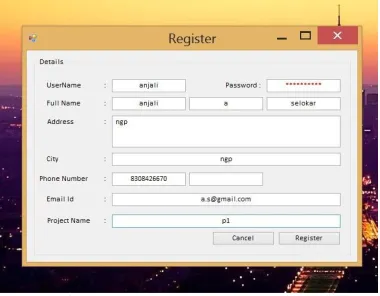
Figure 4.1: Registration process
In the registration module first a user needs to register him/her by providing necessary information such as name, username, email address and password etc. username is the field in which user can insert any name what he want to insert as his/her username. Whereas in password he should insert 6 character not less than that otherwise it shows exception same in case of phone number, where their is need of only 10 digit if it is less then same then the message will pop up. So remaining field should be insert by user which is very common like city, address, email id. The project name is the name of project on which they are working. And then click on register so after that user will register for this we are using SQL INSERT query to insert the information into the table SharedDataRegister into online database. After successful registration, the data first goes to the admin for verification. If the above processes are successfully carried out the user will get access to his/her personal home page where he/she will be able to perform various operations such as sharing and downloading of files.
Admin Approval Form
Figure 4.2: Admin verification
if he want to provide authorization to this user then he click on that user-id and select after that click on grant so this user will become authorized and can share data whereas if admin want to remove authorization then he click on deny button after that user can not send data or anything.
Login Form
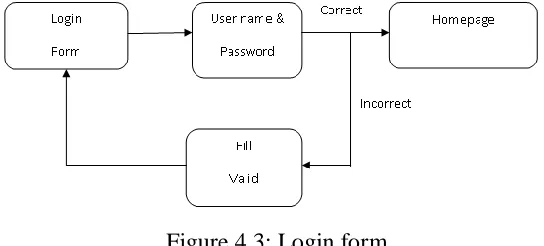
In the login module a screen appears which contains two specific fields namely USER NAME and PASSWORD. Here using SqlConnection Class we have created a database named TeamV. Using SELECT query we are verifying the user-id and password entered by the user with the data stored in SharedDataRgistered table. If the user-id and password are matched and the the admin has granted access, the user will be logged in. Otherwise the pop up box will show credential invalid. If the user is not registered then user can click on register button to register.
Figure 4.3: Login form
Homepage
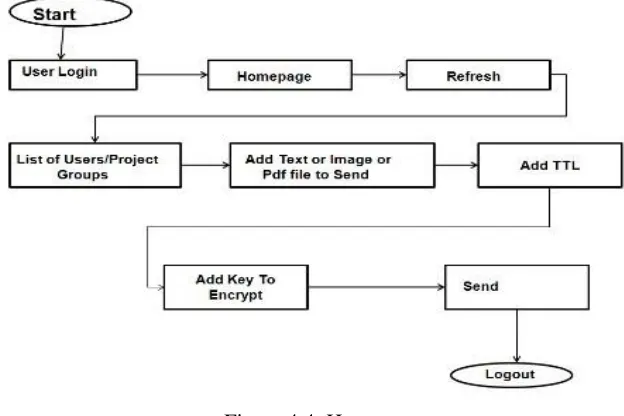
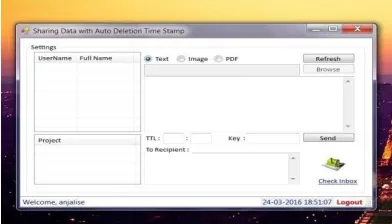
After the successful registration and passing the verification module the specific user will get access to his personal home page where he/she can perform various operations like sharing and downloading of text, PDF files, mp3 files and images. This is the page which come after login. Here user first click on refresh button then the list of user come on left hand side where username and fullname is given of various user who are authorized. Then user can select the names to whom user want to send data that user name will be added in add recipient column. User can also use project name to send the data. By selecting project name .user can send the data to multiple user. if user want to send data in text format then he click on text and type text. Same with image and Pdf , he click on image radio and then click on browse.
message then click on sent so the message box will pop up that message sent successfully. After that user add TTL ( time to live )in hrs:min format like 00:22 it means for 2 min . Up to that 2 min the data will present in this system after this if time will expire, then the data will self destructed. The inbox shows the list of files received by the user.
Figure 4.4: Homepage
Inbox
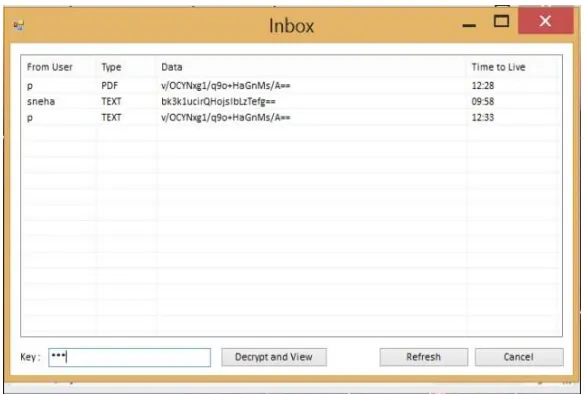
This page will come after clicking on check inbox. This page consist of the username from whom the data received. It consist of type field as second column where it shows whether the data is in text format or in image format. And in third column there is data field which consist of data in encrypted form. This encrypted form data is the combination of cipher text and the key. Last column contain time to live which consist of time up to which the data will remain in system. After that time expired the data will self destructed. Then in this page at lower side there is block for key where user insert key which is symmetric key and click on decrypt and view so then next page come which is for output.
Figure 4.5: Inbox
Auto-deletion scheme
Figure 4.6: Auto-deletion scheme
V. Results
The snapshots generated by this project are as follows. This includes registration, verification,
login, homepage, inbox and outbox.
Registration Page
Registration page is the first module of our application in which the user will provide his name,
email address and password and other necessary details about him/her
Figure 5.1: Registration Page
Admin Approval Page.
Figure 5.2: Admin Approval Page
Login Page
In the login page module the user has to enter his/her user name and password to get log in.His email id will be used as User name if the user provides correct data for the mentioned fields the user will be successfully logged in.
Figure 5.3:Login page
Homepage
This is personal home page of user where he/she can perform various operations like sending and downloading of text or PDF files or images. In homepage the list of Users and project groups shown whom user can send data. At a time user can send data to many user and a project group. After selection of type of data the TTL (Time to Leave) is applied on the data with the encryption.
Figure 5.5: Send Data
SEND DATA
In this figure 4.5 ,user can send image to selected users. By encrypting the cipher text text with the TTL. And providing a key to receivers for decryption applies for PDF and text.
Inbox
In this page the received files by the user are displayed with fetch data from SharedData database. User can only view the data only by applying key of decryption, but the data only visible for the given time.In this page authorized user can view and download whatever he/she received.
View data(output box)
In this page user can also view and download images, and they are stored on the database for the provided time only, after that time get expired the data will automatically get deleted.
Figure 5.7: view data
Time To Leave
In this Page the work of auto-deletion is performed. For this the time which is add with current of the system with the message sent by the sender. After receiving the message the timer starts automatically and it match the time which is stored in the database with the message, if it will matches the will get deleted
Figure 5.8: TTL application
VI.CONCLUSIONS
In this project, we proposed the novel AES encryption algorithm with TSA scheme which is able to achieve the time specific ciphertext. In order to solve these problems by implementing the authorization period and time controllable self data deletion after expectations of time. This project is able to share confidential data with multiple user or a project group. The PDF, image and text are encrypted uses AES which uses public attributes. The sending process uses MSP-ABE scheme, which takes the user public attributes (name and project name), thus the ciphertext is only secured by those user whose attributes are involves in the encryption process. The combination of AES with MSP-ABE with data auto-deletion scheme is successfully implemented in the project.
ACKNOWLEDGEMENT
We have great pleasure to express our most sincere regards and deep of gratitude to our project guide Ms. Kalyani Gajbhiye, Asst. Prof., Department of Computer Science & En- gineering, DBACER, Nagpur for her valuable guidance for completing final year project “iLoon: Data Encryption with Data Auto-deletion
REFERENCES
[1] Zhiqiang Yao Jianfeng Ma Qi Li Kui Geng Jinbo Xiong, Ximeng Liu and Patrick S. Chen.
A secure data self-destructing scheme in cloud computing. IEEE TRANSAC- TIONS ON CLOUD
COMPUTING, VOL. 2, NO. 4,, OCTOBER-DECEMBER 2014.
[2] Zhuo Wei Yongdong Wu and Robert H. Deng. Attribute-Based Access to Scalable Media in Cloud-Assisted
Content Sharing Networks, volume VOL. 15, NO. 4. IEEE TRANSACTIONS ON MULTIMEDIA, June
2013.
[3] Xiaoyu Ding Seung-Hyun Seo, Mohamed Nabeel and Elisa Bertino. ”An Efficient Certificateless Encryption
for Secure Data Sharing in Public Clouds. 2nd Interna- tional Workshop on Cloud Servive Brokerage, 2009.
[4] Prof.R.R. Tuteja Shakeeba S. Khan. Security in cloud computing using cryptographic algorithms.
(International Journal of Innovative Research in Computerand Commu- nication Engineering(An ISO 3297: 2007 Certified Organization), Vol. 3, Issue 1,
January 2015.