VICTORIA ~ UNIVERSITY
•
~
00 0
..
DEPARTMENT OF COMPUTER AND
MATHEMATICAL SCIENCES
Markets For Non-Storable Commodities
Barry A. Goss and S. Gulay A vsar
•
83 ECON7
April, 1997
(AMS
: 90A58, 62J99)
TECHNICAL REPORT
VICTORIA UNIVERSITY OF TECHNOLOGY
P OBOX 14428
MELBOURNE CITY MC
VIC 8001
AUSTRALIA
TELEPHONE (03) 9688 4492
FACSIMILE (03) 9688 4050
MARKETS FOR NON-STORABLE COMMODITIES
by
BARRY
A. Goss
ANDs.
GULA y A
VSAR*Revised September 1996
MARKETS FOR NON-STORABLE COMMODI'l'IES
by
BARRY
A.
Goss A~Ds.
GULA yA
VSAR*ABSTRACT
Published empirical studies of simultaneous rational expectations models of spot and futures markets for non-storable commodities, such as finished live cattle, are extremely rare. Indeed, only two countries, the US and Australia, have produced data sets for the study of such markets. This paper develops, and presents estimates of a simultaneous rational expectations model of the live cattle market in Australia, the world's leading beef exporting country. The model contains functional relationships for short hedgers and speculators combined (there is no disaggregation of hedgers' and speculators' commitments in Australian data), long hedgers and speculators, and consumers, and is completed with a spot price equation and market clearing identity. Augmented Dickey-Fuller and Phillips-Perron tests for unit roots yield ambiguous results, but the Phillips-Perron tests, taken as definitive, indicate that several variables are I(l), including spot and futures prices, real income and consumption of beef, the others being stationary. Johansen cointegration tests indicate that where two or more I(l) variables appear in a structural equation, they are cointegrated. Structural equations with rational expectations are estimated by the instrumental variables method of McCall um in the absence of serial correlation, and by non-linear least squares when a correction for autocorrelation is required. The estimates of all 15 structural parameters have the expected sign, and all are significant at the five per cent level. In a 34 month post-sample period, the model forecasts consumption with a per cent RMSE of 2.3% and spot and futures prices with per cent RMSE's of 4.6% and 2.8% respectively. In forecasting the spot price, the model outperforms, but not significantly, conventional benchmarks such as a random walk, an ARIMA model, and a lagged futures price. The outcome of this last comparison implies that the efficient markets hypothesis cannot be rejected.
JEL Codes: G13 Q13 G14
MARKETS
FOR NON-STORABLE COMMODII'IES
I
INTRODUCilON
The objective of this paper is to develop and present empirical results for a simultaneous,
rational expectations model of the Australian finished live cattle market. Finished live cattle
are non-storable, because they can be kept in their finished condition for a period -of six to
eight weeks only. This model employs information from both spot and futures markets. Only
two countries, the United States and Australia, have introduced futures contracts for live
cattle, and hence only these two countries have produced data sets for the estimation of such
models. While studies of the US live cattle market have been made, comprising simultaneous
rational expectations models, none of these studies has been published, as far as the present
authors are aware, and no such study has been made of the Australian market, to the best of
the present authors' knowledge.
Simultaneous theoretical models of the determination of spot and futures prices have
been developed by Peston and Yamey (1960), Stein (1961, 1964), Dewbre (1981) and Kawai
( 1983 ), the last of these being specifically for non-storable commodities. Empirical,
simultaneous models of (non-storable) livestock markets, without rational expectations, have
been developed and estimated by Leuthold and Hartmann (1979) and Leuthold and Garcia
(1992) and others, while empirical, simultaneous models, with rational expectations, for
storable commodities have been developed by Giles et al. (1985), Goss et al. (1992) and others. This paper extends the work of Peston and Yamey (1960), Giles et al. (1985) and
A major difference between storable and non-storable commodities, for which both
spot and futures markets exist, is that in the case of storable commodities, the extent of the
forward premium or contango (i.e. where the futures price exceeds the spot price) is limited
by the marginal net cost of storage, whereas in the case of non-storables, no such restriction
applies. (On the other hand, this restriction does not apply to the spot premium or
backwardation (i.e. where the spot price exceeds the futures price), even in the case of
storable commodities, as Keynes ( 193 0, pp. 142-44) pointed out)
International live cattle markets have attracted considerable attention from researchers,
particularly markets in the USA. Leuthold (1972) was reluctant to reject the random walk
hypothesis with US live cattle price data, even though some filter rules yielded profits net of
transaction costs. Leuthold (1974) did not reject the unbiasedness hypothesis, for US live
cattle futures prices as predictors of delivery date spot prices, with lags up to three months
I
from maturity, but did reject that hypothesis with longer lags. Giles and Goss (1980) obtained
a very similar result with Australian data. Just and Rausser (1981) compared the predictive
performance of various commercial econometric price forecasts with that of the futures price,
for a range of commodities. In the case of live cattle they found that only one commercial
forecast out of five surpassed the futures price, with a three month lag to maturity, whereas
with longer lags several commercial forecasts surpassed the futures price. While Leuthold
and Hartmann (1979) refined the model prediction approach to market efficiency (for hogs),
Leuthold and Garcia (1992) applied this approach to live cattle, and were unable to reject the
efficient markets hypothesis. The latter authors also computed the Stein (1986) social loss
measure for cattle and hogs, and found that this measure was smaller for cattle.
Australia, with 22.4 million head of cattle in 1989, is one of the leading beef
producing countries in the world, ranking behind, for example, USA (98m head), Brazil
Queensland, New South Wales and Victoria In 1989, Australia exported 872,000 tonnes of
beef, or 55.4% of production, making it the world's leading exporter of beef. The main
export markets served are in USA and Japan; indeed 76.7% of Australia's beef exports goes
to these two countries (see ABARE, 1993 ).
Although a cattle contract was introduced on the Sydney Futures Exchange in July
1975, this contract, which called for the delivery of carcases, traded thinly. Revisions were
made to this contract in May 1977, providing for the delivery of 10,000 kg live weight of
steers every calendar month (28 steers approx.). This revised contract became relatively
successful, with average monthly turnover reaching 16,559 contracts in 1981, and 28,007
contracts being traded in March of that year. By 1985, however, average monthly turnover
had fallen to 1190 contracts, and in May 1986 this Trade Steers Contract, as it had become
known, was replaced by a live cattle contract providing for mandatory cash settlement. This
last contract, although retaining I 0,000 kg live weight of cattle as the contract unit, provided
that contracts were to be settled at the Live Cattle Indicator price, which is itself an average
of cash prices for specified cattle types at specified locations. Trading in the cash settlement
contract became thin after the end of 19 8 8, and this contract was de-listed in May 1994.
The objective of this paper is to develop, present estimates of, and evaluate a
simultaneous, rational expectations model of price determination in the Australian live cattle
market. Section II of this paper discusses the specification of the model, while Section III
discusses the data employed, presents results for tests for unit roots and cointegration, and
discusses the methodology employed for estimation of the model. Results for the intra-sample
period are presented and discussed in Section IV, while Section V discusses post-sample
simulation by the model, compared with various benchmarks. Some conclusions are presented
II
MOD EL SPECIFICATION
This model contains four functional relationships and a market clearing identity. The first
equation explains the combined futures market commitments of both short hedgers and short
speculators, while the second relationship refers to the market commitments of both long
hedgers and long speculators in futures. The model contains also, a consumption relationship
and a spot price equation, and is completed with a futures market clearing identity.
This structure represents a modification of the original model by Peston and Y amey
(1960) and of the approach in the empirical models of Giles et al. (1985) and Goss et al. (1992), to deal with the case of non-storables. The combined nature of the first two equations arises because Australian futures market data on commitments of traders are not disaggregated
into hedging and speculation components, as are data for Reporting Traders provided by the
Commodity Futures Trading Commission in the USA.
Although the ideas of Working (1953, 1962) on discretionary hedging were developed for storable commodities, such as grains, his analysis of the motives for hedging is applicable
to the case of non-storables. Two of the major types of hedging distinguished by Working
(1953, 1962) are carrying charge hedging and selective hedging. On the first hypothesis, the market commitments of short hedgers, who gain from a reduction in the forward premium,
can be expected to vary directly with the current forward premium (futures price less spot
price), and negatively with the expected forward premium. If, on the other hand, short
hedgers are selective hedgers, where a proportion only of their spot market commitments is
hedged, then their futures market commitments would be expected to vary directly with the
current futures price, and negatively with the expected futures price. Preliminary estimation
for short hedgers in this market, such as beef producers, favoured the latter of these two
The market commitments of short speculators, who expect the futures price to fall can
be expected to vary directly with the current futures price, and negatively with the expected
futures price and marginal risk premium. This specification is based on the equilibrium
condition for short speculators (see Goss (1972, p. 23)). The traditional view that the
coefficient of the marginal risk premium is negative (e.g. see Kaldor (1953, p. 23) and
Brennan (1958, p. 54)), has been challenged recently by Stein (1986, pp. 48-52), who argues,
in terms of his "hedging pressure theory", that an increase in the risk premium may have a
positive or negative effect on the futures price, and hence on the market commitments of
speculators.
The supply of futures contracts by short hedgers and short speculators combined may
be expected to be a function of the sum of the influences outlined above. The specification
of this function (HSS) is therefore:
(1)
where
P
1=
current futures price; ,,P,:
1=
rational expectation of the futures price for (t+
I), formed in period t;r,
= marginal risk premium;eit
=
error termand
e1
=
constant;e
2 >o; e
3 <o; e-4
< >o;
This specification suggests a predominance of speculative, rather than hedging, elements.
The rational expectations hypothesis, which is employed in this model, originated with
equation systems" and his suggestion that "rational expectations are the same as the
predictions of the relevant economic theory (Muth, 1961, p. 3 16). Much has been written on
the assumptions, implications and formation of rational expectations, and summaries of this
literature can be found in Sheffrin (1985), Minford and Peel (1986), Goss (1991) and Goss
et al. (1992). While these summaries will not be repeated here, some important points
deserve to be emphasized. The first of these is that the rational expectations hypothesis
(REH) implies that agents have the particular economic model, under review, in mind in
forming their expectations, so that' any test of the REH is a joint test of the expectations
hypothesis and of the appropriateness of the model (Maddock and Carter 1982). The REH
implies, therefore, that the model which agents believe determines returns is the same as the
model driving returns in practice; otherwise abnormal returns would occur (Minford and Peel,
1986, p. 122). Second, the question of the likelihood of agents learning to form rational
expectations may still be open, although some pessimistic notes (e.g. Frydman, 1983) and
some optimistic notes (e.g. Bray and Savin 1986) have been struck. The question of how
agents learn to form rational expectations has been discussed by several authors, including
Blume et al. (1982) who referred to agents using the same forecasting rule for a long period,
and Stein (1986) whose asymptotically rational expectations converge to Muth rational
expectations with repeated sampling. Third, there is experimental evidence on the
convergence of prices to rational expectations equilibrium in futures and asset markets, in the
work of Plott and Sunder (1982), Friedman et al. (1983) and Harrison (1992). It is the view
of the present authors that experimental evidence suggests that a rational expectations
equilibrium can be achieved in a comparatively short time, especially with futures markets
operating. Finally, support for the REH has been found in models of this type for storable
commodities (see Giles et al. (1985), Goss et al. (1992)).
traditionally, have been regarded as the mirror image of those of short hedgers (e.g. see Stein,
1961 ). We would expect the positions of these agents, therefore, to vary negatively with the
current forward premium, directly with the expected forward premium, and directly with
measures of the market commitments of these agents, such as planned consumption and
planned exports. The market positions of long speculators, who expect the futures price to
rise, can be expected to vary negatively with the current futures price, directly with the
expected futures price, and negatively with the marginal risk premium. The combined
functional relationship for these two groups of agents could be expected to reflect the sum of
these influences. Preliminary estimation suggested that the price spread variables were more
important than the level form price variables, and that the planned change in consumption
should replace the planned level of consumption. This last change is a consequence of the
unit root and cointegration tests reported in Section III. The demand function for futures
contracts (HSL ), therefore is
where = current spot price;
= rational expectation of the forward premium in (t+ I) formed in
period t;
.
. c·
A Ct•1
=
Ct•l - t = planned change in consumption next period;= planned exports in period (t+ 1 );
This specification contains a mixture of hedging and speculative elements, although it does
suggest a predominance of hedging activity. It is, however, consistent with the view that
speculators take straddle positions.
The demand for live cattle is derived from the demand for dressed beef. The demand
function for live cattle, therefore, can be seen as dependent upon the spot price of live cattle,
parameters of the demand for the end product, and parameters of the supply of other inputs.
In this case, expected real income next period, and the spot prices of two substitute meats, lamb and pork, have been employed as parameters of the demand for dressed beef. The spot
price of feed grain, a complementary input with live cattle,
is
used as a proxy for the supplyof other inputs. The demand for live cattle, therefore, can be expected to vary negatively with
the spot price of live cattle and the price of oats, and directly with expected real income, the
price of lamb and the price of pork. The resulting specification of this function is
(3)
where
ct
=
consumption of live cattle in period t.Yr: 1
= planned real income in period ( t+ l );A/
= spot price of lamb;At
=
price of pork in period t;A,G
=
spot price of feed grain;and
e
12 'e
16 < 0 ;e
13 ,e
14 ,e
15 > 0 .The model contains also a spot price equation, in which the spot price of live cattle
in these two prices are expected to be closely correlated. Secondly, it is postulated that the
spot price is negatively related to the number of store cattle in current yardings for sale,
because an increase in yardings can be expected to lead to an increase in the number of
finished live cattle, and hence to a decline in the spot price. The spot price equation is
written as
(4)
where
Nt
= number of cattle in current yardings; and 618 > 0; 619 < 0.This model, with five endogenous variables (HSS, HSL, C, P, A) and four equations,
is completed with the futures market clearing identity
(5)
Conventional identification conditions do not apply to linear multi-equation models with
forward rational expectations (Pesaran, 1987, p. 119). The model developed here, however,
fulfils the identification conditions developed by Pesaran (1987, pp. 156-60) for such models.
m
DATA, UNIT ROOTS, COINTEGRA TION TESTS AND ESTIMATION
Data
The sample period for the results reported in this paper, after allowance for leads and lags,
is 1980(05) to 1985(12), comprising a total of 68 monthly observations; the post-sample
forecast period, again after allowance for leads and lags, is 1986(03) to 1988(12), which is
a total of 34 observations. Data are discussed in this section under the headings "Endogenous
Endogenous Variables
Futures price data (P) are futures prices of live steers, on the median trading day of the
month, for a contract two months prior to delivery (the most heavily traded contract), in
Australian cents per kg live weight from the Sydney Futures Exchange Statistical Yearbook
1980-88. Spot price data (A) for the period 1980(05) to 1986(06), during which time the
Trade Steer Contract (deliverable) traded on the SFE, are prices in Australian cents per kg live
weight, for "futures type steers", on the median trading day of the month, provided by the
New South Wales Meat Industry Authority. Data on spot prices for the period 1986(07) to
1988(12), when the Live Cattle (cash settlement) Contract replaced the previous contract, are
SFE Live Cattle Indicator prices, on the median trading day of the month, in Australian cents
per kg live weight, provided by the SFE. The Live Cattle Indicator price is a five day
average of cash prices for specified cattle types at specified selling centres. At maturity,
positions in the Live Cattle Contract are settled at the Indicator price.
The total supply of, and total demand for futures contracts (HSS
=
HSL) are measuredby the open positions (or commitments) of traders, in number of contracts, on the median
trading day of the month, for a futures contract two months from maturity. The data on
commitments of traders, therefore, are synchronized with the data on spot and futures prices.
Data on consumption (C) are Australian consumption of beef and beef meat products,
per quarter, in thousand tonnes, from Australian Bureau of Statistics (ABS) Livestock cmd
Livestock Products (Catalogue 7221. 0). These data were interpolated to monthly observations
using the program TRANSF (Wymer I 977).
Exogenous Variables
Exports of beef (X) are measured by exports of beef meat, fresh chilled or frozen, in tonnes
Expons of Major Commodities and Their Principal Markets (Cat. 5403). Exports of live beef
cattle from Australia are insignificant and are not included.
Real income (Y) is Australian household disposable income per quarter in million
Australian dollars from ABS, divided by the Consumer Price Index (quarterly), also from
ABS. These data were interpolated to monthly observations.
The marginal risk premium (r) is the monthly average 90 day bank accepted bill rate,
in per cent per annum, minus the monthly average 90 day Treasury Bill rate, in per cent per
-annum; observations on both these rates are taken from the Reserve Bank of Australia
Statistical Bulletin. This treatment of the risk premium is consistent with Stein (1991, p. 39).
The spot price of lamb (AL) is the monthly average saleyard price, in Australian cents
per kg for lambs ( l 6kg to l 9kg) on a dressed weight basis. Similarly, the spot price of pork (AP)
is the monthly average saleyard price, in Australian cents per kg for pigs (60kg to 70kg) on
a dressed weight basis. Observations on both these prices were taken from Australian Meat
and Livestock Corporation, Statistical Review of Livestock and Meat Industries, and ABARE
,,
(1993 ). The spot price of feed grain (A G) is the monthly average price of oats, in Australian
dollars per tonne, from ABARE Situation and Outlook: Coarse Grains. The number of cattle
in current yardings (N) is the total number per month of beef cattle in current yardings listed
for sale from ABS Livestock and Livestock Products.
UNIT ROOTS AND COINTEGRA TION TESTS
To obtain meaningful estimates of the parameters of the model, it is necessary that the
residuals of the estimating equations are stationary. This condition will be fulfilled if all the
variables in these equations are stationary (i.e. integrated of order I(O)), or alternatively, if
fulfilled only if the non-stationary variables are integrated of the same order and are
cointegrated. The first step in this procedure is to determine the order of integration of the
variables in the mode!.
In the autoregressive representation of the time series
(6)
where Z is an economic variable, p is a real number, and
e
1 isNl D (0,
a2) , ifIP I
<1,Z,
converges to a stationary series as t ~ .-x;. On the other hand, if p = 1, there is a single unit
root and Z1 is non-stationary, while if
Ip I
> 1, the senes is explosive. Tests of thehypothesis H(p
=
l) in (6), and for variations of this model with constant and time trend,were developed by Dickey and Fuller (1979, 1981). Critical values for these tests are given
in Fuller (1976) and Dickey and Fuller (1981 ). These tests were extended by Said and
Dickey (1984) to accommodate autoregressive processes in er of higher but unkno'Ml order.
In this latter case the model is augmented by lagged first differences in Z to render
e
1as
Nl D (0, o2) , and the hypothesis H(p
=
I) is tested by the Augmented Dickey-Fuller Test(ADF).
In this paper the following models were estimated by ordinary least squares (OLS) to
test the hypothesis of a unit root in all endogenous and exogenous variables in the structural
model:
AZt = µ + Y zr-1 + <t> A z:-1 + er (7)
AZt
=
µ +yZr-1 +<t>AZr-1 +<t>2AZr-2 +et (8)AZt
=
µ + Pt+yZ:_ 1 +<t>AZt-l +et (9)where µ
=
constant;~'
4>. 4>
1 , <1>2 , are coefficients to be estimated;et
is assumed to be NlD(O,a
1).Models (9) and (10) contain a time trend, (7) and (9) contain a single lagged value of~ Zt,
and (8) and (10) contain two such lagged values.1 In each case, (7) was estimated first, the
other models being estimated as necessary to whiten
e,.
The hypothesis H(p=
I) isaddressed by testing the hypothesis H(y = 0) in (7) - ( 10). This is executed by the ADF test,
although it is now preferable to refer to critical values ofMacKinnon (1991), which are based
on more replications than the original Dickey-Fuller tables. Calculated ADP statistics,
together with 5 per cent and 10 per cent critical values from MacKinnon (1991), are provided
in Appendix 1 for all variables in the model. Notwithstanding the low power of these tests
(see Evans and Savin, 1981), for only two variables (consumption of beef C and the spot
price of pork AP) is it not possible to reject the hypothesis of a single unit root; these tests
support the view that all other variables in the model are stationary.2
To address the issue of higher order autocorrelation in (6), the method of Phillips and
Perron (1988) makes a non-parametric correction to the estimated test statistic, to allow for
the autocorrelation which would otherwise be present in the residuals. Asymptotically, the
same limiting distributions apply as in the Dickey-Fuller case, and the same critical values
may be employed. Phillips-Perron tests for unit roots were conducted for all variables in this
paper, and the results of these tests, presented in Appendix 2, suggest that spot and futures
prices (A, P), consumption (C), price of pork (AP), income (Y), and the price of grain (AG)
are I(l) at the 10% level. The Phillips-Perron procedure, however, is thought to suffer greater
greater than nominal size), in the presence of negative moving average components in the errors (see Banerjee et al, pp. 108-109, 113, 129). Nevertheless, the present series do not exhibit negative MA errors, and this disability does not appear to have affected the outcome of the present tests. It is generally agreed that the Phillips-Perron tests have greater power than the augmented Dickey-Fuller tests (see Banerjee et al, p. 113), and in this case these tests have been taken as definitive. In equation (2) of this model, there is one non-stationary
variable,
C,.
1 , and in order to render the residuals in (2) stationary, the first difference ofthis variable is taken. In equation (2), therefore, the planned consumption proxy employed
for long hedgers' commitments is A
ct:
1 •Equations (1) and (4) each contain two I(l) variables, while equation (3) contains five I(l) variables. While C, A, Y*, AP, AG in (3) are non-stationary, it is possible that a linear combination of these variables may be stationary, i.e. they may be cointegrated, in which case the residuals of (3) will be stationary. A similar statement may be made about (1) and (4). To investigate whether these I(l) variables are cointegrated, the cointegration test analysed by MacKinnon ( 1991 ), which is based on the work of Engle and Granger ( 1987), could be employed. The Engle-Granger technique is adequat,e in the case of (1) and ( 4), because the question of cointegration in each of these equations, refers to two variables only. In (4) for example, this test requires first that a relationship between the I (I) variables, such as the following, be estimated by OLS.
(11)
The hypothesis of no cointegration in ( 11) is addressed by testing the hypothesis that
hypothesis of a unit root in
u
1 the following model can be estimated(12)
and the hypothesis H(y
=
0) can be tested, using the Augmented Engle-Granger (AEG) test.The Engle-Granger procedure has been criticized inter alia on the grounds first, that
the distribution of the test statistics is not independent of the nuisance parameters of the
particular application, and second, that it is capable of estimating one cointegrati_!lg vector
only (which varies according to the normalization). The procedure of Johansen (1988) and
Johansen and Juselius (1990) overcomes these difficulties, and their likelihood ratio test is
capable of identifying all cointegrating vectors in a set of I( I) variables. Two tests have been
developed by these authors: the first is the "trace" test, which tests the hypothesis that the
number of cointegrating vectors m is at most equal to q (where q < n, the number of 1(1)
variables in the relationship), against the general alternative that m :::;; n. The second test, the
"A. max" test, tests the hypothesis that m =:; q, against the specific alternative m :::;; q
+
I. In this paper, both these tests have been employed. The results of the trace test, reported inAppendix 3, suggest that, in equations (I) and ( 4 ), there are two co integrating vectors, while
in equation (3), this test suggests that there are 5 cointegrating vectors, at the five per cent
level. The results of the A. max test for equation (3), reported in Appendix 4, also suggest that there are five cointegrating vectors in this equation, at the five per cent level. The unit
root and cointegration tests discussed in this section were executed with program
E-Views-Micro TSP (Hall, Lilien and Johnston, 1994 ).
In summary, these cointegration tests support the view that in equation (1) the current
and expected futures prices are co integrated, and in equation ( 4) the current spot and futures
the specification of ( 1 ), (3) or ( 4) are necessary.
Estimation
Full information estimators of simultaneous models with forward rational expectations, while
potentially more efficient, are less robust to specification errors, and are computationally more
demanding than limited information methods (Pesaran, 1987, p. 162). For these reasons the
model presented here is estimated by the instrumental variables (IV) method of McCallum (1979). This requires that an instrument is obtained, by OLS, for the unobservable
expectation of an endogenous variable, such as
P
1: 1 in (1), as a fitted value on theinformation set at time t ( <l>t) compnsmg all exogenous and predetermined variables
(including lagged endogenous variables) in the model. That is
=
(13)where E ( 111)
=
0 and 111 is uncorrelated with the variables in
$
1, under rational expectations.E ( P1•1
I4>t)
is taken to be linear in the elements of4>,.
The structural equations can thenbe estimated by IV, and if the residuals of those equations are not serially correlated, this
method will produce consistent estimates. This proc,edure is discussed in McCallum (1979)
and is summarized in Giles et al. (1985, pp. 754-55). This procedure has been used for
equation (2) in this model;3 (instruments for Y1: 1 ,
x,:
1 ,c,:
1 also were obtained as fittedvalues on $,).
When serial correlation is present, however, a simple autoregressive (AR) correction
out. In this case an AR transformation has been made, and each of the variables in the
transformed equation was regressed on the elements of the relevant information set, using
OLS. The fitted values so obtained were substituted in the transformed equation (see
McCallum (1979, p. 67-68)), and consistent estimates of the parameters in that equation were
obtained by non-linear least squares, using the option LSQ in TSP (Hall et al., 1993). This
method, which is discussed by Cumby et al. (1983), has been employed for equations (1) and
(3) in this model.•
Equation (4), which does not contain any expectational variables but includes an
endogenous regressor, was estimated by IV, with a correction for first order serial correlation.5
IV
RE:sUL TS: INTRA-SAMPLE PERIOD
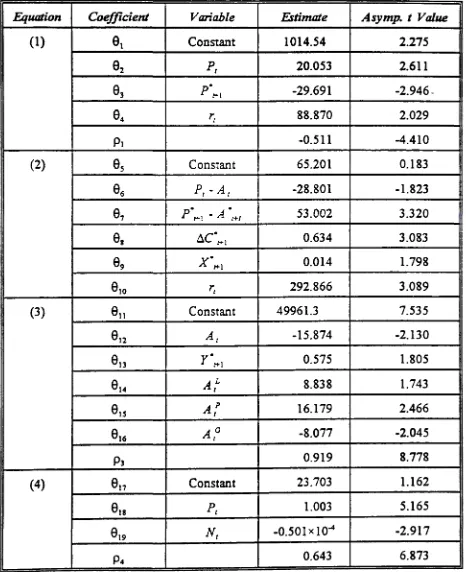
Estimates of the parameters of the model are provided in Table 1, together with their
asymptotic t values. It will be seen that estimates of all 15 structural parameters have the
expected signs and all are significant at the five per cent level (one tail test), thereby
providing strong support for the model specification discussed above. There are, however,
several features of the results for individual equations, which deserve comment. First, the
clear significance of
63
anda,,
the coefficients of the expected futures price and expectedprice spread respectively, appears to provide support for the rational expectations hypothesis
(see also Section V). Moreover, the results for equation (1) support the view that HSS is
essentially a speculative relationship. Similarly, the results for equation (2) suggest that
commitments on the long side of the market are a combination of hedging and speculative
elements, with a strong discretionary component in the hedging activities.
premium in equations (1) and (2) respectively, support an interpretation different from the Kaldor (1953) - Brennan (1958) view of the risk premium. In equation (I) the positive sign
of
6
4 can be explained as follows: an increase in the marginal risk premium cet par will lead
to an increase in the equilibrium futures price, and hence to an increase in the market
commitments of short speculators. In equation (2), an increase in the marginal risk premium cet par will lead to a decrease in the equilibrium price spread, and hence to an increase in the
market commitments of long speculators. These explanations are similar to the '~hedging pressure theory" of Stein (1986, pp. 48-52), although Stein's argument is directed to the effect of a change in the risk premium on price alone.
Thirdly, in equation (3), the consumption relationship, the signs of
6
14 and6
15 areconsistent with a substitution relationship between Iamb and beef and between pork and beef,
respectively. Moreover, the significance
of6
13,e
14 and6
1, suggests that expected realincome and the prices of lamb and pork are parameters of the demand for beef. Moreover,
the negative sign and significance of el6 suggest that live cattle and feed grain are indeed
complementary inputs.
due, in part, to the thinness of the futures market in the latter part of the sample period.
v
POST-SAMPLE S™ULA TION
A more stringent test of model performance is the ability of the model to forecast key
endogenous variables, against pre-determined criteria, outside the sample period, especially
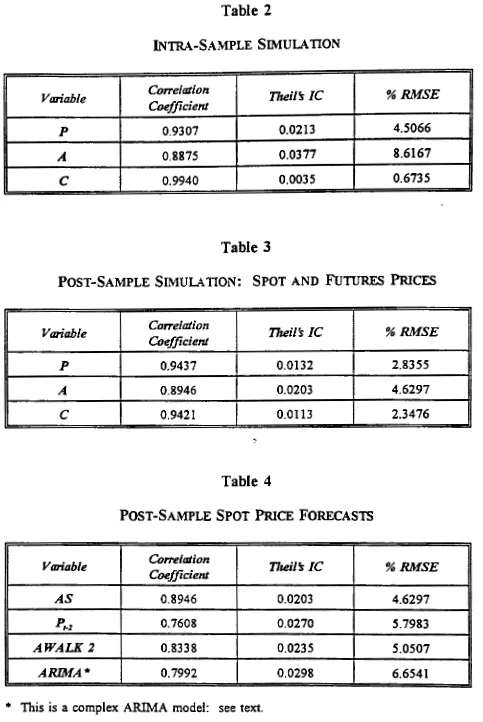
in comparison with alternative forecasts. Table 3 presents an evaluation of (dynamic) two
months ahead forecasts of consumption and the futures and spot prices, for the post-sample
forecast period 1986(03) to 1988(12), comprising 34 monthly observations. Concentrating on
the per cent RMSE criterion, it will be seen first, that the best forecast is again that of
consumption, which has deteriorated compared with the intra-sample forecast, and second that
the better of the two price forecasts is again that of the futures price, and both these price
forecasts have improved significantly compared with intra-sample simulations. This last
outcome with respect to prices provides substantial support for the validity of the model.
The question is then how does the model perform, compared with alternative price
forecasts. Table 4 presents an evaluation of post-sample forecasts of the spot price, two
months ahead, by the model (AS: the same as A in Table 3), compared with three alternative
forecasts. The first alternative forecast is the futures price lagged two months prior to
maturity (
P
1_2), the second is a random walk forecast two months ahead,
7
and the third is
a complex ARIMA model of MA terms with lags of one and five months, and an AR term
with a lag of five months. The two latter forecasts are conventional benchmarks in assessing
the forecasting performance of economic models. Table 4 shows that the model developed
in this paper outperforms all the alternative forecasts of the spot price, according to the per
the random walk (AW ALK 2), however, which is the best of the alternative forecasts, is not
statistically significant, at the five per cent level, according to a test of the type proposed in
Granger and Newbold (1986, pp. 278-79).
Turning to a comparison of the spot price forecasts provided by the model (AS) and
by the lagged futures price ( P
1_2), it should be noted that in executing the model-derived
post-sample forecasts, the parameter estimates of the model were updated by one month
following each forecast. Hence, the model and the futures price were placed alwa~s on the
same informational footing during the post-sample period. While the model outperforms the
futures price in making a two-month ahead forecast of the spot price, according to the per
cent RMSE criterion, again this difference is not significant according to the test employed
above. It must be inferred therefore, that the semi-strong efficient markets hypothesis should
not be rejected, because the model evidently does not contain any publicly available
information, which is not reflected in the futures price (see Leuthold and Hartmann, 1979, and
Leuthold and Garcia, 1991 ). This outcome is consistent with the rational expectations
hypothesis employed above, for this assumption implies that agents know the true economic
model driving returns in practice.
VI
CONCLUSIONS
This paper develops and presents estimates of a simultaneous rational expectations model of
the Australian finished (non-storable) live cattle market, using information from both spot and
futures markets. Published studies of simultaneous rational expectations models of such
markets are extremely rare, and only two countries, Australia and the US, have produced data
Australia is the world's leading beef exporting country. The model developed in this
paper contains functional relationships for short hedgers and short speculators combined (there
is no disaggregation of hedging and speculative positions in Australian market commitments
data), long hedgers and long speculators combined, and consumers. The model contains also
a spot price equation, and is completed with a futures market clearing identity.
Augmented Dickey-Fuller and Phillips-Perron tests for unit roots yield ambiguous
results, and the Phillips-Perron tests, taken as definitive, suggest that spot and futures prices,
consumption of beef, expected real income, the price of pork and the price of grain are I(I ),
all other variables being stationary. Johansen co integration tests suggest that the I(l) variables
in each of the structural equations, are cointegrated; in the case of the long hedging-long
speculation relationship, the first difference of the only 1(1) variable, expected consumption
is employed.
Instruments for expectational variables are obtained as fitted values on the set of
pre-determined variables in the model. The structural equations are estimated by instrumental
variables in the absence of serial correlation of the error term, and by non-linear least squares,
if a correction for serial correlation is necessary.
All parameter estimates have the expected signs, and all are statistically significant at
the five per cent level. The signs and significance of the estimated coefficients of the price
and expected price variables in the combined hedger-speculator relationships for the futures
market, provide support for the rational expectations hypothesis. Moreover, the parameter
estimates for the equation referring to short market commitments suggest that this relationship
is essentially speculative; furthermore, there is support for a rival hypothesis of the risk
premium, of the type discussed by Stein ( 1986, pp. 48-52). Parameter estimates suggest also
that market commitments on the long side of the futures market are predominantly those of
processors. Intra-sample the model simulates the futures price with a per cent R.MSE of 4.5%
and the spot price with per cent RMSE of 8.6%, while for consumption of beef the
corresponding figure is 0. 7%. Post-sample, the forecast errors for futures and spot prices
decline to 2.8% and 4.6% respectively, while that for consumption becomes 2.3%. In
post-sample forecasts of the spot price, the model outperforms rival forecasts such as a random
walk(% RMSE 5.1%), an ARIMA model (6.7%) and a lagged futures price (S.8%), although
none of these differences in per cent RMSE between the model and alternative predictors is
-significant. The result in this last comparison, between the model and the lagged futures
pric,e, implies that the semi-strong efficient markets hypothesis cannot be rejected, for there
is no evidence that the model contains information which is not reflected in the futures price.
This outcome, however, is consistent with the employment of the rational expectations
Endnotes
1. Fuller (1976) has shown that the limit distribution of the t statistic for
y
isindependent of the number of lags of 67.. in the equation.
2. For three variables (A, AG, Y) this rejection is made at the 10 per cent level, using the
most appropriate model from the group (7) - ( 10).
3. The instruments employed for the IV estimation of equation (2) are:
HSL,_
1,HSL,_
2 •4. Tests were executed for the presence of ARCH effects (see Engle 1982, 1983) in this
model. An ARCH (p) process postulates that, conditional on information at time (t-1),
an error term e1 is assumed to be normally distributed with mean zero and variance
'!
Although graphs of the partial autocorrelation functions for the squared residuals
revealed various significant lags for the HSS and HSL equations (only), tests of the
hypothesis H(a.P
=
0) suggested that the coefficients were significant at lags p=
1, 2,3, 4, 5, 7, 8, 9, 10 for HSS only (see Appendix 5, available on request). It is well
known that high order ARCH effects may be represented by a GARCH (1, 1) process
(see Bollerslev, 1986) where
Accordingly, the HSS equation was re-estimated by maximum likelihood, with the
structural parameters have the expected signs, and are significant at the 5% level (see
Appendix 6, available on request), the estimates of et1 and
'3
1 are not significant.These last two estimates suppon the view that the GARCH effects in the HSS
equation are not significant, and therefore the results in Table 1 are retained.
5. The instruments for the IV estimation of equation (4) are:
6. Theil's inequality coefficient and per cent RMSE are defined in Pindyck and Rubinfeld
(1981, pp. 362, 364).
7. Random walk forecasts of the spot pnce two months ahead were obtained by
estimating the following model by IvfL: Ar = ~A
1
_2
wherep
is a parameter to beestimated. From these estimates fitted vales
At
were obtained, which acted asTable 1
PARAMETER ESTIMATES
Equation CoefficienJ Variable Ettimate Asymp. t Value
(1)
01
Constant 1014.54 2.27502
pt 20.053 2.61103
p•t+I -29.691-2.946-e4
rr 88.870 2.029P1
-0.511 -4.410(2)
es
Constant 65.201 0.183e6
P1 -At -28.801 -1.823e,
p·/+I - A .t+I 53.002 3.32098
~c·t+I 0.634 3.083e9
x•t+I 0.014 1.798910
rt 292.866 3.089(3)
011
Constant 49961.3 7.535e12
At -15.874 -2.130e13
y•t+I 0.575 1.805el4
AL t 8.838 1.743015
AP
t 16.179 2.466016
AG t -8.077 -2.045p3
0.919 8.778(4)
017
Constant 23.703 1.162018
P, 1.003 5.165619
Nt -0.50Ixl04 -2.917Table 2
INTRA-SAMPLE Sll\1ULA TION
Variable Co"e/ation
Coefficient Theil's IC
%RMSE
p 0.9307 0.0213 4.5066
A 0.8875 0.0377 8.6167
c
0.9940 0.0035 0.6735Table 3
POST-SAMPLE SIMULATION: SPOT AND FUTURES PRICES
Variable Co"elation
Coefficient Theil's IC %RMSE
p 0.9437 0.0132 2.8355
A 0.8946 0.0203 4.6297
c
0.9421 0.0113 2.3476Table 4
POST-SAMPLE SPOT
PRICE
FORECASTSVariable Co"e/ation Tlieil's IC %RMSE Coefficient
AS 0.8946 0.0203 4.6297
P,.z
0.7608 0.0270 5.7983AWALK 2 0.8338 0.0235 5.0507
ARIMA* 0.7992 0.0298 6.6541
REFEREN CFS
ABARE (Australian Bureau of Agricultural and Resource Economics) (1993).
Commodity StaJistical Bulletin, Canberra.
Banerjee, A., J.J. Dolado, J.W. Galbraith & D.F. Hendry (1993). Co-Integration, Error
Correction, and the Econometric Analysis of Non-Stationary Data, Oxfor~ Oxford
University Press.
-Blume, L.E., M.M. Bray & D. Easley (1982). "Introduction to the stability of rational
expectations equilibrium", Journal of Economic Theory, 26: 313-17.
Bollerslev, T. (1986). "Generalized autoregressive conditional heteroskedasticity", Journal
of Econometrics, 31: 307-27.
Bray, M.M. & N.E. Savin (1986). "Rational expectations equilibria, learning and model
specification", Econometrica, 54( 5): 1129-60.
Brennan, M.J. (1958). "The supply of storage", American Economic Review, 48: 50-72.
Cumby, R.E., J. Huizinga & M. Obstfeld (I 983 ). "Two-step two-stage least squares
estimation in models with rational expectations", Journal of Econometrics, 21:
333-55.
Dewbre, J.H. (1981). "Interrelationships between spot and futures markets: some
implications of rational expectations", American Journal of Agricultural
Economics, 63: 926-33.
Dickey, D.A. & W.A. Fuller (1979). "Distribution of the estimators for autoregressive
time series with a unit root", Journal of the American Statistical Association, 74:
327-31.
Dickey, D.A. & W.A. Fuller (1981). "Likelihood ratio statistics for autoregressive time
Engle, R.F. (1982). "Autoregressive conditional heteroskedasticity with estimates of the
variance of U.K. inflation". Econometrica, 50: 987-1008.
Engle, R.F. ( 1983 ). "Estimates of the variance of U.S. inflation based on the ARCH
model", Journal of Money Credit and Banking, 15: 286-301.
Engle, R.F. & C.W.J. Granger (1987). "Co-integration and error correction:
representation, estimation and testing", Econometrica, SS: 251-76.
Evans, G.B.A. & N.E. Savin (1981). "Testing for unit roots: I", Econometrica, 49:
753-79.
Evans, G.B.A. & N.E. Savin (1984). "Testing for unit roots: 2", Econometrica, 52:
1241-68.
Fama, E.F. (1970). "Efficient capital markets: a review of theory and empirical work",
Journal of Finance, 25: 383-417.
Flood, R.P. & P.M. Garber (1980). "A pitfall in estimation of models with rational
expectations", Journal of Monetary Economics, 6: 433-35.
Friedman, D .• G.W. Harrison & J.W. Salmon (1983). "The informational role of futures
markets: some experimental evidence", Chapter 6 in Futures Mancets: Modelling,
Managing and Monitoring Futures Trading, ed. M.E. Streit, Oxford: Basil
Blackwell.
Frydman, R. (1983). "Individual rationality, decentralization and the rational expectations
hypothesis", Chapter 5 in R. Frydman and E.S. Phelps (eds), Individual
Forecasting and Aggregate Outcomes, Cambridge.: Cambridge University Press.
Fuller, W.A. (I 976). Introduction to Statistical Time Series, New York: Wiley.
Giles, D.E.A. & B.A. Goss ( 1981 ). "Futures prices as forecasts of commodity spot prices:
live cattle and wool", Australian Journal of Agricultural Economics, 25(1): 1-13.
soybeans markets with rational expectations", American Joumal of Agricultural
Economics, 67: 749-760.
Goss, B.A. (1972). The Theory of Futures Trading, London: Routledge and Kegan Paul.
Goss, B.A. (1991) (ed.). Rational Expectations and Efficiency in Futures Markets,
London: Routledge.
Goss, B.A., S.G. Avsar & S-C. Chan (1992). "Rational expectations and pnce determination in the U.S. oats market", Economic Record, Special Issue on Futures
Markets, 16-26.
Granger, C.W.J. & P. Newbold (1986). Forecasting Economic Time Series, second ed., London: Academic Press.
Hall, B.H., C. Cummins & R. Schnake (1993). Time Series Processor Version 4.2
Reference Manual, California: Stanford.
Hall, R.E., D.M. Lilien & J. Johnston (1994). "Econometric Views-Micro TSP", User's
Guide, Version 1.0, California, Irvine.
Harrison, G.W. (1992). "Market dynamics, programmed traders and futures markets:
beginning the laboratory search for a smoking gun", Economic Record, Special
Issue on Futures Markets, 46-62.
Johansen, S. (1988). "Statistical analysis of cointegration vectors", Joumal of Economic
Dynamics and Control, 12, 231-54.
Johansen, S. & K. Juselius (1990). "Maximum likelihood estimation and inference on cointegration - with applications to the demand for money", Ox/ ord Bulletin of
Economics and Statistics, 52: 169-210.
Just, R.E. & G. C. Rausser ( 1981 ). "Commodity pnce forecasting with large-scale econometric models and the futures market", American Journal of Agricultural
Kaldor, N. (l 961 ). "Speculation and economic stability", in Essays on Economic Stability
and Growth, London: Duckworth, 17-58.
Kawai, M. (1983). "Spot and futures prices of nonstorable commodities under rational
expectations", Quarterly Joumal of Economics, 97: 235-54.
Keynes, J.M. (1930). A Treatise on Money, Volume 2, London, Macmillan.
Leuthold, R.M. (1972). "Random walks and price trends: the live cattle futures market",
Joumal of Finance, 27: 879-89.
-Leuthold, R.M. (1974). "The price performance on the futures market of a nonstorable
commodity: live beef cattle", American Journal of Agricultural Economics, 56(2):
313-24.
Leuthold, R.M. & P. Garcia (1991). "Assessing market performance: an examination of
livestock futures markets", Chapter 3 in Goss (1991).
Leuthold, R.M. & P.A. Hartmann (1979). "A semi-strong form evaluation of the
efficiency of the hog futures market", American Journal of Agricultural
Economics, 61(3): 482-9.
McCallum, B.T. (1979). "Topics concerning the formulation, estimation and use of
macroeconomic models with rational expectations", Proceedings of the Business
and Economic Statistics Section, pp.65-72, Washington D.C.: American Statistical
Association.
MacKinnon, J.G. (1991). "Critical values for cointegration tests", in R.F. Engle & C.W.J.
Granger (eds), Long-Run Economic Relationships: Readings in Cointegration,
Oxford: Oxford University Press, 267-76.
Maddock, R. & M. Carter (1982). "A child's guide to rational expectations", Journal of
Economic
Literature, 20: 39-51.Oxford: Basil Blackwell.
Muth, J. ( 1961 ). "Rational expectations and the theory of pnce movements",
Econometrica, 29: 315-35.
Pesaran, M.H. (1987). The Limits to Rational Expectations, Oxford: Basil Blackwell,
(corrected ed. 1989).
Peston, M.H. & B.S. Yamey (1960). "Intertemporal price relationships with forward
. . -:~ .
markets: a method of analysis\ Economica, 27: 355-367.
-Phillips, P.C.B. & P. Perron (1988). "Testing for a unit root in time series regression",
Biometrika, 15, 335-46.
Pindyck, R.S. & D.L. Rubinfeld (1981 ). Econometric Models and Economic Forecasts,
2nd ed., Singapore: McGraw-Hill.
Plott, C.R. & S. Sunder (1982). "Efficiency of experimental security markets with insider information: an application of rational expectations models", Joumal of Political
Economy, 90(4): 663-98.
Said, S.E. & D.A. Dickey (1984). "Testing for unit roots in autoregressive-moving
average models of unknown order", Biometrika, 71(3): 599-607.
Sheffrin, S.M. (1985). Rational Expectations, Cambridge: Cambridge University Press.
Stein, J.L. ( 1961 ). "The simultaneous determination of spot and futures prices", American
Economic Review, 51(5): 1012-25.
Stein, J.L. (1986). The Economics of Futures Markets, Oxford: Basil Blackwell.
Stein, J.L. (1991). International Financial Markets: Integration, Efficiency and
Expectations, Oxford: Blackwell.
Working, H. (1953). "Futures trading and hedging", American Economic Review, 43:
313-343.
Economic Review, June, 52: 431-59.
Wymer, C.R. ( 1977). "Computer programs: TRAN SF manual", Washington DC,
Appendix 1
UNIT ROOT TESTS:
ADF
Calculated
ADF 5% Critical 10% Critical Integration Variable Mode/ Statistic Value Value Order
p 9 -3.8095 -3.4527 -3.1516 1(0)
A
9 -3.3090 -3.4527 -3.1516 1(0)_HSS (=HSL) 9 -4.7421 -3.4527 -3.1516 I(O)
c
9 -1.8444 -3.4527 -3.1516 I(l)(P-A) 7 -3.1357 -2.8889 -2.5812 I(O)
x
8 -3.6586 -2.8892 -2.5813 I(O)y 9 -3.3182 -3.4527 -3.1516 I(O)
r 10 -5.2094 -3.4531 -3.1519 I(O)
AL
7 -5.1816 -2.8889 -2.5812 1(0)AP
8 -2.1550 -2.8892 -2.5813 I(l)N 7 -3.7352 -2.8889 -2.5812 I(O)
Variable p
A
HSS=HSLc
P-Ax
y rAL
AP
NAG
Appendix 2
UNIT ROOT
TESTS:
PHILLIPS-PERRONCalculated Test Statistic -12.1685 -12.5246 -50.0937 -4.1430 -21.3211
-24.7376
-6.0129
-27.7743
-19.2625
-7.6167
-26.8484
-6.0061
Probability of
Rejection
.3073
.2892
.0095 x
io
-
2Equation (1) (3) (4) Equation (3)
Appendix 3
JoHANSEN COINTEGRATION PROCEDURE: TRACE TEST
Variables
Ct, At,
~•l'
Af' AtG
Calculated Test Statistic 8.9470 5.4694 9.5650Appendix 4
Probability of Rejection
.0022
.0174
.0015
No. of Co integrating
Vectors: m
m
~ 1m ~4
m ~ 1
JoHANSEN COINTEGRA TION PROCEDURE: /..., MAX TEST
Calculated 5% Critical No. of
Variables
Test Statistic Value Cointegrating
Vectors: m
106.3510 77.74 in= 0
A 66.1917 54.64 m ~ 1
Ct, At,
Y,.1,
41.7918 34.55 m ~2
p G
At 'At
21.8950 18.17 m ~3