Available Online atwww.ijcsmc.com
International Journal of Computer Science and Mobile Computing
A Monthly Journal of Computer Science and Information Technology
ISSN 2320–088X
IJCSMC, Vol. 4, Issue. 5, May 2015, pg.819 – 824
RESEARCH ARTICLE
Development of Framework for Steady State Visually
Evoked Potentials in Brain Computer Interface
Chetan Bondre
1, Deepak Kapgate
2 1Department of Computer Science & Engineering, G.H.R.A.E.T, Nagpur University, India
2 Department of Computer Science & Engineering, G.H.R.A.E.T, Nagpur University, India 1 [email protected]@gmail.com; 2 [email protected]
Abstract— In this paper we discuss to development of the steady state evoked potentials (SSVEP) framework using electroencephalogram (EEG) signals. The main idea is to capture the signals from the brain for SSVEP application and after processing signals desired output can get. The information transfer rate(ITR) is to be increased using efficient filtering and classification algorithms such as Common spatial filter(CSP) and k-fold cross validation test. This study introduces a technique for classifying different frequencies separately so that accuracy is high. ITR is dependent upon accuracy, the more the accuracy more ITR can get.ITR can be calculated by the Wolpaw’s Method. The focus of this paper is proposing the development of framework that can capture the EEG signals classify them in the SSVEP signals. These SSVEP signals then are used to train the user and application can be used by will of the user.
Keywords— Brain Computer Interface (BCI), Electroencephalogram (EEG), Steady state visually evoked Potentials(SSVEP), Information Transfer Rate(ITR).
I. INTRODUCTION
BCI uses very uncommon way of communication with the system and brain. Though it is uncommon it is the most direct way as the intentions are directly sent to the computer. With a BCI person such as subjects ideally do not need to use common output pathways of peripheral nerves or muscles, which is the main function of a BCI system. Cerebro-electrical brainwaves are measured with the electroencephalography (EEG), which is used to have primarily used for clinical purposes in the past, with amplification and fed into a system under certain circumstances and with proper algorithms able to process them satisfy application needs[19].
BCI can be classified in two categories by input system; those two categories are synchronous and asynchronous BCI. In synchronous BCI there is a predefined window is given in the system for a time variant. If there is any signal is generated outside that time window it is ignored by the system. This means that the user must use application in a specific time window which is specified by the BCI system. There are lots of advantages for the synchronous BCI, as only predefined signals are allowed in the system no other artifacts can be generated because of the user’s fault. This makes the system more reliable and simple.
There are two types of headsets can be used for the collection of the data. They are 10-10 and 10-20. The difference between two headsets is according to their separation of the electrodes. Electrodes in 10-10 system are having distance among them as that of 10% of the total headset while 10-20 system is having distance between electrodes as 10% for boundary electrodes and 20% for other electrodes of the headset. There are total 18-21 electrodes in 10-20 system while 31-38 electrodes in 10-10 system. In 10-20 system we use less power than that of 10-10 system because of numbers of electrodes. Complexity in 10-10 system is more compared to 10-20 system and most of the electrodes in 10-10 systems are covered by electrodes of 10-20 system, because of these attributes generally most of the experiments are done with 10-20 system[6][8].
Fig.1 10-20 and 10-10 EEG headset
SSVEP-BCI offers the classification of a large number of symbols simultaneously and hence we can say that SSVEP BCI is multiclass in nature and provides high performance. Visual evoked potentials (VEPs) are electrical potential differences; those can be derived from the scalps after a visual stimulus, for example a flash-light[28].
There is a very high possibility of information transfer rate with minimal training time to the subject and very low requirements in SSVEP base BCI. Secondly if the system is carefully designed then it can be relatively robust with respect to noise and artifacts. The very important advantage is that we can easily extend the commands of the system because of the input process and short timing phase. The aim is to detect the reliably of frequency with the high accuracy. Furthermore the aim is to detect when the frequency do not appear, hence when the person or subject does not look at the stimulus.
OvenVibe is a software which is used to interface between the computer and EEG capturing device. We have used Openvibe to capture and store the EEG signals. These signals are processed by the framework and then final application can be run after the training is provided to the subject. We have used different modules to create the framework for example configuration of signals, training, classification and final application.
II. THEORETICAL BACKGROUND
Information Transfer Rate: BCI performance might affected by two important task parameters. First is the number of targets. A large no. of targets may increase system performance, as more targets provide more information. Alternatively, a greater no. of targets may decrease system performance by decreasing its accuracy. The other is the rapidity of frequency change. Because of this user may feel tired after continuously watching at the screen.
Jonathon Wolpaw proposed a formula to calculate the ITR
(1)
where N is the no. of possible targets. P is the probability that the target hit (accuracy). Bit rate can be calculated by dividing S by the trial .
In case of this project N=3. Accuracy and S is varying.
K-fold Cross Validation Test : k-fold cross validation is a common technique for estimating the performance of a classifier. , a single run of k-fold cross validation proceeds as follows:
1. Arrange the training examples in a random order.
2. Divide the training examples into k folds. (k chunks of approximately m/k examples each.) 3. For i = 1, . . . , k:
• Train the classifier using all the examples that do not belong to Fold i. • Test the classifier on all the examples in Fold i.
• Compute ni , the number of examples in Fold i that were wrongly classified. 4. Return the following estimate to the classifier error:
III.PROPOSED SYSTEM
The Project is developed in OpenVibe software. The EEG signals are captured by the OpenBCI headset V-3 32 bit kit. There are different modules say scenarios are used in the system are Acquisition of signals, Training to user, CSP filtering and Classification, Online testing.
Acquisition of signals and configuration: Signals are tested in this module. Continuity of signals and quality of signals are checked using this module. We can check individual signals using this module.
Figure 2. Signal Display of various electrode positions on brain.
This module contains FFT of average of all the signals and various boxes like acquisition client, temporal filter spatial filter for averaging, spectral analysis and signal display.
Configuration of the framework is can configure SSVEP experiment. There are two boxes of configuration parameters for peripheral and experimental settings. These settings are for stimulus and refresh rate of the screen.
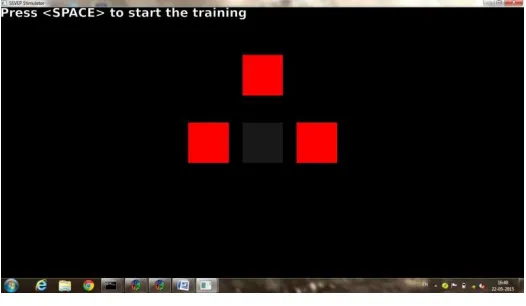
Training of user: This SSVEP module uses Common Spatial Pattern (CSP) spatial filter which automatically selects the best characteristics. This means that user can place the electrodes on the occipital area’s any part of the scalp. This module is used for acquisition of the training data necessary to train the SSVEP classifiers. In order to run correctly it has to be configured by the SSVEP Training Controller. Boxes used in this module are SSVEP training controller, stimulation control, acquisition client, and stream writer to write the data captured by the headset.
Figure 3. Flickering Stimuli for training the user.
processing is done on 3 different stimulation frequencies separately. Boxes used in the module are temporal filter, stimulation based epoching CSP spatial filter training, player controller and generic stream reader which loads the data written in previous module. Classification process contains boxes as generic stream reader, spatial filter, Target stimulator for different frequencies, time based epoching, DSP, Signal Average and classifier trainer. This module calculates the accuracy of the system which is useful for the calculation of ITR.
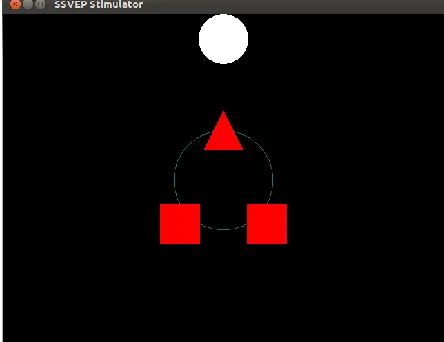
Online Testing: This module is used for the online testing of the framework. The trained data is used for scenario control of the system. This is in form of a game in which a ship is designed. It is having two wings which are flickering in two different frequencies which are used to rotate the ship in clockwise or anticlockwise. It also has a cannon which is used to fire the target. The cannon flicker with different frequency with respect to the two wings. The ship works in a way user concentrates on the flickering stimuli. This scenario contains boxes as SSVEP shooter controller, Scenario control, Button simplifier, player controller, Stimulator control, Spatial filter for three different frequencies, Time based epoching, Simple DSP, Signal average, Feature aggregator, classifier processor,SSVEp voter , VRPN ship control and Acquisition client.
Figure 4. SSVEP stimulator online game
IV.RESULTS
After running all the modules explained above we get the accuracy ranging from 78% to 92%. Which leads to calculation of ITR.ITR is calculated manually and we get it from 24 bits/min to 40 bits/min with the feedback. The signals captured from the EEG headset are unstable with the software we used but most of the times signals captured were continuous and having great quality. The SSVEP stimulation is an online shoot game which is use for the testing of the system. It is running accurately with OpenBCI headsets. If user concentrates at right wing the ship rotates in clockwise direction. If user concentrates at right wing the ship rotates in anticlockwise direction. If user concentrates at cannon ship fires. After one target is vanished other target appears. There are total 8 targets to be vanish to finish the game.
V. CONCLUSIONS
In BCI mostly there is preference to the SSVEP system. As it is Exogenous BCI and it requires very low training to use, it is possible for user to perform actions on the system by their convenience. Furthermore SSVEP gives high information transfer rate so it is possible to use in real life also. Control signals can set up very easily so it is possible to use many options in one system using SSVEP. In this project ITR is increased then many of other frameworks used in past.
References
[1] G. Bin, X. Gao, B. Hong, Z. Yan and S. Gao, “An online multi-channel SSVEP-based brain-computer interface using a canonical correlation analysis method,” Journal of Neural Engineering, vol. 6, no. 4, Article ID 046002, 2009.
[2] Xin-an Fan, Ke Jie, Teng Teng, Hongsheng Ding, and Yili Liu, “Using a Head-up Display-Based Steady-State Visually Evoked Potential Brain–Computer Interface to Control a Simulated Vehicle,” IEEE Trans.
Human Mach. Syst., vol. 43, no. 2, pp. 161–176VOL. 15, NO. 3, JUNE 2014
[3] Muller, S.M.T.”Using a SSVEP-BCI to command a robotic wheelchair” ; Comput. Eng. Dept., Fed. Univ. of Espirito Santo UFES , S o Mateus, Brazil, Industrial Electronics (ISIE), 2011 IEEE International Symposium on27-30 June 2011
[4] S. G. Mason and G. E. Birch, “A general framework for brain-computer interface design,” IEEE Trans. Neural Syst. Rehabil. Eng., 11: 70-85, 2003.
[5] Y. J. Wang, R. P. Wang, X. R. Gao, B. Hong and S. K. Gao, “A practical VEP-based brain-computer interface,” IEEE Trans. Neural Syst. Rehabil. Eng., 14: 234-239, 2006.
[6] G. Y. Bin, X. R. Gao, Z. Yan, B. Hong and S. K. Gao, “An online multi-channel SSVEP-based brain-computer interface using a canonical correlation analysis method,” J. Neural. Eng., 6: 046002, 2009.
[7] P.L. Lee, J. J. Sie, Y. J. Liu, C. H. Wu, M. H. Lee, C. H. Shu, P. H. Li, C. W. Sun and K. K. Shyu, “An
SSVEP-actuated brain computer interface using phase-tagged flickering sequences: a cursor system,” Ann. Biomed. Eng., 38: 2383-2397, 2010.
[8] Z. D. Deng, X. Q. Li, K. H. Zheng and W. T. Yao, “A humanoid robot control system with SSVEP-based
asynchronous brain-computer interface,” Jiqiren/Robot, 33: 129-135, 2011.
[9] G. Garcia-Molina, D. H. Zhu and S. Abtahi, “Phase detection in a visual-evoked-potential based brain computer
interface,” Proc.18thEuropean Signal Processing Conf., 949-953, 2010.
[10]Minkyu Ahn, Mijin Lee, Jinyoung Choi and Sung Chan Jun, “A Review of Brain-Computer Interface Games and an Opinion Survey from Researchers, Developers and Users”, Sensors 2014.
[11]Yijun Wang, Zhiguang Zhang, Xiaorong Gao, Shangkai Gao,” Lead selection for SSVEP-based brain-computer interface”, Proceedings of the 26th Annual International Conference of the IEEE EMBS San Francisco, CA, USA • September 1-5, 2004
[12]Hartwig Holzapfel, Kai Nickel, Rainer Stiefelhagen,” Implementation and Evaluation of a ConstraintBased
Multimodal Fusion System for Speech and 3D Pointing Gestures” Interactive Systems Laboratories Universität Karlsruhe (TH) Germany, German Research Foundation,2004
[13] Alexandre Barachant, St´ephane Bonnet, “Channel Selection Procedure using Riemannian distance for BCI Applications” MINATEC Campus December 17, 2010.
[14]Shangkai Gao, Yijun Wang, Xiaorong Gao, Bo Hong Members, IEEE” Visual and Auditory
Brain-Computer Interfaces” September 23, 2013
[15]Pierre Gergondet, Abderrahmane Kheddar, Christoph Hinterm•uller, Christoph Guger, and Mel Slate “Multitask Humanoid Control with a Brain-Computer Interface: user experiment with HRP-2” European Union FP7 Integrated Project VERE
[16]Bakkama Srinath Reddy, “Evidential Reasoning for Multimodal Fusion in Human Computer Interaction” thesis Master of Applied Science Waterloo, Ontario, Canada, 2007
[17]Sylvain Le Groux, Jonatas Manzolli, Paul F.M.J Verschure, “Disembodied and Collaborative Musical Interaction in the Multimodal Brain Orchestra” SPECS, Universitat Pompeu Fabra, Barcelona, Spain
[18]Nataliya Kos’myna, Franck Tarpin-Bernard,” Evaluation and Comparison of a Multimodal Combination of
BCI Paradigms with Consumer-Grade Hardware and Eye Tracking” CHI’13, April 27 – May 2, 2013, Paris, France.
[19]Luis Fernando Nicolas-Alonsoand Jaime Gomez-Gil “Brain Computer Interfaces, a Review” Sensors 2012,
12, 1211-1279; doi:10.3390/s120201211
[20]Danhua Zhu,Jordi Bieger, Gary GarciaMolina, and RonaldM. Aarts” A Survey of StimulationMethods Used in SSVEP-Based BCIs” Hindawi Publishing Corporation Computational Intelligence and Neuroscience Volume 2010, Article ID 702357, 12 pages
[21]Setare Amiri, Reza Fazel-Rezai, and Vahid Asadpour, “A Review of Hybrid Brain-Computer Interface Systems” Hindawi Publishing Corporation Advances in Human-Computer Interaction Volume 2013, Article ID 187024,
[22]Rajesh Singla and Haseena B. A.,” Comparison of SSVEP Signal Classification Techniques Using SVM
[23]Quan Liu, Kun Chen, Qingsong Ai, Sheng Quan Xie “Review: Recent Development of Signal Processing Algorithms for SSVEP-based Brain Computer Interfaces” Journal of Medical and Biological
Engineering, 34(4): 299-309 12 Aug 2013; doi: 10.5405/jmbe.1522
[24]Josef Faller Gernot Mu¨ ller-Putz, Dieter Schmalstieg, Gert Pfurtscheller,” An Application Framework for Controlling an Avatar in a Desktop-Based Virtual Environment via a Software SSVEP Brain–Computer Interface” Presence, Vol. 19, No. 1, February 2010, 25–34
[25]M. Byczuk, P. Poryzała, and A. Materka,” SSVEP-Based Brain-Computer Interface: On the Effect of Stimulus Parameters on VEPs Spectral Characteristics” Springer-Verlag Berlin Heidelberg 2012
[26]Pablo Martinez, Hovagim Bakardjian, and Andrzej Cichocki,” Research Article Fully Online
Multicommand Brain-Computer Interface with Visual Neurofeedback Using SSVEP Paradigm” Hindawi Publishing Corporation Computational Intelligence and Neuroscience Volume 2007, Article ID 94561 [27]Robert Prueckl, Christoph Guger,” A Brain-Computer Interface Based on Steady State Visual Evoked
Potentials for Controlling a Robot” g.tec, Guger Technologies OEG, Sierningstr. 14, 4521 Schiedlberg, Austria
[28]Seyed Navid Resalat, Seyed Kamaledin Setarehdan, ”An Improved SSVEP Based BCI System Using Frequency Domain Feature Classification” American Journal of Biomedical Engineering 2013, 3(1): 1-8 DOI: 10.5923/j.ajbe.20130301.01
[29]Mary K. Reagor, Chengzhi Zong, IEEE Student Member and Roozbeh Jafari, Senior IEEE Member”Maximizing Information Transfer rates on SSVEP based BCI using individual Bayesian Probability Measures”