Available online: https://journals.pen2print.org/index.php/ijr/ P a g e | 1
Providing Security Using CAPTCHA: Captcha as A
Graphical Password
Mr. Eswaraiah Puttu & Murahari Bhagyaraj#1
Associate Professor,Dept of CSE, PBR Visvodaya Institute Of Technology
And Science,Kavali,India
#2
Studnet,Dept of Master of Computer Application (MCA), PBR Visvodaya
Institute Of Technology And Science ,Kavali,India
ABSTRACT: Various security primitives uses hard mathematical problems. Use of hard AI problems for security is emerging and exciting new pattern, but has not yet been explored. In our project, we present a new security primitive based on hard AI problems, this system is named as Captcha as graphical passwords (CaRP). CaRP is Captcha as well as graphical password scheme. CaRP symbolize a number of security problems together, such as online guessing attacks, relay attacks, and shoulder-surfing attacks. Generally, a CaRP password can be found only probabilistically by automatic online guessing attacks even if the password is in the search set CaRP also offers well approach to address the well-known image hotspot problem in popular graphical password systems, like PassPoints, that generally leads to choices of weak password.
KEYWORDS: Imaged based
CAPTCHA, Graphical CAPTCHA, Authentication, CAPTCHA, Passwords, Graphical Passwords, Security Attacks, Hard AI problem, Click based CAPTCHA, CaRP, Password Guessing Attacks, Security Primitives, etc.
I.INTRODUCTION
Available online: https://journals.pen2print.org/index.php/ijr/ P a g e | 2
authentication based upon username and passwords.
CAPTCHA (Completely Automated Public Turing test to tell Computers and Humans Apart), also known as Human Interactive Proof (HIP), is an automated Turing test in which both generation of challenges and grading of responses are performed by computer programs. CAPTCHAs are based on Artificial Intelligence (AI) problems that cannot be solved by current computer programs or bots, but are easily solvable by humans. A client who provides a correct response to a challenge is presumed to be a human; otherwise a bot. CAPTCHAs have been widely used as a security measure to restrict access from bot. As per Bin B. Zhu present a security analysis of the representative schemes we have identified. For the schemes that remain unbroken, he present our novel attacks. For the schemes for which known attacks are available,
Here propose a theoretical explanation why those schemes have failed. Next, he provide a simple but novel framework for guiding the design of robust IRCs. Then he propose an innovative IRC called Cortcha that is scalable to meet the requirements of large-scale applications. Cortcha relies on recognizing an object by exploiting its surrounding context, a task that humans can perform well but computers cannot. Cortcha’s speed is not a satisfied one, and it does not have large-scale usability.
In Paul Dunphy’s paper he investigate the novel idea of introducing back-ground images to the DAS scheme, where users were initially supposed to draw passwords on a blank canvas
Available online: https://journals.pen2print.org/index.php/ijr/ P a g e | 3
user feedback, it was found that the choice-based method performed better. CCP addresses the ‘Passpoints’ problem by letting users to click once on a series of images with the current click determines the next images. In this Appropriate evaluation in terms of usability and security will then be conducted in order to validate the enhanced scheme. On the other in Philippe Golle’s described an ac-curate in telling apart the images of cats and dogs used in Asirra. This classi er is a combination of support vector machine classi ers trained on color and texture features extracted from images. Asirra to be deployed in a way that maintains an appealing balance between usability and security. One contribution of our work is to inform the choice of safeguard parameters in Asirra deployments.
Several techniques have been developed that help to protect transactions performed over insecure terminals. TAN codes, security tokens, and smart cards prevent an attacker who obtained the user’s password from signing transactions under the user’s identity. As per Guenther Starnberger’s paper, it contributes with the TAN authentication technique. QR-TANs are a transaction authentication technique based on two-dimensional barcodes. Compared to other established techniques, QR-TANs show three advantages: First, QR-TANs allow the user to directly validate the content of a transaction within a trusted device. Second, validation is secure even if an attacker manages to gain full control over a user’s computer. Finally, QR-TANs in combination with smart cards can also be utilized for offline transactions that do not require any server. QR-TANs allow for
Available online: https://journals.pen2print.org/index.php/ijr/ P a g e | 4
than the traditional alphanumeric passwords as memorization of pictures is easier than words. So other systems which we have discussed have been developed to overcome the problems of predefined regions, predictable patterns and password attacks, a new method called Cued Click Points (CCP) is a proposed as an alternative to PassPoints. In addition selection of the sound signature can be done corresponding to each click point which can be used by the user in recalling the click point on an image. In the CCP technique the users are required to remember only one point in one image and the next image is displayed only when the user clicks on the click point of previous image correctly. A graphical password system with a supportive sound signature is much more helpful as it helps to increase the remembrance of the password and has shown very good performance.
In our proposed system, a new security primitive relying on unsolved hard AI problems. CaRP is both a Captcha and a graphical password scheme. The notion of CaRP introduces a new family of graphical passwords, which adopts a new approach to counter online guessing attacks: a new CaRP image, which is also a Captcha challenge, is used for every login attempt to make trials of an online guessing attack computationally independent of each other. A password of CaRP can be found only probabilistically by automatic online guessing attacks including brute force attacks, a desired security property that other graphical password schemes lack. Hotspots in CaRP images can no longer be exploited to mount automatic online guessing attacks, an inherent vulnerability
in many graphical password systems. CaRP forces adversaries to resort to significantly less efficient and much more costly human-based attacks. In addition to offering protection from online guessing attacks, CaRP is also resistant to Captcha relay attacks, and, if combined with dual-view technologies, shoulder-surfing attacks. CaRP can also help reduce spam emails sent from a Web email service.
2.Background
2.1 Graphical password
A Graphical Password system [2] is of three types as:
1. Recognition Based scheme
2.Recall Based scheme
3.Cued Recall Based scheme
2.1.1 Recognition Based scheme
Available online: https://journals.pen2print.org/index.php/ijr/ P a g e | 5
the image is the portfolio, or right otherwise.
2.1.2 Recall Based scheme
In recall based scheme user has to regenerate the same interaction result without cuing. Draw-A-Secret is the well known scheme. A 2D grid is provided to draw a password. The system encodes the sequence of grid cells along the drawing path. Pass-Go [ 5] is another integrated
version of DAS where grid intersections are encoded instead of grid cells.
2.1.3 Cued Recall Based scheme
Pass Points is a click based cued recall scheme where a user requires clicking a sequence of points anywhere on an image to create a password. At the time of authentication user require to click at the same points as the password. Cued
Click Points (CCP) [9] is another scheme where one image per click is used. Persuasive Cued Click Points (PCCP) extends CCP where user has to select a point inside a randomly positioned viewport.
2.2 Captcha
Captcha is the abbreviation for “Completely Automated Public Turing Test to tell Computers and Human Apart”. Captcha finds the difference between humans and bots in solving the hard AI problems. It is a test to check user is Human and not a computer device .Captcha is of two types: Text Captcha which is recognition of non-character objects and Image Recognition Captcha relies on recognition of images [3] .
2.2.1 Text Captcha
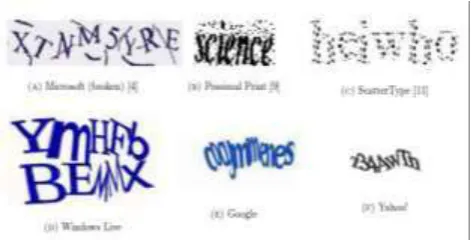
PayPal and Microsoft Captcha are both relied on background noise and random character strings to resist automated attacks. . The Captchas used by Google ,Yahoo! all share similar properties: such
as a lack of background noise, distortion of characters or word images and extreme crowding of adjacent character. The human readability of random Captcha images is captured by site in the form of pixel, marginal probabilities and site by site covariance [3]. EZ-Gimpy uses word images which employ character distortion and clutter. Pessimal Print uses a low quality images by degrading parameters to thicken, crowd, fragment and add noise to character images. These Captchas are shown in Fig.1
Fig. 1 Captcha examples
Available online: https://journals.pen2print.org/index.php/ijr/ P a g e | 6
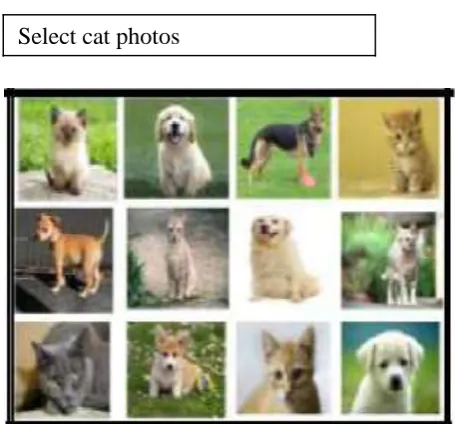
These Captcha consist of combination of images [6]. User has to recognize the images given to him to solve the given puzzle. As shown in Fig. 2 user has to select the cat images as the password characters.
Select cat photos
Fig 2. Image Based Captcha
3. METHODOLOGIES
A new paradigm has achieved just a limited success as compared with the cryptographic primitives based on hard math problems and their wide applications. Is it possible to create any new security primitive based on hard AI problems. This is a challenging and interesting open prob-lem. In this paper, we introduce a new security primitive based on hard AI problems, namely, a novel family of graphical pass-word systems integrating Captcha technology, which we call CaRP(Captcha as graphical Passwords). CaRP is click-based graphical passwords, where a sequence of clicks on an image is used to derive a password. Unlike other click-based graphical passwords, images used in CaRP are Captcha challenges, and a new CaRP image is generated for every
login attempt. The notion of CaRP is simple but generic. CaRP can have multiple instantiations. In theory, any Captcha scheme relying on multiple object classification can be converted to a CaRP scheme. We present exemplary CaRPs built on both text Captcha and image-recognition Captcha. One of them is a text CaRP wherein a password is a sequence of characters like a text password, but entered by clicking the right character sequence on CaRP images. CaRP offers protection against online dictionary attacks on passwords, which have been for long time a major security threat for various online services. This threat is widespread and considered as a top cyber security risk. Defense against online dictionary attacks is a more subtle problem than it might appear. CaRP also offers protection against relay attacks, an increas-ing threat to bypass Captchas protection, wherein Captcha challenges are relayed to humans to solve. Koobface was a relay attack to bypass Facebook’s Captcha in creating new accounts. CaRP is robust to shoulder-surfing attacks if combined with dual-view technologies.
A. Graphical Passwords
A large number of graphical password schemes have been proposed. They can be classified into three categories accord-ing to the task involved in memorizing and entering passwords: recognition, recall, and cued recall. Each type will be briefly described here. More can be found in a recent review of graphical passwords
Available online: https://journals.pen2print.org/index.php/ijr/ P a g e | 7
faces from a database in creating a password. During authentication, a panel of candidate faces is presented for the user to select the face belonging to her portfolio. This process is repeated several rounds, each round with a different panel. A successful login requires correct selection in each round. The set of images in a panel remains the same between logins, but their locations are permuted. Story is similar to Passfaces but the
images in the portfolio are ordered, and a user must identify her portfolio images in the correct order. Déjà Vu is also similar but uses a large set of computer-generated “random-art” images. Cognitive Authentication requires a user to generate a path through a panel of images as follows: starting from the top-left image, moving down if the image is in her portfolio, or right otherwise. The user identifies among decoys the row or column label that the path ends.
B. Captcha
Captcha relies on the gap of capabilities between humans and bots in solving certain hard AI problems. There are two types of visual Captcha, text Captcha and Image-Recognition Captcha (IRC). The former relies on character recogni-tion while the latter relies on recognition of non-character objects. Security of text Captchas has been extensively studied. The following principle has been established text Captcha should rely on the difficulty of character segmenta-tion, which is computationally expensive and combinatorially hard.
Machine recognition of non-character objects is far less capable than character recognition. IRCs rely on the difficulty of
object identification or classification, possibly combined with the difficulty of object segmentation. Asirra relies on binary object classification: a user is asked to identify all the cats from a panel of 12 images of cats and dogs. Security of IRCs has also been studied. Asirra was found to be susceptible to machine-learning attacks. IRCs based on binary object classification or identification of one concrete type of objects are likely insecure. Multi-label classification problems are considered much harder than binary classification problems. Graphical passwords may offer better security than text-based passwords because many people, in an attempt to memorize text-based passwords, use plain words (rather than the recommended jumble of
4.CONCLUSION
Available online: https://journals.pen2print.org/index.php/ijr/ P a g e | 8
References
[1] Bin B. Zhu, Jeff Yan, Guanbo Bao, Maowei Yang, and Ning Xu, “Captcha as Graphical Passwords—A New SecurityPrimitive Based on Hard AI Problems” , IEEE Transactions On Information Forensics And Security, Vol. 9, No. 6, June 2014
[2] Robert Biddle, Sonia Chiasson, P.C. van Oorschot,
“Graphical Passwords:Learning from the First Twelve Years” , ACM Comput. Surveys, vol. 44, no. 4, 2012 [3] Michael A. Kouritzin*, Fraser Newton, And Biao Wu, “ On Random Field Captcha Generation”
[4] L. von Ahn, M. Blum, N. J. Hopper, and J. Langford,
“CAPTCHA:Using hard AI problems for security,” in
Proc. Eurocrypt, 2003, pp. 294–311. [5] H. Tao and C. Adams, “Pass-Go: A proposal to improve the usability of graphical passwords,” Int. J. Netw.
Security, vol. 7, no. 2, pp. 273–292,2008 [6] P. C. van Oorschot and J. Thorpe, “On predictive models and user drawn graphical passwords,” ACM Trans. Inf. Syst. Security, vol. 10,no. 4, pp. 1–33, 2008.
[7] P. C. van Oorschot and J. Thorpe, “Exploiting predictability in clickbased graphical passwords,” J.
Comput. Security, vol. 19, no. 4,pp. 669– 702, 2011
[8] P. C. van Oorschot and S. Stubblebine, “On countering
online dictionary attacks with login histories and humans-in-the-loop,” ACM Trans. Inf.Syst. Security, vol. 9, no. 3, pp. 235–258, 2006
[9] L. von Ahn, M. Blum, N. J. Hopper, and J. Langford,
“CAPTCHA:Using hard AI problems for security,” in
Proc. Eurocrypt, 2003,pp. 294–311.
Author’s Profile:
Eswaraiah Puttu has received his M.Tech (CS) Degree from JNTU Anathapur. Now He is pursuing Ph.D at SV University in
DATA
WAREHOUSING. He is dedicated to teaching field from the last 21 years. He has Guided 30 P.G and 80 U.G students. At present he is working as Associate Professor in PBR Visvodaya Institute of Technology & Science, Kavali, and Andhra Pradesh, India.
Murahari Bhagyaraj,
pursuing Master of Computer