Matthias Fitzi1and Dominik Raub2
1
ETH Z¨urich
Department of Computer Science CH-8092 Z¨urich, Switzerland
fitzi(at)inf.ethz.ch
2
Aarhus University Department of Computer Science
DK-8000 Aarhus C, Denmark raub(at)cs.au.dk
1 Introduction
1.1 Multi-Party Computation
In [Yao82], Yao introduced the concept of secure multi-party computation (MPC): Given an arbitrary but fixed function f and a set of N mutually distrusting players, an MPC protocol allows these players to compute the functionf on their inputs securely, even if some of the players are corrupted by an adversary. This first notion (often called secure function evaluation) has meanwhile been extended to reactive and randomized functionalities.
Security requirements for MPC in the literature (e.g. [Gol01]) include privacy, correctness, robustness, fairness, and agreement on abort.Privacyis achieved if the adversary cannot learn more about the honest players’ inputs than what is implied by the inputs and outputs of the corrupted players.Correctnessmeans that the protocol output is correct for the given inputs according to the specification, or that there is no output. In this paper, our notion of security generally encompasses these two basic requirements, privacy and correctness. Possible additional requirements are notions of output guarantees, which we discuss in order of decreasing strength: A protocol achieves robustness if the adversary cannot prevent the honest players from obtaining output, i.e., if it is guaranteed that no honest player aborts the protocol.Fairnessis achieved if the adversary cannot get any information about the honest players’ inputs in case that any honest player aborts.Agreement on abortmeans that either all honest players abort or none of them does. Security (privacy and correctness) with robustness is often referred to asfull security. Accordingly, we use the term
fair securityfor privacy, correctness, agreement on abort, and fairness (without robustness), and the term
abort securityfor privacy, correctness, and agreement on abort (without robustness or fairness).
1.2 Full Security
A first general solution to the MPC problem was given by Goldreich et al. [GMW87] based on computa-tional intractability assumptions and the availability of a broadcast (BC) channel. They achieve full security against t < N2 actively corrupted players. Ben-Or et al. [BGW88] and Chaum et al. [CCD88] presented protocols which are information-theoretically (IT) secure and require no BC channel. They achieve full se-curity againstt < N3 actively corrupted players. When additionally assuming BC channels IT full security can be achieved for up tot < N2 actively corrupted players as was shown by Beaver [Bea89] and Rabin et al. [RB89].
1.3 Hybrid Security
For MPC protocols, reliance on computational intractability assumptions (e.g. difficulty of factoring) or trusted setup (e.g. broadcast or correct PKI) is undesirable. Such assumptions are generally unproven or even unprovable, and their invalidation generally leads to a complete loss of security for protocols based on the assumption, even if only a single player is corrupted. On the other hand, IT secure MPC can only tolerate a relatively small fraction of actively corrupted players. This leads to the natural question whether it is possible to construct protocols that are fully IT secure against a small portion of corrupted players but that, at the same time, still provide some weaker security guarantees for the case that some larger portion of players is corrupted. That is, are there protocols that allow for a graceful degradation of security as the number of corrupted players rises?
For the standard models with a given broadcast channel or without broadcast nor a public-key infras-tructure (PKI) a full characterization of such degradation was given in [FHHW03,LRM10].
defined with respect to three thresholdstσ,tp, andT, wheretσ, tp≤T. A protocol is said to achievehybrid
securityif it is secure under the following condition:
– t≤T players are corrupted, AND
– ift > tσ players are corrupted then the adversary cannot forge signatures, AND – ift > tpplayers are corrupted then the underlying PKI is consistent.
We refer to such protocols ashybrid protocols. Note that assuming a PKI is a much more realistic assump-tion than assuming broadcast channels since secure physical broadcast channels do not exist. Furthermore, allowing for a possibly inconsistent PKI or possible forgeries by the adversary makes the model even more realistic.
Gupta et al. [GGBS10] and Gordon et al. [GKKY09] consider a related setting, where the private keys oftcparties may be compromised whileta parties may additionally be actively corrupted. In [GKKY09] it is claimed that the model in [FHW04] constitutes the special casestc = 0andtc = N of their model. Note that this is not correct since the model in [FHW04] allows that the adversaryeithercorrupts a large number of players but cannot forge signaturesorcorrupts a small number of players while being able to forge signatures; whereas both alternatives are tolerated by the same protocol.
1.4 Contributions
The treatment in [FHW04] was restricted to fully securehybrid MPC (its robustness implying T < N/2
by an argument in [Cle86]) — for which they give a tight bound. In particular, they did not give bounds on the achievability of hybrid broadcast forT ≥N/2. In this paper we give a tight bound for the achievability of hybrid broadcast for generalT,tσ, andtp. This result then naturally extends to hybrid MPC for general thresholds. In the case of broadcast, our protocols will always achieve full-fledged broadcast. In the case of MPC, we have to allow the possibility of unfair abort whenever necessary (i.e., exactly under the tight conditions in the model with broadcast [LRM10]) — but still abort with agreement, i.e., either no honest player aborts or all honest players do.
The considered adversary is assumed to be static. Note that adaptive security is provably unachievable forT > N/2[HZ10]. We show that hybrid broadcast is possible if and only if
T + 2tσ < N ∧ (tp >0 ⇒ 2T +tp < N). (1)
Furthermore, we show that, essentially, Bound (1) is also tight for the achievability of hybrid MPC.
1.5 Model
As is common for MPC we consider a setP of|P|=Nplayers connected by a complete network of secure3 channels. No broadcast channels are available. Instead, the players share a public-key infrastructure (PKI) with respect to a given (pseudo-)signature scheme. When discussing universally composable (UC) MPC pro-tocols we also require a common reference string (CRS) to avoid the impossibility results of [Can01,CF01]. The adversary may actively corrupt an arbitrary subset oftplayers, taking full control of them.
Furthermore, the public-key infrastructure (PKI) may or may not be controlled by the adversary (and inconsistent, in particular). If not under adversarial control the PKI provides, with respect to each player Pi ∈ P, a random signing-key/verification-key(s) pair for a secure4 (pseudo)-signature scheme such that
3As an exception, authenticated channels are sufficient for the special case of broadcast when based on standard (non-IT)
signa-tures.
4We require the signature scheme to be existentially unforgeable under adaptive chosen-message attacks (UF-CMA), e.g. [CS99].
Pi has exclusive access to his own signing key and each playerPj has access to a verification key for the verification of signatures byPi. If under adversarial control the adversary receives all inputs to and arbitrarily fixes all outputs by the PKI, i.e., defines all involved keys in any possible way. Additionally, the adversary may be able to forge signatures. We model such adversaries by giving them access to all players’ signing keys. More precise UC formalizations can be found in App. A.
Note that the above modelling implies that controlling the PKI is strictly more powerful than the ability to forge signatures. This implies that we can generally assume thattp≤tσ.
2 Hybrid Broadcast (HBC)
In this section we discuss constructions for hybrid-secure broadcast (HBC). We begin by defining broadcast:
Definition 1 (BC).A protocol among a player setP of size|P|=N where a playerPs ∈ P(the sender)
inputs a value xs and every player Pi ∈ P outputs a value yi achievesbroadcast (BC) if the following
conditions hold:
VALIDITY.If the senderPsis honest then every honest playerPioutputsyi=xs. CONSISTENCY.Every honest playerPioutputs the same valueyi=y.
TERMINATION.All honest players terminate the protocol.
A BC protocol is hybrid-secure if it tolerates t ≤ T corrupted players, tolerates an adversarially con-trolled PKI in presence oft≤tpcorrupted players, and tolerates an adversary capable of forging signatures in presence oft≤tσcorrupted players:
Definition 2 (HBC).A protocol amongN players with thresholdstσ,tp, andT (tp ≤ tσ ≤ T) achieves hybrid broadcast (HBC)if it achieves broadcast under corruption oftplayers and the following conditions:
•ift≤tp (unconditionally),
•iftp< t≤tσ and the PKI is correct (trusted),
•iftσ < t≤T, the PKI is correct, and the adversary cannot forge signatures of honest players.
Let us recall the claimed bound for the achievability of HBC:
T + 2tσ < N ∧ (tp >0 ⇒ 2T +tp < N).
In order to demonstrate achievability of this bound we can restrict our treatment to the case wheretp= 0, i.e., we tolerate an adversarially controlled PKI only if no player is corrupted. This is sufficient, sincetp >0 impliesT < N/2— a sub-case for which a protocol has already been given in [FHW04].
For the following construction of a HBC protocol, we will first assume that the PKI is correct. In Sec. 2.3, we then exhibit a generic way of how to fix a possibly adversarially controlled PKI. For our construction, a protocol to satisfy the following definition will be constructed as a building block first.
Definition 3 (Broadcast with extended validity (BCEV) [FHHW03]).A protocol amongNplayers achieves
broadcast with extended validitywith respect to thresholdstσ andT ≥tσif
tσ-BROADCAST:ift≤tσ players are corrupted the protocol achieves broadcast unconditionally,
T-VALIDITY:if tσ < t ≤ T players are corrupted and the adversary cannot forge signatures then the
protocol achieves the validity condition of broadcast.
TERMINATION:All honest players terminate the protocol.
2.1 An Efficient Protocol for BCEV
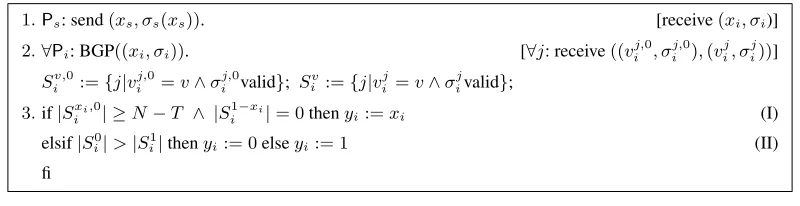
Protocol Πbcev is described by the local view of each player Pi (see Figure 1). Let BGP be the efficient, perfectly secure broadcast protocol in [BGP89] tolerating t < N/3 corrupted players — it starts with its sender sending his input to every player in the first round. We construct protocolΠbcevby combining BGP with selective use of signatures: the idea being that, fort≤tσ, BGP will work correctly and dominate the final outcome whereas, fortσ < t, at least one forgery would be necessary in order to violate validity of the protocol. The protocol works as follows and is summarized in Figure 1:
– In Step 1 of ProtocolΠbcev, the senderPs distributes the pair (xs, σs(xs))wherexs is his input and
σs(xs)is a signature byPsonxs.
– In Step 2, each player Pj redistributes the received pair with an instance of the BGP protocol. Let
(vj,i0, σij,0)be the initial (first-round) message thatPireceives during the BGP instance with senderPj, and(vij, σij)the respective final broadcast result. PlayerPi now assembles player setsSiv,0 andSiv for each possible input valuev ∈ {0,1}, wherej ∈Siv,0means thatPj sentvwith a valid signature byPs during the first round of his BGP protocol, andj ∈Siv means thatv together with a valid signature by Pswas received as the final result ofPj’s BGP.
– Depending on the cardinalities of the setsSiv,0 andSiv,Pi now decides as depicted in Figure 1, Step 3.
1.Ps: send(xs, σs(xs)). [receive(xi, σi)]
2.∀Pi: BGP((xi, σi)). [∀j: receive((vj,i0, σ
j,0
i ),(v j i, σ
j i))]
Sv,i 0:={j|v j,0
i =v∧σ j,0
i valid}; S v
i :={j|vij=v∧σ j ivalid}; 3.if|Sxi,0
i | ≥N−T ∧ |S
1−xi
i |= 0thenyi:=xi (I)
elsif|Si0|>|Si1|thenyi:= 0elseyi:= 1 (II) fi
Fig. 1.ProtocolΠbcev.
Lemma 1. Assuming a correct PKI, ProtocolΠbcev(Figure 1) efficiently achieves BCEV ifT+ 2tσ < N.
Proof. Efficiency easily follows by inspection of the protocol. Let the number of corrupted players bet. Note thatT+ 2tσ < N (tσ ≤T) implies thattσ < N/3and thus that BGP works correctly fort≤tσ.
•Broadcast (t≤tσ): Validity. IfPs is honest andt≤tσ then honestPi sees|Sixs,0| ≥N −tσ,|Sixs| ≥
N −tσ, and|Si1−xs| ≤tσ < N −tσ. ThusPidecides onyi =xsaccording to either Branch (I) or (II). •Broadcast (t≤tσ): Consistency. As t ≤ tσ < N/3, BGP is reliable. So, for all honest Pi, Pj BGP results match, implyingSj0 =Si0andSj1 =Si1. Hence, if no honestPi decides according to Branch (I) then all honestPidecide on the same value since they have the same view of the setsSivand consistency is guaranteed. Thus, it only remains to consider the case that some honest Pi decides according to Branch (I): Then,|Sxi,0
i | ≥N −T and|S
1−xi
i |= 0. We distinguish two cases:
1. honest Pj also decides according to (I).As BGP is reliable (tσ < N/3), any honest player Ph succeeds in broadcasting the message he first sent, soPh ∈Sixi,0 impliesPh ∈ Sixi. As at mosttσ of the players inSxi,0
i are corrupted, playerPj sees|S xi
j | ≥N −T −tσ >0. Thusxj = 1−xiis not possible sinceSxi
j is not empty. Thusxj =xi, and consistency follows.
2. honestPj decides according to (II).Since BGP is reliable (tσ < N/3), it follows that Sj1−xi =
S1−xi
i =∅. Furthermore, by the same argument as above|S xi
•T-Validity. It remains to demonstrate validity fortσ < t≤T. Since the adversary cannot forge signatures in this case, for honest senderPsan honest playerPi sees|Sixs,0| ≥ N −T andS
1−xs
i = ∅and thus
computesyi =xs. ut
2.2 Achieving HBC from BCEV
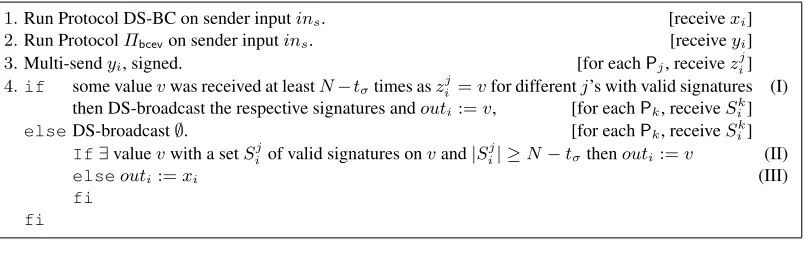
We now construct an HBC protocol by combining the BCEV protocol above with the PKI-based BC protocol of [DS82]. ProtocolΠhbcpki (see Figure 2) is described by the local view of each playerPi. LetPsbe the sender,
ins the sender input, andoutithe broadcast output of playerPi. Let DS-BC denote the efficient broadcast protocol of [DS82] tolerating any number of corrupted players, relying on a PKI and respective signatures.
– In Step 1 of ProtocolΠhbcpki, the senderPsdistributes his inputinsusing an instance of DS-BC. – In Step 2 the sender distributes his inputinsusing an instance ofΠbcev(see previous section).
– In Step 3, each playerPisigns his BCEV result and sends the BCEV result together with the signature to every player.5
– Now, for eachPi,
• if some valuevwas received in Step 3 by at leastN −tσdifferent playersPj together with correct signatures by thesePjthen playerPibroadcasts the respective signatures with an instance of DS-BC and outputsouti =v;
• else Pi distributes the empty set with an instance of DS-BC and then computes his output in the following way: If there is a value v such that at least N −tσ valid signatures (originating from different players) were received by some player during this step thenouti=v, otherwisePiaccepts the result of the initial DS-BC by the sender as his final output.
1.Run Protocol DS-BC on sender inputins. [receivexi] 2.Run ProtocolΠbcevon sender inputins. [receiveyi]
3.Multi-sendyi, signed. [for eachPj, receivezji]
4.if some valuevwas received at leastN−tσtimes aszij=vfor differentj’s with valid signatures then DS-broadcast the respective signatures andouti:=v, [for eachPk, receiveSik]
(I)
elseDS-broadcast∅. [for eachPk, receiveSk
i] If∃valuevwith a setSijof valid signatures onvand|S
j
i| ≥N−tσthenouti:=v (II)
elseouti:=xi (III)
fi
fi
Fig. 2.ProtocolΠhbcpki.
Achieving HBC given a correct PKI means that our protocolΠhbcpki has to be able to tolerate signature forgeries in presence of adversaries corrupting at mostt ≤ tσ players, while providing BC in presence of adversaries corrupting at mostt≤T players. We now show that protocolΠhbcpki achieves this efficiently for any choice of thresholdstσ andTwhereT+ 2tσ < N.
Lemma 2. Assuming a correct PKI, protocolΠhbcpki efficiently achieves hybrid broadcast ifT+ 2tσ < N.
Proof. Efficiency easily follows by inspection of the protocol. Let the number of corrupted players bet.
•t≤tσ. ProtocolΠbcev achieves broadcast, allN −tσ honest players correctly sign their values yj and resend them in Step 3. SinceN−tσ > N/2, every honest playerPiuniquely decides onouti =yi =ins in Step 4 and broadcast is achieved.
5
•tσ < t≤T. In this case we can restrict our attention to adversaries that cannot forge signatures.
Validity. If honestPidecides on (I) then valueoutiwas propagated by at leastN−tσ−T > tσhonest players in Step 3, and thusouti =insbecause ofT-validity of BCEV. If honestPi decides on (II) then at leastN −tσ−T > tσ honest players must have signed valueouti (with Step-3 tagging), and thusouti =insbecause ofT-validity of BCEV. If honestPi decides on (III) thenouti =ins by validity of DS-BC.
Consistency. If no honest player decides on (I) then all honest players agree since their decisions are based solely on information that was DS-broadcasted, and thus on a common view. Thus, assume that there is an honest playerPjwho decides on (I). Then an honestPicannot decide on (III) because |Sij| ≥N −tσ.
1. HonestPidecides on (I): because ofPj’s situationPisees at leastN−tσ−T > tσsignatures on
outi by honest players, and thusouti=outjsince value1−outicannot have enough support. 2. HonestPidecides on (II): for somePk,|Sik| ≥ N −tσ, and at leastN −tσ −T > tσ honest players signedouti(but no other value with the message tag for Step 3). Thus less thanN−tσ
players ever signed value1−outi, and thusoutj =outi. ut
2.3 Fixing the PKI
Previously we assumed that the given PKI was always correct. However, it is our goal to provide a secure BC protocol for any choice of parameterstσ,tp, andTwhere T+ 2tσ < N ∧ (tp >0 ⇒ 2T+tp< N). This protocol must tolerate and adversarially controlled PKI in presence oft≤tpcorruptions. Our solution for the casetp = 0must thus be adapted to tolerate an adversarially controlled PKI for the case thatt= 0 players are corrupted, i.e., for the case that all players are honest. We achieve this by giving a generic construction that transforms a possibly adversarially controlled PKI into a correct one under the condition that all players are honest. The transformation is based on Protocol FGHHS in [FGH+02] for detectable precomputation of a PKI tolerating any number of corrupted players. This protocol sets up a PKI such that
– either all honest players accept the protocol outcome, or all honest players reject; – if no player is corrupted then all players accept the protocol outcome;
– if an honest player accepts the protocol outcome then the PKI is correct.
The transformation works as follows: LetPKI be the given PKI that might be adversarially controlled. Before executing the HBC protocol Πhbcpki, an instance of FGHHS is executed resulting in a second PKI instancePKI0.
If one (and thus all) honest player accepts the newPKI0thenPKI0is correct as guaranteed by the FGHHS protocol. In this case the players use the newPKI0 in the HBC protocol instead of the originalPKI. If one (and thus all) honest player rejects the new PKI0 then some player must be corrupted as by the guarantee of the FGHHS protocol. In this case we have t > tp = 0and the protocol is not expected to tolerate an adversarially controlled PKI; and the players can use the originalPKIin the HBC protocol.
Denote by Πhbc the protocol that, for tp = 0, runs FGHHS and Πhbcpki, and fortp > 0, runs the BC protocol from [FHW04]. We then arrive at the following
Lemma 3. ProtocolΠhbcefficiently achieves HBC if T+ 2tσ < N ∧ (tp>0 ⇒ 2T+tp < N).
Proof. The casetp >0follows from [FHW04]. The casetp= 0follows from Lem. 2 and the discussion of
this section. ut
Theorem 1. HBC is achievable (and then efficiently) if and only if
T + 2tσ < N ∧ (tp >0 ⇒ 2T +tp < N).
Proof. Achievability follows from Lem. 3. Impossibility beyond the given bounds follows from Lem. 6 in
Sec. 4. ut
3 Hybrid Multi-Party Computation (HMPC)
We now discuss Hybrid Multi-Party Computation (HMPC) in the setting where players are provided with a complete network of secure channels and a possibly adversarially controlled PKI.
As for HBC, the exact guarantees provided by HMPC depend on the number tof corrupted players. As in the treatment of HBC, we define a thresholdtσ for tolerating adversaries that may forge signatures and a thresholdtpfor tolerating an adversarially controlled PKI. Additionally, we define a thresholdtcfor tolerating the adversary to be computationally unbounded (given that the PKI is based on unconditionally secure pseudo-signatures). This threshold is independent from the other ones as we will always be able to toleratetc< N/2which is optimal by arguments in [RB89,Kil00].
Furthermore, as suggested by the different standard property increments of the literature, we may also define different thresholds for robustness`r(i.e., full security fort ≤`r), fairness`f (i.e., fair security for
t ≤`f), and abortL(i.e., abort security fort ≤L) — see Sec. 1.1. We refer to these thresholds as limits. Note that thresholds refer to adversarial constraints whereas limits refer to the different increments of MPC. In consistency with this separation, limitLhas taken the role of the upper thresholdTin HBC,L=T.
Naturally, we assume that`r ≥max(tp, tσ) =tσ since we want to demand full security at least as long as the adversary cannot forge signatures. That is, degradation of security properties shall only be tolerated under the strongest possible adversary.
Note that, although we are dealing with a large number of different threshold parameters for the moment, we will end up at a concise simplification in Sec. 3.2 — without loss of generality. This simplification will allow to fix the single threshold parameter L whereas all other threshold parameters will be able to be maximized independently of each other, i.e., any optimally resilient protocol will be characterized by the single parameterL.
Definition 4 (Hybrid Multi-Party Computation (HMPC)).Lettσ,tp,tcbe thresholds, and`r,`f,Lbe
limits, with the additional constraint thattp ≤ tσ ≤ `r ≤ `f ≤ L. Let a PKI and a complete network of
secure channels be given. Consider an adversary corruptingtplayers in the following adversarial setting:
1. ift > tcthen the adversary is computationally bounded, otherwise it may be unbounded,
2. ift > tσ then the adversary cannot forge signatures, otherwise it may be able to do so,
3. ift > tpthen the PKI is correct, otherwise it may be controlled by the adversary.
A protocol then achieveshybrid multi-party computation (HMPC)if it achieves
1. fully secure MPC (privacy, correctness, and robustness) fort≤`r,
2. fair secure MPC (privacy, correctness, and fairness) for`r< t≤`f,
3. abort secure MPC (privacy, correctness, and agreement on abort) for`f < t≤L.
In [LRM10], for the model with broadcast channels,N-player MPC is defined with respect to a limit
`r=ρand implicitly defined limits`f, andL. In keeping with the above definition of these limits, the MPC protocolπSAρ of [LRM10] is fully secure againstt≤`r, fair secure againstt≤`f, and abort secure against
t≤Lcorrupted players.6 They demonstrate the following bound for the achievability of such MPC:
2tc< N ∧ 2`f < N ∧ L+`r< N . (2)
6
This bound is tight as shown in [IKLP06,Kat07,Cle86,Kil00] and discussed in [LRM10]. We will show that HMPC is achievable if and only if both the bounds of Eq. (2) and Thm. 1 are satisfied, i.e.,
Theorem 2 (Bounds for HMPC).HMPC with thresholdstσ,tp,tc, and limits`r,`f, andL, wheretp ≤
tσ ≤`r≤`f ≤L, is achievable if and only if
L+ 2tσ < N ∧ (tp >0 ⇒ 2L+tp < N) ∧ 2tc< N ∧ 2`f < N ∧ L+`r< N . (3)
Actually, our impossibility results in Sec. 4 even imply that agreement in MPC comes for free: limiting our requirements to privacy and correctness without agreement allows for no higher thresholdL.
3.1 Proof of Thm. 2
Necessity of the right part (Eq. (2)) of Bound (3) directly follows from [LRM10] as their model is strictly more powerful. It remains to demonstrate necessity of the left part of Bound (3). For this, we exhibit a special case of HMPC that is not achievable beyond. Note that HBC itself cannot be such a candidate instance since HMPC does not imply HBC (as HMPC does not require robustness). However, if we augment HBC with the possibility of such non-robustness, we arrive at exactly such an instance: hybrid broadcast with abort, HBCA for short. That is, HBCA is the same as HBC except for the additional limit`r ≥tσand the additional property that robustness is only required ift≤`r. In Sec. 4, impossibility of HBCA beyondL+ 2tσ < N andtp>0 ⇒ 2L+tp< N is demonstrated. This finishes the necessity argument of the proof.
We now argue sufficiency by exhibiting an HMPC protocol that achieves the bounds above. We combine the MPC protocolπSAρ of [LRM10] with our HBC protocolΠhbc, thus deriving an MPC protocolπSAρ ◦Πhbc for the model with a PKI instead of a BC channel.6 The MPC protocolπρSAof [LRM10] is fully secure for
t ≤ `r, fair secure fort ≤ `f, and abort secure fort ≤ Lcorrupted players. The protocolΠhbcis secure under the bounds of Thm. 1.
As the MPC protocolπSAρ ◦Πhbc exhibits the same security properties as protocolπSAρ when run with BC channels, we arrive at the following:
Theorem 3 (Security ofπSAρ ◦Πhbc).Let a PKI and a complete network of secure channels be given. Let
tσ,tp,tcbe thresholds and`r,`f,Lbe limits wheretp ≤tσ ≤`r ≤`f ≤Las in Thm. 2, i.e.,
L+ 2tσ < N ∧ (tp>0 ⇒ 2L+tp< N) ∧ 2tc< N ∧ 2`f < N ∧ L+`r < N .
Then ProtocolπρSA◦Πhbc achieveshybrid multi-party computation (HMPC)secure against a static active
adversary corrupting up totof the players.
Proof. The theorem follows from the discussion above. ut
This completes the proof of Thm. 2. ut
A discussion of HMPC in the UC setting including a UC restatement of Thm. 2 can be found in App. A.
3.2 Simplification
We now simplify Thm. 3 by expressing all bounds implicitly by the parameterL. Parametertcis independent of all other parameters and we may already fix it to its maximal possible valuetc=
N−1 2
. We distinguish the casesL < N/3,N/3≤L < N/2, andL≥N/2, where the first case is covered by [BGW88,CCD88]. For N/3 ≤ T < N/2 we arrive at HMPC with the properties in [FHW04]. Note that the constraint
Corollary 1 ([FHW04] N/3≤L<N/2).Let a PKI and a complete network of secure channels be given and letLbe fixed such thatN/3≤L < N/2. And lett≤Lbe the number of corrupted players. Then fully secure HMPC is achievable exactly under the following adversarial constraints
1. the adversary is allowed to be computationally unbounded, and 2. ift < N−2Lthen the adversary is allowed to control the PKI, and 3. ift < N−2L then the adversary is allowed to forge signatures.
In particular, these bounds are independent in the sense that the lowering of one threshold does not allow for an increase of any other threshold.
ForL≥N/2we obtain new results that go beyond those of [FHW04]. Let us fixLanywhere such that
L≥N/2. Our bound then directly impliestp = 0. Without loss, we can now independently maximize the thresholdstσ,`r, and`f, with respect toLwithout violating thattσ ≤`r ≤`f.
Corollary 2 (L≥N/2).Let a PKI and a complete network of secure channels be given and letLbe fixed such thatL ≥N/2. And lett≤Lbe the number of corrupted players. Then HMPC is achievable exactly under the following adversarial constraints
1. ift < N2 the adversary is allowed to be computationally unbounded, and 2. ift= 0the adversary is allowed to control the PKI, and
3. ift < N−2L the adversary is allowed to forge signatures, and providing the security properties
1. full security ift < N −L, and 2. fair security ift < N2, and 3. abort security.
In particular, these bounds are independent in the sense that the lowering of one threshold does not allow for an increase of any other threshold.
4 Impossibility
We demonstrate impossibility of HBC and HMPC beyond the bounds of Thms. 1 and 2 by showing that HBCA, i.e., hybrid broadcast with abort, is not achievable. HBCA is the same as HBC except that robustness is only required ift≤tσ.
Definition 5 (HBCA).A protocol with parameters tp, tσ, and T, tp ≤ tσ ≤ T, among a player set P, |P| =N, where a playerPs ∈ P (the sender) inputs a valuexs 6=⊥and every playerPi ∈ P outputs a
valueyiachieveshybrid broadcast with abort (HBCA)if, under the condition that
•the PKI may be controlled by the adversary ift≤tp, and •the adversary may forge signatures ift≤tσ,
the following holds:
•ift≤tσ then the protocol achieves broadcast, and
• ift ≤ T then the protocol either achieves broadcast or all honest players terminate the protocol with
output⊥.
Impossibility of HBCA beyond the bounds of Lem. 2 can be shown along the lines of [FLM86] and [FHW04] by demonstrating the impossibility of the following two special cases:
4.1 Impossibility ofT + 2tσ ≥Nwhentσ >0.
For the sake of contradiction, assume a protocol that achieves HBCA under these conditions among a player setP,|P|=N ≥3. We can partition the players in to three setsP0,P1, andP2, with cardinalities|P0| ≤T
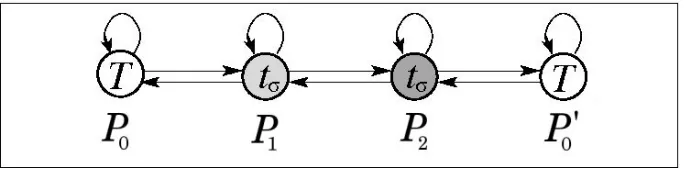
and|P1|,|P2| ≤tσwhere the senderPsis inP0. LetP0ibe a copy of playerPi ∈ P0andP00 ={P0i|Pi ∈ P0} where playerP0i holds the same protocol information asPi. We show that the assumed protocol leads to a contradiction when we connect the players inP0 =P0∪ P1∪ P2∪ P00 in a certain way and let the protocol
run.
The players are connected in the following way — see Figure 3. Exactly all pairs in(P0∪P1)×(P0∪P1),
(P1∪ P2)×(P1 ∪ P2), and(P2∪ P00)×(P2 ∪ P00)are connected by pairwise channels meaning that a
message that normally would be sent from Pi ∈ P2 toPj ∈ P0 is sent from Pi toP0j ∈ P
0
0 instead, and
thatP0j communicates with the players inP2∪ P0
0 as it would with the players inP2∪ P0 under normal
conditions. Note that no further connections exist.
Fig. 3.Simulated system by the adversary for the casetσ>0
We first show that for inputxs = 0of the original senderPsand inputx0s = 1of the sender’s copyP0s the joint view among the different setsP0∪ P1,P1∪ P2, andP2∪ P00, are indistinguishable from their joint
view in a protocol under normal conditions where the adversary corrupts the remaining players.
Joint view ofP0∪ P1 withxs = 0. By corrupting all players inP2 in the original system the adversary
simulates all players inP2∪ P0
0 of the new system. Since|P2| ≤tσ, the adversary can forge all signatures by players inP00 required for the simulation. Thus the joint view of the players inP0∪ P1 in the original
system is exactly the same as their view in the new system.
Joint view ofP2∪ P0
0withx0s= 1. By symmetry, this case follows from the above paragraph.
Joint view ofP1∪ P2. By corrupting all players inP0in the original system the adversary can simulate all players inP0∪ P00 of the new system. Note that, by corrupting the players inP0, the adversary gains access
to all corresponding secret keys and thus is not required to forge any signatures for the simulation. Thus the joint view of the players inP1∪ P2in the original system is exactly the same as their view in the new system.
Contradiction. The assumption that the given protocol achieves HBCA implies that the playersPi ∈ P0∪P1
must agree onyi =xs= 0since the adversary corrupts the at mosttσplayers inP2. By the same argument,
the playersPj ∈ P2∪ P00 must agree onyj =x0s= 1. However, this implies that the players inP1and the
players inP2disagree on their outputs in contradiction to the definition of HBCA. This implies that HBCA
is not achievable under these conditions.
Lemma 4. Iftσ >0then HBCA is not achievable ifT + 2tσ ≥N.
4.2 Impossibility of2T + tp ≥Nwhentp >0.
We proceed in the same way as in the previous section. We can partition the players in to three setsP0,P1,
andP2, with cardinalities|P0| ≤tpand|P1|,|P2| ≤T where the senderPsis inP0. LetPi0,P00, andP0 be
defined as in the previous section.
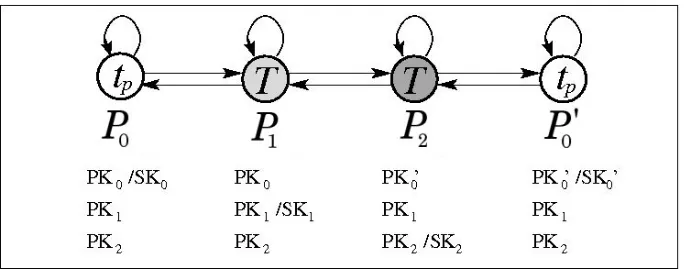
The players are connected in the following way — see Figure 4. Exactly all pairs in(P0∪P1)×(P0∪P1),
(P1∪ P2)×(P1∪ P2), and(P2∪ P00)×(P2∪ P00)are connected as in the previous section. Additionally,
for all playersP0i ∈ P0
0 the old secret-key/public-key pair is erased and replaced by a random valid pair
(SK0i,PK0i); and for all playersPj ∈ P2∪ P00 Pj’s copy of PKiis replaced by PK0i.
Fig. 4.Simulated system by the adversary for the casetp>0
We again show that for inputxs= 0of the original senderPsand inputx0s= 1of the sender’s copyP0s the joint view among the different setsP0∪ P1,P1∪ P2, andP2∪ P00, are indistinguishable from their joint
view in a protocol under normal conditions where the adversary corrupts the remaining players.
Joint view ofP0∪ P1 withxs = 0. By corrupting all players inP2 in the original system the adversary
simulates all players inP2 ∪ P0
0 of the new system. For allPi ∈ P00 it generates a random valid
secret-key/public-key pair(SK0i,PK0i) and overwritesPi’s own secret key, and, for allPj ∈ P2 ∪ P00, overwrites
Pj’s copy ofPi’s public key. The PKI among the players inP0∪ P1 is still fully correct and thus the joint
view of the players inP0∪ P1in the original system is exactly the same as their view in the new system.
Joint view ofP2∪ P00 withx0s= 1. By symmetry, this case follows from the above case.
Joint view of P1 andP2. Since |P0| ≤ tp the adversary can control the PKI and may distribute keys according to Figure 4. By corrupting all players inP0in the original system the adversary can now simulate
all players inP0∪ P00 of the new system. Thus the joint view of the players inP1∪ P2in the original system
is exactly the same as their view in the new system.
Contradiction. Assuming the protocol to achieve HBCA now implies that the playersPi ∈ P0∪ P1 must
output yi ∈ {xs,⊥} = {0,⊥} since at most T players are corrupted. By the same argumentation, the playersPj ∈ P2∪ P00 must outputyj ∈ {x0s,⊥}={1,⊥}. However, this means that the players inP1and
the players inP2either disagree on their outputs or jointly output⊥, which is, under corruption oft ≤tp players, in contradiction to the definition of HBCA. This implies that HBCA is not achievable under these conditions.
Lemma 5. Iftp >0then HBCA is not achievable if2T +tp ≥N.
Lemma 6. HBC, HBCA, and HMPC are not not achievable iftσ >0andT + 2tσ ≥N, or iftp >0and
2T +tp ≥N (for HMPC, replaceT withL).
Proof. The lemma follows from Lem. 4, Lem. 5, the fact that HBC implies HBCA, and the fact that HBCA
is an instance of HMPC. ut
Note that the impossibility result for HMPC even applies if we merely demand privacy and correctness without robustness, fairness, or agreement fort > tσ, as private and correct MPC already implies BCA, and thus such HMPC implies HBCA. As such our impossibility result implies that agreement in HMPC comes for free: limiting our requirements to privacy and correctness without agreement allows for no higher thresholdL.
5 Conclusions
References
[Bea89] Donald Beaver. Multiparty protocols tolerating half faulty processors. In Gilles Brassard, editor,CRYPTO, volume 435 ofLecture Notes in Computer Science, pages 560–572. Springer, 1989.
[BGP89] Piotr Berman, Juan A. Garay, and Kenneth J. Perry. Towards optimal distributed consensus (extended abstract). In
Proceedings of IEEE Symposium on the Foundations of Computer Science (FOCS) ’89, pages 410–415, 1989. [BGW88] Michael Ben-Or, Shafi Goldwasser, and Avi Wigderson. Completeness theorems for non-cryptographic fault-tolerant
distributed computation (extended abstract). InSTOC, pages 1–10. ACM, 1988.
[BPW04] Michael Backes, Birgit Pfitzmann, and Michael Waidner. A general composition theorem for secure reactive systems. InTCC’04, volume 2951 ofLNCS, pages 336–354. Springer, 2004.
[Can01] Ran Canetti. Universally composable security: A new paradigm for cryptographic protocols. In Bob Werner, editor,
IEEE Symposium on Symposium on Foundations of Computer Science (FOCS) 2001, pages 136–147, Los Alamitos, CA, October 14–17 2001. IEEE Computer Society.
[CCD88] David Chaum, Claude Cr´epeau, and Ivan Damg˚ard. Multiparty unconditionally secure protocols. InACM Symposium on the Theory of Computing (STOC) 1988, pages 11–19. ACM, 1988.
[CF01] Ran Canetti and Marc Fischlin. Universally composable commitments. InCRYPTO’01, pages 19–40. Springer, 2001. [Cle86] R Cleve. Limits on the security of coin flips when half the processors are faulty. InSTOC’86, pages 364–369. ACM,
1986.
[CS99] Ronald Cramer and Victor Shoup. Signature schemes based on the strong RSA assumption. In6th ACM Conference on Computer and Communications Security (CCS ’99), pages 46–51, New York, 1999. ACM Press.
[DS82] Danny Dolev and H. Raymond Strong. Polynomial algorithms for multiple processor agreement. InProceedings of the Fourteenth Annual ACM Symposium on Theory of Computing (STOC) ’82, pages 401–407. ACM, 1982.
[FGH+02] Matthias Fitzi, Daniel Gottesman, Martin Hirt, Thomas Holenstein, and Adam Smith. Detectable Byzantine agreement secure against faulty majorities. In21st ACM Symposium on Principles of Distributed Computing (PODC), pages 118–126, 2002.
[FHHW03] Matthias Fitzi, Martin Hirt, Thomas Holenstein, and J¨urg Wullschleger. Two-threshold broadcast and detectable multi-party computation. In Eli Biham, editor,Advances in Cryptology — EUROCRYPT 2003, volume 265 ofLecture Notes in Computer Science, pages 51–67. Springer-Verlag, May 2003.
[FHW04] Matthias Fitzi, Thomas Holenstein, and J¨urg Wullschleger. Multi-party computation with hybrid security. In Christian Cachin and Jan Camenisch, editors,Advances in Cryptology — EUROCRYPT 2004, volume 3027 ofLecture Notes in Computer Science, pages 419–438. Springer-Verlag, May 2004.
[FLM86] Michael J. Fischer, Nancy A. Lynch, and Michael Merritt. Easy impossibility proofs for distributed consensus problems. In Barbara B. Simons and Alfred Z. Spector, editors,Fault-Tolerant Distributed Computing, volume 448 ofLecture Notes in Computer Science, pages 147–170. Springer, 1986.
[GGBS10] Anuj Gupta, Prasant Gopal, Piyush Bansal, and Kannan Srinathan. Authenticated byzantine generals in dual failure model. In Krishna Kant, Sriram V. Pemmaraju, Krishna M. Sivalingam, and Jie Wu, editors,ICDCN, volume 5935 of
Lecture Notes in Computer Science, pages 79–91. Springer, 2010.
[GK08] Vipul Goyal and Jonathan Katz. Universally composable multi-party computation with an unreliable common reference string. InTCC’08, volume 4948 ofLNCS, pages 142–154. Springer, 2008.
[GKKY09] S. Dov Gordon, Jonathan Katz, Ranjit Kumaresan, and Arkady Yerukhimovich. Authenticated broadcast with a partially compromised public-key infrastructure. Cryptology ePrint Archive, Report 2009/410, 2009. http: //eprint.iacr.org/.
[GMW87] Oded Goldreich, Silvio Micali, and Avi Wigderson. How to play any mental game or a completeness theorem for protocols with honest majority. InACM Symposium on Theory of Computing, pages 218–229, 1987.
[GO07] Jens Groth and Rafail Ostrovsky. Cryptography in the multi-string model. InCRYPTO’07, volume 4622 ofLNCS, pages 323–341. Springer, 2007.
[Gol01] Oded Goldreich.Foundations of Cryptography: Basic Tools, volume 1. Cambridge University Press, 2001.
[Her05] Amir Herzberg. On tolerant cryptographic constructions. InCT-RSA’05, volume 3376 ofLNCS, pages 172–190. Springer, 2005.
[HZ10] Martin Hirt and Vassilis Zikas. Adaptively secure broadcast. In Henri Gilbert, editor,EUROCRYPT, volume 6110 of
Lecture Notes in Computer Science, pages 466–485. Springer, 2010.
[IKLP06] Yuval Ishai, Eyal Kushilevitz, Yehuda Lindell, and Erez Petrank. On combining privacy with guaranteed output delivery in secure multiparty computation. InCRYPTO’06, volume 4117/2006, pages 483–500. Springer, 2006.
[Kat07] Jonathan Katz. On achieving the “best of both worlds” in secure multiparty computation. InSTOC’07, pages 11–20. ACM, 2007.
[Kil00] Joe Kilian. More general completeness theorems for secure two-party computation. InSTOC’00, pages 316–324. ACM, 2000.
[PW96] Birgit Pfitzmann and Michael Waidner. Information-theoretic pseudosignatures and byzantine agreement fort >=n/3. Research Report RZ 2882 (#90830), IBM Research, November 1996.
[PW00] Birgit Pfitzmann and Michael Waidner. Composition and integrity preservation of secure reactive systems. InACM CCS’00, pages 245–254, 2000.
[RB89] Tal Rabin and Michael Ben-Or. Verifiable secret sharing and multiparty protocols with honest majority. InProc. 21st annual ACM symposium on theory of computing (STOC ’89), pages 73–85, 1989.
A UC Security
In this section we place our result into the context of universally composable (UC) security.
A.1 Security Definitions and Notations
We follow the Universal Composability (UC) paradigm [PW00,Can01,BPW04]7, which defines a simulation-based security model. The security of a protocol (the real world) is defined with respect to aTrusted Third PartyorIdeal FunctionalityFthat correctly performs all desired computations (the ideal world). Informally, a protocolπ is secure if whatever an adversary can achieve in the real world could also be achieved in the ideal world.
More precisely, letP = {P1, . . . ,PN}be the set of players, and define [N] := {1, . . . , N}. We only consider static corruptions and useH ⊆ Pto denote set of honest players, andA=P \ Hto denote the set of corrupted players. In thereal world, there is a given set of resourcesR(e.g., secure channels, broadcast channels) to which for each honest playerPi ∈ Ha protocol machineπi is connected. Corrupted players access the resources directly. This real world is denoted byπH(R). In [Can01], resources are modeled as ideal functionalities available in a hybrid model . Theideal worldconsists of the ideal functionalityFand an ideal adversary (or simulator)Sconnected toFvia the interfaces of the corrupted playersA. This ideal world is denoted bySA(F).
A protocol π securely implements a functionality F if, for every possible setAof corrupted players, there is a simulatorS such that no distinguisherDcan tell the real world and the ideal world apart.8 For this purpose, the distinguisher directly interacts either with the real or with the ideal world, by connecting to all open interfaces, and then outputs a decision bit. This interaction is denoted byD(X), whereX ∈ {πH(R),SA(F)}.
In [Can01], all protocol machines, simulators, ideal functionalities, and distinguishers are modeled as Interactive Turing Machines (ITM). We defineΣallas the set ofallITMs, andΣeffas the set ofpolynomially boundedITMs. In this paper, however, ITMs are specified on a higher level of abstraction.
Definition 6 (Universally Composable (UC) Security).A protocol π UC securely implements an ideal functionalityFif
∀A ∃SA ∈Σeff ∀D∈Σeff/all: |Pr[D(SA(F)) = 1]−Pr[D(πH(R)) = 1]| ≤ε(κ),
whereε(κ)denotes a negligible function in the security parameterκ. ForD∈Σeff, the security is compu-tational(CO). ForD∈Σall, the security isinformation-theoretic(IT).
Simulators must be efficient not only in the CO, but also in the IT setting, since otherwise, IT security does not imply CO security. We formalize hybrid security using ideal functionalities that are aware of both the set of corrupted players and the computational power of the adversary. In other words, the behavior of the functionality, and hence the security guarantees, varies depending on both parameters. A protocolπ
UC securely implements an ideal functionalityF with hybrid-security ifπ securely implements Fin both the CO and the IT setting. Note that in contrast to [Can01], we use a synchronous communication model with static corruption. As resourcesRwe will, unless otherwise stated, assume a complete networkNetN of synchronous secure channels. For MPC we will also need a common reference string (CRS)CRSto avoid the impossibility results of [Can01,CF01].
7
We follow the UC model of [Can01] in spirit, but do not adhere to the notation of [Can01].
8In this model, the adversary is thought of as being part of the distinguisher. Canetti [Can01] shows that this model without
In the UC setting, a strong composition theorem can be proven [Can01,BPW04]. This theorem states that wherever a protocolπis used, we can indistinguishably replace this protocol by the corresponding ideal functionalityFtogether with an appropriate simulator.9
We will, in the following, generally be interested in MPC, i.e., in securely implementing an arbitraryN -player functionalityF. We thus model implementing a functionalityFwith subsets of the security properties privacy, correctness, robustness, fairness, and agreement on abort. We describe the following four specific security notions:
Full Security.Computing functionality Fwith privacy, correctness and robustness, which implies all the security notions mentioned above, is modeled by functionalityFitself, since, in the setting we consider, demanding a secure implementation of functionalityFalready amounts to demanding full security.
Fair Security.Demandingprivacy, correctness and fairness (which implies agreement on abort) only for functionalityF is captured by the ideal functionality Ffair, which operates as follows: Ffair internally runsF. Any inputs toF are forwarded, as are any messagesF may output to the adversary. IfFmakes an outputy, thenFfairrequest an output flago∈ {0,1}from the adversary, defaulting too= 1if the adversary makes no suitable input. Finally, for o = 1functionalityFfair makes outputy toallplayers, foro = 0it halts.
Abort Security. The functionalityFab, specifyingprivacy, correctness and agreement on abort only, works likeFfairbut forwards outputyto the adversary before requesting an output flag.10
No Security.The functionalityFnoSec models demanding no security whatsoever: FunctionalityFnoSec turns control over to the adversary by forwarding all inputs from the honest players to the adversary and letting the adversary fix all outputs to honest players.
As a simulator SnoSec can use the inputs of honest players to simulate honest protocol machines, this already proves the following (rather trivial) lemma:
Lemma 7. Any protocolπUC securely implements the ideal modelFnoSec.
A.2 UC Security of HBC
In our synchronous variant of the UC setting, BC can be formalized by means of an ideal BC functional-itybc, which behaves as follows: When an arbitrary playerPsgives inputxs, functionalitybcoutputs(xs, s) to all players.
We are interested in implementing BC and MPC in a hybrid-setting where a PKI is provided, but where the adversary may control the PKI if he corrupts less thatt≤tpplayers, or where the adversary may be able to forge signatures if he corrupts less thatt≤tσplayers.
We model this setting by providing an unreliable PKI resourcePKItp,tσthat models the capabilities of the adversary. For simplicity let an unconditionally secure pseudo-signature scheme (e.g. [PW96]) be given. We could also use a signature scheme existentially unforgeable under adaptive chosen-message attacks (UF-CMA) (e.g. [CS99]), but then unbounded adversaries can forge signatures, which complicates treatment. FunctionalityPKItp,tσ then operates as follows:
– In case oft≤tp corruptions, functionalityPKItp,tσ turns control over to the adversary, so the adversary may fix all public and private keys arbitrarily.
9This follows from the free interaction between the distinguisher and the system during the execution, which implicitly models
that outputs of the system can be used in arbitrary other protocols, even before the execution ends. This is in contrast to a stand-alone definition of security where the distinguisher is restricted to providing input in the beginning of the computation, and receiving output only at the end.
10We could relax the definition further by allowing the adversary to send one output flag for each player, dropping agreement on
– In case oftp < t≤tσcorruptions, functionalityPKItp,tσ independently and honestly generates keys for each playerPi ∈ Paccording to the prescribed signature scheme and distributes them. Then functional-ityPKItp,tσ reveals all signing keys to the adversary, to model that the adversary may forge signatures. – In case of t > max(tσ, tp) corruptions, functionality PKItp,tσ independently and honestly generates
keys for each playerPi∈ P according to the prescribed signature scheme and distributes them.
We can now restate the security of our HBC protocolΠhbc as claimed in Lem. 3 in the UC setting as follows
Lemma 8 (UC security of HBC).ProtocolΠhbc efficiently and UC securely implements functionalitybc
in the IT setting11 from a PKI PKItp,tσ and a networkNet
N as resources in presence of at mostt ≤ T
actively corrupted players whenever
T + 2tσ < N ∧ (tp >0 ⇒ 2T +tp < N).
Proof of Lem. 8 Efficiency easily follows by inspection of the protocols. We show that the protocolΠhbc indeed implements functionalitybcwhenever at mostt≤Tplayers are corrupted andT+2tσ < N ∧ (tp>
0 ⇒ 2T+tp< N)by providing an appropriate simulatorSbc:
The simulator Sbc connects to the interfaces of corrupted players to functionalitybc. Simulator Sbc internally emulates the protocol machinesΠi
hbcfor the honest playersPiand an instance of the PKIPKItp,tσ. The connections to corrupted players are exposed to the adversary.
LetPi be the honest player with the smallest indexi, andPj be the corrupted player with the smallest indexj.
If the internally emulated protocol machine of playerPioutputs(xs, s)wherePsis corrupted, thenSbc inputsxstobcvia the interface ofPs.
The simulator Sbc identically emulates the same protocol machines Πhbci in the ideal model that the honest players run in the real model. This means ideal and real model are perfectly indistinguishable, as long as the outputs of all emulated protocol machines match the outputs of the ideal functionalitybc. This amounts to nothing else then demanding consistency and validity as proven above.
A.3 UC Secure HMPC
We now translate Sec. 3 to the UC setting. First, we formalize HMPC by providing an ideal functional-ityFhybt
c,`r,`f,L. This functionality evaluates an arbitraryN-player functionalityFwith the HMPC properties:
Definition 7 (FunctionalityFhybt
c,`r,`f,L).Given an arbitraryN-player functionalityF, functionalityF hyb tc,`r,`f,L
behaves as follows:
1. Ift > tcand the adversary is computationally unbounded, or
2. ift > L
functionalityFhybt
c,`r,`f,Lturns over control to the adversary by runningF
noSec. Otherwise functionalityFhyb tc,`r,`f,L
behaves like
1. functionalityF(full security) fort≤`r,
2. functionalityFfair(fair security) for`r < t≤`f,
3. functionalityFab(abort security) for`f < t≤L.
11
Consider the protocol πρ◦Πhbc obtained from the MPC protocolπρof [LRM10] by using out HBC protocolΠhbcfor broadcasts. As for the stand-alone setting in Sec. 3 we now show that protocolπρ◦Πhbc is a UC secure HMPC protocol in the following sense: Protocolπρ◦Πhbccan implement an HMPC for an arbitraryN-player functionalityFunder the bounds of Eq. (3).
To avoid the impossibility results of [Can01,CF01], we have to move to theCRS-model where a common reference stringCRS drawn from a prescribed distribution is made available to all players. So, we will in the following assume as resources R a common reference string CRS and a complete networkNetN of synchronous secure channels and an unreliable PKIPKItp,tσ.A correctly chosenCRSis a prerequisite to the security of the protocols from [LRM10].12
Theorem 4 (Security of πρ◦ Πhbc). Given an arbitrary N-player functionality F, protocol πρ ◦ Πhbc
UC securely implements functionality Fhybt
c,`r,`f,L from an unreliable PKIPKItp,tσ, a complete network of
synchronous secure channelsNetN, and aCRSfor any choice of thresholds respecting
L+ 2tσ < N ∧ (tp >0 ⇒ 2L+tp < N) ∧ (4)
`r≤`f ≤L ∧ 2tc< N ∧ 2`f < N ∧ L+`r < N .
in presence of an active, static adversary.
Proof. The proof of Thm. 4 is almost trivial.
By Lem. 8 the BC protocol Πhbc implements functionalitybc under the bounds of Lem. 3. Now, by the choice of bounds in the definition of functionalityFhybt
c,`r,`f,L, we then find: In any setting where func-tionalityFhybt
c,`r,`f,L does not turn over control to the adversary, the BC protocolΠhbcimplements function-ality bc. According to the UC Theorem it is hence sufficient to prove that protocol πρ◦ bc implements functionalityFhybt
c,`r,`f,L. But on a plainbc, protocolπ
ρprovides precisely the guarantees made by
function-alityFhybt
c,`r,`f,L(also see [LRM10]). ut
Results along the lines of Cor. 1 and Cor. 2 are easily translated to the UC setting. We refrain from restating them here.
12