Authenticating with Attributes
Dalia Khader
University of Bath
Abstract. Attribute based group signature (ABGS) is a a new gener-ation of group signature schemes. In such a scheme the verifier could define the role of a signer within the group. He determines the attributes possessed by the member signing the document. In this paper we pro-pose the first ABGS scheme with multi-authorities and define its security notions. We construct an ABGS that is proved to be fully traceable and fully anonymous. Our scheme is efficient and secure.
1
Introduction
Attribute Based Group Signature (ABGS) is a new paradigm of cryptography. The idea behind it is authenticating that a person has certain credentials. The following is a scenario were such a scheme is needed:
Alice requests a prescription from Bob’s pharmacy. Bob is willing to give her a discount if she is a student, an elder, or an employee in his pharmacy. He also wants a prove that an authorized public or private medical practice prescribed the medicine for her. He needs to check that she has a national health insurance. Alice and Bob have no previous knowledge about each other. Alice is sensitive about her details. She does not want to tell Bob whether she goes to a private practice or a public one. She definitely does not want her identity to be revealed. She doesn’t want Bob to know whether she bought any medicine from him before. Bob, on the other hand, is not willing to break his policy and wants to make sure that any information he gets from Alice is true.
From this scenario we could derive the properties of the ABGS scheme:
– No previous knowledge. We can not assume that the communicators, Alice and Bob, know information about each other.
– Attributes can not be forged.Alice should prove possession of attributes. That prove must guarantee that the attributes Bob needs are included and they belong to Alice only.
– Anonymity.Bob should not be able to reveal the identity of Alice.
– Linkability.If Alice buys twice from Bob. He should not be able to tell that the first purchase and the second were done by her.
A possible solution is to use digital signatures. Alice has a certificate for each attribute she owns signed by trusted third party. Bob announces the attributes he requires. Alice encloses the certificates she owns. Bob verifies each certificate and makes a decision on whether Alice is eligible to have the medicine with a discount. The drawback of such a solution is the need to run the verification algorithm many times. Alice is sending the certificates she owns even though Bob requires a proof of satisfying his policy only, therefore breaching here privacy. Moreover, a colluding attack is possible. Alice may have some certificates Bob needs. She could get together with another person who has the rest of the certificates and they could pretend to be one person when dealing with Bob. Therefore, we could conclude that this solution is not ideal.
Another suggestion would be using identity based signatures (IBS) which are digital signatures that use the identity of the person in the verification process rather than a public key. Such a scheme could be considered as the first attempt to create attribute based signatures. Assume we concatenate identities in IBS schemes to some attribute templates. This would limit the possibility of colluding attacks. However, the verifier will need an identity of the signer in order to create his verification request. The signer is forced to attach his identity to the signature which leads to breaking the anonymity and linkability of the scheme.
To overcome the anonymity problem in the previous solutions, group signatures could be used. Group signatures are digital signatures that allow any member of a group to sign anonymously on behalf of others. We could present all owners of a certain attribute as a group. For example, all students may belong to a group. Even though, group signature solves one problem, it still requires the number of verifications to be equal to the number of attributes needed from the verifier. In other words Alice still has to enclose all certificates Bob needs. It is also vulnerable to colluding attacks.
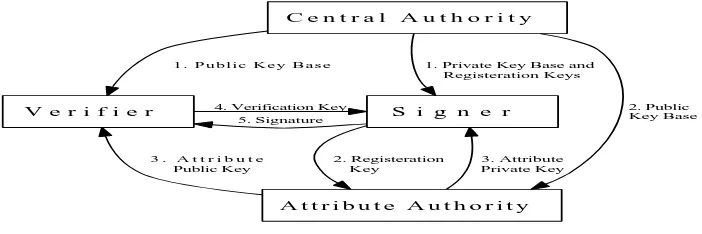
and her signature implicitly proves that Bob’s request has been satisfied(See Figure 1).
C e n t r a l A u t h o r i t y
V e r i f i e r
1 . P u b l i c K e y B a s e
S i g n e r
1. Private Key Base and Registeration Keys
A t t r i b u t e A u t h o r i t y
2. Public Key Base 4. Verification Key
5. Signature
2. Registeration Key 3 . A t t r i b u t e
Public Key
3. Attribute Private Key
Fig. 1.ABGS
1.1 Related Work
In the early nineties Chaum and Heyst proposed the first group signature scheme [2]. Since then various research has been done on improving the schemes efficiency, security and features.
Many security notions were introduced such as unlinkability, unforgeability, ex-culpability, coalition-resistance, anonymity, and traceability [3–9]. In [9] the au-thors tried to unify and simplify all those security notions with defining the two core requirements: full anonymity and full traceability. They proved their defi-nitions to implicitly include all of the other security notions. ABGS is required to be fully traceable and anonymous.
Cryptographers tried adding new features to group signatures. New ideas were born such as Identity based group signatures [10–13], blind group signatures [14, 15], and group signcryption [16, 17]. Our scheme is a continuation of that effort where we propose an attribute based group signature
1.2 Outline
The rest of the paper is organized as follows. We start with giving a precise defi-nition of an ABGS in 2. Formal defidefi-nitions of the security notions are presented in 2. Section 4 gives an example of an ABGS construction. Required preliminar-ies for the construction are given in section 3. We finally, conclude in section 5. In the Appendix a comprehensive proof of security is given.
2
Attribute Based Group Signature
algorithms of an ABGS scheme. Finally, we would provide the definitions of the required security notions.
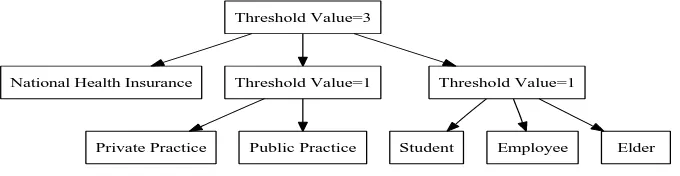
An attribute tree is the structure used in presenting the verifier’s request. It is a tree in which each interior node is a threshold gate and the leaves are linked to attributes. A threshold gate represents the fact that the numbermofnchildren branching from the current node need to be satisfied for the parent to be con-sidered satisfied. Satisfaction of a leaf is achieved by owning an attribute. For further explanation, consider the example in Figure 2, which demonstrates an attribute tree for the scenario mentioned earlier:
Threshold Value=3
National Health Insurance Threshold Value=1 Threshold Value=1
Private Practice Public Practice Student Employee Elder
Fig. 2.Attribute Tree
Attribute Based Group Signature Schemes: An Attribute Based Group Signature (ABGS) scheme is specified by eight algorithms:Setup,M.KeyGen,
A.KeyGenpub, A.KeyGenpri, V.KeyGen, Sign, V erif y, and Open. As a
pre-requisite to describing the algorithms we define certain notations.
U is the universal set of attributes withmbeing the size of it.Γ will be used as a description to our attribute tree. For example, to represent the tree in Figure 2,
Γ ={(3,3),National Insurance, (1,2), (1,3), Private Practice, Public Practice, Student, Employee, Elder}, where (m, n) represents a threshold gate m of n. You readΓ in a Top-Down-Left-Right Manner.κis the number of leaves inΓ.
Υi is a set describing all private keys a member owns. For example, if Smith is
a student and works in the pharmacy.ΥSmith ={Student, Employee}. The size
ofΥi is represented byµ.
After having defined the notations we require, we could describe the algorithms as follows:
– Setup: This algorithm is run by the central authority. It takes a security parameter as an input. It outputs two sets of parameters, Spri and Spub.
The central authority keeps the system parametersSprito itself. It publishes
Spub so everyone else can use them.
– M.KeyGen(Spri, n) : This algorithm is run by the central authority. It takes
the inputsSpri and n, where nis the number of members in the group. It
them to the members of the group. Thebsk[i] is kept private to the user, while theAi is given to trusted third parties, as shown inA.KeyGenpri. – A.KeyGenpub(Spub) : This algorithm is run by the attribute authorities.
Each authority is responsible of an attribute or more. The authority has for each attribute j, a master key tj. That key will be used in creating
attribute-related keys. Using the master keys the authority creates public keysbpkj representing attributes it supports. Only the attribute authorities
could produce such keys since it requires the knowledge oftj.
– A.KeyGenpri(Ai, j) : This algorithm is run by the attribute authorities. The
idea of this algorithm is that member i registers with his key Ai to get a
special private keyTi,j. That key is calculated using the attribute authority’s
master key tj. Member i will be using his private key gsk[i] = hbsk[i],Ai,
Ti,1,...,Ti,µito sign. Notice that not allTi,jhave been generated by the same
attribute authority.
– V.KeyGen(bpk1, ..., bpkκ) : This algorithm is run by the verifier. Verifier
createsΓ. The verifier then creates a verification key,gpk. To do so he uses
Γ and the attribute public keysbpk1,...,bpkκ.
– Sign(gpk, gsk[i], M, Γ) : This algorithm is run by the signer. The signer uses the verification keygpk, the attribute treeΓ, and his private keygsk[i], to sign on the messageM. The output is a signatureσ
– V erif y(gpk, M, σ) : This algorithm is run by the verifier. He verifies the signatureσusing the verification keygpk. The output is either an acceptance or rejection of the signature.
– Open(σ, M, Spri) : This algorithm is run by the central authority. It traces
a signatureσon a messageM to the signeri.
Attribute based group signature schemes are considered an extension to group signature schemes. Therefore, it is natural to require the same security notions: full anonymity and full traceability which include all other notions. However, the additional property of an ABGS scheme makes it a necessarily to strengthen the definitions in [9]. The following sections provide adversarial models that define the security notions. These models give the adversary access to a private attribute key oracle and give him the opportunity to decide the universal set of attributes he would like to be challenged upon.
2.1 ABGS Anonymity Definition
We say that an Attribute Based Group Signature Scheme is anonymous under a specific set of attributes, if no polynomially bounded adversaryAdam has a non-negligible advantage against the challengerCharlesin the following game:
– Init:Adamdecides the universal set of attributesU in which he would like to be challenged upon.
– Setup: Charles will play the role of the central authority and attribute authority. He will run the algorithmsSetup,M.KeyGen, andA.KeyGenpub.
private key basesbsk[i] and i registration keys Ai. He chooses the master
keysht1,...,tmirandomly fromZp. Finally, he will generatempublic attribute
keyshbpk1,...,bpkmi. The tuplehSpub, bpk1,...,bpkmiis sent to Adam. – Phase 1: Charles will run three algorithms in this phase: Private Key
Oracle, Private Key Base Oracle, and Signature Oracle.
Adamcould query the private key base oracle by sending an indexi. He will get fromCharlesa private key basebsk[i] and a registration keyAi.Adam
could also query the private key oracle by sending a set of attributesΥi and
the registration key Ai. Υi should have at least one attribute j. Charles
responds back withTi,1,...,Ti,µ.
WhenAdamwants to issue a query to the signature oracle, he sendsCharles
an indexi, a verification keygpkfor an attribute treeΓ, and a messageM.
Charlesresponds with a signatureσ.
– Challenge:Adamasks to be challenged on a messageM, two indicesi0,i1,
and verification keygpk of treeΓ. Charlesresponds back with a signature
σb, whereb∈ {0,1}. The signer could be eitheri0or i1.
– Phase 2:This stage is similar to Phase 1.
– Output:Adamoutputs a guess `b∈ {0,1}. If `b=b,Adamwins the game.
If we prove that the previous game is anonymous, we implicitly prove that it is unlinkable. The reason behind such a claim is that the adversary is given the capability of requesting a challenge which he already queried in the signature oracle in phase 1. If the scheme is linkable then the adversary could easily win this game by linking the challenge to a previous queried signature.
2.2 ABGS Traceability Definition
We say that an Attribute Based Group Signature Scheme is traceable if no polynomially bounded adversaryAdamhas a non-negligible advantage against the challenger in the following game:
– Init: Adam decides the universal set of attributes U he would like to be challenged upon.
– Setup: Charles will play the role of the central authority and attribute authority. He will run the algorithmsSetup,M.KeyGen, andA.KeyGenpub.
He will produce the systems Spub, and Spri. Charles also will generate i
private key basesbsk[i] andi registration keysAi. Finally, he will generate
mpublic attribute keyshbpk1,...,bpkmi. The tuplehSpub,bpk1,...,bpkmiis sent
toAdam.
– Running Queries:Charlesruns three queries: Private Key Base, Private key, and finally Signature queries.
Adam could request for a private key base. He sends Charles an index i.
Charlesreplies back with the registration keyAiand private key basebsk[i].
Adammight want to issue a private key query. He sends a registration key
Ai and a setΥi. The set Υi has one or more attributes. Charles responds
Finally,Adamcould runV.KeyGento obtain a Γ of his choice and agpk. He could send to Adam the output with a message M, and an index i, requesting a signature.Charleswill reply with a signatureσ.
– Challenge:Adamasks to be challenged on a messageM.Charlesgenerates aΓ and the correspondinggpk. He sends them toAdam.Adamreplies with a forged signatureσ. Charles verifies the signature. If it turns up to be a valid signature, he tries tracing it to a signer. If it traces to a signer in which
Adamdid not query before or if it traces to a nonmember thenAdamwins the game.
Full traceability includes unforgeability. One can reduce the challenge to be producing a valid pair of message and signature, where the message was not queried in phase 1. The new adversarial model is the definition of unforgeability. Therefore, full traceability implicitly proves unforgeability.
In the following section we will give a construction of an ABGS scheme. That scheme is proven to be fully traceable and anonymous in the appendix.
3
Preliminaries
In this section we will explain some of the preliminaries that are used in con-structing the ABGS scheme and proving it secure. We will defineq-Strong Diffie-Hellman which is used in building the scheme and proving it’s traceability. Then we state the Decision Linear Diffie-Hellman Assumption used in constructing the scheme and proving it anonymous. Finally, we define Bilinear Maps which we base our scheme on to enable handling the attribute tree.
Definition 1. (q-Strong Diffie-Hellman Problem [18])
Let G1, G2 be cyclic groups of prime order p, with a computable isomorphism
ψ or possibly G1 = G2. Assuming the generators g1 ∈ G1, and g2 ∈ G2.
The q-SDH problem in (G1, G2) is defined as follows: given a (q+ 2) tuple
(g1, g2, g2γ, g
γ2
2 , ..., g
γq
2 )as an input, output what is called a SDH pair(g 1/(γ+x) 1 , x)
wherex∈Z∗
p. An algorithmAhas an advantageεin solvingq-SDH in(G1, G2)
if:P r[A(g1, g2, g2γ, g
γ2
2 , ..., g
γq
2 ) = (g 1/(γ+x)
1 , x)]≥ε,where the probability is over
a random choice of a generatorg2(with g1←ψ(g2)), ofγ∈Zp∗ and of random bits of A.
This problem is considered hard to solve in polynomial time and ε should be negligible [18].
Definition 2. (Decision Linear Problem inG1[19])
LetG1be a group of prime orderpandu, v, hbe generators in that group. Given
u, v, h, ua, vb, hc ∈G
1 as an input,it is hard to decide whether or nota+b=c.
Definition 3. (Bilinear Maps [20]):
– Bilinear: We say that a map eˆ: G1×G2 → GT is bilinear if eˆ(g1a, gb2) =
ˆ
e(g1, g2)ab for any generatorg1∈G1,g2∈G2 and anya, b∈Zp.
– Non-degenerate: The map does not send all pairs inG1×G2 to the identity
inGT.
– Computable: There is an efficient algorithm to compute eˆ(g1, g2) for any
g1∈G1 andg2∈G2.
A bilinear map satisfying the three properties above is said to be an admissible bilinear map.
4
Construction of an ABGS
In this section we will construct an ABGS scheme based on Boneh and Shacham [21]. Notice that the Openalgorithm has been replaced byRevoke. In case of a dis-pute, the central authority creates a fake revocation list and adds all members in the group to it. The authority verifies the signature and checks whether the signer is revoked. If the signature is not forged the signer should be a member of the group. Therefore, running the revocation algorithm on the fake list should output true. Otherwise, the signature is forged.
– Setup: Consider a bilinear pair (G1, G2) with a computable isomorphism
ψ. Suppose that SDH assumption holds on (G1, G2) and the decision
lin-ear assumption holds on G2. Define the bilinear map ˆe : G1×G2 → G3.
All three groupsG1, G2, G3 are multiplicative and of a prime orderp.
Se-lect a hash function H : {0,1}∗ → Z
p. Select a hash function H0 with
respected range G2
2. Select a generator g2 ∈ G2 at random and then set
g1 ← ψ(g2). Select a random γ from Zp and set w = g2γ. Let Spub =
hG1, G2, GT,e, H, Hˆ 0, g1, g2, wiandSpri=γ.
– M.KeyGen(Spri, n) : Usingγ generate for each user i,1≤i≤n, a private
key basebsk[i] =hAi, xii. Allbsk[i] should be SDH pairs, wherexi is chosen
randomly fromZ∗
p andAi=g11/(γ+xi)∈G1.
– A.KeyGenpub(Spub): The public key for attributej isbpkj=g2γ/tj =w1/tj,
wheretj is chosen randomly from Zp
– A.KeyGenpri(Ai, j, R): Useri wants to register attributej. It contacts the
attribute authority in charge, which checks the revocation listR.Rcontains all registeration keys of users who have been revoked. If the memberiis not on the list, authority calculatesTi,j=Atij and gives to useri. The private
key for a useri will be the tuplegsk[i] =hAi, xi,Ti,1,...,Ti,µi.
– V.KeyGen(bpk1, ..., bpkκ) : Verifier chooses a Γ. Then he chooses a
polyno-mialqnode of degreednode=knode−1 for each node in the tree.knode is the
threshold gate value of every node. In other wordsknode children need to be
is done in top-down manner. Starting from the rootqroot(0) =srnd, where
srndis chosen randomly fromZpand other points in the polynomial will be
random. The other nodes we setqnode(0) =qparent(index(node)) and choose
the rest of the points of the polynomial randomly. Once all polynomials have been decided the verification key for a certain structure will be gpk=hg1,
g2, w,D1,...,Dκiwhere Dj =bsk[i]qj(0).
– Sign(gpk, gsk[i], M, Γ): The signer picks randomly an r from Zp and
ob-tains (ˆu,ˆv) fromH0(gpk, M, r). Then compute their imagesu←ψ(ˆu) and
v←ψ(ˆv). Userichoosesαandβ randomly fromZp.
Then he computesC1=uα, C2=Aivα,C3= ˆe(vα, w)β andC4=wβ.
We need to define a recursive algorithmSignN ode. If the node we are
cur-rently on is a leaf in the tree the algorithm returns the following:
SignN ode(leaf) =
If (j ∈Γ); return ˆe(Ti,jβ, Dj) = ˆe(Ai, w)βqj(0)
Otherwise return⊥
For a nodeρ which is not a leaf the algorithm proceeds as follows: For all childrenz of the node ρ it calls SignN odeand stores output as Fz. Let ˆSρ
be an arbitrarykρ sized set of children nodesz such thatFz6=⊥and if no
such set exist return⊥.
Otherwise let ∆Sˆρ,index(z) = Πι∈{index(z):z∈Sˆρ−index(z)}(−ι/(index(z)−ι))
and compute
Fρ=Πz∈SˆρF
∆Sρ,indexˆ (z)
z =Πz∈Sˆρˆe(Aβi, w)
qz(0).∆Sρ,indexˆ (z) = ˆe(Aβ
i, w)qρ(0)
To create the signature calculateFroot. If the tree is satisfied thenFroot =
ˆ
e(Aβi, w)srnd.
Letδ=xiα. Pick randomlyrα,rx, andrδ from Zp.
LetR1=urα,R2= ˆe(C2, g2)rxeˆ(v, w)−rαˆe(v, g2)−rδ andR3=C1rxu−rδ.
Computec = H(gpk, M, r, C1, C2, C3, C4, R1, R2, R3), sα = rα+cα, sx =
rx+cxi andsδ =rδ+cδ.
Finally, output the signatureσ= (r, C1, C2, C3, C4, c, sα, sx, sδ, Froot).
– V erif y(gpk, M, σ, R): The verifier could calculate (ˆu,vˆ) = H0(gpk, M, r)
thenu←ψ(ˆu), andv←ψ(ˆv). Verifier derivesR1,R2 andR3 by calculating
¯
R1=usα/C1c,
¯
R2= ˆe(C2, g2)sxeˆ(v, w)−sαeˆ(v, g2)−sδ.(ˆˆee((gC12,g,w2)))c.
¯
If c 6= H(gpk, M, r, C1, C2, C3, C4,R¯1,R¯2,R¯3) reject the signature.
Other-wise verifier needs to check whether the signer is in the revocation list and whether he satisfies the attribute treeΓ.
IfF1/srnd
root .C3= ˆe(C2, C4) that implies that userihas satisfied the attribute
treeΓ. The revocation listRhas all values ofArevokedwhereArevoked is the
registration key of revoked users. If for all revoked users ˆe(C2/Arevoked,uˆ) =
ˆ
e(C1,vˆ) does not hold then useristill is a valid user.
– Revoke(i): Revoke is about building a revocation listR. The algorithm gets an index of a useriand addsAi to the list.
Theorem 1. The ABGS scheme is correct.
Proof. To prove the scheme is correct we need to show thatR1= ¯R1,R2= ¯R2,
and R3 = ¯R3. That way we prove H(gpk, M, r, C1, C2, C3, C4, R1, R2, R3) =
H(gpk, M, r, C1, C2, C3, C4,R¯1,R¯2,R¯3). The signature should be correctly
veri-fied unless the user is revoked. We start our proof with showing that the three equations hold:
¯
R1=usα/C1c=urα+cα/ucα=urα=R1
¯
R3=C1sx.u−sδ= (uα)rx+cxi.u−(rδ+cδ)=uαrx+αcxi−rδ−cδ=C1rx.u−rδ =R3
¯
R2= ˆe(C2, g2)sxˆe(v, w)−sαeˆ(v, g2)−sδ.(eeˆˆ((Cg12,g,w2)))c
= (ˆe(C2, g2)rx.eˆ(v, w)−rα.ˆe(v, g2)−rδ).(ˆe(C2, g2)xi.ˆe(v, w)−α.ˆe(v, g2)−αxi.ˆˆee((Cg12,g,w2)))c
=R2((ˆe(C2v−α, wg2xi))/eˆ(g1, g2))c =R2(ˆe(Ai, wg2xi)/ˆe(g1, g2))c =R2
In the verifying algorithm we check revoked users before accepting a signature. In the signature we have C1 =ψ(ˆu)α and C2 = Aiψ(ˆv)α for some random α.
We reject a signature when (ˆu,v, Cˆ 1, C2/Arevoked) is a co-Diffie Hellman tuple.
We also check whether signer satisfies the tree Γ by checking the equality of
F1/srnd
root .C3 = ˆe(C2, C4). The correctness of that could be proved by starting
with the fact thatFroot = ˆe(Aβi, w)srnd when the tree is satisfied. This implies
F1/srnd
root .C3= ˆe(Aβi, w).ˆe(vα, w)β = ˆe(Aivα, wβ) = ˆe(C2, C4).
In the appendix we use the adversial models in section 2 to prove the following theorems:
Theorem 2. If SDH is hard on groups(G1, G2)then the selective model of the
Theorem 3. If the decision linear assumption holds in groupG2 then the
At-tribute Based Group Signature Scheme is said to be anonymous under the random oracle.
5
Conclusion
In this paper we define an ABGS with multi-authorities and its security no-tions. We construct an example and prove that to be fully anonymous and fully traceable. Our scheme enables authority segregation which implies having each authority responsible of giving out certain attributes. Moreover, our scheme is dynamic in the sense that you could add and remove members of the group. Furthermore, the ABGS scheme is efficient since the size of keys and signature is independent from the number of members of the group and number of attributes involved. However, the drawback of such a scheme is the verification key for two reasons. First of all, the key size depends on the number of attributes a veri-fier requests. This could be unpreventable since the veriveri-fier has to list down the attributes he requires. The second disadvantage is that any eavesdropper could guess the attributes the verifier needs. A possible solution using searchable en-cryption techniques to preserve confidentiality of the verifier.
References
1. V. Goyal, O. Pandeyy, A. Sahaiz, and B. Waters. Attribute-based encryption for fine-grained access control of encrypted data. In Proceedings of the 13th ACM conference on Computer and communications security, pages 89 – 98, 2006. 2. D. Chaum and V. Heyst. Group signatures. InProceedings of Eurocrypt 1991,
volume 547 of Lecture Notes in Computer Science, pages 257–265. Springer-Verlag, 1991.
3. X. Boyen and B. Waters. Compact group signatures without random oracles. In In Proceedings of EUROCRYPT’06, volume 4004 ofLecture Notes in Computer Science, pages 427–444. Springer-Verlag, 2006.
4. Y. Komano, K. Ohta, A. Shimbo, and S. Kawamura. Toward the fair anonymous signatures: Deniable ring signatures. InTopics in Cryptology - CT-RSA, volume 3860 of Lecture Notes in Computer Science, pages 174–191. Springer-Verlag, 2006.
5. D. X. Song. Practical forward secure group signature schemes. InIn: Proc. of the 8th ACM Conference on Computer and Communications Security, volume 2229, pages 225–234, 2001.
6. I. Teranishi, J. Furukawa, and K. Sako. k-times anonymous authentication. In Proceedings ASIACRYPT’04, volume 3329 of Lecture Notes in Computer Science, pages 308–322. Springer-Verlag, 2004.
7. J. Camenisch. Efficient and generalized group signatures. In Proceedings of Eurocrypt 1997, volume 1233 ofLecture Notes in Computer Science, pages 465– 479. Springer-Verlag, 1997.
9. M. Bellare, D. Micciancio, and B. Warinschi. Foundations of group signatures: Formal definitions, simplified requirements, and a construction based on general assumptions. InProceedings EUROCRYPT 2003, volume 2656 ofLecture Notes in Computer Science, pages 614–629. Springer-Verlag, 2003.
10. S. Park, S. Kim, and D. Won. Id-based group signature. InElectronics Letters, pages 1616–1617, 1997.
11. S. Popescu. An efficient id-based group signature scheme. InStudia Univ. Babes-Bolyai Informatica, http://www.cs.ubbcluj.ro/ studia-i/2002-2/, pages 29–36, 2002.
12. V. Wei, T. Yuen, and F. Zhang. Group signature where group manager members and open authority are identity-based. In Proceedings of Information Security and Privacy, volume 3574 ofLecture Notes in Computer Science, pages 468–480. Springer-Verlag, 2005.
13. M. Au, J. Liu, T. Yuen, and D. Wong. Id-based ring signature scheme secure in the standard model. In Proceedings of Advances in Information and Com-puter Security, volume 4266 ofLecture Notes in Computer Science, pages 1–16. Springer-Verlag, 2006.
14. A. Lysyanskaya and Z. Ramzan. Group blind digital signatures: A scalable solution to electronic cash. InProceedings of Financial Cryptography’98, volume 1465 of Lecture Notes in Computer Science, pages 184–197. Springer-Verlag, 1998.
15. J. Herranz and F. Laguillaumie. Blind ring signatures secure under the chosen-target-cdh assumption. InIn Proceedings of Information Security, volume 4176 ofLecture Notes in Computer Science, pages 117–130. Springer-Verlag, 2006. 16. G. Wang, R. Deng, D. Kwak, and S. Moon. Security analysis of two signcryption
schemes. In Information Security, volume 3225 ofLecture Notes in Computer Science, pages 123–133. Springer-Verlag, 2004.
17. D. Kwak, S. Moonb, G. Wangc, and R. Dengd. A secure extension of the kwak’moon group signcryption scheme. InComputers and Security, volume 25, pages 435–444. ELSEVIER, 2006.
18. D. Boneh and X. Boyen. Short signatures without random oracles. In Pro-ceedings of Eurocrypt 2004, volume 3027 ofLecture Notes in Computer Science, pages 382–400. Springer-Verlag, 2004.
19. D. Boneh, X. Boyen, and H. Shacham. Short group signatures. InProceedings of Crypto 2004, volume 3152 ofLecture Notes in Computer Science, pages 41 – 55. Springer-Verlag, 2004.
20. D. Boneh and M. Franklin. Identity based encryption from the Weil pairing. SIAM Journal on Computing, 32(3):586–615, 2003.
21. D. Boneh and H. Shacham. Group signatures with verifier-local revocation. In In proceedings of the 11’th ACM conference on Computer and Communications Security, pages 168–177, 2004.
22. Kazuo Ohta and Tatsuaki Okamoto. On concrete security treatment of signa-tures derived from identification. In Advances in Cryptology - CRYPTO’98, volume 1462 ofLecture Notes in Computer Science, pages 223–242, 1998. 23. D. Pointcheval and J. Stern. Security arguments for digital signatures and blind
A
Extra Preliminaries
A.1 Forking Lemma
Pointcheval and Stern [23], developed the Forking Lemma as a method to prove certain security notions of a digital signature scheme. We will be using it in proving our scheme to be traceable(See Appendix B). Assume a signature scheme produces the triplehσ1, h, σ2iwhereσ1 takes its values randomly from a set.h
is the result of hashing the message M together with σ1. σ2 depends only on
(σ1, h, M). The Forking Lemma is as follows [23]:
Theorem 4. (The Forking Lemma)
Let A be a Probabilistic Polynomial Time Turing machine, given only the pub-lic data as input. If A can find, with non-negligible probability, a valid signa-ture(M, σ1, h, σ2)then, with non-negligible probability, a replay of this machine,
with the same random tape but a different oracle, outputs new valid signatures
(M, σ1, h, σ2)and(M, σ1,`h,σ`2)such thath6= `h.
A.2 Heavy Row Lemma
In this section we define a Boolean Matrix. We define a Heavy Row in that matrix [22]. Both definitions are used in the Heavy Row Lemma [22] which will be used in proving traceability of our scheme together with the Forking lemma(See Section B).
Definition 4. (Boolean Matrix of Random Tapes)Consider a hypothetical ma-trix M whose rows consists of all possible random choices of an adversary and the columns consist of all possible random choices of a challenger. Let each entry be either ⊥ when the adversary fails or⊤ if the adversary manages to win the game.
Definition 5. (Heavy Row)A row inM is called heavy if the fraction of⊤along the row is less than ε/2 whereεis the advantage of the adversary succeeding in attack.
Lemma 1. (Heavy Row Lemma) Let M be a boolean matrix, given any entry that equals ⊤, the probability that it lies in a heavy row is at least 1/2.
A.3 The Strong Diffie-Hellman Assumption
In addition to theq-SDH problem mentioned earlier in section 3, we would need the Boneh and Boyen SDH Equivalence theorem to prove traceability of the scheme.
Theorem 5. (Boneh-Boyen SDH Equivalence [18])
Given a q-SDH instance (`g1,`g2,g`γ2,g`
γ2
2 , ...,g`
γq
2 ), and then applying the Boneh
and Boyen’s Lemma found in [18] we can obtain g1 ∈G1, g2∈G2, w =g2γ and
(q−1) SDH pairs (Ai, xi) (such that e(Ai, wgx2i) =e(g1, g2)) for each i. Any
A.4 Linear Encryption
In this section we will define an encryption scheme which depends on the diffi-culty of the Decision Linear Diffie-Hellman Assumption. The IND-CPA security of the following encryption scheme would be used to prove our scheme anony-mous.
Definition 6. (A Linear Encryption Scheme [19])
In a Linear Encryption scheme a user’s public key is u, v, h∈G1. The private
key is the exponents ξ1, ξ2 ∈ Zp such that uξ1 = vξ2 = h. To encrypt a mess-sage M choose random elementsα, β∈Zp and output the triple hC1, C2, C3i=
huα, vβ, M hα+βi. To decrypt computeC
3/(C1ξ1C
ξ2
2 ).
LE has been proven to be IND-CPA secure under the Decision Linear Problem.
B
Traceability
Theorem 6. If SDH is hard on groups(G1, G2)then the selective model of the
Attribute Based Group Signature Scheme is said to be traceable under the random oracle.
Proof. In order to prove that we need three steps. Defining a security model for proving traceability, introducing two types of signature forger, and then we show that the existence of such forgers implies that SDH is easy. Suppose we are given an adversary Adam that breaks the traceability of the signature scheme. The security model will be defined as an interacting framework between theCharles
andAdamas follows:
– Init: Adam decides the universal set of attributes U it would like to be challenged upon.
– Setup: Charles is given a bilinear pair (G1, G2) with respective
genera-tors g1, and g2. It is also given a value w = gγ2 and n private key bases
bsk[i] = hAi, xii for an 1 ≤ i ≤ n. Some of those pairs have xi = ⋆
which implies that xi corresponding to Ai is not known; Other pairs are
valid SDH pairs(Theorem 1).Charles chooses randomly t1,...,tm from Zp,
where m is the size of the set U. He then runs the A.KeyGenpub and
gives Adam the tuple hbpk1,...,bpkmi where bpkj = w1/tj. Charles sends
Spub=hG1, G2, GT,e, gˆ 1, g2, wiand keepsSpri=γ. Hash functionsH0 and
H are presented as Random Oracles later on.
– Private Key Base Queries: Adamcould ask for certain private keys by sending the Charles an index i. If Adam queries an index where xi = ⋆
– Hash Queries:When theAdamasksCharlesfor the hash of
(gpk, M, r, C1, C2, C3, C4, R1, R2, R3), Charles responds with a random
el-ement inG1 and saves the answer just incase the same query is requested
again. That represents the hash functionH. When theAdamasksCharles
for the hash of (gpk, M, r), Charlesresponds with two random elements in
G2 and saves the answer.
– Revocation Queries:Adampicks a random indexito revoke.Aiis added
to the listR. The size of the list should be reasonable enough to run the rest of the oracles in the next steps.
– Signature Queries:Adamruns the V.KeyGen for an attribute treeΓ of his choice. He createsgpk=hg1,g2,w, D1,...,Dκiwhere Dj=bpkqjj(0).
Adamasks for a signature on a messageM by the member i. Ifxi6=⋆ the
Charlesfollows the same signing procedure done in section[4].
If xi = ⋆, Charles simulates a signature. He picks a random r from Zp.
He then gets (ˆu,ˆv) =H0(gpk, M, r). Setsu←ψ(ˆu) andv ←ψ(ˆv) . Picks a
randomαandβ from Zp.
Charlesthen calculatesC1=uα,C2=Aivα,C3= ˆe(vα, w)β andC4=wβ.
It randomly picksc,sδ,sx, andsα fromZp. CalculatesR1=usα/C1c,R3=
Csx
1 u−sδ and R2= ˆe(C2, g2)sxeˆ(v, w)−sδeˆ(v, g2)−sδ.(ˆe(C2, w)/eˆ(g1, g2))c.
Charlesaddscto the list of the hash oracleH to maintain consistency.
Charlestakes everyDj in gpkand calculates ˆe(Atij, Dj)β.
Charlescould now calculateFroot using the elements it calculated andΓ.
Charles returns the signature σ = (r, C1, C2, C3, C4, c, sα, sx, sδ, Froot) to
Adam.
– Private Key Queries:Adamissues a query for a private key by sending
CharlesanAi, and a setΥi.Υishould have at least one elementj. Ifxi 6=⋆,
Charles responds back with gsk[i] =< Ai, xi, Ati1,...,A tµ
i >. Otherwise,
Charles fails and terminates the game. In other words,Charles runs the
A.KeyGenpri algorithm.
– Challenge:Adam asks to be challenged and sendsCharlesa message M.
Charlesresponds back with agpkfor a certainΓ. IfAdamis successful, he will output a forged signatureσ= (r, C1, C2, C3, C4, c, sα, sx, sδ, Froot) on a
messageM.C1 andC2should not have any of the revocation list elements
Arevoked encoded in them. Let A∗i be the value used in signing the forged
signature. Fori = 1, ..., n, Charles checks whether ˆe(C2/Ai,uˆ) = ˆe(C1,vˆ).
If the equality holds then that implies that A∗
i =Ai. In that case check if
si∗ =⋆to outputσor otherwise declare failure. If the for loop goes through
From this model of security there are two types of forgery. Type-I outputs a signature that could be traced to some identity which is not part of{A1,...,An}.
Type-II hasA∗
i =Ai where 1≤i≤nbutAdamdid not do a private key query
oni. We should prove that both forgeries are hard.
Type-I: If we consider Theorem 5 for a (n+ 1)SDH, we could obtain g1,g2
andw. We could also use the ipairs (Ai, xi) to calculate the private key bases
hAi, xii. We use these values in interacting withAdam.Adam’s success leads to
forgery of Type-I and the probability isε.
Type-II: Using the same Theorem 5 but for a (i)SDH this time, we could obtaing1,g2andw. Then we could also use thei−1 pairs (Ai, xi) to calculate
the private key baseshAi, xii. In a random indexi∗, we could choose the missing
pair randomly whereAi∗ ∈G1and setxi∗ =⋆.Adamin the security model will
fail if he queries the private key or private key bases oracle in index i∗. Other private key queries will succeed. In the signature oracle and because the hashing oracle is used it will be hard to distinguish between signatures with a SDH pair and ones without. As for the output algorithm the probability of tracing to a forged signature that leads to index i∗ is equal toε/n.
Now we need to prove that the existence of any of the two forgeries contradicts with SDH assumption. For that we use the Forking Lemma (See Theorem[4]). Let Adam be a forger of any type in which the security model succeeds with probability `ε. A signature will be represented ashM,σ0,c,σ1,σ2i.M is the signed
message.σ0=hr,gpk,C1,C2,C3,C4,R1,R2,R3i.c is the value derived from
hash-ing σ0. σ1 = hsα, sx, sδiwhich are values used to calculate the missing inputs
for the hash function. Finally σ2 =Froot the values that depend on the set of
attributes in each signature oracle.
We require Adamto queryH0 beforeH to ensure that by rewinding the game
we could change values of H(M, r, ..), while values of H0(M, r) should remain
the same. Therefore the argumentsu, vused inH remain unchanged too. One simulated run of the adversary is described by the randomness stringω(used
by Adam and Charles),by the vector ℓ0 of responses made by H0 and by the
vector ℓ of responses made by H. Let S be the set of tuple (ω, ℓ0, ℓ) where
Adam successfully forges the signature (M, σ0, c, σ1, σ2) and he queried H on
(M, σ0). Let Ind(ω, ℓ0, ℓ) be the index of ℓ at which Adam queried (M, σ0).
Letν =P r[S] = `ε−1/p where 1/pterm represents the possibility that Adam
guessed the hash of (M, σ0) without quering it. For eachχ, 1≤χ≤qH, letSχ
be a set of the tuple (ω, ℓ0, ℓ)whereInd(ω, ℓ0, ℓ) =χ. LetΦbe the set of indices
χ whereP r[Sχ|S]≥1/2qH causingP r[Ind(ω, ℓ0, ℓ)∈Φ|S]≥1/2.
Let ℓ|b
a be the restriction of ℓ to its elements at indices a, a + 1, ..., b. For
each χ ∈ Φ consider the heavy row lemma (See Section[A.2]) with a matrix with rows indexed with(ω, ℓ0, ℓ|χ1−1) and columns (ℓ|qχH). If (x, y) is a cell, then
P r[(x, y)∈Sχ]≥ν/2qH. Let the heavy rowsΩχbe the rows such that∀(x, y)∈
which leads toP r[∃χ∈Φ:Ωχ∩Sχ|S]≥1/4.
Therefore Adam’s probability in forging a signature is aboutν/4. That signa-ture derives from the heavy row (x, y)∈ Ωχ for some χ ∈ Φ, hence execution
(ω, ℓ0, ℓ) such that the P rℓ`[(ω, ℓ0,ℓ`) ∈ Sj|ℓ`|j1−1 = ℓ|
j−1
1 ] ≥ ν/(4qH). In other
words if we have another simulated run of the adversary with `ℓthat differs from
ℓstarting thejth queryAdamwill forge another signaturehM, σ0,`c,σ`1, σ2iwith
the probabilityν/(4qH).
Now we show how we could extract fromhσ0, c, σ1, σ2iand hσ0,c,`σ`1, σ2ia new
SDH tuple. Let∆c=c−`c,∆sα=sα−s`α, and similarly for ∆sx, and∆sδ.
Divide two instances of the equations used previously in proving correctness of the scheme (See section 4). One instance is with `c and the other is withcto get the following:
– DividingCc
1/C1c`=usα/us`α we get
uα˜ =C
1; where ˜α=∆sα/∆c – DividingCsx
1 /C `
sx
1 =usδ/us`δwill lead to
∆sδ = ˜α∆sx
– Dividing (ˆe(g1, g2)/ˆe(C2, w))∆c will lead to
ˆ
e(C2, g2)∆sxeˆ(v, w)−∆sαeˆ(v, g2)−α∆s˜ x
Letting `x=∆sx/∆cwe get ˆe(g1, g2)/eˆ(C2, w) = ˆe(C2, g2)x`ˆe(v, w)−α`eˆ(v, g2)−`xα`
this could be rearranged as ˆe(g1, g2) = ˆe(C2v−α`, wgx2`). Let `A=C2v−α` we get
ˆ
e( `A, wgx`
2) = ˆe(g1, g2). Hence we obtain a new SDH pair ( `A,x`) breaking Boneh
and Boyens Lemma(See Section[5]). Now putting things together we get the following theorems:
Theorem 7. We could solve an instance of (n+ 1) SDH with a probability
(ε−1/p)2/16q
H using a Type-I forgerAdam
Theorem 8. We could solve an instance of n SDH with a probability (ε/n− 1/p)2/16q
H using a Type-II forgerAdam
C
ABGS Scheme Anonymity
Theorem 9. If the decision linear assumption holds in groupG2 then the
At-tribute Based Group Signature Scheme is said to be anonymous under the random oracle.
AssumingAdamis an adversary that breaks the anonymity of the ABGS scheme. We will prove that there is an adversary Evethat solves the decisional linear assumption usingAdam’s talent. Note thatEvein this game plays a challenger’s role when it comes to interacting withAdamand an adversary’s role when she interacts withCharles. So the game is demonstrated below:
– Setup: Charles givesEve the tuple hu0,u1,u2,h0 =ua0,h1 = ub1,Zi where
u0,u1,u2∈G2anda, b∈Zp.Zis either random orZ=ua2+b.Eveshould
de-cide whichZshe was given. Recall thatg1, g2are inG1andG2 respectively.
Evechooses a random γ from Zp.Eve also chooses t1,...,tm for attributes
in U, where mis the size of U.Eveassigns w=g2γ. She creates then−2 private key bases bsk[i] = hAi, xii as in section[4]. She will then choose a
randomW ∈G2. The missing private key bases of useri0 and i1 are
cho-sen randomly. They are defined asAi0 =ZW/u a
2 andAi1 =W u b
2 for some
xi0,xi1. Notice that if Z = u a+b
2 then Ai0 = Ai1. Eve does not know the
values of eitherbsk[i0] or bsk[i1]. We will show later in our security model
how she could still interact withAdampretending she does know them.Eve
givesAdamtheSpub =hG1,G2, GT, ˆe, g1,g2, wikeepingSpri =γ. It also
runs theA.KeyGenpubalgorithm and givesAdamthe valueshbpk1,...,bpkmi.
– Phase 1: Everuns five oracles, a signature oracle, a private key oracle, a private key base oracle, revocation oracle and a hash oracle. IfAdamqueries the hash oracle,Eveshould keep a list of her responces to ensure random-ness and consistancy for both hash functionsH andH0. In the rest of the
oraclesEve’s reaction will be divided into three depending whether Adam
queriedi0,i1or neither.
If Adam queries the signature oracle he should send an index i, a verify-ing keygpk for a certain attribute treeΓ, and a messageM. If (i6=i0, i1);
Evewill reply with a signatureσ=hr,C1,C2,C3,C4,c,sα,sx,sδ,Frootias done
in section[4]. If (i =i0), Evepicks a random s, t, l, β ∈Zp and makes the
following assignments:
C1=h0us0; C2=ZW us2ht0ust0; ˆu=ul0; ˆv= (u2ut0)l.
Letα= (a+s)/l∈Zp. ThenC1= ˆuα andC2=Ai0vˆ α.
Eveassigns C3 = ˆe(ZW, w)β and C4 =wβ. It calculatesFroot by replacing
the recursive algorithmSignN odewithF ake−SignN ode, which is described
below:
F ake−SignN ode(leaf) =
If (j∈Γ); return ˆe((us
2ht0ust0)tj, Dj)β
=ˆe(us
2ht0ust0, w)βqj(0)
Otherwise return⊥
Froot in this case will equal ˆe(us2h0tust0, w)βsrnd. Notice that F 1/srnd root .C3 =
ˆ
e(C2, w)β. If β1, β2 are random elements inZp, it is hard to distinguish
be-tween the following two triples: heˆ(vα, w)β1, wβ1,eˆ(A
i, w)β1srndiandheˆ(ZW, w)β2, wβ2,ˆe(us2ht0ust0, w)β2srndi.
If (i = i1), Eve picks a random s, t, l, β ∈ Zp and makes the following
assignments:
C1=h1us1; C2=W ht1ust1/us2; ˆu=ul1; ˆv= (ut1/u2)l
Letα= (b+s)/l∈Zp. ThenC1= ˆuαandC2=Ai1ˆv α.
the recursive algorithmSignN odewithF ake−SignN odewhich is described
below:
F ake−SignN ode(leaf) =
If (j∈Γ); return ˆe((ht
1ust1/us2)tj, Dj)β
=ˆe(ht
1ust1/us2, w)βqj(0)
Otherwise return⊥
Froot in this case will equal ˆe(ht1u1st/us2, w)βsrnd. Notice that F 1/srnd root .C3 =
ˆ
e(C2, w)β. If β1, β2 are random elements inZp, it is hard to distinguish
be-tween the triple : heˆ(vα, w)β1, wβ1,eˆ(A
i, w)β1srndiandheˆ(W, w)β2, wβ2,eˆ(ht1ust1/us2, w)β2srndi
Evechooses random valuesr, c, sα, sx, sδ fromZp.Evesets the values
R1=usα/ψ(C1)c,R3=ψ(C1)sxψ(u)−sδ, and
R2= ˆe(ψ(C2), g2)sxˆe(ψ(ˆv), w)−sαeˆ(ψ(ˆv), g2)−sδ(ˆe(ψ(C2), w)/eˆ(g1, g2))c.
The probability that H(gpk, M, ψ(C1), ψ(C2), ψ(C3), ψ(C4), R1, R2, R3) or
H0(gpk, M, r) have been queried before is at mostqH/pwhereqHis the
num-bers of queries. If a collusion happensEvereports a failure. Otherwise we add
H(gpk, M, ψ(C1), ψ(C2), ψ(C3), ψ(C4), R1, R2, R3) =candH0(gpk, M, r) =
(ˆu,ˆv) to the hash oracle’s list.
Evesends back the signature σ =hr,ψ(C1),ψ(C2),ψ(C3),ψ(C4),c,sα,sx,sδ,
Frooti
WhenAdamissues a query on the private key oracle he needs to sendEve
an attribute setΥi and an indexi, whereΥishould have at least an element
j representing an attribute. Eve responds back with hAi,xi,Ati1,...,A tµ i i. If
Adamqueriesi0, i1,Evereports failure. Finally when querying the
revoca-tion oracleAdamsends a users index i to revoke. Evereplies with adding
Ai toR. If Adamqueriesi0, i1,Evereports failure.
– Challenge:Adamasks to be challenged on messageM, verification keygpk
for a certainΓ and indexesi∗
0plusi∗1. If{i∗0, i∗1} 6={i∗0, i∗1}thenEvereports
failure. Otherwise,Evepicks randomlyb∈ {0,1}and generates a signature the same way it would have done in the signature query. SoEveresponces back with a signatureσb.
– Phase 2:Is exactly like phase 1.
– Output : Adam outputs a guess `b ∈ {0,1}. If b = `b then Z is random, otherwiseZ =ua2+b.
There are two ways this game could end. Case one is whenEvedoes not abort. If Z is random then P r[b = `b] > 1/2 +ε otherwise if Z = ua2+b then both signatures should be identical and therefore challenge is independent ofbhence
P r[b= `b] = 1/2. So the advantage ofEvesolving the linear challenge is at least
The second case isEveaborts and fails.Evecould abort in the signature queries with probabilityqSqH/pwhereqS is the number of signature queries andqH are
hash queries. The probability that all queries in phase 1 and the challenge do not cause Eveto abort is 1/n2. Concatenating both cases together the probability
ofEvesolving the linear challenge is (ε/2)((1/n2)−(q