Available online: https://pen2print.org/index.php/ijr/ P a g e | 1295
Affective Commitment and Teachers’ Performance in
Secondary Schools in Rivers State.
MOSES-PROMISE, Omonefe Jemilatu
[email protected]
Prof. S.O. OLUWUO
[email protected]
&
MOSES, Zechariah Olilanya Promise
[email protected]
Department of Educational Management
Faculty of Education
University of Port Harcourt
Abstract
Available online: https://pen2print.org/index.php/ijr/ P a g e | 1296
performance in secondary schools in Rivers State. It was therefore recommended that the government should provide a conducive work environment for teachers so as to improve their commitment which will contribute to their performance.
Introduction
Affective commitment has to do with the employees’ strong loyalty to, identification with and involvement in the organization. It is a situation whereby the employees’ are emotionally attached to an organization that gives them the strong drive to remain committed and retain their employment with the organization because they want to do so (Fields, 2002). Organizational support has been argued to be the most important antecedent of affective commitment. In a recent meta-analytic review of the TCM, organizational support was found to be the strongest predictor of affective commitment and to a lesser extent of normative commitment (Meyer, 2002). Giving strong leadership enables the organization to support its employees because transformational leadership was found to be related strongly to affective commitment and moderately to normative commitment. If employees are also treated fairly, they will be able to perform well. Affective organizational commitment can be defined as an individual’s attitudes towards the organization that has to do with a strong belief in and acceptance of an organization’s goals, willingness to exert considerable and a strong desire to maintain membership in the organization (Mowday, Steers, and Porter, 2002 and Eby, Freeman, Rush, and Lance, 2005).
Available online: https://pen2print.org/index.php/ijr/ P a g e | 1297
will show a level of organizational commitment in exchange for organizational support and rewards.
Employees will have affection for their job when they have a reasonable salary scale, the job is safe and secured, the workload is appropriate, the school administration provides full support in implementing teaching activities, good working relationship with the principal, good working relationship with the students, principals’ management style, involvement in decision making, well organized communication system and teaching provides them the opportunity to use their academic and professional skills effectively (Eby, et.al, 2005).
Reasonable salary scale: When teachers don’t receive what they are supposed to get based on their experience, qualifications, input and so on, they perform poorly because they don’t do their job with joy. When they are also not paid on time, it worsens the whole situation hence it is necessary to pay teachers as at when due so they could plan with the money and as such it will make them happy doing the job and they will want to go out of their way to give in their best thereby improving their productivity and level of commitment (Bagraim, 2003). Continuous strike actions as a result of non-payment of teachers’ salaries, arrears and other allowances happens every day amongst teachers which is not proper because it will divert their attention hence so many of them now engage themselves in different businesses that takes most of their time and interest and then teaching now becomes a secondary assignment to them (Cagri, 2013). When teachers are paid what befits them and paid on time, their affection for the job will increase and so also will their productivity because then they will be sure when the next salary would be paid.
Available online: https://pen2print.org/index.php/ijr/ P a g e | 1298
with this, he cannot be arbitrarily dismissed from his job. Job security of workers in the areas of income and employment will improve teachers’ stability of personnel and their level of commitment (Nakpodia, 2006).
Full support from school administration in implementing teaching activities: Most roles in schools are being played by the teachers which include creating a supportive academic environment for teachers and students. Hence Leithwood, Harris, and Hopkins (2008) posited that despite the fact that teachers are the ones that influences students’ performance, they are also needed to set the tone of the learning environment and patterning an effective teaching practice. The principal has a great role to play in the promotion of teachers, supporting their achievements, providing a positive work environment for them and enhancing staff morale which also provides the appropriate learning environment for students (Leithwood et al, 2008; Firestone, Monfils, Martinez, Polovsky, Camilli, & Hayes, 2001).
Good working relationship with colleagues
A work environment depends solely on the kind of relationship existing between the teachers and their colleagues as well as other people around the work place including the community in which the school is situated. When teachers are not committed to their work, the community members become hostile to them but when they are hardworking, they become friendly with them. In other words, the type of relationship existing between the teachers and their colleagues has an effect on their level of commitment and their attitude towards the job. Organizational climate is perceived to be related to job satisfaction in the areas of interpersonal relationship, group cohesiveness and task involvement (Ukeje in Nakpodia, 2011).
Available online: https://pen2print.org/index.php/ijr/ P a g e | 1299
satisfaction to those involved so as to improve their productivity and these strategies should be fully implemented.
Involvement in decision making: Teachers should be involved in participatory decision making in the educational system for quality delivery and quality outcomes in the educational sector. Decision making is the means of selecting between two or more options to get the one that will best suit a particular situation requiring altered action. If the teacher is involved in decision making, the curriculum can easily be improved upon (Tanfox, 2010). On the contrary, in a situation whereby the curriculum is planned by others without them being involved and they are called upon to implement that which was planned by others, there won’t be a balance and there will be no satisfaction for them. The consequence of such a situation is poor performance of the teachers and noticeable falling standard of education in the system. It appears that teachers are not involved in decision making in their schools. Hence Ako (2013) pointed that poor involvement of teachers in decision making can make teachers resistant to orders and poor performance of teachers. The teacher cannot actually perform well if he is not involved in taking decisions in the areas that concerns him. In other words, stressed that the teacher factor is one major input that should never be compromised (Abraham, 2003).
Well organized communication system: In an environment where communication is effective and well organized, both teachers’ and students become productive because they are easily clear about what, how and when to do anything and with this teachers’ productivity will increase. With a well-organized communication system, teachers will be fully involved in school activities and also interested in updating themselves by getting involved in training and re-training schemes.
Available online: https://pen2print.org/index.php/ijr/ P a g e | 1300
communication, the learning aspects such as involvement and success and the classroom phenomena such as environment and climate and organization and management.
Some indicators of teachers’ performance are writing of lesson notes, marking registers, filling diary and marking students note (Ali, Zaman, Tabassam, Iqbal, 2011).
These indicators of
teachers’ performance can be achieved if the following factors are met and they
include: salary and fringe benefit, working condition and environment, supervision
and so on.
Salary and Fringe Benefits
According to Popoola, Bello and Atauda (2009) the inability of the government to allocate enough funds for education programmes in Nigerian still remains the greatest challenge facing the education sector as it is believed that any allocation below what UNESCO recommends will affect the management of human resources and it will also affect the provision of infrastructures, teaching materials, amenities and so on, that is when there is inadequate fund in the educational system. Inadequate funding of secondary schools will lead to lack of funds to procure facilities and equipment, lack of funds for organizing seminars and workshops, poor remuneration for teachers, irregular payment of teachers’ salaries, lack of funds for regular staff development, inadequate funds to carry out supervisory programmes and so on.
Available online: https://pen2print.org/index.php/ijr/ P a g e | 1301 Anderson (2004) observed that teachers’ salaries cover 70 to 90% of the education
budget in most countries. This is due to the fact that the teacher and other staff members
determines what goes on in the classroom and the school environment as a whole. On the other hand, when teachers are poorly paid or not paid when they are supposed to or being deprived of their rights and benefits, it brings about laxity in their performance and this also affects the students’ performance and by so doing, the goals of secondary education cannot be achieved. Fadipe (2003) posited that teachers apart from students are the largest most crucial inputs of an educational system. They influence to a great extent the quality of the educational output. Problems such as teachers’ irregular promotion, low package and societal perception of the job have dampened the morale of teachers and this will in turn affect their level of job commitment and lead to non-accomplishment school goals. It is therefore the responsibility of the personnel management (personnel manager) to adequately manage these problems by way of motivating employees to bring about the best in them.
Working Conditions/Environment
Teachers are satisfied and believe that their job is safe when workload is appropriate, communication system is well-organized and teaching provides them the opportunity for effective use of professional skills (Ogunlade, 2015). On the other hand, teachers seem less satisfied when there are no provisions for sufficient teaching materials, absence of collaborative culture in school, poor facilities provision and so on. These facilities include inadequate classrooms, chairs, tables, unqualified teachers, libraries, laboratories, school halls, dormitories, dispensaries and so on. These facilities are of utmost importance and as a result there won’t be a school without these facilities and at the same time those student that will learn under such conditions where these facilities are not provided, suffer a lot because they won’t be learning under a conducive environment (Ahmed, 2003).
Available online: https://pen2print.org/index.php/ijr/ P a g e | 1302
knowledge or were unprepared or motivated as a result of having inadequate facilities and equipment. When these infrastructures are not put in place, managing the students turns out to be a problem.
Jaiyeoba and Atanda (2003) also posited that these infrastructures are the things that help a skillful teacher achieve a level of instructional effectiveness which exceeds what is possible when they are not put in place. Making these infrastructures and facilities available in the appropriate quantity and quality is germane in education provision. A school that does not have such infrastructures as adequate classrooms and facilities such as chairs, lockers, libraries, textbooks, laboratories, and workshop will not produce good students because suc h students will learn and be taught under unfavourable conditions and as a result teachers’ performance will also be minimal. Unfortunately, most secondary school in Nigeria fall prey to this as they lack adequate infrastructure and facilities (CBN, 2010). Ahmed (2003) supports the fact that in most secondary schools in the country, teaching and learning is done under unconducive environment, not having the basic materials thereby hindering the fulfillment of educational objectives.
According to Ekundayo (2010) the success of any secondary school is based on the resources made available to it. Money is very essential in this regard because it is needed to acquire all the vital elements needed in the school such as school building, purchase of equipment, payment of teachers’ salaries and allowances, running expenses and so on. With this, teachers’ performance will be improved upon.
Supervision
Available online: https://pen2print.org/index.php/ijr/ P a g e | 1303
part of government, concerned ministry and individual proprietors has a great effect on teachers’ performance. This results in non-provision of school’s statutory material and physical plants and it also makes it very difficult for supervisors to checkmate teachers. Supervisors are unable to move because of insufficient funds to go out from school to school to check what teachers and school heads are doing in the running of their schools (Eregie and Ogiamen, 2007). Sometimes money is set aside for such activities but those at the top may not want to release the money to the supervisors and sometimes also the supervisors themselves embezzle the funds made available for them (Eregie and Ogiamen, 2007). When this happens continuously, it will affect the level of teachers’ performance because teachers sometimes need supervision for them to perform effectively.
Statement of Problem
The government of the day naturally took over the ownership and management of schools so as to harmonize the operations and curriculum and to also achieve the expected educational goals but it became more complex and difficult to manage and maintain the schools and teachers adequately because factors such as teacher’s low salaries, low status, growing class sizes and erratic changes in the educational system is seriously causing job dissatisfaction. From the researcher’s observation, it was noticed that most teachers nowadays go to work because they are being supervised and in areas where supervisors rarely go to like the riverine areas and areas in crisis, the teachers do the job haphazardly and this to a great extent affects their performance since they are not committed to their jobs. In other words, does affective commitment actually have a relationship with teachers’ performance?
Research Questions
The following research question was used to guide the study;
1) To what extent does affective commitment contribute to teachers’ performance in secondary
Available online: https://pen2print.org/index.php/ijr/ P a g e | 1304 Hypothesis
The following null hypothesis was formulated for this study
Ho1: There is no significant contribution of affective commitment to teachers’ performance in
secondary schools in Rivers state.
Methodology
This study used the correlational design. Answer was sought to the research question and the research hypothesis was tested for results that were inferred on the population of the study. The population of the study comprised all the principals from the 247 public secondary schools in Rivers States. From which a sample of 152 principals was drawn using the multistage sampling approach. The principals responded to two structured validated instruments titled Affective Commitment Questionnaire (ACQ) and Teachers’ Performance Questionnaire (TPQ) designed by the researcher and its reliability coefficient was 0.73 using cronbach alpha method. Simple regression was used to answer the research questions while t-test associated with simple regression was used to test the null hypotheses.
Research Question 1
To what extent does affective commitment contribute to teachers’ performance in secondary
schools in Rivers State?
Table 4.1: Simple regression analysis on the extent affective commitment relates to teachers’
Available online: https://pen2print.org/index.php/ijr/ P a g e | 1305
Model R R Square Adjusted R Standard error
Square of the estimate
1 0.358 0.128 0.123 2.99
0.128x100=12.80%. This shows that affective commitment predicts 12.80% of teachers’ performance in secondary schools in Rivers State. The remaining 87.20% cannot be accounted by affective commitment.
Hypothesis 1: There is no significant contribution of affective commitment to teachers’
performance in secondary schools in Rivers state.
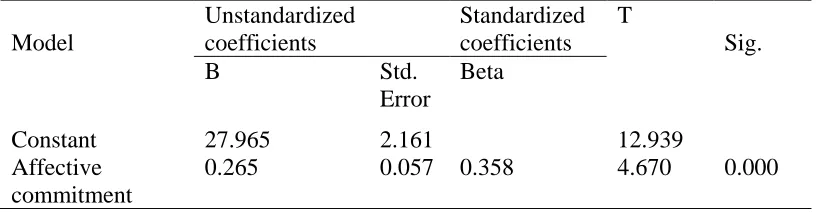
Table 4.2: t-test associated with simple regression analysis on the extent affective commitment
relates to teachers’ performance in secondary schools in Rivers state.
Model
Unstandardized coefficients
Standardized coefficients
T
Sig.
B Std.
Error
Beta
Constant Affective commitment
27.965 0.265
2.161
0.057 0.358
12.939
4.670 0.000
The table showed the probability value to be 0.000 which is less than the alpha level of 0.05. Hence there was a significant contribution between affective commitment and teachers’ performance in secondary schools in Rivers State. Based on the above, the null hypothesis was rejected.
Discussion
Available online: https://pen2print.org/index.php/ijr/ P a g e | 1306
emotionally attached to an organization that gives them the strong drive to remain committed and retain their employment with the organization because they want to do so. In support, Allen and Meyer (2004) posited that affective commitment has to do with the employee’s positive feelings of, identification with, attachment and involvement in the organization’s work and as a result, his performance will be improved.
From the findings of other researchers, it is clear that affective commitment involves the emotions of the teacher towards his/her job, if the teacher is emotionally attached to his job, he performs better and if not his performance becomes poor. The researcher is also of the view that a teacher that is emotionally attached to his/her job performs better than a teacher that does not have any emotion for his job. From observation and findings of the study, it is obvious that when teachers are happy with their job the students benefit to a great extent because their performance will be high. This happens easily when the organization is also committed to its employees by providing their basic needs and those things that will make the work enjoyable for them. By so doing, they do the job as if it was their own and since findings of the study revealed that there is a significant contribution of affective commitment to teachers’ performance, it therefore means that the organization has to play its part in ensuring that teachers’ are emotionally attached to their job so as to improve their performance.
Conclusion
The study concluded that affective commitment predicted 12.80% of teachers’ performance in secondary schools and there was a significant contribution between affective commitment and teachers’ performance in secondary schools in Rivers State.
Recommendations
The following recommendations were highlighted based on the findings of the study.
Available online: https://pen2print.org/index.php/ijr/ P a g e | 1307
2. The principals should ensure that teachers to an extent are satisfied with their job so that they can be committed.
References
Abraham, N. M. (2003). Educational administration in Nigeria. Port Harcourt: Pam Unique.
Ahmed, N. (2003). The school, the teacher and the learning environment. Kaduna: Jami press.
Ako, S. (2013). Analysis of teachers’ job satisfaction in Nigeria. Kaduna. Shamac
Ali, A.A., Zaman, T. D., Tabassam, F., Iqbal, Z. (2011). A study of job satisfaction of secondary school teachers. Journal of Education and Practice.
Anderson L. (2005).Managing Finance and External Relations in South African Schools.London: The Commonwealth Secretariat.
Bagraim, J. J. (2003). The dimensionality of professional commitment. SA Journal of Industrial Psychology.
Çağri, T. M. (2013). A passionate teacher: teacher commitment and dedication to student learning. International Journal of Academic Research in Progressive Education and Development.
Central Bank of Nigeria (2010). The changing structure of the Nigeria economy and implications for development. Lagos: Realm Communications Ltd.
Chamundeswari, S. (2013). Job satisfaction and performance of school teachers. International Journal of Academic Research in Business and Social Sciences.
Chike-Okoli, A. (2006). A handbook on supervision and instruction. Ibadan: Gabesther.
Available online: https://pen2print.org/index.php/ijr/ P a g e | 1308
Eby, L. T, Freeman, D. M, Rush, M.C, & Lance, C. E. (2005). Motivational bases of affective organizational commitment: A Partial Test of an integrative theoretical model. Journal of Occupational and Organizational Psychology.
Ekundayo, H .T (2010). Administering secondary schools in Nigeria for quality output in the 21st century : The principal's challenge. European journal of educational studies.
Eregie, A. E, & Ogiamen, V. O (2007). School supervision and administrative techniques in primary and secondary schools in Nigeria. Journal of Knowledge Review.
Fadipe, J.O. (Eds) (2003). Management of Nigerian Education: School Project Monitoring and School Plant Maintenance. NIEPA, Ondo.
Fields, D. (2002). Taking the measure of work: A guide to validated scales for organizational research and diagnosis. Sage, Thousand Oaks, CA.
Firestone, W., Monfils, L., Martinez, M.C., Polovsky, T., Camilli, G. & Hayes, M. (2001). Principal leadership in the context of a state-testing program: an exploratory study.
Annual Meeting of the University Council for Educational Administration in Cincinnati.
Ingersoll, R. (2001). Teachers’ turnover and teacher shortages: An organizational analysis.
American educational research journal.
Jaiyeoba, O.A, Atanda, A.I. (2003). Quality sustenance in the Nigerian educational system: challenges to government. Op Cit.
Leithwood, K., Harris, A. & Hopkins, D. (2008). Seven strong claims about successful school leadership. School Leadership & Management.
Meyer, J. P. (2002). Commitment in a changing world of work. In H. J. Klein, T. E. Becker, & J. P. Meyer (Eds.) Commitment in organizations: Accumulated wisdom and new directions. Florence, KY: Routledge/Taylor
Available online: https://pen2print.org/index.php/ijr/ P a g e | 1309
Mowday, R.T., Steers, R.M & Porter, L.W. (2002). The measure of organizational commitment. Vocat Behay.
Nakpodia, E.D (2006). Teacher factors in the implementation of universal basic education programme in junior secondary schools in the south senatorial district of Delta State, Nigeria. Journal of Public Administration and Policy Research.
Nakpodia, E.D. (2011). Work environment and productivity among primary school teachers in Nigeria. International Multidisciplinary Journal, Ethiopia.
Ogunlade, J.O. (2015). Motivational factors and teachers commitment in public secondary schools in Mbale Municipality. Journal of Education and Practice.
Peter, D. (2005). The importance of good basic education. http//www.bring2mind.net, Retrieved on 28th January, 2018.
Plecki, M.L., Elfers, A.M., Loeb, H., Zahir, A. & Knapp, M.S. (2005). Teacher retention and mobility: a look inside and across districts and schools in Washington State. Seattle: University of Washington.
Popoola, S. O. L., Bello, A. A. & Alanda, F. A. (2009). Universal basic education in Nigeria: Challenges and way forward. Med well journals.com.