______________________________
Top-down shielding from
distraction in visual attention:
Factors of influence
______________________________
Dissertation
Harriet-Rosita Goschy
______________________________
Top-down shielding from
distraction in visual attention:
Factors of influence
______________________________
Dissertation
at the Graduate School of Systemic Neurosciences
Ludwig-Maximilians-Universität München
submitted by
Harriet-Rosita Goschy
Date of oral defense:
25
thJune 2014
Supervisors:
PD Dr. Michael Zehetleitner
(1
stSupervisor)
Acknowledgements
First of all, I would like to thank my two supervisors Michael Zehetleitner and Hermann Müller for having made this work possible and for their support during the whole process of conducting this thesis. Thanks to Michael Zehetleitner for teaching me a lot of things in science; among others how to design and conduct experiments, how to write scientific articles – and, importantly, how to think analytically and critically. Thanks to Hermann Müller for the valuable input on my research projects, the detailed feedback on my manuscripts, and for providing an inspiring scientific environment at the Chair of General and Experimental Psychology.
I would like to thank the Graduate School of Systemic Neurosciences for offering a stimulating scientific framework, which allows its students to see the bigger picture.
Many thanks to Daniel Reutter for having been extremely helpful with technical obstacles; and to Dragan Rangelov and Paul Taylor for having been very pleasant office mates, who were also always very approachable for questions.
I would also like to thank Stephanie Ganzenmüller and Isabel Koch. Thank you, Stephanie, for countless coffee breaks with enjoyable conversations, which always enriched my day. Thank you, Isabel, for rewarding discussions about science and non-science topics and for having been a great colleague to work with.
Summary
The present work examines top-down shielding from distraction in visual attention; that is, under which circumstances can the intentions and goals of an observer counteract the bottom-up salience of irrelevant distractors. Several factors of influence will be considered: First, prior experience with distractors, i.e. did observers previously acquire an effective distractor shielding strategy; second, intra- vs. cross-dimensionality of distractors, i.e. are irrelevant distractors defined in the same feature dimension (e.g., shape, color) as the target or in a different feature dimension; third, time, i.e. how effective is distractor shielding early vs. later in processing; and finally, the incentive for effective distractor shielding.
Study 1 examined prior distractor experience and intra- vs. cross-dimensionality of
distractors as factors of influence on top-down shielding from distraction. Previous research (Müller, Geyer, Zehetleitner, & Krummenacher, 2009) has shown that prior experience with distractors contributes to effective distractor shielding. Leber and Egeth (2006b) have intro-duced a training paradigm, which can be used to induce a feature search mode (i.e., a goal-directed search-strategy) and a singleton detection mode (i.e., a stimulus-driven search mode). Study 1 set out to connect these two lines of research: The results showed that even in feature search mode prior experience with distractors is crucial for effective distractor shielding. Furthermore, concerning intra- vs. cross-dimensionality of distractors, Study 1 investigated whether top-down distractor shielding in feature search mode is based on independent feature weighting or rather on “hierarchical” feature weighting as suggested by the so-called dimension-weighting account (e.g., Found & Müller, 1996; Müller, Heller, & Ziegler, 1995). It was found that observers trained to use a feature search mode were unable to prevent interference from intra-dimensional distractors, which argues against independent feature weighting in feature search mode. Instead, evidence from additional experiments argues in favor of a “hierarchical” weighting mechanism; however, this was observed unequivocally only for the shape dimension, but not for the color dimension. There may be differences in top-down distractor shielding for the various feature dimensions.
Study 2 focused on time as factor of influence on top-down distractor shielding.
salient, but task-irrelevant distractors. Study 2 set out to systematically examine to which degree even early short-latency saccades can be influenced by top-down distractor shielding by means of a parametric salience difference manipulation between a target and a cross-dimensional distractor. The results showed that the amount of top-down control available already early in processing is non-negligible: When target and distractor were comparable in salience, the majority of short-latency saccades went to the target. Even when the target was somewhat less salient than the distractor, the majority of short-latency saccades could be directed to the target. Accordingly, the estimated point of equal selection probability between target and distractor was shifted to a salience difference where the distractor had a considerable bottom-up salience advantage over the target.
Study 3 investigated incentive as factor of influence on top-down shielding from
Table of Contents
Summary ... 5
1 General Introduction ... 8
1.1 Bottom-up vs. top-down control of visual attention ... 9
1.2 Factors of influence on top-down shielding from distraction ... 12
1.2.1 Prior experience ... 12
1.2.2 Intra- vs. cross-dimensionality ... 14
1.2.3 Time ... 15
1.2.4 Shielding incentive ... 16
1.3 Aims of the thesis ... 17
2 Cumulative Thesis ... 23
2.1 Top-down control of attention: It’s gradual, practice-dependent, and hierarchically organized ... 24
2.2 Early top-down control over saccadic target selection: Evidence from a systematic salience difference manipulation ... 67
2.3 Probability cueing of distractor locations: Both intertrial facilitation and statistical learning mediate interference reduction ... 101
3 General Discussion ... 125
3.1 Synopsis of results ... 125
3.2 Future directions ... 129
3.3 Conclusions ... 132
References (General Introduction and General Discussion) ... 135
Curriculum Vitae ... 139
List of Publications ... 140
Affidavit ... 141
1 General Introduction
In everyday life, visual search is an omnipresent task: Looking for a certain book in the bookshelf, trying to find a friend in a crowd of people or searching for a particular product in the supermarket. However, the object one is looking for is rarely the physically most conspicuous stimulus in the environment; hence, potential distraction by salient, but irrelevant stimuli is a condition one constantly has to deal with. When an object is attentionally selected in accordance with the goals or intentions of the observer, this is usually termed “goal-directed”, “endogenous”, or “top-down” selection (e.g., Yantis, 1993). By contrast, when an object captures attention because of its physical salience, independent of the observer’s goals or intentions, this can be termed “stimulus-driven”, “exogenous” or “bottom-up” selection (e.g., Yantis, 1993). Ultimately, attentional selection is most likely neither fully stimulus-driven, nor fully goal-directed, but rather based on an interaction or combination of these two processes (e.g., Yantis, 1993); accordingly, most theories of visual attention incorporate both bottom-up and top-down components (e.g., Bacon & Egeth, 1994; Folk, Remington, & Johnston, 1992; Müller & Krummenacher, 2006; Navalpakkam & Itti, 2005; Wolfe, 1994). In general, whether or not a salient, but irrelevant stimulus interferes with goal-directed search, could be thought of as being dependent on the relative strengths of the bottom-up activation of the irrelevant stimulus and the top-down control settings of the observer. Under some circumstances top-down distractor shielding may be strong enough to avoid interference by salient, but irrelevant stimuli; in some cases, however, top-down distractor shielding may fail to avoid interference. This dissertation investigates several factors of influence on top-down shielding from distraction, that is, factors which play a role in determining whether or not top-down control can be strong enough to effectively avoid distraction by conspicuous, but irrelevant stimuli.
1.1 Bottom-up vs. top-down control of visual attention
“Distraction” of visual attention is often operationalized in variants of the so-called “additional-singleton paradigm” (Theeuwes, 1992). In this task, observers have to search for a predefined target item surrounded by several nontarget items while in a certain proportion of trials a salient, but task-irrelevant distractor is presented in addition to the target. Since the target and the distractor compete for focal-attentional selection, “distraction” can be measured as response time interference, i.e. response time slowing in the presence compared to absence of the irrelevant distractor.
Theeuwes (1992) originally had his observers search for a shape-defined target item, while a color-defined distractor item was present in half of the trials. This caused significant distractor interference, i.e. observers were significantly slower when the distractor was present compared to absent. By contrast, when observers had to search for a color-defined target item, while a shape-defined distractor was present in half of the trials, there was no significant response time slowing. Since finding the color-defined target item was considerably faster than finding the shape-defined target item (in the no-distractor condition), Theeuwes (1992) concluded that the first one had a higher bottom-up activation (i.e., was more salient) compared to the latter one and that this should account for the observed asymmetry in the described findings. In line with this, he found that when color was made less salient and harder to discriminate (i.e., yellowish red surrounded by yellowish green nontargets compared to red surrounded by green nontargets) than shape, a shape-defined distractor interfered with search for a color-shape-defined target, while a color-shape-defined distractor did not interfere with search for a shape-defined target. Accordingly, Theeuwes (1992; see also Theeuwes, 1991) formulated an automatic-attentional-capture account,
which states that preattentive parallel search cannot be influenced by top-down control to favor a specific feature or dimension. Instead, attention is automatically captured by the item with the highest local feature contrast, i.e. the most salient item, which accounts for distractor interference if the distractor is more salient than the target.
In contrast to Theeuwes’ (1992) automatic-attentional-capture account, there are various other influential theories of visual attention, which incorporate the possibility of top-down control even in preattentive parallel search. For instance, the search-mode account
singleton detection mode or a feature search mode, for performing visual search tasks: Visual search in singleton detection mode is completely stimulus-driven; accordingly if the target item is not the most salient item in the search display, interference by more salient (but task-irrelevant) distractors in inevitable. On the contrary, visual search in feature search mode is goal-directed, that is observers have a strong attentional set for the target-defining feature and can effectively avoid interference by all items not sharing this feature. Bacon and Egeth assume that maintaining a feature search mode may be cognitively more demanding than maintaining a singleton detection mode. This implies that if a task can be successfully accomplished in a feature search mode as well as in a singleton detection mode, observers could tend to minimize cognitive effort and prefer to operate in singleton detection mode – even if this implies accepting a slightly inferior search performance. Consequently, Bacon and Egeth hypothesized that Theeuwes (1992) might have observed strong attentional capture effects not because attentional capture is automatic and inevitable, but rather because his observers used a singleton detection mode rather than a feature search mode. To test this hypothesis, Bacon and Egeth presented their observers with visual search displays, which encouraged the use of a feature search mode: For instance, in one experiment, observers had to search for a shape-defined target while a color-defined distractor was present in half of the trials; critically, however, in one third of the trials an additional unique shape was present and in another third of the trials two additional unique shapes were present. Under those conditions, a singleton detection mode would frequently favor the wrong item, and, hence, observers were expected to use a feature search mode. In line with this, there was no significant distractor interference – not even for the one third of displays, which contained only one unique shape (i.e., the target item). Accordingly, Bacon and Egeth concluded that distractor interference can be avoided if observers are using a feature search mode.
Another account, which takes a strong stance in favor of top-down control over attentional selection, is the contingent-attentional-capture account (Folk et al., 1992). In one
the abrupt onset group, valid cues led to significant response time benefits, and invalid cues led to significant response time costs. While there were also significant benefits for valid cues in the color group, there were no significant costs for invalid cues in this group. This means that invalid cues only produced significant response time costs when they shared the target-defining feature, but valid cues caused significant response time benefits irrespective of whether or not they shared the target-defining feature. According to Folk et al. (1992), this pattern of results can be interpreted in terms of “contingent involuntary orienting”: Depending on the task requirements, observers form an attentional set for certain stimulus properties; attentional capture by irrelevant stimuli should then be dependent on whether or not the irrelevant stimuli share the critical stimulus property or not. For instance, when looking for a color-defined target, there should be no attentional capture by irrelevant onset-defined items; when, however, looking for an onset-onset-defined target, attentional capture by onset-defined items should not be effectively avoidable.
1.2 Factors of influence on top-down shielding from distraction
Good theories of visual attention have to account for factors of influence on top-down shielding from distraction, i.e. why does capture occur under certain circumstances but can be prevented or reduced under different circumstances? In the following, four factors of influence on top-down shielding from distraction, which will be relevant for the main experimental part of this thesis, will be outlined: Prior experience with distractors, intra vs. cross-dimensionality of the distractor in relation to the target, time (i.e., early vs. late in processing), and, finally, distractor shielding incentive.
1.2.1 Prior experience
could be associated with a certain search mode: In their experiment, during a training phase, singleton detection and feature search displays were always paired with a certain task-irrelevant scene context. In the subsequent test phase, observers were presented with option trials, which allowed for the use of both search modes. However, each of these displays was randomly presented within a scene, which had been paired with either feature search mode or singleton detection mode during the training phase. In line with the idea that context can reactivate an associated search mode, in the test phase, distractor interference was only present for displays embedded in a scene context previously associated with a singleton detection mode, but not for displays embedded in the feature search mode scene context.
Müller et al. (2009) have suggested that distractor experience per se, rather than learning to handle distractors in a certain search mode, is a critical factor for top-down shielding from distraction. According to them, the acquisition of a top-down shielding strategy during practice is a key factor for effective distractor shielding. This was, among others, tested in an experiment (Müller et al., 2009, Experiment 2), in which groups of observers received different practice blocks before the measurement of distractor interference effects: Half of the observers consistently encountered irrelevant distractors during the practice block (100% distractor prevalence), whereas the other half of the observers never encountered distractors during the practice block (0% distractor prevalence). In line with the idea that observers in the 100% distractor groups had the opportunity to acquire a distractor shielding strategy, while observers in the 0% distractor groups did not, the 100 % groups exhibited subsequent reduced distractor interference compared to the 0% groups. According to the dimension-weighting account (e.g., Found & Müller, 1996; Müller
et al., 1995; Müller et al., 2003) distractor shielding is achieved by increasing the top-down weight for the target-defining dimension or by decreasing the top-down weight for the distractor-defining dimension. Müller et al. (2009) speculated that distractor practice could be a critical factor for distractor shielding because, during practice, observers might learn to optimally tune the weight distribution for the target and distractor dimensions.
to the irrelevant distractor dimension (or feature) after encountering a distractor defined in that dimension (or by that feature). Accordingly, on the next trial, a distractor defined by that dimension (or feature) would cause comparably less activation on the master salience map, which guides attentional selection, and, hence would lead to less distractor interference.1 Intertrial distractor shielding effects of this kind are also in line with various findings from research on cognitive control processes and their role in the resolving of response conflict: Interference from response incongruent stimuli is reduced if response conflict was present, as compared to absent, on the previous trial (e.g., flanker task: Gratton, Coles, & Donchin, 1992; Stroop task: Kerns et al., 2004; Simon task: Stürmer, Leuthold, Soetens, Schröter, & Sommer, 2002). These effects have often been interpreted in terms of “conflict monitoring” (Botvinick, Braver, Barch, Carter, & Cohen, 2001). According to this prominent theory, the anterior cingulate cortex detects conflict on a given trial and thereupon engages the recruitment of additional cognitive control, which modulates performance on subsequent trials: The recruited cognitive control on the current trial n is larger when conflict was encountered on the preceding trial n-1, compared to when no conflict was encountered – which predicts interference to be smaller on trials following conflict trials compared to trials following non-conflict trials.
1.2.2 Intra- vs. cross-dimensionality
In addition to being influenced by prior experience, there is reason to assume that distractor shielding may differ depending on whether the distractor item is defined in the same or in a different dimension than the target item. For instance, when looking for a shape-defined target, it might be easier to shield against interference from a color-defined (cross-dimensional) distractor compared to interference from a shape-defined (intra-(cross-dimensional) distractor. Theoretically, this claim can be derived from the dimension-weighting account
(e.g., Found & Müller, 1996; Müller et al., 1995; Müller et al., 2003) according to which the weighting of features and dimensions is hierarchically organized with the result that the weighting of a particular feature will always bring along an increased weighting of the whole feature dimension compared to other feature dimensions. Consequently, if observers are presented with a target and a distractor defined in the same dimension, distractor interference should not be effectively preventable: By assigning weight to the target-defining feature, the
1 Note however that these n-1 effects were dependent on the overall distractor frequency: That is, they were more
weight of any distractor defined by another feature in the same dimension would also be increased; although, depending on the strength of the hierarchical coupling, not necessarily to the same degree as the target weight. Accordingly, there would be two activation peaks on the master salience map, and the distractor would be processed with priority in a certain proportion of trials, inevitably causing interference.
Empirical support for this notion comes for instance from Kumada (1999), who had his observers search for orientation-defined target items (rectangles tilted 45° to the left relative to vertical nontargets) and presented them with intra-dimensional distractors. These distractors were (in different experiments) either equally salient as the target (rectangles tilted 45° to the right) or less salient than the target (rectangles tilted 22.5° to the right). In a simple search task (where observers had to indicate the presence vs. absence of the target item), both the equally salient and the less salient intra-dimensional distractor caused significant response time slowing (see van Zoest & Donk, 2004, for similar results). These results were replicated in two experiments with compound search tasks (where observers had to indicate the location of a line segment intersecting the target item): A distractor tilted 45° to the right significantly interfered with search for a target tilted 45° to the left. The finding of less salient intra-dimensional distractors causing response time slowing was replicated within the color dimension: For two groups of observers the target item was either a red rectangle, and the distractor a green rectangle (surrounded by gray nontargets), or the other way around. Since response times for the green target (in the no-distractor condition) were significantly faster than response times for the red target (in the no-distractor condition), it can be concluded that the green feature contrast was higher compared to the red feature contrast. Despite that, there was significant distractor interference in both search groups; again, suggesting that if target and distractor are defined within the same dimension, dis-tractor shielding cannot even avoid interference by disdis-tractors less salient than the target.2
1.2.3 Time
Another important factor of influence on top-down shielding from distraction is “time”: For instance, according to the current version of the automatic-attentional-capture account
(Theeuwes, 2010), attentional selection is initially completely driven by the bottom-up factors of the environment. Hence, the first location to be selected rather automatically is the
one with the highest salience or feature contrast (“attentional capture”). Only later in processing, i.e. time, top-down control comes into play by influencing the speed of attentional disengagement from the selected item. Strong support for this notion comes from Theeuwes, Atchley, and Kramer (2000), who presented their observers with a variant of the classical additional-singleton paradigm (Theeuwes, 1992): The task was to search for a shape-defined target item, while a color-defined distractor item was present in some trials. Critically, the distractor item appeared at different stimulus-onset asynchronies (SOAs) before the presentation of the remaining search display. The results showed that there was no distractor interference effect, when the distractor was presented 150 ms (or longer) before the search display. It was concluded that while the color distractor captured attention early in processing, attentional capture could be overcome later in time by top-down control.
Another theory, which emphasizes the importance of time in top-down shielding from distraction is the timing account of visual selection (e.g., van Zoest et al., 2004): Van
Zoest et al. (2004) employed a saccadic selection variant of the classical additional-singleton paradigm (Theeuwes, 1992), in which observers were asked to make a speeded saccade towards a known target item, while a salient, but irrelevant distractor item was likewise present in the search display. Across several experiments, they observed that the proportion of correct target saccades increased with increasing saccadic latency, i.e. observers made more correct target fixations, the slower the eye movements were initiated. When target and distractor were comparable in salience (e.g. tilted 45° to the left or to the right relative to vertical nontargets), they also attracted an equal amount of early (i.e., short-latency) saccades; only later in time (i.e., with increasing saccadic latency) were observers able to direct more saccades to the target in comparison to the equally salient distractor. Based on these findings, van Zoest et al. (2004) concluded that “saccadic visual selection is initially completely stimulus driven”, whereas “later in time, goal-driven control dominates visual selection” (p. 755). Several subsequent studies by van Zoest and Donk (e.g., 2005, 2006, 2008) provided further empirical support for this view; however, van Zoest and Donk (2008) departed slightly from the strong original conclusion that saccadic visual selection is initially completely determined by bottom-up factors and acknowledged some limited top-down selectivity even early in time.
1.2.4 Shielding incentive
shielding incentive as distractor prevalence: If distractors appear in a high proportion of trials, i.e., potentially capturing attention rather often, observers should have a comparably higher incentive to minimize interference by those distractors. By contrast, if distractors appear only in a low proportion of trials, observers might be more willing to tolerate the little interference those distractors might cause – especially considering that distractor shielding is probably an effortful process. In line with this, Müller et al. (2009) observed more pro-nounced response time interference effects in trial blocks with a higher distractor prevalence and comparably smaller interference effects in blocks with a lower distractor prevalence (see also Forster & Lavie, 2008, and Zehetleitner et al., 2009, for similar results).
Similar results were reported by Geyer, Müller, and Krummenacher (2008), who not only measured manual response times, but also eye movements: In their experiment, the presence of a salient, but irrelevant distractor, led to increased saccadic latencies compared to the distractor-absent condition – however, only if distractors were rather infrequent, i.e., when the shielding incentive was low. In addition, (erroneous) distractor fixations occurred more often if distractors were infrequent compared to frequent. Sayim, Grubert, Herzog, and Krummenacher (2010) used onset (rather than static) distractors and likewise observed a decreasing percentage of saccades captured by the distractor, the higher the proportion of onset distractors within a block.
Distractor prevalence effects can also be accounted for by the conflict monitoring model (Botvinick et al., 2001) previously introduced (see 1.2.1): One core assumption of this model is that the recruited cognitive control, rather than decaying immediately after the next trial, is carried along some time – and, so, does not only influence performance on the immediately following trial, but also on subsequent trials. Therefore, if conflict trials are frequent, the recruited cognitive control accumulates and, thus, reduces the overall inter-ference effect, compared to when conflict trials are rare.
1.3 Aims of the thesis
effective with prior distractor experience (e.g., Müller et al., 2009) and with cross-dimen-sional compared to intra-dimencross-dimen-sional distractors (e.g., Kumada, 1999). However, it is yet unknown, whether these two factors of influence are also relevant when observers are using a goal-directed search strategy, i.e., a feature search mode. Gaining such information will be helpful in evaluating the search-mode account (e.g., Bacon & Egeth, 1994) and its associated idea of two distinct search modes. Similarly, previous research has shown that top-down distractor shielding is more effective later in time than early in time. However, little is known about the magnitude of early top-down control. Estimating the magnitude of early top-down control is, among other things, important to evaluate the claim that attentional se-lection is initially completely driven by the bottom-up factors of the environment, as suggested by the current version of the automatic-attentional-capture account (Theeuwes, 2010). Finally, previous research has shown that top-down distractor shielding is more effective if observers have a higher shielding incentive, i.e., distractor interference is reduced if distractors appear frequently as compared to rarely (e.g., Müller et al., 2009). Yet it is still unknown, whether a shielding incentive of this kind can also be “fine-tuned” to specific distractor areas (which frequently contain distractors) and what the underlying mechanism of such a fine-tuning could be. Investigating this possibility is potentially relevant for Guided-Search-type models of visual attention (e.g., Wolfe, 1994; Found & Müller, 1996), since the existence of such a location-specific shielding mechanism would suggest that top-down feature- or dimension weighting could also involve a spatial component. Taken together, the present dissertation set out to specify present knowledge about factors of influence on top-down shielding from distraction, thus providing potentially relevant information for current theories of visual attention.
Study 1 set out to investigate both prior experience (see 1.2.1) and intra- vs. cross-
distractors were present in half of the trials; accordingly, those observers also had prior experience with distractors, which, according to Müller et al. (2009), may be a critical factor for effective top-down distractor shielding. Hence, Study 1 set out to investigate whether prior distractor experience is a prerequisite for effective distractor shielding in feature search mode. To this end, Experiment 1 of Study 1 was a replication of the search mode training paradigm of Leber and Egeth (2006b), while Experiment 2 modified the paradigm in so far as no distractors were shown during the training phase, which was supposed to induce the respective search modes (feature search mode and singleton detection mode). If prior experience with distractors is crucial for effective interference reduction in feature search mode, the feature search group of Experiment 1 should be able to avoid distractor inter-ference, while the feature search group of Experiment 2 should not be able to do so.
Study 2 focused on time (see 1.2.3) as factor of influence on top-down shielding from
distraction: The timing account of visual selection (e.g., van Zoest et al., 2004) suggests that
early visual selection is mostly stimulus-driven, whereas later in selection goal-directed control takes over; accordingly, when observers are asked to make an eye movement to a target item, while a salient, but irrelevant distractor item is present at the same time, the vast majority of early (short-latency) eye movements should go to the salient distractor, and only later (long-latency) eye movements should be successfully guidable to the target. This pattern of results has been demonstrated repeatedly (e.g., van Zoest et al., 2004; van Zoest & Donk, 2005, 2006, 2008). The aim of Study 2 was to systematically investigate to which degree even early (short-latency) eye movements can be subject to top-down guidance.
To this end, the salience difference between a target item and a cross-dimensional distractor was parametrically manipulated, which allowed to examine percentage (early) target and distractor fixations as a function of the salience difference between target and distractor. Salience difference was estimated (in a separate experiment) as the difference in detection response times between the target feature and the distractor features (see Zehetleitner, Koch, Goschy, & Müller, 2013, for a similar salience estimation procedure): The faster the distractor feature was detected by comparison to the target feature, the more salient by comparison to the target feature it was assumed to be; distractor features, which were detected equally fast as the target feature, were assumed to be of comparable salience.
When examining percentage target and distractor fixations as a function of their parametric salience difference, a pure bottom-up account of early saccadic target selection and a top-down account of early saccadic target selection make divergent predictions; this allows for a comparison of these two accounts: First, percentage target and distractor fixations for a salience difference close to zero were analyzed. In this case, target and distractor should be of comparable salience. Hence, according to a pure bottom-up account of early saccadic target selection, both target and distractor should attract an equal amount of early fixations (50% : 50%).3 On the contrary, according to a top-down account of early saccadic target selection, the target should have an increased selection probability and, thus, attract more early fixations than the distractor. Second, the percentage fixation distributions for distractors more salient than the target were analyzed: If early saccadic target selection
3 As previously discussed (see 1.2.3), van Zoest et al. (2004) did in fact observe an equal amount of early target and
were purely bottom-up, distractors more salient than the target should always attract more early fixations than the target. By contrast, if there were top-down control over early saccadic target selection, it should be able to overcome a certain bottom-up salience advantage of the distractor: Hence, if the target is only somewhat less salient than the distractor, it should still be able to attract more early fixations than the distractor. Third, the salience difference point of equal selection probability (for target and distractor) was estimated: According to a pure bottom-up account of early saccadic target selection, target and distractor should have a comparable selection probability if they are of comparable salience. However, if the estimated point of equal selection probability is shifted to a salience difference at which the distractor is more salient than the target, this is a strong (even quantitative) indicator for early top-down control over saccadic target selection.
Study 3 was concerned with the question whether the observers’ “shielding incentive” (see
1.2.4) can also be fine-tuned to specific distractor locations: I.e., if distractors appear compa-rably frequently in a certain region of the visual field, can observers selectively suppress interference from distractors appearing in this area of the visual field? If this were the case, interference by distractors appearing in frequent distractor regions should be reduced compared to distractors appearing in rare distractor locations.
A similar question was investigated by Reder, Weber, Shang, and Vanyukov (2003) in a target localization paradigm, in which observers had to indicate which of four locations contained a target item, while a distractor item could be present at the same time at one of the other locations. While the target item appeared equally often at each of these four locations, the distractor item was not equally probable at these locations. This manipulation affected the response times: Distractors at frequent locations caused essentially no response time slowing, whereas distractors appearing at rare locations led to substantial slowing.
Shaw & Shaw, 1977). Traditionally, this effect has been attributed to “statistical learning”, i.e. the formation of location-specific stimulus expectancies over a longer sequence of trials (e.g., Druker & Anderson, 2010; Geng & Behrmann, 2002, 2005; Hoffmann & Kunde, 1999). However, if a target is more likely to appear in a certain location, target position repetitions in this location are also more frequent compared to a location where the target is less likely to appear. Hence, Walthew and Gilchrist (2006) have suggested that the proba-bility cueing effect might also be attributable to intertrial facilitation due to target position repetitions: A vast amount of research has shown that repeating the target position on conse-cutive trials leads to faster response times compared to changing the target position (e.g., Geyer, Zehetleitner, & Müller, 2010; Kristjánsson, Vuilleumier, Schwartz, Macaluso, & Driver, 2007; Kumada & Humphreys, 2002; Maljkovic & Nakayama, 1996).
2 Cumulative Thesis
2.1 Top-down control of attention:
It’s gradual, practice-dependent, and hierarchically organized
SUMMARY
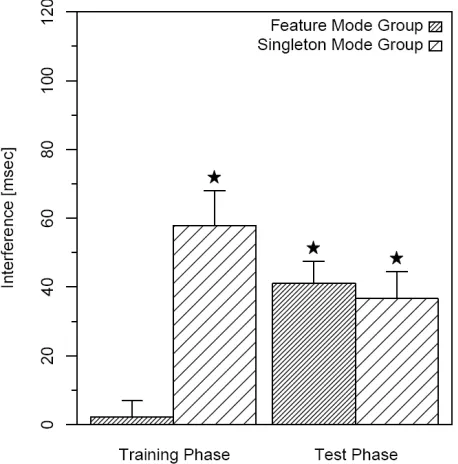
Leber and Egeth (2006b) have developed a training paradigm, which can be used to induce different search modes: In this paradigm, observers trained to use either a feature search mode or a singleton detection mode during a training phase, carry over this search mode to a test phase, where both search modes would be applicable. In the first study presented in this dissertation, this training paradigm was utilized, to investigate the contribution of distractor practice to distractor shielding in feature search mode and the specificity of distractor shielding in feature search mode, that is, are there differences in shielding against intra-dimensional distractors (i.e., distractors defined in the same dimension as the target) compared to cross-dimensional distractors (i.e., distractors defined in a different dimension than the target)? Experiment 1 replicated the results of Leber and Egeth (2006b): Observers trained to use a feature search mode during a training phase did not show any distractor interference during a subsequent test phase, while observers trained to use a singleton detection mode during a training phase, could not effectively prevent distractor interference during the subsequent test phase. Experiment 2 was a modification of Experiment 1, in which there were no distractors shown during the training phases: Under those circum-stances, both search mode groups were unable to avoid distractor interference during the subsequent test phase. This demonstrates that, even in feature search mode, distractor practice is essential for effective distractor shielding.
cross-dimensional distractors with the distractor-defining feature changing from the training to the test phase. If top-down distractor shielding were based on hierarchical feature weighting, distractor practice with one distractor feature should facilitate distractor shielding against another distractor defined in the same distractor dimension. In Experiment 4, color-defined distractors were presented (in addition to a shape-color-defined target); distractors in the training phase were orange, while distractors in the test phase were pink. However, feature search mode observers were unable to utilize distractor practice with the orange training phase distractor to effectively shield against the pink test phase distractor. In Experiment 5, shape-defined distractors were presented (in addition to a color-defined target); distractors in the training phase were squares, while distractors in the test phase were diamonds. By contrast to Experiment 4, feature search mode observers could utilize distractor practice with the square training phase distractor to effectively avoid distractor interference by the diamond test phase distractor. Taken together, the present results are difficult to reconcile with the idea of independent feature weighting. Instead, they suggest a hierarchical weighting structure – at least for the shape dimension, but not necessarily for the color dimension. This suggests that weighting structures might differ between various feature dimensions (e.g., between color and shape).
CONTRIBUTIONS
HG and MZ share first authorship. Parts of the experimental work for this study were done
in the context of the diploma thesis project of HG, which was supervised by MZ. HG and
MZ conceived and designed the experiments. HG collected and analyzed the data. HG
discussed the results with MZ and HJM. HG, MZ, and HJM wrote the paper.
REFERENCE
Copyright © 2012 by the American Psychological Association. Reproduced with permission. The official citation that should be used in referencing this material is Zehetleitner, M., Goschy, H., & Müller, H. J. (2012). Top-down control of attention: It’s gradual, practice-dependent, and hierarchically organized. Journal of Experimental Psychology: Human
Perception and Performance, 38(4), 941-957. http://dx.doi.org/10.1037/a0027629
Top-down control of attention:
It’s gradual, practice-dependent, and hierarchically organized
Michael Zehetleitner*
Ludwig-Maximilians-Universität München, Munich, Germany
Harriet Goschy*
Graduate School of Systemic Neurosciences, Ludwig-Maximilians-Universität München, Munich, Germany
Hermann J. Müller
Ludwig-Maximilians-Universität München, Munich, Germany, and Birkbeck College, University of London, London, UK
ABSTRACT
When searching for a ‘pop-out’ target, interference from a salient but irrelevant distractor can be reduced or even prevented under certain circumstances. Here, five experiments were conducted to further our understanding of three different aspects of top-down interference reduction: first, whether or not qualitatively different search modes can account for different reduction patterns; second, whether distractor practice plays a causal role in reduction; and third, how specific reduction is, that is, whether interference by intra-dimensional distractors can be reduced as effectively as interference by cross-dimensional distractors. The results provide evidence that interference reduction does not critically depend on the implement-tation of a feature search mode, but rather on practice with the distractor, that is, the acquisition of an effective suppression strategy. In addition, they suggest that interference reduction is based on hierarchically organized feature weighting (‘dimension weighting’), rather than on completely independent feature weighting.
INTRODUCTION
Most current theories of visual search take the possibility of top-down control over the allocation of attention into consideration (e.g., Folk, Remington, & Johnston, 1992; Bacon & Egeth, 1994; Wolfe, 1994; Navalpakkam & Itti, 2005; Müller & Krummenacher, 2006; Zehetleitner, Krummenacher, Geyer, Hegenloh, & Müller, 2011). According to these accounts, by applying top-down control, bottom-up salience calculations can be modulated in accordance with the behavioral goals of the observer, which has the potential to attenuate attentional capture by distracting objects. Attentional capture is usually measured as response time (RT) slowing in the presence, compared to the absence, of a distracting object (distractor ‘interference’). Indeed, various studies have shown that interference by salient but irrelevant singletons can be reduced or even prevented under certain circumstances (e.g., Bacon & Egeth, 1994; Leber & Egeth, 2006a, 2006b; Müller, Geyer, Zehetleitner, & Krummenacher, 2009). However, what remains controversial is how top-down control actually works. The present study focuses on three issues of how top-down control reduces interference in visual search, which are currently under debate: (i) Are there qualitatively different search modes? (ii) What is the contribution of practice? (iii) What is the specificity of top-down control?
Are there qualitatively different search modes?
differential ‘search modes’. The search-mode account, initially proposed by Bacon and Egeth (1994; see also Pashler, 1988), assumes that there are two distinct strategies, or processing modes, for performing visual search tasks: a singleton detection mode and a feature search mode (in the following shortly referred to as ‘singleton mode’ and ‘feature mode’). Observers operating in singleton mode automatically allocate attention to the item generating the highest local salience (feature contrast) signal; that is, search is stimulus-driven. Consequently, interference is unavoidable if the target is not the most salient item. By contrast, observers using a feature mode have a fixed attentional set for the (known) target-defining feature, preventing interference by all features not matching this set. Thus, according to the search-mode account, the operation of a feature mode is the causal mechanism underlying interference reduction.
Strong support for this idea comes from findings of divergent patterns of distractor interference under induced singleton and feature modes (Leber & Egeth, 2006a, 2006b). In addition, the same studies have provided evidence that, once established, the different search modes are used persistently even in the face of small task changes. Recently, Leber, Kawahara, and Gabari (2009) showed that even after an interval of one week, observers reactivated an established search mode when presented with a similar task.
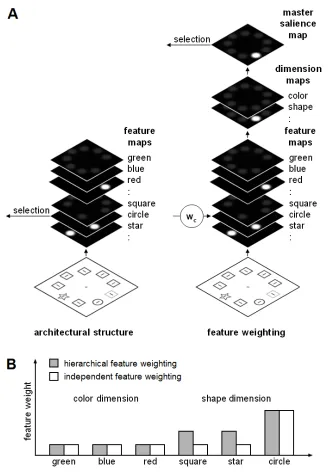
Note, however, that there are two possible ways in which a feature mode could be realized (see also Figure 1a): On the one hand, attentional selection could be based directly on the relevant target feature map (e.g., Treisman & Souther, 1985; Pashler, 1988; see also Bravo & Nakayama, 1992). In this case, activity in all other feature maps would be ignored and distractors not sharing the target-defining feature would have no capacity at all for capturing attention. On the other hand, attentional selection could be based on a master salience map composed of the activity from various feature maps (e.g., Koch & Ullman, 1985; Itti & Koch, 2000). In this case, observers would top-down assign a high weight to a particular feature they are interested in, while scaling down the weighting for all other features (e.g., Wolfe, 1994; Navalpakkam & Itti, 2005). On the first, architectural version of
the feature mode, interference reduction would work in a binary/discrete (all-or-nothing) fashion, while on the second, weighting version, the strength of top-down weights to a
Figure 1. (A) Schematic representation of two architectures that can realize the feature
mode: In the architectural structure (left), attentional selection is based solely on the
relevant feature map. In the feature weighting structure, attentional selection is based on a
map (circle: wc), which leads to an increased activation of the weighted feature signal (relative to the unweighted feature signals) on the master salience map. Attentional capture is therefore dependent on the amount of exerted feature weighting: If the target weighting is strong enough to outweigh the bottom-up activation of the distractor features (as in the example depicted), distractor interference would be completely prevented. Note that on this assumption of independent feature weighting, both the weighting of the intra- and the cross-dimensional distractor can be reduced to a similar degree (B, independent feature weighting). In contrast, given a hierarchically organized feature weighting structure as proposed by the dimension-weighting account (B, hierarchical feature weighting), weighting of the target feature (circle: wc) will automatically increase the weighting of other features within the same dimension (compared to features of other dimensions). Accordingly and depending on the strength of the hierarchical weight coupling, interference reduction for intra-dimensional distractors cannot be achieved as effectively as for cross-dimensional distractors.
In more detail, findings of interference reduction previously attributed to qualitatively different search modes can also be explained by a continuum of top-down control as suggested by Guided-Search-type models (e.g. Wolfe, Cave, & Franzel, 1989; Wolfe, 1994; Müller, Heller, & Ziegler, 1995; Found & Müller, 1996, Navalpakkam & Itti, 2005). These models assume a single processing route with a two-stage architecture: In the first, preattentive, parallel stage, local salience-based feature contrast signals are calculated, which can be top-down modulated or ‘weighted’ prior to their integration into the master salience map, which regulates access to the second, limited-capacity stage required for more complex operations, such as object identification (Müller & Krummenacher, 2006; Zehetleitner, Proulx, & Müller, 2009; Zehetleitner, Krummenacher, & Müller, 2009; Zehetleitner, Krummenacher, et al., 2011). Accordingly, whether or not interference by salient but task-irrelevant distractors can be down-regulated should not depend on the application of a certain search mode, but rather on the top-down weight setting on a given trial (i.e., whether or not it is strong enough to overcome the bottom-up activation generated by a salient distractor).
every trial) compared to mixed-singleton search (in which the target feature changes unpredictably from trial to trial within the same dimension) – at variance with the search-mode account, on which a salience-based strategy should have been used in both tasks. This finding led Lamy and colleagues to question the notion of a distinct singleton mode that is solely reliant on stimulus salience. On this background, the first issue to be examined is whether there are qualitatively different search modes, and, if so, whether interference reduction in feature mode works in an all-or-nothing fashion or whether there is a continuum of how strongly bottom-up signals are modulated by feature-based top-down weighting.
What is the contribution of practice?
If observers are capable of reducing the interference caused by salient but task-irrelevant distractors, one central question is: why do they not always choose to do so? Recent findings indicate that the extent to which top-down control is applied depends both on the incentive to do so (provided by the task) and on practice in dealing with the distractor. Attentional capture, by a distractor that is defined in another dimension and physically more salient than the target, varies in magnitude as a function of distractor prevalence, with relatively little interference when distractors are frequent (thus providing a high incentive for suppression) and pronounced interference when distractors are rare (providing a low suppression incentive; Müller et al., 2009; Geyer, Müller, & Krummenacher, 2008; Zehetleitner, Proulx, & Müller, 2009; Forster & Lavie, 2008). In addition, observers who consistently encountered, relative to observers who never encountered, distractors in a practice block before the measurement of interference showed reduced distractor interference – arguably attributable to the fact that they had the opportunity to acquire a suppression strategy (Müller et al., 2009). Following up these findings, the second question to be examined concerns the contribution of distractor practice to effects of interference reduction, that had previously been attributed solely to the acquisition of different search modes.
What is the specificity of top-down control?
is possible even with distractors defined in the same dimension as but by a different feature to the target.
By contrast, there is an alternative account, which assumes that feature-specific top-down control has a differential impact on other features of the same or of different dimensions. This idea is spelled out in detail in the dimension-weighting account (e.g., Müller et al., 1995; Found & Müller, 1996), which is essentially an extension of the Guided- Search model (e.g., Wolfe, Cave, & Franzel, 1989; Wolfe, 1994). It assumes that the weighting of features and dimensions is hierarchically organized, such that the weighting of a particular feature will always involve an increased weighting of all features defined in the same dimension compared to features of other dimensions (see also Figure 1b). This idea of top-down ‘hierarchical feature weighting’ is supported by results of a trial-by-trial symbolic pre-cueing experiment (Müller, Reimann, & Krummenacher, 2003; see also Zehetleitner, Krummenacher, et al., 2011; Zehetleitner, Hegenloh, & Müller, 2011): the cueing benefits in this experiment were comparable regardless of whether the target was actually defined by the cued feature or rather by another feature in the same dimension; for example, when observers, in response to the cue word ‘red’, prepared for a target defined by the color red (79% cue validity), a blue target (with a 7% likelihood) was detected almost as fast as the cued target, but faster than a target defined by left- or right-tilted orientation (each with a 7% likelihood). Similarly, Meeter and Theeuwes (2006) reported that cueing the target identity not only speeded up target detection, but also influenced distractor interference: distractors defined in the cued dimension (but by another feature) caused larger interference as distractors defined in another dimension (see also Schubö & Müller, 2009, for electro-physiological evidence of differential processing of intra- vs. cross-dimensional distractors).
are defined in different dimensions; by contrast, independent feature weighting should lead to comparable interference reduction with both intra- and cross-dimensional distractors.
Even though top-down control in feature mode has mostly been assumed to be based on independent feature weighting or feature selection, Kumada (1999) casted doubt on this possibility in a re-evaluation of the original search mode experiments: Bacon and Egeth (1994) had attempted to discourage observers from using a singleton mode by adding other unique shapes, in addition to the target shape, to the search displays. In one third of the trials, the target was either the only unique shape, one of two unique shapes, or one of three unique shapes. While the presentation of a color distractor (in addition to the shape singletons) caused no significant interference, as expected if observers were operating in feature mode, RTs became significantly affected by the number of unique shapes. While Bacon and Egeth attributed the slowed RTs with additional unique shapes to reduced nontarget-nontarget similarity (Duncan & Humphreys, 1989), Kumada pointed out that they might as well reflect attentional capture by (one of) the additional shape singletons. In support of this argument, Kumada (similar to van Zoest & Donk, 2004) reported that with target and distractor defined in the same dimension, even distractors less salient than the target caused interference.
Purpose of the present study and overview of the experiments
The present study was designed to clarify the three open issues elaborated above, by examining interference effects in different induced search modes under various practice conditions and with both intra- and cross-dimensional distractors. It is important to point out that in situations in which the search task can be successfully accomplished using either search mode (for instance, even though the target-defining feature is known exactly, making a feature search possible, the target may also be easily detectable using a salience-based strategy), it is not possible to induce a feature mode simply by instructing observers to use one (Kawahara, 2010). However, it is possible to induce a feature mode by making observers use it in an appropriately designed training task, as has been demonstrated in several studies (Leber and Egeth, 2006a, 2006b; Leber et al., 2009). Therefore, the present study applied the training paradigm of Leber and Egeth (2006b), so as to ensure that observers were indeed using the intended search strategies.
Leber and Egeth (2006b) initially trained two separate groups of participants to use either a singleton or a feature mode. This training phase with separate tasks was followed by a test phase in which the task was identical for the two groups and, importantly, permitted the observers to use either search mode. It was observed that in the latter task, the singleton mode observers exhibited significant distractor interference, whereas the feature mode observers showed no sign of a capture effect at all. It was concluded that both groups stuck to the respective search mode they were induced to use during the initial training phase.
test phase distractor should nevertheless be conducive to minimizing interference in the test phase.
EXPERIMENT 1
Experiment 1 was a replication of Leber and Egeth’s (2006b) study and, thus, closely modeled after their methodology. Two groups of participants were trained to use either a singleton or a feature mode. Observers in the singleton mode training searched for a consistently shape-defined but featurally non-predictable target among shape-homogeneous nontargets. As the observers did not know the exact target-defining feature on a given trial, they had no other choice but to adopt a singleton mode, that is, to search for any discontinuity in the display. Observers in the feature mode training searched for a target of consistent shape among shape-heterogeneous nontargets (similar to Bacon & Egeth, 1994). By adding additional unique shapes to the display, a stimulus-driven search strategy was rendered ineffective and observers were forced to adopt a feature mode. The two different training phases were followed by an identical test phase, of so-called option trials (e.g.,
Leber & Egeth, 2006a), for both search groups: on these trials, the target was consistent (i.e., always the same) in shape and the nontargets were homogeneous – thus, it was possible to operate in either search mode for finding the target. In this situation, where both search modes are available in principle, observers typically maintain their previously established search mode (see Leber & Egeth, 2006a, 2006b; Leber et al., 2009). In both the training and test phases, a color distractor was presented in half of the trials (the other half were no-distractor trials). Additionally, the number of items in the search display (the ‘display size’) was manipulated to permit search efficiency (i.e., the slope of the function relating search RT to display size) to be assessed. Controlling search efficiency is necessary to circumvent the ‘serial-search criticism’ of Theeuwes (2004), who had suggested that attentional capture occurs only in efficient, but not inefficient, search. The purpose of Experiment 1 was to replicate Leber and Egeth’s (2006b) finding of divergent interference patterns in different search modes, while also testing for interference reduction through practice over the course of the experiment.
Method
Participants. Twenty-eight (17 female, all right-handed) observers with a
were randomly assigned to one of the two training groups: half of them to the singleton mode group, the other half to the feature mode group. All reported normal or corrected-to-normal visual acuity and color vision. They were either paid for their participation (at a rate of 8 Euros per hour, approximately 11 USD) or received a course credit.
Apparatus. The experiment was conducted in a sound-isolated, dimly-lit chamber
with black interior. Stimuli were generated with a ViSaGe system (Cambridge Research Ltd., UK), controlled by a personal computer running under the Windows XP operating system, and presented on a 22-inch Mitsubishi Diamond Pro 2070SB with a screen refresh rate of 120 Hz and a screen resolution of 1104 x 828 pixels. Observers viewed the monitor from a distance of about 70 cm, maintained by using a chin rest. They reported the horizontal or vertical orientation of a line within the target item by pressing the right or left button of a mouse using their left- or, respectively, right-hand index finger.
Stimuli. The stimulus display, presented on a black background, consisted of either
five or nine outline shapes whose geometric centers were equidistantly arranged on the circumference of an imaginary circle with a radius of 3.75° of visual angle around a white fixation cross. This fixation cross (0.5° wide x 0.5° high; line width of 0.05°) was situated in the center of the screen. The outline shapes presented were a circle (diameter of 1.5°), a square (side length of 1.3°), a diamond (a square rotated through 45°), and an equilateral upwards-pointing triangle (side length of 1.3°). All contours had a line width of 0.1° and were green (RGB: 0.36, 0.97, 0.42). If a distractor was present, one of the shapes was red (RGB: 1, 0, 0). Centered inside all of the shapes, there was a white line (length of 0.5°; width of 0.05°) which could be either vertical or horizontal in orientation.
Design. There were two different training phases, following which both training
groups participated in an identical test phase. In the feature mode training the target item was always a circle and thus consistent in shape. The nontargets were heterogeneous in shape and comprised always a diamond and a triangle, while the remaining nontarget items were squares. In the singleton mode training the target item varied in shape and could either be a circle, a diamond, or a triangle. Each of these target shapes was presented randomly on one third of the trials. The nontargets in this training phase were always squares and therefore homogeneous in shape. During the test phase, all observers constantly searched for a circle among homogeneous squares. Spatial positioning of the items was randomized in all trials.
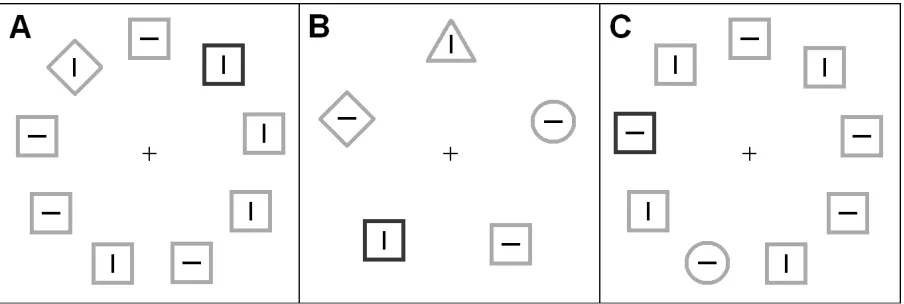
these trials, one of the nontarget items was red. The line orientation inside the target shape was vertical on half of the trials and horizontal on the other half. The orientations of the lines inside the nontarget shapes were random and independent of each other. Figure 2 shows examples of the displays used during the training and test phases.
Figure 2. Illustration of stimulus displays used in the two training phases and the test phase
of Experiment 1. Light-grey items were green, dark-grey items red. In half of the trials, a color-defined distractor was present. (A) In the singleton mode training phase, the target was randomly a diamond, a circle, or a triangle. (B) In the feature training phase, the target was always a circle; on every trial, two additional unique shapes were present: a diamond and a triangle. (C) In the test phase, the target was always a circle; no other unique forms were present.
Combination of the factors display size, distractor condition, and line orientation resulted in eight different conditions which were repeated 60 times both during training and test. Hence, there were 480 trials per phase, which were presented in eight blocks of 60 trials. Presentation order of the trials was randomized per phase. The training phase was preceded by a practice block with 24 trials, which was not included in the analysis.
Procedure. Prior to the experiment, all observers received both written and oral instructions: The observers in the singleton mode training were asked to search for the item with the unique shape; the observers in the feature mode training were asked to search for the circle. In the test phase, both groups were instructed to search for the circle. Half of the observers had to press the right mouse button if the line inside the target item was vertical and the left mouse button if the line was horizontal. For the other half, this assignment was reversed. All participants were told to proceed as fast and accurately as possible.
reappeared and a new trial begun. If the response was incorrect, the word ‘Fehler’ (German for error) was presented in capital letters in the center of the screen for 1500 ms before a new trial started. At the end of each block of trials, observers were informed about their percentage error rate in the previous block via a message on the screen. The next block started upon a button press by the observer. The whole session lasted approximately 45 minutes.
Results
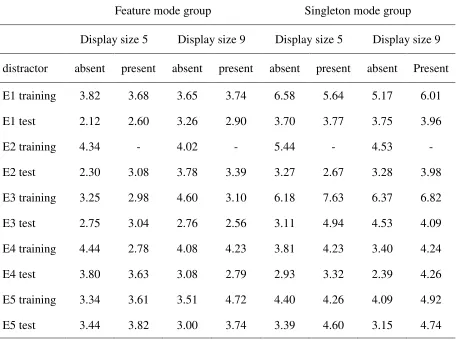
For both the training and the test phase, RTs below 200 ms and more than 3 standard deviations above an observer’s mean per display size and distractor condition were discarded as outliers (1.80% of all trials). Response error trials were excluded as well (4.04% of all trials). Table 1 gives an overview of the error rates under the different experimental conditions. Neither the error rates in the training phase nor those in the test phase were systematically related to group assignment, display size, or distractor condition (all ps > .12).
Table 1
Mean error rates [%] for all experiments (E1–E5), separately for the two search groups, dependent on display size and distractor presence
Feature mode group Singleton mode group
Display size 5 Display size 9 Display size 5 Display size 9 distractor absent present absent present absent present absent Present
E1 training 3.82 3.68 3.65 3.74 6.58 5.64 5.17 6.01
E1 test 2.12 2.60 3.26 2.90 3.70 3.77 3.75 3.96
E2 training 4.34 - 4.02 - 5.44 - 4.53 -
E2 test 2.30 3.08 3.78 3.39 3.27 2.67 3.28 3.98
E3 training 3.25 2.98 4.60 3.10 6.18 7.63 6.37 6.82
E3 test 2.75 3.04 2.76 2.56 3.11 4.94 4.53 4.09
E4 training 4.44 2.78 4.08 4.23 3.81 4.23 3.40 4.24
E4 test 3.80 3.63 3.08 2.79 2.93 3.32 2.39 4.26
E5 training 3.34 3.61 3.51 4.72 4.40 4.26 4.09 4.92
The RTs of the training phase were entered into a mixed-design ANOVA with training
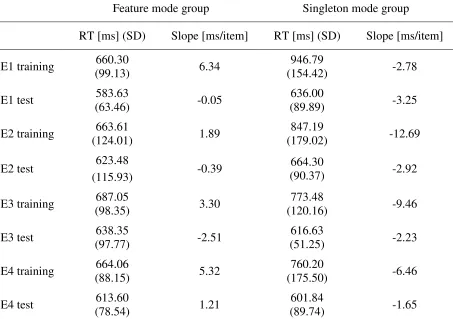
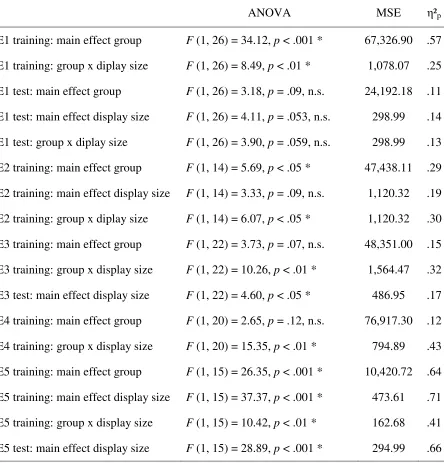
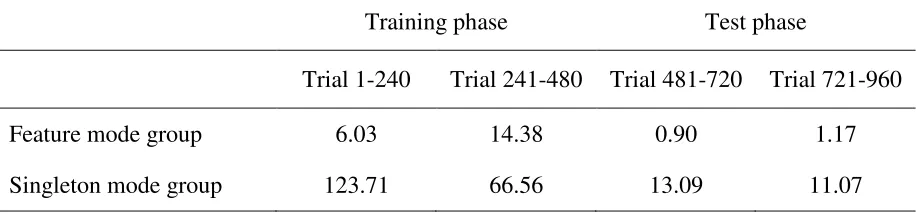
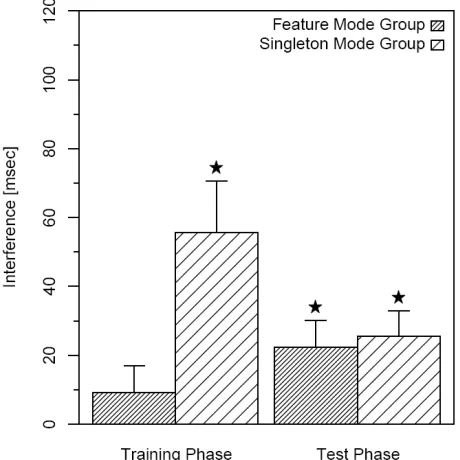
(feature or singleton mode) as a between-subjects factor and display size (5 or 9 items) and distractor condition (present or absent) as within-subjects factors. For reasons of clarity and the sake of brevity, the presentation and discussion of the results will focus on the main and interaction RT effects concerning distractor interference, for the current and the subsequent experiments. Mean RTs as well as search slopes for both search groups can be seen in Table 2. Additionally, the results of (near) significant main and interaction effects not related to distractor interference are summarized in Table 3. Main and interaction effects that are not reported were not significant. Overall, the distractor was able to capture attention, as indicated by a significant main effect of distractor condition, F (1, 26) = 95.25, p < .001,
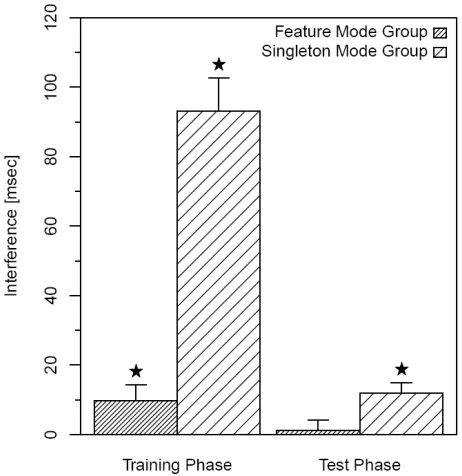
MSE = 772.96, η²p = .79. However, this main effect was qualified by a significant distractor condition x training interaction, F (1, 26) = 62.46, p < .001, MSE = 772.96, η²p = .71.
Planned comparisons revealed significant interference in both the feature mode (9.82 ms;
t (13) = -2.17, p < .05) and the singleton mode group (93.09 ms; t (13) = -9.70, p < .001) –
however, with this effect being much more marked in the latter group (see Figure 3).
Table 2
Mean RTs [ms] (standard deviation in brackets) and search slopes [ms/item] for all experiments (E1–E5), separately for the two search groups
Feature mode group Singleton mode group
RT [ms] (SD) Slope [ms/item] RT [ms] (SD) Slope [ms/item] E1 training (99.13) 660.30 6.34 (154.42) 946.79 -2.78
E1 test 583.63
(63.46) -0.05
636.00
(89.89) -3.25
E2 training (124.01) 663.61 1.89 (179.02) 847.19 -12.69
E2 test 623.48
(115.93) -0.39
664.30
(90.37) -2.92
E3 training (98.35) 687.05 3.30 (120.16) 773.48 -9.46
E3 test 638.35
(97.77) -2.51
616.63
(51.25) -2.23
E4 training (88.15) 664.06 5.32 (175.50) 760.20 -6.46