A preliminary version of this paper, entitled “Hash functions from Sigma protocols and improvements to VSH,” appears inAdvances in Cryptology - ASIACRYPT 2008, Lecture Notes in Computer Science Vol. 5350 pp. 125–142, J. Pieprzyk ed., Springer-Verlag, 2008. This is the full version.
A Characterization of Chameleon Hash Functions and
New, Efficient Designs
Mihir Bellare1 Todor Ristov2
May 2011
Abstract
This paper shows that chameleon hash functions and Sigma protocols are equivalent. We provide a transform of any suitable Sigma protocol to a chameleon hash function, and also show that any chameleon hash function is the result of applying our transform to some suitable Sigma protocol. This enables us to unify previous designs of chameleon hash functions, seeing them all as emanating from a common paradigm, and also obtain new designs that are more efficient than previous ones. In particular, via a modified version of the Fiat-Shamir protocol, we obtain the fastest known chameleon hash function with a proof of security based on thestandardfactoring assumption. The increasing number of applications of chameleon hash functions, including on-line/off-line signing, chameleon signatures, designated-verifier signatures and conversion from weakly-secure to fully-secure signatures, make our work of contemporary interest.
1
Department of Computer Science and Engineering, University of California at San Diego, 9500 Gilman Drive, La Jolla, CA 92093-0404, USA. URL:http://cseweb.ucsd.edu/~mihir/. Supported in part by NSF grants CNS 0524765, CNS 6627779, CCF 0915675 and CNS 0904380.
2
Contents
1 Introduction 3
2 Related work 6
3 Definitions 7
4 Σ-hash theory 9
4.1 The transform . . . 9
4.2 Overview of constructions . . . 10
4.3
Sch
. . . 104.4
G Q
. . . 114.5
F S
andSF S
. . . 114.6
M S
andSM S
. . . 134.7 Additional functions . . . 14
5 Σ = chameleon 14 5.1 Definitions . . . 14
5.2 Sigma is chameleon . . . 15
5.3 Chameleon is Sigma . . . 16
6 Σ-hash practice and performance 17 6.1 Extending the domain . . . 17
6.2 Metrics . . . 18
6.3 Performance of Σ-hash functions . . . 18
6.4 Comparisons . . . 19
7 Improvements to VSH 20
1
Introduction
The failure of popular hash functions MD5 and SHA-1 [54, 55] lends an impetus to the search for new ones. The contention of our paper is that there will be a “niche” market for as-fast-as-possible hash functions proven secure under standard assumptions. We provide a general paradigm that yields such functions.
The hash functions we get are chameleon [31] and we extend the treatment to get a characterization of chameleon hash functions, on the one hand unifying and clarifying previous constructs and on the other hand yielding new and more efficient ones. Let us now look at all this in more detail.
The need for proven-secure hashing. Suppose an important document has been signed with
a typical hash-then-sign scheme such as PKCS#1 [30]. If collisions are found in the underlying hash function the public key needs to be revoked and the signature can no longer be accepted. Yet there are instances in which we want a public key and signatures under it to survive for twenty or more years. This might be the case for a central and highly disseminated certificate or an important contract. Revocation of a widely disseminated public key is simply too costly and error-prone. In such a case, we want to be able to trust that collisions in our hash function will not be found even twenty years down the line.
Given the failure of MD5 and SHA-1, it would be understandable, from this twenty-year perspec-tive, to feel uncertain about any hash function designed by “similar” methods. On the other hand, we may be very willing to pay a (reasonable!) computational price for security because documents or certificates of the ultra-importance we are considering may not need to be signed often. In this case, hash functions with proven security are interesting, and the faster they are the better. Our contribution is a general transform that yields a plurality of such hash functions, not only providing new ones but “explaining” or improving old ones.
From Σ to hash. We show how to construct a collision-resistant hash function from any (suitable)
Σ-protocol. Recall that Σ-protocols are a class of popular 3-move identification schemes. Canonical examples are the Schnorr [46], Fiat-Shamir [21] and GQ [24] protocols, but there are many others as well [36, 39, 10, 25, 45, 38, 40]. Briefly, the protocols achieve a strong form of the usual honest-verifier zero-knowledge property, and our hash function is defined using the simulator. (We stress that the computation of the hash is deterministic even though the simulator is randomized.) The collision-resistance stems from strong special soundness [9], a well-studied property of Σ-protocols. The advantage of our approach is that there is a rich history in constructing proven-secure Σ-protocols and we can now leverage this to get collision-resistant hash functions. For future reference let us refer to a hash function derived from our approach as a Σ-hash function.
Damgard [19] and Cramer, Damgard and Mckenzie [16] have previously shown that it is possible to design commitment schemes based on Σ-protocols, but prior to our work it has not been observed that one can design collision-resistant hash functions from Σ-protocols. Note that secure commitment is not known to imply collision-resistant hashing and in fact is unlikely to do so because the former can be based on one-way functions [37] and the latter probably not [49]. Perhaps as a consequence, our construction requires slightly stronger properties from the Σ-protocols than do the constructions of [19, 16].
Specific designs. The Schnorr [46] and GQ [24] schemes are easily shown to meet our conditions,
Pre
H
-D aH
-STH
-SF S0 1 0.22 2
2048 1 0.33 4
16384 1 2 8
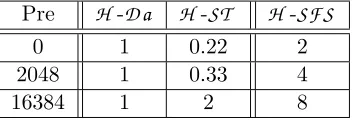
Figure 1: Performance of factoring-based hash functions. The modulus and output size are 1024 bits and the block size is 512 bits. “Pre” is the amount of pre-computation, in number of group elements stored. The table entry is the rate, defined as the average number of bits of data hashed per modular multiplication.
but we modify it to a protocol
SF S
(strongF S
) that we prove does under the factoring assumption, thereby obtaining a Σ-hash functionH
-SF S. From a modified version of the Micali-Shamir protocol [36] we obtain a Σ-hash functionH
-SM S with security based on the SRPP (Square Roots of Prime Products) assumption of [36]. We also obtain a Σ-hashH
-O ka from Okamoto’s protocol [39] and a pairing-based Σ-hashH
-H S from an identification protocol of [5] derived from the identity-based signature scheme of Hess [25].How fast? One question we consider interesting is, how fast can one hash while maintaining a proof
of security under thestandard factoring assumption? Figure 1 compares
H
-SF S to the fastest known factoring-based functions and shows that the former emerges as the winner. (VSH, the Very Smooth Hash function of [14], is faster than all these, but is based on a non-standard assumption related to the difficulty of extracting modular square roots of products of small primes. We will discuss VSH, and our improvement to it, in a bit.) In Figure 1,H
-D a is the most efficient factoring-based instantiation known of Damg˚ard’s claw free permutation-based hash function [17, 23, 31].H
-ST is the hash function of Shamir and Tauman [47]. The table entries are the rate, defined as the average number of bits of data hashed per modular multiplication in MD mode with a block size of 512 bits and a modulus and output size of 1024 bits. The figure shows that without pre-computation,H
-SF S is twice as fast asH
-D a and 9 times as fast asH
-ST . ButH
-SF S is amenable to pre-computation based speedup andH
-D a is not, so the gap in their rates increases swiftly with storage.H
-ST is also amenable to pre-computation based speedup butH
-SF S remains a factor 4 faster for any given amount of storage. We also remark that additionallyH
-SF S is amenable to parallelization, unlike the other functions. We remark thatH
-SM S is faster thanH
-SF S but based on a stronger assumption. In Section 6 we recallH
-D a andH
-ST and justify the numbers in Figure 1. We also discuss implementation results.Additional features. Σ-hash functions are keyed. While one can, of course, simply hardwire into
the code a particular key to get an unkeyed function in the style of MD5 or SHA-1, it is advantageous, as explained in [7], to allow each user to choose their own key. The reason is that damage from a collision is now limited to the user whose key is involved, and the attacker must re-invest resources to attack another key. This slows down the rate of attacks and gives users time to get patches in place or revoke keys.
The reductions underlying the security proofs of Σ-hash functions are tight, so that the proven security guarantees hold with standard values of the security parameters.
Σ-hash functions are chameleon. Krawczyk and Rabin [31] introduced chameleon hash functions.
and utility of the primitive.
Krawczyk and Rabin [31] presented two example constructions of chameleon hash functions, and others were found by [47, 2, 3]. The analyses, however, are ad hoc. We, in contrast, show a general result, namely, that any Σ-hash is chameleon (cf. Theorem 5.1). As a consequence, we immediately obtain that
H
-G Q ,H
-SF S,H
-SM S,H
-O ka andH
-H S are chameleon. In particular, inH
-SF S, we obtain the fastest known chameleon hash function under the standard factoring assumption.Shamir and Tauman used chameleon hash functions to build on-line/off-line signature schemes [47]. (The concept is due to [20].) This means that when one uses a Σ-hash one can completely eliminate the on-line cost of signing. (This cost is shifted entirely to the off-line phase.) Another application is chameleon signatures [31], which provides a recipient with a non-repudiable signature of a message without allowing it to prove to a third party that the signer signed this message. As explained in [31] this is an important tool for privacy-respecting authenticity in the signing of contracts and agreements. Chameleon hash functions are also used in designated-verifier signatures to achieve privacy [29, 50]. Finally, chameleon hashing can be used to transform a weakly-secure signature scheme into a fully-secure one. This is used in many places [31, 48, 11, 26] and a full statement and proof were provided by Hohenberger and Waters [27] whose design of RSA-based signatures made crucial use of this transform. By adding new and more efficient chameleon hash functions to the pool of existing ones we enable new and more efficient ways to implement all the different applications.
Reverse connection. As indicated above, we show that Σ-hash functions are chameleon. To
complement this, we show that the converse is true as well, namely, all chameleon hash functions are Σ-hash functions (cf. Theorem 5.2). We prove this by associating to any chameleon hash function
H
a Σ-protocolSP
such that applying our Σ2H (Σ-to-hash) transform toSP
returnsH
. We thereby have a characterization of chameleon hash functions as Σ-hash functions, which, as we discuss below, allows us to unify previous work.We also obtain numerous new Σ-protocols, and thus identification protocols and, via [16, 19], commitment schemes, from existing chameleon hash functions such as
H
-D a [17] andH
-ST [47]. However, we are not aware of any practical benefit of these constructs over known ones.Unifying previous work.
H
-Sch turns out to be exactly the classical hash function of Chaum, VanHeijst and Pfitzmann [13], which was shown to be chameleon by [31].
H
-O ka is an extension thereof [13].H
-G Q is a special case of a chameleon hash function proposed by Ateniese and de Medeiros [2, 3]. (Our other hash functionsH
-SF S,H
-SM S andH
-H S are new.) The re-derivation of these hash functions as Σ-hashes sheds new light on the designs and shows how the Σ paradigm explains and unifies previous constructs.Finally we make a connection between VSH [14] and
H
-SM S, the Σ-hash function emanating from the protocol of Micali and Shamir [36]. The latter is a more efficient version of the Fiat-Shamir protocol in which the public key, rather than consisting of random quadratic residues, consists of small primes. InterestinglyH
-SM S turns out to be theVSHcompression function [14] modulo some details. We suggest that this provides some intuition for the VSHdesign. It turns out that we can exploit this connection to get some improvements to VSH.VSH∗.
modifica-tion VSH∗
whose compression function, unlike that of the original, is collision resistant, leading to better performance for short messages. (Our implementations show thatVSH∗
is up to 5 times faster than VSH on short messages. On long messages they have the same performance.) This is impor-tant because short messages are an imporimpor-tant case in practice. (For example, most Internet packets are short.) VSH∗
remains provably collision-resistant under the same VSSR assumption as VSH. A different collision-resistant modification of the compression function ofVSHis provided by [51].
We provide analogous improvements for the Fast-VSH variant of VSH provided by [14]. Again we can provide Fast-VSH∗
whose underlying compression function (unlike that of Fast-VSH) is proven collision-resistant, leading to speedups in hashing short messages. However, the speed gains are smaller than in the previous case.
Overall we believe that, even putting performance aside, having a collision resistant compression function underlying a hash function is a plus since it can be used directly and makes the hash function more misuse-resistant.
What Σ-hash functions aren’t. Some recent work [15, 6, 1] suggests that general-purpose hash
functions should have extra properties like pseudorandomness. Σ-hash functions are merely collision-resistant and chameleon; they do not offer these extra attributes. But as indicated above, Σ-hash functions are not intended to be general purpose. The envisaged applications are chameleon hashing and proven-secure, reasonable cost (purely) collision-resistant hashing.
2
Related work
Damg˚ard [17] presents a construction of collision-resistant hash functions from claw-free permutation pairs [23]. As noted above, his factoring-based instantiation, based on [23] and also considered in [31, 47], is slower than our
H
-SF S.Ishai, Kushilevitz and Ostrovsky [28] show how to transform homomorphic encryption (or com-mitment) schemes into collision-resistant hash functions. This is an interesting theoretical connection between the primitives. As far as we can tell, however, the approach is not yet practical. Specifically, their quadratic-residuosity (QR) based instantiation has a rate of 1/40 (that is, 40 modular multi-plications per bit) with a 1024 bit modulus. (Their matrix needs 80 rows to get the 80-bit security corresponding to a 1024-bit modulus.) Hence their function is much slower than the constructs of Figure 1 in addition to being based on a stronger assumption (QR as opposed to factoring). Addi-tionally it has a 80·1024 bit output so in a practical sense is not really hashing. Other instantiations of their construction that we know (El Gamal under DDH, Paillier [41] under DCRA) are also both slower than known ones and based on stronger assumptions.
Lyubashevsky, Micciancio, Peikert and Rosen [34] present a fast hash function SWIFFT with an asymptotic security proof based on assumptions about the hardness of lattice problems [42, 33], but the proof would not seem to yield guarantees for the parameter sizes proposed in [34]. In contrast, our reductions are tight and the proofs provide guarantees for standard values of the security parameters. Bellare and Micciancio’s construction [4] (whose goal was to achieve incrementality) uses random oracles, but these can be eliminated by using a small block size, such as one bit. In this case their MuHASH is provably collision-resistant based only on the discrete-log assumption, and runs at 0.33 bits per group operation in MD mode. In comparison,
H
-Sch (also discrete log based) is faster, at 0.57 bits per group operation in MD mode.[52] and in fact to not even be pre-image resistant [43]. Tillich and Z´emor [53] present a hash function based on the assumed hardness of some graph problems, whose security properties and efficiency were improved by Petit, Veyrat-Charvillon, and Quisquater [44]. The hash function of [44] is slower than Fast-VSH, and thereby slower than Fast-VSH∗
, according to the performance results reported in [14] and [44].
Heng and Kurosawa [32] definereversible Σ-protocols and show that these and trapdoor commit-ment schemes are equivalent. Reversibility, a property we do not assume, requires that the prover’s randomness or internal state can be reconstructed from the public key and last two messages in the protocol given the secret key. The binding property of the commitment scheme is a weak form of collision resistance which rules out efficiently finding message-randomness pairs where the message parts are different but the corresponding commitments are the same. They do not claim or provide (chameleon) collision-resistant hash functions.
Steinfeld, Pieprzyk and Wang [51] suggest a collision-resistant modification of the VSH compression function based on restricting the domain of the second argument. This makes iterating the compression function somewhat less convenient but it can be done using the methods we discuss in Appendix A and would then appear to yield performance benefits similar to those we get via VSH∗
. They do not consider Fast-VSH.
Preliminary version. A preliminary version of this paper appeared as [8].
3
Definitions
Notation and conventions. We denote by a1k · · · kan a string encoding ofa1, . . . , an from which
the constituent objects are uniquely recoverable. We denote the empty string by ε. Unless otherwise indicated, an algorithm may be randomized. If A is a randomized algorithm then y←$A(x1, . . .) denotes the operation of runningA with fresh coins on inputsx1, . . . and lettingy denote the output. We denote by [A(x1, . . .)] the set of ally that have positive probability of being output byAon input
x1, . . .. If S is a (finite) set then s←$S denotes the operation of picking s uniformly at random from S. If X =x1kx2k. . .kxn, then x1kx2k. . . xn ← X denotes the operation of parsing X into its constituents. Similarly, if X = (x1, x2, . . . , xn) is an n-tuple, then (x1, x2, . . . , xn) ← X denotes the operation of parsing Xinto its elements. We denote the security parameter byk, and by 1k its unary encoding. Vectors are denoted in boldface, for example u. If u is a vector then |u|is the number of its components and u[i] is its i-th component. “PT” stands for polynomial time.
Σ-protocols. A Σ-protocol is a three-move interactive protocol conducted by a prover and a verifier.
Formally, it is a tuple
SP
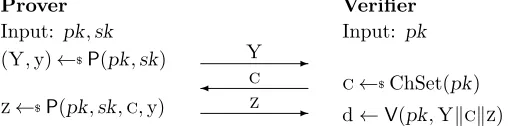
= (K,P,V,CmSet,ChSet,RpSet), where K,P are PT algorithms andV is a deterministic boolean algorithm. The key-generation algorithm K takes input 1k and returns a pair (pk,sk) consisting of a public and secret key for the prover. The latter is initialized withpk,sk while the verifier is initialized with pk. The parties interact as depicted in Figure 2. The prover begins by applying P to pk,sk to yield his first move Y ∈ CmSet(pk), called the commitment, together withstate information y, called the ephemeral secret key. The commitment is sent to the verifier, who responds with a challenge c drawn at random from ChSet(pk). The prover computes its response z
by applying P to pk,sk, the challenge and the ephemeral secret key y. (This computation may use fresh coins although in the bulk of protocols it is deterministic.) Upon receivingcthe verifier applies
V to the public key and transcript Ykckz of the conversation to decide whether to accept or reject.
Prover
Input: pk,sk
(Y,y)←$P(pk,sk)
z←$P(pk,sk,c,y)
Y
-c
z
-Verifier
Input: pk
c←$ChSet(pk) d←V(pk,Ykckz)
Figure 2: Σ-protocol. Keyspk and sk are produced using key-generation algorithm K.
always accepting. Formally, for allk∈Nwe have d = 1 with probability 1 in the experiment (pk,sk)←$K(1k); (Y,y)←$P(pk,sk); c←$ChSet(pk);
z←$P(pk,sk,c,y); d←V(pk,Ykckz).
The verifier given pk,Ykckz should always check that Y ∈ CmSet(Y) and c ∈ ChSet(pk) and z∈RpSet(pk) and reject otherwise. We implicitly assume this is done throughout.
Security notions. We provide formal definitions of strong special soundness (sss) and strong
hon-est verifier zero-knowledge (StHVZK). Strong special soundness of Σ-protocol
SP
= (K,P,V,CmSet, ChSet,RpSet) [9] asks that it be computationally infeasible, given only the public key, to produce a pair of accepting transcripts that are commitment-agreeing but challenge-response-disagreeing. Formally an sss-adversary, on input pk, returns a tuple (Y,c1,z1,c2,z2) such that Y ∈ CmSet(pk);c1,c2 ∈ChSet(pk); z1,z2 ∈ RpSet(pk) and (c1,z1) 6= (c2,z2). The advantage Advsss
SP,A(k) of such an ad-versary is defined for all k ∈N as the probability that V(pk,Ykc1kz1) = 1 and V(pk,Ykc2kz2) = 1
in the experiment where K(1k) is first executed to get (pk,sk) and then A(pk) is executed to get (Y,c1,z1,c2,z2). We say that
SP
has strong special soundness if AdvsssSP,A(·) is negligible for all PT sss-adversaries A. To define StHVZK, let
T r
SP be the algorithm that on input (pk,sk) executes Pand Vas per Figure 2 and returns the transcript Ykckz. Recall that a PT algorithm Sim is a HVZK simulator for
SP
if the outputs of the processes(pk,sk)←$K(1k); Return(pk,Sim(pk)) and
(pk,sk)←$K(1k); Return(pk,
T r
SP(pk,sk))
are identically distributed. (We require perfect, not computational, ZK. This simplifies applications and there is no particular loss from assuming it since it is provided by the candidate protocols.) We say that a PT algorithmStSimis a strong HVZK (StHVZK) simulator for
SP
ifStSimis deterministic and the algorithm Simdefined on inputpk byc←$ChSet(pk); z←$RpSet(pk); Y←StSim(pk,c,z); Return Y||c||z
is a HVZK simulator for
SP
. We say thatSP
is StHVZK if it has a PT StHVZK simulator and also the commitmentY generated via (Y,y)←$P(pk,sk) is uniformly distributed over CmSet(pk) for all (pk,sk)∈[K(1k)]. We denote byΣ(sss) the set of all Σ-protocols that satisfy strong special soundness and by Σ(StHVZK) the set of all Σ-protocols that are strong HVZK.Discussion. While the basic format of Σ-protocols as 3-move protocols of the type above is agreed
Collision-resistant hash functions. A family of n-input hash functions (where n ≥ 1 is a
constant) is a tuple
H
= (KG,H,D1, . . . ,Dn,R). The key-generation algorithm KG takes input 1k and returns a key K describing a particular function HK : D1(K)×. . .Dn(K) → R(K). As this indicates, D1, . . . ,Dn,R are functions that given K return sets. A cr-adversary, on input K returns distinct tuples (x1, . . . , xn),(y1, . . . , yn) such that xi, yi ∈ Di(K) for all 1 ≤ i ≤ n. The advantage AdvcrH,B(k) of such an adversaryB is defined for all k∈Nas the probability thatH(K, x1, . . . , xn) =H(K, y1, . . . , yn) in the experiment where KG(1k) is first executed to getK and thenB(K) is executed to get ((x1, . . . , xn),(y1, . . . , yn)). We say that
H
is collision resistant if the cr-advantage of any PT adversary B is negligible.4
Σ
-hash theory
This section covers the theory of Σ-hash functions. We present and justify the Σ2H transform that turns a Σ-protocol
SP
∈Σ(sss)∩Σ(StHVZK) into a collision-resistant hash functionH
-SP. Then we find Σ-protocols which we can prove have the required properties and derive specific Σ-hash functions. In Section 5 we relate Σ and chameleon hash functions. In Section 6 we discuss the practical and performance aspects of our Σ-hash functions.4.1 The transform
We show how to build a collision-resistant hash function from any Σ-protocol
SP
= (K,P,V,CmSet, ChSet,RpSet) ∈ Σ(sss) ∩Σ(StHVZK) that satisfies strong special soundness and strong HVZK. Let StSim be a strong HVZK simulator forSP
. Let K(1) be the algorithm that on input 1k lets (pk,sk)←$K(1k) and returnspk. We define the 2-input family of hash functionsH
= (KG,H,ChSet, RpSet,CmSet) byKG=K(1) and Hpk(c,z) =StSim(pk,c,z). In other words, the key is the prover’spublic key. (The secret key is discarded.) The inputs to the hash function are regarded as the chal-lenge and response in the Σ-protocol. The output is the corresponding commitment. The existence of a StHVZK simulator is exploited todeterministically compute this output. We refer to a family of functions defined in this way as a Σ-hash. We write
H
=Σ2H(SP) to indicate thatH
has been derived as above from Σ-protocolSP
. The following theorem says that a Σ-hash family is collision-resistant. Theorem 4.1 LetSP
= (K,P,V,CmSet,ChSet,RpSet)∈Σ(sss)∩Σ(StHVZK) be a Σ-protocol. LetH
= (KG,H,ChSet,RpSet,CmSet) = Σ2H(SP) be the family of hash functions associated toSP
as above. For every cr adversary B againstH
there exists an sss-adversary A againstSP
such that for all kwe have AdvcrH,B(k) ≤AdvSPsss-,Ana(k), and the running time ofB is that ofA.The proof of this theorem, given below, is simple, but we note some subtleties, which is the way it relies on the (strong) HVZK and completeness of the Σ-protocol in addition to the strong special soundness.
Proof of Theorem 4.1: We define adversary A as follows. AdversaryA(pk)
Algorithm K(1k) (hGi, p, g)←$G(1k)
x←$Zp
X ←g−x; sk←x
pk ←(hGi, p, g, X) Return (pk,sk)
Prover Verifier
y←$Zp; Y←gy Y
-c
c←$Zp
z←y +x·cmodp z- d←(X
cgz=Y)
Hpk:Zp×Zp → G Hpk(c,z) =Xcgz
Figure 3:
Sch
Σ-protocol and the derived Σ-hash family, whereG
is a prime-order group generator.By definition of a cr-adversary we know that (c1,z1)= (6 c2,z2). HenceA satisfies the definition of an
sss adversary. Let Yi =Hpk(ci,zi) fori= 1,2. The definition of a cr-adversary also implies that ci ∈
ChSet(pk) and zi ∈RpSet(pk) for i= 1,2. Strong HVZK now implies that the transcripts Yikcikzi
have positive probability of being produced in the protocol, meaning of being output by
T r
SP(pk,sk). The completeness of the protocol now implies that V(pk,Y1kc1kz1) = 1 and V(pk,Y2kc2kz2) = 1.Finally, if B succeeds then Y1 =Y2 soA also succeeds.
To construct Σ-hash functions we now seek Σ-protocols which we can show are inΣ(sss)∩Σ(StHVZK).
4.2 Overview of constructions
We begin, as illustrative examples, with the Schnorr [46] and GQ [24] Σ-protocols, which we can easily show to have the desired properties. The hash functions obtained are known [13, 2, 3] and their re-derivation as Σ-hashes sheds new light on their design and also shows how the Σ-hash paradigm unifies and explains existing work. More interesting is the Fiat-Shamir [21] Σ-protocol. It doesn’t satisfy strong special soundness, but we modify it to a Σ-protocol
SF S
that we prove is inΣ(sss)∩Σ(StHVZK) under the standard factoring assumption. With non-standard factoring-related assumptions (that it is hard to extract modular square roots of products of small primes) we get a faster Σ-hashH
-SM S from a modification of the Micali-Shamir Σ-protocol [36]. We also get another discrete-log based Σ-hash from Okamoto’s protocol [39] and a pairing based one from theH S
protocol [25, 5]. Let us now detail all this.4.3
S ch
We fix a prime-order group generator, by which we mean a PT algorithm
G
that on input 1k returns the descriptionhGiof a groupGof prime orderp∈ {2k−1, . . . ,2k−1}together withpand a generator g of G. The key-generation process and protocol underlying theSch
Σ-protocol of [46] are then as shown in Figure 3. The algorithm that on input pk = (hGi, p, g, X) picks c,z←$Zp and returns Xcgzkckz is a HVZK simulator forSch
, soSch
∈ Σ(StHVZK) and the derived Σ-hashH
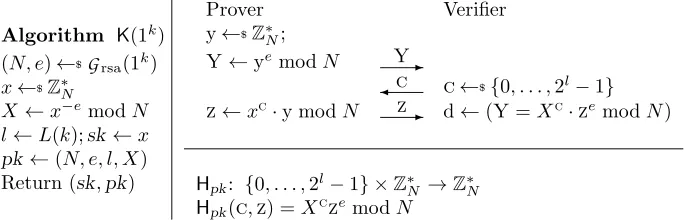
-Sch is as shown in Figure 3. The key observation for strong special soundness is that if Xc1gz1 =Xc2gz2 and (c1,z1) 6= (c2,z2) then it must be that c1 6= c2. This leads us to associate to sss-adversary A thediscrete log finderD that on inputhGi, p, g, X runsA on the same input to get (Y,c1,z1,c2,z2) and
returns (z2−z1)(c1 −c2)−1 modp. Then for all k we have Advsss
Sch,A(k) ≤ AdvdlG,D(k), where the latter is defined as the probability that x′
Algorithm K(1k) (N, e)←$Grsa(1k)
x←$Z∗ N
X ←x−emodN
l←L(k);sk←x
pk←(N, e, l, X) Return (sk,pk)
Prover Verifier
y←$Z∗ N;
Y←yemodN Y
-c
c←${0, . . . ,2
l−1}
z←xc·y modN z
- d←(Y=X
c·zemodN)
Hpk: {0, . . . ,2l−1} ×Z∗
N →Z∗N Hpk(c,z) =XczemodN
Figure 4:
G Q
Σ-protocol and the derived Σ-hash family, whereG
rsais a prime exponent RSA generator with associated challenge length L.4.4
G Q
We fix a prime-exponent RSA generator with associated challenge length L(·), by which we mean a PT algorithm
G
rsa that on input 1k returns an RSA modulus N ∈ {2k−1, . . . ,2k −1} and an RSA encryption exponent e > 2L(k) that is a prime. The key-generation process and protocol underlying Σ-protocolG Q
of [24] are then as shown in Figure 4. The algorithm that on inputpk = (N, e, l, X) picks c←${0,1}l;z←$Z∗
N and returns Ykckz, where Y = X
cze modN, is a HVZK simulator for
G Q
, soG Q
∈ Σ(StHVZK) and the derived Σ-hashH
-G Q is as shown in Figure 4. Again observe that if Xc1ze1 = X
c2ze
2 and (c1,z1) 6= (c2,z2) then c1 6= c2. To ad-versary A attacking the strong special soundness, this leads us to associate the inverter
I
that on input N, e, X runs A on input N, e, l, X where l = L(⌊log2(N)⌋ + 1) to get (Y,c1,z1,c2,z2)and returns (z2z−1
1 )bXamodN where a, b satisfy ae+b(c1 −c2) = 1 and are found via the ex-tended gcd algorithm. (This is where we use the fact that e is prime.) Then for all k we have AdvsssG Q,A(k) ≤AdvGrsarsa,I(k), where the latter is defined as the probability that x
′
=x in the experi-ment where we let (N, e)←$
G
rsa(1k) andx←$Z∗N and then let x ′←$
I
(N, e, xemodN).This shows thatG Q
has strong special soundness if RSA is one-way relative toG
rsa. By Theorem 4.1,H
-G Q is collision-resistant under the same assumption.4.5
F S
andS F S
We fix a modulus generator, namely a PT algorithm
G
mod that on input 1k returns a modulusN ∈ {2k−1, . . . ,2k−1}and distinct primesp, q such thatN =pq. We also fix a challenge length L(·). Ifc is al-bit string and u∈(Z∗N)l then we let u c
=Q
u[i]c[i] where the product is over 1≤i≤l andc[i] denotes thei-th bit ofc. The key-generation algorithm and protocol underlying the
F S
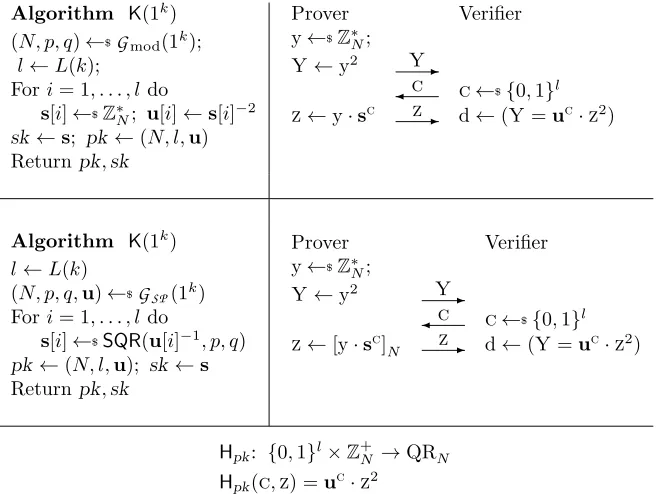
Σ-protocol arethen as shown in Figure 5. However this protocol does not satisfy strong special soundness because if
Ykckz is an accepting transcript relative to pk = (N, l,u) then so is Ykckz′ wherez′ =N −z. We now show how to modify
F S
so that it has strong special soundness. First, some notation. For w∈ZN we let [w]N equal w if w ≤N/2 andN −w otherwise. Let Z+N =Z∗N ∩ {1, . . . , N/2}. The modified protocolSF S
(StrongF S
) is shown in Figure 5. Here CmSet((N, l,u)) is the set QRN of quadratic residues in Z∗N and ChSet((N, l,u)) is {0,1}l, just as in
F S
, but RpSet((N, l,u)) is now equal toZ+N rather than Z ∗
Algorithm K(1k) (N, p, q)←$Gmod(1k);
l←L(k);
Fori= 1, . . . , ldo
s[i]←$Z∗
N; u[i]←s[i]−2
sk←s; pk←(N, l,u) Returnpk,sk
Prover Verifier y←$Z∗
N;
Y←y2 Y
-c
c←${0,1}
l
z←y·sc z
- d←(Y=u
c·z2)
Algorithm K(1k)
l←L(k)
(N, p, q,u)←$GS P(1k) Fori= 1, . . . , ldo
s[i]←$SQR(u[i]−1, p, q)
pk ←(N, l,u); sk←s
Returnpk,sk
Prover Verifier y←$Z∗
N;
Y←y2 Y
-c
c←${0,1}
l
z←[y·sc]N
z
- d←(Y=u
c ·z2)
Hpk: {0,1}l×Z+N →QRN
Hpk(c,z) =uc·z2
Figure 5:
F S
,SF S
,M S
andSM S
protocols and the Σ-hash derived fromSF S
,SM S
. The upper left key-generation algorithm is that ofF S
andSF S
, while the lower left one is that ofM S
andSM S
. The upper protocol is that ofF S
andM S
while the lower protocol is that ofSF S
andSM S
. HereG
mod is a modulus generator andG
SP is a small prime modulus generator. The computations are in Z∗N, meaning moduloN.Proposition 4.2 Let
G
mod be a modulus generator and L(·) a challenge length. LetSF S
be the associated Σ-protocol as per Figure 5. If A is a sss-adversary againstSF S
then there is a factoring algorithm F againstG
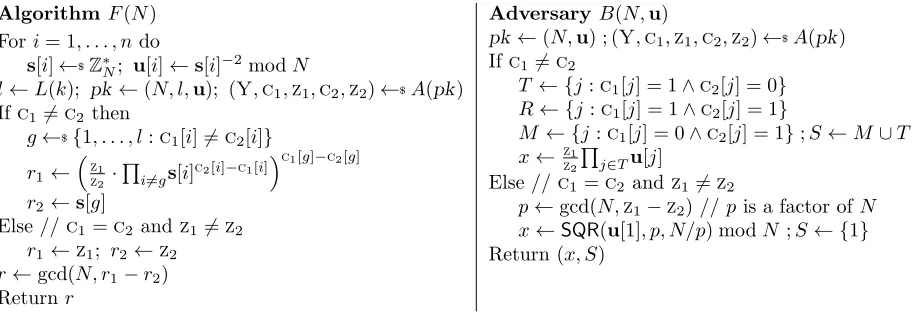
mod such that for allk we have AdvsssSF S,A(k)≤2·AdvfacGmod,F(k). The running time ofF is that ofAplus the time for at mostL(·) multiplications, one inversion moduloN, and the time for one execution of the gcd algorithm.Proof:The factoring algorithm F is shown in Figure 6. For the analysis, consider two cases. The first is that c1 6=c2 and the second is that c1 =c2 and z1 6=z2. In the first case, a simple computation
shows that r2
1 ≡ r22 (modN). On the other hand, s[g] is chosen at random in Z∗N and the only information A gets about it isu[g] =s[g]−2 modN so s[g]6∈ {r
1, N −r1}with probability 1/2. So in this case F succeeds with probability 1/2 times the probability thatA succeeds. In the case c1 =c2
butz16=z2 we have, moduloN, Y≡z2
1·
Ql i=1s[i]
c1[i]≡z2 2·
Ql i=1s[i]
c2[i]
and c1 =c2 implies z2
1 ≡z22. Butz1 6=z2 andz1,z2 ∈Z+N so it must be thatz1 6∈ {z2, N−z2}. SoF succeeds with the same probability as A in this case.
Now, the algorithm that on inputpk = (N, l,u) lets c←${0,1}l; z←$Z+
N, andY ← u c
·z2 modN
Algorithm F(N) Fori= 1, . . . , ndo
s[i]←$Z∗
N; u[i]←s[i]−2modN
l←L(k); pk←(N, l,u); (Y,c1,z1,c2,z2)←$A(pk) Ifc16=c2 then
g←${1, . . . , l:c1[i]6=c2[i]}
r1←
z1
z2 · Q
i6=gs[i]
c2[i]−c1[i]c1[g]−c2[g]
r2←s[g]
Else //c1=c2 andz16=z2
r1←z1; r2←z2
r←gcd(N, r1−r2) Returnr
Adversary B(N,u)
pk←(N,u) ; (Y,c1,z1,c2,z2)←$A(pk) Ifc16=c2
T ← {j:c1[j] = 1∧c2[j] = 0}
R← {j:c1[j] = 1∧c2[j] = 1}
M ← {j:c1[j] = 0∧c2[j] = 1};S←M ∪T
x← z1
z2 Q
j∈Tu[j]
Else //c1=c2 andz16=z2
p←gcd(N,z1−z2) //pis a factor ofN
x←SQR(u[1], p, N/p) modN ;S← {1}
Return (x, S)
Figure 6: Factoring algorithm F for proof of Proposition 4.2 and spr-adversary B for proof of Proposition 4.3.
4.6
M S
andS M S
The Micali-Shamir protocol [36] is a variant of
F S
in which verification time is reduced by choosing the coordinates of u to be small primes. As withF S
it does not satisfy sss, but we can modify it to do so and thereby obtain a collision-resistant hash functionH
-SM S that is faster thanH
-SF S at the cost of a stronger assumption for security. To detail all this, letG
SP be a small prime modulusgenerator with challenge length L(·), by which we mean a PT algorithm that on input 1k returns a modulusN ∈ {2k−1, . . . ,2k−1}, distinct primesp, q such thatN =pq, and anL(k)-vector u each of whose coordinates is a prime in QR(N) ={x2modN :x∈Z∗
N}.For efficiency we would choose these primes to be as small as possible. (For exampleu[i] is thei-th prime in QR(N).) An spr-adversaryB against
G
SP, Ltakes inputN andu∈(Z∗N)L(k)and returns (x, S) wherex∈Z ∗
N andSis a non-empty subset of {0,1}l. Its spr-advantage is defined for allk by
AdvsprGSP,L,B(k) = Prhx2≡Q
i∈Su[i] (modN) : (N, p, q,u)←$
G
SP(1 k) ; (x, S)←$B(N,u)
i .
The SRPP (Square Root of Prime Products) assumption [36] says that the spr-advantage of any PT B is negligible. Now, Figure 5 shows our modified version
SM S
of the Micali-Shamir protocol. It is in Σ(StHVZK) for the same reason asSF S
and hence the derived hash function is again as shown, where SQR(·, p, q) takes input w∈QR(N) and returns at random one of the four square roots of w modulo N =pq, computed using the primesp, q. Strong special soundness ofSM S
is proven in the following under the SRPP assumption.Proposition 4.3 Let
G
SP be a small prime modulus generator with associated challenge length L.Let
SM S
be the associated Σ-protocol as per Figure 5. IfAis a sss-adversary againstSM S
then there is a spr-adversary B such that for allkwe haveAdvsssGSP,L,A(k)≤Adv
spr
GSP,L,B(k).The running time of
B is that ofA plus timet= max{t1, t2}, wheret1 is the time it takes to execute one inversion modulo
Proof: Let’s explain why the adversary B shown in Figure 6 works. IfA succeeds then
z12Qn j=1u[j]
c1[j]≡z
22Qnj=1u[j]
c2[j] (modN) (1)
Now, when c16=c2, multiplying both sides of this equation byQ
j∈Tu[j]/ Q
j∈Ru[j] gives:
z12Q
j∈Tu[j]2 ≡z22Qj∈M∪Tu[j] (modN) From c1 6= c2 it follows that T ∪M 6= ∅, and therefore by outputting (z1
z2
Q
j∈Tu[j], M ∪T) the adversary B succeeds.
In the other case, when c1 = c2, it has to be z1 6= z2 and the equation Equation (1) becomes z2
1 ≡z22modN. By finding the gcd of N and z1−z2,B can factorize N, and so it can compute the square root ofu[1] moduloN.
Proposition 4.3 and Theorem 4.1 imply that
H
-SM S is collision-resistant under the SRPP assumption.4.7 Additional functions
Okamoto’s protocol [39] is StHVZK and can be shown to have special soundness if the discrete loga-rithm problem is hard relative to the underlying prime-order group generator, and hence we obtain a collision-resistant Σ-hash family
H
-O ka. The key has the form (hGi, p, g1, g2, X), where g1, g2 ∈ G∗ and X ∈ G, and Hpk : Zp ×(Zp ×Zp) is defined by Hpk(c,(z1,z2)) = Xcgz1 1 g
z2
2 . However, this hash function seems to offer no performance advantage over
H
-Sch. A pairing based identification protocolH S
, derived from the id-based signature scheme of [25], is noted in [5]. It is shown in [5] to have special soundness under concurrent attack assuming the hardness of the one more computational Diffie-Helman problem relative to an underlying prime-order bilinear group generator. The proof can be easily extended to show strong special soundness while relaxing the assumption to the hardness of the computational Diffie-Helman problem.H S
can also be shown to be StHVZK and hence we obtain a Σ-hash familyH
-H S. The key has the form (hG1i,hG2i, q, P,hei, α) whereG1 and G2 are groups of prime order p; e :G1×G1 → G2, is non-degenerate bilinear map;P ∈G∗1 and α∈G2. The function Hpk : Zp×G1 → G2 is defined by Hpk(c,z) = e(z, P)·αc. Due to the pairing, however, this hash function is slower thanH
-Sch.5
Σ
= chameleon
We move from examples of Σ-hash functions to a general property of the class, namely that any Σ-hash function is chameleon and vice-versa.
5.1 Definitions
A 2-input hash family
H
= (KG,H,D1,D2,R) is said to be trapdoor if the following are true. First, there is a PT algorithm K, called the full key-generation algorithm, that on input 1k returns a pair (K, T), and algorithmKGis equal toK(1), meaning algorithmKG, on input 1k, runsK(1k) to get (K, T) and returns K. Second, there is a deterministic, PT algorithm,I
, called the inversion algorithm, such that for all (K, T) ∈K(1k)
and all c1,c2 ∈ D1(K) and all Y ∈ R(K) the map defined by z →
I
(K, T,Y,c1,z,c2) is a bijection of SHK,c1(Y) to S
H
K,c2(Y), where S
H
HK(c,z) = Y}.1 We say that
H
has the uniformity property if for all K and all c ∈ D1(K) itis the case that HK(c,·) is uniformly distributed over R(K) when regarded as a random variable over a random choice of its argument z from D2(K). We say that
H
is chameleon if it is trapdoor,collision-resistant and has the uniformity property.
The (standard) completeness requirement for a Σ-protocol
SP
= (K,P,V,CmSet,ChSet,RpSet) implies that from a secret keysk and challengec, one can easily (in PT) compute the responsez, butonly if one has the ephemeral secret key y underlying the commitment. To obtain chameleon hash functions from Σ-protocols we need the latter to satisfy a strong form of completeness which says that a response, distributed identically to the response of the real prover P, can be computed even without the ephemeral secret key so long as we have access to some accepting conversation. Formally a strong HVZK Σ-protocol
SP
= (K,P,V,CmSet,ChSet,RpSet) satisfies strong completeness if there is a deterministic PT algorithmP
∗ called the strong prover such that for all (pk,sk) ∈K(1k)
and all c1,c2 ∈ ChSet(pk) and all Y ∈ CmSet(pk) the map defined by z →
P
∗(pk,sk,Y,c1,z,c2) is a
bijection of SSP
pk,c1(Y) to S
SP
pk,c2(Y), where S
SP
pk,c(Y) = {z ∈RpSet(pk) : StSim(pk,c,z) =Y} where
StSimis the strong HVZK simulator. We letΣ(sc) be the class of all Σ-protocols that have the strong completeness property.
5.2 Sigma is chameleon
The following implies that any Σ-hash is chameleon.
Theorem 5.1 Let
SP
= (K,P,V,CmSet,ChSet,RpSet)∈Σ(StHVZK)∩Σ(sss)∩Σ(sc) be a Σ-protocol. Then the Σ-hash familyH
-SP =Σ2H(SP) = (KG,H,ChSet,RpSet,CmSet) is chameleon.Proof of Theorem 5.1: Theorem 4.1 implies that
H
-SP = (KG,H,ChSet,RpSet,CmSet) is collision resistant. We now show that the strong HVZK property ofSP
implies uniformity ofH
-SP. Fix (pk,sk) ∈K(1k)
and also fix c ∈ ChSet(pk). We want to show that Hpk(c,·) = StSim(pk,c,·)
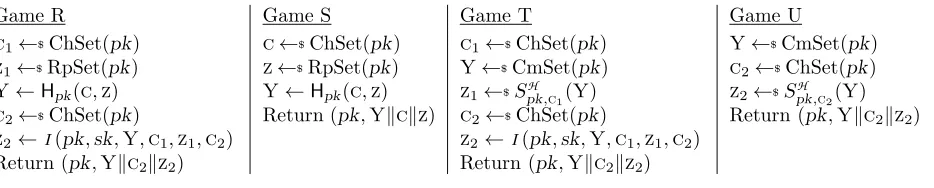
is uniformly distributed over CmSet(pk) when its argument is drawn at random from RpSet(pk). Consider the games of Figure 7. Let D be any (computationally unbounded) adversary. Then it suffices to show that
Pr
SD ⇒1
= Pr
TD ⇒1
where “GD ⇒1” denotes the event thatDoutputs 1 on input the output of gameG, and the probability is over the coins of Gand D. But this follows because
Pr
SD ⇒1
= Pr
RD ⇒1
(2) Pr
RD ⇒1
= Pr
TD ⇒1
, (3)
where game T is also in Figure 7. Equation (2) is true by the strong HVZK property. (The real and simulated conversation transcripts are equally distributed, and hence continue to be so conditioned on a particular challenge.) Equation (3) is true because our definition of strong HVZK required that a commitment generated by the prover is uniformly distributed over CmSet(pk).
1
Game R
(Y,y)←$P(pk,sk)
z←$P(pk,sk,c,y) Return Y
Game S
z←$RpSet(pk)
Y←$StSim(pk,c,z) ReturnY
Game T
Y←$CmSet(pk) Return Y
Figure 7: Games for proof of uniformity of
H
-SP in proof of Theorem 5.1. Herepk,sk,c are fixed.P(pk,sk)
c1←$ChSet(pk)
z1←$RpSet(pk)
Y←Hpk(c,z)
y←(Y,c1,z1)
Return (Y,y)
P(pk,sk,c2,y)
(Y,c1,z1)←y
z2 ←
I
(pk,sk,Y,c1,z1,c2)Return z2
Figure 8: Prover algorithm for the proof of Theorem 5.2. In line 2 of the second column, (Y,c1,z1)←y
means we parse y as shown.
To show that
H
-SP is trapdoor we need to exhibit the full key-generation algorithm and the inversion algorithm. The full key-generation algorithm is simply the key-generation algorithm KofSP
, so that the trapdoor is the secret key of the protocol. The inversion algorithm is simply the strong prover from the strong completeness condition. That the trapdoor condition is met is a tautology, since the set SHpk,c(Y) is exactly the setS SP
pk,c(Y).
As a consequence, we obtain the following new chameleon hash functions:
H
-G Q,H
-SF S,H
-SM S,H
-O ka,H
-H S.(H-Sch was already known to be chameleon [31].) This yields numerous new and more efficient instantiations of on-line/off-line signatures [47], chameleon signatures [31] and designated-verifier signatures [29, 50]. It also provides new and more efficient ways to turn weakly-secure signatures into fully-secure ones that can improve the performance of schemes like [27].5.3 Chameleon is Sigma
We also prove the converse. The following theorem says that any chameleon hash family is a Σ-hash family, meaning the result of applying ourΣ2Htransform to some Σ-protocol.
Theorem 5.2 Let
H
= (KG,H,ChSet,RpSet,CmSet) be a family of chameleon hash functions. Then there is a Σ-protocolSP
= (K,P,V,CmSet,ChSet,RpSet) ∈ Σ(StHVZK)∩Σ(sss)∩Σ(sc) such thatH
=Σ2H(SP) is the Σ-hash family corresponding toSP
.Proof of Theorem 5.2: Since
H
is trapdoor, it has a full key-generation algorithm K and an inversion algorithmI
. Let the former be the key-generation algorithm ofSP
. Now we define the prover algorithm as shown in Figure 8. Define the verifier V on input pk,Ykckz to output 1 ifHpk(c,z) =Y andY ∈CmSet(pk) and c∈ChSet(pk) andz∈RpSet(pk), and 0 otherwise. We now
need to show that
SP
satisfies strong HVZK, strong special soundness, and strong completeness. (We need to also show thatSP
satisfies completeness, but this is implied by strong completeness.)LetStSim be defined byStSim(pk,c,z) =Hpk(c,z) . We now show this is a strong HVZK simulator.
Game R
c1←$ChSet(pk)
z1←$RpSet(pk)
Y←Hpk(c,z) c2←$ChSet(pk)
z2←I(pk,sk,Y,c1,z1,c2)
Return (pk,Ykc2kz2)
Game S
c←$ChSet(pk)
z←$RpSet(pk)
Y←Hpk(c,z)
Return (pk,Ykckz)
Game T
c1←$ChSet(pk)
Y←$CmSet(pk)
z1←$SH pk,c1(Y)
c2←$ChSet(pk)
z2←I(pk,sk,Y,c1,z1,c2)
Return (pk,Ykc2kz2)
Game U
Y←$CmSet(pk)
c2←$ChSet(pk)
z2←$SH pk,c2(Y) Return (pk,Ykc2kz2)
Figure 9: Games for proof of strong HVZK in proof of Theorem 5.2. Here (pk,sk) are fixed.
based on the prover algorithm of Figure 8 while S generates a simulated transcript based on StSim. We want to show that
Pr
RD ⇒1
= Pr
SD ⇒1
(4) for any (computationally unbounded) adversary D. But the uniformity property implies that
Pr
RD ⇒1
= Pr
TD ⇒1 . On the other hand, by the trapdoor property we have
Pr
TD ⇒1
= Pr
UD ⇒1
Re-applying uniformity we have
Pr
UD ⇒1
= Pr
SD ⇒1
and so we have equation Equation (4).
The collision-resistance of
H
directly implies strong special soundness ofSP
. Also, the trapdoor property ofH
implies strong completeness ofSP
by simply letting the strong prover for the strong completeness condition be the inversion algorithm of the trapdoor condition. Again, the required conditions are met simply because the sets SHpk,c(Y) and S SP
pk,c(Y) are the same.
Applying this to known chameleon-hash functions like
H
-D a [17, 31] andH
-ST [47] yields new Σ-protocols and hence new identification schemes and, via [19, 16], new commitment schemes.6
Σ
-hash practice and performance
In this section we cover practical issues related to Σ-hash functions, including performance, perfor-mance comparison with existing constructions and implementation results.
6.1 Extending the domain
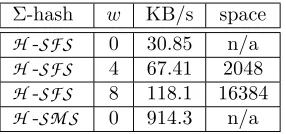
Σ-hash w KB/s space
H-S F S 0 30.85 n/a
H-S F S 4 67.41 2048
H-S F S 8 118.1 16384
H-S M S 0 914.3 n/a
Table 1: Implementation results. Herew is the “width” parameter determining pre-computation and the space is the number of group elements that need to be stored.
easily and naturally to MD iteration. But in the case of
SF S
andSM S
we have CmSet((N, l,u)) =Z∗
N $ Z+N = RpSet((N, l,u)). In Appendix A we show how to resolve these problems by appropriate “embeddings” that effectively allow the second input of the compression function to be used as a chaining variable at the cost of 1 bit in throughput and in particular allows us to run any of our Σ-hash functions in MD mode. We won’t detail the general transform here, but it is instructive to describe the modified compression function. The public key has the form (N, l,u, v) whereN, l,u are as before andv∈QR(N), andHpk :{0,1}l×Z∗
N →Z ∗
N is defined by
Hpk(c,z) =uc·z2·vfN(z) modN, (5)
where fN(z) = 0 if z ∈ Z+N and 1 otherwise. It can be shown that this modified function is also a Σ-hash, meaning the result of applying Σ2H to a suitably modified version of the original Σ-protocol that retains the sss, StHVZK and sc properties of the original. But now CmSet((N, l,u, v)) =Z∗
N = RpSet((N, l,u, v)) so MD-iteration is possible.
6.2 Metrics
We measure performance of a hash function in terms of rate, which we define as the average number of bits hashed per group operations. (By “average” we mean when the data is random.) In this measure, an exponentiation a7→Aa costs 1.5ngroup operations and a two-fold multi-exponentiation a, b7→AaBb costs 1.75n group operations wherenis the length of aand also of b. We will use these estimates extensively below. We can consider two modes of operation of a given Σ-hash function
H
-SP, namely compression and MD. In the first case the data to be hashed by Hpk is the full inputc,z, while in the second case it is only c. (The second input is the chaining variable which is not
part of the data.) The rate in MD mode is lower than in compression mode for most hash functions. (SF S is an interesting exception.) Compression mode is relevant when the function is being used as a chameleon hash, since the data can then be compressed with a standard (merely collision-resistant) hash function such as SHA-1 before applying the Σ-hash [31, Lemma 1]. MD mode is relevant when one wants to avoid conventional hash functions and get the full provable guarantees of the Σ-hash by using it alone. Our performance evaluations will consider MD mode.
6.3 Performance of Σ-hash functions
in fact performance is hardly affected by the modification.) On the average about half the bits of c
are 1 so
H
-SF S comes in at about 0.5 modular multiplications per bit. This explains the claim of Figure 1 in regard toH
-SF S without pre-computation. Now we look at how pre-computation speeds it up, using a block size of l = 512 (the same as MD5 and SHA-1) for illustration. The method is obvious. Pick a “width” w that divides land let t=l/w. Lettingpk = (N, l,u, v) denote the public key, pre-compute and store the table T with entriesT[i, x] =Qw
j=1u[(i−1)w+j]x modN (1≤i≤t, x∈ {0, . . .2w−1})
The size of the table is t2w =l2w/w group elements. Now computing
H
-SF S takes t+ 2 = 2 +l/w multiplications sinceHpk(c,z) = Qt
i=1T[i, xi]
·z2·vfN(z)
modN,
where xi is the integer with binary representation c[(i−1)w+ 1]. . . c[iw] (1 ≤ i≤ t). The number
of group operations per bit is thus [2 +l/w]/l ≈ 1/w, meaning the rate is w. Figure 1 showed the storage and this rate for w= 4 andw= 8.
Analytical assessment of the performance of
H
-SM S is difficult, but we have implemented both it and (for comparison)H
-SF S. The implementation used a 1024 bit modulus and (for MD mode) a 512 bit block size. Table 1 shows thatH
-SM S is about 30 times faster than the basic (no pre-computation) version ofH
-SF S. The gap drops to a factor of 15 and 7.5 when compared with thew= 4 andw= 8 pre-computation levels ofH
-SF S, respectively. Note thatH
-SM S here is without pre-computation. (The latter does not seem to help it much.) These implementation results are on a Dual Pentium IV, 3.2GHz machine, running Linux kernel 2.6 and using the gmp library [22].6.4 Comparisons
We now assess performance of previous schemes, justifying claims in Section 1. Damg˚ard [17] shows how to construct collision-resistant hash functions from claw-free permutations [23]. Of various factoring-based instantiations of his construction, the one of [23, 31], which we denote
H
-D a, seems to be the most efficient. The key is a modulusN product of two primes, one congruent to 3 mod 8 and the other to 7 mod 8, and the hash functionHN :{0,1}l×Z∗N →Z ∗
N is defined byHN(m, r) = 4m·rsmodN wheres= 2l. Since multiplying by 4 is cheap, we view it as free and the cost is then one multiplication per bit, meaning
H
-SF S is twice as fast. But pre-computation does not helpH
-D a since r is not fixed, and the gap in rates increases as we allow pre-computation forH
-SF S as shown in Figure 1.The key of Shamir and Tauman’s [47] hash function is a modulus N and an a ∈ Z∗
7
Improvements to
VSH
The performance of a hash function on short inputs is important in practice. (For example, a significant fraction of Internet traffic consists of short packets.) We present a variantVSH∗
of VSHthat is up to 5 times faster in this context while remaining proven-secure under the same assumption asVSH. The improvement stems from VSH∗
, unlike VSH, having a collision-resistant compression function.
Background. The key of Contini, Lenstra and Steinfeld’sVSHfunction [14] is a modulusN product of two primes. The VSHcompression functionvshN :{0,1}l×Z∗
N → Z ∗
N is defined by
vshN(c,z) =z2·Ql i=1p
c[i]
i modN,
where pi is the i-th prime and c[i] is the i-th bit of c. The hash function VSH is obtained by MD-iteration of vshwith initial vector 1. A curious feature ofVSHis that the compression function is not collision-resistant. Indeed,vshN(c, z) =vshN(c, N−z) for anyc∈ {0,1}l andz∈Z∗N. Nonetheless, it is shown in [14] that the hash functionVSHis collision-resistant based on the VSSR assumption. The latter states that given N, l it is hard to find x ∈Z∗
N and integers e1, . . . , el, not all even, such that
x2≡pe1
1 ·. . .·p
el
l (modN). The proof makes crucial use of the fact that the initial vector is set to 1.
VSH∗.
We alter the compression function of VSH so that it becomes (provably) collision-resistant and then define VSH∗ by MD iteration with the initial vector being part of the data to be hashed. The first application of the compression function thus consumes much more (1024 bits more for a 1024 bit modulus, for example) of the input, resulting in significantly improved rate for the important practical case of hashing short messages. For example, the implementation results of Table 2 show speed increases of a factor of 5 over VSH when hashing 1024 bit messages. Performance for long messages is the same as for VSH. VSH∗
and its compression function vsh∗
are provably collision-resistant under the same VSSR assumption asVSH.
The inspiration comes from
H
-SM S which we notice is very similar to vsh but, unlike the latter, is collision-resistant. The difference is that inH
-SM S the primes u[1], . . . ,u[l], v —referring to the MD-compatible version of the function from Equation (5)— are quadratic residues. But this turns out to be important for the completeness of the Σ-protocol rather than for collision-resistance. This leads to the compression function vsh∗N :{0,1}l×Z∗N →Z ∗
N defined by
vsh∗N(c,z) =Ql i=1p
c[i]
i
·pfN(z)
l+1 ·z2modN, where fN(z) = 0 if z ∈ Z+
N and 1 otherwise, pi is the i-th prime and c[i] is the i-th bit of c. As a check notice thatvsh∗
N(c,z) is unlikely to equal vsh ∗
N(c, N−z) becausefN(z)6=fN(N−z), meaning the attack showing vshis not collision-resistant does not apply. Of course this is not the only possible attack, but the proof of strong special soundness of
SM S
Proposition 4.3 can be adapted to show that vsh∗is collision-resistant under the VSSR assumption. Finally VSH∗
is obtained by MD iteration of vsh∗
but with the initial vector being the first k−1 bits of the input. For MD-strengthening, the standard padding method of SHA-1 is used.
The implementation results given in Table 2 were again obtained on a Pentium IV, 3 GHz machine using the gmp library [22]. We set the block size to 128 for both functions and considered hashing a 1024 bit input. In this case (even taking into account the increase in length due to MD strengthening) VSH∗
needs 1 application of its compression function. On the other handVSH (with their own form of strengthening) needs 9. The implementation shows that VSH∗
Hash Function block size input size Iterations Avg. time
VSH 128 8×128 9 140µs
VSH∗ 128 8×128 1 25µs
Table 2: The size of the modulus used here is 1024. The block and the input size are given in bits.
are tested on the same platform.
Acknowledgments
We thank the Journal of Cryptology referees for their valuable comments and careful reading of the paper.
References
[1] Elena Andreeva, Gregory Neven, Bart Preneel, and Thomas Shrimpton. Seven-property-preserving iterated hashing: ROX. In Kaoru Kurosawa, editor,ASIACRYPT 2007, volume 4833 ofLNCS, pages 130–146, Kuching, Malaysia, December 2–6, 2007. Springer, Berlin, Germany. [2] Giuseppe Ateniese and Breno de Medeiros. Identity-based chameleon hash and applications. In
Ari Juels, editor,FC 2004, volume 3110 ofLNCS, pages 164–180, Key West, USA, February 9–12, 2004. Springer, Berlin, Germany.
[3] Giuseppe Ateniese and Breno de Medeiros. On the key exposure problem in chameleon hashes. In Carlo Blundo and Stelvio Cimato, editors, SCN 04, volume 3352 of LNCS, pages 165–179, Amalfi, Italy, September 8–10, 2004. Springer, Berlin, Germany.
[4] Mihir Bellare and Daniele Micciancio. A new paradigm for collision-free hashing: Incrementality at reduced cost. In Walter Fumy, editor,EUROCRYPT’97, volume 1233 ofLNCS, pages 163–192, Konstanz, Germany, May 11–15, 1997. Springer, Berlin, Germany.
[5] Mihir Bellare, Chanathip Namprempre, and Gregory Neven. Security proofs for identity-based identification and signature schemes. In Christian Cachin and Jan Camenisch, editors, EURO-CRYPT 2004, volume 3027 of LNCS, pages 268–286, Interlaken, Switzerland, May 2–6, 2004. Springer, Berlin, Germany.
[6] Mihir Bellare and Thomas Ristenpart. Multi-property-preserving hash domain extension and the EMD transform. In Xuejia Lai and Kefei Chen, editors, ASIACRYPT 2006, volume 4284 of LNCS, Shanghai, China, December 3–7, 2006. Springer, Berlin, Germany.