Non Observability in the Random Oracle Model
Prabhanjan Ananth and Raghav Bhaskar Microsoft Research India
Bangalore 560001
Abstract
The Random Oracle Model, introduced by Bellare and Rogaway, provides a method to heuristically argue about the security of cryptographic primitives and protocols. The basis of this heuristic is that secure hash functions are close enough to random functions in their behavior, and so, a primitive that is secure using a random function should continue to remain secure even when the random function is replaced by a real hash function. In the security proof, this setting is realized by modeling the hash function as a random oracle. However, this approach in particular also enables any reduction, reducing a hard problem to the existence of an adversary, toobserve the queries the adversary makes to its random oracle and toprogram the responses that the oracle provides to these queries. While, the issue of programmability of query responses has received a lot of attention in the literature, to the best of our knowledge, observability of the adversary’s queries has not been identified as an artificial artefact of the Random Oracle Model. In this work, we study the security of several popular schemes when the security reduction cannot “observe” the adversary’s queries to the random oracle, but can (possibly) continue to “program” the query responses. We first show that RSA-PFDH and Schnorr’s signatures continue to remain secure when the security reduction is non observing (NO reductions), which is not surprising as their proofs in the random oracle model rely on programmability. We also provide two example schemes, namely, Fischlin’s NIZK-PoK [Fis05] and non interactive extractable commitment scheme, extractor algorithms of which seem to rely on observability in the random oracle model. While we prove that Fischlin’s online extractors cannot exist when they are non observing, our extractable commitment scheme continues to be secure even when the extractors are non observing. We also introduce Non Observing Non Programming reductions which we believe are closest to standard model reductions.
1
Introduction
methodology has resulted in many provably secure (in ROM), and at the same time, practical and efficient schemes.
Since no real world hash function is truly random, proofs in ROM have been a subject of debate by cryptographers. Public key encryption and Signature schemes have been devised such that they can be proved secure in the ROM but which become insecure as soon as the random oracle is instantiated by any real hash function [CGH04]. However, no real attacks have been demonstrated against any practical scheme that has been proved secure in ROM. This ambiguity about the reasonability of ROM has been of great interest to cryptographers. Furthermore, from a practical viewpoint, random oracle heuristic is the only basis for arguing the security of some of the most efficient cryptographic schemes (e.g. [PS00, BR, BR96]). Therefore, it is of fundamental importance to understand why certain cryptographic schemes can be proved secure in the ROM while no proof of security exists for them in the Standard model.
In ROM, the challenger (or the reduction) simulates the random oracle for the adversary in the security game. This new power to simulate the random oracle for the adversary enables the challenger to solve some hard problem, thus ruling out the possibility of the adversary winning in the security game. The ability to simulate the random oracle seems to “artificially” augment the capabilities of the challenger (in comparison to a Standard model challenger) in the following two ways:
• The challenger can now observe the input points at which the adversary makes queries to the random oracle. We will refer to this ability of the challenger asobservability.
• The challenger can now control the response of the random oracle at these input points, often embedding instances of some hard problem in the response. We will refer to this ability of the challenger asprogrammability.
Both these additional capabilities of the reduction are very artifical when compared to Stan-dard model reductions. Neither do we know of hash functions that can support such complicated programming nor do we know of a way of observing an algorithm’s queries to a hash function when the reduction is black-box. The possibility of programming the random oracle has been exploited in constructing many security reductions and thus the programmability aspect of the ROM has attracted much attention (see [Nie, FLR+10]). We explain some of that work later. On the other hand, even though observability is often criticized (explicitly in [Nie]) for providing the challenger with an unreasonable ability1, to the best of our knowledge, no formal study of this capability of the reduction has been done. Perhaps one of the most important reasons for the lack of this study is a general perception that observability is crucial to every proof in the ROM and that nothing can be achieved without it, thereby leaving no motivation to study reductions that limit observability. In this work, we study the role of observability in the construction of security reductions for several schemes. We call such reductions, in which the communication between the adversary and the random oracle is hidden from the reduction, as Non Observing reductions.
1.1 Non Observing reductions.
While in ROM, reductions often work by providing a simulation of the random oracle to the adversary, we want Non Observing reductions to operate in the presence of an external random oracle. All entities make their queries to this external random oracle which is independent of the reduction. All communication between the random oracle and the adversary is hidden from the reduction. As our focus is on restricting the observability capability of the reductions, we do let
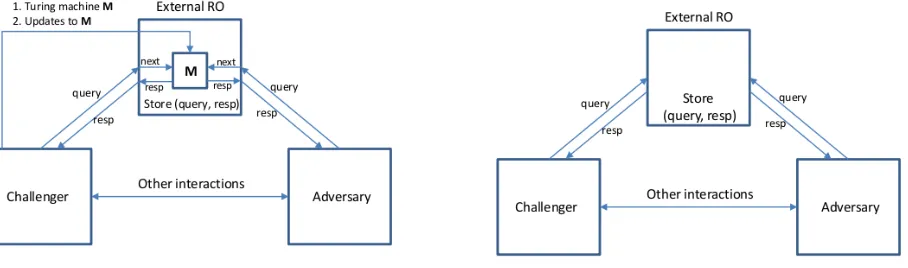
the reduction control the responses returned by the random oracle to the adversary (as long as the returned responses are uniformly distributed in the range of the random function). As shown in Figure 1, the reduction first sends a Turing machine to the external random oracle which uses this machine to respond to the queries as follows. On receiving a query, the external random oracle, inputs “Next” to the Turing machine, sent by the reduction, to obtain an output r which it sends as a response to the query. Note, that the reduction may still be able to figure out the number of queries made by the adversary. Non-Observing reductions, the way we have defined, deliberately have a fair bit of programming capability as our focus is to identify security reductions which crucially rely on Observability.
Our first result is about online extractors2 for NIZK-POK proposed by Fischlin in [Fis05]. The Fischlin transformation converts an interactive ZK-PoK (with some special properties) into NIZK-PoK with online extractors in the ROM. An online extractor, as defined in [Fis05], can output the witness given a (acceptable) proof and the queries made by the prover to the random oracle (i.e. with no rewinding). Such a NIZK-PoK can be easily converted into a secure signature scheme. We introduce the notion of Non Observing extractors, which can program the responses but not observe the queries made by the adversarial prover, and then prove that they do not exist for NIZK-PoKs obtained from the Fischlin transformation, thus also ruling out possibility of proving the security of the resulting signature scheme. Our proof idea can be extended to rule out the online extractor of [Pas03b] as well though we do not discuss this in our work. Thus, our result clearly proves that Observability is crucial for the existence of Fischlin extracor, as expected by looking at its construction.
Our second result demonstrates the existence of extractable commitment schemes with non observing extractors. The security of the extractable commitment schemes as studied in [Pas03a] seem to rely on the fact that the extractors can observe the set of query-response pairs. We show that the capability to observe is not necessary by constructing a secure extractable commitment scheme where the extractor is not allowed to observe the queries made by the committer but only allowed to program the random oracle.
We also show (in Appendix B) that both RSA-PFDH and Schnorr signatures remain secure (under the notion of Existential Forgery with Chosen Message Attack) with Non Observing re-ductions. This confirms the fact that our Non Observing reductions have enough programming capabilities so as to be able to rewind and embed.
1.2 Related work.
As part of this ongoing scrutiny of ROM, weaker versions of the Random Oracle model have been proposed. We briefly survey a few of them that have been proposed since [CGH04]:
• Micali and Reyzin [MR98] initiated the study of the security of signing with weak hashing by considering hash functions for which an adversary can fix arbitrarily the input-output values at polynomially many inputs.
• Nielsen [Nie] proposed a variant of the random oracle model where the random oracle is not programmable. In this model, one cannot program or set the value that the random oracle returns to any arbitrary value. He establishes separation results between proofs in the (programmable) random oracle model and non-programmable random oracle model
a) Non Observing Reductions b) Non Observing Non Programming Reductions
Table 1: Non Observing reductions can return responses to adversary’s queries without actually observing the query. Non Observing Non Programming reductions can neither observe the queries nor influence the responses.
• Liskov [Lis06] proposed models for weak hash functions where there exist the random oracle and the additional oracles that break some properties of the ROM. He listed several such oracles that provide, for example, collisions. He also proposed a general construction of a hash function from weak hash functions. Pasini and Vaudenay [PV] applied Liskov’s idea to the security analysis of digital signature schemes. They considered the security of hash-then-sign type signature schemes in the random oracle model with an additional oracle that returns first-preimages. Numayama, Isshiki and Tanaka [NIT] studied the security of the Full Domain Hash signature scheme, as well as three variants thereof in weakened random oracle models.
• Mironov [Mir] relaxed the collision-resistant requirement of hash functions in hash-and-sign constructions, without addressing the need for a random oracle. He notably revisited two popular signature schemes, DSA and PSS-RSA, and proposed variants based only on the target-collision resistant property of the underlying hash function. Their proofs of security, while still dependent on random oracles, only require short-input ones. In [HK], Halevi and Krawczyk proved similar results.
• Unruh [Unr] pointed out the fact that it might be more realistic to consider random oracles with auxiliary input. The auxiliary input models the fact that adversary at times has access to certain information about the hash function (e.g. collisions) before the initiation of the protocol. He showed that the RSA-OAEP encryption scheme [BR] is secure in the random oracle model even in the presence of oracle-dependent auxiliary inputs
2
Non Observing Reductions
2.1 Modeling issues
In this section, we formally define Non Observing reductions. As discussed in the introduction, a non observing reduction cannot observe the interaction between the adversary and the oracle, though it can continue to ’influence’ the query responses. Modelling how the reduction can influence the responses returned by the oracle machine while ensuring that the reduction can get no ‘information’ about the queries of the adversary is tricky. One way of modelling it is as follows: The reduction sends a (stateful) Turing machineM to the oracle. On receiving a query q from the adversary,M
is executed by the oracle machine on input q to obtain an element r. The value r is then sent to the adversary as a response. Also, M needs to be programmed in such a way that for a repeat query, the same response is returned. Unfortunately, this approach does not work because consider a machine M designed in a way, such that on receiving a ’special’ query from the reduction, all the queries made by the adversary till then are revealed. Thus, even though the reduction did not actually “see” the queries made by the adversary it still gets information about the queries made by the adversary through the machine M. The problem with the previous approach was that the response returned to a query could depend upon all the queries made till then. We can rectify this problem by forcing the condition that the machine M should return responses from a list which is fixed before the adversary makes any query. We allow the reduction to program this list before the random oracle is initiated. This again suffers from the following problem: After the execution of the adversary, the reduction can make special queries in such a way that the queries made by the adversary are leaked. This can be done by associating a (query numbern, bit positionp, bit value
b) tuple with each response in the list. The reduction can then make a special query indicating the desired query number and bit position, and M can then return the response associated with the bit value of thepth bit of the nth query. From this, the reduction can figure out all the queries made by the adversary. The main problem with this approach is that the machine M is allowed to maintain state. We can fix this problem by requiring M to be stateless. Thus, the reduction sends a stateless machine M along with a list Lsuch that for every query q the following is done:
M(q, L) is executed to obtainr. It is verified whetherr is inL before sending it to the adversary. This seems to do better than the previous approaches, in that the machine can no longer return responses which are correlated to the queries made till that point. But even this approach does not work! For two different queries q1 and q2, M(q1, L) and M(q2, L) can give the same answer
which might help the adversary in distinguishing between a pure random oracle from M because in a pure random oracle model this can happen only with negligible probability. Another problem with this approach is that the returned response can still leak information about some bits of the query. To circumvent these problems, we present a model, defined in the next subsection, which seems to not only capture non observability reasonably well but also is a more natural transition from (programmable and observable) ROM.
2.2 Our model
message. The machine M, at this point, can provide any response to the oracle as long as it is uniformly distributed in the range of the random function represented by the oracle. The reduction is also allowed to send updates to M during the lifetime of its exection. The reduction can also directly send updates to the external random oracle in the form of (query, response) pairs of its choice. Both these update procedures, allow the reduction to dynamically adjust its responses to the random oracle queries. As the reduction may be interacting with the adversary through other channels (for instance it may be simulating a signature oracle for the adversary), it can therefore use all of its knowledge from these other channels in returning the response. On receiving a response from the reduction, the oracle stores the (query, response) pair for future use and returns the response to the adversary. The reduction can also send queries of its own to the random oracle. In case of it being a fresh query, the oracle will answer it just like an adversary’s fresh query, else it will return a response using the stored (query, response) pairs. Thus, our Non Observing reduction can do almost all what a reduction in ROM can do, but has no visibility of the adversary’s queries ever. We show this in Figure 1. Before we formally define the model, we present some preliminaries.
For a cryptographic primitive S with the security property ΠS, let AdvΠS(A) be defined as the success probability of the adversaryAin violating the security property ΠS. For an oracle adversary
AO, the probabilityAdvΠ
S(AO) is taken over the random coins of the oracleOas well. More formally,
AdvΠS(AO) is the weighted average of the Adv parameters when instantiated with specific oracles and the weights correspond to the probabilities that the corresponding specific oracles are chosen. This definition can analogously be extended to setting of multiple oracles. We say that an adversary
AΠS-breaks S if there exists a polynomialp(·) such thatAdvΠS(A)>1/p(n) for infinitely many n. Consider cryptographic primitives S and f with security properties ΠS and Πf respectively. Let
A denote an attacker on the primitive S and let R denote a reduction from f to S, i.e., R uses
A to attack primitive f. We will denote byO to denote a random oracle that chooses a response uniformly at random from its range and by O(M) an oracle that uses the machine M produced by reduction R to provide the responses to its queries. We will use RA
O(M)
to denote the fact that the interaction between A and O(M) is hidden from R and RAO(M),O(M) to denote such a
reduction with its own oracles access toO(M).
Definition 1. There exists a black-box Non Observing reduction from f to S if there exists a PPT ITM machine R that outputs M with the property that if AO(M) ΠS-breaks S, making qO
queries to the oracle O(M), then RAO(M),O(M)(w) Π
f-breaks f, where O(M) is computationally indistinguishable fromO.
We define a Non Observing Non Programming reduction as a Non Observing reduction that can no longer provide the responses to the oracle. Thus, such a reduction works with oracle O
rather thanO(M). See Table 1 for a diagramatic representation of the reduction.
Definition 2. There exists a black-box Non Observing Non Programming reduction fromf toS if there exists a PPT ITM machine R with the property that if AO ΠS-breaks S, making qO queries
to the oracle O, then RAO,O(w) Π
f-breaks f.
3
Non Observing Online Extractors
witness for an input instance, given a proof (accepted by an honest verifier) and all the queries made by the prover to the random oracle. The online extractors deviate from the traditional extractors in that rewinding is not necessary to extract the witness. As remarked in [Fis05], rewinding leads to loose security reductions and hence online extractors can be useful to obtain tight security results. The formal definition of online extractors for a non interactive zero knowledge proof of knowledge is given below.
Definition 3 (Online Extractor). [Fis05] There exists a probabilistic polynomial time algorithmK
such that the following holds for any algorithmA. Let O be a random oracle, (x, π)←AO(k) and QO(A) be the sequence of queries of A to O. Let w←K(x, π, QO(A)). Then as a function of k,
P r[(x, w)6∈Wk∧VO(x, π) = 1]≈0
In the above definition, the online extractor does not have any power to choose the random oracle. In other words, the extractor is not allowed to program the random oracle. We first describe the result from [Fis05] which gives the construction of online extractors. [Fis05] gave a transformation, termed as Fischlin transformation, to convert an interactive proof of knowledge (defined as Fiat Shamir Proof of knowledge; see definition 8 in Appendix) to a NIZK-PoK which has an online extractor.
We give an informal description of the Fischlin transformation. Fischlin transformation converts a 3-message interactive ZKPoK (PF S, VF S) to a non interactive ZKPoK (PH, VH), where H is the random oracle, as follows. PH executes logarithmically many copies, denoted by r, of the underlying prover PF S. In each execution it gets the commitment comi from PF S. In the ith execution, PH then sequentially checks whether there exists any challenge ch
i from 0 to 2t−1 such that H(com, i, chi, respi) has all its last b bits as 0, where b is typically logarithmic in the security parameter and respi is the response returned by theith copy of PF S on challenge chi. If no such challenge exists thenPH picks the challengech
i for whichH(com, i, chi, respi) is minimum among all other challenges. Finally, PH composes the proof (com
i, chi, respi)1≤i≤r. The verifier
VF S on input x,(comi, chi, respi)1≤i≤r checks whether VF S accepts the proof (x, comi, chi, respi) for all 1≤i≤r. And also, it checks whether the last bbits of summation of H(com, i, chi, respi) is at most logarithmic in the security parameter. We formally describe the Fischlin transformation below.
Definition 4 (Fischlin Transformation). [Fis05] Let H be a random oracle. Let (PF S, VF S) be an interactive Fiat-Shamir proof of knowledge with challenges of ℓ=ℓ(k) =O(log(k))bits for relation
W. Define the parameters b, r, S, t (as functions of k) for the number of test bits, repetitions, maximum sum and trial bits such that br =ω(logk), 2t−b =ω(logk), b, r, t=O(logk), S =O(r) and b ≤ t ≤ ℓ. Define the following non-interactive proof system for relation W in the random oracle model, where the random oracle maps to b bits.
- Prover. The prover PH on input (x,w) first runs the prover P
F S(x, w) in r independent repetitions to obtain r commitments com1, · · ·, comr. Let com = (com1,· · · , comr). Then
PH does the following, either sequentially or in parallel for each repetition i. For each chi = 0,1,2,· · · ,2t−1 (viewed as t-bit strings) it lets P
F S compute the final responses respi =
respi(chi) by rewinding, until it finds the first one such that H(x,com, i, chi, respi) = 0b; if no such tuple is found then PH picks the first one for which the hash value is minimal among all2t hash values. The prover finally outputsπ = (com
i, chi, respi)i=1,2,...,r. - Verifier. The verifier VH on input x and π = (com
We first give an intuitive description of the proof of online extractability of the above transformation. Consider an adversary who, on inputx, has produced a proofπwithout having a witness forx. Let
Qbe the set of queries made by the adversary to the random oracle. We first claim that there cannot exist two queries (com, i, chi, respi) and (com, i, ch∗i, respi∗) in Q such that both (comi, chi, respi) and (comi, ch∗i, resp∗i) are accepted by the verifier VF S. If there existed two such queries then by the special soundness property of (PF S, VF S), the witness can be extracted. The extraction can be done by the online extractor since he can observe the queries made by the adversary. Hence, once the commitment tuple is fixed the adversary can query the random oracle for one particular challenge chi fori from 1 to r. Let si be the value output by the random oracle for the challeng e chi. Using simple probability arguments it can be shown that the summation of si for all the repetitions is negligible. Thus, for a given commitment tuple adversary succeeds with negligible probability in producing an accepting proof corresponding to that tuple. Since, adversary can try only polynomially many commitment tuples he can succeed in producing an accepting proof only with negligible probability.
The capability of the online extractor to extract the witness comes from crucial fact that the extractor can observe the queries made by the prover. If the extractor is not allowed to see the queries made by the prover and not allowed to program the random oracle then it can be seen that the extractor cannot extract the witness from the proof. In other words, there does not exist an online extractor for any NIZKPoK that neither programs the random oracle nor observes the queries made by the prover. The reason is that, if such an extractor were to exist then a malicious verifier can simply run the extractor to get the witness thus contradicting the zero knowledge property of the protocol. The same is not clear when the extractor is allowed to program the random oracle. More precisely, we want to understand whether there exist online extractors for NIZKPoK which are allowed do some limited programming of the random oracle but not allowed to observe. We term this class of online extractors as non observing online extractors and formally define them below.
Definition 5 (Non Observing Online Extractors). There exists a probabilistic polynomial time algorithm K = (K1, K2) such that for large enough k the following holds for any algorithm A.
There exists a polynomial p(k) such that (M, aux) ←K1(k, p(k)) and (x, π) ← AO(M)(k) making
qO ≤p(k) queries to the oracle O(M). Then we have thatw ← K2O(M)(x, π, M, aux). Then as a function of k,
P r[(x, w)6∈Wk∧VO(M)(x, π) = 1]≈0
We first show that there is a NIZKPoK which has a non observing extractor in the random oracle model. Consider a NIZKPoK (P, V) in the common reference string model. Construction of NIZKPoK in the common reference string model has been well studied in literature. See [DSP92] for one such example. The fact that (P, V) is a NIZKPoK means that it has an extractorE= (E0, E1)
which executes as follows. On input security parameter,E0 produces a pair of strings (σ, aux). Let
π be an acceptable proof produced by an adversary Aon input x as well asσ. Then,E1 on input
(x, π, σ, aux) outputs a witnesswforxwith non negligible probability. We construct (P∗, V∗) in the
random oracle model from (P, V) as follows. P∗ on inputx, queries the random oracle on the point
xto get the responseσ. P∗ then executesP(x, σ) to obtainπ. The verifierV∗, on receivingπ, first
queriesxto the random oracle to getσ and then executesV(x, π, σ). V∗ then outputs whateverV
outputs. We can construct a non observing online extractorE∗ = (E∗0, E1∗) as follows. Consider an adversarial proverA. LetqO be the number of queries made by the adversary. E∗
0 executesE0 for
qO times to obtain the strings(σ1, aux1), . . . ,(σqO, auxqO)
. E0∗then constructs a Turing machine
M which on being invoked for the ith time with input next outputs the string σ
the Turing machine M to the random oracle. After receiving the proofπ from an adversaryA,E∗
1
then queries x to the random oracle to obtain σi and then it executes E1(x, π, σi, auxi) to obtain
w. From the extractability property of (P, V), it follows that if π is an acceptable proof then E∗
outputs a witness for x with non negligible probability. This shows the existence of a NIZKPoK having non observing extractors.
The natural question to ask now is whether this is true for all NIZKPoK in the random oracle model. That is, whether there exists non observing online extractors for all NIZKPoK. We show that this is not true. In fact, we show that all the NIZKPoKs that are obtained from the Fischlin transformation do not have non observing online extractors. We formalize this result in the following theorem. To understand the theorem given below, we refer the reader to the definitions of special zero knowledge and one way instance generators in Appendix A.
Theorem 1. Consider a relation W having a one-way instance generator I. Let (PH, VH) be a non-interactive zero-knowledge proof of knowledge obtained by applying the Fischlin transformation to an interactive Fiat-Shamir proof of knowledge, (PF S, VF S) defined for the relation W. Then, there does not exists a Non Observing extractor for (PH, VH) 3.
Proof: We show that if a Non Observing online extractor K exists for (PH,VH), then we can construct an algorithm B, termed as inverter, which does the following. It takes as inputx where
x is produced by the one way instance generator, I. It then outputs a witness w forx with non-negligible probability such that (x, w)∈W. This contradicts the fact that I is a one-way instance generator for the relation W. We now give the construction of B. The algorithm B on input x
executes the following steps.
Step 1) B first executes K1 to get the Turing machine M which is passed on to the random oracle.
It then makes 2tr queries to a copy of M to obtain a list L. The reason why the size of the list is set to 2tr is because the honest prover makes at most 2tr queries. Note, the list L is the same as the first 2tr responses returned by O(M).
Step 2) B chooses ther challengeschi, i∈[1, r] by looking up the listL. As B has access to the list
Lof hash responses, it can figure out the exact challenges which an honest prover will include in his proof by imitating the honest prover’s strategy. B considers the first 2t elements in the listL whichK1(1k) outputs. If there is an element whose least significantb bits are 0 (if
there are many such elements pick the one with the least index in L), then B assigns ch′1 to be its index else assign ch′1 to be the index of the minimum among the first 2t elements. If (ch′1)th element corresponds to an element whose least significantbbits are 0, thenB repeats the process to compute ch′2 starting from the (β1′ + 1)th element of L. Whereas if (ch′
1)
th
element corresponds to the smallest element in the first 2telements, repeat the above process starting from the (2t+ 1)th element of the list. Thus, using the above approach B computes
ch′i, for all i∈[1, r]. Assign chi to bech ′
i ifi= 1 else chi=ch ′ i−ch
′ i−1.
Step 3) B executes the special zero knowledge simulator, Z, of the interactive Fiat-Shamir proof of knowledge, (PF S, VF S), at (x, chi, YES) to obtain comi and respi for all i ∈ [1, r]. Let
com= (com1, . . . , comr). Step 4) B makesch′
r queries to the random oracleO(M) as follows. At query numbersch ′
(x,com, 1, 0, 0), where comis a r-sized vector with each element chosen randomly from the commitment space.
Finally,BproducesπB= ((com1, ch1, resp1),(com2, ch2, resp2), . . . ,(comr, chr, respr)) as the proof. The following lemma proves that no probabilistic polynomial time algorithm (even with access to the Turing machineM) can distinguish proofπBfrom a proofπPO(L) produced by an honest prover
PO(M), where PO(M) is same as the prover PH but with random oracle H replaced with O(M). Lemma 1. Let Dbe a probabilistic polynomial time algorithm. The following two distributions are indistinguishable.
• K1(1k,2tr) → M. B is executed with input (x, M) and oracle access to O(M) which then
outputs πB. Output DO(M)(x, M, πB).
• K1(1k,2tr)→ M. PO(M) is executed with input x, w and oracle access to O(M) which then
outputs πPO(M). Output DO(M)(x, M, πPO(M)).
Proof. B’s strategy of producing the challenges and the special zero-knowledge property ensure that the distributions of πB is computationally indistinguishable from πPO(M) and thus D cannot distinguish the proof transcript πB from πPO(M). But as the queries made to the random oracle by B are different from that of an honest prover, D could try guessing the queries. We show below that this happens with negligible probability. Let the set of queries made by PO(M)
(re-spectively, B) to O(M) during its execution be QueryPO(M) (resp. QueryB). Denote the set of respones returned by O(M) corresponding to QueryPO(M) (resp. QueryB) by RespPO(M) (resp.
RespB). To prove the theorem, we first make the claim that RespPO(M) is in fact the same as
RespB. This follows from the description of B and PO(M). Let πPO(M) = (comi, chi, respi)1≤i≤r and πB = (com
′ i, ch
′ i, resp
′
i)1≤i≤r. We then claim that in both the cases, if the distinguisher makes a query q to O(M) then q belongs to (QueryPO(M)\{(com1,· · ·, comr, i, chi, respi) : 1 ≤ i ≤ r}) (resp. qbelongs to (QueryB\{(com
′
1,· · · , com
′ r, i, ch
′ i, resp
′
i)}) with negligible probability. To prove this claim, consider the following cases.
Case 1. PO(M): Without loss of generality letq be equal to (com
1,· · ·, comr, i, ch, resp) for some
i∈ {1, . . . , r}. Since q∈(QueryPO(M)\{(com1,· · · , comr, i, chi, respi) : 1≤i≤r}), it should hap-pen that (comi, ch, resp) is an accepting transcript (this is because the honest prover follows the protocol and hence all its queries correspond to accepting transcripts). We now have two accepting transcripts (comi, chi, respi) (from πPO(M)) and (comi, ch, resp) using which we can extract a wit-ness forx. Using this observation, we can construct a polynomial time procedure which can extract a witness from the input instance. Now, we make the observation that we could have executed the zero knowledge simulator to obtainπSim (which is indistinguishable from πPO(M)) and then using the strategy ofD(in a non black box way) to find q we could then extract a witness for the input instance. Since such an approach gives us a probabilistic polynomial time algorithm to compute the witness, our assumption that the considered relation has a one-way instance generator is violated. Case 2. B: Consider the query q′ = (com′′
1, . . . , com
′′
r,0,0,0) in the set (QueryB\{(com ′
1, · · ·,
com′r), i, ch′i, respi′}). The probability that q′ =q is negligible sincecom′′
1, . . . , com
′′
r is picked uni-formly at random.
From the above two cases it can be inferred that the distributionsDO(M)(x, L, π
PO(M)) andDO(M)(x,
Now, consider the following probabilistic polynomial time algorithm.
Input: Instance x obtained as the output of the one-way instance generatorI. Output: Witnessw.
1. K1(1k,2tr)→M.
2. BO(M)(x, M)→π
B. 3. K2O(M)(x, M, πB)→w.
Using Lemma 3 and the construction of B, it can be seen that the above algorithm outputs w
with non-negligible probability for input x such that (x, w) ∈ W contradicting the assumption thatW has a one-way instance generator. Thus, Non Observing online extractors do not exist for (PH, VH).
4
Extractable commitment schemes
The notion of extractable commitment schemes has been studied [Pas03a, ACP09] in the common reference string model as well as the random oracle model. Extractable commitments are commit-ment schemes equipped with an additional algorithm, called the extractor, which can recover the committed value given the commitment as well as the trapdoor to the CRS (in the CRS model) or given access to the queries to the random oracle made by the committer to generate the com-mitment. In this section, we study extractable commitments in the random oracle model. If the extractor is allowed to observe the queries made by the committer then there is a simple com-mitment scheme as described in [Pas03a]. We give an example of an non interactive extractable commitment scheme where the extractor is allowed the program the random oracle but not allowed to observe the queries made by the committer to the random oracle. We now define the notion of extractable commitment schemes in the random oracle model when the extractor is non-observing. For preliminaries on commitment schemes, refer to Appendix D.
Definition 6. Consider a non-interactive commitment scheme (C, R)defined in the random oracle model whereC is the committer and Ris the receiver. We say (C, R)is an extractable commitment scheme with non observing extractors if there exists a PPT extractor K= (K1, K2) which does the
following. The algorithm K1 on input security parameter ouputs a Turing machine M along with
auxillary informationaux. Let the output of the committer with access toO(M)be the commitment
c. Then,K2 on input (c, M, aux)and access to the random oracleO(M)outputsmwith probability
negligibly close to the probability that the committer succeeds in decommitting to m.
We now describe our extractable commitment scheme. Consider the random oracle H mapping from {0,1}∗ to{0,1}n, where n is some polynomial in the security parameter. Let k
1 < n and k2
be polynomials in the security parameter. ExtCom.
Commit phase:
On input m, the committer picks a value R from {0,1}k2 uniformly at random. It then sends the queries (m, R,1), . . . ,(m, R, l) toH to receive the responses (h′
1, . . . , h′l), wherel is the length of m. It then picks a non-zero key K from the space {0,1}n−k1\{0n−k1} uniformly at random 4. It then computes (h1, . . . , hl) as follows: hi = h′i if mi = 0 (mi denotes the ith bit of m) else
4This means that it picks anon-zerokey from the space{0
,1}
n−k1
hi =h′i⊕(K||0k1). It then sends (h1, . . . , hl) as the commitment. Reveal phase:
The committer sends (m, R, K) as the decommitment. Let the input received by the receiver during the commit phase be (h1, . . . , hl). The receiver accepts if the following conditions are satisfied. 1. K 6= 0.
2. H(m, R, i) =hi ifmi = 0, elseH(m, R, i)⊕(K||0k1) =hi.
We now show that the above commitment scheme satisfies both the hiding and the binding proper-ties. We first show that the commitment scheme satisfies computational hiding property. Observe that the only way for the adversary to distinguish the commitments corresponding to two different messages is when it queries the random oracle on the message which is contained in the commit-ment. Since the adversary runs in polynomial time the probability that it guesses R (picked by the committer) correctly is negligible, sinceR is polynomial in the security parameter. This shows that no PPT adversary can distinguish commitments corresponding to two different messages. We now show that the extractable commitment scheme satisfies the binding property. Let m1 and
m2 be two distinct messages which correspond to the opening of a commitment c = (h1, . . . , hl). Without loss of generality, assume that the ith bit of m
1 is different from the ith bit of m2. Also
assume that the ith bit of m
1 is 1 while the ith bit of m2 is 0. Since c can be opened to both
m1 and m2, this means that H(m1, R, i)⊕(K||0k1) = H(m2, R, i). In other words, the last k1
bits of H(m1, R, i) is the same as the last k1 bits of H(m2, R, i). But this can happen only with
probability 21k1 =negl(k) which in turn means that with negligible probability the commitment c
can be opened to both m1 andm2 for any two distinct messages m1 and m2. This shows that the
commitment scheme satisfies binding property.
The following theorem shows that the above described commitment scheme is a secure ex-tractable commitment scheme even when the extractor is non observing, as per Definition 6. Theorem 2. ExtCom is an extractable commitment scheme secure in the random oracle model. Further, the extractor in the commitment scheme is non-observing.
Proof. We demonstrate the existence of an extractor K for the commitment scheme ExtCom which succeeds in extracting the message from the commitment with non-negligible probability. To do this, we crucially use the fact that the extractor can program the random oracle. Further, the extractor we construct is a non-observing one: the extractor cannot see the interaction between the oracle and the adversary. We now define the extractorK which is decomposed into algorithms
K1 and K2.
K1 picks a list L of responses of lengthqh uniformly at random. It then constructs a machine
M which does the following. On being invoked for the ith time with the next query, M outputs theith entry in the listL. Note thatM is a stateful machine and so can store the number of times it has been invoked till now. K1 then sends M to the oracleO. We now define K2: On input a
commitment (h1, . . . , hl) along with the Turing machine M and oracle access to O(M), K2 does
the following. It executesM(next) forqh times to get a list L. It then computes a messagem such that for alli= 1, . . . , l it assigns theith bit ofm to be 0if h
i is found inL else it assignsmi to be 1. It then outputsm.
We claim that, with overwhelming probability the output of K2 is the same as the message
decommitted by the sender during the reveal phase. More precisely, if the sender successfully decommits to m then K outputs m′ such thatm′ =m with overwhelming probability. To prove
any non-zeroK, whererespi, respj are any two responses returned by the machineM. This follows from the following two cases: if respi =respj then respi 6=respj ⊕(K||0k1) since K is non-zero and if respi 6=respj then respi can be same asrespj⊕(K||0k1) with negligible probability since the probability that the lastk1 bits of respi and respj are the same is 21k1 (because the responses
returned by M are picked uniformly at random). This proves that respi =respj ⊕(K||0k1) with negligible probability which further proves that the probability that m′ 6= m is negligible. This
completes the proof. ⊓⊔
These ideas can be extended further, in a straightforward manner, to construct plaintext aware encryption schemes having non observing plaintext extractors.
References
[ACP09] M. Abdalla, C. Chevalier, and D. Pointcheval. Smooth projective hashing for condition-ally extractable commitments. Advances in Cryptology-CRYPTO 2009, pages 671–689, 2009.
[BR] M. Bellare and P. Rogaway. Optimal Asymmetric Encryption. InAdvances in Cryptol-ogy -Eurocrypt’94, pages 92–111.
[BR93] M. Bellare and P. Rogaway. Random Oracles are Practical: A Paradigm for Designing Efficient Protocols. In Proceedings of the First ACM Conference on Computer and Communications Security, pages 62–73, 1993.
[BR96] Mihir Bellare and Phillip Rogaway. The exact security of digital signatures - how to sign with rsa and rabin. In EUROCRYPT, pages 399–416, 1996.
[CGH04] R. Canetti, O. Goldreich, and S. Halevi. The Random Oracle Methodology, Revisited. J. Assoc. Comput. Mach., 51(4):557–594, 2004.
[DSP92] A. De Santis and G. Persiano. Zero-knowledge proofs of knowledge without interaction. In Foundations of Computer Science, 1992. Proceedings., 33rd Annual Symposium on, pages 427–436. IEEE, 1992.
[Fis05] Marc Fischlin. Communication-efficient non-interactive proofs of knowledge with online extractors. In In CRYPTO 2005, pages 152–168. Springer-Verlag, 2005.
[FLR+10] Marc Fischlin, Anja Lehmann, Thomas Ristenpart, Thomas Shrimpton, Martijn Stam,
and Stefano Tessaro. Random oracles with(out) programmability. In ASIACRYPT, pages 303–320, 2010.
[GMR88] Shafi Goldwasser, Silvio Micali, and Ronald L. Rivest. A digital signature scheme secure against adaptive chosen-message attacks. SIAM J. Comput., 17(2):281–308, 1988. [HK] S. Halevi and H. Krawczyk. Strengthening Digital Signatures Via Randomized Hashing.
InAdvances in Cryptology - Crypto 2006, pages 41–59.
[Mir] I. Mironov. Collision-Resistant No More: Hash-and-Sign Paradigm Revisited. In 9th International Workshop on Practice and Theory in Public Key Cryptography, PKC 2006, pages 140–156.
[MR98] S. Micali and L. Reyzin. Signing with Partially Adversarial Hashing. Technical Report 575, MIT/LCS/TM, 1998.
[MvOV97] A. J. Menezes, P. C. van Oorschot, and S. A. Vanstone. Handbook of Applied Cryp-tography. Discrete Mathematics and its Applications. CRC Press, Boca Raton, FL, 1997.
[Nie] J. B. Nielsen. Separating Random Oracle Proofs from Complexity Theoretic Proofs: The Non-committing Encryption Case. In Advances in Cryptology - Crypto 2002, pages 111–126.
[NIT] A. Numayama, T. Isshiki, and K. Tanaka. Security of Digital Signature Schemes in Weakened Random Oracle Models. In 11th International Workshop on Practice and Theory in Public Key Cryptography, PKC 2008, pages 268–287.
[Pas03a] R. Pass. On deniability in the common reference string and random oracle model. Advances in Cryptology-CRYPTO 2003, pages 316–337, 2003.
[Pas03b] Rafael Pass. On deniability in the common reference string and random oracle model. InIn proceedings of CRYPTO 03, LNCS series, pages 316–337. Springer-Verlag, 2003. [PS00] D. Pointcheval and J. Stern. Security Arguments for Digital Signatures and Blind
Signatures. J. Cryptology, 13(3):361–396, 2000.
[PV] S. Pasini and S. Vaudenay. Hash-and-Sign with Weak Hashing Made Secure. In In-formation Security and Privacy: 12th Australasian Conference, ACISP 2007, pages 338–354.
[PV05] Pascal Paillier and Damien Vergnaud. Discrete-log-based signatures may not be equiv-alent to discrete log. In ASIACRYPT, pages 1–20, 2005.
[RSA83] Ronald L. Rivest, Adi Shamir, and Leonard M. Adleman. A method for obtaining digital signatures and public-key cryptosystems (reprint). Commun. ACM, 26(1):96–99, 1983. [SG98] V. Shoup and R. Gennaro. Securing threshold cryptosystems against chosen ciphertext
attack. Advances in CryptologyEUROCRYPT’98, pages 1–16, 1998.
[Unr] D. Unruh. Random Oracles and Auxiliary Input. InAdvances in Cryptology -Crypto 2007, pages 205–223.
A
Preliminaries
Letλ∈Nbe the security parameter. We say that a function isnegligible inλif it is asymptotically smaller than the inverse of any fixed polynomial. More precisely, a functionη(λ) from non-negative integers to reals is called negligible in λ if for every constant c > 0, ∃λc such that ∀λ > λc,
A.1 Signatures
Definition 7 (Digital Signatures Scheme.). A signature scheme [GMR88] consists of three algo-rithms(Gen,Sign,Verify)for key generation, signing and verification, respectively. More concretely,
- Key Generation. Gen(1λ) generates a public key secret key pair, (pk,sk). - Signing. Sign(sk, m) outputs a signature σ on message m.
- Verification. Verify(pk, m, σ) outputs a bit.
A signature scheme is said to be completeif, for every(pk,sk)←Gen(1λ), any messagem∈ {0,1}λ and any σ ←Sign(sk, m), we haveVerify(pk, m, σ) = 1.
Attack and Forgery types: An adversary can broadly mount two kinds of attacks against signature schemes: Key-only attack (KOA, also called no-message attack) and Chosen message attack (CM A). In the first attack, the attacker knows only the public key of the signer while in the latter, the attacker can also obtain signatures on messages of his choice adaptively. The result of the attacks by the adversary are classified as follows:
1. Total Break - The adversary learns the secret key of the signer.
2. Universal Forgery (UF) - The adversary can produce a valid signature for any given message. 3. Existential Forgery(EF) - The adversary can produce a new message signature pair.
Thus, by combining the attack type and the attack result, one can talk about various levels of security for digital signatures. For instance, a (ε, τ)-universal forger under key-only attack is an adversary who, knowing only the public key, can produce a signature on any given message with probability ε in time at most τ. An (ε, τ, qh)-universal forger under key-only attack is the same adversaryin the Random Oracle Model who, makes at mostqh hash queries to the random oracle. For details refer to [MvOV97, PV05].
Security notions are obtained by coupling an adversarial goal with an attack model. We dis-tinguish between several notions for which general results are immediate, as shown on Figure 1. We refer the reader to the extensive cryptographic literature for a more formal definition of these security notions.
Existential forgeries EF-KOA[S] ⇒ EF-CMA[S]
⇑ ⇑
Universal forgeries UF-KOA[S] ⇒ UF-CMA[S]
⇑ ⇑
Breakability BK-KOA[S] ⇒ BK-CMA[S] Goal vs. Attack Key only Chosen message
Figure 1: Major security notions for signature schemes. S denotes an arbitrary signature scheme and P1 ⇐P2 means that P1 is polynomially reducible toP2. Security notions are defined by their
underlying probleme.g.UF-KOA[S] denotes the problem of computing a universal forgery under a
Definition 8. A Fiat Shamir proof of knowledge (withl(k)-bit challenges) for relation W is pair (P, V) of probabilistic polynomial time algorithms P = (P0, P1), V = (V0, V1) with the following
properties. [Completeness.]For any parameterk, any(x, w)∈Wk, any(P(x, w), V0(x))→(α, β, γ)
it holds V1(x, α, β, γ) = 1.
[Commitment Entropy.]For parameter k, for any(x, w)∈Wk, the min-entropy ofP0(x, w)→α is
superlogarithmic in k.
[Public Coin.]For any k, any(x, w)∈Wk any α←P0(x, w)the challengeV0(x, α)→β is uniform
on{0,1}l(k).
[Unique responses.]For any probabilistic polynomial time algorithmA, for parameterkandA(k)→
(x, α, β, γ, γ′) we have, as a function ofk,
P r[V1(x, α, β, γ) =V1(x, α, β, γ′) = 1∧γ 6=γ′]≈0
[Special Soundness.] There exists a probabilistic polynomial time algorithm K, the knowledge ex-tractor, such that for any k, any (x, w) ∈ Wk, any pairs (α, β, γ),(α, β′, γ′) with V1(x, α, β, γ) =
V1(x, α, β′, γ′) = 1 and β6=β′, for K(x, α, β, γ, β′, γ′)→w′ it holds (x, w′)∈Wk.
[Honest-Verifier Zero-Knowledge.] There exists a probabilistic polynomial time algorithm Z, the zero-knowledge simulator, such that for any pair of probabilistic polynomial time algorithms D = (D0, D1) the following distributions are computationally indistinguishable:
• Let D0(k) → (x, w, δ) and (P(x, w), V0(x)) → (α, β, γ) if (x, w) ∈ Wk and ⊥ → (α, β, γ) otherwise. OutputD1(α, β, γ, δ).
• Let D0(k)→ (x, w, δ) and Z(x, Y ES) →(α, β, γ) if (x, w) ∈Wk and Z(x, N O)→ (α, β, γ). Output D1(α, β, γ, δ).
Definition 9 (Special Zero-Knowledge). There exists a probabilistic polynomial-time algorithm X, the special zero-knowledge simulator, such that for any pair of probabilistic polynomitime al-gorithms D = (D0, D1) the following distributions are computationally indistinguishable: (-) Let
(x, w, ch, δ)←D0(k) and(com, ch, resp) ← (P(x, w), V0(x, ch))if (x, w)∈Wk and(com, ch, resp)
← ⊥ else. Output D1(com, ch, resp, δ). (-) Let (x, w, ch, δ) ← D0(k) and (com, ch, resp) ←
Z(x, ch, Y ES)if(x, w)∈Wkand(com, ch, resp)←Z(x, ch, N O)else. OutputD1(com, ch, resp, δ).
Definition 10. A relationW is said to have a one-way instance generatorI if for any parameterk
algorithmI returns in probabilistic polynomial time(x, w)∈Wk, but such that for any probabilistic polynomial time algorithm, termed as inverter, I, for (x, w)∈ I(1k) and I(x)→w′ the probability P((x, w′)∈Wk) is negligible in k.
B
Schnorr Signatures are secure without observability
In this section we provide a positive result arguing the security of the Schnorr signature scheme. We define below the Discrete Log problem and the Schnorr signature scheme and then show that Schnorr signatures are secure against existential forgery under chosen message attack (EF-CMA). We refer the reader to Appendix A for an introduction to signature schemes and related security models.
Definition 11 (DL Problem). Let G = hgi be a group of prime order q generated by g. Given
A probabilistic algorithmA is said to be an (ε, τ)-solver for DL if Pr
k←$Zq
h
A(gk) =ki≥ε,
where the probability is taken over the random tape of A and random choices of k and A stops after time at mostτ.
The (ε, τ)-discrete log assumption (for groupG) says that no (ε, τ)-solver can exist for DL over G. The (asymptotic)DL-assumption says that the (ε, τ)-discrete log assumption holds whenever
τ = poly(logq) and εis a non-negligible function of logq.
Definition 12 (Schnorr Signature Scheme). Let p and q be primes such that q |(p−1) Let g be a generator of the cyclic subgroup Gof order q in Z∗p. Let H be a secure hash function with range
{1, . . . , q−1}. The Schnorr signature scheme consists of the following three algorithms:
1. Key Generation: Choose a random x with0< x < q. x is the private key and y:=gx is the public key.
2. Signing: Given the input message m, choose a random k mod q. Let c := H(m, gk), and
s:=k+cx. Return (c, s) as the signature.
3. Verification: Given the message m and the signature pair (c, s), calculate r = gsy−c. Let
c′ =H(m, r). If c=c′ then return true else returnf alse.
We now show that there exists a Non Observing reduction from the Discrete Log assumption to any adversary (making atmost qh hash queries) that generates existential forgeries under key only attack. To give an intuition behind our idea we start by recalling the original proof of Schnorr in the random oracle model. The key idea in the proof [PS00] is to execute the adversary twice using the same input and random tape. This adversary will make hash queries and the reduction needs to respond to these queries. In both executions, the reduction responds with the same hash responses till some chosen query called the “forking point”. Starting from this “forking point” the reduction uses different hash responses in the two executions. With certain probability both executions of the adversary will generate forgery at the “forking” point and this allows the reduction to compute the discrete log. As for the adversary’s signature query for some messagem, the reduction returns a randomly chosen tuple (s,c) as the signature and then updates the random oracle to return the responsec when queried at (m;gsy−c).
Our positive results relies on the observation that in the proof of security of Schnorr signatures, the reduction does not need to actually know the queries made by the adversary to the random oracle. It just needs to be able to achieve a “forking” situation. Furthermore, this effect can be achieved by programming two separate random oracles for the two executions, that respond with the same value up till the “chosen query.”
We start by recalling the Splitting Lemma. We refer the reader to [PS00] for details on the proof. Then we provide a formal proof for the security of the Schnorr signature scheme in non observing reduction model.
Lemma 2 (The Splitting Lemma.). Let A⊂X×Y such that P r[(x, y)∈A]≥ε. For,
B =n(x, y)∈X×Y |P ry′∈Y[(x, y′)∈A]≥ ε 2
o
The philosophy of splitting lemma is that when a subset Ais “large” in a product spaceX×Y, then it has many “large” sections.
Theorem 3. There exists a Non Observing reduction from the (τ′, ε′)-secure Discrete-Log problem
to any adversary that (ε, τ, qh, qs)-breaks existentially unforgeability (under chosen message attack) of the Schnorr signature scheme such that
ε≈poly ε′, qh
and τ ≈poly τ′, ε, qh, qs
where qh is the number of random oracle queries andqs is the number of signature queries that the Schnorr forger makes.
Proof. We closely follow the ideas from [PS00]. Given an existential Schnorr forger oracle machine
A, which receives the public key pk and makes up to qh random oracle queries and up to qs signature queries, we construct a Non Observing reductionR= (R1,R2) that solves the
Discrete-Log problem. The reduction will execute the adversary twice. We start by describing R1, the
first part of the reduction. For the two executions of the adversary, R1 generates machines M1
and M2 that it will send to the two instances of the random oracle. Execution of the adversary
instantiated with the oracle O(M1) when using machine M1 is denoted by A
O(M1)
. Similarly, adversary instantiated with the oracle O(M2) when using machine M2 is denoted byA
O(M2)
. We start by describing how R1 generates the machines M1 and M2. R1 samples a random
value j ∈ [qh] and qh random hash responses ρ1, ρ2. . . ρqh. It creates a list L1 with these values
ρ1, ρ2. . . ρqh. This list is used by machine M1 to return the query responses and in that order.
Similarly, it initializes machine M2 with list L2= {ρ1, ρ2. . . ρj−1, ρ′j. . . ρ′qh}, where ρ
′
j. . . ρ′qh are
freshly chosen.
Reduction R2 chooses fresh randomness ̟ and executesA
O(M1)
with input pk and with ran-domness̟. It then executesAO(M2) with the same inputpkand the same randomness̟. Observe that the reduction R2 remains oblivious of all the queries that the adversaries make to their
or-acles. However, since we execute AO(M1) and AO(M2) with the same input and randomness we can assume that in both executions the adversary will make the same first query to the respective oracle. Further, if it is given same responses then its future queries, in the two executions, will also be the same. In our setting, the firstj−1 responses provided byL1 and L2 will be the same
and therefore the first j queries made by the adversary will necessarily have to be the same. The queries made by the adversaries after this point might vary. In effect, we have achieved the effect of rewinding even though the reductionR2 remains oblivious of actual queries made by bothA
O(M1)
and AO(M2).
To answer the signature queries of the adversary, the reduction exploits the fact that it can send dynamic updates to the random oracle. Thus, when the signature oracle is queried at pointm, the reduction randomly choosessandcfrom [1, p−1], and returns (s, c) as the signature. At the same time, it sends an update to the random oracle to returnc when queried at point (m, gs·y−c).
If both executionsAO(M1) and AO(M2) return valid signatures on the jth query we can use the two forgeries to solve the Discrete-Log problem. In all other cases our reduction aborts.
Probability Analysis. Let ν be the probability that the adversary returns a forgery on a hash query that it made to its oracle at some point. The probability that the adversary comes up with a forgery involving a hash query for which the random oracle was never queried is q−11. Thus
success the adversary returning forgery involving some hash query is at least ν. Therefore, there exists a β ∈ [qh] such that over the random coins of ̟, ρ1. . . ρqh the probability of success of
the adversary returning forgery involving the βth hash query is at least ν
qh. We say that a value
̟, ρ1. . . ρβ−1 is “good” if an adversary on input̟, ρ1. . . ρqh successfully outputs a forgery on the
βthhash query with probability at least ν
2qh, where the probability is taken over the random choices
of ρβ. . . ρqh. Now using Lemma 2, at least
ν
2qh fraction of the values̟, ρ1. . . ρβ−1 will be “good.”
Finally, this yields that the over all success probability of our reduction in solving discrete log is at least q1
h·
ν
2qh
3
, which is non negligible. For a more detailed analysis, refer to [PS00]. ⊓⊔
C
RSA based Signature Schemes.
RSA [RSA83] public system consists of a public key (N, e) and a secret key (N, d), whereN is the product of two λ/2 bit primes, and e, d ∈Z∗
φ(N) satisfying ed ≡1 mod φ(N). The RSA function
f : Z∗
N → Z∗N is defined by f(x) = xe mod N and its inverse f−1 : Z∗N → Z∗N is defined by
f−1(y) =yd mod N (x, y∈Z∗
N). Let (N, e, d)← RSA(1λ) be the RSA key generation algorithm. Definition 13 (RSA Problem). Given (N, e) and y ∈Z∗
N computing xe mod N is known as the RSA inversion problem.
A probabilistic algorithmA is said to be an (ε, τ)-solver for the RSA inversion problem if Pr
(N,e,d)←RSA(1λ),x←$Z∗
N
[(A(N, e, xe)) =x]≥ε,
where the probability is taken over the random tape of A, random choices of RSA and x and
A stops after time at mostτ.
The (ε, τ)-RSA inversion assumption says that no (ε, τ)-solver can exist for RSA inversion prob-lem. The (asymptotic) RSA inversion assumption says that the (ε, τ)-RSA inversion assumption holds whenever τ = poly(logq) andεis a non-negligible function of logq.
Definition 14 (Probabilistic Full Domain Hash (PFDH) signatures.). This signature scheme is parameterized by a length parameter k0. Let H : {0,1}∗ → Z∗N be a secure hash function. The PFDH signature scheme consists of the following three algorithms:
1. Key Generation: Let (N, e, d) ← RSA(1λ). Further let (N, d) be the private key and (N, e) be the public key.
2. Signing: Given the input messagem, and the secret key(N, d), choose a randomr← {$ 0,1}k0. Computes:= (H(m, r))d mod N and return (r, s) as the signature.
3. Verification: Given the messagemand the signature(r, s), check ifse=H(m, r) modN. If it is indeed the case then returntrue else return f alse.
When k0 = 0 then the above described signature scheme is in fact deterministic and is referred
to as the Full Domain Hash (FDH) signature scheme.
Theorem 4. Assuming that the RSA inversion problem is (τ′, ǫ′)-secure, the PFDH signature scheme with parameterk0 is(ǫ, τ, qh, qs)-existentially unforgeable under chosen message attack (un-der Non Observing reductions) in the random oracle model such
where qh is the number of the hash queries and qs is the number of signature queries that the forger makes.
Proof. Given an existential forger oracle machineA, which receives the public keypkand makes up toqh queries and uptoqssignature queries, we construct a Non Observing reductionR= (R1,R2).
R1 is responsible for generating a machine M that will be used by it to return responses to the
random oracle for the adversary. R1 generates a list L as follows: R1 samples qs+qh elements
µ1, . . . , µqs+qh ∈ Z
∗
N. It picks a number iuniformly at random from [qs+qh]. It then writes the elements µe
1, . . . , µei−1, yµei, µei+1, . . . , µeqs+qh onL, wherey is the RSA inversion challenge. The
ma-chineM is then programmed to return the reponses to its queries from listLand in that order. We next describe the simulation of signature queries. Reduction R2 then instantiates the adversary
with input (N, e) and oracle access to O(M). On receiving a message m, the reduction picks a bit
r ofk0 bits uniformly at random and queriesO(M) with (m, r). If the response returned byO(M)
is of the form µej then reduction returns µj to the adversary else it aborts.
Outputting an inverse: The reduction returns a forgery (r, s) on message m with randomness
r such that it never received a signature on this message. Let the response of O(R1) to the query
(m, r) be h. Either h is of the formµe
j or yµej for somej ∈[qs+qh]. If h=yµej then R2 outputs s
µj as RSA inverse ofy.
Probability analysis: The reduction succeeds only if the adversary produces a forgery corre-sponding to the element yµe
i. But the adversary can choose this element with probability qs+1qh.
Hence, the probability that the reduction outputs an RSA inverse ofy is ǫ′ qs+qh.
⊓ ⊔
D
Commitment schemes
In this section, we recall the definition of commitment schemes in the random oracle model. A commitment scheme consists of three PPT algorithms: Commit, Decommit and Verify which are as described below. The committer executes the Commit algorithm during the commit phase and it executes the Decommit algorithm during the reveal phase. Consider a random oracle H.
• Commit(m,r): It takes the messagem and chooses randomnessr to derive a commitment c
using the random oracleH.
• Decommit(c): The commitment cis opened by outputting m and r.