Memory Delegation
∗Kai-Min Chung† Yael Tauman Kalai‡ Feng-Hao Liu§ Ran Raz ¶
June 15, 2011
Abstract
We consider the problem of delegating computation, where the delegator doesn’t even know the input to the function being delegated, and runs in time significantly smaller than the input length.
For example, consider the setting ofmemory delegation, where a delegator wishes to delegate her entire memory to the cloud. The delegator may want the cloud to compute functions on this memory, and prove that the functions were computed correctly. As another example, consider the setting ofstreaming delegation, where a stream of data goes by, and a delegator, who cannot store this data, delegates this task to the cloud. Later the delegator may ask the cloud to compute statistics on this streaming data, and prove the correctness of the computation. We note that in both settings the delegator must keep a (short) certificate of the data being delegated, in order to later verify the correctness of the computations. Moreover, in the streaming setting, this certificate should be computed in a streaming manner.
We construct both memory and streaming delegation schemes. We present non-interactive constructions based on the (standard) delegation scheme of Goldwassweret. al.[GKR08]. These schemes allow the delegation of any function computable by anL-uniform circuit of low depth (the complexity of the delegator depends linearly on the depth). For memory delegation, we rely on the existence of a polylog PIR scheme, and for streaming, we rely on the existence of a fully homomorphic encryption scheme.
We also present constructions based on the CS-proofs of Micali. These schemes allow the delegation of any function inP. However, they are interactive (i.e., consists of 4 messages), or are non-interactive in the Random Oracle Model.
1
Introduction
The problem of delegating computation considers a scenario where one party, thedelegator, wishes to delegate the computation of a function f to another party, the worker. The challenge is that
∗
An extend abstract of this paper will appear in Crypto ’11 [CKLR11].
†
Department of Computer Science, Cornell University, Upson Hall 4108, Ithaca, NY 14850, USA.http://www. cs.cornell.edu/~chung/. [email protected]. Supported by US-Israel BSF grant 2006060 and NSF grant CNS-0831289.
‡
Microsoft Research, One Memorial Drive, Cambridge MA, 02142, USA. http://research.microsoft.com/ en-us/um/people/yael/. [email protected].
§
Department of Computer Science, Brown University, Providence RI, 02912, USA. http://www.cs.brown.edu/ people/fenghao/. [email protected].
¶
the delegator may not trust the worker, and thus it is desirable to have the worker “prove” that the computation was done correctly. Obviously, verifying this proof should be easier than doing the computation.
This concept of “outsourcing” computation received a lot of attention in recent years, partly due to the increasing interest in cloud computing, where the goal is to outsource all the computational resources to a (possibly untrusted) “cloud”. There are several reasons why the client (or delegator) may not trust the cloud, and thus would like to receive proofs for the correctness of the computation. For example, the cloud may have an incentive to return incorrect answers. Such an incentive may be a financial one, if the real computation requires a lot of work, whereas computing incorrect answers requires less work and is unlikely to be detected by the client. Moreover, in some cases, the applications outsourced to the cloud may be so critical that the delegator wishes to rule out accidental errors during the computation.
In order to ensure that the worker (or the cloud) performed the computation correctly, we would like the worker to prove this to the delegator. Of course, it is essential that the time it takes to verify the proof is significantly smaller than the time needed to actually run the computation. At the same time, the running time of the worker carrying out the proof should also be reasonable — comparable to the time it takes to do the computation.
The problem of delegating computation has been studied excessively (see Section 1.2 for an overview on previous work). However, most previous work on delegation allow the delegator to run in time polynomial in the input size, as long as this runtime is significantly smaller than the time it takes to do the computation. For example, when delegating the computation of a function f that runs in time T and has inputs of size n, typically the desired runtime of the delegator is poly(n,logT) and the desired runtime of the worker is poly(T).
In this work, we want the delegator to run in time that is even smaller than the input size n. Namely, we don’t allow the delegator even to read the input! At first, this requirement may seem unreasonable and unachievable. So, let us start by motivating this requirement with two examples.
Memory delegation. Suppose that Alice would like to store all her memory in the cloud. The
size of her memory may be huge (for example, may include all the emails she ever received). Moreover, suppose she doesn’t trust the cloud. Then, every time she asks the cloud to carry out some computation (for example, compute how many emails she has received from Bob during the last year), she would like the answer to be accompanied by a proof that indeed the computation was done correctly. Note that the input to these delegated functions may be her entire memory, which can be huge. Therefore, it is highly undesirable that Alice runs in time that is proportional to this input size. More importantly, Alice doesn’t even hold on to this memory anymore, since she delegated it to the cloud.
Streaming delegation. Suppose that there is some large amount of data that is streaming by, and suppose that a user, Alice, wishes to save this data, so that later on she will be able to com-pute statistics on this data. However, Alice’s memory is bounded and she cannot store this data. Instead, she wishes to delegate this to the cloud. Namely, she asks the cloud to store this streaming data for her, and then she asks the cloud to perform computation on this data. As in the case of memory delegation, in order to later verify the correctness of these computations, Alice must save some short certificate of this streaming data. As opposed to the setting of memory delegation, here the certificate should be computed (and updated) in a streaming manner.
The settings of memory delegation and streaming delegation are quite similar. In both settings Alice asks the cloud to store a huge object (either her memory or the streaming data). There are two main differences between the two: (1) In the setting of streaming delegation, the certificates and updates must be computed in a streaming manner. Thus, in this sense, constructing streaming delegation schemes may be harder than constructing memory delegation schemes. Indeed, our streaming delegation scheme is more complicated than our memory delegation scheme, and proving soundness in the streaming setting is significantly harder than proving soundness in the memory setting. (2) In the setting of streaming delegation, the memory is updated by simply adding elements to it. This is in contrast to the setting of memory delegation, where the memory can be updated in arbitrary ways, depending on the user’s needs. However, in the memory setting, we allow the delegator to use the help of the worker when updating her certificate (or secret state), whereas in the streaming setting we require that the delegator updates her certificate on her own. The reason for this discrepancy, is that in the memory setting the delegator may not be able to update her certificate on her own, since she may want to update her memory in involved ways (such as, erase all emails from Bob). On the other hand, in the streaming setting, it seems essential that the delegator updates her certificate on her own, since in this setting the data may be streaming by very quickly, and there may not be enough time for the delegator and worker to interact during each update.
1.1 Our Results
We construct both memory delegation and streaming delegation schemes. The memory delegation scheme consists of an offline phase, where the delegator D delegates her memory x ∈ {0,1}n to a workerW. This phase is non-interactive, where the delegator sends a single message, which includes her memory content x to the worker W. The runtime of both the delegator and the worker in the offline phase is poly(n), where nis the memory size. At the end of this phase, the delegator saves a short certificateσ of her memory, which she will later use when verifying delegation proofs.
The streaming delegation scheme, on the other hand, doesn’t have such an offline phase. In the streaming setting, we consider the scenario where at each time unit t a bit xt is being streamed. The delegator starts with some secret state (or certificate) σ0, and at time unit t+ 1 she uses her
secret state σt and the current bit xt+1 being streamed, to efficiently update her secret state from
σt toσt+1.
of the Computeprotocol.
In the streaming setting, the delegator updates her secret state on her own in time polylog(N), whereN is an upper bound on the length of the stream. Namely, the update function, that takes as input a certificate σt and a bit xt+1, and outputs a new certificate σt+1, can be computed in
time polylog(N).
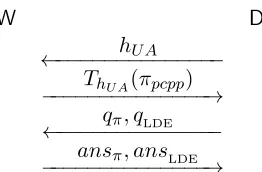
We present two memory and streaming delegation protocols. The first are non-interactive (i.e, Compute(f) consists of two messages, the first sent by the delegator and the second sent by the worker). They are based on the non-interactive version of the delegation protocol of Gold-wasser et. al. [GKR08, KR09], denoted by GKR (though are significantly more complicated than merely running GKR). As in GKR, the efficiency of the delegator depends linearly on the depth of the circuit being delegated. Our second memory and streaming delegation protocols are interac-tive (i.e., Compute(f) consists of four messages). These schemes are based on CS-proofs of Micali [Mic94], and allow for efficient delegation of all functions inP.
In what follows we state our theorems formally. We refer the reader to Section 6 for the formal definition of a memory delegation scheme, and to Section 8 for the formal definition of a streaming delegation scheme.
Theorem 1 (Memory Delegation) Assume the existence of a poly-log PIR scheme(as defined
in Definition 5), and assume the existence of a collision resistant hash family. LetF be the class of all L-uniform poly-size boolean circuits. Then there exists a non-interactive (2-message) memory delegation scheme mDel, for delegating any functionf ∈ F. The delegation scheme, mDel has the following properties, for security parameter k.
• The scheme has perfect completeness and negligible (reusable) soundness error.
• The delegator and worker are efficient in the offline stage; i.e., both the delegator and the worker run in time poly(k, n).
• The worker is efficient in the online phase. More specifically, it runs in time poly(k, S)
during eachCompute(f)andUpdate(f)operation, whereS is the size of theL-uniform circuit computing f. The delegator runs in time poly(k, d) during each Compute(f) and Update(f)
operation, where dis the depth1 of theL-uniform circuit computing f.2
In particular, assuming the existence of a poly-logarithmic PIR scheme, and assuming the existence of a collision resistent hash family, we obtain a memory delegation scheme for L-uniform NC
computations, where the delegator Druns in time poly-logarithmic in the length of the memory.
Theorem 2 (Streaming Delegation) Let k be a security parameter, and let N be a parameter
(an upper bound on the length of the stream). LetF be the class of all L-uniform poly-size boolean circuits. Assume the existence of a fully-homomorphic encryption scheme secure againstpoly(N) -size adversaries. Then there exists a non-interactive (2-message) streaming delegation schemesDelF
for F with the following properties.
• sDelF has perfect completeness and negligible reusable soundness error.
1We assume thatd≥logn. 2
Thus, for every constantc∈N, if we restrict the depth off to be at most kc, then the delegator is considered
• D updates her secret state in timepolylog(N), per data item.
• In the delegation protocol, when delegating a function f ∈ F computable by an L-uniform circuit of size S and depth d, the delegator D runs in timepoly(k, d,logN), and the worker
W runs in time poly(k,logN, S).
In particular, assuming the existence of a fully-homomorphic encryption scheme secure against ad-versaries of size poly(N), we obtain a streaming delegation scheme forL-uniformNCcomputations, where the delegatorD runs in time poly-logarithmicin the length of data stream.
Remark. We note that the property we needed from the GKR protocol is that the verifier does
not need to read the entire input in order to verify, but rather only needs to access a single random point in the low-degree extension of the input. (We refer the reader to Section 3.3 for the definition and properties of a low-degree extension.) We note that the CS-proof delegation scheme of Micali [Mic94], for delegating the computation of (uniform) Turing machines, also has the property that verification can be done by only accessing a few random points in the low-degree extension of the input, assuming the underlying PCP is a PCP of Proximity [BSGH+05, DR06].
Indeed using this delegation scheme, we get a memory delegation scheme and a streaming delegation scheme for all ofP. Using this scheme, theCompute(f) protocol is interactive (i.e., it is a 4-message protocol). The runtime of the delegator is polylog(T) and the runtime of the worker is poly(T), where T is the runtime of the Turing machine computing the function f.3 Furthermore, the memory delegation scheme relies only on the existence of a collision resistant hash family, without the need of a poly-log PIR scheme.
Theorem 3 (Interactive Memory Delegation) Assume the existence of a collision resistant
hash family. Then there exists a memory delegation scheme mDel, for delegating any function computable by a polynomial-time Turning machine. The delegation scheme, mDelhas the following properties, for security parameter k.
• The scheme has perfect completeness and negligible (reusable) soundness error.
• The delegator and worker are efficient in the offline stage; i.e., both the delegator and the worker run in time poly(k, n).
• The worker is efficient in the online phase. More specifically, it runs in time poly(k, T)
during eachCompute(f) andUpdate(f)operation, whereT is an upper-bound on the running time off. The delegator runs in time poly(k,logT) during each Compute(f) and Update(f)
operation.
• BothCompute(f) andUpdate(f) operations consist of 4 message exchanges.
Theorem 4 (Interactive Streaming Delegation) Let k be a security parameter, and let N be
a parameter (an upper bound on the length of the stream). Let F be the class of all functions computable by a polynomial-time Turning machine. Assume the existence of a fully-homomorphic encryption scheme secure against poly(N)-size adversaries. Then there exists a streaming delega-tion scheme sDelF for F with the following properties.
• sDelF has perfect completeness and negligible reusable soundness error.
• D updates her secret state in timepolylog(N), per data item.
• In the delegation protocol, when delegating a function f ∈ F computable in time T, the dele-gator Druns in time poly(k,logN,logT), and the worker W runs in time poly(k,logN, T). The delegation protocol consists of 4 message exchanges.
We note that in the Random Oracle Model (ROM) [BR97], the delegation scheme of Micali is non-interactive. This yields a non-interactive memory delegation scheme and a non-interactive streaming delegation scheme, for delegating all functions in P, in the ROM.
1.2 Previous Work
Various delegation protocols have been proposed in the literature. Some provide delegation proto-cols that are sound against any cheating worker, whereas others provide delegation protoproto-cols that are secure only against computationally bounded cheating worker (i.e., arguments as opposed to proofs). Some of these protocols are interactive, whereas others are non-interactive. We survey some of these results below, however, we emphasize that in all these solutions, the delegator runs in time that is (at least) linear in the input size, and thus do not apply to our settings of memory delegation or streaming delegation.
Interactive proofs. The celebrated IP=PSPACE Theorem [LFKN92, Sha92] yields interactive
proofs for any function f computable in polynomial space, with a verifier (delegator) running in polynomial time. Thus, the IP=PSPACE protocol can be seen as a delegation protocol for languages in PSPACE. However, the complexity of the prover (worker) is only bounded by polynomial space (and hence exponential time). This theorem was refined and scaled down in [FL93] to give verifier complexity poly(n, s) and prover complexity 2poly(s)for functionsfcomputable in timeT and space s, on inputs of length n. Note that the prover complexity is still super-polynomial in T, even for computations that run in the smallest possible space, namelys=O(logT).
The prover complexity was recently improved by Goldwasser et al. [GKR08] to poly(T,2s), which is poly(T) whens=O(logT). More generally, Goldwasser et al. [GKR08] give interactive proofs for computations of smalldepthd(i.e. parallel time). For these, they achieve prover complexity poly(T) and verifier complexity poly(n, d,logT). (This implies the result for space-bounded computation because an algorithm that runs in timeT and space scan be converted into one that runs in time poly(T,2s) and depthd=O(s2).) However, if we do not restrict to computations of small space or depth, then we cannot use interactive proofs. Indeed, any language that has an interactive proof with verifier running time (and hence communication)TV can be decided in space poly(n, TV).
Interactive arguments. Interactive arguments [BCC88] (aka computationally sound proofs [Mic00])
Toward non-interactive Solutions. This possibility of efficient non-interactive arguments was suggested by Micali [Mic00], who showed that non-interactive arguments with prover complexity poly(T, k) and verifier complexity poly(n, k,logT) are possible in the Random Oracle Model (the oracle is used to eliminate interaction a la Fiat–Shamir [FS86]). Heuristically, one might hope that by instantiating the random oracle with an appropriate family of hash functions, we could obtain a non-interactive solution to delegating computation: first the delegator (or a trusted third party) chooses and publishes a random hash function from the family, and then, the proofs are completely non-interactive (just one message from the prover to the verifier). However, the Random Oracle Heuristic is known to be unsound in general [CGH04] and even in the context of Fiat– Shamir [Bar01, GK03]. Thus, despite extensive effort, the existence of efficient non-interactive arguments remains a significant open problem in complexity and cryptography.
There has been some recent progress in reducing the amount of interaction needed. Using a transformation of Kalai and Raz [KR09], the GKR delegation protocol [GKR08] can be converted into a 2-message argument (assuming the existence of single-server private-information retrieval (PIR) schemes). However, like the interactive proofs of [GKR08], this solution applies only to small-depth computations, as the verifier’s complexity grows linearly with the depth.
Very recently, Gennaro, Gentry, and Parno [GGP10], and the followup work of Chung, Kalai, and Vadhan [CKV10], gave a 2-message delegation scheme for arbitrary functions. However, these constructions have an offline phase, where the delegator invests time poly(T, k) and computes a
secret state (T is the time it takes to compute the function, and k is the security parameter). In the online phase, the delegator’s running time is reduced to poly(n, k,logT) for an input of length n, and the worker’s complexity is poly(T, k). Thus, the delegator’s large investment in the offline phase can be amortized over many executions of the online phase to delegate the computation of f on many inputs. Their online phase is not completely non-interactive, but rather consists of two messages. However, in many applications, two messages will be necessary anyway, as the delegator may need to communicate the inputx to the worker.
We remark that one main drawback of these works [GGP10, CKV10] is that soundness is only guaranteed as long as the adversarial worker does not learn whether the delegator accepted or rejected the proofs.
In another followup work, Applebaum, Ishai, and Kushilevitz [AIK10] also consider the of-fline/online setting, but focus on efficient solutions for one-time delegation (i.e., the online phase can only be executed one time). They also consider the case when the delegation functions are represented as arithmetic circuits.
PCPs and MIPs. The MIP=NEXP Theorem [BFL91] and its scaled-down version by Babai et
al. [BFLS91] yield multi-prover interactive proofs and probabilistically checkable proofs for timeT computations with a prover running in time poly(T) and a verifier running in time poly(n,logT), exactly as we want. However, using these for delegation require specialized communication models — either 2 non-communicating provers, or a mechanism for the prover to give the verifier ran-dom access to a long PCP (of length poly(T)) that cannot be changed by the prover during the verification.
Streaming Interactive Proofs. Recently, Cormode, Thaler, and Yi [CTY10] considered
poly-logarithmic) space. They observed that both the GKR protocol [GKR08] and universal argu-ments [BG02] can be modified to yield efficient streaming interactive proofs/arguargu-ments.
Streaming interactive proofs are closely related to streaming delegation. The main difference is that streaming interactive proofs correspond to one-time streaming delegation, whereas in our streaming delegation model, the delegator is allowed to delegate as many computations to the worker as she want. Indeed, the GKR protocol is also the starting point of our construction of streaming delegation scheme, and the main effort is to make the scheme reusable.
2
Overview of Our Constructions
In what follows we present the high-level overview of our constructions. For more elaborate overviews, we refer the reader to Section 7.1 for an overview of our memory delegation scheme, and to Section 9.1 for an overview of our streaming delegation scheme.
2.1 Overview of our Memory Delegation Scheme
The starting point of this work is the observation of Goldwasswer et. al. [GKR08], that their delegation protocol can be verified very efficiently (in time sub-linear in the input size), if the delegator has oracle access to the low-degree extension of the input x (we refer the reader to Section 3.3 for the definition of a low-degree extension). Moreover, as observed by [GKR08], the delegator needs to access this low-degree extension LDEx at a single point z, which depends only on the random coin tosses of the delegator.
This observation immediately gives rise to a memory delegation scheme with one-time sound-ness: The delegator’s secret state will be (z,LDEx(z)). Then, she will use this secret state in order to verify computation using the GKR protocol. As was argued by Goldwassweret. al., this indeed works if the delegator runs the delegation protocolonce. However, the soundness crucially relies on the fact that the delegator’s secret state is indeed secret, and if the delegator uses this state more than once, then soundness breaks completely.
One idea, following the idea of Gennaroet. al.[GGP10], is to use a fully homomorphic encryption (FHE) scheme to encrypt all the communication, in order to hide the secret state. This indeed works if the worker does not learn whether the delegator accepts or rejects his proofs. However, if the worker does learn the verdict of the delegator, then there are known attacks that break soundness.
In the streaming setting, we follow this approach, and we succeed in overcoming this problem, and construct a scheme that is sound even if the worker does learn the verdict of the delegator. We could follow this approach in the memory delegation setting as well. However, for several reasons, we choose to take a different approach. First, the approach above relies on the existence of an FHE scheme, whereas our memory delegation scheme relies on the existence of a poly-logarithmic PIR scheme (see Definition 5), arguably a more reasonable assumption. Second, the approach above results with the delegator having a secret state, whereas in our memory delegation scheme, the state of the delegator is public. Finally, the construction and proof of the memory delegation scheme is simpler.
family, and keeps (h, Th(LDEx)) as her state. In addition to giving the worker her memory x, she also gives him the hash function h. We stress that her state is not secret, which makes the proof of security significantly simpler than that in the streaming setting (where the delegator’s state is secret).
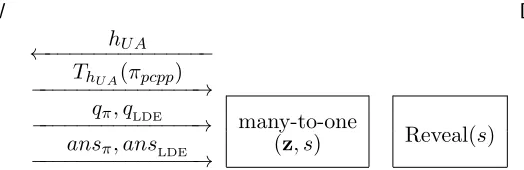
Very roughly speaking, when the delegator wishes to delegate the computation of a function f, they execute Compute(f) by simply running the (non-interactive) delegation protocol GKR(f). Recall that at the end of the GKR protocol the delegator needs to verify the value of LDEx(r) for a randomr. However, she doesn’t havex, since it was delegated to the prover, and all she has is the state (h, Th(LDEx)). So, rather than computing the value of LDEx(r) on her own, the worker will reveal this value, by sending the augmented path in the Merkle tree corresponding to the leaf r.
Unfortunately the high-level description given above is a gross oversimplification of our actual scheme, and there are several technical issues that complicate matters. We elaborate on these in Section 2.3.
We mention that when the delegator wishes to update her memory from x to g(x), she needs to update her secret state from (h, Th(LDEx)) to (h, Th(LDEg(x))).4 However, she cannot perform
this operation on her own, since she does not have x. Instead she will delegate this computation to the worker, by requesting aCompute(g0) operation, where g0(x) =Th(LDEg(x)).
2.2 Overview of our Streaming Delegation Scheme
Our streaming delegation scheme is similar to our memory delegation scheme described above, and the main difference is in the way the certificate is generated and updated, and in the way the worker reveals the value LDEx(r).
Generating and updating the certificate. Recall that in the memory delegation scheme, the
certificate of the delegator D consists of a tree-commitment to the low-degree extension of her memoryx. Namely, her certificate is (h, Th(LDEx)), whereh is a collision resistant hash function. Note that this certificate cannot be updated in a streaming manner, since any change toxchanges the low-degree extension LDEx almost everywhere.
Instead, in the streaming setting, we replace the tree commitment with an “algebraic commit-ment”, which has the property that it can be updated efficiently when new data items arrive. The resulting certificate is a random point in the low-degree extension of the streamx; i.e., (z,LDEx(z)) for a random point z. This certificate is efficiently updatable, if we assume some upper-bound N on the size of the stream, and we take parametersH,F, mof the low-degree extension, such that
|H|= polylog(N), m=θ
logN log logN
, |F|= poly(|H|) (1)
(this follows from Proposition 6).
As in the memory delegation scheme, at the end of each delegation protocol, the delegator needs to verify the value of LDEx(r) at a random pointr. In the memory delegation scheme this was done using a Reveal protocol where the worker reveals the augmented path of the leaf r in the Merkle tree-commitment of LDEx. In the streaming setting, the Reveal protocol is totally different, since
4
the delegator cannot compute the tree-commitment of LDEx. Unfortunately, unlike in the memory delegation scheme, in the streaming setting constructing a reusable and sound reveal protocol is highly non-trivial.
The Reveal protocol. Our starting point is a basic reveal protocol Reveal1described in Figure 1.
Note that the soundness of Reveal1 relies on the secrecy of the certificate σ. Namely, assuming
that W does not know the point z, it is not hard to see, by the Schwartz-Zippel Lemma, that an adversarial worker can cheat with probability at mostd/|F|, where dis the (total) degree of LDEx.
Reveal1 protocol: Dstores asecret stateσ= (z,LDEx(z)), wherex∈ {0,1}N andzis a random point in Fm, and wants to learn the value of LDEx(s) fromW.
• D sends to W the line `sz that passes through the points s and z. More specifically,
D chooses two random points α1, α2 ← F, and defines `s,z to be the line that satisfies `s,z(α1) =z and `s,z(α2) =s.
• W returns a univariate polynomialp:F→F, which is the polynomial LDEx restricted to the line`s,z (i.e.,p= LDEx|`s,z).
• Dchecks whetherp(α1) = LDEx(z), and if so accepts the value p(α2) = LDEx(s). Other-wise, she rejects.
Figure 1: Reveal1 protocol
However, note that the Reveal1 protocol is not reusable. Suppose that Duses the above reveal
protocol to learn the value of LDExon two random points s, s0 ∈Fm. From the two executions, an
adversarial workerW∗receives two lines`s,z and`s0,z, and can learn the secret pointzby taking the
intersection of the two lines. Once W∗ learns z, W∗ can easily cheat by returning any polynomial p∗ that agrees with LDEx only on pointz but disagrees on the remaining points.
As observed by Gennaro et. al. [GGP10], a natural way to protect the secret point z, is to run the above Reveal protocol under a fully-homomorphic encryption (FHE) scheme. Namely, D
generates a pair of keys (pk,sk) for a FHE (Gen,Enc,Dec,Eval), and sends pk and an encrypted line ˆ`s,z = Encpk(`s,z) to W, who can compute the polynomial p = LDEx|`s,z homomorphically
under the encryption. Indeed, by the semantic security of FHE, an adversarial workerW∗ cannot learn any information from D’s message ˆ`s,z. This indeed makes the protocol reusable provided thatW∗ does not learn the decision bits ofD, as proved in [GGP10, CKV10].
However, since the decision bit ofDcan potentially contain one bit information about the secret point z, it is not clear that security holds if W∗ learns these decision bits. In fact, for both of the delegation schemes of [GGP10, CKV10], which use FHE to hide the delegator D’s secret state, there are known attacks that learn the whole secret state of Dbit-by-bit fromD’s decision bits.
Fortunately, we are able to show that a variant of the Reveal1 protocol described in Figure 2 is
reusable even ifW∗ learns the decision bits ofD. The main difference between Reveal1and Reveal2
is that in Reveal2, the delegatorDuses a randomtwo-dimensionalaffine subspace instead of a line,
and uses an FHE to mask the entire protocol.
Reveal2 protocol: Dstores a secret stateσ= (z,LDEx(z)), wherex∈ {0,1}N andzis a random point in Fm, and wants to learn the value of LDEx(s) fromW.
• Ddoes the following.
1. Generate a pair of keys (pk,sk)←Gen(1k) for a fully homomorphic encryption scheme FHE.
2. Choose a random two-dimensional affine subspaceSs,z ⊂Fm that contains the points
sandz. More specifically, choose two random pointsα1, α2←F2and letSs,z ⊂Fmbe
a random two-dimensional affine subspace that satisfiesSs,z(α1) =zandSs,z(α2) =s.
3. Send ˆSs,z ←Encpk(Ss,z) andpk toW.
• W homomorphically computes the two-variate polynomial p= LDEx|Ss,z under the FHE
(denote the resulting ciphertext ˆp), and sends ˆp toD.
• D decrypts and checks whether p(α1) = LDEx(z), and if so accepts the value p(α2) =
LDEx(s).
Figure 2: Protocol Reveal2
and is one of the main technical difficulties in this work. Informally, the proof first uses Lemma 16, which claims that the ciphertext ˆSs,z and the decision bitbof D(which depend on the strategy of W∗) do not give too much information aboutSs,z toW∗. In other words, the random subspaceSs,z still has high (pseudo-)entropy from the point of view ofW∗. Then it uses aninformation-theoretic
argument to argue that a random point z in a sufficiently random (with high entropy) subspace Ss,z is statistically close to a random point in Fm, which implies that W∗ does not learn useful
information about z. We refer the reader to Section 4 for the techniques developed in order to prove the reusable soundness.
The Field Size. Recall that by Schwartz-Zippel Lemma, an adversarial worker can cheat with
probability at most d/|F|, where d is the (total) degree of LDEx. Recall that in our setting of parameters:
|H|= polylog(N), m=θ
logN log logN
, |F|= poly(|H|).
Thus, a cheating worker can cheat (and more importantly, obtain information about the secretz) with probability d/|F|=O(1/polylog(N)), which is not low enough.
The idea is to reduce the cheating probability to negligible by simply increasing the field size to be super-polynomial. However, we cannot increase the field size in the GKR protocol, since it will increase the complexity of the worker. Instead, we use an extension field ˜FofF, of super-polynomial
size, only in the certificate and the Reveal protocol, but run the GKR protocols as before. Namely, the secret state is σ= (z,LDEF˜,H,m(z)) wherez← ˜
Fm, The GKR protocol is run exactly as before
2.3 Additional Technicalities
The high-level description given above (in Sections 2.1 and 2.2) is a gross oversimplification of our actual schemes, and there are several technical issues that complicate matters.
Recall that in the overview above, we claimed thatCompute(f) merely runs GKR, in addition to a Reveal protocol which helps the delegator verify the GKR protocol.5 There are several technical reasons why this actually does not work. In what follows, we explain what are the main technical problems with this simple idea, and we give the highlevel idea of how to overcome these problems.
1. The first technicality (the easiest one to deal with), is that the GKR delegation scheme does not have a negligible soundness error. In our setting, especially in the setting of memory del-egation, it is very important to have negligible soundness. The reason is that if the soundness is non-negligible, then a cheating worker may cheat in the update procedure of the memory delegation scheme (which is also being delegated). The problem is that if a worker cheats even once in an update procedure, all soundness guarantees are mute from that point on. So, we really need the soundness error to be negligible. In order to reduce the soundness error, we will run the GKR protocol in parallelu times (for any parameter usuch that 1/2u =ngl(k), where k is the security parameter). We denote the u-fold parallel repetition of GKR by GKR(u). As a result the worker will need to reveal to u random points in the low-degree extension: LDEx(r1), . . . ,LDEx(ru).
2. The second technical point is more subtle. In the offline stage, when the delegator computes the tree commitmentTh(LDEx), she needs to choose the parametersH,F, mfor the low-degree
extension. The typical choice for these parameters is:
|H|= polylog(n), |F|= poly(|H|), m=O
logn log logn
,
where n=|x|. When delegating the computation of a function f, the worker and delegator run GKR(u)(f) and need to verify LDEx(ri) = vi for random points r1, . . . , ru. However, here the parameters of the low-degree extension LDEx depend on the depth dof the circuit computing f. Namely, looking at the parameters given in [GKR08] (see Theorem 8), the parameters of the low-degree extension are
|H0|=θ(d·logn), m0=θ
logn logd
, |F0|= poly(|H0|).
Therefore, the worker cannot simply execute the Reveal protocols of the memory delegation or the streaming delegation. In the memory setting, the tree commitment is w.r.t. parameters
H,F, mwhereas the delegator needs to verify LDEF
0,
H0,m0
x (ri) =vi. In the streaming setting, the secret state of the delegator is (z,LDEF,H,m
x (z)), as opposed to (z,LDEF
0,
H0,m0
x (z)), thus
the Reveal protocol described in Section 2.2 doesn’t work.
We get around this technical problem by delegating the functions gri(x) , LDEF 0,
H0,m0
x (ri). Luckily, these functions can be computed by a poly-size circuit of depth at most log2n, assum-ing the delegated functionf is of poly-size (see Proposition 6). We delegate the computation
5
of each of these gri using GKR
(u) to ensure negligible soundness. Thus, finally the worker
will need to reveal tou2 points in LDE
x (u points for eachgri).
6
3. The final technical difficulty is that all these algorithms need to run in parallel, since we want our final delegation schemes to be non-interactive (i.e., to consist of only two messages). Typically, there is no problem in running several two-message protocols in parallel [BIN97, CHS05]. However, in our case, the delegator uses a commonsecret input in these protocols. Namely, the delegator uses secret randomness r1, . . . , ru ∈(F0)m
0
in the parallel repetition of the delegation protocol GKR(f) which ends with her needing to verify that LDEF0,H0,m0
x (ri) = vi for everyi∈[u]. In addition she uses these sameri’s in the delegation protocols GKR(gri).
Moreover, at the end of each of the GKR(gri) protocols, the delegator needs to verify that
LDEF,H,m
x (zi,j) = wi,j for random points zi,1, . . . , zi,u ∈ Fm. Finally, they also run a reveal
protocol for eachzi,j, denoted by Reveal(zi,j).
We note that the protocol GKR(f) (resp. GKR(g)) is not sound if theri’s (resp. zi,j’s) are a priori known to the worker. To ensure that soundness still holds even if we run all these algorithms in parallel, we mask parts of the delegator’s message using a PIR scheme or an FHE scheme, and then we claim that the soundness error remains negligible. To this end, we use our parallel composition lemma (Lemma 24), which roughly states that if a set of protocols Π1, . . .Πt are executed in parallel, and the verifiers use the same common private randomnesspin all these protocols, then the soundness remains if the messages of the verifiers hide this common secret randomness p. (We refer the reader to Section 5 for details.)
3
Preliminaries
3.1 Computational Private Information Retrieval (PIR)
Definition 5 Let k be the security parameter and N be the database size. Let QPIR and DPIR be
probabilistic circuits, and let RPIRbe a deterministic circuit. We say thatPIR = (QPIR,DPIR,RPIR)
is a poly-logarithmic private information retrieval scheme if the following conditions are satisfied:
1. (Size Restriction:) QPIR and RPIR are of size ≤ poly(k,logN), and DPIR is of size ≤ poly(k, N). The output of QPIR and DPIR is of size ≤poly(k,logN) .
2. (Perfect Correctness:)7 ∀N,∀k,∀database x= (x1, x2, . . . , xN)∈ {0,1}N, and∀i∈[N],
PrRPIR(k, N, i,(q, s), a) =xi|(q, s)←QPIR(k, N, i), a←DPIR(k, x, q)
= 1
3. (User Privacy:) ∀N,∀k,∀i, j∈[N], and∀adversary A of size at most 2k3,
Pr[A(k, N, q) = 1|(q, s)←QPIR(k, N, i)]−Pr[A(k, N, q) = 1|(q, s)←QPIR(k, N, j)] ≤2−k
3
.
6
We note that there are several ways to improve efficiency, such as thinking of (gr1, . . . , gru) as one function.
However, for the sake of simplicity of exposition, we focus on the simplest (rather than most efficient) solution.
7
3.2 Fully Homomorphic Encryption
A public-key encryption scheme E = (KeyGen,Enc,Dec) is said to be fully homomorphic if it is associated with an additional polynomial-time algorithm Eval, that takes as input a public key
pk, a ciphertext ˆx = Encpk(x) and a circuit C, and outputs, a new ciphertext c = Evalpk(ˆx, C),
such that Decsk(c) = C(x), where sk is the secret key corresponding to the public key pk. It is
required that the size of c= Evalpk(Encpk(x), C) depends polynomially on the security parameter
and the length of C(x), but is otherwise independent of the size of the circuit C. We also require that Eval is deterministic, and the the scheme has perfect correctness (i.e. it always holds that Decsk(Encpk(x)) =xand that Decsk(Evalpk(Encpk(x), C)) =C(x)). For security, we simply require
that E is semantically secure.
In a recent breakthrough, Gentry [Gen09] proposed a fully homomorphic encryption scheme based on ideal lattices. Following this, Dijk, Gentry, Halevi and Vaikuntanathan [vDGHV10] proposed an alternative construction based on the extended GCD assumption. In these schemes, the complexity of the algorithms (KeyGen,Enc,Dec) depends linearly on the depth dof the circuit C, wheredis an upper bound on the depth of the circuitCthat are allowed as inputs to Eval. However, under the additional assumption that these schemes are circular secure (i.e., remain secure even given an encryption of the secret key), the complexity of these algorithms are independent ofC.
Our streaming memory delegation scheme relies on the existence of a fully homomorphic scheme. For the sake of simplicity, we assume that the FHE scheme has perfect completeness. We note that the FHE schemes of both [Gen09] and [vDGHV10] indeed have perfect completeness.
3.3 Low Degree Extension
Let H be an extension field of GF[2], and let F be an extension field of H (and in particular, an
extension field of GF[2]), where |F|= poly(|H|).8 We always assume that field operations can be
performed in time that is poly-logarithmic in the field size. Fix an integerm∈N. In what follows, we define the low degree extension of an n-element string (w0, w1, . . . , wn−1) ∈Fn with respect to F,H, m, wheren≤ |H|m.
Fix α : Hm → {0,1, . . . ,|H|m −1} to be any (efficiently computable) one-to-one function. In
this paper, we take α to be the lexicographic order ofHm. We can view (w0, w1, . . . , wn−1) as a
functionW :Hm →F, where
W(z) =
(
wα(z) ifα(z)< n,
0 otherwise. (2)
A basic fact is that there exists a unique extension of W into a function ˜W :Fm → F (which
agrees withW onHm; i.e., ˜W|Hm ≡W), such that ˜W is anm-variate polynomial of degree at most
|H| −1 in each variable. Moreover, as is formally stated in the proposition below, the function ˜W
can be expressed as
˜
W(t1, . . . , tm) = n−1
X
i=0
˜
βi(t1, . . . , tm)·wi,
8Usually, when doing low degree extensions,
Fis taken to be an extension field ofGF[2], andHis simply a subset
ofF(not necessarily a subfield). In this work, following the work of [GKR08], we takeHto be a subfield. However,
where each ˜βi :Fm → F is an m-variate polynomial, that depends only on the parameters H,F,
and m (and is independent ofw), of size poly(|H|, m) and degree|H| −1 in each variable.
The function ˜W is called the low degree extension of w = (w0, w1, . . . , wn−1) with respect to
F,H, m, and is denoted by LDEFw,H,m. We omit the index ofF,H, mwhen the context is clear. Also, sometimes we use ˜W for simplicity.
Proposition 6 There exists a Turing machine that takes as input an extension field H of GF[2],9
an extension field F of H, and integer m. The machine runs in time poly(|H|, m,log|F|) and
outputs the unique 2m-variate polynomial β˜ : Fm ×Fm → F of degree |H| −1 in each variable
(represented as an arithmetic circuit of degree |H| −1 in each variable), such that for every w =
(w0, w1, . . . , wn−1)∈Fn, where n≤ |H|m, and for every z∈Fm,
˜
W(z) = X
p∈Hm
˜
β(z, p)·W(p),
where W :Hm →F is the function corresponding to (w0, w1, . . . , wn−1) as defined in Equation (2),
and W˜ :Fm →F is its low degree extension (i.e., the unique extension of W :Hm → F of degree
at most|H| −1 in each variable).
Moreover, β˜ can be evaluated in time poly(|H|, m,log|F|). Namely, there exists a Turing ma-chine that runs in time poly(|H|, m,log|F|) that takes as input parametersH,F, m (as above), and
a pair (z, p) ∈Fm×
Fm, and outputsβ˜(z, p). Furthermore, there exists a circuit for evaluating β˜
in the above sense with sizepoly(|H|, m,log|F|) and depthpoly(m,log|F|).
Corollary 7 There exists a Turing machine that takes as input an extension field Hof GF[2], an
extension field F of H, an integer m, a sequence w= (w0, w1, . . . , wn−1)∈Fn such that n≤ |H|m,
and a coordinatez∈Fm. It runs in timen·poly(|
H|, m,log|F|), and outputs the valueW˜(z), where
˜
W is the unique low-degree extension of w (with respect to H,F, m). Furthermore, there exists a
circuit for the same task with size n·poly(|H|, m,log|F|) and depthpoly(m,log|F|).
3.4 Delegation Schemes
In recent years, as cloud computing is gaining popularity, there have been many attempts to construct efficient delegation schemes. Loosely speaking, a delegation scheme is a protocol between a delegator D and a worker W, where the delegator asks the worker to do some computation, and prove that he indeed did the computation correctly. Typically, a delegation scheme is with respect to a class of functions F, and the requirement is that on input (f, x) where f ∈ F and x is in the domain of f, the worker outputs f(x), along with a proof (which may be interactive or non-interactive). The requirement is that the worker runs in time that is polynomial in the size of f (when representingf as a circuit), and the delegator runs in time that is significantly shorter than the size of f (as otherwise, it would simply computef(x) on its own). In this work, we use the 2-message delegation protocol of [GKR08], which in turn uses a round reduction technique from [KR09]. The protocol has the following guarantees.
9Throughout this work, when we refer to a machine that takes as input a field, we mean that the machine is given
Theorem 8 [GKR08, KR09] Assume the existence of a poly-logarithmic PIR scheme, as defined in Definition 5. Let k be the security parameter, and let F be the family of functions computable by L-space uniform boolean circuits of size S and depth d≥logS. Then, there exists a delegation protocol for F with the following properties.
1. The worker runs in time poly(S, k) and the delegator runs in time n·poly(k, d), wheren is the length of the input.
2. The protocol has perfect completeness and soundness s≤ 1
2 (can be made arbitrarily small),
where soundness is against any cheating worker of size ≤2k3.
3. The protocol consists of two messages, with communication complexityd·poly(k,logS). More-over, the first message sent by the delegator depends only on her random coin tosses, and is independent of the statement being proved.
4. If the delegator is given oracle access to the low-degree extension of x, rather than being given the input x itself, then it runs in time poly(k, d), and the protocol still has all the properties described above, assuming the parametersH,F, mof the low-degree extension satisfy
the following:
|H|=θ(d·logn), m=θ
logn logd
, |F|= poly(|H|)
where poly is a large enough polynomial.10 Moreover, the delegator queries the low-degree extension of x at a single point, which is uniformly random (over his coin tosses).
Throughout this paper, we denote this protocol by GKR.
3.5 Merkle Tree Commitments
Definition 9 Let h:{0,1}k× {0,1}k → {0,1}k be a hash function. A Merkle tree commitment of
a sting x∈ {0,1}n w.r.t. h, denoted by T
h(x), is a k-bit string, computed as follows: The input x
is partitioned into m = dn/ke blocks x = (B1, . . . , Bm), each block of size k.11 These blocks are
partitioned into pairs(B2i−1, B2i), and the hash function h is applied to each pair, resulting inm/2
blocks. Then, again these m/2 blocks are partitioned into pairs, and the hash function h is applied to each of these pairs, resulting with m/4 blocks. This is repeatedlogm times, resulting in a binary tree of hash values, until one block remains. This block is Th(x).
4
Our Leakage Lemma
In this section, we define some machinery that is needed in order to prove the soundness of our streaming delegation scheme in Section 9. The main contribution of this section is a leakage lemma (Lemma 22), which essentially says that given an encryption (pk,Encpk(S)) of a random
2-dimensional subspaceS ←Fm×2, and given any additional arbitrary (not necessarily efficient) bit
of leakage b =L(pk,Encpk(S)), then a random vector z ←S is computationally indistinguishable
from a truly random vectoru←Fm. We formally state and prove this lemma in Section 4.2.
10
The larger poly is, the smaller the soundness becomes.
11
This lemma plays a central role in analyzing the (reusable) soundness of our streaming delegation scheme. In this scheme, the delegator has a secret state, and we need to prove that a cheating worker cannot learn any information about her secret state, even after running several delegation protocols with the delegator, and learning the bit of whether she accepted or rejected. In the soundness proof, this verdict bit is thought of as a leakage bit.
In the proof of Lemma 22, which is our main leakage lemma, we use another leakage lemma (Lemma 16), which is formally stated below and proved in Section 4.1. This leakage lemma roughly says that conditioning on a short leakage cannot decrease the conditional pseudo-entropy of a random variable too much.
In order to even state these lemmas formally, we first need to define the notion of conditional pseudo-entropy. There are several possible notions of conditional pseudo-entropy with subtle differ-ences. In the following, we present our definition along with discussions on other possible notions. We start with the information-theoretic notion of min-entropy and conditional min-entropy.
Definition 10 (Min-Entropy) Let X be a distribution over finite support. The min-entropy of
X is defined as
H∞(X) = min x∈supp(X)log
1
Pr[X=x] =−log
max
x∈supp(X)Pr[X =x]
.
Definition 11 (Conditional Min-Entropy) Let (X, C) be a joint distribution over finite
sup-port. The (worst-case) conditional min-entropy of X conditioned on C is defined as
H∞(X|C) = min
(x,c)∈supp(X,C)log
1
Pr[X=x|C=c] =c∈supp(minC)H∞
(X|C=c).
The above worst-case definition may seem too stringent as it requires X to have good min-entropy conditioned on every possible c ∈ supp(C). Several relaxed definitions have been used. For example, Renner and Wolf [RW05] defined a smooth version of the above definition, whereX hasε-smooth conditional min-entropynconditioned onC if (X, C) isε-close in statistical distance to a distribution (X0, C0) with H∞(X0|C0) = n. Such a slackness will be implicitly allowed in our definition of conditional pseudo-entropy. On the other hand, Dodis, Ostrovsky, Reyzin, and Smith [DORS08] defined an average-case version of conditional min-entropy, where Havg∞ (X|C) = −log(Ec←C[maxx{Pr[X=x|C=c]}]).12
In the computational setting, Hsiao, Lu, and Reyzin [HLR07] defined conditional HILL entropy. Informally,Xhas high conditional HILL entropy conditioned onC if there exists a random variable Y = Y(C) such that (1) (X, C) is computationally indistinguishable from (Y, C), and (2) Y has high average conditional min-entropy conditioned on C (a la [DORS08]). In this work, we use a slightly different definition. The only difference between our definition and the [HLR07] definition is that we use the worse-case version of conditional min-entropy, as opposed to the average-case version. We work with the worst-case definition since it is more convenient for our application and makes the analysis simpler. For convenience, we refer to our notion also as conditional HILL entropy.
12We note that the two notions of [RW05] and [DORS08] are equivalent up to an additive log(1/ε) term. A detailed
Definition 12 (Conditional HILL Entropy) Let (X, C) be a joint distribution over a finite support, and let n, s ∈ N and ε ∈ (0,1) be parameters. We say that X conditioned on C
has conditional HILL entropy at least n against circuits of size s with advantage ε, denoted by
HHILLε,s (X|C) ≥ n, if there exists a distribution Y = Y(C) jointly distributed with C such that (1)
H∞(Y|C)≥n, and (2) (X, C) and(Y, C) are computationally indistinguishable against circuits of
size swith advantage ε.13
In the asymptotic setting where there is a security parameter k, we say HHILL(X|C)≥n, if for every constant c∈N, HHILLk−c,kc(X|C)≥n.
Remark 13 Note that in the above definition, we only consider distributions (Y, C) that are
indistinguishable from (X, C), i.e., we do not allow modifying the distribution ofC. An alternative weaker definition is to consider all distributions (X0, C0) that are indistinguishable from (X, C). The two definitions may not be equivalent in general.14 We emphasize that the more stringent definition seems more relevant for cryptographic applications, since C is often some leakage information on X learned by an adversary. We further emphasize that we do not claim that our definition is the “right” one, and we only use it as a tool to prove our main result.
Our goal is to show that if X has high conditional HILL entropy conditioned on C (say,
HHILL(X|C) ≥ n) and B = B(X, C) is an arbitrary, but short (say, one bit) leakage informa-tion on X, then after further conditioning on B, X still has high conditional HILL entropy (i.e.,
HHILL(X|C, B)≥n−tfor some smallt). WhenB can be efficiently generated from (X, C), this is very easy to prove. However, proving this for generalB =B(X, C) is not trivial. Indeed, in order to prove this, we need to further strengthen our definition of conditional HILL entropy.
Definition 14 (Conditional HILL Entropy w.r.t. Samplable Distributions) Letkbe a
se-curity parameter. For a finite distribution(X, C), we say HHILL(X|C)≥n w.r.t. samplable distri-butions if there exists a distribution Y =Y(C) such that the following holds.
1. H∞(Y|C)≥n.
2. (X, C) and(Y, C) are computationally indistinguishable.
3. There exists a poly(k) time algorithm Smp that on input c ∈ supp(C), outputs a sample
y←(Y|C=c).
Remark 15 This definition differs from Definition 12 in two ways. First, we require the
distri-butions Y|C=c to be efficiently samplable for every c. Second, we require a single distribution Y = Y(C) such that (X, C) and (Y, C) are indistinguishable for any poly(k)-size distinguisher; whereas in Definition 12, we fix the sizekcof distinguisher first and require a distributionY =Y(C) such that (X, C) and (Y, C) are indistinguishable for kc-size distinguishers.
Lemma 16 Let k be a security parameter and n, `, t be any parameters such that n ≤ poly(k),
`=O(logk), and t=ω(logk). Let (X, C) be a joint distribution over {0,1}∗× {0,1}∗ of poly(k)
length. If HHILL(X|C) ≥n w.r.t. samplable distributions, then for any distribution B =B(X, C)
over {0,1}`, we have
HHILL(X|C, B)≥n−t.
13Note that theεslackness is inherent in the above HILL-type definition. 14
The lemma says that further conditioning on O(logk) bits can only decrease the conditional HILL entropy by ω(logk). Note that an upper bound of O(logk) on the length ofB is necessary, since the pseudo-entropy of X could be generated from merely ω(logk) bits of real entropy. For example,X can be the output of a pseudo-random generator (PRG) with sub-exponential stretch, and B can be the whole seed, if the length limit on B is relaxed. On the other hand, we do not know whether the samplability assumption onY(C) is necessary or not. Moreover, we do not know whether we inherently needω(logk) entropy loss, or whether one can prove `=O(logk) entropy loss.
Before presenting the proof of the lemma, we first compare it with previous results of [DP08, RTTV08]. Dziembowski and Pietrzak [DP08] (implicitly in Lemma 3), and Reingold, Trevisan, Tulsiani, and Vadhan [RTTV08] (Theorem 1.3, phrased in a different language of “dense model theorem”) proved that if HHILL(X) ≥ n and E is an event that occurs with probability p ≥ 1/poly(k), then after conditioning on the event E, HHILL(X|E) ≥n−log(1/p).15 This implies a special case of our Lemma 16 whereC is not present: SupposeHHILL(X)≥n andB =B(X) is of lengthO(logk), then HHILL(X|B)≥n−ω(logk).
In contrast, we consider a more general setting where a (possibly long) prior leakage information C is presented, which may information-theoretically determineX. Indeed, in our setting, C is an encryption ofX and hence determinesX.
4.1 Proof of Lemma 16
4.1.1 Preliminaries
We proceed to present the proof of Lemma 16. The first part of our proof follows the same line as previous results [DP08, RTTV08], where we convert (conditional) HILL-type entropy to (conditional) “metric-type” entropy, defined by Barak, Shaltiel, and Wigderson [BSW03]. On the other hand, the second part of our proof is more involved than previous results. We start by defining a conditional version of metric entropy.
Conditional Metric Entropy. Loosely speaking, metric entropy is weaker than HILL entropy
and is defined by switching the order of quantifiers in the definition of HILL entropy. Recall that the HILL definition says that X has HILL entropy n if there exists a random variable Y with min-entropy n such that every small distinguisher D fails to distinguish between X and Y. In contrast, the definition of metric entropy requires that for every small distinguisherD, there exists a random variableY (which may depend onD) with min-entropynsuch thatDfails to distinguish betweenX and Y.
Definition 17 (Conditional Metric Entropy) Let (X, C) be a joint distribution over a finite
support. Let n, s ∈ N and ε ∈ (0,1) be parameters. We say X conditioned on C has condi-tional metric entropy at leastn against randomized circuits of sizes with advantageε, denoted by
Hmetricε,s (X|C) ≥n, if for every randomized circuit D of size at most s, there exists a distribution
Y =Y(C) jointly distributed withC such that H∞(Y|C)≥n, and
|Pr[D(X, C) = 1]−Pr[D(Y, C) = 1]| ≤ε.
15
In the asymptotic setting where there is a security parameter k, we say Hmetric(X|C) ≥ n, if it holds that Hmetric
k−c,kc(X|C)≥n for every constantc∈N.
We emphasize that, except for the natural generalization to the conditional version, our defini-tion differs from that of [BSW03] in that we allow the distinguishers to be randomized, as opposed to deterministic.16 The reason is that, as pointed out by Vadhan [Vad10] and Dziembowski and Pietrzak [DP08], the result of [BSW03] does not hold when deterministic distinguishers are consid-ered, and randomized distinguishers should be used instead.17
Lemma 18 (Theorem 5.2 of [BSW03], generalized) Let (X, C) be a joint distribution over
{0,1}m1×{0,1}m2, and letε, δ >0,s, k ∈Nbe parameters. IfHmetric
ε,s (X|C)≥n, thenHHILLε+δ,s0(X|C)≥
n for s0 =s·O(δ2/(m1+m2)).
Lemma 18 is proved in exactly the same way as the proof in [BSW03], where one uses von-Neuman’s min-max theorem [Neu28] to switch the order of quantifiers. For the sake of completeness, we give a proof sketch below.
Proof. (sketch) For the sake of contradiction, assume that HHILLε+δ,s0(X|C) < n. This means that
for every distribution Y = Y(C) with H∞(Y|C) ≥ n, there exists a size s0 distinguisher D that distinguishes (X, C) from (Y, C) with advantage ≥ε+δ. Applying min-max theorem, we obtain the following statement. There exists adistributionDover size-s0distinguishers such that for every Y =Y(C) withH∞(Y|C)≥n, we have
D←DE [D(X, C)]−D←DE [D(Y, C)]
≥ε+δ.
Now, it can be shown by standard Chernoff and union bounds that there exists a set S = {D1, . . . , DO((m1+m2)/δ2)}of circuits in supp(D) such that for every (z, c)∈ {0,1}m1× {0,1}m2,
D←DE
[D(z, c)]− E Di←S
[Di(z, c)]
≤δ/2.
Since this holds point-wise, it follows that for everyY =Y(C) with H∞(Y|C)≥n,
DiE←S
[Di(X, C)]− E Di←S
[Di(Y, C)]
≥ε.
We obtain a contradiction by observing that choosing a random circuit Di ← S and outputting Di(z, c) can be implemented by a sizes=s0·O((m1+m2)/δ2) randomized circuit.
As a corollary, the lemma implies that conditional HILL entropy and conditional metric entropy are equivalent in the asymptotic setting.
Corollary 19 Let k be a security parameter. For every joint distribution (X, C) of polynomially
bounded length|(X, C)| ≤poly(k), we have HHILL(X|C) =Hmetric(X|C).
16Note that, for HILL-type entropy, randomized distinguishers and deterministic distinguishers are essentially
equivalent, since one can turn a randomized distinguisher to a deterministic one by fixing the “best” coins that preserves the advantage for distinguishing two distributions. In contrast, for the case of metric entropy, it is unclear whether randomized distinguishers can be converted into deterministic ones since the distinguisher needs to work for all distributions.
17[DP08], instead of using randomized distinguishers, use deterministic [0,1]-valued distinguishers. We choose to
4.1.2 Formal Proof of Lemma 16
Proof. Suppose for contradiction that there exists a distribution B = B(X, C) such that
HHILL(X|C, B)< n−t. By Corollary 19, this implies thatHmetric(X|C, B)< n−t. Namely, there exists some constantc0 ∈Nand arandomized circuitDof sizekc0 such that for every distribution
Z =Z(C, B) withH∞(Z|C, B)≥n−t,
|Pr[D(X, C, B) = 1]−Pr[D(Z, C, B) = 1]|> k−c0def= ε. (3)
On the other hand, the fact that HHILL(X|C) ≥ n w.r.t. sampleable distributions implies that there exists a distribution Y = Y(C) such that (1) H∞(Y|C) ≥ n, (2) (X, C) and (Y, C) are computationally indistinguishable, and (3) there exists a PPT algorithm Smp that on input c ∈ supp(C), outputs a sample y←(Y|C=c).
For notational convenience, let
pc,b(z),Pr[D(z, c, b) = 1].
We construct a polynomial-size (randomized) circuit D0 that distinguishes between (X, C) and (Y, C), as follows. On input (w, c) which comes from either (X, C) or (Y, C),D0 does the following:
1. Use the sampling algorithm Smp to samples= (4·2`/ε) independent samples ofyi ←Y|C=c.
2. For every b ∈ {0,1}`, compute estimators for p
c,b(w) and pc,b(yi), denoted by ˜pc,b(w) and ˜
pc,b(yi), respectively. More specifically, runD(w, c, b) (resp.,D(yi, c, b)) with fresh randomness t,Θ(`(log2k)(logs)/ε2) times, and let ˜pc,b(w) (resp., ˜pc,b(yi)) be the average of the outputs.
3. If there exists someb∈ {0,1}` such that
˜
pc,b(w)≥max yi
{˜pc,b(yi)}+ε/4,
then output 1. Otherwise, output 0.
Note that D0 can be implemented by a randomized circuit of size poly(k,2`,1/ε) = poly(k). We also note that the parametert= Θ(`(log2k)(logs)/ε2) defined in Step 2 is chosen so that, with overwhelming probability,all estimators have error less thanε/8, i.e.,
|˜pc,b(w)−pc,b(w)|< ε/8, and |˜pc,b(yi)−pc,b(yi)|< ε/8. (4)
This follows from a standard Chernoff bound,18 which says that a single estimator has error less thanε/8 with probability 1−e−Ω(tε2)
= 1−e−Ω(`(log2k)(logs)). Since there are 2`·(s+ 1) estimators, by a union bound, the probability that all estimators have error less thanε/8 is at least
1−e−Ω(`(log2k)(logs))·2`·(s+ 1)≥1−ngl(k).
We proceed to prove the following two claims, which jointly imply thatD0 distinguishes between (X, C) and (Y, C) with advantageε/4−ngl, and thus completes the proof.
18We use the following basic version of Chernoff bound: Let A
1, . . . , An be i.i.d. boolean random variables with
Pr[Ai= 1] =p, and letε∈(0,1) be a parameter. Then
Pr
1
n X
Ai
−p
≥ε
Claim 20 Pr[D0(Y, C) = 1]≤ε/4.
Claim 21 Pr[D0(X, C) = 1]≥ε/2−ngl.
Proof of Claim 20. Note that when (w, c)←(Y, C), thenwandyi’s are i.i.d. copies of (Y|C=c).
Hence, for everyb∈ {0,1}`,
Pr[pc,b(w)>max yi
{pc,b(yi)}]<1/s.
By a union bound,
Pr[∃b∗ ∈ {0,1}` s.t. pc,b∗(w)>max
yi
{pc,b∗(yi)}]<2`/s=ε/4.
Denote byEGoodthe event that Equation (4) holds; i.e., the event that all estimators have error less than ε/8. Recall that we chose the parameter so that event EGood holds with overwhelming probability (i.e., probability 1−ngl(k)). Note that if eventEGoodholds,
˜
pc,b(w)≥max yi
{p˜c,b(yi)}+ε/4 ⇒ pc,b(w)>max yi
{pc,b(yi)}
Therefore,
Pr[D0(Y, C) = 1]
= Pr
∃b∈ {0,1}` s.t. ˜p
c,b(w)≥max yi
{˜pc,b(yi)}+ε/4
≤ Pr
∃b∈ {0,1}` s.t. ˜pc,b(w)≥max yi
{˜pc,b(yi)}+ε/4
∧EGood
+ Pr[¬EGood]
≤ Pr
∃b∈ {0,1}` s.t. pc,b(w)>max yi
{pc,b(yi)}
+ngl(k)
≤ ε/4 +ngl(k).
Proof of Claim 21. We first argue that we can assume, without loss of generality, that for every
Z withH∞(Z|C, B)≥n−t,
Pr[D(X, C, B) = 1]−Pr[D(Z, C, B) = 1]> ε. (5)
The reason is the following: Suppose for the sake of contradiction that there exists some distribution Z withH∞(Z|C, B)≥n−tsuch that
Pr[D(X, C, B) = 1]−Pr[D(Z, C, B) = 1]> ε,
and yet there exists another distributionZ0 with H∞(Z0|C, B)≥n−tsuch that
Pr[D(Z0, C, B) = 1]−Pr[D(X, C, B) = 1]> ε.
Equation (3).
For every pair (c, b) ∈supp(C, B), let Hcb be a set of the “heaviest” 2n−t points w that max-imize pcb(w). Consider the distribution Z+ = Z+(C, B) such that Z+|(C,B)=(c,b) is the uniform
distribution overHc,b. Note that H∞(Z+|C, B) =n−t. For every (c, b)∈supp(C, B), define
p+c,b ,Pr[D(Z+|C=c,B=b, c, b) = 1].
Using these notations, Equation (5) implies that
E
(x,c,b)←(X,C,B)
[pc,b(x)]− E
(c,b)←(C,B)
[p+c,b]≥ε.
By a Markov argument, with probability at least ε/2 over (x, c, b)←(X, C, B),
pc,b(x)−p+c,b ≥ε/2.
We next prove that in this case, Pr[D0(x, c) = 1]≥1−ngl(k), which implies that
Pr[D0(X, C) = 1]≥(1−ngl(k))·(ε/2)≥ε/2−ngl(k).
Fix any x, c, bsuch thatpc,b(x)−p+c,b ≥ε/2. It remains to prove that
Pr[D0(x, c) = 1]≥1−ngl(k).
Note that by definition, pcb(w)≤ p+c,b for every w /∈Hcb. Recall that we choose the parameter so that with overwhelming probability, all estimators have error at most ε/8. As before, denote by EGood the event that indeed all estimators have error at most ε/8.
Pr[D0(x, c) = 1] ≥ Pr[˜pcb(x)≥max
yi
{p˜cb(yi)}+ε/4]
≥ Pr[(˜pcb(x)≥max yi
{˜pcb(yi)}+ε/4)∧EGood]−Pr[¬EGood]
≥ Pr[pcb(x)≥max yi
{pcb(yi)}+ε/2]−ngl(k)
≥ Pr[∀i, yi ∈/Hcb]−ngl(k)
≥ (1−ngl(k))−ngl(k) ≥ 1−ngl(k),
where the second-to-last inequality follows from the fact that |Hcb|= 2n−tand H∞(Y|C=c)≥n.
4.2 Main Leakage Lemma
Throughout this section, we consider the following setting. Letk∈Nbe a security parameter. Let Fbe a finite field of sizeq ≥2log
2k
1. Let S ∈R Fm×2 be a random m-by-2 matrix representing a random 2-dimensional linear
subspace
{a1v1+a2v2:a1, a2 ∈F},
wherev1, v2 are columns of S.
2. Let (pk,sk)←Gen(1k), and let ˆS= Encpk(S).
3. LetL:{0,1}∗ → {0,1}be an arbitrary (randomized, not necessarily efficient) leakage function that maps ( ˆS,pk) to one bit, and let b=L( ˆS,pk).
4. Letu←Fm be a random point in
Fm, andzbe a random point inS. Specifically,z=S·a=
a1v1+a2v2 wherea= (a1, a2) is a uniformly random vector in F2.
Our goal in this section is to prove the following lemma.
Lemma 22 In the above setting, the distributions (z,S,ˆ pk, b)and (u,S,ˆ pk, b) are computationally
indistinguishable.
The lemma says that computationally, the encryption ( ˆS,pk) together with an arbitrary leak-age bit b does not leak any information aboutz. Note that information-theoretically, ( ˆS,pk) does contain information about z, since we know that z is in S. Also note that whenb is not present, semantic security readily implies that (z,S,ˆ pk) and (u,S,ˆ pk) are computationally indistinguish-able. However, when the bit b is present, the proof becomes highly non-trivial, and in particular, our proof makes use of Lemma 16.
Proof. We first consider the distribution (S,S,ˆ pk). By the semantic security, (S,S,ˆ pk) is
computationally indistinguishable from (S0,S,ˆ pk), where S0 is an i.i.d. copy ofS. Note that this implies
HHILL(S|S,ˆ pk)≥2m·logq
w.r.t. sampleable distributions. By Lemma 16,
HHILL(S|S,ˆ pk, b)≥(2m·logq)−t,
where we sett= (logq)/4 =ω(logk). Namely, for every constantc∈N, there exists a distribution T =T( ˆS,pk, b) such that:
1. H∞(T|S,ˆ pk, b)≥(2m·logq)−t, and
2. (S,S,ˆ pk, b) and (T,S,ˆ pk, b) are computationally indistinguishable against circuits of size kc with advantagek−c.
Note that z←S is efficiently sampleable, say, using a circuit of size m3 = poly(k) . Therefore, the distributions (zS, S,S,ˆ pk, b) and (zT, T,S,ˆ pk, b), wherezS←S andzT ←T are random points in S and T respectively, are computationally indistinguishable against circuits of size (kc−m3) with advantage k−c.