Scholarship@Western
Scholarship@Western
Electronic Thesis and Dissertation Repository
8-28-2018 9:00 AM
Episodic-like Memory in Dogs: Solving What-Where-When Tasks
Episodic-like Memory in Dogs: Solving What-Where-When Tasks
Ka Ho Lo
The University of Western Ontario
Supervisor
Roberts, William A.
The University of Western Ontario Co-Supervisor Sherry, David F.
The University of Western Ontario Graduate Program in Psychology
A thesis submitted in partial fulfillment of the requirements for the degree in Master of Science © Ka Ho Lo 2018
Follow this and additional works at: https://ir.lib.uwo.ca/etd
Part of the Comparative Psychology Commons
Recommended Citation Recommended Citation
Lo, Ka Ho, "Episodic-like Memory in Dogs: Solving What-Where-When Tasks" (2018). Electronic Thesis and Dissertation Repository. 5554.
https://ir.lib.uwo.ca/etd/5554
This Dissertation/Thesis is brought to you for free and open access by Scholarship@Western. It has been accepted for inclusion in Electronic Thesis and Dissertation Repository by an authorized administrator of
Abstract
Episodic memory is a unique, personal memory that contains what happened,
where it happened, and when it happened. Although episodic-like memory (ELM) in
non-human animals has been shown using what-where-when (WWW) memory paradigms, it
has not previously been shown in dogs. Dogs are an excellent candidate for developing
translational models of neurodegenerative disorders related to episodic memory,
including Alzheimer’s disease. Dogs were tested on experiments that involved spatially
and temporally unique odour sequences. Dogs were tested to see if they remembered the
odours, their locations, and their time of presentation by choosing the earlier-exposed
odour at the test. Findings suggest that dogs can encode ELM, can flexibly use WWW
memory on unpredictable tests, and can solve a similar what-where task without odours.
My study reveals the usefulness of utilizing olfactory cues to study ELM, and its
potential usefulness in examining other aspects of cognition in dogs.
Keywords
Episodic-like Memory, Episodic Memory, Dog, Canine, Cognition, What-Where-When,
Co-Authorship Statement
All the experiments that I performed were supervised by Dr. William A. Roberts and Dr.
Acknowledgements
I would first like to express my sincerest gratitude to my supervisor Bill. You took me in
under your wing even though I wasn’t the most knowledgeable in the animal cognition
field, let alone in psychology. You supported me throughout these years on not only my
undergraduate and Master’s work, but also on some difficult life decisions. I am forever
thankful for all the opportunities you’ve given me.
I was very fortunate to have met now Dr. Krista Macpherson and her wonderful
collies. I would not have been here had you not taken me in for volunteering
opportunities, teaching me about dog cognition which I didn’t even know people
researched, and introducing me to Bill which have now led me here. You are a
kind-hearted friend and have selflessly helped me with dog projects over and over. For that, I
will always be grateful to have met you.
Thank you to Hayden MacDonald for being an amazing lab buddy. You are
smart, kind, and have helped me so much around the lab when I’ve felt lost. I’m lucky to
have you as a friend, and I wish you the best on your future endeavours. To Lyn and
Austin: I wished I could have worked with you all for a longer period of time because
both of you were awesome to be around. I wish you both the best. To Glynis, your
enthusiasm, and your dogs, are really welcoming. I look forward to working with you in
the future.
I’m very humbled to have two very respectable, smart, and kind advisors: Dr.
David Sherry and Dr. Scott MacDougall-Shackleton. Thank you for taking the time out
of your busy lives to help me. Your advices and suggestions for improvement have
greatly helped my thesis.
I’d like to thank the dog owners. Thank you all for the friendly chats, and for
allowing me to work and play with your dogs repeatedly. Thank you to all the dogs that
participated in this study. I am grateful for your contributions to research. Working with
each of you, with your unique personalities and quirks, kept me smiling every single day.
Finally, thank you to those I love back home. To my mom, my dad, and my sister,
thank you all for providing me with unfailing support. I am the person I am today
because of you all, and I wouldn’t be here without your encouragement throughout these
years. To Alvina, thank you so much for your continuous love and support. You’ve
helped me so much throughout the ups and downs in the past few years. You’ve made me
Table of Contents
Abstract ... i
Co-Authorship Statement... ii
Acknowledgements ... iii
Table of Contents ... v
List of Tables ... viii
List of Figures ... ix
Appendix ... x
Chapter 1 ... 1
1 Introduction ... 1
1.1 Episodic-like Memory ... 1
1.1.1 Episodic-like Memory in Non-human Animals ... 1
1.1.2 Elements of Episodic-like Memory ... 3
1.1.3 Value of Studying Episodic-like Memory in Non-human Animals ... 4
1.1.4 Episodic-like Memory in Dogs ... 5
1.2 Current Study ... 6
Chapter 2 ... 9
2 Experiment 1 ... 9
2.1 Methods... 9
2.1.1 Animals ... 9
2.1.2 Testing Apparatus ... 9
2.2 Procedure ... 14
2.2.1 Habituation. ... 14
2.2.2 Lid Training ... 14
2.2.4 No-food Trials ... 17
2.2.5 Double-blind Testing ... 17
2.3 Results ... 18
2.4 Discussion ... 20
Chapter 3 ... 22
3 Experiment 2 ... 22
3.1 Methods... 23
3.1.1 Animals ... 23
3.1.2 Testing Apparatus. ... 23
3.2 Procedure ... 23
3.2.1 Testing Procedures ... 23
3.2.2 No-food Trials and Double-blind Testing... 24
3.3 Results ... 25
3.4 Discussion ... 30
Chapter 4 ... 32
4 Experiment 3 ... 32
4.1 Methods... 33
4.1.1 Animals ... 33
4.1.2 Testing Apparatus ... 33
4.2 Procedure ... 33
4.2.1 Testing Procedures ... 33
4.2.2 No-food Trials and Double-blind Testing... 36
4.3 Results ... 37
4.4 Discussion ... 44
5 Experiment 4 ... 48
5.1 Methods... 48
5.1.1 Animals ... 48
5.1.2 Testing Apparatus ... 48
5.2 Procedure ... 49
5.2.1 Testing Procedures ... 49
5.2.2 No-food Trials and Double-blind Testing... 49
5.3 Results ... 50
5.4 Discussion ... 52
Chapter 6 ... 55
6 General Discussion... 55
6.1 Overall Findings... 55
6.2 Elements of Episodic-like Memory Revisited ... 58
6.3 Serial Position Effects ... 58
6.4 Expectedness of the Tests ... 59
6.5 Temporal Component of Episodic-like Memory ... 59
6.6 Concluding Statement ... 61
References ... 62
Appendix A ... 66
List of Tables
Table 2.1: Name, age, sex, and breed of dog subjects that participated in this study,
ordered by age. ... 10
Table 2.2: List of essential oil odours used in Experiments 1, 2, and 3, ordered
alphabetically. ... 13
Table 4.1: Dogs’ performance in Experiment 3 on the three tests for each of the three
lags. ... 40
Table 4.2: Dog performance in Experiment 3 on three test types, categorized by grouped
List of Figures
Figure 2.1: Representation of the semi-circle configuration of the testing apparatus,
viewed from above.. ... 11
Figure 2.2: Sample trial in Experiment 1. ... 16
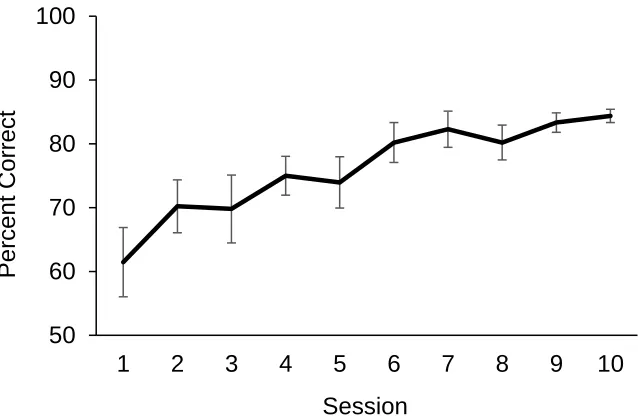
Figure 2.3: Percent correct across 9 sessions in Experiment 1. ... 19
Figure 3.1: Percent correct across 10 sessions in Experiment 2. ... 26
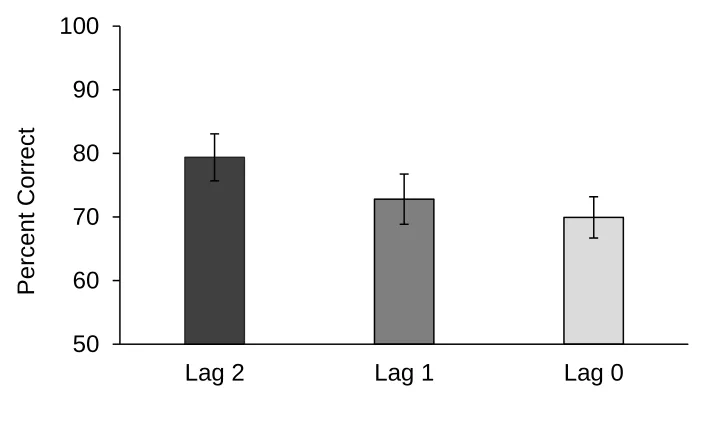
Figure 3.2: Percent correct across lag groups in Experiment 2. ... 28
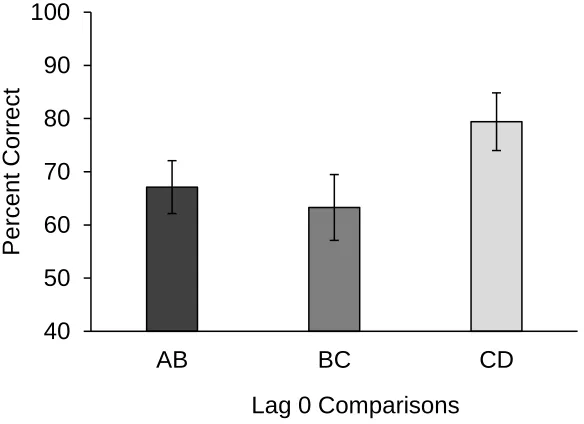
Figure 3.3: Percent correct in lag 0 comparisons in Experiment 2. ... 29
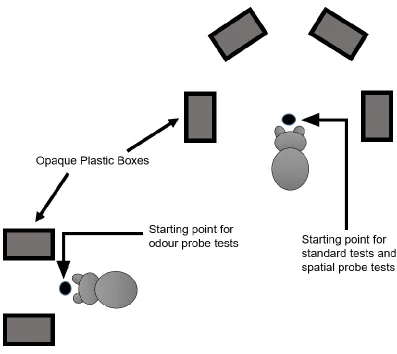
Figure 4.1: The testing apparatuses used in Experiment 3, viewed from above in the same testing room.. ... 34
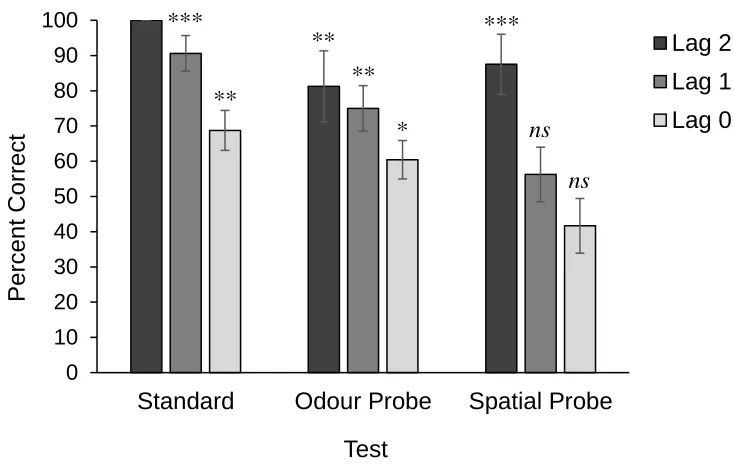
Figure 4.2: Percent correct in the three lag types across the three test types in Experiment 3... 38
Figure 4.3: Percent correct at lag 0 comparisons in Experiment 3. ... 43
Figure 5.1: Percent correct of dogs in Experiment 4 across 7 sessions. ... 51
Figure 5.2: Percent correct of dogs in Experiment 4 across the three test phase distances. ... 53
Appendix
Chapter 1
1
Introduction
1.1
Episodic-like Memory
An episodic memory is a memory of an event that one personally experienced. This
experienced event involves properties that occurred during the event, including what
activities occurred, where this event happened, and when this event happened in relation
to other personal events (Tulving, 1972). Thus, an episodic memory is comprised of a
memory for what happened which involves spatial and temporal information about the
event. When an individual recalls an episodic memory, they mentally travel back in time
to subjectively remember a specific event, a phenomenon known as autonoetic
consciousness which was believed to be unique to humans (Tulving, 2005). However,
researchers in the last two decades have revealed evidence for episodic memory in
non-human animals. Animals have been shown to remember the contents of events,
specifically showing that they remember “what” occurred in the past, “where” things occurred, and “when” the event happened. These what-where-when (WWW) components
were deemed the behavioural criteria for episodic memory (Clayton, Bussey, &
Dickinson, 2003a). Because studying these behavioural criteria cannot reveal whether
non-linguistic animals have subjective autonoetic experiences, WWW memory in
animals has been referred to as episodic-like memory (Clayton & Dickinson, 1998).
1.1.1
Episodic-like Memory in Non-human Animals
Episodic-like memory has now been investigated in a variety of non-human species using
various WWW memory tasks. These tasks involve WWW components, and generally
take advantage of animals’ natural abilities or instincts. The first evidence for
episodic-like memory in a non-human animal was shown in scrub jays (Aphelocoma coerulescens)
(Clayton & Dickinson, 1998). Taking advantage of scrub jays natural food-caching
behaviour, the authors showed that scrub jays could remember what types of food items
they cached (a preferred perishable food item, worms, or a less-preferred non-perishable
food item, peanuts), where they cached the food items, and when they cached the food
which scrub jays should have gone to retrieve their cache depended on the amount of
time elapsed between caching and retrieval. Upon a short delay between caching and
retrieval (4 h), 80% of scrub jays first retrieved the preferred perishable food item.
Conversely, upon a long delay between caching and retrieval (124 h), all scrub jays first
retrieved the less-preferred non-perishable food item (124 h). The authors described this
behaviour as only possible if the scrub jays remembered what items they cached (what),
where they cached the items (where), and how long ago they cached each item (when),
thus showcasing WWW memory.
Further evidence for episodic-like memory in non-human animals was shown in
rats (Rattus norvegicus) in Babb and Crystal (2005). Taking advantage of rats’ robust
spatial memory on radial mazes, the authors tested rats to see if they could remember
what food items they ate, where they ate these food items, and, depending on how much
time passed after eating these food items, where to go to retrieve the most food items.
First, rats were placed on an eight-arm radial maze, in which four of the arms were
inaccessible. At the end of three accessible arms was a piece of standard rat chow, while
at the end of the one remaining arm was a piece of highly preferred chocolate. Rats were
then removed from the maze and returned after a period of time, in which now all eight
arms were accessible. Some days rats were returned after a short interval (30 min),
whereas other days rats were returned after a long interval (4 h). If rats were returned
after 30 min, the previously inaccessible arms would be baited with standard rat chow
and the previously visited arms would all be non-baited. If the rats were returned after 4
h, in addition to the previously inaccessible arms being baited with standard rat chow, the
arm that was previously baited with chocolate was re-baited with chocolate. Optimal
performance should be revisiting the chocolate arm after 4 h but not after 30 min. Rats
revisited the chocolate arm more often when 4 h passed than when 30 min passed. Thus,
rats, like scrub jays, can encode WWW memory by remembering what food items they
visited, where they visited these items, and can make optimal decisions based on how
much time has elapsed since food retrieval.
Evidence for episodic-like memory in non-human animals has been shown in
chickadees (Poecile atricapillus), like scrub jays, choose the preferably perishable item
after a short delay but not after a long delay. Similarly, Martin-Ordas, Haun, Colmenares,
and Call (2010), using a task similar to that of Clayton and Dickinson (1998), showed
that chimpanzees (Pan troglodytes), orangutans (Pongo pygmaeus), and bonobos (Pan
paniscus) reliably chose the platform with a preferred perishable food after a short period
of time, and reliably chose the platform with a non-perishable food after a long period of
time. Thus, like scrub jays, black-capped chickadees and apes remembered what food
items were located where, and chose optimally depending on how much time had passed.
Additionally, Ferkin, Combs, delBarco-Trillo, Pierce, and Franklin (2008) studied
episodic-like memory in meadow voles (Microtus pennsylvanicus) by taking advantage
of their natural ability to keep track of the state of receptivity of other female voles. After
one visit to a female at a certain location, male voles were able to keep track of the
reproductive state of the female (what), its location (where), and make mating decisions
based on how long the female will stay in its reproductive state (when). Furthermore,
Pahl, Zhu, Pix, Tautz, and Zhang (2007) studied episodic-like memory in honeybees
(Apis mellifera L.) by taking advantage of honeybees’ natural foraging behaviours.
Honeybees were able to forage appropriately based on what colour patterns they saw
(what), which mazes they were in (where), and what time of day it was (when).
1.1.2
Elements of Episodic-like Memory
Researchers have discussed what the key elements are when developing a task to study
episodic-like memory in animals. On top of the content of episodic-like memory
(WWW), one other critical element of an episodic-like memory is that the structure of the
memory is fully integrated (Clayton et al., 2003a). Griffiths, Dickinson, and Clayton
(1999) described how a task that tests for episodic-like memory should be one in which
an animal cannot make correct choices by solely remembering “what” food was cached,
solely remembering “where” it cached the food, or solely remembering “when” the event
occurred. Instead, an animal should only be able to perform correctly on the task by
integrating all three types of WWW information components into one episodic-like
Another critical element of episodic-like memory is that the memory can be used
flexibly (Clayton et al., 2003a). That is, an animal should be able to change how it uses
information from an encoded event based on the current conditions. Clayton, Yu, and
Dickinson (2003b) showed that scrub jays demonstrated flexible expression of
episodic-like memory. Scrub jays first learned to go to the proper locations to retrieve their
preferred perishable food item after a short period of time but not after a long period of
time. Subsequently, when the scrub jays were shown that the perishable food decayed
quicker than expected, the scrub jays immediately switched their search preferences and
avoided searching at the location of their now-perished food item. The authors suggested
that these birds flexibly processed new information into their encoded episodic-like
memory to make correct choices during food retrieval.
1.1.3
Value of Studying Episodic-like Memory in Non-human
Animals
Studying episodic-like memory in non-human animals provides the opportunity to
develop new translational models for neuro-degenerative diseases that affect episodic
memory in humans. Alzheimer’s disease, a progressive and irreversible disorder of
memory and cognition, affects over 35 million people across the world (Ferri et al.,
2005), and its prevalence is predicted to grow exponentially (Ballard et al., 2011; Ferri et
al., 2005). Early symptoms of Alzheimer’s disease typically begin with deficits in
episodic memory (Bäckman, Jones, Berger, Laukka, & Small, 2004). Thus, studying
episodic-like memory in animals could be a promising start to developing translational
models for Alzheimer’s disease.
Translational models for Alzheimer’s disease have been primarily developed in mice.
Mice have anatomical components highly similar to that of humans, such as hippocampal
and entorhinal cortex circuits, which are impacted in patients with Alzheimer’s disease
(Hall & Roberson, 2012). Genetic engineering in mice is efficient and reproducible,
making mice an easy-to-study model for investigating pathogenic diseases like
Alzheimer’s disease. Although these models have aided our understanding of
although they have shown promising preclinical results, they have often failed in clinical
trials.
1.1.4
Episodic-like Memory in Dogs
Dogs (Canis familiaris) are an excellent candidate for developing a translational model
for Alzheimer’s disease. Unlike mice, as dogs age, they naturally undergo memory loss
and decline in learning ability (Milgram, Head, Weiner, and Thomas, 1994). On a
physiological level, dogs with canine cognitive dysfunction develop specific
neuropathological features and inflammatory markers that correspond to those seen in
humans with Alzheimer’s disease (Schütt et al., 2016). Aged dogs naturally accumulate
the human-type beta-amyloid in the brain, which is a peptide that is thought to lead to
cognitive decline, as seen in patients with Alzheimer’s disease (Hardy & Higgins, 1992).
On a genetic level, the recent genetic sequencing of beta-amyloid in dogs has been shown
to be approximately 98% similar to that of humans (Zerbino et al., 2018), suggesting that
the processes for beta-amyloid production are similar in humans and dogs (Head et al.,
2008). Furthermore, dogs naturally produce early neuropathological conditions similar to
those seen in early Alzheimer’s disease patients, making them an ideal model for investigating prevention of Alzheimer’s disease (Davis & Head, 2014). Translational
canine models have already been developed for neurogenerative diseases such as human
Amyotrophic Lateral Sclerosis (ALS) (Fernández-Trapero et al., 2017), and have been
said to be an optimal model due to natural genetic expressions in dogs compared to
genetic modifications in rodent models (Gitler, Dhillon, & Shorter, 2017). Thus,
behaviourally establishing whether dogs have episodic-like memory may be the first step
for attempting to generate translational canine models of Alzheimer’s disease.
The possibility that dogs encode and retrieve episodic-like memory has been
suggested in a handful of studies. Fujita, Morisaki, Takaoka, Maeda, and Hori (2012)
asked if dogs could solve an unexpected test based on a single past experience. In their
first experiment, dogs were exposed to four open containers which were all baited with
food and were allowed to eat from two of them. After 10 min, dogs were unexpectedly
returned and allowed to explore the boxes; 11 out of 12 dogs first visited a container from
containers, two of which contained food, one of which contained an nonedible object, and
one of which was empty. Dogs could explore all four containers, but could only eat from
one of them. After removing the dog from the room, dogs were unexpectedly returned to
the room again and made their initial visits to the container that they had not yet eaten
from significantly more often than chance. The authors claimed that dogs may have
incidentally encoded and retrieved “what” and “where” information from a single
experience. Similarly, Fugazza, Pogány, and Miklósi (2016) asked whether dogs could
rely on episodic memory to recall a certain imitated action on an unexpected test. They
first trained dogs until they could imitate a specific human action on command, which
involved an action at a specific location. Then, dogs were trained to lie down so that they
would no longer expect to be commanded to imitate. Dogs were then unexpectedly
commanded to imitate the previously trained action. Dogs were able to imitate the action
after a 1-min or a 1-hr retention interval. Thus, both studies suggest that dogs have some
capacity to encode a past event and recall this event to perform a proper action.
1.2
Current Study
Although dogs have been shown to remember where they did not eat (Fujita et al., 2012)
and what action they previously imitated (Fugazza et al., 2016), dogs have not yet been
shown to demonstrate some key elements of episodic-like memory. Dogs have not yet
been shown to demonstrate the “when” component of episodic-like memory. Dogs have
also not yet been shown to encode and integrate all three WWW components from
personal events. Furthermore, dogs have also not yet been shown to be able to flexibly
use an episodic-like memory. Thus, my current study investigates these key components
by testing dogs on a WWW task.
The four experiments presented investigate if and how dogs encode episodic-like
memory. In these experiments, odours were used for the “what” component, box
locations were used for the “where” component, and time was used for the “when”
component. Specifically, dogs were sequentially presented with four odours at four
different box locations, each at a different time. Odours were used as the “what’
component, as olfaction is closely linked with emotion and memory (Aggleton &
highly potent at evoking vivid episodic memories in humans (Adolph & Pause, 2012). In
tandem with dogs’ keen sense of smell (Walker et al., 2006) and impressive olfactory
memory capacity (Lo, Macpherson, MacDonald, & Roberts, unpublished), olfaction
serves as an ideal cue to study episodic-like memory in dogs.
Designs for Experiments 1, 2, and 3 were adapted from the WWW task used for
rats by Ergorul and Eichenbaum (2004). Specifically, Experiment 1 asked if dogs could
encode episodic-like memory. Dogs were first presented with a sequence of four odours
(what) at four different locations (where), each at a different time (when). Then, the first
odour and the last odour were presented simultaneously at the same two boxes that were
visited previously. Dogs were rewarded for choosing the earlier odour in the sequence (in
this case the first odour) and non-rewarded for choosing the last odour. I hypothesized
that dogs would solve this WWW task by meeting a success criterion.
In Experiment 2, dogs were tested to find out if they were encoding all events
from the four-event sequence, and how flexibly they could use their episodic-like
memory to solve an unpredictable task. Dogs were again presented with a sequence of
four odours at four different locations, each at a different time. Then, two out of the four
odours were presented simultaneously at the same two boxes that were visited previously.
Dogs could not predict which two would be presented. This required dogs to encode all
events in the study phase and to flexibly use their memory for these events. I
hypothesized that dogs would solve this WWW task by meeting a success criterion.
In Experiment 3, dogs were tested on a task which assessed whether they could
encode and integrate all three WWW components in each of the four events. Dogs were
again presented with the same four-event sequence as in Experiment 1 and 2. Then, dogs
were tested on three different types of tests: standard tests which replicated the test used
in Experiment 2, odour probe tests which removed the “where” component (box locations
made irrelevant), and spatial probe tests which removed the “what” component (odours
poorly on odour probe tests. Correct performance in all three tests required the encoding
and integration of all three WWW components
Finally, in Experiment 4, dogs were tested on a similar task which completely
omitted odours. This task was used to assess whether dogs could encode spatial
information in the absence of olfactory information. I hypothesized that dogs would solve
Chapter 2
2
Experiment 1
The objective of Experiment 1 was to investigate whether dogs have the capacity to
encode episodic-like memory. A what-where-when task that involved olfaction, spatial
information, and time was devised. In this task, dogs were sequentially presented with
four odours that were visited at different locations and at different times. Then, dogs were
simultaneously presented with the first and the last odour from the sequence. Dogs were
rewarded for choosing the first odour and non-rewarded for choosing the last odour. Dogs
could pass the experiment by meeting a success criterion of choosing the first odour at
least five out of six times in two consecutive sessions. By placing the two previously
visited odours at their previous locations, we assessed whether dogs can remember what
odours they smelled, where they went to smell these odours, and when in time these
events occurred. Experiment 1 served as the initial foundation test of whether dogs can
demonstrate episodic-like memory by encoding what-where-when information. I
hypothesized that dogs would solve this what-where-when task and thus meet the success
criterion.
2.1
Methods
2.1.1
Animals
Subjects were 16 domestic dogs, Canis familiaris, recruited with the dog owners’
permission (see Table 2.1 for age, sex, and breed of dog subjects). All dogs were
experimentally naïve when beginning Experiment 1. Dogs had access to water in the
testing room at all times.
2.1.2
Testing Apparatus
The testing area was an enclosed room (6.02 m X 2.77 m) with a door and windows in
front and to the right of the testing apparatus. Windows were approximately 1 m off the
floor. Four plastic boxes (8.5 cm x 14 cm bottom surface, 11.2 cm x 17 cm top surface,
Table 2.1: Name, age, sex, and breed of dog subjects that participated in this study,
ordered by age. Age was recorded by the dog owner prior to beginning Experiment 1.
Dog Age Sex Breed
Maggie 4 months Female Rough Collie
Chappie 6 months Male German Shepherd
Bilbo 7 months Male Cockapoo
Frank 8 months Male English Bulldog
Sam 2 years Female German Shephard
Gus 2.5 years Male Maltese and Shih Tzu Mix
Sky 2.5 years Female Chihuahua
Annabelle 3 years Female English Bulldog
Maia 3 years Female Golden Retriever
Molly 3 years Female Labrador Retriever
Nutmeg 3 years Female English Springer Spaniel
Cash 4.5 years Male Rough Collie
Lucy 6 years Female Labrador Retriever
Sedona 6.5 years Female Rough Collie
Diesel 9 years Male Jack Russell Terrier and Beagle Mix
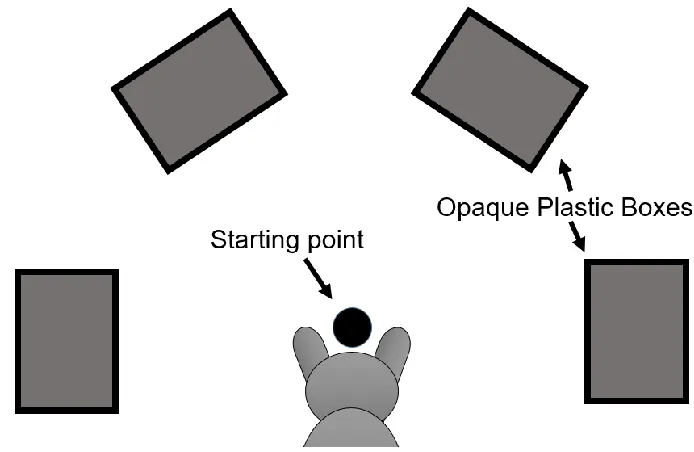
Figure 2.1: Representation of the semi-circle configuration of the testing apparatus,
viewed from above. A dog image is shown in front of the starting point, illustrating
where a dog would be held before making a choice during test phases. Boxes are referred
Figure 2.1). Boxes were made fully opaque using grey masking tape. The diameter of the
semi-circle shape was approximately 50 cm. Adjacent boxes along the semi-circle shape
were equidistant at 43 cm apart. Boxes were 25 cm away from the starting point which
was located midway between the left end box and the right end box. Boxes were taped on
the floor using grey masking tape such that the long side of the boxes faced the starting
point.
To control for the possibility that dogs might choose a box based on the food
reward odour, an additional plastic box was taped inside each of the four boxes attached
on the floor. These additional plastic boxes were identical to the boxes attached on the
floor, except that six circular holes (0.5 cm diameter) were cut out from the bottom of
each box. Between the outer and inner boxes was a handful of the food reward used
during testing such that dogs could smell food in all four boxes but could not access the
food. Food reward varied from dog to dog based on owner recommendations, including
different types of cheese, chicken sausages, and dried beef liver.
Twenty five plastic lids (11.2 cm long x 17 cm wide x 0.5 cm high) were used for
the olfactory cue. The lids were made fully opaque using grey masking tape. Pieces of
gauze approximately 2.5 cm long x 2.5 cm wide were taped on the centers of all 25 lids.
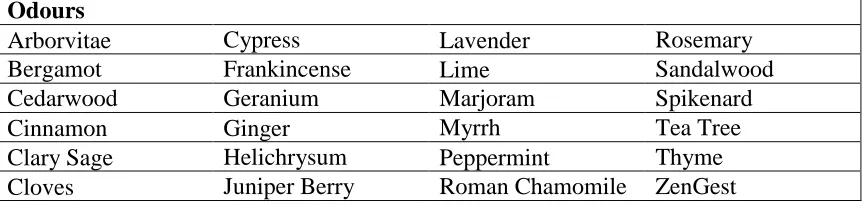
On 24 lids, approximately one drop (5 mL) of a unique scented essential oil, supplied by
the dōTERRA company located in Utah, United States, was applied on a gauze at the
beginning of each testing day. Each of the lids had a different scented essential oil, for a
total of 24 different essential oils based on the odours of various herbs, plants, and food
odours (see Table 2.2 for a list of essential oil odours). The 24 scented lids were stored in
sealed plastic bags, and were placed on a table away from the testing apparatus. The
unscented lid was used for training. A white opaque tri-fold cardboard (121.9 cm x 91.4
cm) was used as a visual blocker for the dogs. Before every trial, dogs were leashed to
the door handle in a way that the dog could not see the testing apparatus or the
experimenter during set up. When a trial was ready to begin, dogs were removed from the
Table 2.2: List of essential oil odours used in Experiments 1, 2, and 3, ordered
alphabetically. Odours were obtained from the dōTERRA company.
Odours
Arborvitae Cypress Lavender Rosemary
Bergamot Frankincense Lime Sandalwood
Cedarwood Geranium Marjoram Spikenard
Cinnamon Ginger Myrrh Tea Tree
Clary Sage Helichrysum Peppermint Thyme
2.2
Procedure
2.2.1
Habituation
Before beginning Experiment 1, dogs freely explored the testing room and the testing
apparatus. Dogs were given a few pieces of the food reward and were encouraged to
socialize with the dog handler. The habituation phase lasted 5 to 15 min, and lid training
began immediately after.
2.2.2
Lid Training
The goal of lid training was to train dogs to be comfortable with knocking over a plastic
lid that fully covered a box, revealing a food reward. To do this, the handler first showed
a piece of food reward to the dog before placing the food in one of the four uncovered
boxes. The dog was then allowed to explore all boxes until the food was eaten. Next, the
process was repeated, except after placing the food in the box, the unscented lid was
immediately placed on top of the boxes covering half of the box. This was repeated until
the dog comfortably knocked over the lid to obtain the food without guidance. Then, the
process was repeated, except that after each successful independent food retrieval, more
of the inside of the box was covered by the lid until the dog comfortably knocked over a
lid that fully covered the box. Lid training was complete when the dog could knock over
a fully covered lid three times. Lid training lasted around 1-10 min.
2.2.3
Testing Procedures
Dogs were tested on 1-3 sessions a day for 1-3 days a week for all experiments. For dogs
that were tested for more than one session in a day, the time that elapsed between
sessions ranged from 1 min to 3 h. For some dogs, their owner was present during testing
and was seated near the door and out of reach of the dog. Each session contained six
trials. In each trial, four unique sequential events were generated by presenting dogs with
four different odours placed at different locations and at different times. Dogs were tested
with two of the four odours and, critically, were rewarded for choosing the odour that
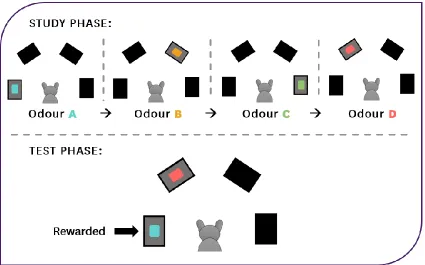
Specifically, each trial contained a study phase with four events and a test phase.
The time that elapsed between each event in the study phase was 10-15 s, and the time
that elapsed between the last event in the study phase and the test phase was 10-15 s (see
Figure 2.2 for a sample trial). For the first event of the study phase, a randomly selected
scented lid (for example, odour A) was placed on top of a randomly selected box that had
a piece of food inside (baited). The other three boxes were empty and uncovered. The
dog was then released from the door and allowed to freely explore all boxes until the lid
was knocked over and the food reward was eaten. The dog would then be attached to the
door handle and the scented lid would be removed from the box, ending the events. The
next three study phase events were identical to the first study phase event with two
crucial things involved. First, odours used for each study phase were unique within a
trial, such that each trial involved four out of the 24 unique odours (for example, odour
A, B, C, and D, in that order). Second, each of the four scented lids were placed on a
different box, such that for every trial, one unique odour was paired with a unique
location at a unique point in time over a period of approximately 1 minute.
Approximately 10-15 s after the last event of the study phase, the test phase began.
In the test phase, the odours that were presented first (odour A) and last (odour D)
in the study phase were placed simultaneously at the same two locations that they were
placed in the study phase. Odour A was baited with food, but odour D was not. To
control for the sound of baiting boxes with food as a cue, the sound of dropping the food
was imitated by taping a finger on the bottom of the non-baited box. The order in which
the imitated sound and the food-dropping sound were made was random, such that in
some trials the imitated sound was made first, and for other trials the food-dropping
sound was made first. The dog would then be guided with a leash to the starting point.
The dog would be held at the starting point with a neutral grip for 5 s while the handler
looked down. The dog was positioned so that the front of its body faced directly in
between the two tested odours, with its front two legs behind the starting point. For
example, if the two tested odours were positioned at box 1 and box 2 (see Figure 1 for
specific box locations), the dog’s body would face directly at the midpoint between box 1
and box 2. Before being released to make a choice, the dog was allowed to turn its head
Upon release, a trial was deemed correct if the dog chose the earlier-visited box first (in
this case, odour A). A box was considered chosen when more than 20% of the inside of
the box was exposed by moving the lid. Dogs were immediately removed from the
apparatus upon making an incorrect choice, except for the first session, in which they
could choose the correct box following an incorrect choice to promote learning. To pass
Experiment 1, dogs needed to reach a success criterion of a minimum of five out of six
correct trials in two consecutive sessions (10 out of 12 consecutive trials), excluding the
first session. The binomial probability of choosing correctly in 10 out of 12 trials is
approximately 1.6%.
Critically, although the same 24 odours were used in every session, no sequences
of four odours used for a trial were repeated for individual dogs, thus generating unique
combinations of events on each trial. With 24 odours, there are over three-hundred
thousand permutations of unique odour sequences. For dogs to be consistently successful,
they needed to learn that the odour presented earlier in time in the study phase odour
sequence was rewarded in the test phase. To do this, they needed to remember what they
smelled, where they smelled it, and at what point in time these events occurred relative to
each other.
2.2.4
No-food Trials
In every session, one of six trials was randomly chosen to be a no-food trial. No-food
trials were identical to regular trials, except for one crucial thing: no boxes were baited.
Instead, if a dog chose the correct box first, the handler would immediately toss a piece of
food inside the box. It was crucial that the dog handler knew which of the two boxes was
correct so that immediate reinforcement would occur upon a correct choice. No-food
trials acted as an additional food control to check whether dogs would do better on
regular trials than on no-food trials, possibly because they could smell which box was
baited in the test phase.
2.2.5
Double-blind Testing
Because the dog handler knew which of the two tested odours was correct, human
for this possibility, one session of double-blind testing was performed for each dog after
it reached the success criterion. The procedure on this session was identical to the
procedure in Experiment 1, except that two people were involved during testing. One
person was responsible for setting up the study phase events, handling the dog for these
events, and setting up the test phase. The other person, who faced away from the
apparatus until the test phase was ready, was the dog handler for the test phases. Because
the dog handler for the test phase never knew which of the two lids was correct during
the testing phase, no accidental human cuing was possible. No-food trials were omitted
for this test because the dog handler did not know which of the two test phase boxes were
correct, making immediate reinforcement difficult.
2.3
Results
All 16 dogs reached the success criterion of five out of six correct choices in two
consecutive sessions, excluding the first session. The mean number of sessions required
to reach the success criterion was 5.88, SE = 0.61. A one sample t-test was used to assess
if the mean percent correct in the last two sessions of each dog (M = 86.98, SE = 1.27)
was significantly above chance (50%). Percent correct refers to the percentage of times
that the dog chose the earlier-presented odour. The test revealed that dogs performance
was significantly higher than chance, t(15) = 28.20, p < .001, one-tailed. A paired t-test
was used to compare mean percent correct in the last two sessions with the mean percent
correct of no-food trials in the last two sessions (M = 90.63, SE = 5.04). The test revealed
that the difference was not significant, t(15) = -0.72, p = .486. Thus, baited trials were
unlikely to have aided dogs’ performance. A paired t-test was used to compare mean
percent correct in the last two sessions with the mean percent correct of double-blind
sessions (M = 85.42, SE = 3.36). The test revealed that the difference was not significant,
t(15) = 0.51, p = .617, suggesting that potential human cuing were unlikely to have aided
dogs’ performance.
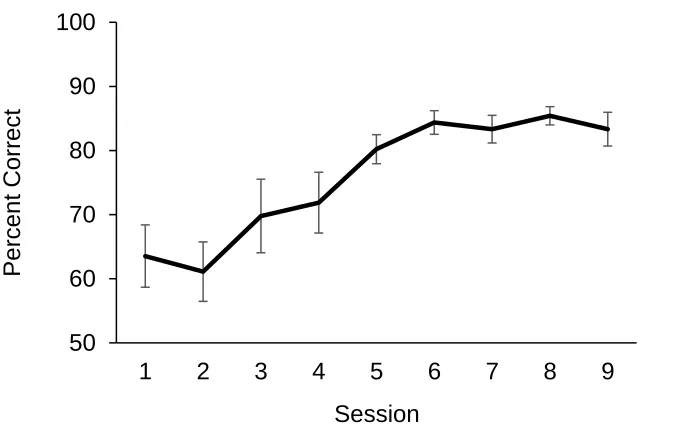
A learning curve averaged across dogs was plotted to examine dogs’ rate of
learning as sessions progressed (see Figure 2.2). The figure illustrates performance from
the first session to the ninth session for all 16 dogs. Because one out of 16 dogs
Figure 2.3: Percent correct across 9 sessions in Experiment 1. Error bars represent SEM.
50 60 70 80 90 100
1 2 3 4 5 6 7 8 9
Pe
rcen
t
C
orr
ect
were removed for illustration purposes. For dogs that reached criterion in less than nine
sessions, the percent correct of their last session was repeated for all remaining sessions
for illustration and statistical purposes. The curve suggests that dogs were somewhat
above chance on sessions 1-2, showed a steady rise in performance to session 6, and
leveled off over the subsequent sessions 7-9. A repeated measures ANOVA was
performed on this curve to test for a significant increase in accuracy. Mauchly’s test
indicated that the assumption of sphericity had been violated, χ2(35) = 102.40, p < .001.
As such, the degrees of freedom were corrected using Greenhouse-Geisser estimates of
sphericity (ε = .53). The overall model revealed a significant increase in accuracy over
sessions, F(4.24, 63.54) = 6.56, p < .001, ηp2 = .30.
2.4
Discussion
Dogs completed this initial what-where-when task in just under a mean of six sessions,
supporting my hypothesis for Experiment 1. There was no significant difference in
performance between non-blind testing and double-blind testing, suggesting that potential
human cuing were unlikely to have aided dogs’ performance. There was also no
significant difference between regularly baited trials and no-food trials, suggesting that
dogs did not use the scent of the food reward to aid them in making choices. Figure 2.2
illustrates that dogs seem to gradually improve performance across sessions, suggesting
that dogs not only learned the task, but also retained the knowledge between sessions.
This observation shows impressive retention of task learning, as the time that elapsed
between sessions ranged from 1 min to six weeks.
Experiment 1 provided the first line of evidence suggesting that dogs have
episodic-like memory, as they could solve the where-when task. To solve this
what-where-when task on every trial, dogs likely remembered multiple events in which they
smelled different odours at different locations and at different times. They accurately
recalled these events to solve the task by choosing the first visited box.
An alternative explanation that could account for the results of this experiment is
that dogs may not have been remembering all four events within each trial. Instead,
rewarded odour in the test phase, dogs could have learned to only remember the first
odour and to ignore the rest. Similarly, because it was always the first and last odours out
of the four-odour-sequence of each trial that were presented in the test phase, dogs could
have learned to remember the last odour and avoided it during the test phase. In both
cases, dogs could simply remember one event within a trial and ignore the other three. To
assess whether dogs could remember all four events and recall these events to solve a
task, dogs were tested in a second experiment in which the optimal strategy would be to
Chapter 3
3
Experiment 2
The results of Experiment 1 suggested that dogs have the capacity to encode what, where,
and when events occurred, and recall this episodic-like memory to solve a task. However,
whether dogs were encoding all the events in the study phase and flexibly using their
memory to solve the task was unclear. The objective of Experiment 2 was to determine if
dogs could still solve a similar what-where-when task if it required them to remember all
the events in the study phase, and if the test phase was unpredictable. Similar to
Experiment 1, dogs were sequentially presented with four odours that were visited at
different locations and at different times (Odour A, then B, then C, then D). Then, dogs
chose from two of the four odours, which were simultaneously presented. These two
odours were one of six possible odour comparisons (A vs. D, A vs. C, B vs. D, A vs. B, B
vs. C, or C vs. D). Because the test phase was unpredictable, dogs needed to flexibly use
their memory to solve the task each trial. Dogs were rewarded for choosing the odour that
was visited earlier in the four-odour sequence, but were not rewarded for choosing the
odour that was visited later in the four-odour sequence. For example, in the case of A vs.
C, odour A would be rewarded and odour C would be non-rewarded. A correct choice
was one in which the dog chose the rewarded odour first. Dogs could pass the experiment
by meeting a success criterion of choosing the rewarded odour in five out of six trials in
two consecutive sessions.
By varying odour comparisons, dogs were not able to predict which two odours
from the four-odour sequence would be tested. Thus, dogs should remember all four
events in the four-event sequence and flexibly use this memory in order to consistently
choose correctly. I hypothesized that dogs would solve this what-where-when task and
thus meet the success criterion. I also predicted that dogs would perform better at odour
comparisons where the tested odours were visited further apart in time (for example, A
vs. D) than odour comparisons where the tested odours were visited closer together in
time (for example, C vs. D). I also predicted that dogs would demonstrate serial position
previously visited first or last (odour A or odour D) than odour pairings where the tested
odours were previously visited between the first and last odours (odour B and odour C).
3.1
Methods
3.1.1
Animals
The same 16 dogs that met the success criterion in Experiment 1 participated in
Experiment 2 upon completion of double-blind testing in Experiment 1.
3.1.2
Testing Apparatus
The same testing apparatus used in Experiment 1 was used in Experiment 2.
3.2
Procedure
3.2.1
Testing Procedures
The study phase used in Experiment 2 was identical to the study phase used in
Experiment 1. Dogs were sequentially presented with unique odours at different locations
and at different times, for a total of four unique odours per trial (odour A, then odour B,
then odour C, then odour D). For the test phase, the same testing conditions used in
Experiment 1 were used in Experiment 2 except for two conditions. First, one of six
possible odour comparisons was tested on each trial. These comparisons included: A vs.
D (the only comparison tested in Experiment 1), B vs. D, A vs. C, A vs. B, B vs. C, and C
vs. D. All six comparisons were tested in a random order in each session, for a total of six
trials per session. A trial was deemed correct if the dog chose the box that appeared
earlier in the study phase sequence, which could involve odours A, B, or C depending on
the test phase comparison. For example, if the test phase comparison was B vs. C,
choosing odour B would be correct but choosing odour C would not. The second
condition that differed from Experiment 1 was that dogs were immediately removed from
the apparatus upon making an incorrect choice in the test phase, including the first
session. This was done to keep dogs motivated to make correct choices. The same
minimum of five out of six correct choices in a session for two consecutive sessions,
excluding the first session.
By having six possible test phase comparisons and by randomizing the order in
which the comparisons were tested in each session, two conditions that encouraged
episodic-like memory encoding were involved. Firstly, dogs were encouraged to encode
more than one event from the study phase. If a dog used a strategy in which it only
remembered the first or the last event from the study phase, the dog would not be able to
meet the success criterion as there were no more than three possible comparisons that
involved the first or the last odour. That is, if a dog only encoded the first event, it would
not be able to perform consistently well as there were three test phase comparisons that
did not involve odour A (B vs. C, B vs. D, C vs. D). Similarly, if a dog only encoded the
last event, it would not be able to perform consistently well either as there were also three
test phase comparisons that did not involve odour D (A vs. B, A vs. C, B vs. C).
Secondly, the test phase comparison was unpredictable. The dog could not have
known which test phase comparison would appear in each trial. Although dogs could
likely expect the test phase with repeated trials, they could not expect which odour
comparison would be tested. As such, dogs were encouraged to flexibly use their memory
of the four-event sequence. Overall, encoding all four study phase events would have
been the most effective strategy to obtain the reward and thus meet the success criterion.
3.2.2
No-food Trials and Double-blind Testing
The same conditions for both the no-food trials and double-blind testing used in
Experiment 1 were used in Experiment 2. That is, a no-food trial was randomly given in
one of six trials every session, and a double-blind session was performed after a dog
reached the success criterion. For the double-blind session, the test phase comparisons
were pseudo-randomly ordered such that all six comparisons were tested once in the
3.3
Results
All 16 dogs reached the success criterion in a mean of 5.94 sessions, SE = 0.70. A
one-tailed one sample t-test comparing mean percent correct of the last two sessions of each
dog (M = 85.41, SE = 0.93) against chance (50%) revealed that dogs performance was
significantly higher than chance, t(15) = 37.98, p < .001, one-tailed. A paired t-test was
used to compare mean percent correct in the last two sessions with the mean percent
correct of no-food trials in the last two sessions (M = 90.63, SE = 5.04). The test revealed
that the difference was not significant, t(15) = -1.07, p = .301. Thus, baited trials were
unlikely to have aided dogs performance. A paired t-test was used to compare mean
percent correct in the last two sessions with the mean percent correct of double-blind
sessions (M = 84.38, SE = 3.56). The test revealed that the difference was not significant,
t(15) = 0.31, p = .763, suggesting that potential human cuing were unlikely to have aided
dogs’ performance.
A learning curve averaged across dogs was plotted to examine dogs’ rate of
learning as sessions progressed (see Figure 3.1). The figure illustrates performance from
the first session to the tenth session for all 16 dogs. The one dog that reached criterion in
11 sessions had its eleventh session removed for illustration purposes. For dogs that
reached criterion in less than 11 sessions, the percent correct of their last session was
repeated for all remaining sessions for illustration and statistical purposes. The curve
shows that dogs were somewhat above chance on session 1, showed a steady rise in
performance to session 7, and leveled off over the subsequent sessions 8-10. A repeated
measures ANOVA was performed on this curve to assess the accuracy increase.
Mauchly’s test indicated that the assumption of sphericity had been violated, χ2(44) =
119.03, p < .001. As such, the degrees of freedom were corrected using
Greenhouse-Geisser estimates of sphericity (ε = .49). The overall model revealed a significant
increase in accuracy over sessions, F(4.41, 66.07) = 4.88, p = .001, ηp2 = .25.
The first prediction of this experiment stated that dogs would perform better at
comparisons in which the tested odours were visited further apart in time than at
comparisons in which the tested odours were visited closer together in time. With study
Figure 3.1: Percent correct across 10 sessions in Experiment 2. Error bars represent SEM.
50 60 70 80 90 100
1 2 3 4 5 6 7 8 9 10
Pe
rcen
t
C
orr
ect
phase comparisons were grouped into lag groups and shown on Figure 3.2. Comparisons
were grouped by lag in the following way: lag 2 (A vs. D), lag 1 (A vs. C and B vs. D),
and lag 0 (A vs. B, B vs. C, C vs. D). The lag number equals the number of odours visited
in the study phase between the tested odours. For example, A vs. C is grouped into lag 1
because one odour (odour B) was visited after odour A and before odour C in the study
phase. Thus, lag 2 included the test phase comparisons that had odours that were the most
temporally spaced apart, lag 1 included odour comparisons that were less temporally
spaced apart, and lag 0 included odour comparisons that were the least temporally spaced
apart. Because the number of observations was unequal for each lag group (one
comparison for lag 2, two comparisons for lag 1, and three comparisons for lag 0), scores
were averaged such that there was one averaged score at each lag from each dog. For
example, scores on A vs. B, B vs. C, and C vs. D were averaged as one lag 0 score for
each dog. Figure 3.2 suggests that dogs performed best at lag 2, followed by lag 1, and
worst at lag 0. A repeated measures ANOVA was used to assess for performance
differences between lag groups. Mauchly’s test indicated that the assumption of
sphericity had not been violated, χ2(2) = 2.52, p = .284.The model revealed an overall
non-significant trend in the predicted direction, F(2, 30) = 1.72, p = .197, ηp2 = .10, with
the highest percent correct at lag 2 (M = 79.37, SE = 3.69), followed by lag 1 (M = 72.80,
SE = 3.94), and lowest at lag 0 (M = 69.93, SE = 3.24).
The second prediction of this Experiment stated that dogs would perform better at
test phase odour pairings that were presented first or last in the study phase than odour
pairings that were presented in the middle of the study phase. To test this prediction,
dogs’ performance at A vs. B, B vs. C, and C vs. D comparisons (lag 0 comparisons) was
examined. Figure 3.3 shows accuracy at these three comparisons. By only analyzing
comparisons that involved lag 0, potential lag effects were controlled. The A vs. B
comparison tested for a primacy effect as it involved the first odour. Thus, if dogs show a
primacy effect, they should perform best at the A vs. B comparison. Similarly, the C vs.
D comparison tested for a recency effect as it involved the last odour. Thus, if dogs show
a recency effect, they should perform best at the C vs. D comparison. Figure 3.3 shows
Figure 3.2: Percent correct across lag groups in Experiment 2. Error bars represent SEM.
50 60 70 80 90 100
Lag 2 Lag 1 Lag 0
P
e
rcen
t
Corr
e
Figure 3.3: Percent correct in lag 0 comparisons in Experiment 2. Error bars represent
SEM.
40 50 60 70 80 90 100
AB BC CD
P
e
rcen
t
Corr
e
ct
comparison, and slightly worse at the B vs. C comparison. A repeated measures ANOVA
was used to test for performance differences between lag 0 comparisons. Mauchly’s test
indicated that the assumption of sphericity had not been violated, χ2(2) = 3.55, p = .170.
The overall model was not significant, F(2, 30) = 2.33, p = .114, ηp2 = .14. As such, there
was an overall non-significant trend supporting the prediction of a serial position curve,
as dogs achieved the highest percent correct at the C vs. D recency comparison (M =
79.41, SE = 5.42), followed by the A vs. B primacy comparison (M = 67.11, SE = 4.98)
and the lowest at the B vs. C comparison (M = 63.28, SE = 6.19).
3.4
Discussion
All dogs met the success criterion in Experiment 2 in just under a mean of six sessions,
supporting my hypothesis for Experiment 2. Similar to Experiment 1, there was no
significant difference between non-blind testing and double-blind testing, suggesting that
potential human cuing were unlikely to have helped dogs reach the success criterion.
There was also no significant difference between regularly baited trials and no-food
trials, indicating that dogs did not use the scent of the food reward to aid them in making
choices. Figure 3 illustrated that dogs seem to gradually improve performance across
sessions. The time that elapsed between sessions in this Experiment ranged from 1 min to
four months, again showing excellent memory for the task between sessions.
Although there were no significant differences between lag conditions, the overall
trend was in favour of the predicted direction. Dogs performed better at lag 2 and worst at
lag 0, suggesting that it was more difficult to recall the order of odours that were less
temporally separated. This result suggests that the greater the temporal separation
between events (as in lag 2 comparisons), the easier it was for dogs to distinguish the
events and to make correct choices. Similarly, it may be harder to distinguish the order of
events that occurred closer together in time, thus explaining the poorer performance seen
at lag 0 comparisons.
Although there were no significant serial position effects, the overall trend was in
the predicted direction. Dogs performed better at the C vs. D comparison, which
primacy comparison, the difference in performance between A vs. B comparisons and B
vs. C comparisons was small (M = 3.83) compared to the difference in performance
between C vs. D comparisons and B vs. C comparisons (M = 12.3). Performing best at
the comparison that resembled the recency effect could be explained by the fact that
within each trial, less time had passed between the test phase and the previous odours C
and D visits. As such, memory for more recent events may have been easier to recall than
memory for events that occurred longer ago.
Overall, Experiment 2 provide an additional line of evidence supporting the idea
that dogs have episodic-like memory, as they were again able to solve the current
what-where-when task with unexpected tests. Because this experiment specifically required
dogs to remember all the events in the study phase, the results of Experiment 2 suggested
that dogs were encoding all four events in a trial. It seems highly probable that dogs
remembered all four odours they smelled, where they encountered these four odours, and
when in time these odours were presented.
Yet, one caveat to these results so far is that, although it seemed clear that dogs
were encoding all four events in a study phase, it was uncertain as to whether dogs were
encoding all three what-where-when components in these events. That is, it is possible
that dogs were only encoding what odours they smelled and when they smelled them, or
only encoding where they went and when they went there. Hypothetically, a dog could
solely remember odours A, B, C, and D (what component) and when each of these odours
was visited (when component). The dog could then have chosen correctly by strictly
relying on remembering the visited odours and when in time they smelled them.
Similarly, a dog could instead just remember the four box locations (where component),
and remember when each of these boxes was visited (when component). The dog could
have then chosen correctly by strictly relying on remembering where it visited and when
in time it visited each location. To tease apart what strategies dogs were using to solve
the what-where-when task, dogs were tested in a third experiment in which some tests
isolated olfaction (simulating a what-when task) while other tests isolated spatial
Chapter 4
4
Experiment 3
Although Experiment 2 provided strong evidence for the idea that dogs have
episodic-like memory for remembering multiple what-where-when events, it was unclear whether
dogs were encoding all three what-where-when components in each event. This was a
crucial distinction, as a memory can only be defined as episodic-like if the
what-where-when components were integrated (Clayton et al., 2003a). The objective of Experiment 3
was to investigate how dogs encoded each event to solve the what-where-when task. In
this experiment, the study phase was identical to Experiment 2, as dogs were sequentially
presented with four odours that were visited at different locations and at different times
(Odour A, then B, then C, then D). By using the same study phase procedures, all three
what-where-when components were available for encoding. Then, the six test phase
comparisons were tested in three different ways.
Specifically, three different types of tests were used. The first type was identical
to that of Experiment 2, which was termed the standard test. In the standard test, two
odours were placed at their respective study phase locations. The second type was termed
the odour probe test, in which only olfactory information was relevant. The third type
was termed the spatial probe test, in which only spatial information was relevant. The
results of these three tests should reveal how dogs were encoding events in the study
phase. If dogs were only encoding what odours they smelled and when they were smelled
(what-when components), they should perform poorly on spatial probe tests. Conversely,
if dogs were only encoding the locations they went to and when they went to those
locations (where-when components), they should perform poorly on odour probe tests.
Correct performance on all three types of tests would suggest that dogs were encoding
and integrating all three WWW components. The results of Experiment 3 will reveal how
4.1
Methods
4.1.1
Animals
The same 16 dogs that participated in Experiment 2 also participated in Experiment 3
upon completion of double-blind testing in Experiment 2.
4.1.2
Testing Apparatus
In addition to the apparatus used in Experiment 2, two new boxes were used, which were
identical to the boxes in the original semi-circle box apparatus. These two boxes were
taped down side by side at a separate location away from the original four-box apparatus
within the same testing room. These boxes were 25 cm apart and were used for odour
probe tests. The starting point for tests with these two boxes was in front of the boxes, 35
cm away from each box. Additionally, two new plastic opaque lids (11.2 cm long x 17
cm wide x 0.5 cm high) were used for spatial probe tests. These lids were identical to the
original scented lids, except that they had no odours applied as there were no pieces of
gauze attached. For tests that used this new two-box apparatus (odour probe tests), the
dog would be placed so that the front of its body faced the midpoint between the two
boxes (see Figure 4.1 for testing apparatus configuration of the three test phase types).
4.2
Procedure
4.2.1
Testing Procedures
The study phase used in Experiment 3 was identical to the study phase used in
Experiment 2. In summary, dogs were sequentially presented with unique odours at
different locations and at different times, for a total of four unique odours per trial (odour
A, then odour B, then odour C, then odour D). In the test phase of a trial, one of three
different test phases was used: a standard test, an odour probe test, or a spatial probe test.
In the standard test, the test phase procedures were identical to the test phase procedures
from Experiment 2. That is, two of the four visited odours were placed at their respective
study phase locations. Dogs again were rewarded for choosing the lid that was visited
earlier in the study phase sequence. Because the two test phase odours were the same two
Figure 4.1: The testing apparatuses used in Experiment 3, viewed from above in the same
testing room. A dog image is shown in front of both starting points, illustrating where a
dog would be held before making a choice during test phases. The bottom left starting
point was used for odour probe tests, and the top right starting point was used for
standard tests and spatial probe tests. The four boxes in the semi-circle configuration in
the top right are referred to as box 1, box 2, box 3, and box 4 from left to right from the
dog’s perspective. The two boxes in the bottom left are referred to as the left box and the
phase, dogs could have solved this test using one of three strategies. Firstly, dog could
have encoded all three what-where-when components (what odours they smelled, where
they smelled these odours, and when they smelled these odours). Secondly, dogs could
have encoded what odours they smelled and when they smelled these odours (what-when
components). Thirdly, dogs could have encoded what locations they went to and when
they went to these locations (where-when components). As such, performance at the
standard test acted as a baseline to compare with performance at the odour probe tests
and at the spatial probe tests. These two probe tests restricted what strategies dogs could
use to be successful on the task.
In the odour probe test, dogs were also presented with two of the four odours from
the study phase, except now at locations that were never visited in the study phase.
Instead of placing the two odours at their positions in the four-box study phase apparatus,
the two odours were placed at new two-box positions (see Figure 4.1 for details). Dogs
could make a correct choice by choosing the odour that was visited earlier in the study
phase sequence. Because the same two odours were presented at the test, olfactory
information was relevant during this test. However, because the odours were placed at
new locations that did not reflect a semi-circle configuration, spatial information was
irrelevant during this test. For dogs to perform accurately on odour probe tests, they must
have at least encoded olfactory information and temporal information. That is, if a dog
only encoded what odours they smelled and when they smelled these odours (what-when
components), the dog could still perform accurately on this task. In contrast, if a dog only
encoded what locations they went to and when they went to these locations (where-when
component), the dog should perform poorly on this task.
In the spatial probe test, dogs were not presented with any odours. Instead, two
new odourless lids would be placed on two boxes in the same four-box semi-circle
apparatus. The location of the lids depended on the order of box visits and the testing
comparison. For example, if the sequence of events in the study phase was odour A at
box 1, then odour B at box 2, then odour C at box 4, then odour D at box 3 (see Figure
4.1 for details on box locations), a testing comparison of B vs. D meant that the odourless