Available Online atwww.ijcsmc.com
International Journal of Computer Science and Mobile Computing
A Monthly Journal of Computer Science and Information Technology
ISSN 2320–088X
IMPACT FACTOR: 5.258
IJCSMC, Vol. 5, Issue. 3, March 2016, pg.192 – 196
Application of Game Theory to Road
Traffic Optimisation
Syed Md. Galib1, Md. Shafiul Alam Forhad2, G. M. Muradul Bashir3,Md. Bellal Hossain4
¹,²Department of Computer Science and Information Technology, Patuakhali Science and Technology University, Bangladesh ³Department of Computer and Communication Engineering, Patuakhali Science and Technology University, Bangladesh
4Department of Mathematics, Patuakhali Science and Technology University, Bangladesh
1
[email protected]; 2 [email protected]; 3 [email protected]; 4 [email protected]
Abstract— People travel from one place to another for various reasons and cause traffic flow in the road networks. Travellers usually strive to minimise their travel times and avoid congestion. They also are mostly independent in their route choice. All these factors are similar to a game where players have specific goals and receive utilities upon performing their actions. Players of a game can be modelled as intelligent agents. Thus game theory is a potential candidate to solve road traffic optimisation problem. Here in this paper, we discussed several game theoretic approaches to road traffic optimisation basically in the form of traffic assignment where travellers are thought as agents in a multi-agent system. Finally, we also shed light on a common misconception of reducing congestion by adding new roads or expanding the capacities of the existing roads through Braess’ paradox.
Keywords— Game theory, Nash equilibrium, Multi-agent system, Minority Game, Traffic Assignment, Wardrop equilibrium, Congestion
I. INTRODUCTION
In everyday life, people travel from origins to destinations. Trips are made for many reasons - going to work, shopping, dropping or picking up children or spouse, joining various events or even for relaxing in parks or on beaches. Trips are often made by cars on roads and because of people travelling from one place to another traffic flow is created in the road networks. Roads naturally have limited capacities. When the traffic flow exceeds or approaches the capacity of a road, congestion occurs[1]. Congestion costs time and has a negative impact on the environment as well. In order to avoid congestion, an even distribution of the travellers on their route alternatives is desirable.
of the travellers, reducing congestion through a fair and efficient traffic distribution in the network can minimise travel times.
II. GAME THEORY
In a penalty kick scenario of a soccer match, a player from one team takes the penalty kick and the goal keeper from the other team attempts to save the penalty. In this situation, the player taking the penalty is required to choose how to target the kick and the goal keeper is required to defend against it. The decision of the goal keeper to dive in a direction particularly depends on the other players’ shooting direction. This scenario can be modelled using game theory. Game theory relates to making decisions where the action of the decision maker does not only depend on herself but also depend on other parties involved in that scenario. The parties involved in the decision making process are often called players. The example given above is one such scenario. Another example may be deciding on how to bid in an auction where many players are bidding on an item. The players usually do not know what the other players are thinking and how they would bid.
Game theory deals with situations where the outcome of a player’s decision depends on his way of choosing an option as well as the choices made by other players with whom he is interacting[3]. Each player has her own interest i.e. players are self-interested. They want to maximise their own utility and they usually do not care about other players’ utilities. The players usually do not communicate with each other. In such a non-cooperative scenario where players do not communicate, the players must make their own decisions independently. The players of a game may have a set of possible strategies to choose from in an attempt to maximise their utilities which are jointly dependent on the decisions of all players involved in the game[4].
From the above discussion follows that a game consists of three attributes[3].
Players - the set of participants in the game.
Strategies - a set of options how each player acts or takes decisions in the game. Strategies can be either pure strategies or mixed strategies. Pure strategies are strategies which players choose deterministically. Mixed strategies are randomisations over pure strategies i.e. in this case, players assign a probability on the pure strategies to choose from.
Utility - the payoff for using a strategy after all players' actions.
Thus we can define a game Γ as
(1)
where,
N is the (finite) set of players involved in the game
is the (finite) set of pure strategies for player i
is the utility for using by player i
As each player uses a strategy and acts upon that strategy, the outcome of the game and thus the payoff for the players depend on the N strategies played by N players. There exists a tuple of N strategies for which the players’ utilities are the highest. In this situation, no player can increase her payoff by changing her strategy. This state is known as Nash Equilibrium[5, 6].
Players in a game also have the property of rationality i.e. players act rationally. Players want to achieve a goal and make decisions to maximise their utilities given their current knowledge. The rationality can be perfect or bounded. Perfect rationality means every player has complete knowledge about all players, their utility functions and their knowledge about their opponents. Given this condition, each player must act according to the best available strategy. On the other hand, bounded rationality implies that the game may be very complex to comprehend for the players and the players do not possess complete knowledge about other players. Bounded rationality has been given much attention by researchers[7, 8] as in reality, perfectly rational behaviour is rare. A detailed discussion on boundedly rational decision making will be presented later in this chapter. First it is necessary to relate game theory with road traffic.
III.GAME THEORY AND ROAD TRAFFIC
Travellers in a road network can be seen as players in a game. They strive to maximise a utility which is usually the minimal travel time to a destination. The travellers are independent in their decision making. They have strategies for choosing routes. For example, one traveller may want to use a single route every time she travels; another traveller may want to use a route which has scenic beauty; yet another traveller may want to avoid the route he chose last time he travelled as there was congestion on that route.
Thus road traffic scenarios can be seen as a game and researchers have paid attention to this kind of formulations[9], [10], [11].
A. An Illustrative Example
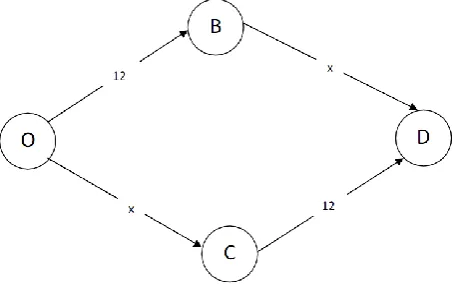
We present an example road network scenario where all travellers are going from an origin to a destination. Here, the simplified road network, shown in Fig. 1, is represented by a directed graph where the links/edges are roads and the nodes are the intersections from where travellers can divert to another road. The symbols on to the links are the times (in minutes) required to travel the corresponding links.
Fig. 1: An Example Road Network
We can consider this as a commuting scenario where O is a residential area and D is a central business district. O-B-D and O-C-D are two routes of which the links/roads O-C and B-D are highly sensitive to the traffic flow. Thus the travel times on these two links or roads depend on the number of travellers present on the links. The travel times for these two links are x minutes where x is the number of travellers present on the road. The travel times on both O-B and C-D do not depend on the traffic flow and they are 12 minutes for both links.
If there are 10 travellers commuting from O to D and everyone pursues the goal of reaching the destination in the minimal possible time, the scenario can be viewed as a N = 10 player game where the players would use strategies to choose a route from O to D and their payoff would be the negative of their travel time. Note that we are considering travel times as dis-utility and thus minimising the dis-utility can be considered as maximising the payoff. A possible set of strategies can be as follows.
Choose route O-B-D.
Choose route O-C-D.
Choose a route randomly.
Choose the route chosen last time.
Choose the route not chosen last time.
Choose the route chosen last time if that route was not congested.
Choose one route as long as the travel time is below a specific threshold, otherwise switch to the other
route next time.
Note that we cannot define the payoffs for the strategies here as the payoff can only be calculated after all players have used a strategy and taken decisions about their route choices. This is due to the fact that players are assumed to make decisions simultaneously and the travel time can be calculated after everyone has reached the destination. There is a payoff for every single strategy played by each player. Therefore, this commuting scenario represents a game of $10$ players who are independent, self-interested and goal-driven.
the travellers would experience the minimum possible travel time and thus obtain the maximum possible payoff. Therefore, having 5 players choosing the first strategy listed above and 5 players choosing the second strategy results in a Nash equilibrium. In terms of road network scenarios, this equilibrium is known as Wardrop's equilibrium[12]}, because no traveller can reduce her travel time by unilaterally changing her route between her origin and destination.
Nash equilibrium is a state of a game for a given set of strategies - one for each player - for which the players obtain the highest possible utility in a game. Wardrop equilibrium is the distribution of traffic for which the travellers experience minimum possible travel time and thus the highest possible payoff. At Nash equilibrium, no player can gain any payoff by changing the strategy. Similarly, at Wardrop equilibrium, no traveller can reduce the travel time (gain more payoff) by changing the route from the origin to the destination.
We can observe that the traffic game of the scenario of Figure 1 reached the Nash equilibrium from the user's point of view. The travel time of 12 minutes is the minimum possible travel time each traveller can experience. Thus, the travellers distribute themselves so that five travellers choose the route O-B-D and the remaining five travellers choose O-C-D which achieves user equilibrium (UE).
From the system's point of view, the travel time of 17 minutes is also minimum possible average travel time for the system. Thus, assigning five travellers to the route O-B-D and the remaining five travellers to O-C-D is a system optimal (SO) assignment. Therefore, The Nash equilibrium in the traffic game of the scenario of Figure 1 does not only reach the UE but also achieves SO travel times. However, not all game scenarios have a Nash equilibrium which results in the optimal travel time. Braess[13] showed that the a modification of the road network for the sake of reducing the travel time may affect the network adversely and the travellers may experience longer travel times.
IV.BRAESS’ PARADOX
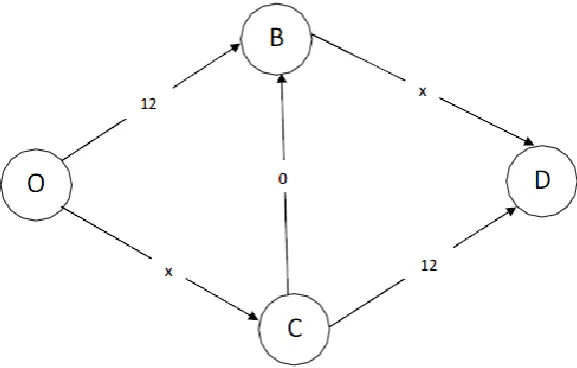
The traffic distribution for the road network in Fig. 1 was optimal for the travellers as well as from the point of view of the system. However, a small change in the network may cause an entirely counterintuitive situation. If a new very fast link with (virtually) infinite capacity is added to the network, the new network becomes the one shown in Figure 2. We assume that the newly added link between C and B has zero travel time regardless of the number of travellers present on the link.
Fig. 2: Addition of a very fast link between 2 nodes of the network in Fig. 1.
result, the one traveller who chose O-B from O experience 22 minutes while others experience 20 minutes. Thus, using the route O-C-B-D is a Nash/Wardrop equilibrium which does not achieve optimal travel time. This phenomenon is called Braess's Paradox.
German mathematician Dietrich Braess first introduced this phenomenon originally in German[14]). It has been translated into English in 2005[13]. According to Braess, adding extra capacity to a network with self-interested travellers can in fact increase the travel time in some cases. This is due to the fact that the Nash equilibrium of such a system may not necessarily be optimal.
Braess's Paradox has been observed in practice. In Seoul, South Korea, travel time was reduced after the destruction of a six-lane highway[15]. On Earth day in 1990, there was no historic traffic jam after closing down the 42nd Street of New York[16]. Youn et al.[17] reported that travel times can be reduced by closing down some roads in Boston, New York city and London.
Therefore, for transportation planners, building new roads to avoid congestion is not necessarily a solution for the congestion problem. As travellers usually choose routes independently and always strive to reduce their travel times without communicating with each other, a game-theoretic approach may be an effective approach to the traffic assignment problem.
V. CONCLUSIONS
In this paper, we have shown how travellers’ route choice can be modelled using game theoretic formulations. We reviewed some game theoretic formulations which deal with road traffic optimisation. Finally, we presented an illustrative example with which the traffic assignment problem has been explained within the game theoretic paradigm. We also discussed a common misconception of addition of new roads or expanding the capacities of roads in a network and showed with the help of Braess’ paradox that addition of new roads in a network may not be a solution to the congestion problem. Therefore, we propose to apply game theory in road traffic optimisation as Galib and Moser [10] or Chen and Ben-Akiva[9] proposed.
REFERENCES
[1] F. H. Administration. (2013, May 31). Congestion: A National Issue. Available: http://www.ops.fhwa.dot.gov/aboutus/opstory.htm [2] Y.-C. Chiu, J. Bottom, M. Mahut, A. Paz, R. Balakrishna, T. Waller, and J. Hicks, "A Primer for DTA," ed: ADB30 Transportation Network Modeling Committee Transportation Research Board, 2010.
[3] D. Easley and J. Kleinberg, {Networks, Crowds, and Markets: Reasoning About a Highly Connected World}: Cambridge University Press, 2010.
[4] T. Schlegel, "Decentralised Agent-based Resource Allocation in Open and Dynamic Environments," PhD Thesis, Faculty of Computer Science and Information Technology, Swinburne University of Technology, Melbourne, Australia, 2010.
[5] J. Nash, "Equilibrium points in N-person games," Proceedings of the National Academy of Sciences, vol. 36, pp. 48-49, 1950. [6] M. Osborne and A. Rubinstein, A Course in Game Theory: The MIT Press, 1994.
[7] W. B. Arthur, "Inductive Reasoning and Bounded Rationality," American Economic Review (Papers and Proceedings), vol. 84, p. 6, 1994.
[8] H. A. Simon, "Bounded Rationality and Organizational Learning," Organization Science, vol. 2, pp. 125-134, February 1, 1991. [9] O. Chen and M. Ben-Akiva, "Game-Theoretic Formulations of Interaction Between Dynamic Traffic Control and Dynamic Traffic Assignment," Transportation Research Record: Journal of the Transportation Research Board, vol. 1617, pp. 179-188, 1998. [10] S. M. Galib and I. Moser, "Road traffic optimisation using an evolutionary game," presented at the Proceedings of the 13th annual conference companion on Genetic and evolutionary computation, Dublin, Ireland, 2011.
[11] R. Villiger, "Game Theory and Traffic Control," 2000.
[12] J. Wardrop, "Some theoretical aspects of road traffic research," in Proceedings of the Institution of Civil Engineers, Part II, 1952, pp. 325-362.
[13] D. Braess, A. Nagurney, and T. Wakolbinger, "On a paradox of traffic planning," Transportation Science, vol. 39, pp. 446-450, Nov 2005.
[14] D. Braess, "Über ein Paradoxon aus der Verkehrsplanung," Unternehmensforschung, pp. 258-268, 1968.
[15] L. Baker. (2009; retrieved on 08-08-2012, February) Removing Roads and Traffic Lights Speeds Urban Travel. Scientific American. 20-21.
[16] G. KOLATA, "What if They Closed 42d Street and Nobody Noticed?," in New York Times, ed, 1990; http://www.nytimes.com/1990/12/25/health/what-if-they-closed-42d-street-and-nobody-noticed.html; retrieved on 08-08-2012.
[17] H. Youn, M. T. Gastner, and H. Jeong, "Price of Anarchy in Transportation Networks: Efficiency and Optimality Control,"