© 2019, IJCSMC All Rights Reserved 69 Available Online atwww.ijcsmc.com
International Journal of Computer Science and Mobile Computing
A Monthly Journal of Computer Science and Information Technology
ISSN 2320–088X
IMPACT FACTOR: 6.017
IJCSMC, Vol. 8, Issue. 1, January 2019, pg.69 – 79
HINIGARAN COMMUNITY
EMERGENCY ASSISTANCE
SYSTEM APPLICATION
Jennifer Padilla-Juaneza
Information Technology Department Carlos Hilado Memorial State College-Binalbagan Brgy.Enclaro, Binalbagan, Negros Occidental, PhilippinesAbstract - The innovation of technological devices and gadgets improved the lives of people worldwide. In this paper, the developer developed the Hinigaran Community Emergency Assistance System Application that provides effective and efficient rescue operations to the residence of the community in case of emergencies and disasters. The quick response and operations of the different cooperating agencies includes safety and security to their constituents as it disseminates accurate information through SMS on the safe a reas and guidelines on what to do when emergency and disaster occurred. The user acquired help using the application and after the verification process the cooperating agencies will response quickly using the Global Positioning System (GPS). The application provides immediate accessibility and functionality to user in responsive to emergency in the Municipality of Hinigaran which satisfies in terms disaster and environmental concerns in transmitting early warning signals, provides direct hotline on the cooperating agencies using the mobile application to alert the responder and immediately locate the person that needs the help with the use of the Global Positioni ng System (GPS). The used of the application answers the requirements in helping the community by maximizing the potential of mobile and smartphone devices towards the emergency requirements of Hinigaran. The designed application follows the need of the users through conducting evaluation that will made it user-friendly to the covered community.
Keywords: Assistance, Emergency, GPS, System, Technology
I. INTRODUCTION
© 2019, IJCSMC All Rights Reserved 70
In the future, knowledge will manage the world since knowledge gives a power to people/states to direct governmental and non-governmental organizations [4].
Information Technology organizations will become knowledge centric. They will fundamentally change from eliminating problems to acquiring knowledge. Problem solving processes, decision making processes, and communication processes will change to promote knowledge transfer and acquisition. Technology will be implemented to create and maintain the knowledge base repository [5]. For the last 25 years, organizations have invested heavily in information technology to support their work processes. In today's organizations, intra- and inter organizational work systems are increasingly IT-enabled [6]. Although information technology is becoming a vital part of the workplace of skilled professionals, it is unclear what factors contribute to its acceptance by them [7].
In just the past couple of years, there has been a flood of mobile devices on the market – from tablets to wearables – that is making it easier for people to adopt their use. Mobile communication technologies are ready modifying well-established communication pattern, amplifying and substituting for them. Indeed, even creative and unanticipated uses are proliferating, with consequences for the pace and content of all walks of life [8]. In the event of emergency, having a cell phone can allow help to reach you quickly and could possibly save lives.
However, the importance of cell phones goes way beyond personal safety. Modern cell phones are capable of internet access, sending and receiving photos and files, and some cell phones are equipped with GPS technology, allowing for use in most locations around the world and allowing the cell phone to be found or the user located in the event of loss or emergency [9]. As a response to this study the researcher developed an Emergency Assistance System Application that can benefit the community in terms of providing solution to the problems that the people are facing during emergencies. An application to create a quick, efficient and reliable mechanism for government agencies like Philippine National Police, Bureau of Fire Protection, Municipal Disaster Risk and Reduction Management Office (MDRRMO), or even another person to provide assistance to the user in need most specifically in the Municipality of Hinigaran.
Objectives of the Study
The study aims to develop an emergency assistance application for the Municipality of Hinigaran which provides quick and efficient response to different emergencies. Specifically, the purpose of developing the system is to answer the following question; (1) What are the essential features for emergencies assistance application? (2) What is the level of performance of HCEASA? (3) How effective is the system application in emergency response situation?
II. MATERIALS AND METHODS
A. Research Design
The researcher used two types of research methods in this study such as the descriptive research and developmental research. Descriptive research refers to the type of research question, design, and data analysis that will be applied to a given topic [10] and [11] its value is based on the premise that problems can be solved and practices improved through observation, analysis, and description. It specifically intends to determine the efficiency and effectiveness of the Hinigaran Community Emergency Assistance System Application by utilizing both quantitative and qualitative research methodologies and using the development of technology. Developmental research is particularly important in the field of instructional technology in which most common types of developmental research involve situations in which the product-development process is analysed and described, and the final product is evaluated [12].
B. Respondents of the Study
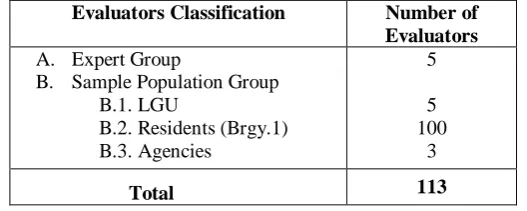
The respondents of the study are the residence of the Municipality of Hinigaran, the cooperating agencies such as the Philippine National Police, Bureau of Fire Protection and Municipal Disaster Risk and Reduction Management Office and the different Local Government Units. These respondents are the direct and in-direct users or the end-users of the Hinigaran Community Emergency Assistance System Application. The sample size of the respondents was determined through Slovin’s for proper distribution shown in Table 1.
Table I. Summary of Evaluators during the Initial Testing and User Acceptance Testing
Evaluators Classification Number of
Evaluators
A. Expert Group
B. Sample Population Group B.1. LGU
B.2. Residents (Brgy.1) B.3. Agencies
5
5 100
3
© 2019, IJCSMC All Rights Reserved 71 C. Research Instrument
Validity of instruments:
A research instrument is a data collection tool designed to gather important data needed by the researcher. Devellis believed that valid instrument is one which measures what it is supposed to measure [13]. The researcher adapted the research instrument through an interview and standardized questionnaire.
Interview was conducted from the cooperating agencies such as Philippine National Police, Bureau of Fire Protection and Municipal Disaster Risk and Reduction Management Office to identify the different important features that will reflect in the application. Further the follow-up interview is also considered and implemented to strengthen the real solution of the project. In line with this, the standardized questionnaire was utilized to provide the necessary information for the completion of this study using McCall’s Software Evaluation Criteria for the IT Experts Evaluation and ISO/IEC 9126-1:2000 Software Quality Model Characteristics for the users.
The McCall’s Software Quality Model was developed to assess the relationships between external factors and product quality criteria. The quality characteristics were classified into three major types, 11 factors which describe the external view of the software, 23 quality criteria which describe the internal view of the software, and metrics which defined and used to provide a scale and method for measurement. The number of the factors was reduced to eleven in order to simplify it that includes Correctness, Reliability, Efficiency, Integrity, Usability, Maintainability, Testability, Flexibility, Portability, Reusability and Interoperability.
The International Organization for Standardization (ISO) proposed a standard, known as ISO 9126 (ISO, 2001), that provides a generic definition of software quality in terms of six main characteristics for software evaluation. These characteristics for software evaluation include: Functionality, Reliability, Usability, Efficiency and Portability. One of th e advantages of this model is to identify the internal and external quality characteristics of a software product. Thus, Likert scale is used where 5 as the highest and 1 as the lowest. To statistically compute for the results of the survey questionnaire, the Mean statistics was used. The formula used in computing the mean is:
where is the mean
x is the summation of individual raw scores n is the number of population
D. Data Gathering Procedures
Berg suggest that, any information the investigator gathers can potentially be used to answer the questions or solve the problems that have been identified [14]. The researcher personally distributed the questionnaires to the respective end users of the Hinigaran Community Emergency Assistance System Application. The researcher discussed and instructed the respondents on the procedures on how to answer the evaluation tools. The respondents were given adequate time to answer all the question s in the evaluation form. The instructions were clearly stated in order for the respondents to completely and thoroughly answer each item. Within the day, the researcher personally retrieved the accomplished questionnaires and have it ready for tabulation and analysis.
E. Data Analysis Procedures
After the collection of data, the researcher evaluated and tabulated the statistical data for the analysis and interpretation. The objectives proposed in the study were tested in the following manner by determining the extent of implementation of the Hinigaran Community Emergency Assistance System Application for each cooperating agency and the efficiency of implementation in terms of criteria-based assessment and efficiency measures, the mean was used.
F. Software Life Cycle Model
© 2019, IJCSMC All Rights Reserved 72 Figure 1. Emergency Application development model
The RAD methodology shown in figure 1 basically focused on gathering the user requirements through a focus groups where in this study includes the Philippine National Police, Bureau of Fire Protection and Municipal Disaster Risk and Reduction Management Office, early testing of the prototypes by the end-user that uses iterative concept, the reuse of the existing prototypes, continuous integration and rapid delivery if the system is already 100% complete.
G. Software Development Phases
The Software Development Phases for Rapid Application Development (RAD) includes Requirements Planning, User Design, Construction, Testing and Cutover.
1.) Analysis and Quick Design:
The first phase which is where the researcher gathered all the needed and important requirements from the respondents or target user that includes the Hinigaran Philippine National Police, Bureau of Fire Protection and Municipal Disaster Risk and Reduction Management Office staff. Interview has taken place and distribution of questionnaires that were used as inputs to the Hinigaran Community Emergency Assistance System Application.
Upon gathering all the requirements that will be use in this study, a Quick Design for the system has been done in order to create a visualization of the interface design and the output of the entire system application.
2.) Context Flow Diagram:
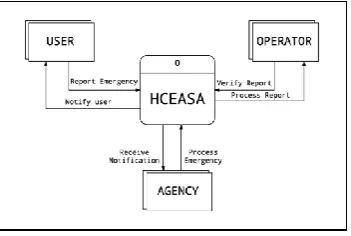
A context diagram shown in figure 2 is an overall view of the target system and contains only one process and the primary inputs and outputs[16]. At this level, there is only one visible process node that represents the functions of a complete system in regards to how it interacts with external entities. The context flow diagram in this study identified and explained the process of the Hinigaran Community Emergency Assistance System Application in order to fully understand the concept of the system application.
Figure 2. System process using the application
3.) Data Flow Diagram:
The Data Flow Diagram illustrates in figure 3 the overall explanation and process of the Hinigaran Community Emergency Assistance System Application in order for the user to know its functionality and sequence.
The User will register on the mobile application for the purpose of user profiling and for the designated operator to know that the one who needed help is valid.
© 2019, IJCSMC All Rights Reserved 73 Figure 3. The function of the system within the application and server
4.) Operational Framework
The Operational Framework shown in figure 5 for Hinigaran Community Emergency Assistance Application illustrates the overall process of the application. The user will use the application and will choose among the different features intended for use. The application should be connected to the internet in order to send the data through a channel which is a database server.
Figure 4. Network architecture of the operation for Hinigaran Community Emergency Assistance Application
The server will be managed by an operator, if the operator received an emergency message, he/she will call the user and asked his/her needs. If the operator validates the help information, then it will immediately notify the agencies corresponding to the user’s needs to respond quickly.
5.) User Design Interface
The User Interface Design shows the design of the Hinigaran Community Emergency Assistance System Application. It will be improved based on the user needs and requirements. The following are the samples of the interface of the system application.
Figure 5. Home Page Screen
© 2019, IJCSMC All Rights Reserved 74 Figure 6. Disaster Information Interface
Figure 6 shows the Disaster Information Interface. The user will select on the category and each category will provide important information, guidelines and tips of what they will do in case there is fire, earthquake, flood, tsunami, typhoon and volcano eruption.
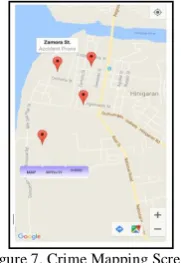
Figure 7. Crime Mapping Screen
Figure 7 shows the location on the map where there is dangerous area in Hinigaran. This will help the user to avoid those specific areas in Hinigaran.
Figure 8. Safe Area Screen
Figure 8 shows the different location of the safe area in Hinigaran. This will help the user to identify the location for safety and security.
© 2019, IJCSMC All Rights Reserved 75
Figure 9 shows the help message confirmation when the user will press the Help Button. This will inform the user that his/her help message is successfully sent to the server and that is when the operator will call the victim.
Figure 10. Hinigaran Community Emergency Assistance System Web Server
Figure 10 displays the emergencies web server. This is where the help message from the mobile application will be received by the operator. It indicates the sender number that will be use by the operator to call the victim. It has a View in Map button where the operator can find the exact location of the victim.
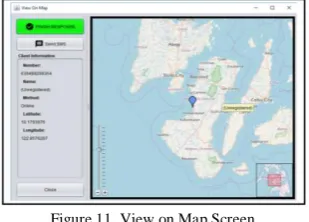
Figure 11. View on Map Screen
Figure 11 displays the map where the victim is located. The operator can immediately verify the exact location of the sender. If the victim has been responded already the operator will click the finish response button. On the Send SMS button, the operator can send a message to the victim while the specific agency for response is on their way.
Figure 12. Emergency History Screen
Figure 12 displays the lists of the responded victim of the cooperating agency. It also includes the dates when it has been responded for information.
Figure 13. Clients Screen
© 2019, IJCSMC All Rights Reserved 76 Figure 14. Broadcast SMS Screen
Figure 14 shows the broadcast SMS. The operator of the server can send information regarding disasters and other emergency messages on the people who are listed on the system.
6.) Prototype Cycles (Build, Demonstrate, Refine)
After the Quick Design has been accomplished and approved for the output, the researcher builds the system application using Basic for Android (B4A) in accordance to the user needs. In constructing the system, the developer undergone a series of iteration from structuring the interface design, demonstrate the system to the user and refine the system if the user is unsatisfied with the output of the system application. In line with this, the developer has the opportunity to complete and make sure that the system is 100% in functionality.
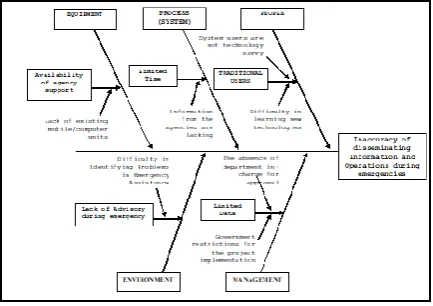
In the contrary, the Ishikawa Diagram was used to illustrate the cause and effect of the development of this study. The Ishikawa Diagram was developed by Kaoru Ishikawa during the 1960s and sometimes referred to as "fish bone" diagrams because they resemble a fish skeleton, with the "ribs" representing the causes of an event and the final outcome appearing at the head of the skeleton. Figure 20 is the Ishikawa Diagram that states the problem of inaccuracy of information and operations during Emergency. It shows the different major cause and sub-causes during the development of the Hinigaran Community Emergency Assistance System Application.
Figure 15. Different causes during development 7.) Testing
Software testing is a process which is used to measure the quality of software developed. It is also a process of uncovering errors in a program and makes it a feasible task. It is useful process of executing program with the intent of finding bugs [17]. The researcher uploaded the system application on GooglePlay.com in order for other user to test the capability of the Hinigaran Community Emergency Assistance System Application. During the testing process, the researcher distributed evaluation forms for feedback purposes to the evaluators. The standard questionnaires were used such as the McCall’s Software Evaluation Criteria for Software Quality Model and the ISO/IEC 25010 software characteristics. The McCall’s questionnaires were intended for the expert group while the ISO/IEC questionnaires were distributed to the sample population.
The Hinigaran Community Emergency Assistance System Application was tested by the user or the respondents of the system and the experts. The overall output of the system is 100% running and out of errors in order to achieve consistency and it means that the developer meet the requirements and standards of the user.
8.) Implementation
© 2019, IJCSMC All Rights Reserved 77
For the development of the app-based module, the researcher uses Basic for Android (B4A) includes a visual designer that simplifies the process of building user interfaces that target phones and tablets with different screen sizes.
III. RESULTS AND DISCUSSION
On the development of Hinigaran Community Emergency Assistance System Application using mobile technologies that is reliable and easy to learn for the cooperating agencies of Hinigaran.
Table III. Evaluators’ feedbacks on the development of the proposed system application in terms of reliability and functionality.
Objective Mean Verbal Interpretation
Develop an application system using mobile technologies in terms of:
a. Reliability 4.54 Excellent
b. Functionality 4.62 Excellent
The results shown in Table 3 indicated that the proposed Hinigaran Community Emergency Assistance System Application, in terms of reliability has a numerical value of 4.54 and the proposed system got a mean value of 4.62 respectively which are interpreted as “Excellent”.
The level of usability of the proposed Hinigaran Community Emergency Assistance System Application (Table 4) as perceived by Hinigaran cooperating agencies.
Table IV. Evaluation on the Level of usability of the proposed system application as Perceived by cooperating agencies.
Objective Mean Verbal Interpretations
Determine the level of usability of the proposed Hinigaran Community Emergency Assistance System Application as perceived by the cooperating
agencies
4.58 Excellent
The results showed that the level of usability and acceptability of the proposed Hinigaran Community Emergency Assistance System Application has a mean value of 4.58 which is interpreted as Excellent.
This finding connotes that the proposed Hinigaran Community Emergency Assistance System Application when implemented possesses a high level of usability because the users can be able to use it easily due to its simple but well performing components. It also has a high level of learnability because the interface designs are simple using since the proposed system’s interfaces are presented using graphical user interfaces (GUI).
The following table presents the performance of the proposed Hinigaran Community Emergency Assistance System Application in terms of performance efficiency.
Table V. Evaluation of the performance in terms of its performance efficiency.
Objective Mean Verbal Interpretation
Evaluate the proposed Hinigaran Community Emergency Assistance System Application in terms of Performance efficiency
4.48 Excellent
© 2019, IJCSMC All Rights Reserved 78
The results shown in Table 5 reflected that as far as performance of the proposed system in terms of its performance efficiency, it yielded a mean of 4.48 which is interpreted as “Excellent”.
The following table presents the performance of the proposed Hinigaran Community Emergency Assistance System Application in terms of maintainability and portability.
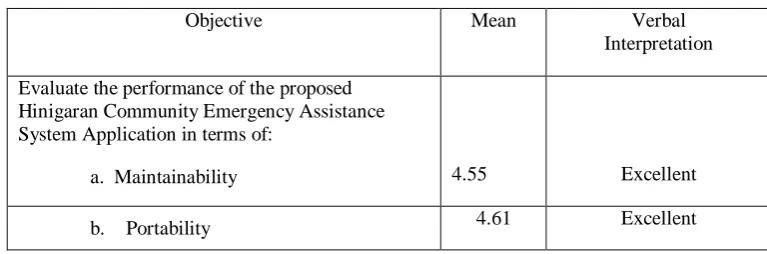
Table VI. Evaluation of the performance of the proposed Hinigaran Community Emergency Assistance System Application in terms of maintainability and portability.
Objective Mean Verbal
Interpretation
Evaluate the performance of the proposed Hinigaran Community Emergency Assistance System Application in terms of:
a. Maintainability 4.55 Excellent
b. Portability 4.61 Excellent
The results shown in Table 6 reflected that as far as performance of the proposed system in terms of maintainability, it yielded a mean of 4.55 and in terms of portability with a mean of 4.61 which are interpreted as “Excellent”.
The findings suggest that upon evaluation of the performance of the proposed Hinigaran Community Emergency Assistance System Application, the respondents believed that it is effective and efficient to use and can be installed or uninstalled successfully.
On the evaluation of the expert with regards to the proposed system based on McCall’s Software Quality Model.
The table shows that the system application was rated Excellent. The Audibility, Accuracy, Conciseness, Observability, Self-Documentation, Software System Independence, Controllability, Decomposability, Execution Efficiency, and Hardware Independence was rated Excellent. For the reason that the consistency of the design and documentation techniques is achieved, the ease of its conformance to standards, the modules can be tested independently and the system application executed efficiently.
The Consistency, Security, Simplicity, Traceability, Expandability and Modularity was rated Excellent. It is because of the consistency of the system functionalities, the security of the data is confidential and saved in the system’s server, the design is understood without difficulty, the actual system application can be tracing the design representation, the design is basically can be extended and the functional independence of the system components.
The Completeness, Communication Commonality, Operability, and Training was rated Excellent. It is because the full functionality has been achieved, the standards interfaces and protocols are understood and the software assists in enabling n ew users to apply the system.
The Error Tolerance was rated Excellent. It is because of the less damage that occurs when a program system encounters an error.
Generally, the IT experts concluded that the system application was feasible to use by the residence and cooperating agencies of the Municipality of Hinigaran. Table 7 presents the evaluation of the five experts of the proposed Hinigaran Community Emergency Assistance System Application
Table VII. Overall Experts Evaluation of The Proposed Hinigaran Community Emergency Assistance System Application.
Objective Mean Verbal
Interpretation Evaluation of the Experts
using the McCall’s Software Quality Model.
4.800 Excellent
© 2019, IJCSMC All Rights Reserved 79
IV. CONCLUSIONS
The importance of emergency creates security and significance to every people in the community. It is therefore concluded that Hinigaran Community Emergency Assistance System Application will have a disseminating information in terms of disaster and environmental concerns for the user in order for them to have knowledge and ideas during disasters. Direct hotline on the cooperating agencies wherein the system provides a help button where the user will click in case of emergency and whenever it was clicked it will automatically alert the operator in the server to coordinate with the cooperating agencies for them to respond to the victim quickly.
Dissemination of early warning signals to the people will send a broadcast SMS to the registered user of the system to notify them during disasters. It also locates the person in need using Global Positioning System (GPS) wherein the feature of the system application will be able to immediately locate the person who needs help during emergency, it will be easier for the cooperating agencies to respond or rescue the victim thru mapping the location.
ACKNOWLEDGEMENT
I would like to thank our Lord, the Almighty for the blessings, wisdom and knowledge for the completion of this research paper. To my colleagues in the Information Technology Department of CHMSC-Binalbagan for helping me throughout the construction of this research paper. Most of all, to my family, Jorge, Michael Anthony & Louise Andrea for the support, love and inspiration in the completion of this paper.
REFERENCES
[1] Wu, F., Yeniyurt, S., Kim, D., & Cavusgil, S. T. (2006). The impact of information technology on supply chain capabilities and firm performance: A resource-based view. Industrial Marketing Management, 35(4), 493-504.
[2] Mansell, R., & Wehn, U. (1998). Knowledge societies: Information technology for sustainable development. United Nations Publications.
[3] Townsend, A. M., DeMarie, S. M., & Hendrickson, A. R. (1998). Virtual teams: Technology and the workplace of the future. The Academy of Management Executive, 12(3), 17-29.
[4] Akca, H., Sayili, M., & Esengun, K. (2007). Challenge of rural people to reduce digital divide in the globalized world:
Theory and practice. Government Information Quarterly, 24(2), 404-413.
[5] Harris, D. B. (1996). Creating a knowledge centric information technology environment.
[6] Jasperson, J. S., Carter, P. E., & Zmud, R. W. (2005). A comprehensive conceptualization of post-adoptive behaviors associated with information technology enabled work systems. MIS quarterly, 29(3), 525-557.
[7] Mun, Y. Y., Jackson, J. D., Park, J. S., & Probst, J. C. (2006). Understanding information technology acceptance by
individual professionals: Toward an integrative view. Information & Management, 43(3), 350-363.
[8] Katz, J. E., & Aakhus, M. (Eds.). (2002). Perpetual contact: Mobile communication, private talk, public performance. Cambridge University Press.
[9] Kingston, K., The Importance Of Cell Phones In Modern Society,
http://www.streetdirectory.com/travel_guide/153893/cell_phones/the_importance_of_cell_phones_in_modern_society.ht ml September 16, 2017.
[10] What Is Descriptive Research?, http://members.aect.org/edtech/ed1/41/41-01.html, August 11, 2017
[11] Koh, E. T., & Owen, W. L. (2000). Descriptive Research and Qualitative Research. In Introduction to Nutrition and Health Research (pp. 219-248). Springer, Boston, MA.
[12] Richey, R. C., & Klein, J. D. (2014). Design and development research. In Handbook of research on educational communications and technology (pp. 141-150). Springer, New York, NY.
[13] DeVellis, R. F. (2003). Scale development: Theory and applications. Applied social research methods series. Bickman, L
and DJ Rog.
[14] Berg, B. L. (2004). Methods for the social sciences. Qualitative Research Methods for the Social Sciences. Boston: Pearson Education.
[15] Coleman, G., & Verbruggen, R. (1998). A quality software process for rapid application development. Software Quality Journal, 7(2), 107-122.
[16] Coleman, G., & Verbruggen, R. (1998). A quality software process for rapid application development. Software Quality Journal, 7(2), 107-122.
[17] Khan, M. E. (2010). Different forms of software testing techniques for finding errors. International Journal of Computer
Science Issues, 7(3), 11-16.