Available Online atwww.ijcsmc.com
International Journal of Computer Science and Mobile Computing
A Monthly Journal of Computer Science and Information Technology
ISSN 2320–088X
IMPACT FACTOR: 6.017IJCSMC, Vol. 8, Issue. 3, March 2019, pg.261 – 268
An Analysis of Accessibility in Learning
Management System in the Context of
Higher Education Institution
LAYTH AL-SAMARAI1; Prof. Dr. Osman Nuri UÇAN2; Assoc. Prof. Oğuz BAYAT3
¹ ² ³ School of Engineering and Natural Sciences, Altinbas University, Istanbul-Turkey
1
[email protected]; [email protected]; [email protected]
Abstract— The main outcomes of the research to define new stander as guidelines for disability usage for LMS in higher and further education institutions, this results enable website designer and programmer to support system disability by enhance the system and analysis it for student to develop improved system that enable disability student to use eLearning CMS, Our main objective to design methodology or stander to indicate if accessible LMC is support disability users to facilitates full interaction by all users in this research first, we will explore main disability function that include in current online eLearning LMS in higher for two main famous eLearning system as Chamilo and Moodle. It also questions the legal and moral.
Keywords— Moodle, eLearning, Accessibility, Chamilodisability
I. INTRODUCTION
This In last 10 years, the Virtual Learning Environment (VLE) has become very important topics because it’s included many features of electronic service for education, and within developing for information technology most of universities focus on delivery the educational contents as online activities and electronic courses, regardless of disability tested or support.
For the content that publishes on eLearning system have such standers and important issue such as delivery, functionality, sustainability and usability. Most researches can be found for examine the functionality of eLearning systems, with usability of content in eLearning, our research will focus on disabled users to define modules to use as Standards for support accessibility for design related to html tags for text, images and video, universities need to apply accessibility in their eLearning system in Higher Education, e-learning system usability and identifying continuing accessibility needs.
This proposal of this research as continues personal research as I have professional practice in eLearning system and to support disability, in general and in electronic learning as special case, particularly within the area of end-user systems accessibility. Related to [1] show that the statistical results as we have as 15% of the world’s population they have disability, if we assume that the word population are One billion people.
II. MATERIALS AND METHODS
Altinbas eLearning web accessibility Evaluator support 3 modules, as describe in next section. For validation, suggested new system support php and java Validator, and the developer can access it from footer links on the system. For validation and analyses the site the user adds the title of the site and URL, then the system generate report shown the accessibility support or not for the site, next figure show the main page to submit the URL.
III.RESULTS
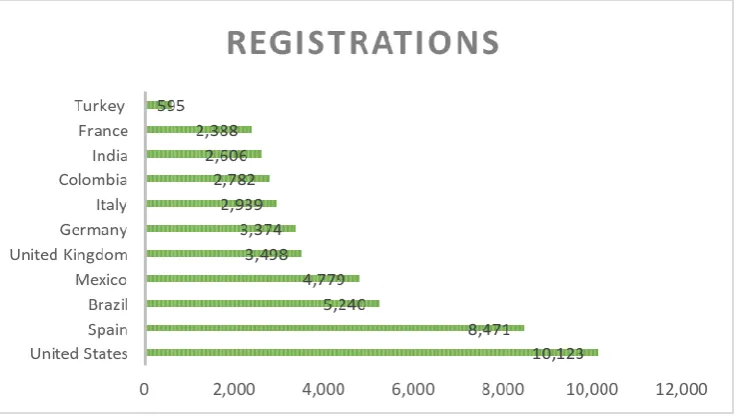
All Moodle used widely around the word and have more than 100k Registered sites in 229 Countries, many university as primary learning system for education and delivery the course, from statistical charts [2] show below that united states have about 10 thousand organization used Moodle system and register to mmodle.org, in Turkey they have approximate 600 site register in moodle.org.
Results of the analysis of the accessibility of the selected Turkey University web pages.
TABLEI
ANALYSIS OF THE ACCESSIBILITY FOR WEBSITE
Type Moodle Chamilo
Error warning Error warning
Main site 20 70 9 2
login 6 6 13 7
Course category 12 26 9 82
Above table show results for moodle.kemerburgaz.edu.tr/moodle/ and campus.chamilo.org. results show that Moodle have errors and warning, next will describe main accessibility errors found.
IV.DISCUSSION
This section will introduce main obstacle and opportunities faced by disability students when using LMS, determine the main issues in LMS based on usability, after developing the system do we need training for disability users, for web developments standers related to disability users access include set of usability issues be practically resolved to implications of industry-standard developments.
In e-learning, Drachsler [2] referenced the fundamental explanations behind eLearning to rating data is incredibly meager are an absence of inspiration for students to rate, an absence of scoring instruments, and the booked yet restricted learning time of students, E-learning recommender frameworks expect to prescribe a succession of things to students, that is, to propose the most proficient or compelling ways through a plenty of learning assets to accomplish a specific capability. Martins et al. [3] referenced that the client model ought to be helpful for making the instructive procedure progressively versatile and fit for getting ready students for future callings, understudy can be concentrating completely on the web as well as a mix adapting part on learning on the web other face to face learning, as blended of on the web and face the board frameworks, for example, Chamilo or Moodle.
In [4] shows that the virtual learning systems in this article, have been adopted and are becoming increasingly popular among academics. A virtual learning system (VLS) has a suite of tools with associated functions and non-functional system characteristics, demonstrates that the constructs of perceived importance, generally linked to technology usage can be used to measure educators’ beliefs on software quality characteristics. The perceived usefulness and perceived importance constructs are related to implied user needs and user satisfaction.
Usage of e-learning and data correspondence innovations in training framework could display an open door for educators to overhaul and to improve the addresses and students' exhibitions. ICT improvement is quick and there is requirement for fuse of ICT in instructing and learning process. Utilizing ICT in class can improve information in the field of elucidation, in the learning procedure, yet in addition for future expert action [5].
V. RESEARCH PROBLEM TO SOLVE
In other words, it may be expected that the LMS market will be worth about $ 4 billion in 2015 and more than $ 7 billion in 2018. North America is expected to generate the highest proportion of revenue contribution.
We focus on evaluating two of the most successful open source learning management systems, Chamilo and Moodle, from different approaches, benefits and problems associated with each system to analyze how disability is activated differently online and its impact on internet learning and teaching and accessibility for the main system feature.
The majority of university education is now under way throughout school and little attention has been paid to the benefits of learning analytics to institutional, educational and content - creative students with disabilities who are unavailable. [10].
In [11] Constructs an independent pronunciation recognition and evaluation system based on the Chinese Mandarin learning framework. Improved in the acoustic model aspect and the parametric scoring evaluation is performed and discussed from the point of view of the correlation between the machine score and the expert score
A. MODEL OF disability main categories:
First, it’s important to know your disability main categories (sensory, physical and cognitive) to understand your user’s needs, to solve disability for LMS we use three mode to analysis our LMS for
writing, colours and design for the content and system
, as shown in Fig. 1.
Fig. 1 LMS analysis three Modules
B. Writing Content Modules
periods in abbreviations for some text need to write in details format to help screen reader to recognize the abbreviation without periods such as read E-D-U will be read as "Edu"), for other format in text need to
describe
the links When embedding rather than just add it to the user to "hyper link text" For example, it's better to write out, "This link show video about 5 min about how core i9 architecture " and it’s not recommend to write " more details click hear".using
HTML Tags
on content used to title page hierarchical structure such as,
heading
tags <h1>, <h2>, <h3>...
after describing the main title of page need to describe each paragraph text as a
section
using
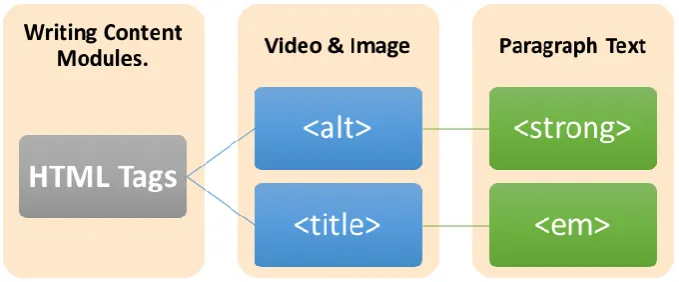
html tag <strong> and <em>.
Fig. 2 Writing Content Modules main attribute
The implementation of our module main role according to WebAIM's WCAG 2 [13] Checklist
as following:
Images and Video Modules Success Criteria:
1. All images tag <img > should include Alt text.
2. Related to images the <img > tag used, if image not include text, therefore we recommend to set null for alt property as text (alt="") and backgrounds add in CSS.
3. Form buttons have a descriptive value while form inputs have associated text labels. 4. User should note that Embedded multimedia is identified via accessible text.
5. For each media object should include recommends transcripts for all multimedia content. 6. Semantic mark-up using text (<strong>).
Writing Content Modules Success Criteria:
7. Text or images of text should have a contrast ratio of at least 4.5:1. 8. Large text size recommends typically 24px or 18.66px.
9. Text and images a contrast ratio of at least 7:1.
Paragraph Text Modules Success Criteria:
10. Text under 80 characters wide and NOT completely legitimized with the satisfactory line separating min 1/2 the tallness of the content. For section separating (1.5 occasions line dispersing).
11.
12. paragraph separating to multiple times the text dimension. 13.
14. word separating to multiple times the text dimension, and letter dispersing to multiple times the text dimension.
C. Control Colours Modules
Fig. 3 Control Colours Modules Main attribute
Colour Modules Success Criteria:
Colours isn't utilized as the sole technique for passing on substance or recognizing visual components. Colours alone isn't utilized to recognize joins from encompassing content except if the different
proportion between the connection and the encompassing content is in any event 3:1 and an extra refinement (e.g., it moves toward becoming underlined) is given when the connection is drifted over and gets the center.
D. Design Modules
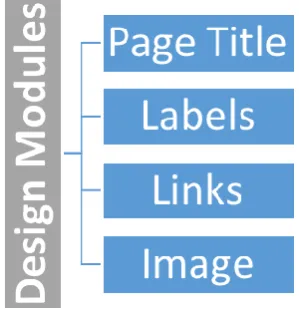
This module analysis 4 type of property, for mobility users with problems, and its essential issue for accesability users as we have small items and user will click on some of them to know what’s the related
information about images or video? for that it should to use simple and small paragraphs.
placing content in dyslexia-accommodating text styles, giving guidance as to successful examination and work propensities, and making a steady and open workplace in online gatherings, discussions and web sheets, to add image in content we should use as a large icon to allow user to click easily, for links Users should be able to navigate using buttons and keyboard, for labels with inputs should support visual presentation. For each page Labels describe attribute should add and unique.
A page title used by screen reader in initial point. unique and describe main idea about page, linked page should be navigable using a keyboard.
E. Accessibility with LMS.
To analysis Accessibility for LMS for large set of activity, resources and web interfaces to allow disability user to accessible to an individual eLearning content to meet legal accessibility requirements needs immediately within the learning context. By develop our module will decreases exclusion and increases usability.
For content creator or teacher its complex job to worry about all issue and criterial to publish the content for disability users, it’s not simple we have six criteria should apply as describe in next diagram, for that we will add in our research some of these criteria hidden and other add to teacher to follow it, it’s important to identify if LMS use AJAX and JavaScript for Events triggered for this to support accessibility need to support ARIA attributes can assist users of such browsers to follow a dynamic change.
Fig. 5 Accessibility Specifications [9]
In e-learning, most content-based (CB) recommender systems [11] provide recommendations depending on matching rules between learners and learning objects (LOs), E-learning systems are one of the most widely used learning in virtual spaces. Some methods of e-learning have been implemented but the most positive feedback from e-learning systems is the main topic. Introduce a new e-learning system methodology called' Network Learning' and review other e-learning systems aspects. Also, [12] Presents benefits and benefits in educational and fast learning programme, using these systems. Network Learning can be programmable and flexible with too good results for any system of education.
F.
Compare Chamilo with Moodle related TO Activity
Fig. 6 Moodle Stat.
Number of commits who made changes to the Moodle and Chamilo source code each month as shown next, this show that Moodle have more updated and add new feature for the system as the community needs.
Fig. 7 - commits made changes over last 3 years
VI.CONCLUSIONS
The LMS analysis accessibility module include three main module and sub modules, the main task for this module to generate accessibility report based on URL. The Moodle platform allow developer to support accessibility by customized using themes and thousands of settings.
R
EFERENCES
[1] W. Bank, “WORLD REPORT ON DISABILITY,” https://www.worldbank.org/en/topic/disability.
[2] H. Drachsler, K. Verbert, O. C. Santos and N. Manouselis, “Panorama of Recommender Systems to Support Learning,”
Recommender Systems Handbook., pp. 421-451, 2015.
[3] L. F. C. D. C. E. C. C. Martins, “User modeling in adaptive hypermedia educational systems,” Educ. Technol. , p. 194–207, 2008.
[4] I. Padayachee, “Educator Perceptions of Virtual Learning System Quality Characteristics,” South African Computer Journal,
[5] N. T. E.V. Tikhonova, “Information and communication technologies in the teaching of interpreting,” Procedia-Soc, p. 534– 538, 2014.
[6] W. (n.d.), EduTools course management system features and criteria., 2017.
[7] V. N. e. al., “Survey of quality models of e-learning systems,” Physica A: Statistical Mechanics and its Applications, , vol. vol. 511, p. pp. 324–330, 2018.
[8] Moodle, Oct 2018. [Online]. Available: https://moodle.net/local/hub/top/sites/.
[9] W. H. Organization, “International Classification of Functioning,” Disability and Health. WHO, Geneva, 2001. [Online]. [10] “IMS Global Learning Consortium,” 2018. [Online]. Available: http://www.imsglobal.org/.
[11] S. W. a. Z. Niu, “An e-learning recommendation approach based on the self-organization of learning resource,” Knowledge-Based Systems, vol. vol. 160, p. pp. 71–87, 2018.
[12] A. D. M. a. J. Abdollahi, “New designing of E-Learning systems with using network learning,” Education. 2010.
[13] M. Cooper, R. Ferguson and A. Wolff, “What Can Analytics Contribute to Accessibility in e-Learning Systems and to Disabled Students’ Learning?,” ACM, pp. 99-103 , 2016.

![Fig. 5 Accessibility Specifications [9]](https://thumb-us.123doks.com/thumbv2/123dok_us/1895155.1247844/6.595.126.468.211.429/fig-accessibility-specifications.webp)