On Security of RASP Data Perturbation for Secure
Half-Space Queries in the Cloud
ABSTRACT
Secure data intensive computing in the cloud is challenging, in-volving a complicated tradeoff among security, performance, extra costs, and cloud economics. Although fully homomorphic encryp-tion is considered as the ultimate soluencryp-tion, it is still too expensive to be practical at the current stage. In contrast, methods that preserve special types of data utility, even with weaker security, might be acceptable in practice. The recently proposed RASP perturbation method falls into this category. It can provide practical solutions for specific problems such as secure range queries, statistical anal-ysis, and machine learning. The RASP perturbation embeds the multidimensional data into a secret higher dimensional space, en-hanced with random noise addition to protect the confidentiality of data. It also provides a query perturbation method to transform half-space queries to a quadratic form and, meanwhile, preserving the results of half-space queries. The utility preserving property and wide application domains are appealing. However, since the security of this method is not thoroughly analyzed, the risk of using this method is unknown. The purpose of this paper is to investigate the security of the RASP perturbation method based on a specific threat model. The threat model defines three levels of adversarial power and the concerned attacks. We show that although the RASP perturbed data and queries are secure on the lowest level of adver-sarial power, they do not satisfy the strong indistinguishability def-inition on higher levels of adversarial power. As we have noticed, the indistinguishability definition might not be too strong to be use-ful in the context of data intensive cloud computation. In addition, the noise component in the perturbation renders it impossible to exactly recover the plain data; thus, all attacks are essentially es-timation attacks. We propose a weaker security definition based on information theoretic measures to describe the effectiveness of estimation attacks, and then study the security under this weaker definition. This security analysis helps clearly identify the security weaknesses of the RASP perturbation and quantify the expected security under different levels of adversarial power.
1.
INTRODUCTION
Data-driven (big data) approaches represent an emerging trend of
Permission to make digital or hard copies of all or part of this work for personal or classroom use is granted without fee provided that copies are not made or distributed for profit or commercial advantage and that copies bear this notice and the full citation on the first page. To copy otherwise, to republish, to post on servers or to redistribute to lists, requires prior specific permission and/or a fee.
Copyright 200X ACM X-XXXXX-XX-X/XX/XX ...$10.00.
scientific research and industrial development. With the rapid de-velopment of cloud infrastructures, conducting data intensive com-puting in the cloud has become the top choice for economical and scalable processing [4, 2]. Such computing tasks may include but not limited to querying, mining, and visualizing data. They share a commonality that users need to manipulate the data on top of the cloud infrastructures, not simply storing data in the cloud. How-ever, once the data collections are exported to the cloud, the data owner loses the control over the data. As big data collections are becoming important properties, and cloud providers are normally considered as an untrusted party, data owners have reasonable con-cerns over data ownership, security, and privacy [22]. Unless we can find a way to conduct computation on “protected” data in the cloud, most data owners will not be likely to use public clouds to process their sensitive data.
Secure computation in the cloud has to put equal weights on both security and utility of the protected data. Traditional encryption approaches cannot be simply applied because they do not protect data utility (except for the simple case of storing data in the cloud). When considering the utility of a solution, we cannot ignore the cost of the scheme as well. Fully homomorphic encryption (FHE) [18] aims to implement the lowest level operations: addition and multiplication on the encrypted data without decrypting the data. Theoretically, any function can be built on addition and multiplica-tion by using a FHE scheme. However, as most researchers noticed, at the current stage it is too expensive to be practical, even for a sim-ple application like keyword search over encrypted database [34]. On the other hand, many approaches developed in the database community focus on performance, only providing very weak se-curity. For example, Crypto-index [23, 25] and order-preserving encryption (OPE) [3, 5] depend on strong assumptions that attack-ers do not have sufficient prior knowledge about the data, which excludes many realistic attacks from investigation.
Instead of preserving the utility of low level operations on sin-gle dimensions, Chen et al. proposed the RASP perturbation ap-proach [9] to preserve half-space queries [8] for multidimensional data. A half-space query works on multidimensional data space and retrieves data vectors satisfying the query condition. It uses a hyperplane to partition the whole space, and returns the result (normally statistics, like the count of vectors) about one of the half spaces. The RASP perturbation approach also allows the original half-space queries to be securely transformed and processed on the perturbed dataset to get the exact query results as they do on the original dataset. Half-space queries have many applications in data intensive analysis. For example,
query conditions. A range query is an intersection of a num-ber of half-space queries, describing “areas” in the multidi-mensional space. Thus, preserving half-space queries also preserves range queries.
• Machine Learning. Linear classifier is one of the most pop-ularly used classification models. A linear classifier is rep-resented as a half-space query. Given a record, the classifier checks whether the record is in the half-space query result set or not [24]. Linear classifiers can serve as the base classifiers in the bagging or boosting approach [15] to construct more sophisticated classification models.
Thus, we believe that the RASP perturbation has great potentials for many data analytics tasks in the cloud. However, the security of the RASP perturbation method has not been carefully studied yet.
Scope of the Paper.In this paper, we aim to systematically ana-lyze the security of RASP perturbation based on a precisely defined threat model. The threat model describes the protected assets in the context of secure computation in the cloud, the concerned attacks (passive data disclosure attacks only), and the prior knowledge that attackers may have. The perturbed data and queries are studied un-der two types of security definitions: the strong indistinguishability definition [27], and the statistical-estimation based weakened def-inition, corresponding to the traditional distinguishing attacks and the more realistic estimation attacks in the context of cloud com-puting, respectively. Based on the threat model, we start our studies from the stronger security definition and then extend to the weaker definition. To evaluate the security to the estimation attacks, we also design a new measure the loss of confidentiality (LOC) -based on statistical learning theory and information theory. Con-cretely, there are several unique contributions.
1. We define a precise and comprehensive threat model for ap-plying the RASP perturbation approach in the cloud, which suggests studies on two types of attacks: distinguishing at-tacks and estimation atat-tacks, based on three levels of adver-sarial power that attackers may obtain in the context of cloud computing.
2. We prove that the RASP perturbation is not indistinguishably secure under the Level 2 and 3 adversarial power.
3. We develop a weakened security definition for estimation at-tacks, and design the LOC measure for evaluating the secu-rity of RASP perturbation on estimation attacks.
4. We show how the LOC measure is applied to evaluate esti-mation attacks under the Level 3 adversarial power.
5. We also study the query privacy based on the same threat model. The result shows that perturbed queries are also not indistinguishably secure under the Level 2 and 3 adversarial power. We show that the information exposed by queries does not damage the security of the perturbed data.
The rest of the paper is organized as follows. Section 2 describes the framework and the thread model that the RASP perturbation works with. Section 3 precisely defines the RASP perturbation. Section 4 focuses on the security of the RASP perturbed data, and Section 5 focuses on the perturbed queries. Section 6 presents some relevant approaches for secure computation in the cloud.
2.
FRAMEWORK AND THREAT
MODEL-ING
,;Ƌ͕͛͛Ϳ ͛
Data owner
͛с&;Ϳ
Data D D’
Authorized Users
Ƌ͛сY;ƋͿ
Query q q’
Zс';Z͛Ϳ Result
R’ Result R
Trusted Honest but curious
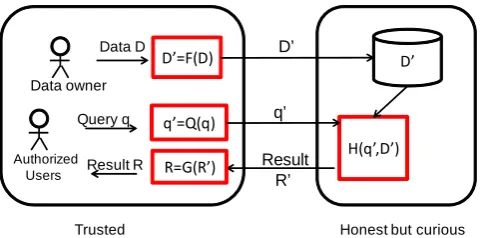
Figure 1: Illustration of the framework for perturbation-based secure computation in the cloud.
This section gives the framework that the RASP perturbation works with, which is actually general to all secure computation approaches in the cloud. Based on this framework, we precisely define a threat model for security analysis.
2.1
Framework
Figure 1 shows the typical scenario of hosting a secure interac-tive statistical analysis service in the cloud. The data owner exports the perturbed data to the cloud and then queries the protected data to learn statistics. Meanwhile, the authorized users can also submit queries to learn statistics. The database in the cloud serves as a statistical database [12], but it is only accessible to the authorized users. Thus, it is different from the privacy problems in traditional statistical databases, where the service provider is trusted and the users can be any person including malicious ones.
There are a number of basic procedures in this framework: (1)
F(D)is the RASP perturbation that transforms the original data
Dto the perturbed dataD′; (2)Q(q)transforms the original query
qto the protected formq′ that can be processed on the perturbed data; (3)H(q′, D′)is the query processing algorithm that returns the resultR′, typically the number of records. When other statistics such as SUM or AVG of a specific dimension are needed, RASP can work with partial homomorphic encryption such as Paillier en-cryption [32] to compute these statistics on the encrypted data [17], which are then recovered with the procedureG(R′). For simplic-ity, we assume the queries return the simplest statistics: the number of records. Statistical analysis heavily depends on the this informa-tion to estimate the distribuinforma-tions. In addiinforma-tion, classificainforma-tion model-ing can be achieved with only the count statistics [28], if the class label is presented unperturbed.
2.2
Threat Modeling
The application scenario is described as in Figure 1. The data owner stores and processes perturbed data in the cloud. The cloud environment is untrusted and out of the data owner’s control. The aim of our design is to prevent attackers from precisely recovering or estimating the original data. We consider several aspects of the threat model [31] in our research.
Assets. The protected assets are the data stored and processed in the cloud. We assume these data are multidimensional vector databases. The privacy of query is also concerned.
useful in our context. We identify that the main attacks are based on statistical estimation. Data tampering or dishonest cloud service providers is not addressed by our study, which can be covered by integrity preserving techniques [38, 35, 30].
Attacker modeling.Active attackers will try to obtain as much knowledge as possible to help recover the original data. To better analyze the security of the RASP perturbation, we define the ad-versarial power according to the levels of prior knowledge on the data.
• Level 1: the attacker observes only the perturbed data and the perturbed queries, without any other additional knowledge.
• Level 2: apart from the perturbed data, the attacker also knows the domain of the original data, such as the mean-ing of the attributes, the attribute domains, the attribute dis-tributions (e.g., the probability density functions (PDF) or histograms), and the covariance between attributes. In prac-tice, such distributional information is possibly exposed to the public via statistical database interfaces. Similarly, the query distribution might be leaked via side channels.
• Level 3: the attacker manages to obtain a small set of plain records and the corresponding perturbed data records, via some side channel. We call them known input-output pairs. This corresponds to the known-plaintext attack in cryptog-raphy. Similarly, they may gain known input-output query pairs.
Adversarial power in Level 3 is quite strong in the setting of secure cloud computing. Since the database is not open to the public, the attacker has to depend on unusual methods such as social engineer-ing. Based on this thread model, we will analyze the security of the perturbed data and protected queries, respectively.
3.
RASP DATA AND QUERY
PERTURBA-TION
Chen et al. has presented the RASP perturbation method [9] for efficient secure range query processing in the cloud. In this section, we will precisely define the RASP perturbation algorithm with a more general setting. The query perturbation algorithm is also described to show how the query utility is preserved. We also describe some applications of the RASP perturbation to show its significance.
3.1
Perturbing Data
We assume the dataset exported to the cloud for processing is a set ofd-dimensional column vectors. For the convenience of formal treatment, we assume all the values aren-bit real num-bers. Thei-th data vector is represented as a column vectorxi =
(xi1, . . . , xid)T. We also use Rdto represent thed-dimensional real space and thusxi ∈ Rd. The RASP perturbation method is defined in the following steps.
• Gen: Assume that we have a pseudo-random invertible ma-trix generatorKA. Let’s draw a(d+ 2)×(d+ 2)matrixA randomly, where each element hasnbits.
• PreP:drandomly chosen non-linear strictly monotonic func-tions fj, j = 1. . . d are used to transform each dimen-sion. Letydefined by the dimensional valuesy.j=fj(x.j), wherex.j and y.j represent the dimensional values. This step is to introduce non-linear components and change the distributions to increase the security of the perturbation.
• Ext: A random positive real valuer, r ∈ R+, is selected
from a pseudo-random positive real number generatorKr, which is used to extend the vectory toz = (yT,1, r)T, where the notationyT
represents vector transpose.
• Pert:On the matrixA, and the vectorz, the final perturbed result is
p=Az, (1)
whereAzis the multiplication between the matrixAand the vectorz, which results in a(d+ 2)-dimensional vectorpin the perturbed space.
In the RASP perturbation a set of parameters are fixed for the same dataset, including the functionsfj()in thePrePstep, and the parameter matrixAin thePertstep, while the positive random noise is individually generated for each vector. Note that the RASP perturbation does not have a decryption component. Because the perturbed data are only used to support statistical analysis, there is no need to recover the perturbed data. In the case that the original records need to be recovered, the vectorpcan be stored together with the encrypted vectore=Enc(x), whereEncis an existing encryption algorithm.
Because of the random noise component inz, for any original vectorx, there are possibly2n−1images (the total choices of the
positive random numbers) in the perturbed space. For the same vector perturbed multiple times, each time we get a different image with high probability. However, any one of the perturbed vectors is uniquely mapped back to one of the original vectors. This guaran-tees the correctness of processing queries in the perturbed space.
In thePrePstep, Chen et al. used an order-preserving encryp-tion (OPE) scheme to transform the data distribuencryp-tions to Gaussian distributions [9]. According to the definition of OPE, OPE is one type of strictly monotonic function. Due to theExtandPertsteps, the RASP approach does not preserves the dimensional value order, and it is thus not a variant of OPE schemes. Therefore, RASP is not subject to the dimensional-order based attacks on OPE schemes [3, 5].
3.2
Perturbing Half-space Queries
The typical half-space queries in the original space are likex.j<
aas conditions presented in typical SQL queries [14], wherex.j represents the dimension j, a is a constant, and the comparison operations can be any of{<, >,≥,≤}. For simplicity, we only
discuss the casex.j < awhile other cases are similar. In order to query the perturbed data, the original query needs to be represented in the perturbed data space, and the transformed query needs to return the same set of records as the original query does.
Let’s look at the RASP transformations step by step and apply them to the query. The first step is to apply the strictly monotonic function to the query, which results iny.j< fj(a)(ory.j> fj(a) iffjis monotonically decreasing), based on the strict monotonic-ity. Letube a(d+ 2)-dimensional vector(. . .1. . .−fj(a),0), wherej-th dimension is 1,(d+ 1)-th dimension is−fj(a)and all other dimensions are 0. Then, the original half-space query is transformed to the query
y.j−fj(a) = (. . . ,1, . . . ,−fj(a),0)(y.1, . . . , y.d,1, r)T
= uTz <0, (2)
wherez is as defined in theExtstep anduTz is dot product of the two vectors. It is then further transformed touTA−1p < 0
the original queryx.j < a, thus we can expect both to return the same set of records.
However, this initial version of query transformation is not re-silient to attacks [9]. The problem is fundamentally rooted on the simplicity of the query function - essentiallyH(p)is a linear func-tion. The following method is used to expand the query function to an equivalent quadratic form by including the random noise di-mension. Note that the(d+ 2)-th dimension ofzis always positive and randomly chosen. Thus, the query functionz.,d+2H(p) <0
is equivalent to the original queryH(p)<0. Similarly,z.,d+2can
be represented in terms of the variablep. Letϕ= (. . . ,1)Twith all dimensions zero except for only thed+ 2dimension set to 1. Thus,z.,d+2H(p)<0can be represented as
pT
i(A−1)TϕuTA−1pi < 0, which is simplified to the canonical quadratic form
pTiQpi<0, (3) whereQis thequery parameter matrix:(A−1)TϕuTA−1. Letα
j be thej-th row ofA−1. Qis in fact(αj−fj(a)αd+1)Tαd+2,
which will be used in discussing the security of perturbed queries.
3.3
Sample Applications
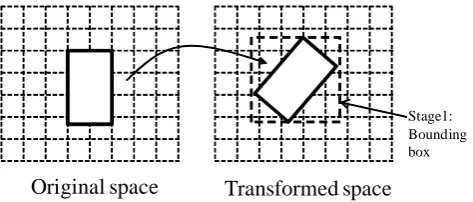
Since the half-space queries are fully preserved, we can apply this technique to securely learn the range query results. A typical range query in the original space is a hyper-cube formed by multi-ple half-space queries. Figure 2 (Left) shows the enclosed area of a typical range query in the two dimensional space. Four half-space queries (the four sides) together define this range query. After the perturbation, the range query is transformed to irregular shapes in the perturbed data space, where traditional multidimensional in-dexing structures such as R-trees can be used to reduce the time of query processing to sub-linear [9].
Original space
Transformed space
Stage1: Bounding box
Figure 2: Illustration of range query processing on RASP-perturbed data.
This perturbed data can also be used for securely learning mod-els from labeled data vectors. Without loss of generality, we work on the two-class case, where the labels are either ‘+’ or ‘-’. And we assume the labels are insensitive and thus not perturbed. The user can thus submit random half-space queries to learn the numbers of ‘+’ and ‘-’ instances in the half-spaces, respectively. By apply-ing techniques such as boostapply-ing [15] a sophisticated classification model can be learned (Figure 3).
4.
SECURITY ANALYSIS ON RASP
PER-TURBED DATA
We analyze the data security in terms of the three levels of ad-versarial power. We will dedicate the next section to the security of perturbed queries.
4.1
Level 1 Security Analysis
_ +
_ +
_ +
_
+ _
_
_ +
+ + + _
__
Xi
Xj
a<Xi
b>Xj __ + + _ +
_
+ _
_
_ + +
++ _
_ _
Pi
Pj
pTQ 1p<0
pTQ 2p<0 RASP
Original space Perturbation space
Figure 3: Illustration of learning classifiers.
The Level 1 assumption actually fits many application scenarios in the cloud computing context, where no additional information about the private data is leaked. We show that the RASP perturba-tion is indistinguishably secure under this assumpperturba-tion.
PROPOSITION 1. RASP perturbed data is indistinguishably se-cure on the Level 1 assumption.
PROOF. The proof is based on the assumption that the random invertible matrix is uniformly sampled from the whole set of(d+ 2)-dimension invertible matricesΩd+2. Let the perturbed vector
drawn from a random variableP, and the vector generated in the
Extstep drawn from another random variableZ. Let’s just look at the difficulty of findingz0 that generates a sample vectorpofP,
while finding the original vectorx0will certainly not be easier.
We try to estimate the probabilityP r(Z = z|P = p), where
zisanyvector in the definition ofZ. For a randomly selectedz, there is an angle betweenzandp, denoted asθ. Thus, there exists a unique “rotation” (orthogonal) matrixRθand a scalars, so that
p=sRθz, i.e., rotatingzfor an angleθtowardspand then scaling up/downzto the same length ofp. SinceRθis invertible, according to the definition of thePert,sRθis a valid setting forA. Thus, the probabilityP r(Z=z|P =p)isP r(A=sRθ|P =p), which is in turnP r(A=sRθ)asAis randomly selected independent ofP. Ann-bit representation can represent at most2ndistinct val-ues. According to the orthogonal group theory [33], the number of
(d+ 2)×(d+ 2)orthogonal matrices in the fieldF2nis around
O(2dn∏d/2
i=1(2
nd−22ni). Based on the assumption of uniformly choosing the invertible matrixAfrom all invertible matrices that include the orthogonal group, we haveP r(Z = z|P = p) =
P r(A=sRθ)<1/O(2dn)). Thus, for any pair of vectors inZ,
(z0, z1), the probability of distinguishing which one is perturbed to
pis
|P r(Z =z0|P=p)−P r(Z=z1|P =p)|<2/O(2dn). (4)
i.e., they cannot be distinguished.
4.2
Level 2 and 3 Indistinguishability
We show that the RASP perturbed datasets do not satisfy the indistinguishability definition, if Level 2 or Level 3 assumption on the adversarial power is held.
4.2.1
ICA Attack with Level 2 Knowledge.
data. Let matrixScomposed by source signals, where row vectors represent source signals, and column vectors represent the values of different signals at certain time stamp. Suppose we can observe the mixed signalsY, which is generated by a linear transformation
Y =AS. The ICA model is designed to reconstruct the indepen-dent components (the row vectors) of the original signalsSfrom the mixed signalsY, if the following conditions are satisfied:
1. The source signals are independent to each other;
2. All source signals must have non-Gaussian distribution with possible exception of one signal;
3. The number of observed signals, i.e. the number of row vec-tors ofY, must be at least as large as the independent source signals;
4. The transformation matrixAmust be of full column rank.
The existing ICA algorithms [26, 24] share the same idea that tries to find a matrixWwhereSˆ=W Y maximizes the non-Gaussianity and independency of the resultant row vectors, which are used to approximate the signals inS. However, the ICA algorithms will re-sult in re-ordering and re-scaling of the signals, for which the user needs to use the signal characteristics such as signal distributions to precisely identify each reconstructed signal.
ICA reconstruction can be certainly used to attack RASP per-turbed data. It has several implications. (1) If the noise dimen-sion ofzis non-Gaussian, the noise can be possibly reconstructed, which endangers the security of the perturbed data. (2) Without the PreP step, independent dimensions of the original data can be effectively reconstructed. With the Level 2 knowledge, the at-tacker can use the distributional information to correctly identify the reconstructed values and align them with the original data do-main. (3) Without carefully designedPreP, which generates non-Gaussian independent dimensions, the independent and non-non-Gaussian dimensions ofzin theExtcan be reconstructed, based on which more methods might be developed to crack thePrePstep.
Thus, the best practice is to make all dimensions ofz, except for the constant(d+ 1)-th dimension, transformed to Gaussian distri-bution. This can be done in thePrePstep for the firstddimensions, and to use pseudo-random positive Gaussian noise generator for the
(d+ 2)-th dimension.
4.2.2
Plane Attack with Level 3 Knowledge.
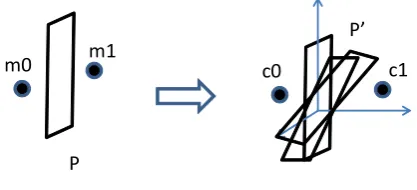
If attackers are able to submit half-space queries and obtain pairs of plain and corresponding perturbed vectors, we show that aPlane Attackcan be used to distinguish the perturbation of any pair of chosen plain vectors.
PROPOSITION 2. RASP is not indistinguishable to chosen plain-text attack, if the attacker can also submit half-space queries.
PROOF. Letc = F(m), wheremis the plain vector andcis the perturbed vector. The distinguisher experiment is described as follows.
1. m0andm1are two vectors randomly sampled from the
orig-inal data spaceRd.
2. The vectormb, whereb ∈ {1,0}is randomly selected, is perturbed tocbwith the RASP perturbation and given to the adversary.
3. In addition, the adversary can request a polynomial number of plain vectors {mi, i > 1, mi ∈ Rd} to be perturbed, wheremi̸=m0andmi̸=m1. With some attacking
algo-rithm, the adversary finally outputs a bitb′.
ŵϬ
ŵϭ
ĐϬ
Đϭ
W
W͛
Figure 4: Plane Attack illustrated
If|P r(b′ =b)−P r(b′ ≠ b)| <1/p(n),p(n)is some polyno-mial function in terms of the bit-lengthn, we say the perturbed data vectors are computationally indistinguishable under chosen plain-text attack (IND-CPA). We show that the following “Plane Attack” allows the adversary to accurately predictb, i.e.,P r(b′=b) = 1. Thus, RASP is not IND-CPA.
Ifm0 ̸=m1, there is always a plane on some dimension, say
x.j=a, separating these two vectors. Let’s assumem0in the
half-spacex.j < a, andm1inx.j > a. Remember that the perturbed half-space queries always preserve the query results. If the attacker is able to submit the perturbed query ofx.j < a, saypTQp <0, then the attacker can always precisely determineb- ifcTbQcb<0 then b = 0, otherwise,b = 1. Such planes can be many, and any one of them can serve as the distinguishing purpose. Figure 4 illustrates this attack.
The above result shows that RASP perturbed datasets cannot de-feat distinguishing attacks. However, distinguishing attacks in the context of RASP-based cloud computing appear not as important as in the secure communication. As described in the threat model, attackers could be more interested in estimating the original plain vectors. Such estimation attacks make us consider a weakened se-curity definition.
4.3
Weakened Security Definition Based on
Learning Theory and Information Theory
As the indistinguishability definition is not satisfied on the Level 2 and 3 adversarial power, we explore a weakened definition based on statistical estimation. This becomes necessary because the pres-ence of the random noise component in the RASP perturbation makes all attacks essentially estimation attacks. Attacks cannot ex-actly discover the exact original vectors; the best they can do is statistical estimation - a unique feature distinguishing from encryp-tion schemes. In this sense, attacks can be modeled as a learning problem: given the background knowledge (e.g., Level 2 and 3) and the perturbed data, what is the theoretical bound of the estimation accuracy?As the accuracy is related to the data domain and distribution, we will need a measure to precisely describe it without being bi-ased towards different domains and distributions. We adopt the idea proposed by Agrawal et al. [1] for the quantification of privacy in privacy-preserving data mining. The derived measure is explained and defined as follows. This measure considers the effect of orig-inal data distributions, assuming the Level 2 and 3 knowledge is available to the attackers. LetX represent a random variable gen-erating a dimension of the dataset, andXˆrepresent the estimated values. The measure considers both the uncertainty ofXand how accuratelyXˆ can be used to modelX. Intuitively, if most of the
call this uncertainty the inherent amount of confidentiality for that data dimension, which can be evaluated by the normalized entropy
2h(X). Calculating this measure for a uniform distribution in the domain [0, a] can help explain the intuition:2h(X)=a
. Thus, the amount ‘1’ of this measure has a specific implication: it is equiva-lent to the amount of uncertainty associated to a uniform distribu-tion in [0, 1]. WithXˆ, theX’s uncertainty might be reduced, which is evaluated by the conditional differential entropyh(X|Xˆ), sim-ilarly normalized to2h(X|Xˆ). Now we can define the normalized
loss of confidentiality (LOC) as
L(X|Xˆ) = (2h(X)−2h(X|Xˆ))/2h(X)= 1−2−I(X; ˆX), (5) whereI(X; ˆX) =h(X)−h(X|Xˆ)is the mutual information be-tween the two random variables. This measure has a lower bound 0, when the attack is no better than random sampling from the known distribution (with the Level 2 knowledge). It has a upper bound
1−2−h(X), determined by the uncertainty of the original domain.
If this errorEis also independent of the the estimationX, which is valid in the case of independent noise injection, then
h(X|Xˆ) = h(E) forX = ˆX +E. Thus, the LOC measure is determined byh(E)for a given data domain. The entropy of error represents the effectiveness of attack - the smallerh(E), the more effective the attack has. However, the learning theory [29] says there is the theoretical lower bound of estimation error for any possible learners for the specific training data. That saysh(E)
cannot be arbitrarily small; it has a lower bound. Therefore, we have the following weakened security definition.
DEFINITION 1. If the estimation error is independent of the the original data, the LOC measure1−2h(E)−h(X)defines the secu-rity of a specific dimensionXfor a RASP-perturbed dataset under the specific estimation attack. The theoretical lower bound ofh(E)
defines the corresponding absolute security under all estimation at-tacks.
Sometimes, it might be inconvenient to directly analyze the en-tropy. If we further assume the errorEhas a Gaussian distribution, then there is a relationship between the variance and the entropy [10],
h(E) = (1/2) ln(2πeV ar(E)). (6) In this case, it will be equivalent to study the lower bound of error variance. This is important because it is easier to analyze the min-imum error variance based on the statistical learning theory, and the error variance is also tightly related to the concept of mean-squared-error (MSE) in statistical learning [24].
Testing the Effectiveness of Attack.This measure has an extra benefit in evaluating a new type of estimation attacks. It can be used to assess how serious the attack can be based on attack simulation. First, we randomly sample the dataset to generate a subset. The simulated attack will generate an estimation on the subset, which is used to calculate the estimation errorE. Then, the LOC measure can be calculated. Repeating this procedure multiple times on dif-ferent random sample sets, we can get a robust estimation on the effectiveness of the new attack.
4.4
Revisiting Level 3 Security
Based on the discussion on the LOC security measure, we ap-ply the weakened definition of security to analyze the effectiveness of estimation attacks under Level 3 adversarial power. In this sec-tion, we will first analyze the optimal estimation attack; then we derive the lower bound of error variance (equivalent toh(E)) for the estimation attack.
Assume the attacker knows a number of plaintext/perturbed vec-tor pairs. Concretely, letUd×m be the knownm d-dimensional original records(u1, . . . , um), m > d+ 2andui ∈ Rd, that in-cluded+ 2linearly independent vectors. LetWd+2×mbe the cor-respondingd+ 2-dimensional vectors(w1, . . . , wm),wi∈Rd+2. Assume the noise dimension is drawn from a Gaussian distribution with the mean valueµvand the varianceσv2.
We use the simpler version of RASP perturbation for easier ma-nipulation, where thePrePstep is not included. Note this exclu-sion will not increase the difficulty of attack. Thus, the derived lower bound will not be higher than the actual lower bound for the full version. Let the key matrixAdecomposed into blocksA = (A1, A2, A3), whereA1,A2andA3have block sizes(d+ 2)×d,
(d+ 2)×1and(d+ 2)×1, respectively.
LetX andP be the plain and perturbed datasets, respectively.
Then, with theExtstep, the extended data is X1
v
where1is
the row vector with all ‘1’ andvis a row vector with random pos-itive values. According to the simpler version of RASP definition, the relationship betweenXandPis
P= (A1, A2, A3)
X1
v
=A1X+A21+A3v. (7)
whereA3vis a random noise matrix, whose the elements follows
a Gaussian distribution. At the first look, Eq. 7 is a standard affine transformation with a noise component.
We show that
PROPOSITION 3. the lower bound of error variance forj-th di-mension, in terms of the Level 3 estimation attack, is larger than
γj2σ
2
v, whereγjis thej-th element of(AT1A1)−1AT1A3, andσ2vis the variance of the random noise dimension.
PROOF. Letv=µv+ ˜v, wherev˜has mean value zero and the same varianceσv2. Thus, the noise component can be decomposed toA3µv+A3v˜. As the constant componentA21+A3µvcan be canceled by subtracting any pair of known plain/perturbed vectors fromX andP, respectively. Let’s denote the subtracted datasets asX′andP′. For easier manipulation, we transform the equation to the canonical regression problem that has the “responses”X′
on the left side of the equation, with the constant items have being removed.
X′= (AT1A1)−1AT1P′−(A
T
1A1)−1AT1A3v.˜ (8)
Let’s consider the estimation onj-th dimension ofX′only. Let
xbe thej-th row (i.e.,j-th dimension) ofX′to be estimated, and
βbe thej-th row of(AT1A1)−1AT1 andϵbej-th element of
−(AT1A1)−1AT1A3v˜. The equation is simplified to
x=βP′+ϵ, (9)
which is a canonical single-response regression problem. The stan-dard method for the above problem is regression modeling. Ac-cording to the Gauss-Markov theorem [24], the least square regres-sion (LSR) method is also the minimum variance unbiased estima-tor, i.e., no other estimator gives lower variance than LSR.
Since the noise componentϵis not recoverable, the best the at-tacker can do is to get the estimate ofβ: βˆ, which can be done with LSR and the known vector pairs inU andW, and then use
ˆ
x= ˆβP′to estimatex. By doing so, we can derive the variance of the estimation errorV ar(x−xˆ)is
The variance can be decomposed in such a way, because the noise generation is independent of the data distribution. The result shows that the variance of the estimation error is always larger than the variance ofϵ, regardless how small theβ’s estimation error is.
Let’s look closer at the variance ofϵto understand this relation-ship. Letγjbe thej-th element of the vector(AT1A1)−1AT1A3
(note this is a column vector). It follows thatvar(ϵ) =γ2
jσv2 im-mediately.
Therefore, the lower bound varianceV ar(ϵ) is co-determined by the key matrixAand the variance of the original noisev. In particular, in order to get satisfactory lower bound, we can choose or tuneAto makeγjsufficiently large.
5.
SECURITY ANALYSIS ON PERTURBED
QUERIES
In this section, we briefly discuss the security of the perturbed queries and show whether the attacker can utilize it to damage the perturbed data. As described in Section 3.2, the perturbed querypTQp < 0is used to query the perturbed data. Let αj represent thej-th row of the matrixA−1. We haveQ = (αj−
fj(a)αd+1)Tαd+2. Since the parameterAand the functionsfj are fixed for the perturbed dataset, this is a deterministic transfor-mation. There are two questions related to the security analysis. (1) How much is the query privacy preserved? (2) Does the transfor-mation leak the infortransfor-mation of perturbation parameters?
Under the Level 1 assumption, the attacker sees only the query matrixQ. Without any other information, the attacker can gain nothing from the query matrices. We skip the detailed discussion here.
Level 2 Security and Distributional Attack. Since the query transformation is deterministic, the same query is always mapped to the same perturbed query. The attacker can keep track of the frequencies of the perturbed queries. With the Level 2 knowledge about the query distribution and counting a sufficiently large num-ber of perturbed queries, the attacker can possibly build a mapping between the original queries and the perturbed queries. Thus, the privacy of some queries could be breached under the Level 2 ad-versarial power.
Level 3 Security and Eigen-Structure Attack. We also show that an eigen-structure based attack can work with the Level 3 knowledge to determine which dimension the query is about. Thus,
PROPOSITION 4. with the Level 3 assumption only (excluding Level 2), the perturbed queries are not indistinguishably secure.
PROOF. Let the known pairs of queries be
QS = {(q1, Q1), . . . ,(qm, Qm)}, whereqi are original queries andQiare perturbed ones. We show that we can determine which dimension the new perturbed queryQis about based on the known pairs of queries. Each perturbed query is
Q= (αj−fj(a)αd+1)Tαd+2=Sj+fj(a)S, (11) whereSj =αTjαd+2andS = αTd+1αd+2. For different
dimen-sionsSjdiffers. Although the attackers cannot figure out the ex-act values inSjandS, they are able to figure of the matrix struc-ture (e.g., eigenvalue distribution and eigenvectors). Based on this knowledge, they can determine whether a pair of queriesQiandQj are about the same dimension or not. Thus, the indistinguishability definition is not satisfied.
Assume two known queries, Q1 and Q2, are on the j-th
di-mension with different constantsa1 anda2, we getQ1 −Q2 =
(fj(a2)−fj(a1))S. Without knowing(fj(a2)−fj(a1))andS
we can still identify the structure ofSvia methods like eigenvalue decomposition. Note that with different constantr, the eigenvec-tors ofrSwill not change. If two known queries, e.g.,Q1andQ3,
are on different dimensions, e.g.,i-th andj-th, thenQ1−Q3 =
Si−Sj+ (fi(a2)−fj(a1))S, which has high probability having
different eigenvectors fromQ1−Q2. Therefore, we can use the
following testing algorithm (Algorithm 1) to distinguish perturbed queries.
Algorithm 1Level 3 Query Distinguishing Attack.
1: Input: Q: the new perturbed query; QS: the known plain/perturbed query pairs. There is at least two distinct queries for some dimension, sayQ1andQ2;
2: eigenvectorsE←eigdecompose(Q1−Q2);
3: foreach dimension (i) do
4: Q(i)is the corresponding perturbed query;
5: eigenvectorsEi←eigdecompose(Q−Q(i));
6: ifEimatchesEthen 7: Qis about dimensioni; 8: break;
9: end if
10: end for
Parameter Security.Another important problem is whether the Level 3 knowledge will enable attackers to crack the perturbation parameters, i.e., discover the matrixAor some part of it. We infor-mally show that it is impossible. Q= (αj−fj(a)αd+1)Tαd+2
involves3(d+ 2) + 1 unknowns. With a pair of queries in the same dimension, sayQ1andQ2, we haveQ1−Q2 = (fj(a2)−
fj(a1))αd+1)Tαd+2, reducing unknowns to2(d+ 2) + 1. It is
clear that knowing more queries on the same dimension does not help further reduce the number of unknowns. However, knowing
Q1, Q2, and even(fj(a2)−fj(a1)), is not enough for identifying
the vectorsαd+1andαd+2. In fact, there are an infinite number of
solutions forαd+1andαd+2, because
αd+1=
(Q1−Q2)αd+2
(fj(a2)−fj(a1))||αd+2||
, (12)
where||.||means the vector length, as long asαd+1andαd+2are
linearly independent.
On the other hand, knowing queries of different dimensions does not help reduce the unknowns. Thus, the quadratic query transfor-mation helps protect the perturbation parameters.
6.
RELATED WORK
The current research on secure computation in the cloud is still embryonic, requiring a balanced study on both utility and secu-rity. Fully homomorphic encryption [18, 19] in theory allows any operation on encrypted data that can be traced back to equivalent operations on the corresponding plaintexts. The current solutions focus on the basic operations: addition and multiplication, build-ing an application on which is too expensive to be practical even for a simple application like encrypted keyword search. To achieve better performance, some researchers have applied partially homo-morphic encryption schemes such as Paillier encryption [32] to data analysis [17] and matrix computation [37], which requires reveal-ing partial data in the computation. However, the impact of the revealed data on the security was not fully analyzed.
[3] preserves the dimensional value order after encryption. Thus, it can be used in most database operations, such as indexing and range query. Boldyreva et al. [5, 6] has formally analyzed the secu-rity of OPE. As widely understood, all OPE schemes are vulnerable to distributional attacks, if the attackers are aware of the distribu-tion of the original data. Crypto-Index is based on column-wise bucketization. It assigns a random ID to each bucket; the values in the bucket are replaced with the bucket ID to generate the auxiliary data for indexing. However, the bucketization scheme leaks a lot of information. Thus, a bucket-diffusion scheme [25] was proposed to introduce noise records into the results to improve the security, which, however, has to sacrifice the precision of query results. Se-cure keyword search on encrypted documents [36, 21, 20, 7, 11] is another cluster of utility preserving encryption methods. They allow the server to scan each encrypted document in the database and find the documents containing the keyword. There have been rigid security analysis on this line of research [20, 11].
In the statistical database [12] setting, the trusted server (or the data owner) hosts sensitive databases and serves queries for possi-bly malicious users, who may want to figure out private information by submitting carefully designed queries. There are two settings: interactive and non-interactive. Traditional statistical database re-search focuses on the interactive setting and inference attacks [12]. Recent studies emphasis on the non-interactive setting, i.e., releas-ing micro data based on privacy definitions such ask-anonymity,l -diversity,t-closeness, and other improved definitions [16]. Among these definitions, differential privacy [13] has been a significant one for both interactive and non-interactive settings. Applications of statistical database are very similar to those we discussed for the RASP perturbation. However, their settings are totally different. In the cloud setting, the server in the cloud is untrusted and the users are authorized trusted users. The concerns are on the data security and query privacy.
7.
CONCLUSION AND FUTURE WORK
The RASP perturbation technique was proposed to conduct half-space queries securely and efficiently on the data hosted in the cloud. The efficient range query processing algorithm has been pro-posed and evaluated in Chen et al. [9], but its security is not fully understood yet. In this paper we carefully analyze the security of RASP perturbed data and queries under the three-level adversarial assumptions. The initial analysis shows that the RASP perturbation does not satisfy the strong indistinguishability definition on Level 2 and 3 assumptions. We notice that the strong indistinguishability definition might not be necessary for the cloud computing setting and the perturbation techniques in general, where estimation-based attacks are the typical threats. Thus, we introduce a weakened def-inition on security. This defdef-inition is based on statistical learning theory and information theory, taking the Level 2 and 3 of adversar-ial knowledge into account. We then analyze a typical estimation attack based on the Level 3 assumption, the regression attack, under the new security definition. We will continue our study on the secu-rity of RASP perturbed data and queries, and explore more applica-tions of the RASP perturbation for secure data intensive computing in the cloud.
8.
REFERENCES
[1] AGRAWAL, D.,ANDAGGARWAL, C. C. On the design and quantification of privacy preserving data mining algorithms. InProceedings of ACM Conference on Principles of Database Systems (PODS)(Madison, Wisconsin, 2002), ACM.
[2] AGRAWAL, R., AILAMAKI, A., BERNSTEIN, P. A., BREWER, E. A., CAREY, M. J., CHAUDHURI, S., DOAN, A., FLORESCU, D., FRANKLIN, M. J., GARCIA-MOLINA, H., GEHRKE, J., GRUENWALD, L., HAAS, L. M., HALEVY, A. Y., HELLERSTEIN, J. M., IOANNIDIS, Y. E., KORTH, H. F., KOSSMANN, D., MADDEN, S.,
MAGOULAS, R., OOI, B. C., O’REILLY, T.,
RAMAKRISHNAN, R., SARAWAGI, S., STONEBRAKER, M., SZALAY, A. S.,ANDWEIKUM, G. The claremont report on database research.SIGMOD Record 37, 3 (2008), 9–19. [3] AGRAWAL, R., KIERNAN, J., SRIKANT, R.,ANDXU, Y.
Order preserving encryption for numeric data. In Proceedings of ACM SIGMOD Conference(2004). [4] ARMBRUST, M., FOX, A., GRIFFITH, R., JOSEPH, A. D.,
KATZ, R., KONWINSKI, A., LEE, G., PATTERSON, D., RABKIN, A., STOICA, I.,ANDZAHARIA, M. Above the clouds: A berkeley view of cloud computing.Technical Report, University of Berkerley(2009).
[5] BOLDYREVA, A., CHENETTE, N., LEE, Y.,ANDO’NEILL, A. Order preserving symmetric encryption. InProceedings of EUROCRYPT conference(2009).
[6] BOLDYREVA, A., CHENETTE, N.,ANDOÏ£¡NEILL, A. Order-preserving encryption revisited: Improved security analysis and alternative solutions. InCRYPTO(2011). [7] BONEH, D., CRESCENZO, G. D., OSTROVSKY, R.,AND
PERSIANO, G. Public-key encryption with keyword search. InProceedings of Advances in Cryptology, (EUROCRYPT) (2004), Springer.
[8] BOYD, S.,ANDVANDENBERGHE, L.Convex Optimization. Cambridge University Press, 2004.
[9] CHEN, K., KAVULURU, R.,ANDGUO, S. Rasp: Efficient multidimensional range query on attack-resilient encrypted databases. InACM Conference on Data and Application Security and Privacy(2011).
[10] COVER, T.,ANDTHOMAS, J.Elements of Information Theory. Wiley, 1991.
[11] CURTMOLA, R., GARAY, J., KAMARA, S.,AND OSTROVSKY, R. Searchable symmetric encryption: improved definitions and efficient constructions. In Proceedings of the 13th ACM conference on Computer and communications security(New York, NY, USA, 2006), ACM, pp. 79–88.
[12] DOMINGO-FERRER, J.Inferance Control in Statistical Databases. Springer, 2002.
[13] DWORK, C.,ANDLEI, J. Differential privacy and robust statistics. InSTOC ’09: Proceedings of the 41st annual ACM symposium on Theory of computing(New York, NY, USA, 2009), ACM, pp. 371–380.
[14] ELMASRI, R.,ANDNAVATHE, S.Fundamentals of Database Systems. Addison Wesley, 2010.
[15] FREUND, Y.,ANDSCHAPIRE, R. E. A short introduction to boosting. InIn Proceedings of the Sixteenth International Joint Conference on Artificial Intelligence(1999), Morgan Kaufmann, pp. 1401–1406.
[16] FUNG, B. C. M., WANG, K., CHEN, R.,ANDYU, P. S. Privacy-preserving data publishing: A survey of recent developments.ACM Computing Survey 42(June 2010), 14:1–14:53.
[17] GE, T.,ANDZDONIK, S. Answering aggregation queries in a secure system model. InProceedings of the 33rd
[18] GENTRY, C. Fully homomorphic encryption using ideal lattices. InSTOC ’09: Proceedings of the 41st annual ACM symposium on Theory of computing(New York, NY, USA, 2009), ACM, pp. 169–178.
[19] GENTRY, C.,ANDHALEVI, S. Implementing gentry’s fully-homomorphic encryption scheme. InEUROCRYPT (2011), pp. 129–148.
[20] GOH, E.-J. Secure indexes. Cryptology ePrint Archive, Report 2003/216, 2003.
[21] GOLLE, P., STADDON, J.,ANDWATERS, B. Secure conjunctive keyword search over encrypted data. InACNS 04: 2nd International Conference on Applied Cryptography and Network Security(2004), Springer-Verlag, pp. 31–45. [22] GREENE, T. Survey: Most businesses haven’t mastered
cloud security.NetworkWorld,
http://www.infoworld.com/d/cloud-computing/survey-most-businesses-havent-mastered-cloud-security-280
(2009).
[23] HACIGUMUS, H., IYER, B., LI, C.,ANDMEHROTRA, S. Executing sql over encrypted data in the
database-service-provider model. InProceedings of ACM SIGMOD Conference(2002).
[24] HASTIE, T., TIBSHIRANI, R.,ANDFRIEDMAN, J.The Elements of Statistical Learning. Springer-Verlag, 2001. [25] HORE, B., MEHROTRA, S.,ANDTSUDIK, G. A
privacy-preserving index for range queries. InProceedings of Very Large Databases Conference (VLDB)(2004).
[26] HYVARINEN, A., KARHUNEN, J.,ANDOJA, E. Independent Component Analysis. Wiley, 2001. [27] KATZ, J.,ANDLINDELL, Y.Introduction to Modern
Cryptography. Chapman and Hall/CRC, 2007. [28] KEARNS, M. Efficient noise-tolerant learning from
statistical queries.Journal of ACM 45, 6 (1998), 983–1006. [29] KEARNS, M. J.,ANDVAZIRANI, U. V.An Introduction to
Computational Learning Theory. MIT press, 1994. [30] LI, F., HADJIELEFTHERIOU, M., KOLLIOS, G.,AND
REYZIN, L. Dynamic authenticated index structures for outsourced databases. InProceedings of ACM SIGMOD Conference(2006).
[31] MYAGMAR, S., LEE, A. J.,ANDYURCIK, W. Threat modeling as a basis for security requirements. InIn Symposium on Requirements Engineering for Information Security (SREIS(2005).
[32] PAILLIER, P. Public-key cryptosystems based on composite degree residuosity classes. InEUROCRYPT(1999), Springer-Verlag, pp. 223–238.
[33] RIEHM, C. R.Introduction to Orthogonal, Symplectic and Unitary Representations of Finite Groups. American Mathematical Society, 2011.
[34] SCHNEIER, B. Homomorphic encryption breakthrough. http://www.schneier.com/blog/archives/2009
/07/homomorphic_enc.html, 2009.
[35] SION, R. Query execution assurance for outsourced databases. InProceedings of Very Large Databases Conference (VLDB)(2005).
[36] SONG, D. X., WAGNER, D.,ANDPERRIG, A. Practical techniques for searches on encrypted data. InIEEE
Symposium on Security and Privacy(Washington, DC, USA, 2000), IEEE Computer Society, p. 44.
[37] WANG, C., REN, K., WANG, J.,ANDURS, K. M. R. Harnessing the cloud for securely solving large-scale systems
of linear equations. InProceedings of ICDCS(Washington, DC, USA, 2011), IEEE Computer Society, pp. 549–558. [38] XIE, M., WANG, H., YIN, J.,ANDMENG, X. Integrity