On Verifying Dynamic Multiple Data Copies over Cloud Servers
Ayad F. Barsoum and M. Anwar Hasan
Department of Electrical and Computer Engineering University of Waterloo, Ontario, Canada.
[email protected], [email protected]
August 15, 2011
Abstract
Currently, many individuals and organizations outsource their data to remote cloud service providers (CSPs) seeking to reduce the maintenance cost and the burden of large local data storage. The CSP offers paid storage space on its infrastructure to store customers’ data. Replicating data on multiple servers across multiple data centers achieves a higher level of scalability, availability, and durability. The more copies the CSP is asked to store, the more fees the customers are charged. Therefore, customers need to be strongly convinced that the CSP is storing all data copies that are agreed upon in the service contract, and the data-update requests issued by the customers have been correctly executed on all remotely stored copies.
In this paper we propose two dynamic multi-copy provable data possession schemes that achieve two main goals: i) they prevent the CSP from cheating and using less storage by maintaining fewer copies, and ii) they support dynamic behavior of data copies over cloud servers via operations such as block modification, insertion, deletion, and append. We prove the security of the proposed schemes against colluding servers. Through theoretical analysis and experimental results, we demonstrate the performance of these schemes. Additionally, we discuss how to identify corrupted copies by slightly modifying the proposed schemes.
Index Terms
Cloud computing, outsourcing data storage, dynamic data integrity, cryptographic protocols
F
1 INTRODUCTION
Cloud computing (CC) is a computational model over a shared-virtualized pool of computing resources, e.g., storage, processing power, memory, applications, services, and network bandwidth. These days, CC has been receiving a great deal of attention from both academia and industry due to a number of important advantages it offers. One fundamental advantage of using CC is pay-as-you-go pricing model, where customers pay only according to their usage of the services [23]. Providing low management overhead and supporting immediate access to a wide range of applications are other principal benefits of adopting the CC technology. In addition, maintenance cost is reduced as a third party is responsible for everything from running the cloud to storing the data. Flexibility to scale up and down information technology (IT) capacity over time to business needs is also a key advantage of using the CC paradigm. Moreover, CC offers more mobility where customers can access information wherever they are, rather than having to remain at their desks.
Nowadays, many individuals and organizations outsource their data to remote cloud service providers (CSPs) relieving the load of constant server updates and other computing issues [35]. Such outsourcing of data storage enables customers to store more data on the CSP than on private computer systems. Also, it permits many authorized users to access the remotely stored data from different geographic locations making it more convenient for them. A relatively recent survey indicates that IT outsourcing has grown by a staggering 79% as organizations seek to focus more on their core competencies and reduce costs [36].
possess the data and it is not being tampered with or partially deleted over time, especially because the internal operation details of the CSP may not be known to cloud customers.
Encrypting sensitive data before outsourcing to remote servers can handle the confidentiality issue. However, the integrity of customers’ data in the cloud may be at risk due to the following reasons. First, the CSP — whose goal is likely to make a profit and maintain a reputation — has an incentive to hide data loss or reclaim storage by discarding data that has not been or is rarely accessed. Second, a greedy CSP might delete some of the data or might not store all data in fast storage required by the service contract with certain customers, i.e., place it on CDs or other offline media and thus making the access of data slower. Third, the cloud infrastructures are subject to a wide range of internal and external security threats. Examples of security breaches of cloud services appear from time to time [16], [21]. In short, although outsourcing data into the cloud is attractive from the view point of cost and complexity of long-term large-scale data storage, it does not offer any guarantee on data completeness and correctness. This problem, if not properly addressed, may hinder the successful deployment of cloud architecture.
Efficient verification techniques are of significant importance for cloud customers to validate data integrity over the CSP. Hash operations, signature schemes, and other traditional cryptographic primitives for data integrity and availability are not applicable on the outsourced data without having a local copy of the data. Downloading all outsourced data in order to validate its integrity is impractical for the excessive I/O cost and the high communication overhead across the network. Therefore, efficient techniques are needed to verify the integrity of outsourced data with minimum computation, communication, and storage overheads. Consequently, many researchers have focused on the problem of provable data possession (PDP) and proposed different schemes to audit the data stored on remote servers.
PDP is a technique for validating data integrity over remote servers. In a typical PDP model, the data owner generates some metadata/information for a data file to be used later for verification purposes through a challenge response protocol with the remote/cloud server. The owner sends the file to be stored on a remote server which may be untrusted, and deletes the local copy of the file. As a proof that the server is still possessing the data file in its original form, it correctly computes a response to a challenge vector sent from a verifier — who can be the original data owner or other trusted entity that shares some information with the owner. Researchers have proposed different variations of PDP schemes under different cryptographic assumptions; for example, see [2], [11], [15], [17], [26], [28], [30], [31], [37]. One of the core design principles of outsourcing data is to provide dynamic scalability of data for various applications. This means that the remotely stored data can be not only accessed by the authorized users, but also updated and scaled by the data owner. PDP schemes presented in [2], [11], [15], [17], [26], [28], [30], [31], [37] focus onstaticor warehoused data and do not consider the case of dynamic data that are usually more prevailing in practical applications.
Dynamic provable data possession (DPDP) constructions [3], [13], [19], [33], [34] reported in the liter-ature focus on the provable possession of a single copy of a dynamic data file. Although PDP schemes have been presented for multiple copies of static data, e.g., [6], [10], [18], to the best of our knowledge, no PDP scheme exists formultiple copies ofdynamic data.
.
Main contributions: Our contributions can be summarized as follows:
1) We propose two dynamic multi-copy provable data possession schemes. Through these schemes, the data owner can have an adequate guarantee that the CSP stores all copies that are agreed upon in the service contract. Moreover, the proposed schemes support outsourcing of dynamic data, i.e., they support operations such as block modification, insertion, deletion, and append. The authorized users — users who have the right to access the owner’s file — can seamlessly access the copies received from the cloud servers.
2) We prove the security (correctness and soundness) of our schemes against colluding servers. Cloud servers can provide valid responses to verifier’s challenges only if they actually have all data copies in an uncorrupted and updated state.
3) We present theoretical analysis and experimental results to justify the performance of the proposed schemes.
and proposed schemes are elaborated in Section 3. The performance analysis and experimental results are presented in Section 4. How to identify the corrupted copies is discussed in Section 5. Concluding remarks are given in Section 6.
2 RELATEDWORK
The key purpose of the PDP schemes is to validate the integrity of data outsourced to remote servers, where a verifier is allowed to efficiently, periodically, and securely validate that a remote server — which supposedly stores the owner’s potentially very large amount of data — is actually storing the data in its original form. A simple solution to tackle the problem of data integrity over remote servers is by fragmenting the data fileF into blocks{b1, b2, . . . , bm}, computing a message authentication code (MAC)
σj for each blockbj: σj =M ACsk(j||bj)1≤j≤m, sending both the data file F and the MACs {σj}1≤j≤m to
the remote/cloud server, deleting the local copy of the file, and storing only the secret keysk. During the verification process, the verifier requests for a set of randomly selected blocks and their corresponding MACs, re-computes the MAC of each retrieved block using sk, and compares the re-computed MACs with the received values from the remote server [37]. This approach suffers from a severe drawback; the communication complexity is linear with the queried data size which is impractical especially when the available bandwidth is limited.
For efficient validation of outsourced data integrity, a number of PDP protocols have been proposed in the recent past [2], [11], [15], [17], [26], [28], [30], [31], [37]. But these schemes support onlystaticdata that are subject to infrequent change. Reference [6] conducted a literature survey and a comparative analysis of various static PDP schemes.
2.1 Hash-Based DPDP Schemes
Ateniese et al. [3] proposed a dynamic version of the PDP scheme based on cryptographic hash function and symmetric key encryption. Their scheme is efficient but allows only a fixed number of challenges due to the fact that through the scheme setup they come up with all future challenges and store pre-computed responses as tokens. These tokens can be stored either at the verifier side in a plain form or at the server side in an encrypted form. Block insertion in [3] cannot explicitly be supported (append operation is supported). Fig. 1 summarizes the scheme presented in [3].
2.2 DPDP Schemes Based on Authenticated Data Structures 2.2.1 Rank-Based Authenticated Skip Lists
A skip list is a hierarchical structure of linked lists [27], and is used to store a sorted set of items. Each node v in a normal skip list stores two pointers (right and down) denoted by rgt(v) and dwn(v) to be used during the searching procedure for a specific target in the leaf nodes (nodes at the base/bottom level). On the other hand, each node v in an authenticated skip list stores rgt(v), dwn(v), and a label f(v) computed by recursively applying a hash function to f(rgt(v)) and f(dwn(v)). The authenticated skip list can provide a proof to indicate whether a specific element belongs to the set represented by the list or not. In addition to rgt(v), dwn(v) and f(v), each node v in a rank-based authenticated skip list stores the number of nodes at the bottom level that can be reached from v. This number is called the rank of v:
r(v).
Fig. 2 [13] shows an example of rank-based skip list, where the number inside the node represents its rank. The top leftmost node (w7) of the skip list is considered to be the start node. To access any node
at the bottom level, searching should begin from the start node.
2.2.2 DPDP Schemes of Erway et al.
Setup
− Data fileF is a set of blocks{b1, b2, . . . , bm}
− g is a pseudo-random permutation, f is a pseudo-random function, and h is a cryptographic hash function.f is used to generate keys for g and to generate random numbers.
− EK andEK−1 are encryption and decryption algorithms under a key K
− Two master keys W and Z
− Data owner generates t random challenges and their corresponding responses/tokens {νi}1≤i≤t as
follows.
- for i= 1 to t do
—-1. Generate ki =fW(i) and ci=fZ(i)
—-2. νi = h(ci,1, bgki(1))⊕ · · · ⊕h(ci, r, bgki(r)) /* r is # of blocks per token */
—-3. νi′ =Ek(ctr, i, νi) /* ctr is an integer counter*/
− Owner sends the fileF ={bj}1≤j≤m and {νi′}1≤i≤t to the remote server. Challenge Response
Data owner Remote Server
Begin challenge i
—1. Generates ki=fW(i) and ci=fZ(i)
- ki,ci
−−−−−−−−−−−−−−−−−→
- 2. z=h(ci,1, bgki(1))⊕ · · · ⊕h(ci, r, bgki(r))
- z,ν
′
i
←−−−−−−−−−−−−−−−−
—3. Computes ν =EK−1(νi′) —4. Checks ν= (ctr, i, z)?
End challenge i
DYNAMICOPERATIONS
Modify
/* Assume that block bj is to be updated to b′j */
Data owner Remote Server
- 1.{νi′}1≤i≤t
←−−−−−−−−−−−−−−−−−−−−−
-2. ctr=ctr+ 1 -3. for i= 1 to tdo
— 3.1zi′ =EK−1(νi′)
——-/* if decryption fails, exit*/
——-/* if zi′ is not prefixed by (ctr-1) andi, exit*/ — 3.2 extracts νi from z′i
— 3.3 computes ki=fW(i) and ci=fZ(i)
— 3.4for l = 1 tor do
———–if(gki(l) ==j) then
—————νi =νi⊕h(ci, l, bj)⊕h(ci, l, b′j)
—/*update all tokens even if they do not include the block to be updated */ — 3.5νi′=Ek(ctr, i, νi)
- j, b
′
j,{νi′}1≤i≤t
−−−−−−−−−−−−−−−−−−→
Delete
/* Assume that block bj is to be deleted*/
The logic of Delete is similar toModify operation but replaces the block to be modified with a special block ”DBlock”. So, the inner for loop (step 3.4) will be:
3.4for l = 1 to r do
—if(gki(l) ==j) then
—–νi=νi⊕h(ci, l, bj)⊕h(ci, l,DBlock) Insert
Physical insert is not supported. Append operation is allowed by viewing the data file as a two dimensional structure (matrix), and appending the new block in a round robin fashion.
Fig. 1: The DPDP protocol by Ateniese et al. [3].
ϭ ϭ ϯ Ϯ ϭ ϭ ϭ ϭ ϭ ϭ ϭ ϭ
Ϯ
ϱ ϰ Ϯ ϯ
ϭϬ ϱ
ϭϭ ϭϮ
࢜ૡ ࢜ ࢜ ࢜ ࢜ ࢜ ࢜ૢ
࢝
࢝ ࢝
࢝
࢜ૠ ࢝ૠ
Fig. 2: Example of rank-based skip list [13].
authenticated skip list in [13] is to authenticate the tag information of the blocks to be updated or challenged.
In the DPDP scheme of [13], the FileF is fragmented intomblocks{b1, b2, . . . , bm}. A representation/tag
T(bj) of blockbj is computed asT(bj) =gbj modN (N is the RSA modulus andg is an element of high
order in Z∗N). The block representationT(bj) is stored at the jth bottom-level node of the authenticated
skip list and the block itself is stored elsewhere by the server. The tags protect the integrity of file blocks, while the authenticated list ensures the security and integrity of tags.
During the challenge phase, the client requests the server to prove the integrity of randomly selectedc blocks{bji}1≤j1,...,jc≤m. The server sends the tags {T(bji)}1≤j1,...,jc≤m along with their search/verification paths. Also, the server sends a combined blockM =∑ci=1ai.bji, where{ai}1≤i≤c are random values sent by the client as part of the challenge. The owner verifies the search/verification paths of the block tags using the metadataMcwhich is the label of the start node. Besides, the owner computesT =
∏c
i=1T(bji)
ai
modN. The owner accepts only if the search paths are verified and T =gM mod N.
The authenticated skip list is used to modify, insert, and delete the block tags achieving the dynamic behavior of the data file. Nodes of skip list along the search/verification path — path from the start node to the node associated with the block to be updated — are only affected by the dynamic operations of file blocks.
The scheme presented in [13] can be summarized by the following procedures:
• Key-generation. This procedure is run by the data owner (the client) and outputs a secret keysk and public keypk. The secret key is kept by the client and the public key is sent to the remote server.
part of the file F, updates to be performed (e.g., full re-write, modify block, delete block, or insert block), and the previous metadata Mc. The output is an encoded version of that part of the file
e(F), encoded informatione(info)about the update, and the new metadatae(M). The output of this procedure is sent to the remote server.
• Update-execution. Upon receiving an update request from the data owner, the server runs this proce-dure in response to the owner’s request. The input parameters to this proceproce-dure arepk, the previous version of the file denoted asFi−1, the metadataMi−1, and the values produced by the client during
theUpdate-preparationalgorithm. The outputs of this procedure are the new version of the file denoted asFi , metadataMi , and metadata M′c to be sent to the owner along with its proof PM′c.
• Update-verification. This procedure is run by the client to verify the server’s behavior during the updates. The input parameters to this procedure are all inputs ofUpdate-preparation algorithm, the metadataM′c, and the proof PM′c (M
′
c and PM′c are sent from the server as outputs of the
Update-execution algorithm). The output of theUpdate-verificationalgorithm is either acceptance or rejection signal.
• Challenge. This procedure is run by the client to challenge the server and verify the integrity of the remotely stored data file. It takes as input sk, pk, and the latest client metadata Mc. The output is
a challengec that is sent from the client to the server.
• Proof-computation. Upon receiving the challengecfrom the client, the server runs theProof-computation
algorithm in response to the owner’s challenge. The input parameters to this procedure arepk, the latest version of the file, the metadata, and the challengec. It outputs a proof P that is sent to the client.
• Proof-verification. This procedure is run by the client to validate the proofP received from the server. The input parameters to this procedure aresk, pk, the client metadata Mc, the challenge c, and the
proofP sent by the server. The output of this procedure is ”accept” to indicate that the server still possesses the file intact or ”reject” otherwise.
In their paper, Erway et al. [13] presented a variant of the DPDP scheme using RSA trees instead of rank-based authenticated lists. Wang et al. [34] used Merkle hash trees [25] (instead of skip lists) and homomorphic authenticators built from BLS signatures [7] to construct a DPDP scheme.
2.3 RSA-Based DPDP Schemes
Hao et al. [19] adapted the protocol proposed in [28] to support both the dynamic nature of data and public verifiability. Public verifiability allows anyone, who knows the owner’s public key but is not necessarily the data owner, challenge the remote server and verify that the server is still possessing the owner’s files. If a disagreement regarding data integrity happens between the owner and the CSP, a third party auditor (TPA) can determine whether the data integrity is maintained or not. This third party auditing process should bring in no new vulnerabilities towards the privacy of owner’s data. The protocol proposed in [19] ensures that the data is kept private during the third party verification, where no private information contained in the data is leaked. Fig. 3 summarizes the protocol presented in [19].
2.4 Cooperative PDP Schemes
Zhu et al. [38] addressed the construction of cooperative PDP scheme on hybrid clouds to support scalability of service and data migration. A hybrid cloud is a CC deployment model in which an organization provides and handles some internal and external resources. For example, an organization can use a public cloud service like Amazon EC2 [1] to perform the general computation, while the data files are stored within the organization’s local data center in a private cloud. In their work, Zhu et al. [38] consider the existence of multiple CSPs that cooperatively store customers’ data
-Remark 1. The previous schemes reported in [3], [13], [19], [34] focus on the data dynamic of a single
Setup
− N =pq is the RSA modulus (p andq are prime numbers)
− g is a generator ofQRN (QRN is the set of quadratic residues moduloN)
− Public keypk= (N, g) and secret key sk= (p, q).
− f is a pesudo-random function
− FileF ={b1, b2, . . . , bm}.
− Data owner generates a tag Dj for each blockbj, where Dj =gbj mod N
− The tags are stored on the owner side and the file is sent to the remote server.
Challenge Response
Verifier Remote Server
1. Generates a random key r ands∈RZN
2. Computes gs=gs modN
- r,gs
−−−−−−−−−−−−−−−−→
- 3. Generates random coefficients {aj =fr(j)}1≤j≤m
- 4. Computes R= (gs)
∑m
j=1aj.bj modN
- ←−−−−−−−−−−−−−−−R
5. Generates a set of random coefficients {aj =fr(j)}1≤j≤m
6. Computes P =∏mj=1(Daj
j modN) mod N
7. Computes R′ =Ps modN 8. ChecksR′ =? R
DYNAMICOPERATIONS
Modify
/* Assume that block bj is to be updated to b′j */
− Server updatesbj to b′j
− Owner computes a new block tag Dj′ =gb′j modN. So, the new block tags are{D1, D2, . . . , D′j, . . . , Dm} Insert
/* Assume a new block ˆb is to be inserted after positionj or appended at the end */
− The server updates its file to be
{b1, b2, . . . , bj,ˆb, . . . , bm+1} (insert & bj+1= ˆb) or{b1, b2, . . . , bm,ˆb} (append).
− The owner computes a new block tag Dˆ = gˆb mod N, and changes the block tags to
{D1, D2, . . . , Dj,D, . . . , Dˆ m+1} (insert & Dj+1 = ˆD) or {D1, D2, . . . , Dm,Dˆ}(append) Delete
/* Assume a block at position j is to be deleted*/
− Server deletes the blockbj
− Owner deletes the corresponding tagDj
Fig. 3: The DPDP protocol by Hao et al. [19].
2.5 Proof of Retrievability
Proof of retrievability (POR) is a complementary approach to PDP that allows a verifier to check the possession of data via a challenge response protocol. POR is stronger than PDP in the sense that the verifier can reconstruct the entire data file from the responses that are reliably transmitted from the server. This is due to encoding of the data file, for example using erasure codes, before outsourcing to remote servers. Various POR schemes can be found in the literature, for example [8], [9], [12], [20], [29], which focus onstatic data.
scale the files stored by the CSP. Thus, if the data file is encoded before outsourcing, modifying a portion of the file requires re-encoding the data file which is not acceptable in practical applications. In addition, we are considering economically-motivated CSPs that may attempt to use less storage than required by the contract through deletion of a few copies of the file. The CSPs have almost no financial benefit by deleting only a small portion of a copy of the file. As a result, in our work we do not encode the data file before outsourcing. Besides, a server’s copy can be reconstructed even from a complete damage using duplicated copies on other servers.
More importantly, unlike erasure codes, duplicating data file across multiple servers achieves scalability which is a fundamental customer requirement in CC systems. A file that is duplicated and stored strategically on multiple servers — located at various geographic locations — can help reduce access time and communication cost for users.
3 PROPOSED DYNAMIC MULTI-COPY PROVABLE DATA POSSESSION SCHEMES 3.1 Cloud Data Storage Model
The cloud computing system model considered in this work consists of three main components as illustrated in Fig. 4: (i) a data owner that can be an individual or an organization originally possessing sensitive data to be stored in the cloud; (ii) a CSP who manages cloud servers (CSs) and provides paid storage space on its infrastructure to store the owner’s files; and (iii) authorized users — a set of owner’s clients who have the right to access the remote data and share some keying material with the data owner. An authorized user sends a data request to the CSP and receives a data copy in an encrypted form that can be decrypted using a secret key shared with the owner.
ĂƚĂKǁŶĞƌ F
ŶĐƌLJƉƚĞĚŽƉŝĞƐ
ĞĐƌLJƉƚŝŽŶ<ĞLJ ĂƚĂ ZĞƋƵĞƐƚ
ƵƚŚŽƌŝnjĞĚhƐĞƌƐ
Fig. 4: Cloud computing data storage system model.
We assume that the interaction between the owner and the authorized users to authenticate their identities and share the secret key has already been completed, and it is not considered in this work. Throughout this paper, the terms cloud server and cloud service provider are used interchangeably.
3.2 Context and Rationale
Homomorphic linear authenticators (HLAs) are basic building blocks in the proposed schemes. The HLA is a fingerprint/tag for each file blockbj that enables a verifier to validate the data possession on a cloud
server by sending a challenge vectorC ={c1, c2, . . . , cr}. As a response, the server can homomorphically
construct a tag authenticating the value ∑rj=1cj·bj. The proposed schemes in this work utilize the BLS
HLAs [29].
the plaintext in a very complex way, i.e., there will be an unpredictable complete change in the ciphertext, if there is a single bit change in the plaintext [32]. The interaction between the authorized users and the CSP is considered through this methodology of generating distinct copies, where the former can decrypt and access a file copy received from the CSP. In the proposed schemes, the authorized users need only to keep a single secret key — shared with the data owner — to decrypt the file copy; it is not necessarily to recognize the index of the received copy.
In this work, the data owner has a file F and the CSP offers to store n copies {Fe1,Fe2, . . . ,Fen} of
the owner’s file in exchange of pre-specified fees. We provide two schemes: tree-based and map-based dynamic multi-copy provable data possession (DMCPDP and MB-DMCPDP, respectively). The TB-DMCPDP scheme can be viewed as a fine-tunedextension to the provable possession of dynamic single-copy models that are based on authenticated data structures, e.g., [13] and [34].
3.3 Notations
− F is a data file to be outsourced, and is composed of a sequence ofmblocks, i.e.,F ={b1, b2, . . . , bm}.
− πkey(·) is a pseudo-random permutation (PRP): key× {0,1}log(m)→ {0,1}log(m). 1
− ψkey(·) is a pseudo-random function (PRF):key× {0,1}∗ →Zp.
− Bilinear Map/Pairing. The bilinear map is one of the essential building blocks of the proposed
schemes. LetG1, G2, and GT be cyclic groups of prime order p. Let g1 and g2 be generators of G1
and G2, respectively. A bilinear pairing is a map eˆ: G1 ×G2 → GT with the following properties
[24]:
1) Bilinear: e(uˆ 1u2, v1) = ˆe(u1, v1)·ˆe(u2, v1), e(uˆ 1, v1v2) = ˆe(u1, v1)·e(uˆ 1, v2) ∀ u1, u2 ∈ G1 and
v1, v2∈G2
2) Non-degenerate: e(gˆ 1, g2)̸= 1
3) Computable: there exists an efficient algorithm for computing ˆe 4) e(uˆ a, vb) = ˆe(u, v)ab∀u∈G
1, v ∈G2, anda, b∈Zp
− h is a cryptographic hash function, e.g., SHA-2.
− H(·) is a map-to-point hash function :{0,1}∗ →G1.
− EK is an encryption algorithm with strongdiffusion property, e.g., AES.
3.4 Underlying Algorithms
The proposed schemes consist of seven polynomial time algorithms: KeyGen, CopyGen, TagGen, Pre-pareUpdate, ExecUpdate, Prove, andVerify.
− (pk, sk)← KeyGen(). This algorithm is run by the data owner to generate public keypk and private keysk.
− eF={Fei}1≤i≤n←CopyGen(CNi, F)1≤i≤n. This algorithm is run by the data owner. It takes as input a
copy numberCNiand a fileF, and generates unique differentiable copiesFe={Fei}1≤i≤n. A file copy
e
Fi is an ordered collection of blocks{˜bij}1≤j≤m, where each block˜bij is fragmented intossub-blocks
(sectors):˜bij ={˜bij1,˜bij2, . . . ,˜bijs}. Thus,Fei ={˜bijk}1≤j≤m
1≤k≤s
, where each sector˜bijk ∈Zp for some large
primep.
− Φ←TagGen(sk,eF). This algorithm is run by the data owner. It takes as input the private keyskand the unique file copies eF, and outputs the tags/authenticators set Φ, which is an ordered collection of tags for the data blocks. Tags are generated per block not per sector to minimize the storage overhead.
− Updateinfo←PrepareUpdate(). This algorithm is run by the data owner to update the outsourced file copies stored by the remote CSP. The output of this algorithm isUpdateinfo: information about the update request. This information may contain a modified version of a previously stored block, a new
block to be inserted, or a delete command to delete a specific block from the file copies.Updateinfo
is sent from the data owner to the CSP in order to perform the requested update.
− (eF′, Φ′, auth) ← ExecUpdate(Fe, Φ, Updateinfo). This algorithm is run by the CSP, where the input parameters are the file copies eF, the tag set Φ, and Updateinfo (sent from the owner). It outputs an updated version of the file copieseF′along with an updated signature setΦ′ and some authentication informationauth 2.
− P← Prove(eF,Φ). This algorithm is run by the CSP. It takes as input the file copieseFand the tag set Φ, and returns a proof P which guarantees that the CSP is actually storing n copies and all these copies are intact, updated, and consistent.
− {1,0} ← Verify(pk,P). Our schemes support public verifiability, so this algorithm can be run by any verifier (data owner or any other trusted auditor). It takes as input the public keypk and the proof
P returned from the CSP, and outputs 1 if the integrity of all file copies is correctly verified or 0 otherwise.
3.5 The Proposed TB-DMCPDP Scheme
The TB-DMCPDP scheme proposed in this work is based on using Merkle hash trees (MHTs) [25], but it can also be constructed using authenticated skip lists [13] or other authenticated data structures.
3.5.1 Merkle Hash Tree
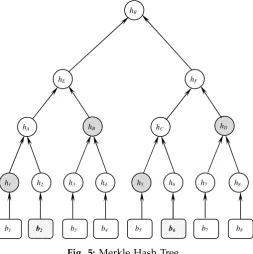
A MHT [25] is a binary tree structure used to efficiently verify the integrity of the data. The MHT is a tree of hashes where the leaves of the tree are the hashes of the data blocks. Fig. 5 shows an example of a MHT used to verify the integrity of a fileF consisting of 8 blocks.hj =h(bj) (1≤j≤8).hA=h(h1||h2),
hE hF
hR
hA hB hC hD
h1 h2 h3 h4 h5 h6 h7 h8
b1 b2 b3 b4 b5 b6 b7 b8
Fig. 5:Merkle Hash Tree.
hB =h(h3||h4), and so on. Finally,hR=h(hE||hF)is the hash of the root node that is used to authenticate
the integrity of all data blocks. The data blocks {b1, b2, . . . , b8} are stored on a remote server, and only
the authentic value hR is stored locally on the verifier side. For example, if the verifier requests to check
the integrity of the blocksb2 andb6, the server will send these two blocks along with the authentication
paths A2 = {h1, hB} and A6 = {h5, hD} that are used to reconstruct the root of the MHT. Aj — the
authentication path ofbj — is a set of node siblings (grey-shaded circles) on the path from hj to the root
of the MHT. The verifier uses the received blocks and the authentication paths to recompute the root in the following manner. The verifier constructs h2 = h(b2), h6 =h(b6), hA = h(h1||h2), hC = h(h5||h6),
hE = h(hA||hB), hF = h(hC||hD), and hR = h(hE||hF). After computing hR, it is compared with the
authentic value stored locally on the verifier side.
The MHT is commonly used to authenticate the valuesof the data blocks. In the dynamic behavior of outsourced data, we need to authenticate both thevaluesand thepositionsof the data blocks, i.e., we need an assurance that a specific value is stored at a specific leaf node. For example, if a data owner requires to insert a new block after positionj, the verifier needs to make sure that the server has inserted the new block in the requested position. To validate the positions of the blocks, the leaf nodes of the MHT are treated in a specific sequence, e.g., left-to-right sequence [22]. So, the hash of any internal node = h(left child || right child), e.g., hA=h(h1||h2)̸=h(h2||h1). Besides, the authentication path Aj is viewed as an
orderedset, and thus any leaf node is uniquely specified by following the used sequence of constructing the root of the MHT.
3.5.2 Directory MHT for File Copies
The proposed schemes in this paper are aiming at supporting multiple copies of dynamic data. To this end, in the TB-DMCPDP scheme a MHT is constructed for each file copy, and then the roots of the individual trees are used to build a hash tree which we call a directory MHT. The key idea is to make the root node of each copy’s MHT as a leaf node in a directory MHT used to authenticate the integrity of all file copies in a hierarchical manner. The directory tree is depicted in Fig. 6. The verifier can keep only one metadata M= h(IDF||hDR), where IDF is a unique file identifier for each owner’s file, and
hDR is the authenticated directory root value that can be used to periodically check the integrity of all
file copies. Embedding theIDF into the metadataMprevents the CSP from cheating using blocks from
different files.
͙͙͙
h1R h2R hnR
hDR
MHT for copy #2 MHT for copy #n …..
Directory root
MHT for copy #1
Fig. 6: Directory tree for the file copies.
3.5.3 TB-DMCPDP Procedural Steps
The procedures of our TB-DMCPDP scheme execution are as follows:
Key Generation. Letˆe:G1×G2→GT be a bilinear map, (u1, u2, . . . , us)∈RG1, and gis a generator
of G2. The data owner runs the KeyGen algorithm to generate a private key x ∈ Zp and a public
keyy =gx ∈G2.
(1≤i≤n,1 ≤j ≤m) by concatenating a copy number i with the block bj, then encrypting using
an encryption schemeEK, i.e.,˜bij =EK(i||bj). The encrypted block˜bij is fragmented into ssectors,
i.e.,Fei ={˜bijk}1≤j≤m
1≤k≤s
, where each sector˜bijk∈Zp for some large primep. The authorized users need
only to keep a single secret keyK. Later, when an authorized user receives a file copy from the CSP, he decrypts the copy blocks, removes the copy index from the blocks header, and then recombines the decrypted blocks to reconstruct the plain form of the received file copy.
Generation of Tags and Trees. Given the distinct file copies eF = {Fei}, where Fei = {˜bijk}, the data
owner runs theTagGenalgorithm to create a tagσij for each block˜bij asσij = (H(˜bij)·
∏s k=1u
˜bijk
k )
x∈ G1 (i : 1 → n, j : 1 → m, k : 1 → s). The data owner then generates an aggregated tag σj for the
blocks at the same indices in each copy Fei as σj =
∏n
i=1σij ∈G1. We denote the set of aggregated
tags asΦ ={σj}1≤j≤m.
The data owner generates a MHT for each file copyFei. The leaf nodes of each tree are the ordered
set {h(H(˜bij))}, i.e., the leaf nodes of the MHT are the cryptographic hashes of H(˜bij), and the
root of the tree is denoted as hRi. Using the roots {hRi}1≤i≤n, the data owner generates a directory
MHT in which the leaf nodes are {hRi}1≤i≤n, and the directory root is denoted as hDR. Note that
the MHTs are constructed using a specific sequence, e.g., left-to-right sequence to authenticate both the value and the position of H(˜bij). The owner computes a metadata M = h(IDF||hDR), where
IDF =F ilename||n||u1||. . .||us, i.e., theIDF is a unique fingerprint for each file comprising the file
name, the number of copies for this file, and the random values {uk}1≤k≤s. The data owner sends
⟨eF,Φ, IDF,{M HTi}1≤i≤n⟩ to the CSP and deletes the copies, the tags, and the trees from its local
storage. The metadataM is stored on the local storage of the owner (or any trusted verifier).
Dynamic Operations on the Data Copies. The dynamic operations in the proposed TB-DMCPDP scheme are performed on the block level via a request in the general form⟨IDF,BlockOp, j,{bi∗}1≤i≤n, σ∗j⟩,
where IDF is the file identifier, and BlockOp corresponds to block modification (denoted by BM),
block insertion (denoted by BI), or block delete (denoted by BD). The parameter j indicates the index of the block to be updated, {b∗i}1≤i≤n are the new block values for all copies, and σ∗j is the
new aggregated tag for the new blocks.
Modification. Data modification is one of the most frequently used dynamic operations in the
outsourced data. For a file F ={b1, b2, . . . , bm}, suppose the owner wants to modify the block
bj with the block b′j for all file copies. The owner runs the PrepareUpdate algorithm to do the
following:
1) Createsn distinct blocks {˜b′ij}1≤i≤n, where˜b′ij =EK(i||b′j) is fragmented into s sectors
{˜b′
ij1,˜b′ij2, . . . ,˜b′ijs}
2) Creates a new tag σij′ for each block˜b′ij as σ′ij = (H(˜b′ij)·∏sk=1u˜b′ijk
k )x∈G1, then generates an
aggregated tagσj′ =∏ni=1σ′ij ∈G1
3) Sends a modify request ⟨IDF,BM, j,{˜bij′ }1≤i≤n, σj′⟩ to the CSP
Upon receiving the modify request from the data owner, the CSP runs theExecUpdatealgorithm to do the following:
1) Replaces the block ˜bij with ˜b′ij∀i, and constructs an updated version of the file copies Fe′ =
{Fei′}1≤i≤n
2) Replaces h(H(˜bij)) with h(H(˜b′ij)) in the leaf nodes of each copy’s MHT, and accordingly
updates the MHTs
3) Calculates the authentication paths⟨Aij⟩1≤i≤nof the updated blocks at positionjin all copies. Aij is an ordered set of node siblings on the path from the leaf nodeh(H(˜b′ij)) to the root of
the MHT of copyi
4) Replaces σj with σj′ in the aggregated tags set Φ, and outputs
Φ′ ={σ1, σ2, . . . , σj′, . . . , σm}
5) Sends⟨Aij⟩1≤i≤n to the owner
to generate a new directory root h′DR and update the metadata M′ =h(IDF||h′DR). The
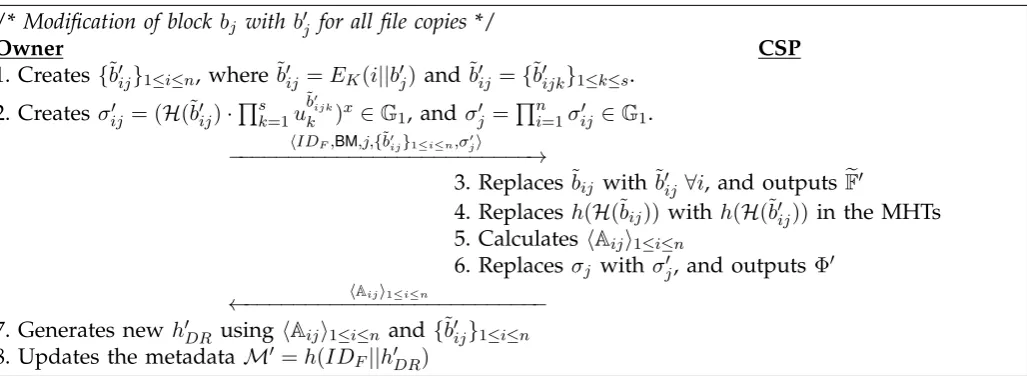
inter-action between the data owner and the CSP during block modification is summarized in Fig. 7.
/* Modification of blockbj with b′j for all file copies */
Owner CSP
1. Creates {˜b′ij}1≤i≤n, where˜b′ij =EK(i||b′j) and˜b′ij ={˜b′ijk}1≤k≤s.
2. Creates σij′ = (H(˜b′ij)·∏sk=1u˜b′ijk
k )x ∈G1, andσ′j =
∏n
i=1σij′ ∈G1.
- ⟨IDF,BM,j,{
˜b′
ij}1≤i≤n,σj′⟩
−−−−−−−−−−−−−−−−−−−−−−−−−→
- 3. Replaces˜bij with ˜b′ij ∀i, and outputs eF′
- 4. Replacesh(H(˜bij)) with h(H(˜b′ij)) in the MHTs
- 5. Calculates ⟨Aij⟩1≤i≤n
- 6. Replacesσj with σ′j, and outputs Φ′
- ←−−−−−−−−−−−−−−−−−−−−−−−−−⟨Aij⟩1≤i≤n 7. Generates newh′DR using ⟨Aij⟩1≤i≤n and {˜b′ij}1≤i≤n
8. Updates the metadata M′=h(IDF||h′DR)
Fig. 7: The block modification protocol in the TB-DMCPDP scheme.
Insertion. In the block insertion operation, the owner wants to insert a new blockˆbafterposition
j in a file F = {b1, b2, . . . , bm}, i.e., the newly constructed file F′ = {b1, b2, . . . , bj,ˆb, . . . , bm+1},
i.e., bj+1= ˆb. The block insertion operation changes the logical structure of the file, while block
modification does not. In the proposed TB-DMCPDP scheme, the block index is not included in the block tag. Thus, the insertion operation can be performed without recomputing the tags of all blocks that have been shifted after inserting the new block. Embedding the block index in the tag results in unacceptable computation overhead, especially for large data files. MHTs are used to validate the positions of file blocks. To perform the insertion of a new blockˆb after position j in all file copies, the owner runs the PrepareUpdate algorithm to do the following: 1) Createsndistinct blocks{ˆbi}1≤i≤n, whereˆbi =EK(i||ˆb)is fragmented intossectors{ˆbi1,ˆbi2, . . . ,ˆbis}
2) Creates a new tag σˆi for each block ˆbi as σˆi = (H(ˆbi)·
∏s k=1u
ˆ
bik
k )x ∈ G1, then generates an
aggregated tagσˆ=∏ni=1σˆi∈G1
3) Sends an insert request ⟨IDF,BI, j,{ˆbi}1≤i≤n,ˆσ⟩ to the CSP
Upon receiving the insert request from the owner, the CSP runs the ExecUpdate algorithms to do the following:
1) Inserts the blockˆbi after position j in the file copy Fei ∀i, and then adds a leaf nodeh(H(ˆbi))
after the leaf nodeh(H(˜bij)) for each copy’s MHT. This leads to constructing a new version
of the file copiesFe′ ={Fei′}1≤i≤n, and a new version of the MHTs
2) Calculates the authentication paths ⟨Abi⟩1≤i≤n of the newly inserted blocks {ˆbi}1≤i≤n in all
copies. Abi is an ordered set of node siblings on the path from the leaf node h(H(ˆbi)) to the
root of the MHT of copyi
3) Inserts σˆ after position j in the set of the aggregated tags Φ, and outputs Φ′ ={σ1, σ2, . . . , σj,σ, . . . , σˆ m+1}, i.e., σj+1 = ˆσ
4) Sends⟨Abi⟩1≤i≤n to the owner
Upon receiving⟨Abi⟩1≤i≤nfrom the CSP, the owner uses these authentication paths and{ˆbi}1≤i≤n
to generate a new directory root h′DR and update the metadata M′ =h(IDF||h′DR). The
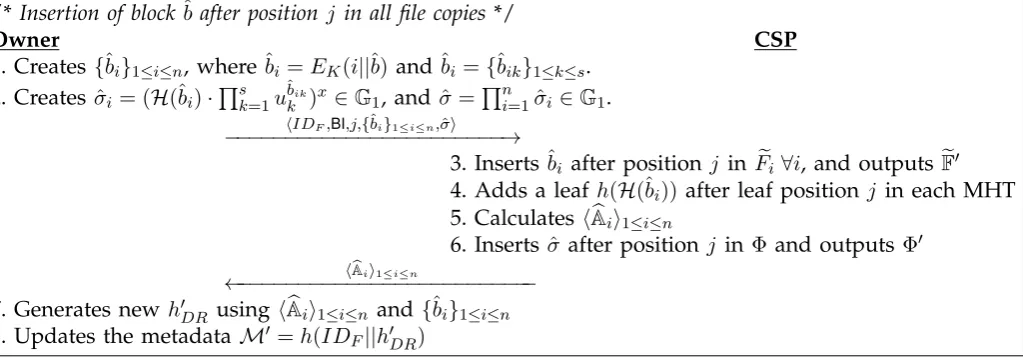
inter-action between the data owner and the CSP during block insertion is summarized in Fig. 8.
Append. Block append operation means adding a new block at the end of the outsourced data.
/* Insertion of blockˆb after positionj in all file copies*/
Owner CSP
1. Creates {ˆbi}1≤i≤n, where ˆbi =EK(i||ˆb) andˆbi ={ˆbik}1≤k≤s.
2. Creates σˆi = (H(ˆbi)·
∏s k=1u
ˆbik
k )x∈G1, andσˆ=
∏n
i=1σˆi∈G1.
- −−−−−−−−−−−−−−−−−−−−−−−→⟨IDF,BI,j,{ˆbi}1≤i≤n,ˆσ⟩
- 3. Insertsˆbi after position j in Fei ∀i, and outputsFe′
- 4. Adds a leafh(H(ˆbi))after leaf positionj in each MHT
- 5. Calculates ⟨Abi⟩1≤i≤n
- 6. Insertsσˆ after position j in Φand outputs Φ′
- ←−−−−−−−−−−−−−−−−−−−−−−−−−⟨bAi⟩1≤i≤n 7. Generates newh′DR using ⟨Abi⟩1≤i≤n and {ˆbi}1≤i≤n
8. Updates the metadata M′=h(IDF||h′DR)
Fig. 8: The block insertion protocol in the TB-DMCPDP scheme
Deletion. Block deletion operation is the opposite of the insertion operation. When one block
is deleted all subsequent blocks are moved one step forward. To delete a specific data block at position j from all copies, the owner sends a delete request ⟨IDF,BD, j, null, null⟩ to the CSP.
Upon receiving this request, the CSP runs the ExecUpdate algorithms to do the following: 1) Calculates the authentication paths⟨Aij⟩1≤i≤nof the blocks at positionj(blocks to be deleted)
in all copies. Aij is an ordered set of node siblings on the path from the leaf node h(H(˜bij))
to the root of the MHT of copyi
2) Deletes the existing blocks{˜bij}1≤i≤n and the leaf nodes {h(H(˜bij))}1≤i≤n, and outputs new
file copiesFe′ along with a new version of the MHTs
3) Deletes σj from Φ, and outputs Φ′={σ1, σ2. . . , σj−1, σj+1. . . , σm−1}
4) Sends⟨Aij⟩1≤i≤n to the owner
The owner uses the authentication information received from the CSP to generate a new directory rooth′DR and update the metadataM′ =h(IDF||h′DR).
Remark 2. Appendix A contains examples that demonstrate how the dynamic operations
per-formed on the outsourced file copies affect the MHTs on the CSP side. Moreover, these examples show how the owner uses the information received from the CSP to generate the new directory root and update the metadata.
Challenge. For challenging the CSP and validating the integrity and consistency of all copies, the verifier sendsc (# of blocks to be challenged) and two fresh keys at each challenge: a PRP(π) keyk1
and a PRF(ψ) key k2. Both the verifier and the CSP use the PRP(π) keyed with k1 and the PRF(ψ)
keyed with k2 to generate a set Q={(j, rj)} of pairs of random indices and random values, where
{j}=πk1(l)1≤l≤c and{rj}=ψk2(l)1≤l≤c.
Response. After generating the setQ={(j, rj)}of random indices and values, the CSP runs theProve
algorithm to generate an evidence that it is still correctly possessing thencopies in an updated and consistent state. The CSP responds with a proof P=⟨σ, µ,{H(˜bij)}1≤i≤n
(j,∗)∈Q
,⟨Aij⟩1≤i≤n
(j,∗)∈Q
⟩, where
σ = ∏
(j,rj)∈Q σrj
j ∈G1 , µik =
∑
(j,rj)∈Q
rj·˜bijk ∈Zp, and µ={µik}1≤i≤n
1≤k≤s
.
⟨Aij⟩1≤i≤n
(j,∗)∈Q
are the authentication paths of {H(˜bij)}1≤i≤n
(j,∗)∈Q
.
Verify Response. Upon receiving the proof P = ⟨σ, µ,{H(˜bij)}1≤i≤n
(j,∗)∈Q
,⟨Aij⟩1≤i≤n
(j,∗)∈Q
1) Constructs the directory roothDR using {H(˜bij)}1≤i≤n
(j,∗)∈Q
and⟨Aij⟩1≤i≤n
(j,∗)∈Q
2) Generates the valueV=h(IDF||hDR), and checks V
?
=M, whereMis the authenticated-most-recent metadata stored on the verifier side. If the checking fails, returns 0, otherwise the Verify
algorithm checks following verification equation:
ˆ
e(σ, g)= ˆ? e(
n
∏
i=1
∏
(j,rj)∈Q
H(˜bij)rj · s
∏
k=1
u ∑n
i=1µik
k , y) (1)
If the verification equation passes, theVerifyalgorithm returns 1, otherwise 0. The correctness of the above verification equation (1) can be shown as follows:
ˆ
e(σ, g) = e(ˆ ∏
(j,rj)∈Q σrj
j , g)
= e(ˆ ∏
(j,rj)∈Q [
n
∏
i=1
σij]rj, g)
= e(ˆ ∏
(j,rj)∈Q [
n
∏
i=1
(H(˜bij)· s
∏
k=1
u˜bijk
k )
x]rj, g)
= e(ˆ ∏
(j,rj)∈Q [
n
∏
i=1
(H(˜bij)· s
∏
k=1
u˜bijk
k )] rj, y)
= e(ˆ ∏
(j,rj)∈Q
n
∏
i=1
H(˜bij)rj ·
∏
(j,rj)∈Q
n ∏ i=1 s ∏ k=1
urj·˜bijk
k , y)
= e(ˆ
n
∏
i=1
∏
(j,rj)∈Q
H(˜bij)rj · s ∏ k=1 u ∑n i=1 ∑
(j,rj)∈Qrj·˜bijk
k , y)
= e(ˆ
n
∏
i=1
∏
(j,rj)∈Q
H(˜bij)rj · s
∏
k=1
u ∑n
i=1µik
k , y)
The TB-DMCPDP scheme can be slightly modified to minimizing the communication overhead by a factor ofnvia allowing the CSP to compute and sendµ={µˆk}1≤k≤s, whereµˆk=
∑n
i=1µik. However,
this modification enables the CSP to simply cheat the verifier as follows:
ˆ µk=
n
∑
i=1
µik= n
∑
i=1
∑
(j,rj)∈Q
rj·˜bijk =
∑
(j,rj)∈Q rj·
n
∑
i=1
˜bijk
Thus, the CSP can just keep the sectors summation∑ni=1˜bijk not the sectors themselves. Moreover,
the CSP can corrupt the block sectors and the summation is still valid. Therefore, we force the CSP to send µ = {µik}1≤i≤n
1≤k≤s
, and the summation ∑ni=1µik is done on the verifier side. The challenge
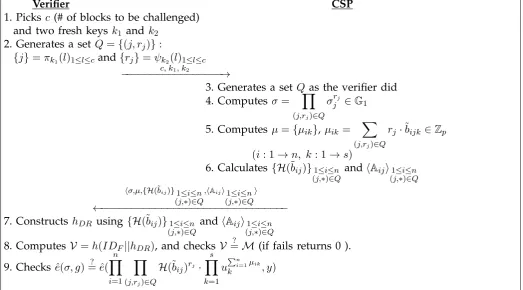
response protocol in the TB-DMCPDP scheme is summarized in Fig. 9.
3.6 The Proposed MB-DMCPDP Scheme 3.6.1 Map-Version Table
Our proposed MB-DMCPDP scheme is based on using a map-version table to support outsourcing of dynamic data. This table is a small data structure stored on the verifier side to validate the integrity and consistency of all file copies stored by the CSP. The map-version table consists of three columns: serial number (SN), block number (BN), and version number (VN). The SN is an indexing to the file blocks. It indicates the physical position of a block in a data file. The BN is a counter used to make a
Verifier CSP
1. Picks c (# of blocks to be challenged) – and two fresh keys k1 and k2
2. Generates a setQ={(j, rj)}:
– {j}=πk1(l)1≤l≤c and{rj}=ψk2(l)1≤l≤c
- −−−−−−−−−−−−−−−−−→c, k1, k2
- 3. Generates a set Qas the verifier did
- 4. Computes σ = ∏
(j,rj)∈Q σrj
j ∈G1
- 5. Computes µ={µik}, µik=
∑
(j,rj)∈Q
rj·˜bijk ∈Zp
- (i: 1→n, k: 1→s)
- 6. Calculates {H(˜bij)}1≤i≤n
(j,∗)∈Q
and⟨Aij⟩1≤i≤n
(j,∗)∈Q
-⟨σ,µ,{H(˜bij)}1≤i≤n
(j,∗)∈Q
,⟨Aij⟩1≤i≤n
(j,∗)∈Q
⟩ ←−−−−−−−−−−−−−−−−−−−−−−−−−−−−−−−
7. ConstructshDR using {H(˜bij)}1≤i≤n
(j,∗)∈Q
and⟨Aij⟩1≤i≤n
(j,∗)∈Q
8. Computes V =h(IDF||hDR), and checksV
?
=M(if fails returns 0 ).
9. Checkse(σ, g)ˆ = ˆ? e(
n
∏
i=1
∏
(j,rj)∈Q
H(˜bij)rj · s
∏
k=1
u ∑n
i=1µik
k , y)
Fig. 9:The challenge response protocol in the TB-DMCPDP scheme
a mapping between the logical numberBN and the physical position SN. TheVN indicates the current version of file blocks. When a data file is initially created the VN of all blocks is 1. If a specific block is being updated, its VN is incremented by 1. It is of significant importance to note that the verifier keeps only one table for any arbitrary number of file copies.
3.6.2 MB-DMCPDP Procedural Steps
The procedures of our MB-DMCPDP scheme execution are as follows:
Key Generation. The same as in the TB-DMCPDP scheme.
Generation of Distinct Copies. The same as in the TB-DMCPDP scheme.
Generation of Tags. Given the distinct file copiesFe={Fei}, whereFei ={˜bijk}, the data owner runs the
TagGenalgorithm to create a tagσij for each block˜bij asσij = (H(IDF||BNj||VNj)·
∏s
k=1u ˜
bijk
k )x ∈G1
(i: 1→n, j: 1→m, k: 1→s). In the tag computation, BNj is the logical number of the block at
physical position j, VNj is the current version of that block, and IDF is a unique file identifier for
each owner’s file constructed as F ilename||n||u1||. . .||us. The IDF is embedded into the block tag
to prevent the CSP from cheating using blocks from different files. The data owner then generates an aggregated tag σj for the blocks at the same indices in each copy Fei as σj =
∏n
i=1σij ∈ G1. Let
us denote the set of aggregated tags as Φ = {σj}1≤j≤m. The data owner sends {F,Φ, IDF} to the
CSP, and deletes the copies and the tags from its local storage. The map-version table is stored on the local storage of the owner (or any trusted verifier).
Dynamic Operations on the Data Copies. The dynamic operations in the proposed MB-DMCPDP scheme are performed at the block level — as in our TB-DMCPDP scheme — via a request in the general form⟨IDF,BlockOp, j,{b∗i}1≤i≤n, σ∗j⟩.IDF is the file identifier,BlockOpisBMfor modification,
BIfor insertion, or BDfor delete,j indicates the index of the block to be updated, {b∗i}1≤i≤n are the
new block values for all copies, and σj∗ is the new aggregated tag for the new blocks.
Modification. For a file F ={b1, b2, . . . , bm}, suppose the owner wants to modify the block bj
following:
1) UpdatesVNj = VNj+ 1in the map-version table
2) Createsn distinct blocks {˜b′ij}1≤i≤n, where˜b′ij =EK(i||b′j) is fragmented into s sectors
{˜b′
ij1,˜b′ij2, . . . ,˜b′ijs}
3) Creates a new tag σij′ for each block˜b′ij as
σ′ij = (H(IDF||BNj||VNj)·
∏s k=1u
˜b′
ijk
k )x∈G1, then generates an aggregated tagσj′ =
∏n
i=1σij′ ∈ G1
4) Sends a modify request ⟨IDF,BM, j,{˜bij′ }1≤i≤n, σj′⟩ to the CSP
Upon receiving the modify request from the data owner, the CSP runs theExecUpdatealgorithms to do the following:
1) Replaces the block ˜bij with ˜b′ij∀i, and constructs an updated version of the file copies Fe′ =
{Fei′}1≤i≤n
2) Replaces σj with σj′ in the setΦ, and outputs Φ′ ={σ1, σ2, . . . , σ′j, . . . , σm}
Insertion. For a file F ={b1, b2, . . . , bm}, suppose the owner wants to insert a new blockˆb after
position j for all file copies eF. The data owner runs the PrepareUpdate algorithm to do the following:
1) Constructs a new table entry ⟨SN,BN,VN ⟩ = ⟨j+1, (M ax{BNj}1≤j≤m)+1, 1 ⟩, and inserts
this entry in the map-version table after positionj
2) Createsndistinct blocks{ˆbi}1≤i≤n, whereˆbi =EK(i||ˆb)is fragmented intossectors{ˆbi1,ˆbi2, . . . ,ˆbis}
3) Creates a new tag σˆi for each blockˆbi as
ˆ
σi = (H(IDF||BNj+1||VNj+1) ·
∏s k=1u
ˆbik
k )x ∈ G1, then generates an aggregated tag σˆ =
∏n
i=1σˆi ∈G1. Note that BNj+1 is the logical number of the new block with current version VNj+1 = 1
4) Sends an insert request ⟨IDF,BI, j,{ˆbi}1≤i≤n,ˆσ⟩ to the CSP
Upon receiving the insert request from the owner, the CSP runs the ExecUpdate algorithms to do the following:
1) Inserts the blockˆbi after position jin the file copyFei ∀i, and constructs a new version of the
file copiesFe′ ={Fei′}1≤i≤n
2) Inserts σˆ after position j in the set Φ, and outputs Φ′ = {σ1, σ2, . . . , σj,σ, . . . , σˆ m+1}, i.e.,
σj+1= ˆσ
Append. Block append operation means adding a new block at the end of the outsourced data.
It can simply be implemented via insert operation after the last block of the data file.
Deletion. To delete a specific data block at positionjfrom all copies, the owner deletes the entry
at positionj from the map-version table and sends a delete request⟨IDF,BD, j, null, null⟩to the
CSP. Upon receiving this request, the CSP runs theExecUpdate algorithms to do the following: 1) Deletes the existing blocks {˜bij}1≤i≤n, and outputs a new version of the file copies eF′ =
{Fei}1≤i≤n
2) Deletes σj from Φ and outputs Φ′ ={σ1, σ2, . . . , σj-1, σj+1, . . . , σm−1}.
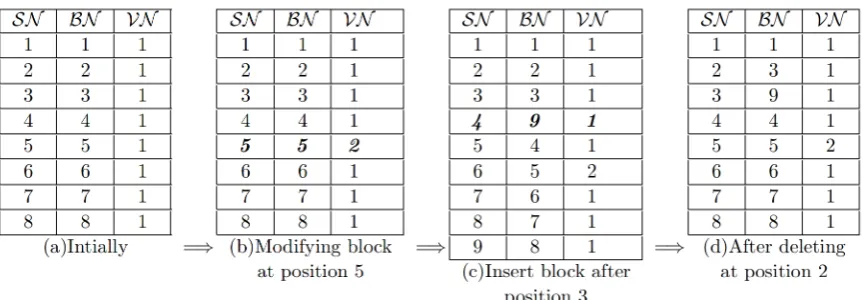
Fig. 10 shows the changes in the map-version table due to dynamic operations on a fileF ={bj}1≤j≤8.
When the file is initially created SNj = BNj, and VNj = 1: 1 ≤ j ≤ 8. Fig. 10.b shows that VN5
is incremented by 1 for updating the block at position 5. To insert a new block after position 3, Fig. 10.c shows that a new entry ⟨4,9,1⟩ is inserted in the map-version table after SN3, where 4
is the physical position of the newly inserted block, 9 is the new logical block number computed by incrementing the maximum of all previous logical block numbers, and 1 is the version of the new block. Deleting a block at position 2 requires deleting the table entry at SN2 and shifting all
subsequent entries one position up (Fig. 10.d). Note that during all dynamic operations, the SN indicates the actual physical positions of the data blocks in the file copies eF.
Challenge. The same as in the TB-DMCPDP scheme.
Fig. 10:Changes in the map-version table due to different dynamic operations.
algorithm to generate an evidence that it is still correctly possessing thencopies in an updated and consistent state. The CSP responds with a proof P={σ, µ}, where
σ = ∏
(j,rj)∈Q σrj
j ∈G1 , µik=
∑
(j,rj)∈Q
rj·˜bijk ∈Zp, and µ={µik}1≤i≤n
1≤k≤s
Verify Response. Upon receiving the proof P = {σ, µ} from the CSP, the verifier runs the Verify
algorithm to check the following verification equation:
ˆ
e(σ, g)= ˆ? e([ ∏
(j,rj)∈Q
H(IDF||BNj||VNj)rj]n· s
∏
k=1
u ∑n
i=1µik
k , y) (2)
If the verification equation passes, theVerifyalgorithm returns 1, otherwise 0. The correctness of the above verification equation (2) can be determined as follows:
ˆ
e(σ, g) = e(ˆ ∏
(j,rj)∈Q σrj
j , g)
= e(ˆ ∏
(j,rj)∈Q [
n
∏
i=1
σij]rj, g)
= e(ˆ ∏
(j,rj)∈Q [
n
∏
i=1
(H(IDF||BNj||VNj)· s
∏
k=1
u˜bijk
k )
x]rj, g)
= e(ˆ ∏
(j,rj)∈Q [
n
∏
i=1
(H(IDF||BNj||VNj)· s
∏
k=1
u˜bijk
k )] rj, y)
= e(ˆ ∏
(j,rj)∈Q
n
∏
i=1
H(IDF||BNj||VNj)rj ·
∏
(j,rj)∈Q
n ∏ i=1 s ∏ k=1
urj·˜bijk
k , y)
= e([ˆ ∏
(j,rj)∈Q
H(IDF||BNj||VNj)rj]n· s ∏ k=1 u ∑n i=1 ∑
(j,rj)∈Qrj·˜bijk
k , y)
= e([ˆ ∏
(j,rj)∈Q
H(IDF||BNj||VNj)rj]n· s
∏
k=1
u ∑n
i=1µik
k , y)
We have not let the CSP to compute and sendµ={µˆk}1≤k≤s, whereµˆk=
∑n
i=1µik as a
countermea-sure against a cheating that may be done on the CSP side by keeping only the sectors summation ∑n
i=1˜bijk, not the sectors themselves, as we have previously illustrated in the TB-DMCPDP scheme.
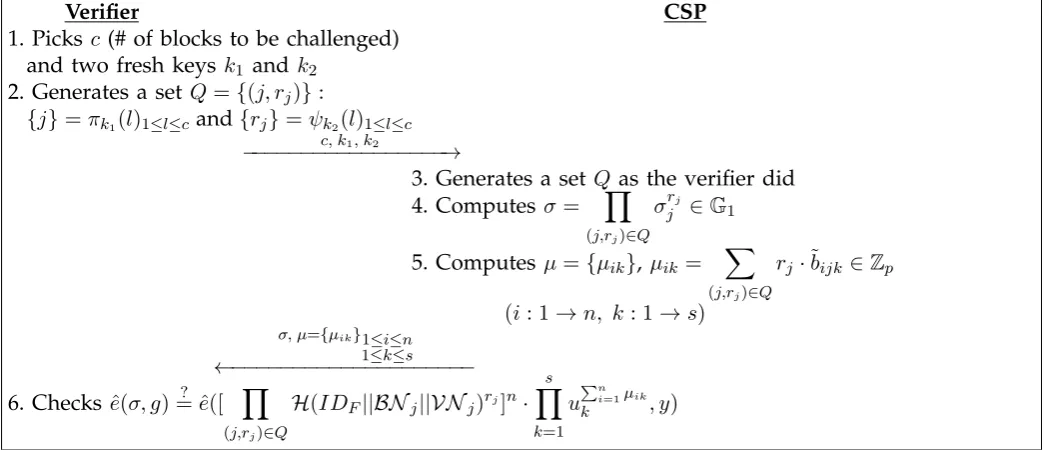
Verifier CSP
1. Picks c (# of blocks to be challenged) – and two fresh keys k1 and k2
2. Generates a setQ={(j, rj)}:
– {j}=πk1(l)1≤l≤c and{rj}=ψk2(l)1≤l≤c
- −−−−−−−−−−−−−−−−−→c, k1, k2
- 3. Generates a set Qas the verifier did
- 4. Computes σ = ∏
(j,rj)∈Q σrj
j ∈G1
- 5. Computes µ={µik}, µik=
∑
(j,rj)∈Q
rj·˜bijk ∈Zp
- (i: 1→n, k: 1→s)
-σ, µ={µik}1≤i≤n
1≤k≤s
←−−−−−−−−−−−−−−−−−−−−
6. Checkse(σ, g)ˆ = ˆ? e([ ∏
(j,rj)∈Q
H(IDF||BNj||VNj)rj]n· s
∏
k=1
u ∑n
i=1µik
k , y)
Fig. 11: The challenge response protocol in the MB-DMCPDP scheme
Remark 2. The proposed two schemes in this work support public verifiability where anyone (not
necessarily the owner) who knows the owner’s public key can send a challenge vector to the CSP and verify the response. Public verifiability can solve disputes that may occur between the data owner and the CSP regarding data integrity. If such a dispute occurs, we can resort to a trusted TPA to determine whether the data integrity is maintained or not. Since the owner’s public key is only needed to perform the verification protocol, the owner is not required to reveal his secret key to the TPA. The formal security analysis of the proposed schemes is presented in Appendix B.
4 PERFORMANCE ANALYSIS AND EXPERIMENTAL RESULTS 4.1 Performance Analysis
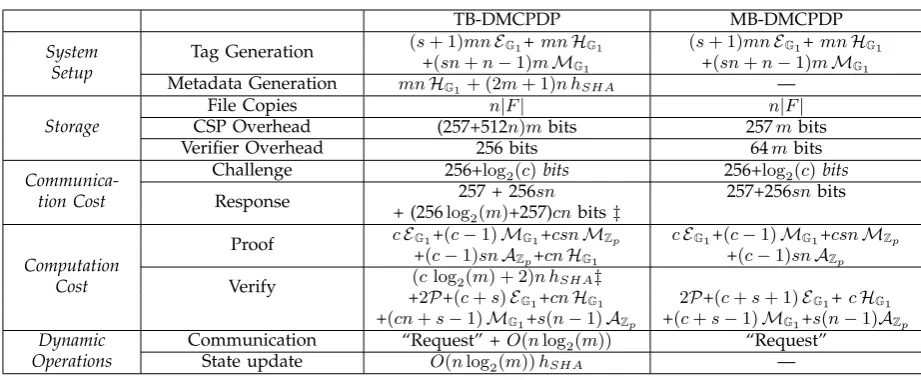
In this section we evaluate the performance of the proposed schemes: TB-DMCPDP and MB-DMCPDP. The computation cost of these schemes is estimated in terms of the cryptographic operations notated in Table 1.G1 indicates a group of points over a suitable elliptic curve in the bilinear pairing.
TABLE 1: Notation of cryptographic operations
Notation Description
hSHA Cryptographic hashing
HG1 Hashing toG1
EG1 Exponentiation inG1
MG1 Multiplication inG1
MZp Multiplication inZp AZp Addition inZp
P Bilinear pairing
![Fig. 1: The DPDP protocol by Ateniese et al. [3].](https://thumb-us.123doks.com/thumbv2/123dok_us/1877474.1244528/5.595.76.526.220.409/fig-dpdp-protocol-ateniese-et-al.webp)
![Fig. 3: The DPDP protocol by Hao et al. [19].](https://thumb-us.123doks.com/thumbv2/123dok_us/1877474.1244528/7.595.39.554.38.600/fig-dpdp-protocol-hao-et-al.webp)