Private and Oblivious Set and Multiset Operations
Marina Blanton and Everaldo Aguiar Department of Computer Science and Engineering
University of Notre Dame {mblanton,eaguiar}@nd.edu
Abstract
Privacy-preserving set operations, and set intersection in particular, are a popular research topic. Despite a large body of literature, the great majority of the available solutions are two-party protocols and are not composable. In this work we design a comprehensive suite of secure multi-party protocols for set and multiset operations that are composable, do not assume any knowledge of the sets by the parties carrying out the secure computation, and can be used for secure outsourcing. All of our protocols have communication and computation complexity ofO(mlogm) for sets or multisets of size m, which compares favorably with prior work. Furthermore, we are not aware of any results that realize composable operations. Our protocols are secure in the information theoretic sense and are designed to minimize the round complexity. Practicality of our solutions is shown through experimental results.
1
Introduction
The ability to securely perform set operations on private inputs has numerous applications. As an example, we mention computing intersection of databases belonging to different agencies or organizations, which by law or other provisions are not permitted to share their records in the clear, but want to compute the set of records common to both of them. This can be used in contexts ranging from finding passengers of an airline who appear in the national watch list to determining customers common to two companies for more effective advertisement. The importance of the topic is also evidenced by a significant body of prior work (see, e.g., [34, 52, 35, 31, 49, 43, 5]).
Work on privacy-preserving set operations started with the seminal work of [34]. Consequently, many other publications appeared with the goal of extending the functionality or improving its performance. Secure protocols are known for set intersection (e.g., [34, 52, 42, 31, 49]), set union (e.g., [52, 35, 43]), set intersection cardinality or over-the-threshold cardinality (e.g., [68, 29]), multiset element reduction ([52]), and others. Most of publications assume the two-party setting, in which Alice and Bob each possess a private set A and B, respectively, apply a set operation to the sets, and learn the result (or only one party learns the result). In such protocols, the knowledge of the private inputA orB is essential for correctly recovering the result.
While this problem formulation has a large number of applications, the existing solutions cannot be securely used as building blocks in larger protocols as they are not designed to be composable.1
That is, a set operation has to comprise the entire computation as neither the output can remain private from both parties nor the existing solutions apply when A or B is the result of prior secure computation and is not known to either party. One example application that could benefit
1Here, by composability we mean the ability to use set operations as building blocks in larger computation using
from composable set operations is privacy-preserving product network aggregation [62], in which set union and set intersection operations are executed one after another. Prior solutions to this problem had to reveal some information at an intermediate step because the existing set union and intersection protocols were not composable. The literature that provides solutions for the multi-party setting [52, 35] likewise assumes that each participant has access to her private set in the clear.
The recent emergence of cloud computing demands techniques for secure outsourcing that will allow the benefits of available cloud services to be utilized to the fullest extent, which otherwise might not be used due to the fear of information disclosure. In that setting the computational parties do not have access to the private inputs and it is essential that they do not learn any information about the data they process, while are able to carry out the computation correctly. In other words, the computation needs to be data-independent or oblivious. From that point of view, it is desirable to have protocols that are both composable and can be used in outsourced tasks, which we set as one of our goals. Note that in many existing solutions, the computation cannot be outsourced because performing the computation requires knowledge of some of the inputs.
We utilize secure multi-party computation (SMC) framework, where n >2 computational par-ties carry out the computation using linear secret sharing and can be independent from input owners or output recipients. This means that the techniques are suitable for traditional secure multi-party computation as well as secure outsourcing by one or more parties who utilize multiple computational servers for secure computation. In the case of secure outsourcing, each client simply distributes its input to the servers and receives and reconstructs the output at the end of the com-putation, i.e., the computation is non-interactive for the client. As we employ secret sharing, only a fractiontof the computational parties (or servers to which the computation is being outsourced) can collude or misbehave to guarantee security, i.e., the majority of the computational parties must be honest. Related problem formulations from the literature include secure outsourcing to a sin-gle server (e.g., [70]), secure outsourcing to two non-colluding servers (e.g., [10]), and server-aided computation with a single server, where the client’s work is not guaranteed to be linear in the input/output size (e.g., [51]).
Our contributions. In this work, we provide a suite of secure multi-party protocols for a number of set and multiset operations, which are union, intersection, difference, symmetric difference, equality, subset and superset relationships, and element reduction (for multisets only). Besides computing the main functionality, we provide variants of the protocols that produce cardinality of the resulting (multi)set or compute over-the-threshold cardinality and produce a bit. Furthermore, our protocols can be used to always hide the size of the input/output (multi)sets or the size can be revealed to make any computation that follows more efficient (since complexity of set operations is proportional to the size of their representation). We also provide a generic conversion from a multiset to a set that allows us to run our protocols for secure set operations on multisets, as well as a direct and more efficient implementation of multiset operations. Finally, we describe a number of optimizations that allow for faster performance of our protocols. In addition to minimizing the total number of operations, substantial part of this work is dedicated to reducing the number of rounds (i.e., sequential interactive operations) of set and multiset operations, which has a tremendous impact of the performance of our protocols in practice. We implement our solutions for selected set and multiset operations and show that their performance is practical and comparable to those of the latest (more restrictive) two-party solutions.
The advantages of our solutions over previously available results are as follows:
participants. The input sets can also be a result of prior privacy-preserving computation and are not known in the clear to any participant.
2. Our protocols are composable. Because both the inputs and outputs are split among the participants, our protocols can be composed an arbitrary number of times or they can be used as building blocks in larger computations.
3. No intermediate results or other information are revealed to the participants, which makes the solution suitable for secure computation outsourcing. In other words, the parties who provide the inputs and/or learn the output can be different from the parties carrying out secure computation. This is in contrast to prior results, where the knowledge of a set in the clear was essential for correctness of the computation.
4. Our solution provides natural support for hiding the sizes of the sets. The input sets can be padded for additional security, and the size of the result is never revealed, unless the parties decide to do otherwise.
5. Unlike most prior literature, our techniques make no use of expensive operations based on public-key cryptography and achieve information-theoretic security (assuming the existence of secure channels between the participants).
6. All of our protocols are efficient and haveO(mlogm) communication and computation com-plexity wheremis the sum of the input sets’ sizes. This compares favorably with the existing solutions (which we detail below).
Security of our protocols is shown in both semi-honest (honest-but-curious or passive) and malicious (active) models. Part of this work appeared in [9].
2
Related Work
Privacy-preserving set operations. The first custom solutions for securely computing set operations were two-party set intersection and intersection cardinality protocols of [34] based on homomorphic encryption and polynomial representation of sets. The authors also proposed an optimization using balanced hash functions that reduced the computation overhead toO(mln lnm), while the overall communication complexity of the protocols wasO(m). Here mrepresents the set size andn≥2 will denote the number of parties. [52] extended that work by building a framework of multiset operations which included set union, intersection and element reduction. This work was also the first to establish protocols secure against malicious players when three or more parties were involved, which was done via zero-knowledge proofs. The protocols secure in the honest-but-curious model (and the set intersection protocol secure in the malicious model) presented in [52] had communication complexities ofO(n2m), or O(c2m) when c < ndishonest players collude, and computation complexity ofO(n2m2). [42] proposed the first two-party private set intersection protocol based on oblivious pseudo-random functions (OPRFs). If we denotem1 andm2 to be the
number of elements in the sets, where the first set is considered to belong to the server and the second to the client, andtto be the size of the binary representation of input elements, the solution in [42] is constant round and have communication and computation (modular exponentiations) complexities of O(m1 ·t+m2). An improvement to this work is presented in [48], and a similar
protocol that replaces the OPRFs with unpredictable functions can be found in [49].
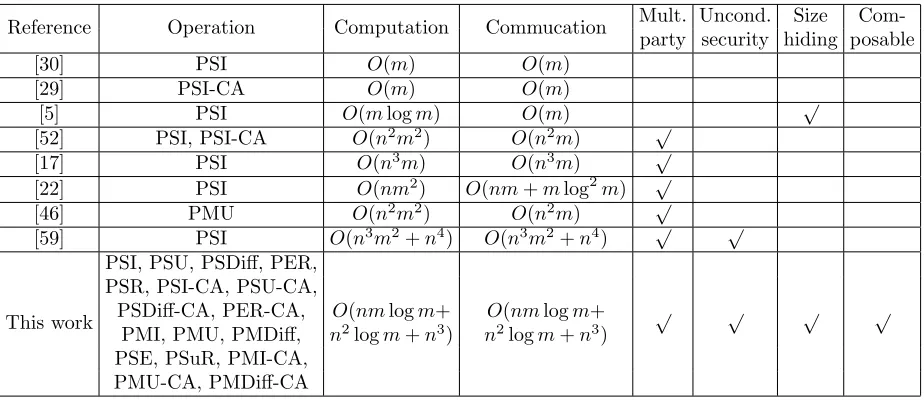
Reference Operation Computation Commucation Mult. Uncond. Size Com-party security hiding posable
[30] PSI O(m) O(m)
[29] PSI-CA O(m) O(m)
[5] PSI O(mlogm) O(m) √
[52] PSI, PSI-CA O(n2m2) O(n2m) √
[17] PSI O(n3m) O(n3m) √
[22] PSI O(nm2) O(nm+mlog2m) √
[46] PMU O(n2m2) O(n2m) √
[59] PSI O(n3m2+n4) O(n3m2+n4) √ √
This work
PSI, PSU, PSDiff, PER,
√ √ √ √
PSR, PSI-CA, PSU-CA,
PSDiff-CA, PER-CA, O(nmlogm+ O(nmlogm+ PMI, PMU, PMDiff, n2logm+n3) n2logm+n3)
PSE, PSuR, PMI-CA, PMU-CA, PMDiff-CA
Table 1: Summary of secure set operations protocols with the best performance.
building on the efficient solution from [31], yields linear complexities (in the number of set elements) for both communication and computation achieving higher efficiency than prior linear-time work [48]. Also, publications [52, 68, 58, 29, 63] propose protocols that compute the set intersection cardinality (rather than the intersection itself), with [29] being the most efficient and having linear-time computation and communication complexities in the semi-honest model (in the random oracle model). One noteworthy recent work [5] adds to the two-party set intersection operation the feature of hiding the size of the input set (including the upper bound) held by the participant who learns the result. The computation performed locally by that party is then no longer linear, but instead isO(mlogm), wherem is size of that party’s input set. Lastly, we highlight the work [63], which describes protocols for several set operations in the Universal Composability framework with malicious adversaries and O(n2m2) complexities.
There are also publications that develop private set intersection protocols in the information-theoretic setting [56, 59, 58, 60]. [56] proposed the first unconditionally secure protocol using polynomial representation of sets and two-dimensional secret sharing (where values are shared among the players and each share is again shared among them) with communication complexity of O(n4m2) in the malicious model and t < n/3 parties under control of an active adversary (though that complexity is contested in [59]). [59] revisit the problem and provide an information-theoretically secure set intersection protocol with communication complexity of O(n3m2 +n4). This solution is used in [60] to build a protocol that works when the adversary controls t < n/2 parties, in which case communication complexity becomes O(n4m2+n5). [58] addresses private
matching, set disjointness, and set intersection cardinality in the information-theoretic setting with semi-honest adversaries.
The only implementations of private set operations that we are aware of are for two-party set intersection in [47] that uses garbled circuits and in [32] that implements the protocol from [30].
of the input sets can be protected by means of padding. We note that [5] achieves a stronger notion of size hiding in which no information about one of the two input sets is revealed. We additionally achieve that no information about the size of the output set (beyond the bounds imposed by the sizes of the (padded) input sets) is revealed to the parties. The complexity of the results in Table 1 that rely on public-key cryptography is measured in public-key operations reported in them (i.e., not the total number of operations) and the security parameters for communication are implicit. The remaining solutions achieve information-theoretic security with communication measured in the number of field elements (of small size). All reported complexities reflect the combined work and communication of all parties.
Secure multi-party computation. The literature on SMC and function evaluation is very extensive and its review is beyond the scope of this work. In the multi-party setting, employed in this work, the available techniques are garbled circuit evaluation (e.g., [38, 8]), linear secret sharing techniques (e.g., [65, 19]), and threshold homomorphic encryption (e.g., [33, 27, 20]). We employ linear secret sharing and design efficient and information-theoretically secure protocols for set and multiset operations.
Parallel set operations. Set operations have also been examined in the realm of parallel comput-ing. Early solutions [53, 66] utilized specially designed array structures to efficiently compute these operations directly in hardware. More recent parallel techniques [11] involve a careful arrangement of the data into random balanced binary trees. While these techniques allow set operations to be performed efficiently, they were not designed to be secure, are not data-oblivious, and do not naturally lend themselves to secure multi-party protocols.
3
Preliminaries
3.1 Framework
In this work we use the multi-party setting in which n > 2 parties P1, . . ., Pn jointly execute prescribed functionality on private inputs. We utilize a linear secret sharing scheme (such as [65]) for representation of, and secure computation over private values. To ensure composability of our protocols, we assumeP1 through Pn receive their shares of the input prior to the computation and compute shares of the output. Then any party with private input will produce shares of it before the computation starts, and upon computation completionP1 through Pn send their shares to the entities entitled to learn the result. This gives flexibility to the problem setting in that the input parties may be disjoint from the computational parties (as in the case with outsourcing). Similarly, the parties receiving the output do not have to coincide with the input parties or computational parties.
Throughout this work we assume that parties P1, . . ., Pn are pair-wise connected by secure authenticated channels (the underlying communication model depends on the employed secret sharing; usually synchronous communication with broadcast channels is assumed). Each input and output party also establishes secure channels with P1 through Pn. With (n, t)-secret sharing, any private value is secret-shared amongnparties such that anyt+ 1 shares can be used to reconstruct it, whilet or fewer shares information-theoretically reveal no information about the shared value. Therefore, the values ofnandtshould be chosen such that an adversary is unable to corrupt more thant computational parties.
performed by each Pi locally on its shares of x and y, while computation of [x][y] is interactive. The most common way of implementing a multiplication operation is by sending the total ofO(n2)
messages (where each participant sends n−1 messages, one to each other participant) using, for instance, the techniques of [36], but recent results [45, 28, 7] lower the communication to O(n) messages per multiplication.
All operations are assumed to be performed in a field Zp for a small prime p greater than the maximum value used in the computation. We use`to denote the bitlength of (multi)set elements, and therefore it must hold that p≥2`. Without loss of generality, we assume that the domain of set elements consists of integers greater than 0, i.e., it is [1,2`−1] (i.e., if the domain is different, it can always be mapped to [1,2`−1] for some `).
Performance of secure computation is of grand significance, as protecting secrecy of data throughout the computation often incurs substantial computational costs. For that reason, besides security, efficient performance of the developed techniques is one of our primary goals. Perfor-mance of a protocol in our setting is typically measured in terms of: (i) the number of interactive operations (multiplications, distributing shares of a private value or opening a secret-shared value) necessary to perform the computation, orinvocations, and (ii) the number of sequential interactions, orrounds. We employ the same metrics here.
3.2 Building blocks
We now proceed with a brief description of building blocks which are used in our solutions, namely, oblivious sorting, comparisons, and prefix AND.
Oblivious sorting. When sorting is utilized in secure computation, the sequence of operations that the parties execute must be independent of the set they are sorting, or data-oblivious, to ensure that no information about the private data is revealed. While most sorting algorithms are not oblivious, using a sorting network results in an oblivious solution. Such techniques use compare-and-exchange operations (CEO), which are fixed and independent of the input. In our setting, a CEO can be implemented as follows:
[s]←GE([a],[b], `) [c]←[s][b] + (1−[s])[a] [d]←[s][a] + (1−[s])[b]
where GE denotes a “greater than or equal” operation for `-bit operands (detailed below) that produces a bit. After comparingaand b,c corresponds to min(a, b) and dto max(a, b).
Ajtai et al. [1] describe a sorting network withO(mlogm) comparisons for a set of cardinalitym, but it has a very high constant behind the big-O notation. More practically, Batcher’s network [6] uses O(mlog2m) comparisons and was the basis of secure multi-party sorting in [50]. More recent results [55, 39, 41] developed oblivious randomized sorting algorithms withO(mlogm) comparisons and low constants which succeed with very high probability. Another recent solution is [72], in which oblivious sorting is achieved in constant round using O(m2) orO(mR) communication and computation, where [0, R] is the range of numbers to be sorted. Throughout the paper, we use notation ([y1], . . .,[ym])←Sort([x1], . . .,[xm], `) to denote secure implementation of oblivious sorting on`-bit values in this framework. In some cases, we also need to sort tuples, where the comparisons are performed using the first element of each tuple, but the entire tuples are swapped based on the outcome of a comparison. We denote this modification bySortT, e.g.,h[x1],[y1]i, . . .,h[xm],[ym]i ← SortT(h[a1],[b1]i, . . .,h[am],[bm]i, `) denotes sorting of 2-tuples.
detail. Goodrich’s shellsort [39] uses asymptotically low 5mlogm−7.5m+ 9 ≈ 5mlogm CEOs, but requires 5m−logm+ 1 ≈ 5m of them to be executed consecutively. The number of rounds then corresponds to this value multiplied by the round complexity of a CEO. Batcher’s network [6] that uses odd-even merge sort involves 14m(log2m−logn+ 4)−1 ≈ 1
4mlog
2m CEOs, but they
can be more effectively parallelized using 12logm(logm+ 1) ≈ 1 2log
2m consecutive CEOs. Also,
form.106, Batcher’s network involves fewer comparisons than Goodrich’s shellsort.
In some cases we also need to merge two sorted arrays, which can be accomplished faster than sorting all elements. For that reason, we define and use protocol Merge(([x1], . . .,[xm1]),
([y1], . . .,[ym2]), `), which is part of Batcher’s oblivious merge sort. Oblivious bitonic merge from [6]
uses 12mlogm CEOs and has depth (i.e., the number of consecutive CEOs) of logm. Similar to sorting, useMergeT to denote the tuple version ofMerge.
Other protocols. We also rely on the following secure protocols from prior literature:
• [b]←Eq([x],[y], `) is an equality protocol that, on input two secret-shared values x and y of length at most`bits, outputs (shares of) a bitbwhich is set to 1 iffx=y. The most efficient implementation of this operation that we are aware of is from [15] which uses `+ 4 log` invocations in 4 rounds, where most of the cost is input independent and can be performed ahead of time.
• [b] ← GE([x],[y], `) is a comparison protocol that, on input two secret-shared `-bit values x and y, outputs a bit bwhich is set to 1 iff x≥y. Efficient implementations of this function also exist, e.g., we can use the protocol from [15] with 4 rounds and 4`−2 invocations, where precomputation can also reduce the cost.
• ([y1], . . .,[yk]) ←PreAND([x1], . . .,[xk]) computes prefix-AND, which on input a sequence of bits x1, . . ., xk, outputs bits y1, . . ., yk, where each yi = Vij=1xj. Secure multi-party imple-mentation of PreAND can be realized by utilizing prefix-OR, PreOR, by calling PreOR(1− [x1], . . .,1−[xk]) and outputting the complements of the returned bits. The PreOR pro-tocol from [15] uses 3 rounds and 5k−1 invocations, where, as before, input-independent precomputation can reduce the cost.
The complexities of Eq, GE, and PreAND functionalities cited above correspond to statistically secure protocols, but alternative implementations that achieve perfect secrecy are also available. All other parts of our solutions, with the exception of another building block described in Protocol 17 in optimizations section 7, are perfectly secure. Therefore, by using perfectly secure implementations of these building blocks the overall solutions will be perfectly secure as well. Because the separation between perfect and statistical security might be important with respect to what security properties we can obtain, we note that perfectly secure versions of Eq, GE, and PreAND that also run in a constant number of rounds and have linear complexities (in`in case ofEqand GEand inkin case ofPreAND) are available from [23]. They can be built from any linear secret sharing scheme with a multiplication protocol. The main difference between these protocols and the protocols from [15] is that the perfectly secure versions of comparison operations assume that the arguments are given in a bitwise form (i.e.,xandyare represented as shares of`bits each). This does not impose a limitation for the type of computations used in this work because the overwhelming number of operations are contributed by comparisons. We therefore can use bitwise representation of (multi)set elements throughout the protocols without increasing their asymptotic complexity. If at any point of the computation bit-decomposition is required (e.g., for computing over-the-threshold versions of set operations), it is also available from [23] and other sources.
number of rounds, where δ is a correctness parameter, and a comparison is performed using O(log`(δ + log log`)) invocations in O(log`) rounds or using O(√`(δ+ log`)) interactive oper-ations in a constant number of rounds for the sameδ. These protocols are, however, more suitable for SMC based on homomorphic encryption and are applicable to our setting only when t= 1.
3.3 Security model
For each presented protocol, we define its secure functionality such that the computational parties do not provide any input and do not receive any output. Instead, it is assumed that prior to the beginning of each protocol the input parties secret-share their sets among the computational parties. Likewise, at the end of the computation, the computational parties send their shares to the entities entitled to learn the result who reconstruct the output.
We next formally define security using the standard definition in secure multi-party computation for semi-honest adversaries, who follow the protocol as prescribed, but might try to learn more than they entitled from the protocol execution. For this case we assume that the adversary is static, i.e., the set of corrupted parties is fixed prior to the protocol execution. When, however, treating the case of malicious adversaries who can follow any arbitrary strategy, we will assume the adaptive adversary who can adaptively corrupt the participants throughout the protocol execution.
Definition 1 Let parties P1, . . ., Pn with pair-wise secure channels engage in a protocol π that
computes a (possibly probabilistic) n-ary function f : ({0,1}∗)n→({0,1}∗)n, where Pi contributes
input ini and receives output outi. Let VIEWπ(Pi) denote the view of participant Pi during the
execution of protocol π. More precisely, Pi’s view is formed by its input and internal random
coin tosses ri, as well as messages m1, . . ., mk passed between the parties during protocol
execu-tion: VIEWπ(Pi) = (ini, ri, m1, . . ., mk). Let I = {Pi1, Pi2, . . ., Pit} denote a subset of the partic-ipants, VIEWπ(I) denote the combined view of participants in I during the execution of protocol π (i.e., VIEWπ(I) = (VIEWπ(Pi1), . . .,VIEWπ(Pit))), and fI(in1, . . .,inn) denote the projection of f(in1, . . .,inn) on the coordinates in I (i.e., fI(in1, . . .,inn) consists of the i1th, . . . , itth
ele-ments that f(in1, . . .,inn) outputs). We say that protocol π is t-private in presence of static
semi-honest adversaries if for each coalition I of size at most t and all ini ∈ {0,1}∗ there exists a
probabilistic polynomial time simulator SI such that {(SI(inI, fI(in1, . . .,inn)), f(in1, . . .,inn))} ≡ {(VIEWπ(I),(out1, . . .,outn))}, where inI = (ini1, . . .,init) and “≡” denotes perfect or statistical indistinguishability.
By secure channels we mean private authenticated channels, in which case security is information-theoretic. In case of malicious adversaries, security is formalized by comparing a protocol execution to an ideal model where the participants simply send their inputs to a trusted third party and receive their outputs back.
Definition 2 Let π be a protocol that computes function f : ({0,1}∗)n → ({0,1}∗)n, with party Pi contributing input ini. Let A be an arbitrary algorithm with auxiliary input x and S be an
adversary/simulator in the ideal model. Let REALπ,A(x),I(in1, . . .,inn)denote the view of adversary A controling parties in I together with the honest parties’ outputs after real protocol π execution. Similarly, let IDEALf,S(x),I(in1, . . .,inn) denote the view of S and outputs of honest parties after
ideal execution of function f. We say thatπ t-securely computesf if for each coalitionI of size at mostt, every probabilistic Ain the real model, allin∈ {0,1}∗ and x∈ {0,1}∗, there is probabilistic Sin the ideal model that runs in time polynomial inA’s runtime and{IDEALf,S(x),I(in1, . . .,inn)} ≡ {REALπ,A(x),I(in1, . . .,inn)}.
4
Set Operations
This section presents our solutions for several set operations – set intersection, union, asymmetric and symmetric difference, subset and superset relationships, and set equality, as well as multiset element reduction. All other multiset operations are treated in consecutive sections. Our solutions assume that the set or multiset operations are performed on`-bit values in integer representation, and the parameter` is omitted from the notation.
Intuitively, correctly computing an operation on sets AandB of sizem without any knowledge of what these sets contain appears to be hard if fewer thanm2comparisons are used (one comparison for eachai ∈A and bj ∈B). Indeed, if any given pair of elements ai, bj have not been (explicitly or implicitly) compared, then for arbitrary setsA andB the result is not guaranteed to be correct. If, however, the result is known to be correct with fewer comparisons, then some information about the input sets must be known which violates our security requirements. Fortunately, relationships between some pairs ai, bj can be determined implicitly, based on other explicit comparisons of elements of A and B, which eliminates the need for m2 comparisons. We notice that once
data-oblivious sorting is used as a building block, we can realize all of our set and multiset operations using O(mlogm) interactive operations (comparisons) and their round complexity exceeds that of sorting by a small (additive) constant. We mark all interactive operations and rounds in our protocols.
4.1 Core protocols
The main idea behind our solutions consists of combining the input sets into one, sorting the result-ing set, and comparresult-ing adjacent elements of the sorted set to determine what elements should be kept and what should be erased, depending on the desired set operation. For certain set operations such as set difference, we also maintain information about the origin of an element (e.g., coming from the first or the second input set) to implement the desired functionality. A more detailed description of each operation is given next.
Set union. The first protocol that we describe computes the set union C = A ∪ B, where A={a1, . . ., am1},B ={b1, . . ., bm2}, andC ={c1, . . ., cm1+m2}. Initially the elements ofAand B
are combined into a new set and subsequently sorted. Next, we need to eliminate duplicates, as we wish to keep only a single instance of each item appearing in either of the sets. To accomplish this, our protocol looks at adjacent items in the sorted set, xi and xi+1. If the elements are the same,
the first instance is erased by setting the corresponding itemci in the resulting set to 0 (recall that 0 is not a valid element of A or B). The protocol makes no changes to those items that occur a single time.
Protocol 1. [c1], . . .,[cm1+m2]←Union([a1], . . .,[am1],[b1], . . .,[bm2])
1. [x1], . . .,[xm1+m2]←Sort([a1], . . .,[am1],[b1], . . .,[bm2], `); // section 3.2
2. fori= 1 to m1+m2−1 do in parallel
3. [ui]←Eq([xi],[xi+1], `); // section 3.2
4. [ci]←[xi](1−[ui]); // 1 round,m1+m2−1 inv
5. [cm1+m2]←[xm1+m2];
6. return [c1], . . .,[cm1+m2];
most basic version, we subsequently describe how the size of the set C can be reduced to contain only non-zero elements (the actual members of the union) if desired.
Set intersection. Following the set union logic, we could implement our protocol for set intersec-tion in a similar manner. This time, after sorting the combined set of sizem=m1+m2, we wish to
erase (i.e., set to 0) each distinct element once (note that there will be either one or two instances of each distinct element). In its simplest form, in the protocol we could compare two consecutive elements xi and xi+1 in the sorted set and keep xi if they are equal. [47], however, notice that the size of the output set can be reduced in half if instead we compare each even element of the sorted set to its adjacent elements. Then if either comparison results in 1, we keep the current element and otherwise set it to 0. The output consists of only even elements, which gives usbm/2c elements in the output set. Implementing this logic in our framework results in similar (in fact, slightly more efficient) performance compared to the simpler logic, but the output size is reduced in half, which improves efficiency of the computations that follow. We also note that from the set operations that we implement in this work, set intersection is the only operation where the output size can be reduced to a fraction of the input set sizes without any knowledge of the inputs by computing values at certain fixed locations.
In our set intersection protocol we implement the logic described above, where we have to make an exception for the last element in case m = m1+m2 is even (i.e., in that case the element at
positionmis compared only to its predecessor at positionm−1). For any given elementx2i of the sorted set, let ui denote the result of the comparison of x2i withx2i−1 and vi denote the result of x2i’s comparison withx2i+1. Then to compute the corresponding element of the output set ci, we need to multiplyx2i with the OR of ui and vi. In general, Boolean ORa∨b can be implemented as a+b−ab, but we note that in our case ui and vi will never be simultaneously 1. This means that the sumui+viwill correspond to their OR, reducing the number of interactive operations. As before, computing all elements of the resultA∩Bproceeds in parallel, which is of grand importance because the size of A and B can be very large. For our example input sets, the protocol outputs h2,0,4i.
Protocol 2. [c1], . . .,[cbm/2c]←Int([a1], . . .,[am1],[b1], . . .,[bm2])
1. [x1], . . .,[xm]←Sort([a1], . . .,[am1],[b1], . . .,[bm2], `); // section 3.2
2. fori= 1 to b(m−1)/2c do in parallel
3. [ui]←Eq([x2i],[x2i−1], `); // section 3.2
4. [vi]←Eq([x2i],[x2i+1], `); // section 3.2
5. [ci]←([ui] + [vi])[x2i]; // 1 round,b(m−1)/2c inv 6. if (mmod 2 = 0)
7. [um/2]←Eq([xm],[xm−1], `); // section 3.2
8. [cm/2]←[um/2][xm]; // 1 inv
9. return [c1], . . .,[cbm/2c];
Subset relationship. The subset protocol computes whether a given setAis contained in another
set B, i.e., A ⊆? B. It returns a bit which is set to 1 if A ⊆ B and 0 otherwise. The algorithm proceeds by comparing all pairs of adjacent elements in the aggregate sorted array and returns 1 iff the number of elements that were equal is exactly the size of the set A. Note that we run the protocol only when m1 ≤ m2 (assuming no padding in the input sets); otherwise, the output bit
is automatically set to 0. For example, for inputs h2,4,1,5i and h4,3,2i, the output is 0 because m1 > m2. For inputs h4,3,2i and h2,4,1,5i, on the other hand, the protocol is executed, but
Protocol 3. [s]←Sub([a1], . . .,[am1],[b1], . . .,[bm2])
1. [x1], . . .,[xm1+m2]←Sort([a1], . . .,[am1],[b1], . . .,[bm2], `); // section 3.2
2. fori= 2 to m1+m2 do in parallel [ui]←Eq([xi],[xi−1], `); // section 3.2
3. [t]←Pm1+m2
i=2 [ui];
4. [s]←Eq([t], m1,dlogm1e); // section 3.2
5. return [s];
Utilizing the logic above, we can also derive a similar protocol to compute set equality. In that scenario, our first step would be to check if m1 = m2, as otherwise we can automatically report
that the sets are not equal. The rest of the protocol will be exactly the same as the steps ofSub. Similarly, we can also produce a protocol for verifying a superset relationship between sets A and B from the logic provided in Protocol 3. In fact, the algorithm need not be changed in this case either, as a subset relationship directly implies an inverse superset relation between the same sets. That is, if the return bit [s] indicates that A is a subset of B, we can conversely say that B is a superset ofA. Hence, the two operations can be done interchangeably by simply switching the order in which the sets are passed toSub.
Set difference. An intuitive solution to computing the set difference A\B is to combine sets A and A∩B, sort the combined set, and eliminate all values that appear twice in the resulting multiset (by erasing both instances). This approach, however, results in running sorting twice (where the second time it is executed on a set of size 2|A|+|B|) and thus more than doubling the overhead compared to other protocols. Our solution instead is to label the elements of the two sets with opposite bits which will allow us to perform this operation using a single sort. In detail, we associate a 0 bit with all elements of set A and a bit with value 1 with the elements of B and sort the concatenation of these tuples. After sorting, we compare (in parallel) each element of the sorted set to its successor and store the results into a bit vector u. Based on these results, the protocol will then erase (set to 0) each pair of elements that have the same value, while keeping those that have unique values unchanged. To erase both instances of duplicate elements, we can compute valuesci’s as
[ci]←[xi](1−[ui]); [ci+1]←[xi+1](1−[ui]);
for each i, where xi’s represent the previously sorted concatenation of the elements of A and B. Although this logic can be safely realized when the computation is executed sequentially, it needs to be modified if we want it to be parallelized. To achieve this, we make sure that the value of each ci in the resulting set depends on the result of the comparison ofxi withxi−1 and xi+1, and
each ci is set only once. In particular, we set ci to 0 if either ui−1 or ui is true and it is set to xi otherwise. Similar to the OR computation in the set intersection, because at most one of ui−1
and ui can be set for each value of i, the OR computation is performed asui−1+ui instead of full ui−1+ui−ui−1ui.
Finally, as the last step of the protocol we compute the elementsci’s of the set difference A\B by erasing all elements ofBthat still remain. This is accomplished using the second element of each tuple of the sorted set, which stores information about the input set from which the value originated. For the example inputsh2,4,1,5iandh4,3,2i, the protocol producesc=h1,0,0,3,0,0,5iafter step 5 andc=h1,0,0,0,0,0,5iafter step 6.
Protocol 4. [c1], . . .,[cm1+m2]←Diff([a1], . . .,[am1],[b1], . . .,[bm2])
1. h[x1],[y1]i, . . .,h[xm1+m2],[ym1+m2]i ←SortT(h[a1],[0]i, . . .,h[am1],[0]i,h[b1],[1]i, . . .,h[bm2],[1]i,
2. fori= 1 to m1+m2−1 do in parallel [ui]←Eq([xi],[xi+1], `); // section 3.2
3. [c1]←[x1](1−[u1]); // 1 round, 1 inv
4. [cm1+m2]←[xm](1−[um1+m2−1]); // 1 inv
5. fori= 2 to m1+m2−1 do in parallel [ci]←[xi](1−[ui]−[ui−1]); // m1+m2−2 inv
6. fori= 1 tom1+m2 do in parallel [ci]←[ci](1−[yi]); // 1 round,m1+m2 inv
7. return [c1], . . .,[cm1+m2];
Symmetric difference. Given two sets A and B, symmetric difference A∆B computes the elements that belong to either of the sets while not being common to both. A naive approach to implementing the operation would be to compose a new protocol that computes (A∪B)\(A∩B). To improve efficiency, however, this operation can be done directly by modifying the above set difference protocol. Note that the last step of Protocol 4 (line 6) removes from the resulting set the elements of B that are not part of the intersection. Hence, by not executing that operation, we automatically obtain the symmetric difference protocol SDiff. This also implies that the SortT routine on line 1 can be replaced by regular sorting.
Element reduction. Element reduction is applied to a single multiset A, during which one instance of each distinct element is erased. The logic for its implementation is very similar to that of the intuitive implementation of set intersection (which we mention but do not use), but now each distinct element can appear any number of times in the sorted combined set instead of only once or twice. We therefore erase the first instance of each distinct element. This is implemented by comparing two adjacent elements xi and xi+1 in the sorted multiset and setting
the element at position i+ 1 in the result, ci+1, to 0 iff xi and xi+1 differ (i.e., xi+1 is a new
distinct element). For correctness, the first elementc1 is always set to 0. For example, if the sorted
input is h1,2,2,3,4,5,5,5i, the protocol outputs h0,0,2,0,0,0,5,5i. As before, computation of each element of the resulting multiset can proceed in parallel.
Protocol 5. [c1], . . .,[cm]←Red([a1], . . .,[am])
1. [x1], . . .,[xm]←Sort([a1], . . .,[am], `); // section 3.2 2. [c1]←0;
3. fori= 1 to m−1 do in parallel
4. [ui]←Eq([xi],[xi+1], `); // section 3.2
5. [ci+1]←[ui][xi+1]; // 1 round,m−1 inv
6. return [c1], . . .,[cm];
4.2 Protocol variants
The above protocols implement the basic functionality of multi-party set operations. In this section we show how they can be modified or extended to enable a number of new features.
Opening the result of a (multi)set operation. The output of the protocols presented in section 4.1 cannot be safely opened without leaking information about their inputs because the locations of erased items will be revealed. If the result is to be opened (e.g., when one of the above operations is the last operation in the computation), the parties will need to additionally sort the result, or randomly permute it, prior to the opening to hide all patterns. To do so, the last line of each protocol in section 4.1 should be changed from
return [c1], . . .,[ck]; to
for the appropriate value of k. In section 7 we also show how this step can be performed more efficiently using set compaction.
Reducing the size of the result of a (multi)set operation. The way our protocols are specified does not reveal the size of the resulting set or multiset. In certain cases, however, for efficiency reasons it is desirable to reveal the size of the output and eliminate all extra elements. We distinguish between these two modes of computation by referring to them as length-hiding and length-preserving, respectively. To perform a length-preserving operation, the parties follow each protocol as defined in section 4.1, after which they sort the outcome and discard zero elements by comparing each of them to 0 and opening the result of the comparison. More precisely, each “return [c1], . . .,[ck]” operation (for the appropriate value ofk) in the original protocol now needs to be replaced with the following:
1. [d1], . . .,[dk]←Sort([c1], . . .,[ck], `); // section 3.2 2. S← ∅;
3. fori= 1 to k in parallel
4. [b]←Eq([di],0, `); // section 3.2
5. b←Open([b]); // 1 round, 1 inv
6. if (b= 0)S ←S∪ {[di]}; 7. returnS;
TheOpenoperation corresponds to broadcasting the shares of its argument, so that all parties can reconstruct its value. As before, faster compaction can be used instead of sorting.
Computing (multi)set cardinality or over-the-threshold cardinality. Our basic protocols for set operations compute the resulting set, while in certain applications different information such as set cardinality needs to be computed. It is, however, rather straightforward to modify our protocols to instead compute the cardinality (e.g., |A∩B| for set intersection) or
over-the-threshold cardinality (e.g., |A∩B|≥? T for set intersection and threshold T) of the resulting set. For completeness, we next describe such modifications, which give us even simpler protocols than the original versions.
To compute set union cardinality, it is no longer necessary to compute the ci’s in the Union protocol. Instead, it suffices to compute only the number of elements that differ from the next adjacent element in the combined sorted setx1, . . ., xm1+m2. In particular, we replace lines 2–6 in
Union with the following computation:
2. fori= 1 to m1+m2−1 do in parallel [ui]←Eq([xi],[xi+1], `); // section 3.2
3. returnm1+m2−Pim=11+m2−1[ui];
The set union over-the-threshold cardinality can likewise compute and return GE(m1 +m2 −
Pm1+m2−1
i=1 [ui], T, `).
The set intersection cardinality and the cardinality of a multiset after element reduction follow a similar logic, where now the parties compute and returnPbm/2c
i=1 [ui] +P
bm/2c
i=1 [vi] andPmi=1−1[ui], respectively. The over-the-threshold versions are formed analogously.
To compute the set difference cardinality, the parties need to produce the count of the number of elements that do not get erased from the resulting set. This can be achieved by replacing lines 3–7 of the Diff protocol with the following:
3. returnm1−Pim=11+m2−1[ui];
3. returnm1+m2−2Pim=11+m2−1[ui];
As before, the over-the-threshold cardinality version is produced analogously.
Performing set operations on multiple input sets. Our protocols have been defined to work on two input sets, while existing literature on multi-party set operations considers the problem of computing set intersection or union ofninput sets withnparticipating parties. Here we show that it is not difficult to modify our set union, intersection, and equality protocols to work on kinputs for any k≥2 (i.e., k may or may not depend on n). We consider only these three set operations as we are not aware of a standard way of defining other operations on multiple input sets.
First, observe that a protocol for multiple-input set union [c1], . . .,[cm] ← Union([a(1)1 ], . . .,
[a(1)m1], . . .,[a (k)
1 ], . . .,[a (k)
mk]), where C = Sk
i=1A(i), A(i) = {a
(i) 1 , . . ., a
(i)
mi} for i = 1, . . ., k, and m = Pk
i=1mi, can be obtained from the original Protocol 1 with virtually no changes. The only obvious difference is that the step 1 now consists of sorting the concatenation of all of the A(i)’s, i.e., [x1], . . .,[xm]←Sort([a(1)1 ], . . .,[a
(1)
m1], . . .,[a (k)
1 ], . . .,[a (k)
mk], `). As before, the algorithm keeps a single instance of each present distinct value and eliminates the rest.
In order to implement multiple-input set intersection [c1], . . .,[cd(m−1)/ke]←Int([a(1)1 ], . . ., [a (1)
m1],
. . .,[a(1k)], . . .,[a(mk)k]), where now C = Tk
i=1A(i), the algorithm in Protocol 2 needs to be modified.
This time we would like to keep only the elements that appear exactlyktimes in the sorted array. To do that, instead of checking two consecutive elements, we need to compare two elements k−1 positions apart. Similar to Protocol 2, instead of producing a set of size m, this time we output a set of size d(m−1)/ke and the OR of multiple bits from which at most one is set is computed as their sum. More precisely, we obtain:
Protocol 6. [c1], . . .,[cd(m−1)/ke]←Int([a(1)1 ], . . .,[a (1)
m1], . . ., [a (k)
1 ], . . .,[a (k)
mk])
1. [x1], . . .,[xm]←Sort([a(1)1 ], . . .,[a (1)
m1], . . .,[a (k)
1 ], . . .,[a (k)
mk], `); // section 3.2 2. fori= 1 to m−k+ 1 do in parallel [ui]←Eq([xi],[xi+k−1], `); // section 3.2
3. d← b(m−1)/kc;
4. fori= 1 to ddo in parallel [ci]←Pkj=1([u(i−1)k+j]·[x(i−1)k+j]); // 1 round,d·kinv
5. if ((m−1) modk6= 0)cd(m−1)/ke←P(m
−1) modk
j=1 [ud·k+j][xd·k+j]; // (m−1) modkinv 6. return [c1], . . .,[cd(m−1)/ke];
Lastly, to obtain a set equality protocol that works on multiple input sets, we only need to sort the concatenation of allksets and compare the elements of the sorted set k−1 positions apart instead of the original 1 position apart in theSub protocol. It is obvious that mi =mj must also hold for everyiand j.
4.3 Length-hiding set operations
Recall that our original protocols do not reveal any information about the size of the resulting set. To enable their use in the full length-hiding mode, we need to make sure that our protocols work correctly when the length of the input sets is also protected. To hide the actual length of a set, one adds to that set a number of additional elements that have value 0. In this framework, for instance, all sets can be padded to be of the same size (or one of few fixed sizes). It remains to show that correctness of our protocols is preserved when the input sets contain dummy zero elements. We consider each protocol in turn.
be set to 0 again, which has no effect on the result of the operation. The only place where a care needs to be exercised is during comparison of zero elementxs and the next non-zero elementxs+1.
Notice that in theUnion protocol, the result of computing Eq([xs],[xs+1], `) has no effect onxs+1.
We therefore obtain that the output of the protocol will be correct regardless of the number of regular elements contained in the sets A and B (including the case when A and B are entirely composed of dummy elements). By applying similar reasoning to other protocols, we obtain that regardless of whether zero elements are reset to zero or their values are preserved, the result of the computation is not affected. In the intersection protocol Int, we have that computation “at the border” of dummy and regular elements, namely, xs and xs+1, can possibly affect xs+1 only
when s+ 1 is even, but we see that in that case c(s+1)/2 will be set correctly to the result of the
comparison of xs+1 and xs+2. Thus, the protocol works as expected on padded inputs. In the
element reduction protocol Red, we can also see that the result of Eq([xs],[xs+1], `) will be 0 and
xs+1 will be set to 0 as required. Finally, in the set difference protocols Diff and SDiff protocols,
the value ofus will be 0 as well and therefore will not affect the correctness of the value ofcs+1.
The only protocol that cannot be executed as previously described on padded inputs is subset relationshipSub. In contrast to other protocols that erase elements from the input sets, the subset protocol counts the number of matched elements (which the padding can increase) and requires the knowledge of the input set size. We therefore next describe a more elaborate version of Sub protocol that works on padded input sets.
In the protocol below, we preserve information about the origin of each element during sorting (note that elements from setA are marked with bit 1). After comparing the adjacent elements of the sorted set, we prepend the array of computed bitsui with 1 if the first element of the sorted set is 0, and with 0 otherwise. Now notice that if the sorted set contains k zero elements (which will precede all other elements), u1 =. . . =uk = 1, while uk+1 = 0. Thus, if we perform prefix-AND
on bits u1, . . ., um1+m2, the output will consist of k 1’s followed by m1+m2−k 0’s. This gives
us a mechanism to identify all zero elements within the sorted set. We then count the number of non-zero elements in A and store the value in t1, and count the number of matches between
non-zero elements in A and B and store the value int2. If the values are the same, the protocol
outputs 1, and otherwise it outputs 0.
Protocol 7. [s]←Sub([a1], . . .,[am1],[b1], . . .,[bm2])
1. h[x1],[y1]i, . . .,h[xm1+m2],[ym1+m2]i ←SortT(h[a1],[1]i, . . .,h[am1],[1]i,h[b1],[0]i, . . .,h[bm2],[0]i,
`); // section 3.2
2. fori= 2 to m1+m2 do in parallel [ui]←Eq([xi],[xi−1], `); // section 3.2
3. [u1]←Eq([x1],0, `); // section 3.2
4. ([v1], . . .,[vm1+m2])←PreAND([u1], . . .,[um1+m2]); // section 3.2
5. [t1]←Pmi=11+m2([yi](1−[vi])); // 1 round, m1+m2 inv
6. [t2]←Pmi=11+m2([ui]−[vi]);
7. [s]←Eq([t1],[t2],dlogm1e); // section 3.2
8. return [s];
This protocol also computes set equality when m1 =m2.
4.4 Security
Correctness of the computation has been discussed with each respective protocol. We only comment on the performance of randomized sorting algorithms, and randomized shellsort [39] in particular, that can fail to sort the input with a small probability. In our context, failure to sort the input can potentially become a security leak that reveals some information about the input sets. Toward this end, we note that the algorithm of [39] can fail with probability at most 1/mb for some b≥1 and has not failed on any tested input. Furthermore, increasing the number c of region compare-exchange operations can be used to reduce the probability of failure to the desired 1/2κfor a security parameter κ, which will result in statistical security. Lastly, we note that our protocols can run inO(mlogm) time even without using randomized sorting algorithms by employing optimizations described in section 7. Security of our protocols can be shown as follows:
Theorem 4.1 The above set operations protocols are t-private in presence of semi-honest partici-pants with private channels with t < n/2.
Proof First, note that the (n, t)-threshold linear secret sharing scheme achieves perfect secrecy in presence of collusions of size at mostt ≤n(i.e., zero information can be learned about secret-shared values by t or fewer parties) in the case of passive adversaries. Also, the multiplication operation does not reveal any information whent < n/2 (see, e.g., [3] for a formal security proof). Furthermore, because most other building blocks used in this work (i.e., Eq, GE, and PreAND) have been previously shown to be secure, information is not revealed during their execution as well. Their most efficient implementations are statistically secure (as opposed to perfectly secure) for any desired security parameter κ. Then if our protocols call only secure building blocks, the security of the overall protocols will follow. In particular, by Canetti’s composition theorem [12], (sequential) composition of secure sub-protocols results in security of the overall solution.
More formally, to comply with the security definition 1, we need to build a simulatorSI for each protocol that can simulate the views of the corrupted partiesI using their inputs and outputs in a way which is indistinguishable from real protocol execution. We can easily build this simulator by invoking simulators for the corresponding building blocks to simulate views for the entire protocol. The resulting views are guaranteed to be indistinguishable from the real protocol execution by the participants.
The only missing piece is security of Sort protocol. First, note that any candidate sorting algorithm suitable for use in secure computation consists of a sequence of compare-and-exchange operations. Each compare-and-exchange operation consists of a comparison GE, multiplications, and additions/subtractions as shown in section 3.2. We thus can easily build a simulator for it by invoking the corresponding simulators for the underlying operations. Second, we employ only oblivious sort, in which the sequence of compare-and-exchange operations is input-independent and therefore cannot leak information about the input. Thus, security of the overall Sort follows from the security of compare-and-exchange operations where we invoke the corresponding simulator the necessary number of times.
Lastly, we mention that the extension to set operation protocols that allows the parties to learn information about the actual size of the resulting set is also secure, because in this case both the functionf and our protocolπ reveal this information.
adaptive adversaries (this applies to the malicious setting as well). When, however, the building blocks are statistically secure, according to [14] static and adaptive models are equivalent when the number of computational parties is small (as a function of the security parameter), e.g., fixed, which means that we also automatically obtain security against adaptive adversaries.
To show security in presence of malicious adversaries, we need to ensure that (i) all participants prove that their input is well-formed, (ii) all participants comply with the prescribed computation by proving that each step was performed correctly, and (iii) if some dishonest participants quit, others will be able to reconstruct their shares and proceed with the rest of the computation. When the computation corresponds to an arithmetic circuit, (ii) and (iii) are normally achieved using a verifiable secret sharing scheme (VSS), and a large number of results have been developed over the years (e.g., [36, 18, 44, 45, 7, 26, 24, 25] and many others). When, however, the participants are expected to additionally perform other operations, we need to employ the corresponding zero-knowledge proofs of zero-knowledge. Similarly, if the input has a specified form, zero-zero-knowledge proofs will need to be employed.
When each input is a set (as opposed to a multiset), each element needs to be unique. Therefore, to ensure correctness of a set operation, the participants need to verify this property prior to execution of the operation. To minimize the overhead associated with such verification, we suggest the following approach: on input two or more sets, the participants sort each set separately, then verify that the difference between two consecutive elements in each sorted set is non-zero, merge the sorted sets, and proceed with the rest of the operation as before. Then if any observed value is zero, the participants abort the protocol. For example, if the input consists of two sets a1, . . ., am1 and b1, . . ., bm2, we replace sorting Sort([a1], . . .,[am1],[b1], . . .,[bm2], `) in any protocol
with the following steps:
1. [x1], . . .,[xm1]←Sort([a1], . . .,[am1], `);
2. [y1], . . .,[ym2]←Sort([b1], . . .,[bm2], `);
3. fori= 1 to m1−1 do in parallel
4. [ci]←Eq([xi+1]−[xi],0, `); 5. ci ←Open([ci]);
6. ifci = 1, output⊥;
7. fori= 1 to m2−1 do in parallel
8. [c0i]←Eq([yi+1]−[yi],0, `); 9. c0i ←Open([c0i]);
10. ifc0i = 1, output⊥;
11. [z1], . . .,[zm1+m2]←Merge(([x1], . . .,[xm1]),([y1], . . .,[ym2]), `);
Clearly, opening the values on lines (5) and (9) does not reveal any information about the private values and is the exactly the condition that the participants want to verify.
When padding is used, each input set is allowed to have multiple instances of zero elements.2 In such a case, the difference between two consecutive elements in a sorted set is allowed to be zero as long as the elements are zero. We then modify the above verification to work with padded sets as follows: now the participants privately compare each element of the sorted set to 0, privately compare each difference between two consecutive elements of the sorted set to 0, and open the value of the form (di 6= 0)∨((di = 0)∧(xi = 0)) for each position i, where xi denotes the ith element of the sorted set anddi the difference betweenxi and xi+1. Letui denote the result of comparison ofxi to 0 andvi the result of comparison xi+1−xi to 0. The participants then compute and open
2The verification algorithm described above does not enforce absence of padding, which is normally not needed.
value viui + 1−vi for each i and abort if any of the opened values is 0. It is straightforward to modify the verification steps given above for sets with no padding to incorporate the computation of the ui’s and opening a modified expression on lines (5) and (9). It is interesting to note that input verification is not needed when inputs are multisets since the inputs can be arbitrary.
Theorem 4.2 Given a (n, n/3)-VSS scheme with support for multiplication, generating a random field element, and opening a secret-shared value, the above set operations protocols are t-secure in presence of malicious participants with private channels with t < n/3.
Proof When the overall computation corresponds to an arithmetic circuit, all we need to obtain security in presence of malicious participants is to employ a VSS scheme which ensures that (i) each multiplication protocol is performed correctly, (ii) each input is secret-shared correctly in case the dealer is corrupt, and (iii) a secret can be properly reconstructed from it shares (when not already implied by the above). There are many such results for a variety of settings and assumptions, normally for t < n/3, and we in particular mention the result of [4] which provides perfect security witht < n/3. Then if at any point of the computation the participants are required to input values of a specific form, they would have to prove that the values they supplied are well formed. For our constructions such proofs are necessary only if statistically secure building blocks (Eq,LE, and PreAND) are used, where the computational parties need to supply private random values of a specific length. While enforcement of this constraint can be performed by using a range proof from prior literature, e.g., [61], we propose an alternative solution that avoids computational assumptions. In particular, when using Eq, LE, and PreAND from [15], collectively choosing a random bit by the computational parties (using protocolRandBit) involves only generating a random field element that VSS techniques already cover. Then to generate a random value of bitlength k, the parties can call RandBit k times in parallel obtaining bits b0, . . ., bk−1, after which each of
them locally computes r = Pk−1
i=0 2ibi. We thus obtain that the security of our protocols in the
malicious model follows from VSS techniques (e.g., [4, 36, 19]) when either perfectly secure or fast statistically secure implementations of the building blocks from [15] are used.
Note that in the malicious model the complexity of RandInt algorithm increases, which now uses O(k) interactive operations to generate a k-bit random value instead of being local using PRSS in the semi-honest setting. This slightly increases the overall number of interactive operations, but has no effect on the asymptotic complexity of set operations.
As mentioned before, security in presence of adaptive and static participants in the malicious model are equivalent for perfectly secure protocols [14] and in that setting we automatically gain security in presence of adaptive adversaries. Then security in presence of adaptive adversaries can only be obtained if the (statistically secure) building blocks are proven secure in the adaptive adversarial model. Lastly, security under concurrent general composition [57] (or, equivalently, universal composability [13]) is also free in the information-theoretic setting according to [54]. That is, every perfectly secure protocol in the stand-alone setting is also secure under concurrent general composition, and every statistically secure protocol in the stand-alone setting can be easily modified to be secure under concurrent general composition (by adding the so-called start synchronization to ensure that all inputs are ready before the computation starts).
5
General Conversion from a Multiset to a Set
Our solution converts a multiset a1, . . ., am to a representationhx1, y1i, . . .,hxm, ymi, where xi’s correspond to the ai’s, and indices yi’s count the number of instances of each distinct value in the multiset. That is, if a value v appears k times in the multiset, the indices of the corresponding elements in the multiset will be numbered 1 throughk. This makes each pairhxi, yiiunique and our protocols for set operations apply. The multiset-to-set protocol below illustrates how this multiset representation can be computed.
Protocol 8. h[x1],[y1]i, . . .,h[xm],[ym]i ←M2S([a1], . . .,[am])
1. [x1], . . .,[xm]←Sort([a1], . . .,[am], `); // section 3.2 2. [y1]←1;
3. fori= 1 to m−1 do
4. [ui]←Eq([xi],[xi+1], `); // section 3.2
5. [yi+1]←[ui][yi] + 1; //m−1 rounds, m−1 inv 6. returnh[x1],[y1]i, . . .,h[xm],[ym]i;
In this protocol, the indices yi have to be computed sequentially. In the attempt to design an algorithm that does not require the number of rounds to be linear in the size of the multiset, we resort to the techniques that were used in [23] to design constant-round protocols for other integer arithmetic operations. In particular, suppose we are given an associative binary operator ◦. Also suppose that we can securely compute this operation on m inputs◦m
i=1[ai] in R rounds and C(m) operations. Given this, [16] describe a method for computing prefix-◦,Pre◦, that uses 2R rounds
and Plog2m
i=1 2iC(m·2
−i) +mC(log
2m) ≤log2mC(m) +mC(log2m) operations. Secure prefix-◦
functionality is defined as ([b1], . . .,[bm]) ←Pre◦([a1], . . .,[am]), where bi =◦ij=1aj. In the context of Protocol 8, this means that if we define a procedure for computing h[xm],[ym]i = ◦mi=1[ai] in the multiset-to-set conversion usingR rounds, we will be able to use their method to compute all h[xi],[yi]i as (h[x1],[y1]i, . . .,h[xm],[ym]i)←Pre◦([a1], . . .,[am]) in 2R rounds.
Before we proceed with further description, we need to specify the operator ◦ used to perform the conversion. The M2S protocol can be viewed as starting with individual elements, each with count 1, and aggregating the first i of them to compute the count at position i. Because the operator must work on “individual” and “aggregate” values, we define it as:
h[c1],[c2]i ← h[a1],[a2]i ◦ h[b1],[b2]i
1. [u]←Eq([a1],[b1], `); // section 3.2
2. [c1]←[b1];
3. [c2]←[u][a2] + [b2]; // 1 round, 1 inv
4. returnh[c1],[c2]i;
The above assumes that the operands are well-formed, i.e., b1 ≥a1. We refer to this operation as
addition with reset, i.e., the count is reset if the value of the current multiset element has changed, and the count is incremented otherwise. The operator can be shown to be associative.
To be able to use the method from [16] for computing Pre◦([a1], . . .,[am]) using a solution to ◦m
i=1[ai], we need a constant round procedure for computing◦mi=1[ai], whereai =hxi, yii. We realize it as shown below. Note that in this protocol each yi can be an arbitrary count (i.e., if yi >1, the pair hxi, yii corresponds to an “aggregate” of several multiset elements with the same value), but thexi’s must form a non-decreasing sequence.
Protocol 9. h[x],[y]i ← ◦m
1. fori= 1 to m−1 do in parallel [ui]←Eq([xi],[xi+1], `); // section 3.2
2. ([vm−1], . . .,[v1])←PreAND([um−1], . . .,[u1]); // section 3.2
3. fori= 1 to m−1 do in parallel [wi]←[vi][yi]; // 1 round,m−1 inv 4. [y]←[ym] +
Pm−1
i=1 [wi];
5. [x]←[xm]; 6. returnh[x],[y]i;
In the protocol above, as a result of prefix-AND in step 2, we obtain an array of bitsvm−1,. . ., v1,
where vi is set to 1 iff all elementsxi through xm are equal. This allows us to count the number of elements in the input which have the same value as xm. Their corresponding counts are added together in step 4 and are returned as the count for the entire set. This computation in particular implies that ifxm > xm−1, then the pairhxm, ymiwill be returned as required. This protocol allows us to obtain a new solution for multiset-to-set conversion where the round complexity is the round complexity of sorting plus a small constant.
Protocol 10. h[x1],[y1]i, . . .,h[xm],[ym]i ←M2S([a1], . . .,[am])
1. [x01], . . .,[x0m]←Sort([a1], . . .,[am], `); // section 3.2 2. fori= 1 to m do in parallel [yi0]←1;
3. h[x1],[y1]i, . . .,h[xm],[ym]i ←Pre◦(h[x01],[y01]i, . . .,h[x0m],[ym0 ]i); // Protocol 9 4. returnh[x1],[y1]i, . . .,h[xm],[ym]i;
This concludes our description of the conversion. To illustrate how it can be used to perform multiset operations, we sketch a solution for multiset union A∪B. It assumes that the input multisets are already available in the proper format with numbered instances of each distinct value. This can be achieved by executing the conversion protocol twice as h[x01],[y10]i, . . .,h[x0m1],[ym0 1]i ← M2S([a1], . . .,[am1]) and h[x
00
1],[y001]i, . . .,h[x00m2],[y
00
m2]i ← M2S([b1], . . .,[bm2]). Alternatively, the
in-put multisets might already be available in the proper format as a result of prior processing. For instance, the output of the multiset union protocol presented next produces an (unsorted) multiset with properly numbered elements. The only exception are zero elements that have been erased as the result of union computation. In particular, their counts are also set to 0 to ensure that such elements do not affect correctness of our protocols during their composition.
Protocol 11. h[x1],[y1]i. . .,h[xm1+m2],[ym1+m2]i ←MUnion(h[x
0
1],[y10]i, . . .,h[x0m1],[y
0
m1]i,h[x
00
1],[y001]i,
. . .,h[x00m2],[ym002]i)
1. k←max(m1, m2) + 1;
2. h[α1],[β1],[γ1]i, . . .,h[αm1+m2],[βm1+m2],[γm1+m2]i ←SortT(hk[x
0
1]+[y10],[x01],[y01]i, . . .,hk[x0m1]+
[ym0 1],[x0m1], [y0m1]]i,hk[x001] + [y001],[x001],[y100]i, . . .,hk[x00m2] + [ym002],[x00m2], [ym002]i, `+dlogke); // section 3.2
3. fori= 1 to m1+m2−1 do in parallel
4. [ui]←Eq([αi],[αi+1], `+dlogke); // section 3.2
5. [xi]←[βi](1−[ui]); // 1 round,m1+m2−1 inv
6. [yi]←[γi](1−[ui]); // optional 7. [xm1+m2]←[βm1+m2];
8. [ym1+m2]←[γm1+m2]; // optional
9. returnh[x1],[y1]i, . . .,h[xm1+m2],[ym1+m2]i;
size of the multisets). In that way, the values will be sorted by the first elementsx0i’s and x00i’s, but in case of their equality, the ties will be resolved – and the tuples will be sorted – by the second elements yi0’s andyi00’s. The safest way to setkis therefore to use k= max(m1, m2) + 1.
As we indicate above, lines 6 and 8 are optional. That is, if the counts for each value do need to be maintained, the protocol returns only [xi]’s. Otherwise, the counts can be computed at low cost (i.e., significantly lower than executing theM2Sprotocol).
The remaining operations (such as intersection, difference, etc.) can be constructed similarly, and we sketch such protocols in Appendix A. Security of these protocols can be shown analogously to the security of set operations.
6
Direct Operations on Multisets
The previous section described efficient algorithms for private multiset operations using a general multiset-to-set conversion. It is, however, often the case that direct implementations are more efficient than utilizing general procedures. This is true for secure multiset operations as well. In particular, by directly computing a multiset operation, both communication and round complexity is reduced approximately by a factor of two because sorting is used only once instead of calling it once for the conversion procedure for each input multiset and once on the combined multiset for the set operation itself. Therefore in this section we describe our solutions that provide direct implementation of multiset operations.
6.1 Overview of the technique
To be able to perform a multiset operation, we first sort the concatenation of two input multisets in such a way that all elements from the first input setAappear before the elements of the same value from the second input set B. It is accomplished by setting indices associated with the elements of A to 0 and indices associated with the elements ofB to 1. We then use values 2ai+ 0 and 2bj+ 1 to compare two elements during sorting, whereai’s andbj’s are elements ofAand B, respectively. This will ensure that all elements with the same original value will be grouped together in the sorted multiset, but the elements from A appear before the elements with the same value fromB. After the sorting, we assign to all elements with the same value counts. The elements fromA have counts that start from 1 and increment, while the counts of the elements from B decrement from the highest count of the elements with same value from A. That is, if the first occurrence of a distinct value comes from A, its count is set to 1 (and otherwise it is set to −1). When another element with the same value from Ais observed, its count is incremented, but once elements from B with the same value are observed, the count will be decremented after each occurrence. For instance, a sorted combined multiset h1,0i,h2,0i,h2,0i,h2,1i,h2,1i,h2,1i,h3,1i will be converted to the multiset with countsh1,0,1i,h2,0,1i,