Available Online atwww.ijcsmc.com
International Journal of Computer Science and Mobile Computing
A Monthly Journal of Computer Science and Information Technology
ISSN 2320–088X
IMPACT FACTOR: 6.017
IJCSMC, Vol. 7, Issue. 5, May 2018, pg.115 – 123
Smart Irrigation System and
Pest Detection Using IOT
Sahana D Gowda
Computer Science &Engineering
PES College Of Engineering Mandya, India
[email protected]
Dr. Minavati
Professor & Head of the Information Science & Engineering
PES College Of Engineering Mandya, India
[email protected]
Abstract— A Semi-automated irrigation system was developed in order to facilitate continuous and efficient irrigation under water and labour scarcity conditions. Due to reliability, robustness and limited resources, resistive sensors were chosen. It proposes an automatic irrigation for agricultural lands. Currently the automation and control is one of the important role in the human life. It is not only provide comfort but also reduce energy, efficiency and time saving. Now the industries are use automation and control machine which is high in cost and not suitable for using in a farm field. So here it also smart irrigation technology in low cost which is usable by Indian farmers. Renesas microcontroller is the main heart of the whole system. Temperature, Moisture, Water level and Pest in the land will be detected and will be given to user via GSM.
Keywords— IOT, moisture, GSM, Pest, Renesas.
I. INTRODUCTION
buildings, house gardens etc. Where watering plants with use of devices like renesas
microcontroller and other sensors. GSM is used to control the system wirelessly while
embedded C programming language is used for automation purpose. This paper contributes
an efficient and fairly cheap automation irrigation system. System once installed has no
maintenance cost and is easy to use.
Although smart irrigation has developed but so far no solution is obtained to measure
accurate flow of water along with availability of data over GSM which could be fetched from
anywhere in the world. Hence our prime move throughout the project work have been to
design an irrigation system which provide all the above features along with conventional
features available in smart irrigation such as measuring moisture profile of the field in order
to prevent crops from water logging issues, temperature sensing is done so that one can check
the temperature sensitive too. The calculation are done by different sensors. Further another
advantage of the designed irrigation system is that it would keep the farmer up to date and
also aware before any adverse situation come in. Thus helping the farmer to have control on
the field.
Need of Automatic Irrigation
➢ Simple and easy to install and configure.
➢ Saving energy and resources, so that it can be utilized in proper way and amount.
➢ Farmers would be able to smear the right amount of water at the right time by automating farm or nursery irrigation.
➢ Avoiding irrigation at the wrong time of day, reduce runoff from overwatering saturated soils which will improve crop performance.
➢ Automated irrigation system uses valves to turn motor ON and OFF. Motors can be automated easily by using controllers and no need of labor to turn motor ON and OFF.
➢ It is precise method for irrigation and a valuable tool for accurate soil moisture control in highly specialized greenhouse vegetable production.
➢ It is time saving, the human error elimination in adjusting available soil moisture levels.
II. SMART IRRIGATION SYSTEM
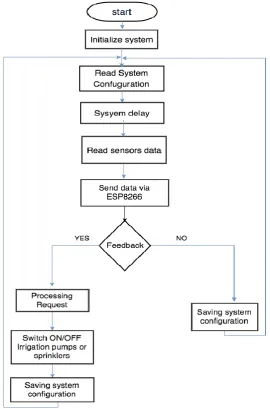
Fig. 1. Flow Chart of Smart Irrigation
A. Water Level Sensor
This sensor uses a pinwheel sensor to measure how much liquid has moved through it. The pinwheel has a little magnet attached, and there‟s a hall effect magnetic sensor on the other side of the plastic tube that can measure how many spins the pinwheel has made through the plastic wall. This method allows the sensor to stay safe and dry.
B. Soil Moisture sensor
The Soil Moisture Sensor uses capacitance to measure dielectric permittivity of the surrounding medium. In soil, dielectric permittivity is a function of the water content. The sensor creates a voltage proportional to the dielectric permittivity, and therefore the water content of the soil. The sensor averages the water content over the entire length of the sensor.
C. Temperature Sensor
III.METHODS
The pipe with water pump is connected to a motor, the other end of the pipe is near to the
root of the plant. The flow of water is managed by solenoid valve. The opening and closing
of valve is done when a signal is send through microcontroller. The water to the root of plant
is done by drop using GSM and moisture level again become normal then sensor senses it and
send a signal to microcontroller and is then closed.
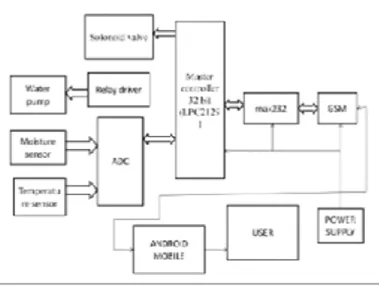
The two SIM of mobile are connected using GSM. The GSM and microcontroller are
connected using MAX232. When moisture of the soil become low moisture sensor sense it
and send signal to mobile and it activate the farmer.
Fig 2: Block Diagram Of Renesas Microcontroller
Algorithm
It states the steps that the proposed system undergoes.
Step 1: Start the process.
Step 2: Initialize power is supplied to GSM
Step 3: Check the moisture level (less than or more than).
Step 4: If the level will be more than a fixed criteria, no need to irrigation
Step 5: If Moisture level is less than a fixed criteria, start irrigation
Step 6: Initialization of pump.
Step 7: After the process completed ,It moves to original state.
Step 8: Stop the process.
differential GPS mounted at the cart to the base station for real-time monitoring and control of the irrigation system. Based on sprinkler head GPS locations, the base station feeds control signals back to the irrigation control station to site-specifically operate individual sprinkler to apply a specified depth of water.
IV.IMPLEMENTATION
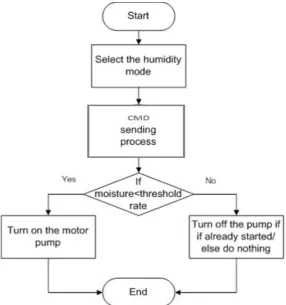
Earlier, farmer faced the problem of sending SMS and making calls, overcoming which we are designing an Android application which does the work by button clicks, here the hardware works in three modes of operation viz. Humidity, Automatic and Manual modes. In Humidity mode, the moisture of the atmosphere is sensed and the switching on/off is done if the weather is dry. In Automatic mode, the hardware automatically turns on the motor for the specified time interval and turns off the motor. In Manual mode, user can turn on and off by pressing the ON/OFF button. All the settings of these features is done via an Android application.
Here we have designed a module using a microcontroller and GSM. Initially farmer needs to check the network by giving a ring to the particular modem number which is implemented near the motor. A user enters the username and password given, which when matches allows the user to switch between the different modes provided. If the password fails to match, no action is taken. In every stage it will send the status to the farmer (authenticated user).i.e., whether the motor is on or off through an SMS. If the motor is on and the farmer needs to switch off he just needs to send an SMS to the same number. The complete operation can be handled by sending an SMS, i.e. by sending ON motor gets on, and by sending OFF motor gets off.
We have three modes of operation. In Humidity mode, the humidity sensor checks the moisture content in the farm and accordingly provides the water required for the crops. In Automatic mode, the timer is set and the motor turns ON/OFF automatically for a certain amount of time. In Manual mode, the farmer has to press ON/OFF for the working of the motor.
MODES OF OPERATION
A. Moisture Settings Manager
B. Automatic Motor Controller
This module is used to control the pump automatically. The pump will be turned on automatically every day at a particular time for 2 minutes, immediately after 2 minutes the pump will turns off. The turning on and off of the pump will work regardless of the moisture rate around the field area. This automatic mode can be set by sending an SMS containing SET2 to the GSM modem in the embedded system connected to the pump.
Fig 4
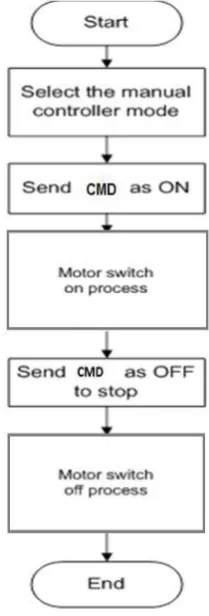
: Flow chart of Automatic Mode C. Manual Controller ManagerThis module is used to control the water pump manually, though without farmer‟s physical presence. We can turn on/off the pump when we require it to. There is no particular time to switch it on or there is no time limit when to turn it off. This module works just by sending an SMS as ON to switch on the motor and OFF to turn off the motor. This SMS has to be sent to the GSM modem connected to the pump.
V. RESULTS AND SNAPSHOTS
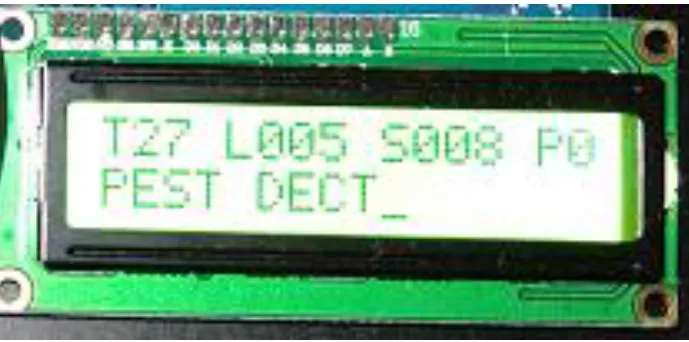
Fig 5: Overall smart irrigation and pest detection system module
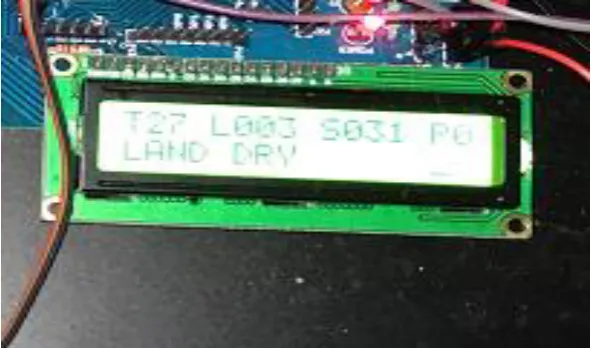
Fig 8
: Land gets dryoutFig 9:Login page of Android Application
VI.CONCLUSIONS
Since earlier days farmer is supposed to visit their agricultural land and check the moisture content of soil manually. To avoid more human efforts this technology can be used. It allows the user to monitor and maintain the moisture remotely irrespective of time. It is really an effective and economic way to reduce human effort and water wastage in agriculture land. Current techniques in agriculture have reduced the ground-water level and availability of human resource. This Irrigation control system using Android can help farmer in many ways through the use of Humidity, Automatic and Manual modes of operation.
R
EFERENCES
[1] R.Suresh, S.Gopinath, K.Govindaraju, T.Devika, N.SuthanthiraVanitha, “GSM based Automated Irrigation Control using Raingun Irrigation System”, International Journal of Advanced Research in Computer and Communication Engineering Vol. 3, Issue 2, February 2014.
[2] Pavithra D.S, M. S .Srinath, “GSM based Automatic Irrigation Control System for Efficient Use of Resources and Crop Planning by Using an Android Mobile”, IOSR Journal of Mechanical and Civil Engineering (IOSR-JMCE) Vol 11, Issue I, Jul-Aug 2014, pp 49-55.
[4] Shiraz Pasha B.R., Dr. B Yogesha, “Microcontroller Based Automated Irrigation System”, The International Journal Of Engineering And Science (IJES), Volume3, Issue 7, pp 06-09, June2014.
[5] S. R. Kumbhar, Arjun P. Ghatule, “Microcontroller based Controlled Irrigation System for Plantation”, Proceedings of the International MultiConference of Engineers and Computer Scientists 2013Volume II, March 2013.
[6] Yunseop (James) Kim, Member, IEEE, Robert G. Evans, and William M. Iversen, “Remote Sensing and Control of an Irrigation System Using a Distributed Wireless Sensor Network”, IEEE TRANSACTIONS ON INSTRUMENTATION AND MEASUREMENT, Volume 57, Number 7, JULY 2008.
[7] Venkata Naga RohitGunturi, “Micro Controller Based Automatic Plant Irrigation System”, International Journal of Advancements in Research & Technology, Volume 2, Issue4, April-2013.
[8] Mahir Dursun and Semih Ozden, “A wireless application of drip irrigation automation supported by soil moisture sensors”, Scientific Research and Essays, Volume 6(7), pp. 1573-1582, 4 April, 2011.
[9] S. Harishankar, R. Sathish Kumar, Sudharsan K.P, U. Vignesh and T.Viveknath, “Solar Powered Smart Irrigation System”, Advance in Electronic and Electric Engineering, Volume 4, Number 4 (2014), pp. 341-346 Karan Kansara et al, / (IJCSIT) International Journal of Computer Science and Information Technologies, Vol. 6 (6) , 2015, 5331-5333.
[10] Arnaud. S. R. M. Ahouandjinou, K. Assogba, C. Motamed, Smart and Pervasive ICU Based-IoT for Improving Intensive Health Care, BioSMART „16, Dubai, UAE, Dec. 4th-7th, 2016.