PROJECT MANAGEMENT PRACTICES AND PERFORMANCE OF AGRICULTURAL PROJECTS BY COMMUNITY-BASED
ORGANIZATIONS IN BUNGOMA COUNTY, KENYA
NALIANYA REMMY SIMIYU D86/CTY/22860/2012
A Thesis submitted to the School of Business in Fulfillment of the Requirements for the Award of the Degree of Doctor of Philosophy in Business (Project
Management) of Kenyatta University
DECLARATION
This thesis is my original work and has not been presented for the award of any degree in any university.
Signature... Date... Nalianya Remmy Simiyu
Management Science Department
We confirm that the work in this thesis was done by the candidate under our supervision.
Signature... Date... Dr. Lucy Ngugi
Department of Management Science Kenyatta University
Signature... Date... Prof. David Minja
Associate Professor
DEDICATION
ACKNOWLEDGEMENT
Many individuals and groups contributed to the success of this thesis. First and foremost I wish to thank God for providing me with the life, energy, and resources to carry out the study. Secondly, I appreciate my supervisor Dr. Lucy Ngugi for her constant support, direction and advice, Prof. David Minja for his encouragement, guidelines and constant responses which has gone a long way to help me in developing this thesis.
Thirdly, I would also like to thank Kenyatta University management for providing a chance to pursue this degree. Special acknowledgement to the university administration for improved management programs that help students to complete their study in the stipulated time. I would also like to appreciate the efforts made by my other lecturers, Dr. James Rosemary, the chairperson of management science, for coordinating departmental programs that have necessitated smooth flow of systems, Dr. Muathe Stephen for his inspirations and Dr. Nzuki for his research guidance.
TABLE OF CONTENTS
DECLARATION... ii
DEDICATION... iii
ACKNOWLEDGEMENT ... iv
TABLE OF CONTENTS ...v
LIST OF TABLES ... ix
LIST OF FIGURES ... xi
OPERATIONAL DEFINITION OF TERMS ... xii
ABBREVIATION AND ACCRONYMS ...xv
ABSRACT ... xvii
CHAPTER ONE: 1 INTRODUCTION ...1
1.1 Background of Study ...1
1.1.1 Project Performance ...2
1.1.2 Project Management Practices ...4
1.1.3 Project Management Practices and Project Performance ...8
1.1.4 Environmental enablers ...10
1.1.5 Agricultural projects by CBOs in Bungoma County ...10
1.2 Statement of the Problem. ...12
1.3 Objectives of the Study ...14
1.3.1 General objectives of the study ...14
1.3.2 Specific Objectives. ...14
1.4 Research hypothesis ...15
1.5 Significance of the Study ...16
1.6 Scope of the study ...17
1.7 Limitations of the Study...17
1.8 Organization of the Study ...18
CHAPTER TWO: LITERATURE REVIEW ...19
2.1 Introduction ...19
2.2 Theoretical Literature Review ...19
2.2.2 Management Theory of project Management ...20
2.2.3 Resource based theory ...23
2.2.4 Social Information Processing Theory ...23
2.2.5 Communication Accommodation Theory ...24
2.3 Empirical Review...24
2.3.1 Project Planning and Project Performance ...25
2.3.2 Project Implementation and Project Performance ...28
2.3.3 Project Monitoring and Evaluation and Project Performance ...30
2.3.4 Project Communication and Project Performance ...33
2.3.5 The Environmental as a Project enabler ...38
2.4 Summary of research gaps ...41
2.5 Conceptual Framework ...45
CHAPTER THREE: RESEARCH METHODOLOGY ...47
3.1 Introduction ...47
3.2 Research Philosophy ...47
3.3 Research Design...48
3.4 Empirical Model ...49
3.5 Operationalization of Variables ...51
3.6 Target Population ...53
3.7 Sampling Design and Procedure ...55
3.7.1 Data Collection instruments ...56
3.8 Validity and Reliability of research instruments ...57
3.8.1 Pilot Testing ...57
3.8.2 Validity of Research Instruments ...57
3.8.3 Reliability of Research Instruments ...58
3.9 Data Collection Procedure ...59
3.10 Data Analysis and Presentation ...60
3.10.1 Diagnostic tests ...61
3.11 Ethical Considerations ...62
CHAPTER FOUR: RESEARCH FINDINGS AND DISCUSSION ...64
4.2 Response Rate and Reliability ...64
4.2.1 Response rate for questionnaire ...64
4.2.2 Reliability test Statistics ...66
4.3 Background information descriptive Statistics ...67
4.3.1 Gender of respondent ...67
4.3.2 Age of Respondents ...67
4.3.3 Educational level ...68
4.3.4 Experience ...69
4.3.5 Location ...69
4.3.6 Sponsors ...70
4.3.7 Types of common Horticultural Crops Grown ...71
4.4 Descriptive Statistics for the Study Variables ...73
4.4.1 Project Planning ...73
4.4.2 Project Implementation ...79
4.4.3 Project Monitoring and Evaluation ...83
4.4.4 Project Communication ...86
4.4.5 Environmental Enablers ...89
4.4.6 Agricultural Project Performance...92
4.5 Regression Analysis ...97
4.5.1 Diagnostic Tests ...97
4.5.2 Multiple Regression results ...100
4.5.3 Moderating effect results ...105
4.6 Qualitative Data Analysis ...108
CHAPTER FIVE: SUMMARY, CONCLUSIONS, AND RECOMMENDATIONS ...111
5.1 Introduction ...111
5.2 Summary ...111
5.3 Conclusions ...112
5.4 Contributions of the Study to Knowledge ...113
5.5 Recommendations for Policy Implication ...115
5.6 Suggestions for Further Research ...117
APPENDIX 1: INTRODUCTORY LETTER TO THE RESPONDENTS ...124 APPENDIX II: QUESTIONNAIRE ...125 SECTION H: PERFORMANCE OF AGRICULTURAL PROJECTS ...132 APPENDIX III: INTERVIEW GUIDE FOR FIELD OFFICERS ON
PERFORMANCE OF AGRICULTURE BASEDPROJECTS IN BUNGOMA
LIST OF TABLES
Table 2.4 Summary of Research Gap ... 41
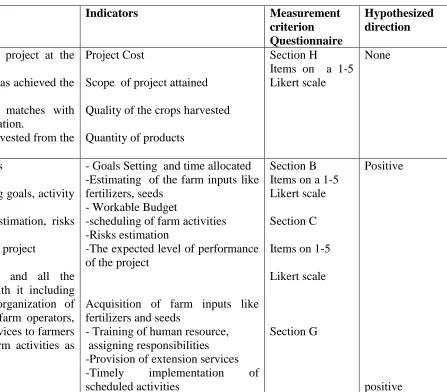
Table 3.1: Operationalization of Variables ... 52
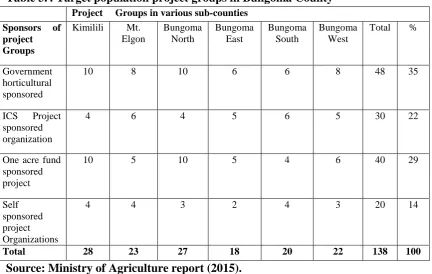
Table 3.4 Target population project groups in Bungoma County ... 54
Table 3.5 Sampled Population ... 56
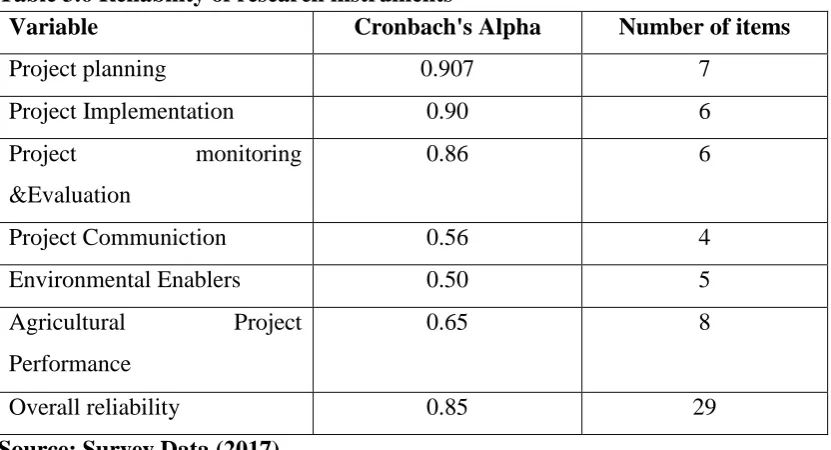
Table 3.6 Reliability of research instruments ... 59
Table 4.1: Reliability Test Statistics ... 66
Table 4.2 Distribution of respondents by Gender ... 67
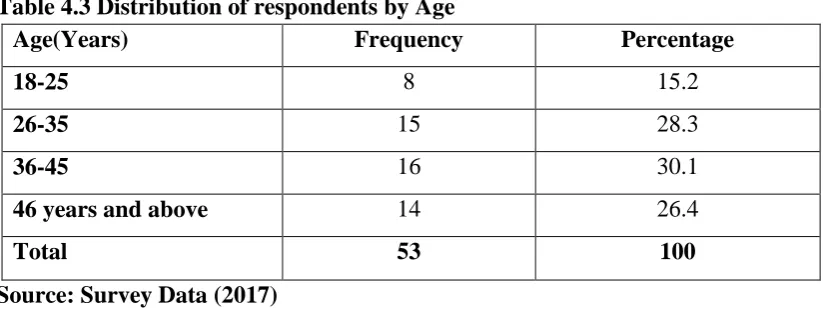
Table 4.3 Distribution of respondents by Age ... 68
Table 4.4 Distribution of respondents by Educational level ... 68
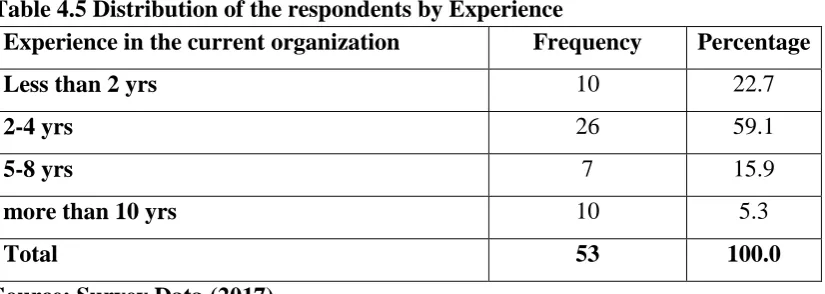
Table 4.5 Distribution of the respondents by Experience ... 69
Table 4.6 Pattern of the Respondents on location of projects ... 70
Table 4.7 Characteristics of the Respondents as per their project sponsors ... 70
Table 4.8 Characteristics of types of horticultural crops grown ... 71
Table 4.9 Other types of crops grown ... 72
Table 4.10 Purpose of starting the project ... 74
Table 4.11 Availability of written project plan ... 75
Table4.12 Planned for farming activities ... 76
Table 4.13 Response on project planning ... 77
4.14 Management participation in project implementation ... 79
Table 4.15 Acquisition of farm inputs ... 80
Table 4.16 Response on Project Implementation ... 81
Table 4.17Presence of a constitution that governs project members ... 83
Table 4.18 Responses on Monitoring and Evaluation. ... 84
Table 4.19 Responses Project Communication ... 87
Table 4.20 Fitness of environment... 89
Table 4.21 Responses to Environmental Enablers on Performance of Agriculture Projects ... 91
Table 4.22 Performance of agricultural projects... 93
Table 4.23 Reasons for poor projects performance ... 94
Table4.24 Response on performance of Agriculture Projects ... 95
Table 4.25 Shapiro-Wilk Test for Normality ... 98
Table 4.27 Results for Multi-colinearity Test ... 99 Table 4.28 Regression results of joint effect of project management practices on performance of agricultural projects. ... 100 Table 4.29(a) Regression of Performance on Project management practices and
LIST OF FIGURES
Fig 1.1 Production in MT of horticultural crops in Bungoma North from 2007 to 2014
... 12
Fig 2.2: The closed loop of the managerial process in project management ... 22
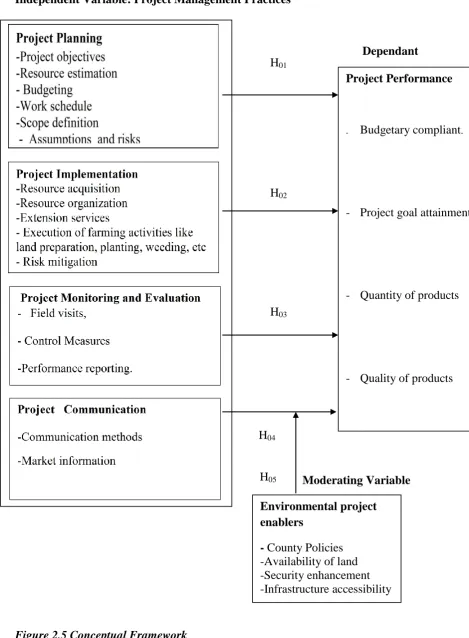
Figure 2.5 Conceptual Framework ... 46
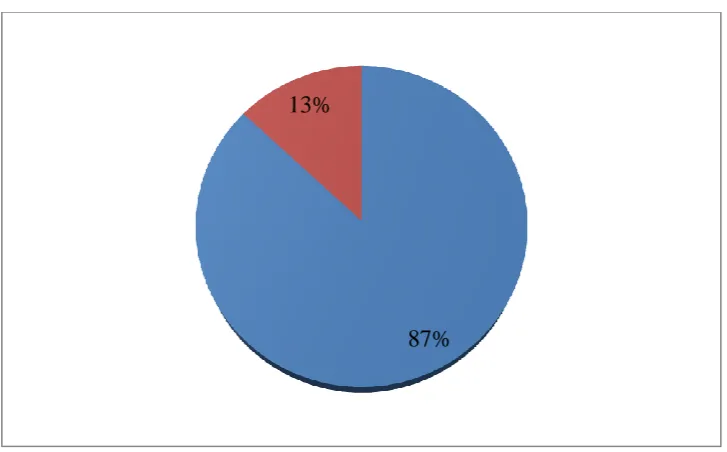
Fig 4.1 Response rate for questionnaires ... 65
OPERATIONAL DEFINITION OF TERMS
Agricultural extension Services: Methods of providing farmers with relevant information with respect to crop cultivation, marketing, and training in new technologies.
Agricultural projects: Activities that involve farming of short term crops and Animal husbandry set up with unique approaches to address a specific situation like poverty or hunger.
Community Based Organization: A group of individuals organized by and for a particular community engaged in some income generating activities within the agricultural projects.
Horticultural projects:Projects that deal with the art of growing of crops that take a short time to mature like fruits, vegetables, nuts, seeds, herbs, sprouts and flowers using improved technology.
Evaluation: Formal methods of providing regular oversight of farm implementation activities in terms of work schedule, targeted output among others.
Environment Project enablers: Environmental aspects that contribute to or influence a project success such as supportive county policies, environmental risk mitigates and security of the project.
Information Management: Methods employed by managers to send and receive information between two or more parties.
documentation of project activities and regular reporting to give feedback for the purpose of improving the project. One acre fund: Is a nonprofit organization that supplies smallholder farmers
in East Africa with asset-based financing, tools and farm inputs like seeds and fertilizers.
Projects: An endeavour in which human, material and financial resources are organized within constraints of cost and time, so as to achieve beneficial change defined by quantitative and qualitative objectives.
Project Communication: Communication methods used while running the project ranging from verbal communication, extension, and application of modern technology like ICT.
Project Implementation: Project execution and all the activities associated with it including resource acquisition, an organization of materials and training farm operators, providing extension services to farmers and implementation farm activities as per the plan. Project Planning: A set up design scheduling all activities starting with
identifying goals, activity sequencing, resource estimation, risks to proposal writing involved in the running of the project for it to meet the set objectives.
Project performance: Estimation of the extent to which specific objectives are achieved in relation to the cost of running the project, time, scope of the project and quantity and quality products.
planning, executing, monitoring, controlling, communication systems and closure of projects to ensure its success.
Return on investment: The net benefits realized out of an investment. Scope of the project: The extent of activities entailed in the project.
ABBREVIATION AND ACCRONYMS
CIG - Common Interested Groups CLRM - Classical linear regression model
IFAD - International Fund for Agriculture Develop IERD - ICT Education for rural development ICT - Information Communication Technology ICS - Investing In children Society
ICFM - International Christian Fellowship Mission ICS - Investing in Children Society
IICD - International Institute for Communication and Development ICTD - Information Communication Technology for Development GDP - Gross Domestic Program
FGLS - Feasible Generalized Least Square. KARI - Kenya Agriculture Research Institute
KIPPRA - Kenya Institute of Public Policy Research and Analysis LFA - Logical Framework Approach
MOLD - Ministry of Livestock Development MNO - Mobile Network Opera
MOA - Ministry of Agriculture
MDG - Millennium Development Goals MIS - Management Information systems
NASEP - National Agriculture Sector Extension policy NALEP - National Agriculture and Livestock Programme NGO - Non-Government Organization
RKN - Rural Knowledge Networking
SPSS - Statistical Packages for Social Scientists SMS - Short message Service
UNDP - Unit National Development Program
ABSRACT
CHAPTER ONE INTRODUCTION 1.1Background of Study
One of the most important organizational developments in recent years has been the significant growth in project work across different sectors and industries (Maylor, 2006). Projects are used as a means of reducing problems of poverty, poor health, and unemployment which are predominant in rural set up of many developing countries (International Development Research Centre, 2004). Many developed and developing countries have invested in agricultural projects. Mrema, Baker, and Kahan (2008) reveal that in some developed countries like U.S.A the government through the ministry of agriculture places a high emphasis on the performance of agricultural projects. Dwyer and Black (2007) revealed that in the United Kingdom, the government policy on agriculture reforms was aimed upon basic research which provides evidence-based recommendations drawn from holistic analysis of contemporary top project performance in different agricultural sectors.
According to the appraisal report for area-based agricultural modernization programme of Uganda by Ssekandi and Chen (2010), the growth of agricultural projects plays a fundamental role in reducing poverty. The government of Uganda adopted the modernization of agriculture as its policy goal for addressing widespread poverty. As a strategy the policy was charged with the use of improved technologies of farming which included the use of strategic plans and digital monitoring systems, improving access to information on ways of acquiring credit, farm inputs and access to a market which led to an increased agricultural productivity.
Kenya's economy is heavily dependent on the agriculture sector and the sector serves as the basis for the development of other sectors (Republic of Kenya National Development plan, 2002). The agriculture sector has a direct contribution to Gross Domestic product (GDP) of 25% and indirectly contributes a further 27% through linkages with agro-based and associated industries (KARI, 2014). The sector employs about 75% of the total labour force, generates 60% of export earnings, and provides 75% of industrial raw materials and 45% of Government revenue. Due to the major role, the sector has placed a lot of emphasis on agricultural projects. One of the strategies adopted by the government is the funding of youth and women to form groups which are then funded to run agricultural projects. These project groups, however, have not performed as expected. (Ministry of Agriculture report, 2011).
1.1.1 Project Performance
Nicolus (1998) views project performance with respect to project objectives and the project is viewed to be performing so long as the project satisfies project objectives. Kezner (2007) notes that a project is said to be performing when it has achieved the project objectives, within time, within cost at the defined performance level while utilizing the assigned resources effectively and efficiently. Pinto and Slevin (1998) define project performance to mean achieving deadlines within the budget and making the customer happy within programmed time, cost, quality, and safety.
Burke (2009) gives a more current perception of performance to mean project success which include completion of the project within the allocated time, within the budgeted cost, at the proper performance or specification level with the acceptance by the client or end user within minimum or mutually agreed upon scope change, without disturbing the main work flow of the organization and without changing the corporate culture. This study adopted the definition given by Burke since it is more contemporal and addresses comprehensive aspects of project performance. Therefore this study measured performance using the following indicators: budgetary compliant, project goal attainment, the quantity of products and products quality.
opportunities by promoting entrepreneurship, innovation, value addition, access to information, linking farmers to markets, access to rural finance and establishing strategic partnership (MOA and MOLD report,2011). Most of the population in rural communities, however, is still suffering from persistent food insecurity and poverty despite all the efforts made by the government through NALEP service extension groups (Youn, 2013).
1.1.2 Project Management Practices
Chandra (2010) noted that projects management is an important activity in many organizations which serves as a strategy for implementation and continuous improvement of projects. Similarly, development sectors such as infrastructure renewal, urban regeneration, and community development, project management practices are becoming increasingly important since good organization and management of projects helps in developing related sectors (Child & McGrath 2001). Project Management Practices are activities that are exercised by the project managers that ensure project success. They include initiating, planning, executing, monitoring and controlling communication systems to ensure project success (Harvey, 2005). Management practices help in organizing and managing resources in such a way that resources deliver all the work required in completing the project within the defined scope, time and cost constraints.
understanding of the application of the required skills, tools and techniques to project activities which is important in delivering expected benefits.
Heldman (2002) reveals that management issues affecting projects include effective planning, effective monitoring and evaluation (M&E), effective project team, proper project scoping, realistic requirement, delays in release of funds for the project, management support and right commitment to the project, community participation and user involvement, demand on project resources by certain key stakeholders, proper feasibility study, adequate basis for the project.
The management practices exercised within the project group like project planning, project implementation, communication management, monitoring, and evaluation are seen to be endogenous while others practiced out of the organization but affect the performance of the projects like environmental enablers and political environment form part of exogenous management practices (Grisham, 2006).
Project planning is a creative and demanding activity of working out what has to be done, how, when, by whom and with what is involved to be done for the particular job in the mind. It is perhaps the most important phase in the project life cycle (Project Management Institute, 2004). It involves preparation for the project to take off smoothly. It is essential that the planning phase is completely done as it forms the basis for the next phase; the implementation phase.
incorporates project initiation, definition, and appraisal. During the planning process, the functional departmental manager develops operational plans that are integrated to form the project plan which focuses on the activities that must be performed to produce the project results or deliverables.
Project implementation entails the execution and actualization of all the activities given in the planning of projects. It takes 80-85% of all the project activities and resources utilization. It requires a combination of techniques, procedures, people and systems focused on the successful completion of a project (Meredith & Mantel, 2010). Due to its significance, there is a great need for coordination, monitoring and controlling together with the application of all techniques of project management. It is in this phase that planning effort, change management, communication management, and motivation is also exercised as part of project management practices. Project implementation includes hiring the required skills, training some of the people without necessary skills, assigning responsibilities, and establishing performance standards as well as the reporting process.
According to the International Union for Conservation of Nature (IUCA, 2014), Project implementation covers all the activities associated with it. The activities include resource acquisition, an organization of materials, training farm operators, providing extension services to farmers and implementation farm activities as per plan. These activities serve to effectively organize the work of the team that will finally lead to a better outcome from the given project.
across all the activities in planning and implementing of the project though is one of the approaches that are lacking in a significant proportion of about 40% in community based projects management completed at the turn of the millennium. According to Joe and Nay (2004), effective monitoring requires adequate planning, baseline data, indicators of performance, that result in practical implementation mechanisms that include actions such as filed visits, stakeholders meetings, documentation of project activities and regular reporting.
Slaymaker and Chapman (2002) point out that improved communication enables project members to access information that can impact positively on the development of agriculture projects in poor remote areas. The power of ICT, for example, to connect the rural areas with the world‟s information society has helped to break down barriers to knowledge and information exchange. Proper management of ICT has led to an overall enthusiasm subsequently resulting in a multitude of projects that are ICT based and help to obtain more information that serves to improve projects for rural inhabitants. Ochola and Kiplakat (2005) however point out that despite the importance of ICT, so little has been achieved in the sector of communication especially in projects initiated in rural areas where 70 to 80% of the population still are largely uncovered by efficient telephone services.
also reveals that project environment on the other hand in many developing countries like Nigeria present special encounters for project managers that almost pre supposes extensive cost and time overruns even before a project commences. These situations arise mainly from inherent risks such as political instability, excessive bureaucratic contract procedures, and lack of adequate infrastructures such as transportation networks, electricity supply, and telecommunications systems.
1.1.3 Project Management Practices and Project Performance
Harvey (2005) and Chandra (2010) points out that for any project to perform, it is important to understand the degree of influence made by the project management practices in any organization. According to Cusworth and Franks (2003), project management practices have mainly contributed to either the success or failure of most of the projects. Morris (2004) concurs, stating that the poor project management practices often lead to projects being completed late or over budget, do not perform in the way expected, involve severe strain on participating institutions and or are cancelled prior to the completion after the expenditure of considerable sums of money.
According to Adriana, Nagy, and András (2011), the modern production, processing, and trading of agricultural products require the adaptation of newer technologies. The Faculty of Agricultural Economics and Rural Development of the University of Hungary have used regional enterprises to employ several students who studied project management as well in agricultural projects. The students employed are believed to have high management and technological skills necessary for better project performance. Furthermore, the faculty organizes specific training in project management to give the opportunity to the practicing managers to improve their knowledge.
1.1.4 Environmental enablers
The natural environment can be affected by a project company‟s activities and through channels such as climate change; the environment can also affect the projects. (Boutilier, 2001). Nardia and Griffiths (2007) point out that the non-human natural environment should be incorporated as a stakeholder in project management. The study argues that the natural environment is a vital part of the business where land, policies and security systems should be guaranteed for any project successes. Including the environment brings a holistic, value oriented, focused and strategic approach to project management. According to Lichtenberg (2000), the farm environment has traditionally has been an important source of direct consumption goods for farmers. Ground water and local streams can be a major source of water for agricultural crops. Protecting wildlife habitat, water quality, ensuring security and other aspects of the environment can thus be equivalent to protecting farmers‟ standards of living.
1.1.5 Agricultural projects by CBOs in Bungoma County
There are many community based organizations operating in Bungoma County which are sponsored by different entities that include government sponsored, self-sponsored, nongovernmental organizations like Investing in Child Society(ICS), Omwabini, International Fellowship Christian Mission (ICFM) and one acre fund. The government through the ministry of agriculture gives grants and loans to youths and women through their community groups to start and run projects. Nongovernmental organizations also give grants to groups but expect the project beneficiaries to extend their services to promote the entire community. The self sponsored project group raises their own capital to start their projects but work within stipulated constitution while the one acre fund is a separate enterprise sponsored by Billy Gate foundation to promote majorly maize planting in the County (Small holder Horticultural Marketing program report, 2010).
According to Ministry of Agriculture (2014) report one acre fund and ICS are the most active organizations especially in western Kenya which offer farmers a diversified loan package that include farm inputs and a variety of crops, including maize, millet, sorghum, sweet potatoes, beans, and cassava apart from supporting poultry and dairy farming. The organizations practice the farming in groups but also promote individual farming through extension services (Ministry of Agriculture, 2012).
Period in years
Fig 1.1 Production in MT of horticultural crops in Bungoma North from 2007 to 2014
Source; (Ministry of Agriculture, 2014)
From the performance illustrated in the fig 1.1 bananas and tomatoes indicated the highest performance but there was no remarkable improvement in performance between 2007 to 2014. All other horticultural crops had either same production or even dropped. The performance trend of most crops is generally fluctuating with some crops having their production improving after one year or two but later declines. This report provokes the need for more study to find out the reasons for this state in the performance of the agricultural projects in Bungoma County
1.2Statement of the Problem
Project failure rates in Kenya are high and the costs involved in starting and running them are equally high (Kenya Agriculture Research Institute, 2012). The findings of an impact assessment on community-funded projects showed that only 5 out of 36
0 1000 2000 3000 4000 5000 6000 7000 8000 9000
2007 2008 2009 2010 2011 2012 2013 2014
tomatoes
bananas
onions
mangoes
avocados
passion fruits Amount
project groups in Bungoma County funded in 2007 were partially active, while the rest had become defunct and could not be traced after cessation of funding (Wabwoba & Wakhungu, 2013).
Despite the ministry of agriculture report on smallholder horticulture marketing program (2014) recommendations through the NALEP service extension group to increase the number of community based organizations and improve skills of farming, there is still persistent food insecurity and poverty among the rural communities in some Counties like Bungoma having 53% of its population still suffering from intense poverty and malnutrition. Most of the agricultural projects are either completed late with over budget and others remain uncompleted with no clear accountability (Youn, 2013).
project management practices influencing the performance of agricultural projects in Bungoma County, Kenya.
1.3Objectives of the Study
1.3.1 General objectives of the study
The aim of this study was to investigate the influence of project management Practices on the performance of agricultural projects by the community based organization in Bungoma County, Kenya.
1.3.2 Specific Objectives
i. To establish the influence of project planning on the performance of agricultural projects by Community based organizations in Bungoma County, Kenya.
ii. To investigate how project implementation influence the performance of agricultural projects by Community based organizations in Bungoma County, Kenya.
iii. To find out the influence of project monitoring and evaluation on the performance of Agricultural projects by community based organizations in Bungoma County, Kenya.
iv. To examine how Project communication influences the Performance of agricultural projects by community based organizations in Bungoma County, Kenya.
agricultural projects by Community based organizations in Bungoma County, Kenya.
1.4Research hypothesis
H01: Project Planning does not significantly influence the performance of agricultural projects by community based organizations in Bungoma County, Kenya
H02: Project Implementation does not significantly influence the performance of agricultural projects by community based organizations in Bungoma County, Kenya
H03: Project monitoring and evaluation does not significantly influence the performance of agricultural projects by community based organizations in Bungoma County, Kenya.
H04: Project communication does not significantly influence the performance of agricultural projects by community based organizations in Bungoma County, Kenya.
1.5Significance of the Study
The study would be significant to the Ministry of Agriculture and Ministry of livestock in Kenya as well as Bungoma County government. It is expected to enable the ministries to enact policies and make decisions which provide would provide a conducive environment for agriculture projects to grow and improve the national GDP. In budgeting, the study would help the relevant ministries to give funding priorities to the management aspects that are more predominant and demanding to ensure the success of the projects.
The community based organizations would benefit from the study by understanding the role of management practices of projects in their organizations. The CBOs would use the information to shape the future of their projects by understanding key issues that should be addressed to promote their performance as well as giving an opportunity to invest rationally in future projects. The farmers were also expected to share with other agencies like government and donors on their discoveries and experiences which is expected to help in advising on future project plans and implementation strategies.
1.6Scope of the study
The study focused on project management practices of all community based organizations in the County. The study involved138 agricultural projects carried out by CBOs project groups in Bungoma County. Bungoma County was chosen since the county is endowed with good soils and conducive climate for the production of several agricultural crops. The Study addressed agricultural projects only because Bungoma County is majorly an agricultural based zone. The study covered four project management practices, project planning, project implementation, project M&E, and project communication since they appeared outstanding in the literature review. The natural occurring variables like weather and landscaping affecting project performance were not considered in this study since these variables have not changed for a long time Bungoma County.
1.7Limitations of the Study.
The study had some limitations as discussed in this section. The study though targeting project outcomes that involve many participants like farmers and local leaders other than management, only involved the field officers and farm coordinators as respondents. The findings were regarded as representative of all the agriculture project groups in Kenya. To address this limitation issues that address separate projects can be handled as isolated cases in demographic information.
Kenyatta University and NACOSTI which assured the respondents of the academic purpose of the study and was to be treated with maximum confidentiality.
1.8Organization of the Study
Chapter one dealt with an introduction, statement of study, objectives, hypothesis and significance of the study, the scope of the study, limitations and study organization. Chapter two presents an extensive theoretical and empirical literature review of the major variables of the study, namely project planning, project implementation, project M&E, and project communication in the context of performance of agricultural based projects. The chapter also presents a conceptual framework of the study depicting the relationship between variables.
Chapter three gives the methodology of the study in which research design, philosophical orientation, target population, sampling procedures, research instruments, and operationalization of variables. The chapter also contains empirical models used to test the hypotheses as well as ethical considerations of the study.
CHAPTER TWO LITERATURE REVIEW 2.1Introduction
This chapter seeks to bring out theoretical issues on the project management practices influencing the performance of agricultural projects in Bungoma County, Kenya. It has identified variables like Project planning, Project implementation, project M&E, Project communication, and environmental enablers and their influences on agricultural project performance and shows what other researchers have done and relates them to the study. The chapter is organized starting with the theoretical review, and then empirical review focuses on the above variables. The empirical review is organized as per objectives and give a critical approach to researches done including their methodologies. A conceptual framework is finally drawn at the end of the chapter with clear indicators.
2.2Theoretical Literature Review
This study was underpinned by a number of theories commonly used in project performance including Theory of constraints, Theory of Management; Resource based theory, Social Information Processing Theory and Communication Accommodation Theory.
2.2.1 Theory of Constraints (TOC)
only as good as its weakest link. It assists organizations in achieving their goals by providing a mechanism to gain better control of their initiatives. TOC is a systemic way to identify constraints that hinder system‟s success and to effect the changes to remove them.TOC consists of separate, but interrelated concepts such as performance measurement processes, logical thinking processes, and logistics. The logical thinking process of TOC gives us a series of steps that combine cause-effect, experience, and intuition to gain knowledge. The theory, in this case, addresses dependent variable, project performance. For any project to perform there is a need to minimize the constraints that can otherwise reduce the quality and quantity of the product and services delivered. These constraints may include poor management practices such as cost overruns caused by poor budgeting and corruption. The theory points out the need for project management to identify project constraints that can limit the performance of the project and tries to give direct approaches on how to solve the constraints. This study will augur its discussion on this theory since it checks on issues that can limit project performance.
2.2.2 Management Theory of project Management
According to (Koskela & Howell, 2002), the theory of execution asserts that managerially, execution is about dispatching tasks to work stations and this is also regarded as the classical communication theory. However, for execution to be effective, the classical communication theory must be complemented with the language/action perspective the vice used in communicating the tasks dispatched to work stations must be completely comprehensive to the operatives. There should be feedback mechanisms that will convey the operatives understanding of the instruction passed and as such, enable tasks to be executed as it is envisaged in the plan.
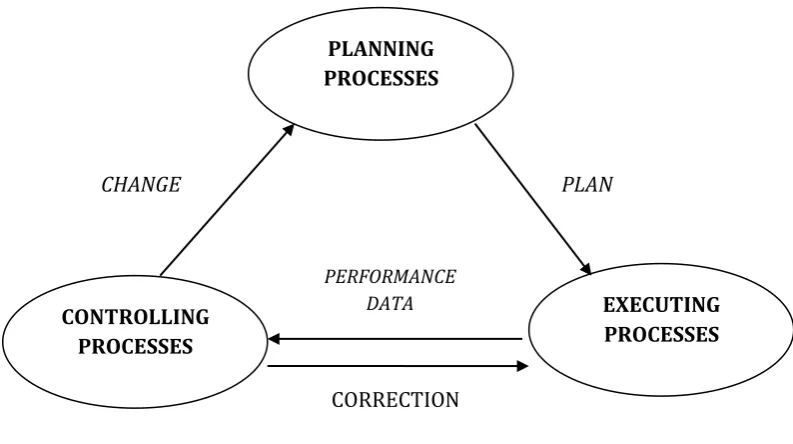
The theory of control consists of two models: themostat model and the scientific experimentation model (Koskela & Howell, 2002). Themostat model conceptualized that in the production process, there is a process to control, a unit for performance measurement, a standard of performance, and a controlling unit, while the scientific experimental model of control as advocated by Shewhart and Deming (1983) cited in Koskela and Howell (2002) focuses on finding causes of deviations and acting on those causes, instead of only changing the performance level for achieving predetermined goals in the case of deviation. The scientific experimentation model adds the aspect of learning to control (Koskela & Howell, 2002). Thus, project control involves gauging performance, identifying deviation and learning what are the causes of deviations, their effects and the best means of countering them. The learning process is an avenue that can be used by contractors to improve on their project performance.
Fig 2.2: The closed loop of the managerial process in project management
Source :( Project Management Institute, 2004)
The three theories; planning Theory, Theory of execution and control Theory all address the independent variables in this study, project planning at the managerial level, controlling processes like M&E and implementation or execution of projects. The planning of agricultural projects should be approached at managerial level through the organization of resources like manpower, materials, time and money. The execution of the project is important and takes the major part of the agriculture project. This is addressed through execution theory. Finally, M&E is a control measure for the performance of any project since it controls all the operations which are geared towards performance. These variables are addressed in the theory of control in this study.
PLANNING PROCESSES
EXECUTING PROCESSES CONTROLLING
PROCESSES CHANGE S
PLAN S
PERFORMANCE DATA
2.2.3 Resource based theory
Barney (1991) developed a resource based theory. The theory states the possession of strategic resources provides an organization with a golden opportunity to develop a competitive advantage over its rivals. This competitive advantage can help the organization to enjoy strong profits compared to similar rival groups. Project managers have a role to utilize the available resources all through the project cycle stages as follows; identify and classify the firm‟s resources, appraise strengths and weaknesses relative to competitors. Identify opportunities for better utilization of resources, Identify the firm‟s capabilities, Appraise the rent generating potential of resources and capabilities in terms of their potential for sustainability, Select a strategy which best exploits the firm‟s resources and capabilities relative to external and Identify resource gaps which need to be filled (Johnstone &Brenman,1996).
This theory explores the need for proper planning and implementation based on resources available. In this way, the management takes an advantage of the available resources and utilizes them to maximize performance. The theory hence addresses the independent variables since it emphasizes proper planning, implementation, and monitoring of project resources.
2.2.4 Social Information Processing Theory
keep in that mind on line relationships also matter, project managers should put more care with their words and how to properly relay their message despite lack of social context. The theory gives emphasis to improved project communication methods between the management and the farmers. The management should impress the developed online communication as a project management practice to help acquire global information that will enhance project performance.
2.2.5 Communication Accommodation Theory
Kylie (2013) came up with another theory of Communication Accommodation which argues that an individual adapts to the person they are communicating with. An individual should try to accommodate others when they interact by changing speech patterns body language and gestures. Project managers have a duty to communicate well with the members. However, the theory warns the management to try to avoid over accommodation that can happen in four ways which are overdoing, sensory, dependency and intergroup accommodation. The theory emphasizes the need to change communication approaches and use the ones that suit a particular group or team to help collect all the required information from the project groups for better performance.
2.3Empirical Review
2.3.1 Project Planning and Project Performance
According to Barry, Dent and Dubois (2000) on a study on Rural Planning in the Developing World rural planners done in developing countries have tended to focus on the provision of social infrastructures like roads, schools, and clinics. Planning for the rural areas has been mainly a top-down process, usually the domain of government departments concerned with rural development, agriculture and natural resources e.g. fisheries, forestry, wildlife, water. The findings of the study show that project plans have usually been made in offices, remote from the areas being planned and the people who would be affected. This approach makes plans lack domestication to the environments they are supposed to be implemented. In the long run, the farmers do not own the project, feel imposed to and the quality and quantity of produce are highly compromised.
taken by nationals as part of the raising of awareness of the issues and possible responses.
Weiss and Wysoiki (2012) add that commonly, procedures set out in planning manuals have been rigidly applied and their focus has been largely on the use of land and land resources. The planning process has relied, first, on the gathering of information about the natural resources and socio-economic conditions of the area under consideration, followed by analysis and interpretation, all as a professional exercise
The issues raised by this study are supported by Hedmanan (2002) which reveal that donor assistance is likely to require considerable investment in training, building capacity and skills, and providing incentives which will encourage bureaucracies to change which requires a long term commitment. Without this, continued investment in or support for projects which arise from flawed planning processes will lead to poor project performance and poverty.
According to Anandajayasekeram (2014) in the study on Agricultural project planning and analysis in Belgium, Project planning represents processes during the identification and preparation stages of the project life cycle in which the broad context of project operation is clarified. The planning stage is where particular problem areas are identified and clear objectives are set to achieve the required changes; where alternatives are developed and choices are made; and where appropriate actions are prepared for implementation.
development programs and national goals are very useful in effective participativeprojectplanning.LFA is essentially used as a tool to clarify cause-effect relationships and to clarify the logical link between project inputs and objectives; project activities and outputs; broader purposes; and the ultimate goals a project could serve. LFA is, therefore, a systematic planning process based on logical deductions. Experience and knowledge are important to apply LFA. Taylor (2006) also points out that Project planning provides the framework for project management, implementation, monitoring, and evaluation. To participate in and manage the planning process it is important to learn to work with uncertainty, subjective perceptions and values, and flexibility, openness, and communication. Participation is a key to successful project planning.
2.3.2 Project Implementation and Project Performance
According to Christen and Pearce (2005) on a study on managing risks and designing products for Agricultural projects and International Fund for Agricultural Development in Rome, bureaucracy in Government has affected implementation of policies related to food security issues. Sometimes these policies are inappropriate or unrealistic and may become vulnerable to economic and political dynamic shifts. The effect may cascade down and affect funding of agricultural activities especially those that are funded by donors and other providers involved with agricultural activities. The findings of the study show that red tape may increase the cost of credit thereby discouraging borrowers from financial institutions thereby hampering smooth project implementation. These policies cause a delay in the process of availing loans to farmers which will contribute to 50% failure interims of execution of the ventures. This will eventually lead to reduced food production and high poverty rates.
related to project management easily especially in agricultural setups in rural areas where women dominate.
According to Laurent (2007) on a study on Currency Transfers by Denomination in Chicago points out that modern information and communication technologies have the potential to increase agricultural productivity through communicating knowledge and information to rural agricultural communities, providing capacity building, accessing markets and credit. The findings of the study reveal that Project managers have used ICT to advance their strategies in several ways to enhance successful project implementation. Over the last few years, several banks have embraced mobile banking technologies, enabling customers to access their bank via their mobile phones. This has helped quick access to funds that have facilitated the smooth running of the farming activities during the implementation of the project.
Project Management Institute (2013) adds that educated society is geared towards correct implementation of setting up plans from management groups since they are able to interpret and apply the given agricultural activities. Dynamism in project activities requires fairly skilled manpower that can interact objectively to achieve project outputs and outcomes. Data exists which points to the fact in the market-place males can succeed with fewer years of schooling than can their female counterparts.
project Management, the decision making is largely taken care of in the planning stage and thus dispatching is reduced to mere communication or authorization to start work.
According to Ndede (2015)on the study entitled leading microfinance institutions in Kenya, including Jamii Bora, K-Rep and Faulu Kenya have also introduced services based on SMS that let their clients view their balances, request account statements and transfer of money. Technology and innovation are therefore a major component of project design and implementation. M-PESA‟s growth is a classic example and its contribution to social activities. Through this platform salaries are paid to farmers involved with projects, information concerning important decisions is conveyed through mobile phones. Project managers also pass important extension message ideas through phone technology.
2.3.3 Project Monitoring and Evaluation and Project Performance
practical implementation mechanisms that include actions such as filed visits, stakeholders meetings, documentation of project activities, regular reporting.
(UNFPA, 2004) points out that in adopting the results-based on M&E framework, care must thus be taken to ensure M&E processes, findings and results form an integral part of the overall project management system. Crucially important for an effective M&E system is the choice of what to track, document and analyze and who should be involved in this. Concepts for deciding what to monitor and evaluate are relevance, cost effectiveness, efficiency, results-orientation, and sustainability of the system. A common mistake in M&E is to gather too much information. This complicates analysis and creates delays, resulting in confusion and non-timely action or no corrective action at all being taken. It should result orientation meaning drawing attention to and highlighting successes as well as failures, rather than merely reporting on progress in meeting targets (Monterrey, 2012).
Joe & Nay (2004) asserts that monitoring in general sense is used to describe a systematic framework to collect and analyze information on events associated with implementation policy with the view to improving the management. The findings in the study show that while perceptions as to the role and function of M&E may vary, its role as a key element of the project cycle is incontrovertible. The Project Cycle Management Guidelines (2002) for example, emphasize the use of M&E results for programming and project identification, as part of a structured process of feedback and institutional learning.
adaptively so that the project is more likely to achieve its intended impacts. For the World Bank, monitoring and evaluation systems are designed “to inform project management of whether implementation of the project is going as the planned or corrective action is needed.
Findings in the study revealed that a well-designed M&E system provides data on the progress of a project and whether it is meeting objectives. These data may indicate what adjustments are required in the project to take into account different circumstances in the local environment. M&E expenditure should be distinct from other management costs and should provide detailed budget items for staffing, training, workshops, and equipment, including computer hardware and software related to the MIS (World Bank, 2006). Being results-based means particular attention is given to providing timely information to management and other project stakeholders on whether and why the project is succeeding or failing. M&E‟s scope also extends to examining the significance and relevance of activities completed and outputs produced i.e. also addressing questions of‟ so what‟ and „then what‟. Hence, focusing solely on either end of the results chain is inappropriate.
projects are concerned, with very few exceptions, the M&E systems have been poorly developed and implemented at the field level. Weaknesses in M&E are traced back to the design of the M&E system, particularly the absence of clearly identifiable monitoring indicators and a lack of ownership and participation by the stakeholders. M&E systems often reflect shortcomings in the description of project objectives, components, and implementation arrangements.
According to Ndagi, Mugo, Keiyoro, Iribe, and Rambo (2016) on the study on Influence of M&E Planning on Sustainability of agricultural food crop projects in Kenya, Monitoring& Evaluation planning meetings or field visits are not conducted regularly by management. This implies that it might be a challenge to enhance experience sharing among the farmers hence hindering monitoring and realization of sustainability of food crop projects. The involvement of the members of a project is critical in monitoring and evaluation. The findings of the study show that the absence of a link between farmers and officers might deny farmers‟ knowledge, information; experiences and technologies required to boost productivity and sustainability.
The theory of change contributed to several indicators in the planning level, like monitoring and evaluation meetings for stakeholders, training seminars for the farmers, field visits and use of available resources relevant to the utilitarian theory and this is critical to the enhancement of sustainability.
2.3.4 Project Communication and Project Performance
Due to this constraints, the farmers are subjected to comprise high transportation costs due to dilapidated roads, improper handling, poor storage facilities, and wastage. These result in fluctuations in both productions and incomes. For livestock marketing, limited cattle holding grounds and meddling with stock-routes has limited access to markets.
Dwyer and Blackstock (2007) revealed that government policy making was aimed at enhancing the performance of agriculture. The policy indicated that performance must be predicated upon research which provides evidenced-based recommendations drawn from holistic analysis of contemporary top project performance in different agricultural sectors. More research was to be done on improving ways of obtaining information from the farming press, electronic media, specialist advisers and training open days to gain information in respect to new developments in the farms.
In their findings, promoting marketing of agricultural produce will require that holding grounds, watering points, stock-routes and livestock markets be developed; the private sector be encouraged to invest in slaughter houses and cold storage; local authorities in collaboration with the private sector invest in storage facilities; the government provides all-weather rural access roads, improve communication facilities and market information systems among others (ILO, 2002). The two sets of interventions, in enhancing agricultural productivity and marketing systems as recognized too by the (SRA, 2004) will lead to agricultural growth.
welfare due to increased need for access to information about prices, new farming methods and markets. The findings show that a number of ICT-based projects have emerged in the last one decade in many developing countries to help the farmer‟s access relevant information. These projects use new and old generation ICT tools to provide market information to farmers in an attempt to resolve information access problems. However, the cost and availability of telecommunications determines the extent to which the ICTs are used and these access costs are often higher in poor countries
Thong (2009) in a study conducted in Singapore on resource constraints and information systems in project performance. The study explains why rural inhabitants are not reaping from the fruits of the enormous wealth the country has. Lack of resources and required expertise are assumed to be a major reason that hinders the adoption of innovations by small scale farmers. Information services that will greatly enhance their productivity, transform their community into a lively and enlightened one, and empower their economic base, is not effective and relevant, and the service is not fashioned towards the set objectives due to infrastructural problems, official corruption in the allocation of funds, unstable political and economic policies growing insecurity and unstable power supply.
to many of the same people, who posted it on information boards in local markets (Diso, 2005).
According to Ochora (2008) in a study on internet development in Kenya, the rapid development and applications of the Internet and other forms of ICTs in the agricultural sector have presented a whole new dimension in the transfer and access of agricultural information. This information was previously was difficult and expensive to obtain. While many projects mainly used electronic broadcast technologies like TV and radio in the beginning, internet and mobile based technologies have emerged during the last two decades.ICT now include computer-based applications and communication tools, such as social media, digital information repositories (online or offline), digital photography and video, as well as mobile phones (Balaji, Meera and Dixit 2007,). The improvement in ICT has led to the formation of a large number of IERD projects seek to provide farmers with the information they need in order to adapt their decision-making to increase knowledge in projects related agricultural sector. However, for ICTs to improve the provision of agricultural information, other inputs and/or conditions such as skill development, policy, and regulatory framework, and improved infrastructure are necessary.
urban dwellers and the rural folks in the country. This will go a long way to improve marketing information access in the country One strategy Ghana Government has adopted to achieve this feat is the establishment of Community Information Centers CICs in districtsthe throughout the country.
Yamano and Megumi (2009) in the study dealing with the role of the effect of new generation ICT tools on project performance by use of questionnaire found that the use of ICT-based information increases the use of high yielding seed varieties and also the margins earned by farmers. The study also revealed that the expansion of mobile phone coverage increases market participation by farmers. Use of mobile phones reduces transportation and other transaction costs suggesting that the improved participation in the market likely arises from the savings in transportation and transaction costs.
In a further study on challenges facing smallholder farmers in Uganda, Asingire and Juma (2011) reveal that access and use of information and communication technologies (ICTs) by the smallholder rural farmer is envisaged to improve their welfare due to increased accesthe s to input and output markets. The study analyzes the constraints to the use of such tools for market linkage in Uganda and policy implications. The paper draws from a case study of two local organizations ICT-based projects namely, Busoga Rural Open Source Development Initiative (BROSDI), and Women of Uganda Network (WOUGNET).
The findings of the study further revealed that constraints identified include lack or poor to ICT tools, poor ICT infrastructure, inadequate resources and high levels of poverty, low levels of literacy, inappropriate modes of information transfer, socio-cultural dynamics and sustainability issues. The paper argues that reaching the poor illiterate smallholder farmers requires redesigning the information content and delivery modes so that the information comes in audio form and in ICT tools that do not require literature. Also, the government athe nd private sector need to work hand in hand to ensure access and usability of ICT tools in rural areas by the former investing more in making electricity available in rural communities and the latter extending network boosters to remote rural areas (Asingire and Juma, 2011).
2.3.5 The Environmental as a Project enabler
contract procedures, and lack of adequate infrastructures such as transportation networks, electricity supply, and telecommunications systems. The summary table presented below outlines this issues as presented in the empirical review.
Martin and Thomas (2004) on their study on a review of factor analytic studies of temperament measures based on the Thomas-Chess structural model added that managers of agricultural projects can take significant consideration of physical effects when planning the management strategies which can help to take advantage of the available resource. The socio-cultural dimensions of the environment consist of customs, lifestyles, and values that characterize a society. While population demographics, rising educational levels, norms and values, language and attitudes toward social responsibilities are examples of socio-cultural variables. These variables have the potential to influence or affect organizations.
geographical location of a project and weather patterns are the most common examples of physical influences. They are unpredictable and as such management actions have not been able to prevent their occurrence.
According Amponsah (2010) in the study on improving project management practice in Ghana with focus on agriculture, banking and construction Sectors of the Ghanaian economy, the environment represents a complex set of inter-dependent relationships, which constantly react with the project as it is brought into reality. Project environment includes the customers and competitors, its geographical, climatic, social, economic and political settings. These factors can affect the planning, organizing, staffing and directing which constitute the project manager's main responsibilities. The study also reveals that most projects are intended to impact the environment in one way or another and this is particularly true of infrastructure projects.
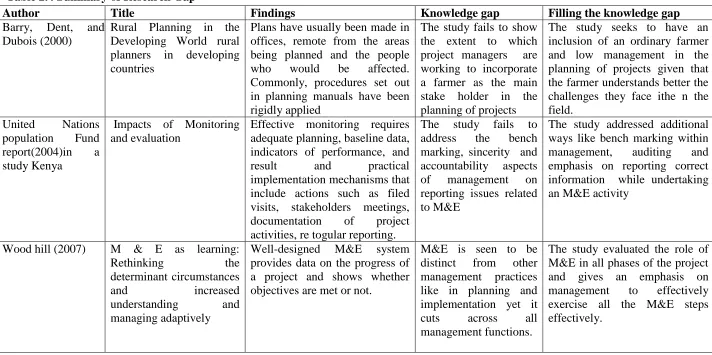
2.4Summary of research gaps Table 2.4 Summary of Research Gap
Author Title Findings Knowledge gap Filling the knowledge gap
Barry, Dent, and Dubois (2000)
Rural Planning in the Developing World rural planners in developing countries
Plans have usually been made in offices, remote from the areas being planned and the people who would be affected. Commonly, procedures set out in planning manuals have been rigidly applied
The study fails to show the extent to which project managers are working to incorporate a farmer as the main stake holder in the planning of projects
The study seeks to have an inclusion of an ordinary farmer and low management in the planning of projects given that the farmer understands better the challenges they face ithe n the field.
United Nations population Fund report(2004)in a study Kenya
Impacts of Monitoring and evaluation
Effective monitoring requires adequate planning, baseline data, indicators of performance, and result and practical implementation mechanisms that include actions such as filed visits, stakeholders meetings, documentation of project activities, re togular reporting.
The study fails to address the bench marking, sincerity and accountability aspects of management on reporting issues related to M&E
The study addressed additional ways like bench marking within management, auditing and emphasis on reporting correct information while undertaking an M&E activity
Wood hill (2007) M & E as learning: Rethinking the determinant circumstances
and increased
understanding and managing adaptively
Well-designed M&E system provides data on the progress of a project and shows whether objectives are met or not.
M&E is seen to be distinct from other management practices like in planning and implementation yet it cuts across all management functions.
Author Title Findings Knowledge gap Filling the knowledge gap Nyangito N. and
Okello (2008)
Kenya‟s Agricultural policy and sector performance
Lack of finance for agriculture due to the high level of bureaucracy which limits production and investment in value addition activities in agriculture.
The methods of finance souring are not independent. They are still hampered by corruption and political interference
The study investigated more on how the policies should be made farmers friendly for better performance in agriculture.
Thong (2009) Resource constraints and information systems in project performance
Information services that will greatly enhance their productivity, transform their community into a lively and enlightened one, and empower their economic base, is not effective and relevant, and the service is not fashioned towards the set objectives due to infrastructural problems, official corruption in allocation of funds, unstable political and economic policies growing insecurity and unstable power supply.
Study does not give approaches on how these factors derailing communication can be minimized in order to maximize production on projects
The study through its recommendation had to show how some of the limiting factors can be mitigated for better agriculture project performance.
Walker & Hughes (2009)
on impact of
environmental factors in Delta state of Nigeria
Physical environment within which agriculture project is sited may impact considerably on its development since these projects are always affected by physical influences.
There need to assess the environment keenly
before the
implementation of any project.