Available Online atwww.ijcsmc.com
International Journal of Computer Science and Mobile Computing
A Monthly Journal of Computer Science and Information Technology
ISSN 2320–088X
IJCSMC, Vol. 4, Issue. 7, July 2015, pg.36 – 42
RESEARCH ARTICLE
Enhancing Lifetime of Wireless Sensor
Network Using Energy Balanced
Routing Algorithm
Apurva Pathak
1, Manisha Bhende
2¹Computer Engg & Savitribai Phule Pune University, India ²Computer Engg & Savitribai Phule Pune University, India
[email protected]; [email protected]
Abstract— Wireless Sensor Networks has been an active research area over past few years. The diversity in the applications used in wireless sensor networks represents its great success. There are different characteristics of the topologies used in routing method. Energy and communication ability is important during designing of a routing protocol for wireless sensor networks so that sensing data can be transmitted to the receiver. To overcome limited energy, an energy balanced routing protocol with Forward Aware Factor is proposed in this paper. The protocol in this paper considers link weight and forward energy density for selection of next hop. The results of this protocol are compared with the LEACH protocol which balances the energy of the network.
Keywords— ―Wireless Sensor Network‖, ―Forward aware factor‖, ―Energy‖, ―link weight‖, ―Routing‖ I. INTRODUCTION
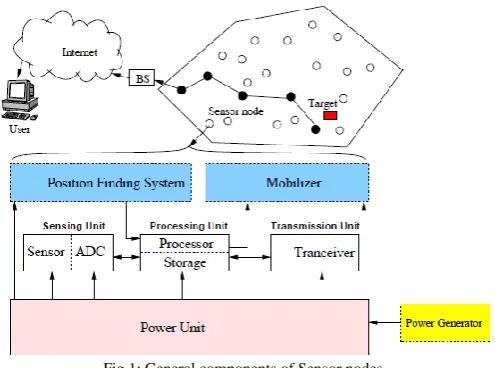
Wireless Sensor networks(WSN) are getting lots of popularity in recent years due to their wide applications like military and disaster surveillance, industrial product line monitoring, agriculture and wildlife observation, healthcare, smart homes etc. A large number of sensor nodes working together collect information from the environment and then transmitting this data to a base station forms the sensor network. A wireless sensor network is design for sensing and processing parameters like temperature, humidity and sound. After sensing data sensor nodes sends it through wireless channels.
Fig 1: General components of Sensor nodes
There are many issues that are arises in terms of wireless sensor networks like unstructured and time varying network topology. Scalability of the network depending on the application requirements is also one of the issues. As the transmission of data from the targeted source to the destination is the main task in the wireless sensor network but one of the issues is method used for forwarding of data is also considered. Routing in the wireless sensor network is most challenging due to high density of nodes, routing protocols with long distances, network structure and size etc. The connectivity of sensor nodes in network and the application of routing protocols to network are considered as topology. It influences on resiliency and communication cost of links.
This paper is organized in following sections. Section 2 reviews the related works. Section 3 gives a detail explanation of the algorithm energy balanced routing algorithm using Forward aware Factor. Section 4 shows the mathematical model. Section 5 gives simulation setup and result. Section 6 gives the conclusion
.
II. PAGE LAYOUT
The research work already done in the same area by the researchers.
In [1] authors have proposed the new algorithm called forward aware factor. Authors has considered BBV model for further network algorithms called LEACH and EUUC. By applying forward aware factor they have improved the performance as well as life time of the large scale networks.
In [2] authors have proposed a modified device profile for web services (DPWS) with its modified protocol stack. They gave the modification based on a new format for DPWS message exchanges without prohibiting the usage of the web services and the extensible markup language set of rules. The basis of this modified protocol is the previous version of the same protocol. The newly formed protocol improves the performance of the stack and the protocol and also it supports the low power personal area network architecture. James Aweya gave the differential clocking which is used when there is a network interface with its own reference source clock and there is the need to transfer this clock over a core packet network to another interface. In paper authors gave servo algorithm and phase-locked loop of a method for differential clock recovery over packet network. The characteristic of this new technique is that it contains differential clock recovery clock [3].
In [4] authors have a novel image de-noising method. The method is based on spherical coordinates system. The authors have redefined the spherical transform in wavelet domain and the properties of spherical transform in wavelet domain. They have overcome the limitation of the traditional shrinking function by giving a novel curve shrinkage function. The new method is simple and effective.
In [5] authors gave the automatic cluster formation and address assignment for wireless sensor network. They have proved that the address assignment scheme defined by ZigBee will perform poorly in terms of address utilization. They have also contributed to show that the automatic address assignment. The proposed method is simple, efficient, systematically formation of path connected cluster and automatic address assignment.
A hybrid multi objective evolutionary approach was given in [7]. The authors have proposed procedure for enhancing the performance of WSN by solving dynamic coverage and connectivity problem in flat WSN subjected to node failures. The proposed approach is compared with an integer linear programming based approach and a similar mono-objective approach with regard to coverage, network life time.
Authors in [8] proposed on multihop distance in wireless sensor network with random node locations. They have used Gaussian pdf for analytical modeling of the maximum distance distribution. They have proposed a greedy method of distance maximization and also evaluate the distribution of the obtained multihop distance through analytical approximations and simulations.
Authors in [9] have worked by adapting a developed theory of utility proportional rate control for wired networks to a wireless setting. They have also gave the mathematical framework to elegant queue backpressure algorithm. Due to this the design the first ever rate control protocol that can efficiently handle a mix of elastic and inelastic traffic in wireless sensor network. The advantages of the proposed algorithm are its simplicity and low complexity.
In [10] authors have presented an analytical model for estimating the per node traffic load in a multi hop wireless sensor network. They have considered a typical scenario in which sensor nodes periodically sense the environment and forward the collected samples to a sink using greedy geographic routing. They have come to result that the irrespective of the radio model, the traffic load increases as a function of the proximity to the sink.
The results of energy balanced routing using forward aware factor is compared with the LEACH algorithm. LEACH is Low Energy Adaptive Clustering Hierarchical Protocol which works on the organization of the nodes in the local clusters. The protocol also divides clusters into a set up phase when clusters are organized and a steady state phase when data are transferred from the nodes to the cluster head and so on to sink.
All the sensors within a network group themselves into some cluster regions by communicating with each other through short messages during the set up phase. At a point one node among the network acts as cluster head and sends message to other nodes in the network. According to signal strength of messages sent by head the nodes join the clusters. Sensor nodes interested of joining a particular cluster head or region responds to the cluster heads by sending a response signal indicating their acceptance to join. This task is done in set-up phase [1].
After selection of a cluster head for a region, the cluster members of that region send the collected or sensed data in their allotted slots to the cluster head. The collected data is then converted to compressed format and then cluster head transmits this data to base station. This procedure is called Steady State Phase. When the steady-state finishes the data transmission to the sink, the whole process ends and a new search for the forming of cluster heads for a region and new cluster-member formation begins. So we can say that a new set/up phase and steady state starts with the end of data transmission done to the sink. Within the region, the alternate selection of cluster head, that carried out in the sensors in self organization helps in reducing the energy utilization.
The main objective of this paper is to develop the energy balance algorithm based on the forward aware factor that will results in low energy consumption. This paper contains the algorithm which considers the factors like energy of node, distance of node and forward aware factor of the node. Forward aware factor is the new concept in this paper which is based on forward energy density and link weight of the node.
Node with maximum forward aware factor is considered as next hop. The algorithm should reduce energy consumption.
III.PROPOSEDWORK
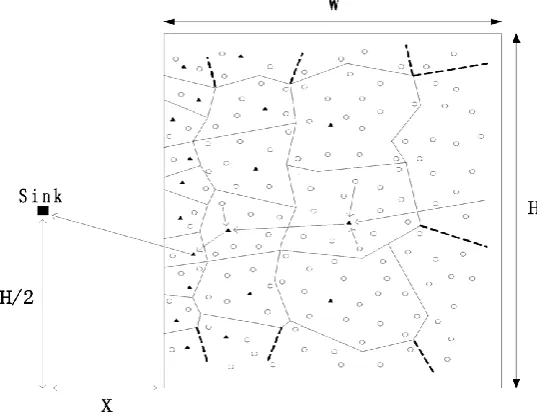
In this paper, we have considered algorithm which is based on the Forward Aware factor. Before this let us consider some important terms and definitions related to network. Suppose sensor nodes are distributed randomly in a rectangular sensing area as shown in fig. 2. Whenever data are to be sent in the area it is first send to regional central node called as sink node and then transferred to sink node called as sink.
1. All the sensor nodes have limited capabilities to compute, communicate and store data. All the sensor nodes are isomorphic.
2. Sensor nodes die after exhausting entire energy. The sensor nodes have limited energy and the initial energy is E0.
3.
According to the distance of sender and receiver transmission power among nodes
varies. The transmission power is decided when the head sends the message to all
nodes and according to the strength of the signal to the receiver the transmission
power is calculated. The head node is selected at the beginning only.
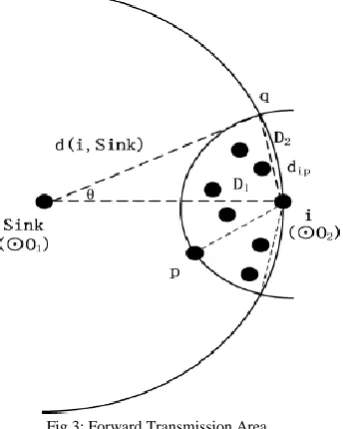
According to the cluster hierarchical routing protocol in Wireless sensor network, sometimes node to which data is to be sent is nearer than the head node. But data should be sent to the head for transmission to sink node. If the backward transmission is frequent then there is the waste of energy. So the proposed algorithm in this paper is the communication protocol that uses forward transmission area according to the position of the sink and the final data flow direction as shown in fig. 3.
Fig 3: Forward Transmission Area
The algorithm Forward Aware Factor based Energy Balanced Routing Method (FAF-EBRM) is used for the large scale wireless sensor networks for static data collection. The steps of algorithms are as the first term takes FED of all the possible next hop nodes into account, which means the ability to transmit data. In the next term weight of the transmit link is considered that is used to choose next hop directly. For the weight of the link the parameters like nodes’ energy, length and load. The FAF-EBRM is able to consider many factors and get a better energy balanced solution.
The steps of the routing algorithm is as follows-
1. Determine FTA (i) and all of the possible next-hop nodes of node i. First, take d0 as the communication
radius; determine the set of all of the nodes that have edges with I, N’ (i). Select the nodes that closer to Sink than i does, which constitute the set of all of the possible next-hop nodes and the furthest node determine FTA (i).
2. Determine FET (j) and SFTA (j) of each possible next-hop node. Determine FTA (j) as we determined
4. Calculate the weight of edges between and each node.
5. Plug the parameters of 3) and for calculation of FAF of each possible transmit link. Choose the next-hop node according to
j = max [FAF (i, j)] j
6. If there is no node closer to Sink than i in N’ (i), directly compare FAF of all of the nodes in N’ (i), and choose the next-hop node. If there is no node in N’ (i), i will increase the transmit power to get a longer radius than d0 until connected with another node, or i will abandon the packet.
7. If Sink is among the forward transmit nodes, i will transmit data directly to Sink and accomplish the procedure.
The above routing algorithm the weights of the nodes is calculated and nodes get their own FED. It avoids the communication launch node doing all of the algorithms.
IV.MATHEMATICALMODEL
1. Let S be the set of system that describes topology control, S= {I, O, f1, f2.,………, fn}
Where,
I is Inputs {vertices, edges, number of nodes, sink} O is Output {FAF, sink}
f1, f2 ,…….., fnare functions
2. Let F be the function that used to calculate Forward Aware Factor.
3. Let w be the weight at certain area A in the nodes N, so, Wi j (t) = ϛ (Ei (t) Ej (t) )ᴪ (1)
(d (I ,j )2) η (Tij (t) )ع
Where,
ϛ, ᴪ, η, ع are constants Ei (t), Ej (t) are energy
i ,j EN
4. The FTA is calculated as ,
SFTA (i) = ½ π d22 – d2 [(d1 - ¼ d22) + (d12 - ½ d22) ×
Across (1-½ (d2 /d)2 ]½ (2)
Where, i Ɛ N
5. The forward aware factor of the communication link Between i and j , FAF (i , j ) is given by,
FAF (i, j) =α FED (j) + β wij (3) Ʃ FED (j) Ʃ wij
6. Finally node with maximum Forward Aware Factor is considered as the next hop.
Fig 4: Deployment of sensor nodes
Fig 5: Communication among sensor nodes
Fig 6: Energy consumption in LEACH algorithm
V. SIMULATIONS AND EXPERIMENTAL RESULTS
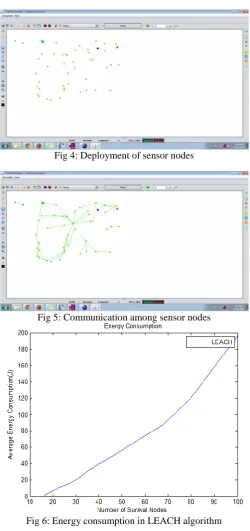
For implementing the algorithm in this paper the simulator used is Java simulator which is component based rather than object based. Using the simulator initially nodes are deployed in the area. The algorithm in this paper is worked; it first selects the area for deploying the sensor nodes. After specifying the area the nodes are randomly deployed in that area as per the user’s specification as shown in fig. 4.
After deployment of sensor nodes the communication among nodes in the network is shown in fig. 5. In the network using the algorithm FAF-EBRM communication is carried out. The input parameters are number of nodes, deployment area, strategy and sink. While output we get is sink using FAF-EBRM and comparison of the FAF-EBRM with the LEACH results. The energy consumption is compared of both the algorithm. The energy consumption of both the algorithm is compared. The energy consumption graph in the LEACH is shown in the fig. 6.
VI.CONCLUSION
In this paper, an energy balanced routing method FAF-EBRM based on the forward aware factor is proposed. Many times in the network during the communication problem of energy consumption arises. So to overcome the problem FAF-EBRM is the solution. In the FAF-EBRM the next node is selected according to link weight and forward energy density.
Further the results of the FAF-EBRM are compared with the LEACH for the energy issue.
REFERENCES
[1] D. Zhang, , G. Li, Ke Zheng, , X. Ming,,and Z.Hua Pan,” An Energy-Balanced Routing Method Based on Forward-Aware Factor for Wireless Sensor Networks”, IEEE transactions on industrial informatics, vol. 10, no. 1, february 2014.
[2] I. K. Samaras and G. D. Hassapis, “A modified DPWS protocol stack for 6LoWPAN-based wireless sensor networks,” IEEE Trans.Ind. Inf.,vol. 9, no. 1, pp. 209–217, Feb. 20J. Wang, J. Wen, F. Lochovsky, and W. Ma, “Instance-Based Schema Matching for Web Databases By Domain-Specific Query Probing,” Proc. Very Large Databases (VLDB) Conf., 2004.
[3] J. Aweya, “Technique for differential timing transfer over packet networks,”IEEE Trans. Ind. Inf., vol. 9, no. 1, pp. 325–336, Feb. 2013.
[4] ] D. G. Zhang and X. J. Kang, “A novel image de-noising method based on spherical coordinates system,” EURASIP J. Adv. Signal Process., vol. 1, p. 110, 2012.
[5] P.Rewagad and H. Nemade,” Automatic Cluster Formation and Address Assignment forWireless Sensor Network”, RESEARCH INVENTY: International Journal of Engineering and Science ,ISBN: 2319-6483, ISSN: 2278-4721, Vol. 1, Issue 11, December 2012. [6] H. B. Zhang and H. Shen, “Energy-efficient beaconless geographic routing in wireless sensor networks,” IEEE Trans. Parallel Distrib.
Syst., vol. 21, no. 6, pp. 881–896, Jun. 2010.
[7] F. V. C. Martins and E. G. Garrano, “A hybrid multiobjective evolutionary approach for improving the performance of wireless sensor Networks” IEEE Sensors J., vol. 11, no. 3, pp. 545–554, Mar. 2011.
[8] ] S. Vural and E. Ekici, “On multihop distances in wireless sensor networks with random node locations,” IEEE Trans. Mobile Computing, vol.9, no. 4, pp. 540–552, Apr. 2010.
J. Jin et al., “Handling inelastic traffic in wireless sensor networks,” IEEE Trans. Sel. Areas Commun., vol. 28, no. 7, pp. 1105–1115, Jul. 2010.
[9] Q. J. Chen, S. S. Kanhere, and M. Hassan, “Analysis of per-node traffic Load in multi-hop wireless sensor networks,” IEEE Trans. Wireless.