Available Online at www.ijcsmc.com
International Journal of Computer Science and Mobile Computing
A Monthly Journal of Computer Science and Information Technology
ISSN 2320–088X
IJCSMC, Vol. 4, Issue. 7, July 2015, pg.380 – 387
RESEARCH ARTICLE
Modified Fractal Image Encoding with
Collaboration of RLE Encoding in
Image Watermarking
Narinder Singh
M.Tech (CSE),Er. Vinod Kumar
Department of Computer Science and Engineering, Guru Kashi University Talwandi Sabo, Bathinda(pb)
Abstract: Today’s life internet offers great convenience in transmitting large amount of data in different parts of the world. However, the safety and security of long distance communication remains an issue. In order to solve this problem has led to the increase in the need of copyright protection. The application of Image watermarking in copy control, broadcast monitoring, copyright protection, video authentication, finger printing, annotation etc. is immensely rising. The main objectives of Image watermarking are undetectability, robustness, and capacity of hidden data. Image watermarking algorithms normally prefers robustness. In this paper, techniques used in image watermarking are discussed with the literature survey and then the shortcoming are analyzed and as conclusion proposal for new points for hiding watermark in Image is given. So there is need for new robust technique which will be able to hide watermark in such a way so that it cannot be extracted easily and provide more security over Image watermarking old techniques. For this as a new research in same field a method with efficient results will be proposed to hide watermark in Image to provide robust and secured watermarking. The method used is a collaboration of fractal encoding and RLE encoding. I analyzed the results on the basis of different parameters (Peak Signal to Noise Ratio, Mean Square Error, Bit Error Rate).
1.
Introduction
A watermark is an identifying image or pattern in paper that appears as various shades of lightness/darkness when viewed by transmitted light (or when viewed by reflected light, atop a dark background), caused by thickness or density variations in the paper. Watermarks have been used on postage stamps, currency, and other government documents to discourage counterfeiting. There are two main ways of producing watermarks in paper; the dandy roll process, and the more complex cylinder mould process.
A watermark is very useful in the examination of paper because it can be used for dating, identifying sizes, mill trademarks and locations, and determining the quality of a sheet of paper. Encoding an identifying code into digitized music, video, picture or other file is known as a digital watermark.
A digital watermark is a kind of marker covertly embedded in a noise-tolerant signal such as audio or image data. It is typically used to identify ownership of the copyright of such signal. "Watermarking" is the process of hiding digital information in a carrier signal; the hidden information should, but does not need to, contain a relation to the carrier signal. Digital watermarks may be used to verify the authenticity or integrity of the carrier signal or to show the identity of its owners. It is prominently used for tracing copyright infringements and for banknote authentication. Like traditional watermarks, digital watermarks are only perceptible under certain conditions, i.e. after using some algorithm, and imperceptible otherwise. If a digital watermark distorts the carrier signal in a way that it becomes perceivable, it is of no use. Traditional Watermarks may be applied to visible media (like images or video), whereas in digital watermarking, the signal may be audio, pictures, video, texts or 3D models. A signal may carry several different watermarks at the same time. Unlike metadata that is added to the carrier signal, a digital watermark does not change the size of the carrier signal.
The needed properties of a digital watermark depend on the use case in which it is applied. For marking media files with copyright information, a digital watermark has to be rather robust against modifications that can be applied to the carrier signal. Instead, if integrity has to be ensured, a fragile watermark would be applied.
Both steganography and digital watermarking employ steganographic techniques to embed data covertly in noisy signals. But whereas steganography aims for imperceptibility to human senses, digital watermarking tries to control the robustness as top priority. Since a digital copy of data is the same as the original, digital watermarking is a passive protection tool. It just marks data, but does not degrade it or control access to the data.
One application of digital watermarking is source tracking. A watermark is embedded into a digital signal at each point of distribution. If a copy of the work is found later, then the watermark may be retrieved from the copy and the source of the distribution is known. This technique reportedly has been used to detect the source of illegally copied movies.
2.
Literature Review
Jian Lu [1] (2014)“A Robust Fractal Color Image Watermarking Algorithm” One of the main objectives of
watermarking is to achieve a better tradeoff between robustness and high visual quality of a host image. In recent years, there has been a significant development in gray-level image watermarking using fractal-based method. This paper presents a human visual system (HVS) based fractal watermarking method for color images. In the proposed method, a color pixel is considered as a 3-D vector in rgb space. And a general form of 3 × 3 matrix is utilized as the scaling operator. Meanwhile, the luminance offset vector is substituted by the range block mean vector. Then an orthogonalization fractal color coding method is achieved to obtain very high image quality. We also show that the orthogonalization fractal color decoding is a mean vector-invariant iteration. So, the range block mean vector is a good place for hiding watermark. Furthermore, for consistency with the characteristics of the HVS, we carry out the embedding process in the CIE space and incorporate a just noticeable difference (JND) profile to ensure the watermark invisibility. Experimental results show that the proposed method has good robustness against various typical attacks, at the same time, with an imperceptible change in image quality.
Saiyyad, M.A.M.[2] ,(Dec. 2014)“Watermarking of compressed images using SWT technique and fragile approach ” The research and application of digital watermark is being paid more focus for content authentication. In recent times, the fast growth of the Internet has made copyright protection of digital contents a critical issue. Watermarking of multimedia content is important to authenticate, copy-control and ownership detection. The scheme used in this paper used two different categories of the watermark which are robust and fragile. Identity Number is used for ownership of the image and Hash function has been implemented to check the integrity of the image. The result of the experiment shows PSNR and SSIM of the watermarked image are higher than the existing technique.
secret sharing; however progressive quality access control of the secret is possible to achieve based on the particular group of users involved in decoding process. Robustness of the proposed method is also studied against a set of common signal processing operations. Extensive simulation results are also shown to validate the efficacy of the proposed method.
Yu Changhui [4] ( Oct. 2014) “Digital Watermarking Technology Based on DCT and Neural Net” This paper concerns the digital watermarking technology on three different processing stages in order to enhance the robustness of digital watermarking under the premise of invisibility. (1) The first stage is watermark signal pre-processing. The watermark signal created using binary gray images is taken the highly nonlinear processing by the chaotic function first and then by the neural network, which enhances the degree of watermark confidentiality greatly, (2) The second stage is watermark embedding strength degree. First a neural network is constructed and trained. The trained neural network can be used in watermark embedding and extraction by which a watermark algorithm can be achieved to do blind detection, (3) The third stage is watermark embedding and extraction. The treated watermark signal is embedded into the airspace of the original image through the trained neural network. And the neural network is also used to extract and detect the watermark. Proved by experimental results, this algorithm has good robustness.
Xie Yong [5] (Oct. 2014) “Effect of Embedding Way on Printed Watermarking Image by Lithography” Aiming at a kind of holographic watermarking embedding algorithm based on DWT, the paper evaluates the robustness and hidden of watermark information through NC and PSNR, respectively. It intends to discuss the influence of embedding way at RGB color model to watermarked printing image. The experimental results show: while the watermark information is embedded into R channel, the extracted watermark after printing has better robustness. When the embedding strength α is equal to 1.0, the embedding channel has little influence on the robustness. When the color component of embedding channel is the maximum, the watermark after printing has good invisibility. However, the rule is abnormal that the hidden decreases with the increasing of the embedding strength through the comprehensive comparison, it could be found that the best embedding channel of RGB color mode is the one including the maximum color component. And the optimal embedding strength is 1.0
Radouane, M. [6] (April 2014 ) “Robust method of digital image watermarking using SVD transform on DWT coefficients with optimal block” Over the last few years, development of internet and technology of media, the protection of copyright have become very important. To protect multimedia data against illegal copying and transferring, the insertion of a signal (digital signature, watermark) has become a duty without modifying quality of the original image, the goal of this operation is to identify the owner and protect his intellectual property. Digital watermarking has been proposed as a solution to solving the copyright problem by introducing invisible data (watermark) into original image. In this paper, we propose a study of digital imageswatermarking. This study is achieved by inserting watermark in different coefficients of DWT (LH, HL, HH) using SVD transform by searching the optimal block that have the maximum entropy which can be used to insert the watermark in original image. The experimental results show the different results of PSNR for each coefficient of DWT and the robustness against most attacks.
Vinita Gupta[7] ( January 2014) “A Review on Image Watermarking and Its Techniques” Digital watermarking is the act of hiding a message related to a digital signals in different forms like an image, song, video within the signal itself. In this paper, we present review on Image Watermarking for Good Robustness .In this paper, we discuss the various factors used in watermarking, properties and application area where water making technique need to be used. Also a survey on the some new work is done in image watermarking field.
3.
Problem Formulation
Watermarking is the process of hiding digital information in a carrier signal; the hidden information should, but does not need to, contain a relation to the carrier signal. Traditional Watermarks may be applied to visible media (like images or video), whereas in digital watermarking, the signal may be audio, pictures, video, texts or 3D models. Fractal compression, based on fractals is a lossy compression method for digital images. The method is best suited for textures and natural images, relying on the fact that parts of an image often resemble other parts of the same image. A challenging problem of ongoing research in fractal image representation is how to choose the ƒ1,...,ƒN such
image transformation into compressed form and the watermark pattern was embedded into the image. This was cumbersome as the image having large number of pixels find it harder to embed the data and the data compression took place. The security of the watermarked image with fractal encoding was lower as the data could be decrypted by any unauthorized user also. Since the pixel number increased so the probability of errors in the conventional technique was higher, this makes these conventional techniques less efficient and impractical. The PSNR of the resultant image also needs to be improved. Combining these factors, it is known that a new technique needs to be proposed which produces efficient results than the conventional techniques. The security of the system needs to be improved, data compression needs to be improved and the PSNR should be increased using new technique. Need is of better quality technique that should be efficient and should have less error probability.
3.1 Parameters used
There are three parameters will be considered in robust video watermarking are discussed below.
(a) Mean Square Error(MSE)
Where N and M are rows and columns, respectively of the image. X(i, j) is the original image and Y(i, j) is the corresponding output image. The MSE should be less, which means the pixel intensity of the input and output image should be as close as possible.
(b) Peak Signal to Noise Ratio (PSNR)
Peak Signal to Noise Ratio should be as large as possible which means that the content of signal in the output is large and the noise is less. Since it is Peak Signal to noise Ratio that’s why the value of signal is considered as maximum which is 255( for gray scale images the gray scale range from 0-255). L reflects the range of values that a pixel can take. For example, if the Y channel is encoded with a depth of 8-bit, then L = 2^8 - 1 = 255.
(c) Bit Error Rate (BER)
BER= 1/ PSNR
The number of bit errors is the number of received bits of a data stream of a communication channel that have been altered due to noise, interference, distortion or bit synchronization errors.
Objective
1. Toimplement two level hierarchy for providing security to message
2. Advancement over transform based watermarking with new fractal approach 3. Analysis over parameters for checking the variation
4.
Research Methodology
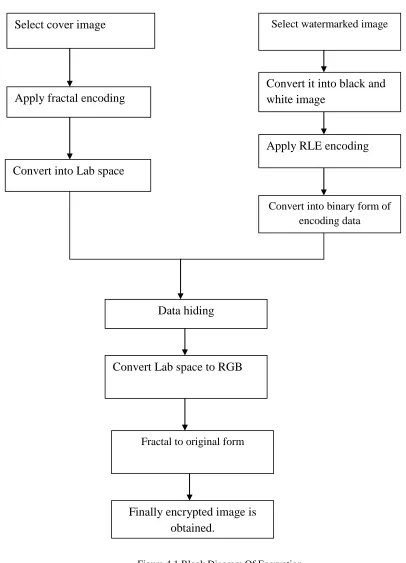
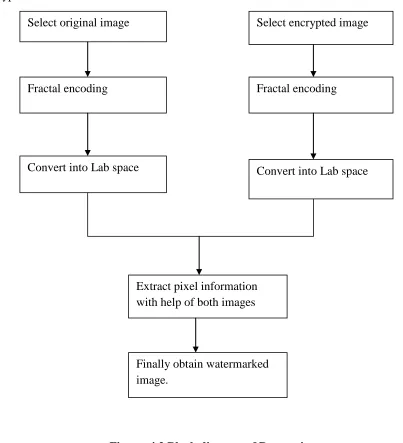
The technique of image watermarking takes place in two steps i.e. first encryption takes place and then the decryption. The methodology of the technique is described below:
Encryption:
1. Firstly the encryption part will take place. For that the first step is to select a cover image so that the technique can proceed further.
2. Then the fractal encoding is applied to the selected cover image. This is the second step in the encryption part.
3. The fractal encoded image is then converted into lab space. This is the third step for encryption in image watermarking. Lab space conversion will take place on the cover image after applying fractal encoding to it.
4. Now, select the watermarked image, that will be the second image selected for the process of encryption. 5. On the selected watermarked image the next conversion is to convert this image into black and white
image. So, the watermarked image will be converted into black and white image in this step. 6. Now, on the black and white image apply RLE encoding i.e. Run length encoding.
7. After applying RLE encoding, the encoded data is to be converted into binary form. 8. Now, both the images are to be combined and data is hided in the images.
10. Again apply fractal encoding to this RGB converted image.After applying all these conversions we finally obtain encrypted image.
Encryption:
Figure 4.1.Block Diagram Of Encryption
Convert into binary form of
encoding data
Apply RLE encoding
Convert it into black and
white image
Select watermarked image
Apply fractal encoding
Convert into Lab space
Finally encrypted image is
obtained.
Fractal to original form
Decryption:
Figure. 4.2 Block diagram of Decryption
5.
Results
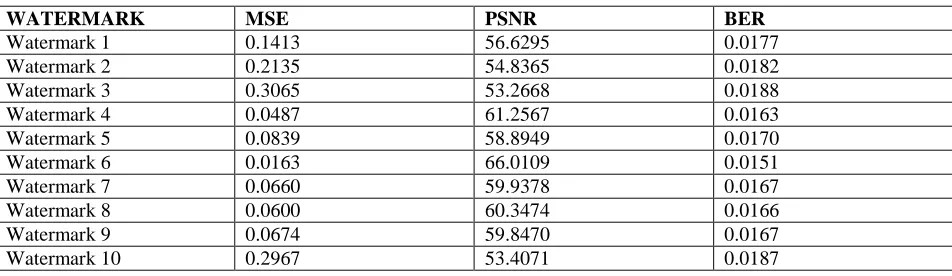
The experimental results showed that there is no perceptible distortion in the watermarked image. The main advantage of this method is that it decreases error probability , More secure with increased data capacity. In the experiments, various images are used as the cover images where all other formats of images are used as watermark images. The proposed algorithm is tested on many images. Every time, it gives better results over the single fractal encoding algorithm. The results of proposed method are summarized in Table 5.2.1
Select original image
Select encrypted image
Fractal encoding
Fractal encoding
Convert into Lab space
Convert into Lab space
Extract pixel information
with help of both images
Table 5..1 Output table
WATERMARK MSE PSNR BER
Watermark 1 0.1413 56.6295 0.0177
Watermark 2 0.2135 54.8365 0.0182
Watermark 3 0.3065 53.2668 0.0188
Watermark 4 0.0487 61.2567 0.0163
Watermark 5 0.0839 58.8949 0.0170
Watermark 6 0.0163 66.0109 0.0151
Watermark 7 0.0660 59.9378 0.0167
Watermark 8 0.0600 60.3474 0.0166
Watermark 9 0.0674 59.8470 0.0167
Watermark 10 0.2967 53.4071 0.0187
6.
Conclusion and Future scope
After applying the proposed technique it has been concluded that this proposed technique provides efficient and
better results of watermarking then the conventional techniques used. In the conventional techniques the problems
that faced were low security, higher error probability and high data compression. These factors decreased the
efficiency of the technique which needed to be improved in the proposed technique. The proposed technique which
includes a hybrid approach of fractal encoding and RLE for embedding a watermark helped improve the factors like
security, error probability etc. this proposed technique increases security, improves data compression and PSNR and
also reduces error probability. So, it can be said that the proposed technique of watermarking provides better results
and improves the quality of watermarking.
Future Scope:
In previous approaches the techniques used results in less security ,high data compression and probability of error were more .In this thesis a new technique is proposed by combing fractal and RLE, this technique is considered to be more effect and better than the previous techniques. By combining Fractal and RLE the no. of bits get reduce, due to which the PSNR improves ,also the probability of finding error is less .this is quite secure as compare to the previous algorithm and data compression is also low.
In future this technique can be used in video watermarking. Swarm intelligence can be used for further enhancement of this proposed technique.
References:
[1] Jian Lu, 2014“A Robust Fractal Color Image Watermarking Algorithm” Hindawi Publishing Corporation Mathematical Problems in Engineering Volume 2014, Article ID 638174, 12 pages
[2] Saiyyad, M.A.M.,Dec. 2014 “Watermarking of compressed images using SWT technique and fragile approach ”IEEE, pp.254-257
[3] Bhattacharjee , T., Nov. 2014 “Progressive quality access through secret sharing and data hiding scheme” IEEE , pp.1-6
[4] Yu Changhui , Oct. 2014, “Digital Watermarking Technology Based on DCT and Neural Net”,IEEE, pp. 202-205
[6] Radouane, M. April 2014 “Robust method of digital image watermarking using SVD transform on DWT coefficients with optimal block” IEEE, pp. 255-260