Protocol Against Passive Attack
Mohammad Reza Sohizadeh Abyaneh [email protected]
Department of Informatics, University of Bergen
Abstract. As a variant of the HB authentication protocol for RFID systems, which relies on the complexity of decodinglinearcodes against passive attacks, Madhavan et al. presented Non-Linear HB(NLHB) pro-tocol. In contrast to HB, NLHB relies on the complexity of decoding a class ofnon-linearcodes to render the passive attacks proposed against HB ineffective. Based on the fact that there has been no passive solution for the problem of decoding a random non-linear code, the authors have claimed that NLHB’s security margin is very close to its key size. In this paper, we show that passive attacks against HB protocol can still be applicable to NLHB and this protocol does not provide the desired security margin. In our attack, we first linearize the non-linear part of NLHB to obtain aHB equivalent for NLHB, and then exploit the passive attack techniques proposed for the HB to evaluate the security margin of NLHB. The results show that although NLHB’s security margin is relatively higher than HB against similar passive attack techniques, it has been overestimated and, in contrary to what is claimed, NLHB is vulnerable to passive attacks against HB, especially when the noise vec-tor in the protocol has a low weight.
Key words: : RFID, Authentication, LPN problem, HB protocols
1
Introduction
Radio Frequency Identification (RFID) tags are forming the next generation technology for identifying objects, and are poised to supplant barcodes in near future. Their advantages such as: more storage and ease of use have caused a universal proliferation of RFID tags in many commercial as well as national se-curity applications; [1] ranging from electronic passports [4, 3], contactless credit cards [2], to supply chain management [6, 5, 7].
This widespread deployment of RFID tags has raised some concerns about their security. On the other hand, RFID tag constraints in processing power and mem-ory make them tougher to deal with in security. These kinds of constraints dictate a paradigm shift in security provision for RFIDs which is known aslightweight cryptography.
tackles providing authentication in highly constrained environments (e.g RFID systems) as well as security provision to a reasonable extent [8, 9].
1.1 Notations Used
– Ga×b:a×b binary matrix.
– h1×b: 1×b binary vector.
– A⊗B: matrix multiplication of A and B. – ⊕: XOR operation.
– xi:ith bit of binary vectorx.
– Hwt(.): hamming weight function.
– h⊗G: matrix multiplication of a vectorhinto matrixG. – R, T: Reader andTag respectively.
1.2 HB Family Protocols
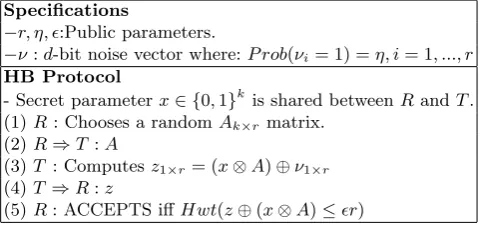
The HB lightweight authentication protocol proposed by Hopper and Blum in 2001 [10] is the first in the HB family of protocols. An overview of a paralleled r-round of the HB protocol is given in Figure 1. This protocol aims at unilateral authenticating of an RFID tag to a reader only by lightweight operations. The operations used in this protocol are one matrix multiplication and some XORs. On the other hand, The security of this algorithm and some others in this fam-ily against passive attacks is reduced to a well-known NP-hard problem called Learning with Parity Noise (LPN) problem [11].
Z The other members of this family emerged as a result of proposing an
at-Specifications
−r, η, :Public parameters.
−ν:d-bit noise vector where:P rob(νi= 1) =η, i= 1, ..., r HB Protocol
- Secret parameterx∈ {0,1}k
is shared betweenRandT. (1)R: Chooses a randomAk×r matrix.
(2)R⇒T :A
(3)T : Computesz1×r= (x⊗A)⊕ν1×r
(4)T ⇒R:z
(5)R: ACCEPTS iffHwt(z⊕(x⊗A)≤r)
Fig. 1.Parallelized version of anr-round HB protocol
which have targeted these authentication protocols consists bothpassive[20, 18, 19] andactive types [21, 22]. In an active attack, the adversary is able to eaves-drop the transcripts between a reader and a tag as well as being able to interact with them and manipulate the messages exchanging in between [23] in order to impersonate either of them. It should be noted that active attacks involve a broad spectrum of attacks which differ in adversary’s capabilities (e.g. DET [23] and GRS [21] attack models). On the contrary, in a passive attack, the adversary has only access to the transcripts from an arbitrary number of authentication sessions between a tag and a reader and aims at impersonating either of them.
1.3 LPN Problem
If we see from a passive adversary perspective, who has only access tosnumber of parallelizedr-round HB protocol transcripts(i.e.Ak×n, z1×n, ηwheren=s×r)
and his goal is to recover secret parameter x, it will be obvious that she faces a decoding problem of a codeword (x⊗A) generated by a random linear block code A in presence of noise ν [25]. This problem is calledLPN problem with parameters k, n, ηand has been shown to be NP-hard in worst case [25].
1.4 LPN Solvers
In addition to worst case complexity results of the LPN problem, there are nu-merous studies on average case complexity [26, 20]. These studies has led to find-ing some algorithms to solve the LPN problem under certain assumptions(LPN solvers). Proposition of these algorithms paved the way for applying passive at-tack against some of HB family protocols.
In [20], the BKW algorithm has been reported which can be considered as an instance of the generalized birthday paradox [27]. In [18], another algo-rithm(FMICM) has been proposed inspired by fast correlation attack [24] on ciphers. The solution proposed by the FMICM algorithm is under the assump-tion of having low bit rate(kn)and highη. Besides some deterministic LPN solvers such as the two aforementioned algorithms, there are some probabilistic algo-rithms such as CTIN [19] which accomplish their goal even when the adversary has access to less amount of transcripts comparing to deterministic ones. As said, applying any passive attack on HB protocol requires to utilize an LPN solver algorithm to solve the LPN problem. Thus, the terms LPN solver and passive attack against HB protocol point to the same notion and are used inter-changeably hereafter.
is very close to its key size.
Our Contribution. In this paper, we present a passive attack on the NLHB protocol. The idea of our attack is the linearization of the non-linear part of the NLHB protocol to convert it to an equivalent of conventional HB protocol. This method has beedn adopted in order to be able to deploy the passive attack techniques used against HB on NLHB.
Outline. The remainder of this paper is organized as follows. In section 2, we give a brief description of the NLHB protocol and section 3 elaborates on our attack method on it. In section 4, we display the results of applying our attack on NLHB compared to similar attacks on HB and eventually, section 5 concludes the paper.
2
Description of the NLHB Protocol
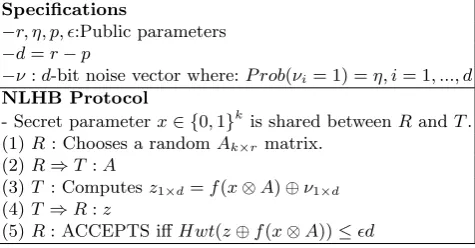
Figure 2 shows one session of a parallelizedr-round version of NLHB protocol. The tag and reader share a k-bit secret x in advance. The reader transmits a randomk×rchallenge matrixAto the tag. HavingAreceived, the tag computes f(x⊗A). Subsequently, it also computesz=f(x⊗A)⊕ν, whereν is a noise-vector whose bits are all independently distributed according to the Bernoulli distribution with parameterη, just like the noise vector in the HB protocol.x⊗A is also anr-bit vector similar to HB, butzdiffers in size. It is ad-bit vector(d= r−p). On receivingz, the reader checks whetherHwt(z⊕f(x⊗A))≤dWhere 0< < η <0.5. If this is true, reader accepts and this means that the tag has been authenticated successfully.
Specifications
−r, η, p, :Public parameters
−d=r−p
−ν:d-bit noise vector where:P rob(νi= 1) =η, i= 1, ..., d NLHB Protocol
- Secret parameterx∈ {0,1}kis shared betweenRandT. (1)R: Chooses a randomAk×r matrix.
(2)R⇒T :A
(3)T : Computesz1×d=f(x⊗A)⊕ν1×d
(4)T ⇒R:z
(5)R: ACCEPTS iffHwt(z⊕f(x⊗A))≤d
Fig. 2.Parallelized version of an r-round NLHB protocol
2.1 Function f
The functionf used in the protocol is a non-linear function which maps{0,1}r
y=f(x);y∈ {0,1}d, x∈ {0,1}r (1) and
yi=xi⊕g(xi+1, ..., xi+p) (2)
whereg:{0,1}p→ {0,1} is a non linear boolean function.
The authors have also proposed some specific functions for g corresponding to parameterpto achieve maximum entropy and lower the complexity of the pro-tocol (see Table 1). In [17], the authors have shown that for a general function
p g
2 xi+1xi+2
3 xi+1xi+2⊕xi+1xi+3
xi+1xi+3⊕xi+2xi+3
xi+1xi+2⊕xi+2xi+3⊕xi+3xi+1
4 xi+1xi+4⊕xi+2xi+3
xi+1xi+4⊕xi+2xi+4⊕xi+3xi+4
xi+1xi+4⊕xi+2xi+3⊕xi+3xi+4 Table 1.Proposedgfunction for NLHB protocol
off, the existing passive attacks on the HB protocol family (discussed in section 1.4) do not work on their protocol.
3
Proposed Attacking Method
3.1 Description
In this section, we present our three-phase passive attack on the NLHB protocol. In this passive attack, we assume that the attacker has access ton rounnds of the NLHB protocol wheren=s×r(i.e.ssessions of anr-round protocol) and thus can form matrixA according to (3).
Ak×n= (A1k×r||. . .||A s
k×r) (3)
whereAik×ris random matrix inithsession.
Phase I: Linearization
Our objective in this phase is to find a relatively good linear approximation for non-linear part of NLHB to convert the problem of decoding a non-linear ran-dom code to LPN problem. To do so, we should find a matrixB such that the probability qin (4) is relatively high.
prob(f(x⊗A) = (x⊗A)1×n⊗Bn×n∗) =q; n∗=n−s×p (4)
To construct matrixB, we require to linearize the whole system and according to (2), the non-linear part of the algorithm is the functiong which will be our target for linearization hereafter. We can use the Walsh-Hadamard technique [28] to find the best linear approximation for the boolean functiong such that:
g(xi+1, ..., xi+p)≈ i+p
X
j=i+1
cjxj (5)
According to table 2, all functions proposed for NLHB can be linearly ap-proximated with a relatively high probability. A linear approximation of all g functions with their probabilitiesqare shown in table 2.
Having cjs from linear approximation of g, we can conclude this phase by
cal-p g ≈g q
2 xi+1xi+2 xi+1 0.75
xi+2 0.75
3 xi+1xi+2⊕xi+1xi+3 xi+1 0.75
xi+1xi+3⊕xi+2xi+3 xi+3 0.75
xi+1xi+2⊕xi+2xi+3⊕xi+3xi+1 xi+2 0.75
4 xi+1xi+4⊕xi+2xi+3 xi+1 0.62
xi+1xi+4⊕xi+2xi+4⊕xi+3xi+4 xi+4 0.75
xi+1xi+4⊕xi+2xi+3⊕xi+3xi+4xi+2⊕xi+3⊕xi+4⊕1 0.75
Table 2.Best linear approximation of functiongin NLHB protocol and their proba-bilities
culating matrix B. Similar to matrix A in (3), matrix B for ssessions has the following structure:
Bn×n∗ = (Bn1×d||. . .||Bsn×d) (6)
in which,
blij =
1 ifi=j
cj forj=i+ 1, ..., i+p
0 otherwise
(7)
Bln×d =
1 0 0
c1 1 0 c2c1 0
..
. c2 ... cp ... . . .
0 cp 0
0 0 0
..
. ... ... 0 0 cp
; l= 1, ..., s (8)
Phase II: Finding a new linear equivalent protocol
In this phase, we attempt to find an equivalent HB protocol for NLHB using the linear approximation obtained in previous phase. Since our approximation is valid with probabilityq, we can rewrite (4) as following to formulate the HB equivalent of our NLHB protocol with new parameters denoted by∗.
y=f(xA) = (x⊗A)⊗B⊕e
= (x⊗A∗)⊕e (9)
whereA∗
k×n∗=Ak×n⊗Bn×n∗, P rob(ei= 1) = (1−q); i= 1, ..., n∗
Now, by adding the noise of protocol to both side of (9) we have:
y=f(x⊗A)⊕ν= (x⊗A∗)⊕ν⊕e= (x⊗A∗)⊕ν∗ (10) whereν∗=ν⊕e.
Asν andeare independent, the probability of error for the new noise vector can be calculated by (11).
P rob(νi∗= 1) =η∗
=P rob(νi= 1) +P rob(ei= 1)−P rob(νi= 1)×P rob(ei = 1)
=η+ (1−q)−(1−q)η. (11)
As it is apparent from (11), the noise of the equivalent HB protocol(ν∗) is more than the noise in NLHB protocol. Therefore, in general, the NLHB protocol is more resistant against the passive attacks comparing to the HB protocol with the same parameters. Nevertheless, according to our results in section 4, this strength is far lower than it has been claimed and desired.
Phase III: Recovering secret parameterx
3.2 Complexity of the Attack
Complexity of our attack consists of three parts corresponding to each phase. For phase I, we need to find the best linear approximation for boolean function g withpvariables. This can be done by finding Walsh-Hadamard coefficients of g with complexity ofO(p2p).
In phase II, we just have a matrix multiplication of Ak×n and Bn×n∗ to form
A∗. This process has the compexity of O(knn∗) in general. But due to sparse form of matrix B in (8), this complexity is reduced to O(kpn∗). Finally, the
complexity of phase III relies on the complexity of the LPN algorithm solver used (e.g. table ??). So, the complexity of our attack is calculated by (12) in which the complexity of phases I, II and III are denoted by CI, CII and CIII
respectively.
C=CI+CII +CIII=O(p2p) +O(kpn∗) +CIII
≈O(kpn∗) +CIII; n∗>> p (12)
It should be noted that the complexity which computed in (12) is thetime com-plexityof our attack. To be more precise, we should calculate thedata complexity of our attack in terms of the amount of protocol rounds required to apply the attack(n∗) as well. Phase I and II are applied on the number of rounds of the protocol which are determined in phase III and these two phases do not impose any additional data complexity to our attack. Therefore, data complexity of our attack only relies on the data complexity of LPN solvers discussed in [20, 18, 19].
4
Results
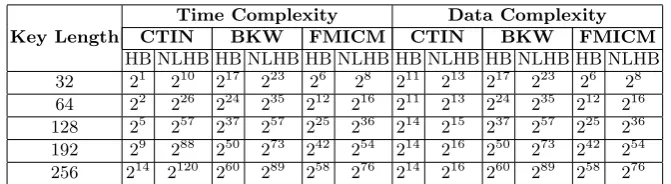
In this section, we demonstrate the results of applying our passive attack using three LPN solvers BKW,FMICM and CTIN on NLHB and compare the secu-rity margins of NLHB(i.e. its equivalent HB) with HB protocol with the same parameters. Our motivation to do such an unfair comparison is to demonstrate that security margin of the NLHB is not far more than th HB protocol with the same parameters.
Tables 3, 4and 5 show a comparative time and data complexity of apply-ing passive attacks on NLHB and HB protocol for three different but low noise probability (η = 0.15,0.10,0.05 for HB and correspondentη∗ = 0.36,0.32,0.29
Time Complexity Data Complexity
Key Length CTIN BKW FMICM CTIN BKW FMICM
HB NLHB HB NLHB HB NLHB HB NLHB HB NLHB HB NLHB 32 221 226 23 215 28 212 23 211 23 215 28 212
64 29 236 231 240 219 222 213 214 231 240 219 222 128 223 278 247 262 235 245 213 215 247 262 235 245 192 239 2118 263 283 252 267 213 216 263 283 252 267 256 256 2162 276 299 271 288 214 216 276 299 271 288
Table 3. Time complexity and Data complexity passive attacks on HB and NLHB η= 0.15,η∗= 0.36
Time Complexity Data Complexity
Key Length CTIN BKW FMICM CTIN BKW FMICM
HB NLHB HB NLHB HB NLHB HB NLHB HB NLHB HB NLHB 32 21 213 220 225 28 210 210 213 220 225 28 210 64 24 230 228 237 217 219 210 213 228 237 217 219 128 213 266 244 259 235 238 213 215 244 259 235 238 192 224 2102 257 278 254 263 213 215 257 278 254 263
256 231 2140 270 294 271 285 214 216 270 294 271 285 Table 4. Time complexity and Data complexity passive attacks on HB and NLHB η= 0.1,η∗= 0.32
Time Complexity Data Complexity
Key Length CTIN BKW FMICM CTIN BKW FMICM
HB NLHB HB NLHB HB NLHB HB NLHB HB NLHB HB NLHB 32 21 210 217 223 26 28 211 213 217 223 26 28 64 22 226 224 235 212 216 211 213 224 235 212 216 128 25 257 237 257 225 236 214 215 237 257 225 236 192 29 288 250 273 242 254 214 216 250 273 242 254 256 214 2120 260 289 258 276 214 216 260 289 258 276
5
Conclusions
We presented a passive attack against NLHB protocol by finding an HB equiva-lent of it and then using some LPN solver techniques. Our results not only negate the authors claim that their protocol is resistant to passive attacks on the HB protocol but also show that the NLHB has not elevated the security margin of the HB remarkably and this is mainly due to the poor design of the non-linear part of the NLHB.
In summary, what we did is as follows. We:
– targeted Non-Linear HB protocol for passive attack.
– found a linear approximation of the non linear part of the protocol and converted the protocol to an equivalent HB protocol with higher noise. – applied three well-known LPN solver techniques as a passive attack to the
equivalent protocol.
– calculated the complexity of our attack on NLHB.
References
1. Raphael C.-W. Phan:Cryptanalysis of a New Ulteralightweight RFID Authentica-tion Protocol-SASI, IEEE Transaction on Dependable and Secure Computing, 2008. 2. T.S. Heydt-Benjamin, D.V. Bailey, K. Fu, A. Juels, and T. O’Hare: Vulnerabilities in First-Generation RFID-Enabled Credit Cards, Proc. 11th Int’l Conf. Financial Cryptography and Data Security (FC ’07), pp. 2-14,2007.
3. D.Carluccio, K.Lemke, C.Paar: E-passport:the Global Traceability or How to feel like a UPS package, Proceeding of WISA’06, LNCS 4298, Springer, pp.391-404, 2007. 4. J.-H. Hoepman, E. Hubbers, B. Jacobs, M. Oostdijk, and R.W. Schreur, Crossing
Borders:Security and Privacy Issues of the European e-Passport, Proc. First Int’l Workshop Security (IWSEC ’06), pp.152-167,2006.
5. CASPIAN, Boycott Benetton: http://www.boycottbenetton.com,2007. 6. Mitsubishi Electric Asia Switches on RFID:
www.rfidjournal.com/article/articleview/2644/,2006.
7. Target, Wal-Mart Share EPC Data: http://www.rfidjournal. com/article/articleview/642/1/1/,2005.
8. G. Avoine and P. Oechslin. RFID Traceability: A Multilayer Problem, Financial Cryptography - FC’05, LNCS, Springer, 2005.
9. T. Dimitriou. A Lightweight RFID Protocol to Protect Against Traceability and Cloning Attacks,Proceedings of the IEEE International Conference on Security and Privacy for Emerging Areas in Communication Networks, SECURECOMM, 2005. 10. N.J. Hopper and M. Blum. Secure Human Identifcation Protocols, in C. Boyd
(ed.) Advances in Cryptology - ASIACRYPT 2001, Volume 2248, Lecture Notes in Computer Science, pp. 52-66, Springer-Verlag, 2001.
11. J. Bringer, H. Chabanne, and E. Dottax. HB++: a Lightweight Authentication Protocol Secure Against Some Attacks, IEEE International Conference on Pervasive Services, Workshop on Security, Privacy and Trust in Pervasive and Ubiquitous Computing SecPerU, 2006.
13. Julien Bringer, Herve Chabanne, and Emmanuelle Dottax.HB++: a lightweight authentication protocol secure against some attacks. In Second International Work-shop on Security, Privacy and Trust in Pervasive and Ubiquitous Computing (SecPerU 2006), 29 June 2006, Lyon, France, pages 28-33. IEEE Computer Society, 2006.
14. Dang Nguyen Duc and Kwangjo Kim. Securing HB+ against GRS man-in-the-middle attack. In Institute of Electronics, Information and Communication Engi-neers, Symposium on Cryptography and Information Security, Jan. 23-26, 2007, Sasebo, Japan, page 123, 2007.
15. Henri Gilbert, Matthew J. B. Robshaw, and Yannick Seurin.HB]: Increasing the security and effciency of HB+. Advances in Cryptology EUROCRYPT 2008, 27th Annual International Conference on the Theory and Applications of Cryptographic Techniques, Istanbul, Turkey, April 13-17, 2008. Proceedings, volume 4965 of Lec-ture Notes in Computer Science, pages 361-378.Springer, 2008.
16. J. Munilla and A. Peinado.HB-MP: A further step in the HB-family of lightweight authentication protocols.Computer Networks, 2007.
17. Mukundan Madhavan,Andrew Thangaraj,Yogesh Sankarasubramaniam and Ka-pali Viswanathan,NLHB : A Non-Linear Hopper Blum Protocol,IEEE National Con-ference on Communications (NCC),2010, CoRR abs/1001.2140:2010.
18. M. Fossorier, M. Mihaljevi, H. Imai, Y. Cuiz, K. Matsuura. A Novel Algorithm for Solving the LPN Problem and its Application to Security Evaluation of the HB Protocol for RFID Authentication. Lecture Notes in Computer Science, vol. 4329, pp. 48-62, Dec. 2006.
19. J. Carrijo, R. Tonicelli, H. Imai, and A. C. A. Nascimento,A Novel Probabilistic Passive Attack on the Protocols HB and HB+, IEICE Transactions, pp. 658662, 2009.
20. A. Blum, A. Kalai and H. Wasserman,Noise-Tolerant Learning, the Parity Prob-lem, and the Statistical Query Model, Journal of the ACM, vol. 50, no. 4, pp. 506-519, July 2003.
21. H. Gilbert, M. Robshaw, and H. Sibert,Active attack against HB+: A Provably-Secure Lightweight Authentication Protocol, IEE Electronics Letters, vol. 41, no. 21, pp. 11691170, Oct. 2005.
22. K. Ouafi, R. Overbeck, and S. Vaudenay,On the Security of HB] against a Man-in-the-Middle Attack, in Proceedings of ASIACRYPT 2008, ser. LNCS, vol. 5350. Springer, 2008, pp. 108124.
23. J. Katz and A. Smith, Analyzing the HB and HB+ Protocols in the Large Error Case, Available from http://eprint.iacr.org/2006/326.pdf.
24. P. Chose, A. Joux and M. Mitton,Fast Correlation Attacks: An Algorithmic Point of View, EUROCRYPT2002, Lecture Notes in Computer Science, vol. 2332, pp. 209-221, 2002.
25. E.R. Berlekamp, R.J. McEliece, and H.C.A. van Tilborg, On the Inherent In-tractability of Certain Coding Problems, IEEE Trans. Info. Theory, vol. 24, pp. 384-386, 1978.
26. A. Blum, M. Furst, M. Kearns, and R. Lipton, Cryptographic Primitives Based on Hard Learning Problems, CRYPTO 93, Lecture Notes in Computer Science, vol. 773, pp. 278-291, 1994.
27. D. Wagner,A Generalized Birthday Problem, CRYPTO 02, Lecture Notes in Com-puter Science, vol. 2442, pp. 288-304, 2002.