www.ijiset.com
A Comparative Study On Structural Behaviour Of Ferro-Cement
And Geogrid Bound Beams With R.C.C Beams
Madhuvanthi D1,Deepa M2, Manoj Kumar N3,Anbarasan C4,Anand Babu T5
Department of Civil Engineering, S.N.S College of Engineering,Coimbatore-641107,Tamil Nadu,India
Abstract:All buildings are built with the integrity that they are
structurally safe and aesthetically beautifull.Cracks are the predominant problem that has been recognized in any type of structure.Improper design,faulty construction,settlement and unequal loading are some of the factors that govern the formation of cracks.Some type of cracks that originate do not require serious attention while the active cracks are structurally hazardous.Inspite of the precise work carried out during construction with the passage of time,cracks occur due to various unavoidable reasons and can be classified as structural cracks and non-structural cracks.Hence intensive care must be taken for the prevention of cracks at earlier stage and before the structure is put into work.In this project we have studied thoroughly the different types of cracks and put forward the concept of Geogrid bound beams.Flexural test was conducted on the R.C.C,Ferrocement and Geogrid bound beams.A positive change in the crack pattern was identified and improvement in flexural strength while using Geogrid was observed consequently.
Keywords:Geogrids,Chicken mesh,Flexural behaviour,First crack point,Ultimate load.
I. INTRODUCTION
The main perspective of Civil Engineering is to prolong the life cycle of large scale structures.Due to the depletion of natural resources and insufficient space the present human race has to rely on the existing structures.This has set forth the development of new technologies and research works.To extend the life expectancy of a building the aspects that has to be improved are i)frequent monitoring ii)strategies and concepts to develop and maintain the existing structure.While monitoring the concrete structures,the important factors that are perceived are the formation of cracks,indicating weak zones and acting forces.But until now there are no definite systems available that allows to measure and analyze cracks precisely.In some cases the formation of cracks result in the failure of the whole structure.Hence.preventing them before the usage of the building in accordance with construction has gained importance.Recent researches have shown that the basic definition of ferro-cement is expanding scope in the 21st century and it can be reinforced with steel or non-metallic meshes such as fiber reinforced polymeric(FRC) meshes or any other type of reinforcements.
Some researches mention the usage of PVA (poly vinyl alcohol),polypropylene,carbon,Kelvar,polyethylene(spectra) as the reinforcements in cement composites also.Spatial structures such as shell and folded plate elements generally use the technique of ferro-cement to rectify cracks.Though it raises many questions when the chicken mesh comes in contact with salt water about the steel rusting,the Geogrid mesh may be
more suitable when compared to the elements reinforced with chicken mesh.It is therefore prime importance to study the flexural behaviour of these materials for their effective use.
The present research,deals with the comparison of flexural behaviour of R.C.C beams with beams reinforced with Geogrid and chicken mesh along with steel reinforcement under direct loading.An experimental investigation of 18 beams(6 Nos R.C.C,6 Nos geogrid bound beams,6 Nos ferro-cement beams )of size 750mm in length,150mm in breadth and 250mm in depth was carried out in the laboratory.All the elements were tested under two point loading after 7days and 28days curing.Results on first crack point and ultimate load are reported and pertinent discussions regarding the efficiency is conveyed.
II. MATERIALSANDMETHODS
A. Method of specimen preparation
The beams were designed to take a load of about 100 kN ,having dimensions 750mm in length,150mm in breadth,250mm in depth and cover of 25mm.The reinforcement was provided according to the provisions adopted in SP34.Bars of 12mm(2 Nos),10mm(2 Nos) and stirrups of 8mm(6 Nos) at a spacing of 150mm are used in each beam.The larger diameter 12mm bars are placed in the bottom row to resist the deflection effects.
www.ijiset.com
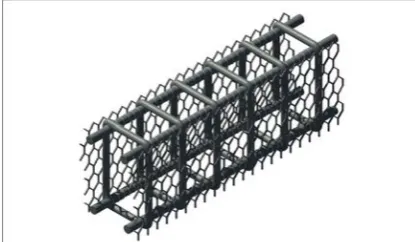
Fig 2.Reinforcement for Geogrid bound beams
Fig 3. Reinforcement for R.C.C beams
An ordinary chicken mesh and Geogrid mesh obtained was cut to the requisite size for the ferro-cement and Geogrid bound beams.Binding wires have been used for tying the meshes to the reinforcement along the longitudinal direction(along the sides only).
Wooden planks of thickness 1inch was used in framing the moulds.The moulds were casted with the dimensions 800mmx200mmx275mm(lengthxbreadthxdepth) with open top.
Fig 4. Wooden moulds
The moulds are made in a form such that each of the four side walls and the base of the form work were detachable so that the mould could be easily separated from cast elements after its initial setting.Six timber moulds were framed totally and three were used in a batch.The contact surfaces of the wooden moulds and the concrete was greased before casting the specimens to ease the demoulding process.
Ordinary Portland Cement,aggregate of size 20mm and river sand passing through 2.38mm sieve was used for casting
the beams.The properties of cement,coarse aggregate and sand are mentioned in Table 1.
TABLE 1.PROPERTIES OF CEMENT,COARSE AGGREGATE AND SAND
S.No Material Property Value
1. Cement
Specific gravity 3.12
Consistency 33
Initial Setting time Not less than 30 minutes
2.
Coarse
aggregate
Impact value 25%
Abrasion value 16.4%
Finess modulus 3.18
Specific gravity 2.42
3. Sand
Finess modulus 2.8
Specific gravity 2.65
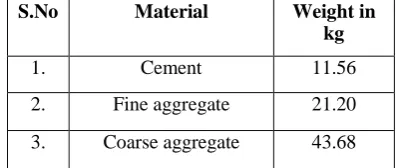
M20 grade concrete of ratio 1:1.5:3 was used for concreting and the quantity of materials for one unit was calculated.
Table 2, represents the quantity of materials calculated.
TABLE 2.QUANTITY OF MATERIALS
S.No Material Weight in
kg
1. Cement 11.56
2. Fine aggregate 21.20
3. Coarse aggregate 43.68
Machine mixing was adopted since the quantity of concrete required was large.At first,fine aggregate and cement was added into the mixer and mixed thoroughly,then coarse aggregate and water was added to prepare the concrete.
Fig 5. Mixing of Concrete
The mixing was allowed until the concrete attained the required workability and then was collected in a pan to be placed into the moulds.
www.ijiset.com 25cm and compacted 25 times with the help of a tamping rod.Since hand compaction was used the consistency of concrete was maintained at a higher level.
Fig 6.Placing of Concrete
Fig 7. Compaction of Concrete
The three types of beams were represented with appropriate legible identifications as Geogrid bound beams unmarked,Ferro-cement as single dot and R.C.C as double dot.
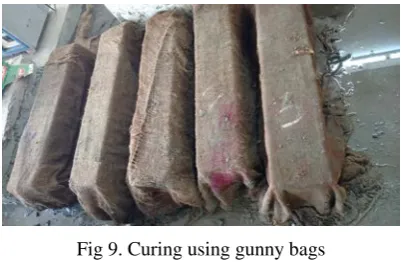
The specimens were air dried for 24hours,to promote initial setting and then cured using gunny bags.
Fig 8. Demoulding
Fig 9. Curing using gunny bags
The beams were cured for 7days testing and 28days testing.They were ensured and inspected frequently that they have sufficient water to attain the necessary strength.
B. Properties of meshes
B.1 Chicken mesh
Chicken mesh is formed by twisting two adjacent wires atleast four times,forming a strong honey comb structure.Hence it has high strength and durability.Even if one portion of the mesh is cut off,it will not lead to the entire chicken mesh structure destroyed.Therefore subjected to extreme changes in temperature,chicken mesh is more acceptable for plastering than welded wire mesh or expanded metals.
Using it while plastering,it effectively prevents plaster layer drying out and cracking.Due to its flexibility structure,chicken mesh is convenient for mounting on curved and angled surfaces.
B.2 Geogrids
Geogrids are geo-synthetic materials made of polymers such as polyester,polyethylene and polypropylene.They are mainly characterized by bands of narrow elements in grid like pattern and large voids are found between their bands.The hexagonal shape of the Geogrid prevents the formation of internal stresses.Their reinforcing potential,appropriate stiffness and interlocking ability with the aggregates has been predominant in the usage of geogrids.
III METHOD OF FLEXURAL TESTING
www.ijiset.com
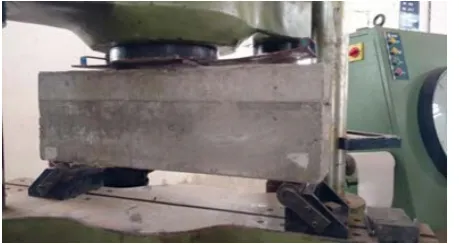
Fig 10.Testing of beam
The load application continued until the deflection became excessive and readings were noted at first crack point and the ultimate load.While testing it was noted that the Ferro-cement and Geogrid bound beams produced initial cracks without any cracking noise and their crack widths were small when compared to the R.C.C beams.
IV RESULTS
Flexural test was conducted on the beams for 7days and 28days curing .The initial crack point and the ultimate load while testing the beams were observed.
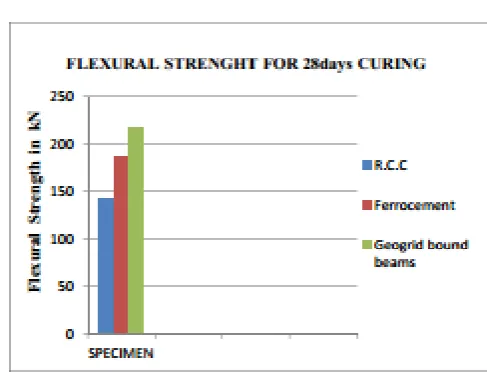
The strength properties in terms of first crack point and ultimate loads of the three types of beams in flexure are summarized in Table 3,4,5 and 6.The relationship between the flexural strength and specimen type is depicted in the form of a graph.The graph is drawn taking the average of the values obtained for the three types of beams.
TABLE 3.FIRST CRACK LOAD FOR 7DAYS CURING
S.No Category Identification
mark
Load attained
in kN
1. R.C.C
double dot 70
double dot 65
double dot 72
2. Ferro-cement
single dot 95
single dot 75
single dot 80
3. Geogrid bound
beams
unmarked 92
unmarked 85
unmarked 98
Fig 11.Comparison of flexural strength attained at initial crack point-7days curing
TABLE 4.FLEXURAL STRENGTH ATTAINED FOR 7DAYS CURING
S.No Category Identification
mark
Load attained
in kN
1. R.C.C
double dot 120
double dot 122
double dot 110
2. Ferro-cement
single dot 120
single dot 127
single dot 122
3. Geogrid bound
Beams
unmarked 136
unmarked 132
unmarked 132
www.ijiset.com
TABLE 5.FIRST CRACK LOAD FOR 28DAYS CURING
S.No Category Identification
mark
Load attained
in kN
1. R.C.C
double dot 105
double dot 100
double dot 110
2. Ferro-cement
single dot 145
single dot 115
single dot 120
3. Geogrid bound
beams
unmarked 140
unmarked 125
unmarked 150
Fig 13.Comparison of flexural strength attained at initial crack point-28days curing
TABLE 6.FLEXURAL STRENGTH ATTAINED FOR 28DAYS CURING
S.No Category Identification
mark
Load attained
in kN
1. R.C.C
double dot 145
double dot 140
double dot 145
Ferro-cement
single dot 198
single dot 180
single dot 180
3. Geogrid bound
Beams
unmarked 230
unmarked 210
unmarked 215
Fig 14. Comparison of flexural strength attained for 28days curing
www.ijiset.com V CONCLUSION
In this experimental investigation 18 specimens were prepared and tested.The following conclusions are made from the flexural behaviour in the form of first crack and ultimate load.
1.It was observed that the Ferro-cement and Geogrid bound beams sustained greater flexural strength when compared to the R.C.C beams.
2.The rate of increase of first crack load is also considerably large for beams bound with Geogrid than that of Ferro-cement and R.C.C beams.
3.On comparing all the three types of beams the crack width was minimum for Geogrid bound beams.
4.The high rate of increase of the first crack load and ultimate load for the Geogrid bound beams is due to the more bonding effect between the mesh and the concrete.
5.The voids in the Geogrid worked on the interlocking mechanism which gave a good grip for the mixture inside it before cracking initiation.
6.Also,from the results it has been observed that the rate of increase of the ultimate load(greater than the designed load) for beams containing Geogrid is conspicuously higher as compared to the Ferro-cement and R.C.C beams.
VI REFERENCES
[1] Namaan,A.E., 2000.”Ferrocement and Cementitious Composites” ,Techno Press 3000,Ann Arbor,Michigan.
[2] Md. Zakaria Hossain*., Md.Rokonuzzaman., Sohji Inoue., “Flexural Behaviour of Cement Composite panels Reinforced with different types of meshes” 30th Conference on Our World in Concrete & Structures:23-24 August 2005,Singapore.
[3] Grishma Thagunna., ”Building cracks-causes and remedies” Department of Civil Engineering,Western Region Campus,Tribhuvan University,Nepal
[4] Md Zakaria HOSSAIN* and INOUE Sohji ,”Young’s Modulus and Bearing Capacity of Thin Panels Reinforced with Geogrid and Hexagonal Meshes”Faculty of Bioresources,Mie University,1515 Kamihama-cho,Tsu-shi,Mie 514-8507,Japan.