_____________________________________________________________________________________________________
*Corresponding author: E-mail: [email protected];
29(2): 1-10, 2019; Article no.JAMMR.47997 ISSN: 2456-8899
(Past name: British Journal of Medicine and Medical Research, Past ISSN: 2231-0614, NLM ID: 101570965)
Effectiveness of Kinesio Taping in the Management
of Knee Osteoarthritis
Aung Aung Nwe
1*, Myo Tint Tun
1, Si Thu Aung
2, La Min Tun
3and Khin Thuzar Myaing
11Department of Physiotherapy, University of Medical Technology, Mandalay, Myanmar.
2Department of Public Health, Ministry of Health and Sports, Myanmar.
3Department of Physical Medicine and Rehabilitation, Mandalay Orthopedic Hospital, Myanmar.
Authors’ contributions
This work was carried out in collaboration between all authors. All authors read and approved the final manuscript.
Article Information
DOI: 10.9734/JAMMR/2019/V29i230063 Editor(s): (1)Dr. Masahiro Hasegawa, Department of Orthopaedic Surgery, Mie University Graduate School of Medicine, Japan. Reviewers: (1) Timothy Hui, USA. (2)Yu, Chia-Li, National Taiwan University Hospital, Taiwan. Complete Peer review History:http://www.sdiarticle3.com/review-history/47997
Received 27 December 2018 Accepted 13 March 2019 Published 19 March 2019
ABSTRACT
Background: Knee osteoarthritis (OA) is one of the commonest chronic joint problems presenting with pain and stiffness. As a consequence, activities of daily living are limited and decline the quality of life. Kinesio tape (KT) has been popular in worldwide by its positive effects including reducing pain, relieving stiffness and improving function. However, the therapeutic application tension, direction and technique have not been identified yet and still weak evidence in OA knee.
Aims: To find out the effectiveness of Kinesio taping in the management of OA knee.
Study Design: Hospital based randomized control trial.
Place and duration of Study: This study was conducted in the Outpatient Department of Physical Medicine and Rehabilitation in both Mandalay Orthopedics Hospital and 300 Bedded Teaching Hospital, Mandalay. It was started from May, 2017 to August, 2018.
Methodology: A total of 60 patients were randomly assigned into group A and group B. Group A (intervention group) received KT plus conventional exercise and group B (control group) received conventional exercise alone. Both groups were assessed in week 0 (before study), week 2 (during
study) and week 3 (end of study). Assessments measures were VAS, WOMAC index and TUG test. The amount of analgesic consumptions was recorded in week 2 and week 3 assessments.
Results: There were no significant differences in baseline characteristics of patients between the two groups. The intragroup analysis showed significant difference in VAS, WOMAC index and TUG test (p<0.05) in both groups. However, intergroup analysis showed more significant improvements of VAS, WOMAC index and TUG test in intervention group than control group in week 2 and week 3 (p<0.05).
Conclusion: KT plus conventional exercise is more effective than conventional exercise alone in terms of relieving pain, reducing stiffness and improving function in patients with OA knee.
Keywords: Knee osteoarthritis; kinesio tape; kineiso taping.
1. INTRODUCTION
Osteoarthritis (OA) is a degenerative disease of joint that implicates the cartilage and its nearby
structures. Pain, stiffness, swelling, joint
instability and muscular weakness are common characteristics of the OA. The resultant is not only diminished daily activities but also impaired quality of life of individual for the reason that pain limits movements such as walking, squatting, ascending and descending stairs [1]. Knee joint suffers osteoarthritis more than any other joint due to its functions of weight bearing and repeated movements [2].
About 250 million people (3.6% of population) suffered OA knee worldwide in 2010 and it is suspected that it can be the fourth cause of disability in 2020 [3]. Treatment for the course of condition of OA has not available yet. Therefore, treatment approaches are focused on relieving symptoms of disease [4]. Current OA knee treatment strategies include pharmacologic, non-pharmacologic and surgical managements [2].
Physiotherapy treatment is one of the
non-pharmacologic treatments. Current
physiotherapy treatments for OA knee include physical modalities, manual therapy, exercises, hydrotherapy and taping [5]. Modalities have been used as adjunct treatment to reduce pain in short term [6].
Kinesio tape (KT) is cotton elastic therapeutic tape created by Kenzo Kase in 1979. It has
waterproof, breathable, and hypo allergic
properties and can be worn up to three to five days. KT has been shown many benefits such as reducing pain, supporting the functions of ligaments and tendon, correcting malposition of structures, increasing range of motion and promoting healing process. KT has benefit over rigid tape in providing stability and protection together with full range of joint motion [7].
Furthermore, pain relief effect of KT may reduce the analgesic consumption in OA knee patients. Therefore, KT is more suitable for patients such as patients who have gastric ulcer, hypertension, bleeding disorders and patients who are contraindicated to analgesic. As it does not restrict joint movement, it can be used along with exercises and patients can go to work without interference.
The previous studies showed significant
improvement of pain in KT groups [8,9,10,11,12] whereas no significant reduction of pain in some studies [13,14]. Concerning with stiffness in OA knee patients, statistically significant stiffness reduction was seen in KT groups [9,10] but contrast was seen in another study [11]. As regards with function of OA knee patients, positive significant result were found in preceding studies [8,9,10,11,12]. However, other studies showed there was no significant improvement in KT groups compared to controlled groups [13,14].
However, physiologic mechanism of KT is still unclear. The standardized application technique and tension have not been identified yet. The systemic review and meta-analysis of KT on OA knee concluded that there is insufficient evidence of KT in treating OA knee and more studies are still needed [15]. Therefore, the aim of this study is to test the effectiveness of KT when used in conjunction with conventional exercise in older OA knee patient.
2. METHODOLOGY
2.1 Study Area
This study was conducted in the Outpatient
Department of Physical Medicine and
Nwe et al.; JAMMR, 29(2): 1-10, 2019; Article no.JAMMR.47997 2.2 Study Population
All patients with OA knee attending Physical
Medicine and Rehabilitation Department,
Mandalay Orthopedics Hospital and 300 Bedded Teaching Hospital, Mandalay.
2.3 Study Design
This was a hospital based randomized control trial.
2.4 Selection Criteria
Diagnosis of OA knee by physiatrists and patients who are age above 50 are included in this study. Exclusion criteria were allergic reaction to tape, history of knee joint surgery and inflammatory arthritis.
2.5 Data Collection Method and Tools
It was started from May, 2017 to August, 2018. 60 patients who met the inclusion criteria were included. These patients were randomly allocated into two groups either group A (conventional group) or group B (control group) according to randomization procedure using block randomization program available at; https:// www.sealedenvelope.com/simplerandomiser/v1/li sts. Written informed consent was obtained from the patient after thorough explanation about aims and objective of the study.
2.6 The Intervention Programs
The Group A (Intervention group) received Kinesio tape application to knee with 2 times per week for 3 weeks and conventional exercise for 3 weeks. Group B (Control group) received conventional exercise only. Both groups were allowed to take analgesic prescribed by physiatrists and they were instructed not to take analgesics if they were bearable to pain.
Before application of KT, the area to be treated was cleaned and checked. All the patients who were eligible to this study were taken allergic test to KT. In this taping method, it consists of 3 strips (Two "Y" strips and one "I' strip). The anchor portion of the tape is about 4 cm in length. The length of "Y" strip is about 13 cm and "I" strip is about 11 cm. All bases of stripes and ends of stripes were applied with paper off tension. The desire tension is applied between the bases and ends (Middle portion). The patient was positioned in supine lying. The first "Y" strip represent of
quadriceps and the tails wrap the patella medially and laterally with 50% tension with maximum knee flexion. For the second strip "Y" strip was applied between tibial tuberosity and inferior pole
of the patella with 90˚of knee flexion. The tails wrap the patella medially and laterally with 50% tension. For the third "I" strip
was applied to patella mediolateral with 50% tension in the position of 30˚ knee flexion (Fig. 1). The KT application was kept for 3 days. After three day interval, KT was replaced. The patient was renewed KT in cases the tape had separated.
Conventional exercise included bilateral toes touching exercise, full range knee extension exercise and mini squat exercise at every movement with 10 times per session. These exercises were given three sessions daily for 3 weeks.
Patients not attending treatment consecutively for 2 sessions were taken as drop-out. There was no dropped-out in this study.
2.7 Assessment
Assessments were done at week 0 (baseline), week 2 (during the study period) and week 3 (end of study).
2.8 Visual Analogue Scale (VAS)
VAS measures the pain intensity. It is self-administered and it consists of 100 mm (10 cm) line. The scale is commonly anchored by "no pain" (score of 0) and "worst imaginable pain" (score of 100). The respondent is asked to place a mark on VAS line at the point that represents the pain intensity. A higher score indicates greater pain intensity [16].
2.9 The Western Ontario MacMaster
Osteoarthritis Index (WOMAC)
Fig. 1. Kinesio tape application (a) The first "Y" strip application with maximum knee flexion (Left) (b) The second "Y" strip application with 90
2.10 The Timed Up and Go Test)
TUG test is used to perform to access the speed during performing functional tasks that disrupt balance. This test requires the patient to rise up from chair, stand and walk to a line on the floor 3 meters, turn around, walk back to chair and s down. The outcome measure of this test is the total time taken by the patient to complete the entire task. Timing begins when the word "go" and stops when the patient’s bottom touches the chair by using hand held stopwatch. A practice trial is carried out prior to the testing. Three test measurements will be taken and the average timing will be counted for that particular assessment [18]. This test can take average of minimum10 seconds and maximum 3 minutes [19]. More than 14 seconds to complete the task is said to be high fall risk in older adults [20].
2.11 Data Processing and Analysis
Data analysis was done by using STATA software version 13.0. For comparison of
tape application (a) The first "Y" strip application with maximum knee flexion (Left) (b) The second "Y" strip application with 90˚ knee flexion (Left) (c) "I" strip application
with knee 30˚flexion (Left)
The Timed Up and Go Test (TUG
TUG test is used to perform to access the speed during performing functional tasks that disrupt balance. This test requires the patient to rise up from chair, stand and walk to a line on the floor 3 meters, turn around, walk back to chair and sit down. The outcome measure of this test is the total time taken by the patient to complete the entire task. Timing begins when the word "go" and stops when the patient’s bottom touches the chair by using hand held stopwatch. A practice ut prior to the testing. Three test measurements will be taken and the average timing will be counted for that particular assessment [18]. This test can take average of minimum10 seconds and maximum 3 minutes [19]. More than 14 seconds to complete the task is said to be high fall risk in older adults [20].
Data Processing and Analysis
Data analysis was done by using STATA software version 13.0. For comparison of
demographic data between the groups, two sample t-test and chi-square test were used. For comparison of mean variables within the same group before and after treatment, paired t was used. For comparison of mean difference variables between week 0 vs 2, week 0 vs 3 of the two groups, two-sample t-test was used. The results were considered statistically significant if p value was less than .05.
2.12 Ethical Consideration
Ethical approval for this study was obtained from the Ethical Review Committee from University of
Medical Technology, Mandalay, Myanmar.
Implementation Research Grant by M
Health and Sport, Myanmar provided financial support for conducting this research. Written informed consent was obtained from the patient after thorough explanation about the study. It was carried out in an area where adequate facilities to manage the complications are readily accessible and not life threatening. Kinesio tape is widely used for a variety of musculoskeletal
tape application (a) The first "Y" strip application with maximum knee flexion ˚ knee flexion (Left) (c) "I" strip application
demographic data between the groups, two square test were used. For comparison of mean variables within the same group before and after treatment, paired t-test was used. For comparison of mean difference variables between week 0 vs 2, week 0 vs 3 of test was used. The statistically significant if
Ethical approval for this study was obtained from the Ethical Review Committee from University of
Medical Technology, Mandalay, Myanmar.
Nwe et al.; JAMMR, 29(2): 1-10, 2019; Article no.JAMMR.47997 conditions. It has fewer risk and complication.
The recognized risk can be minimized by adhering to the precautions of KT. There was neither charge nor incentive for participants. Patients who participate in this study were volunteers and had the right to withdraw from the study at any time and changed appropriate treatment regime. The result of this study was used for research purposes only and was kept confidential.
3. RESULTS
Table 1 revealed demographic data of the two
groups. Mean age was 63.57±9.71 in
intervention group and 61.23 ± 8.44 in control group. There was no statistically difference in age between the two groups (p=.32). With respect to male and female proportion, there were 3 males and 27 females in intervention
group and there were 1 male and 29 female in control group according to randomization procedure. No significant difference in sex distribution between two groups was observed (p=.30).
Table 2 showed baseline data of intervention and control group. The outcome measures VAS, WOMAC pain, WOMAC stiffness, WOMAC function, WOMAC total score and TUG test were not different significantly at baseline (week 0) assessment.
Table 3 indicated comparison of mean
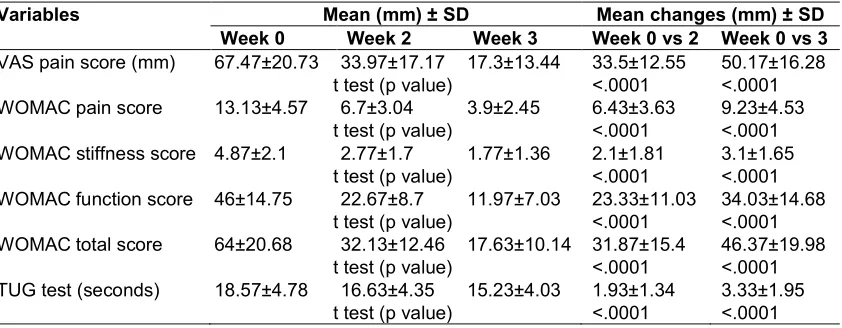
changes in week 0 vs 2 and week 0 vs 3 in intervention group. The Intra group analysis of intervention group found that
all outcome measures were significantly
difference in both week 0 vs 2 and week 0 vs 3 (p<.05).
Table 1. Demographic characteristic of the 2 groups at baseline
Characteristics Variables Intervention group (n=30) Control group (n=30) p value
Age (mean ± SD) 63.57 ± 9.71 61.23 ± 8.44 .32 (t test)
Sex Male
Female
3 (10.00) 27 (90.00)
1 (3.33) 29 (96.67)
.30 (X2)
Table 2. Assessment measure of the 2 groups at baseline
Variables Intervention group (n=30) Control group (n=30) t test
Mean ± SD Mean ± SD (p value)
VAS pain score (mm) 67.47 ± 20.73 69.17 ± 26.34 .78
WOMAC pain score 13.13 ± 4.57 14 ± 5.25 .50
WOMAC stiffness score 4.87 ± 2.1 4.97 ± 2.27 .86
WOMAC function score 46 ± 14.75 45.07 ± 17.32 .82
WOMAC total score 64 ± 20.68 64.03 ± 24.05 .99
TUG test (seconds) 18.57 ± 4.78 19.23 ± 4.71 18.57
Table 3. Intra group analysis of intervention group
Variables Mean (mm) ± SD Mean changes (mm) ± SD Week 0 Week 2 Week 3 Week 0 vs 2 Week 0 vs 3
VAS pain score (mm) 67.47±20.73 33.97±17.17 17.3±13.44 33.5±12.55 50.17±16.28
t test (p value) <.0001 <.0001
WOMAC pain score 13.13±4.57 6.7±3.04 3.9±2.45 6.43±3.63 9.23±4.53
t test (p value) <.0001 <.0001
WOMAC stiffness score 4.87±2.1 2.77±1.7 1.77±1.36 2.1±1.81 3.1±1.65
t test (p value) <.0001 <.0001
WOMAC function score 46±14.75 22.67±8.7 11.97±7.03 23.33±11.03 34.03±14.68
t test (p value) <.0001 <.0001
WOMAC total score 64±20.68 32.13±12.46 17.63±10.14 31.87±15.4 46.37±19.98
t test (p value) <.0001 <.0001
TUG test (seconds) 18.57±4.78 16.63±4.35 15.23±4.03 1.93±1.34 3.33±1.95
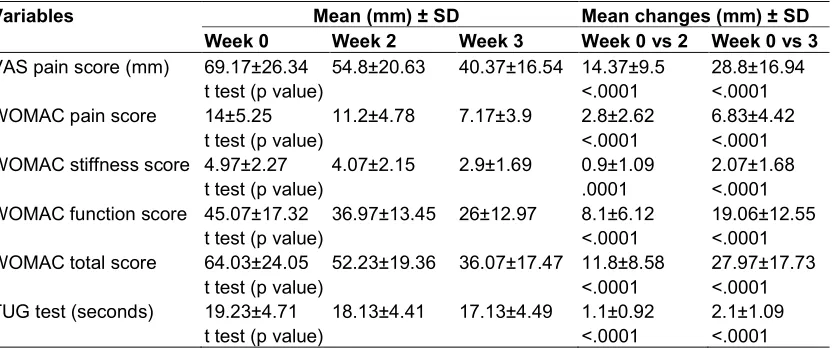
Table 4 discovered the difference in week 0 vs 2 and week 0 vs 3 in control
group. All outcomes measures were
different significantly in week 0 vs 2 and week 0
vs 3 in intra group analysis of control group (p<.05).
The intergroup analysis between intervention and
control group was shown in table 5.
The intervention group was more significantly improved than control group in all outcomes measures (p<.05).
Table 6 showed comparison of frequency of analgesics consumption between the two groups. the analgesics consumption was significantly lessen in intervention group than control group (p<.05).
Table 4. Intergroup analysis of control group
Variables Mean (mm) ± SD Mean changes (mm) ± SD Week 0 Week 2 Week 3 Week 0 vs 2 Week 0 vs 3
VAS pain score (mm) 69.17±26.34 54.8±20.63 40.37±16.54 14.37±9.5 28.8±16.94
t test (p value) <.0001 <.0001
WOMAC pain score 14±5.25 11.2±4.78 7.17±3.9 2.8±2.62 6.83±4.42
t test (p value) <.0001 <.0001
WOMAC stiffness score 4.97±2.27 4.07±2.15 2.9±1.69 0.9±1.09 2.07±1.68
t test (p value) .0001 <.0001
WOMAC function score 45.07±17.32 36.97±13.45 26±12.97 8.1±6.12 19.06±12.55
t test (p value) <.0001 <.0001
WOMAC total score 64.03±24.05 52.23±19.36 36.07±17.47 11.8±8.58 27.97±17.73
t test (p value) <.0001 <.0001
TUG test (seconds) 19.23±4.71 18.13±4.41 17.13±4.49 1.1±0.92 2.1±1.09
t test (p value) <.0001 <.0001
Table 5. Comparison of effectiveness between two groups
Variables Week
Intervention group Control group
p value (t test) Mean
changes (mm)
SD
Mean changes (mm)
SD
VAS pain score (mm) Week 0 vs 2 33.5 12.55 14.37 9.5 <.0001
Week 0 vs 3 50.17 16.28 28.8 16.94 <.0001
WOMAC pain score Week 0 vs 2 6.43 3.63 2.8 2.62 <.0001
Week 0 vs 3 9.23 4.53 6.83 4.42 .04
WOMAC stiffness scores Week 0 vs 2 2.1 1.81 0.9 1.09 .003
Week 0 vs 3 3.1 1.65 2.07 1.68 .019
WOMAC function score Week 0 vs 2 23.33 11.03 8.1 6.12 <.0001
Week 0 vs 3 34.03 14.68 19.07 12.55 .0001
WOMAC total score Week 0 vs 2 31.87 15.40 11.8 8.58 <.0001
Week 0 vs 3 46.37 19.98 27.97 17.73 .0004
TUG test (seconds) Week 0 vs 2 1.93 1.34 1.1 0.92 .0068
Week 0 vs 3 3.33 1.95 2.1 1.09 .0038
Table 6. Comparison of analgesic consumption between two groups at week 2 and week 3
Variables Week Intervention group Control group p value (t test) Mean
(mm)
SD (mm)
Mean (mm)
SD (mm)
Analgesics frequency Week 2 1.33 4.38 17.17 7.84 < .0001
Nwe et al.; JAMMR, 29(2): 1-10, 2019; Article no.JAMMR.47997 4. DISCUSSION
OA knee is one of the most common musculoskeletal conditions and degenerative joint disorder. The prevalence of OA knee is high in elderly population, particularly elderly females in Asia. Persons with OA is limited their physical activities due to this disease and their quality of life is also declined [21]. Disease modifying agents for OA is not available, treatment strategies are directed to relieve symptoms that are correlated to this disease [4]. In this study, there were three patients who reported the mild adverse effect of KT (mild itchy) but received complete intervention without requiring medical treatment.
Regarding to mean age, the present study is comparable to mean age of study done by Castrogiovanni and colleagues (2016) [9]. In current study, females were found to be more affected than males. The prevalence of OA knee is higher in females due to hormonal factors that have a role in developing of OA [22].
Castrogiovanni and colleagues (2016) also reported that the more reduction of pain was noticed since after 15 days of treatment with KT and exercise in management of OA knee in comparison with exercise group [9]. Tripathi & Hande (2017) found that KT plus conventional exercise group studied in geriatric population showed more significant improvement of pain than conventional exercise group after 3 weeks intervention [10]. The present study showed more significant reduction of pain was found in intervention group than control group. Therefore, the result of this study was compatible with literatures.
Immediate improvement in stiffness of OA knee in KT group compared to sham taping group was reported by Aiyegbusi and colleagues [12]. Castrogiovanni and colleagues (2016) also reported that stiffness reduction of OA knee patients in KT plus exercise group than exercise group [9]. Therefore, the above results agree with the present study. By contrast, there was no stiffness reduction in OA knee in KT group in comparison with control group in some study [14]. This may be due to different in taping technique in that facilitation technique of muscle was used whereas the present study used stabilizing effect of kinesio taping technique.
Ogut and colleagues (2018) compared KT treatment and sham KT in sixty one OA knee
female patients and determined a significant improvement in function in KT group after 3
weeks treatment [11]. This finding was
consistent with the current study. On the other hand, no improvement in function was found in KT group with compared to sham in above 60 years old OA knee patients [19]. This may be due to different in KT application. The current study used stabilizing application technique of KT to knee with fascia, space and mechanical
correction application while Wageck and
colleagues (2016) used inhibitory effect of KT to quadriceps and shorter duration of treatment period than the present study [13].
The result of improvement in WOMAC total score of this study was consistent with previous literatures [10,11,12,23]. By contrast, there was no improvement in WOMAC total score after application of KT in OA knee patients [24]. This may be due to inclusion criteria such as small sample size (only 38 patients), Kellgren and Lawrence grade 3 & 4 and Kinesio taping technique is only quadriceps muscle facilitation technique and not comprises knee stabilizing effect in Sarallahi and colleagues (2016) study [24].
Regarding with ambulatory function, there was improvement in ambulatory function in KT plus exercise group than exercise alone group in the study of Castrogiovanni and colleagues (2016). Therefore, Castrogiovanni and colleagues (2016) study agree with the present study [9].
With respect to frequency of analgesic
consumption, patients were given analgesic as required by physiatrists for ethical reason.
Different generic names and different
frequencies of analgesic were included in this study. The consumption was checked at week 2 and week 3 assessments. On analyzing the frequency of analgesic consumption, intervention group was significantly lower than control group. This means that KT has analgesic effect. It is in agreement with Castrogiovanni and colleagues
(2016) in which amount of analgesic
consumption was lower in KT plus exercise group than exercise only group in OA knee patients [9]. Similarly, Homayouni, Foruzi & Kalhori (2016) investigated the analgesic effect of KT on pes anserinus tendino bursitis in which KT alone was more effective than naproxen plus conventional physiotherapy treatment [25].
muscle strength, decrease stability and stiffness. KT is constructed to aid and increase natural healing process of the body and it has numerous type of application and advantage of use. It is suggested that it has an effect of localized
improvement of blood and lymph flow,
decreasing pain, providing anatomical support, enhancing muscle activity and range of motion of joint, and assisting proprioception [10]. However, the standardized skills of application and elastic tension have not been identified yet [15].
The present study found that both groups showed improved significantly in pain, stiffness and function but the intervention group showed a more significant improvement than the control group. Therefore, it can be stated that the additional effect in the intervention group was may be due to KT. This improvement may be related to pain relief effect of KT and regulation of muscle tone by KT.
Possible mechanism for pain relief by KT is as follow. Stabilizing effect (structural support) of KT is believed to relief pain. In addition, lifting effect of KT create additional space between the dermis and the muscle. This additional space is supposed to relieve pressure on the pain receptors located under the skin resulting pain
relief. Moreover, Pacini's bodies which
correspond in rapid pressure changes and
vibration and Rufini's receptors which
correspond in prolonged pressure are activated.
The resultant is suppressed sympathetic
activities. Also, relieves the pain by activating descending pain suppression system [10,26,27].
The application of KT with tension activates
mechano-receptors that causing impulses
reaching brain. Consequently, muscle tone abnormality that is said to be triggering of cartilage degeneration is regulated. Resultant is reducing pain, reducing stiffness and improving function of OA knee so as to reducing of abnormality of increase muscle tone [23,26].
Conventional exercises including stretching, mobilization and strengthening exercises were given in both groups. This can contribute to improvements found in both groups. However, intervention group showed statistically better improvement than control group in intergroup analysis by means of VAS, WOMAC score, TUG score and reduction in frequency of analgesic consumption. Therefore it can be concluded that KT plus conventional exercise is more effective than conventional exercise alone in terms of
relieving pain, reducing stiffness and improving function in the treatment of OA knee.
5. CONCLUSION
KT plus conventional exercise is better than conventional exercise alone in terms of VAS, WOMAC score, TUG test and lower frequency of analgesic consumption. Hence significant relief in pain, reduction of stiffness, improvement in
function and reduction in analgesics
consumption can be attained with KT in patients with knee OA. Therefore, KT should be
incorporated in the non-pharmacological
management of OA knee.
There are some limitations in this study. Firstly, study is relatively short treatment period and no long-term follow-up. Thus carryover effect of KT cannot be found out in this study. Another limitation is that all compartments of the knee OA are included in this study. Therefore, further study of KT for specific compartment of OA knee with longer duration and follow-up period should be carried out.
CONSENT
Written informed consent was obtained after full explanation of the study purpose to them and their rights as participants were provided by the researcher.
ETHICAL APPROVAL
Approval of this study was obtained from
Research and Ethics Committee of the
University of Medical Technology, Mandalay.
ACKNOWLEDGEMENTS
My special thank also go to the Implementation Research Grant Committee (Implementation Research Grant ID 317), Department of Medical Research, Myanmar for funding this study.
COMPETING INTERESTS
Authors have declared that no competing interests exist.
REFERENCES
1. Page CJ, Hinman RS, Bennell KL.
Physiotherapy management of knee
Nwe et al.; JAMMR, 29(2): 1-10, 2019; Article no.JAMMR.47997
2. Cho HY, Kim EH, Kim J and Yoon YW.
Kinesio taping improves pain, range of
motion, and proprioception in older
patients with knee osteoarthritis. American
Journal of Physical Medicine and
Rehabilitation. 2015;94(3):192-199.
3. Cross M, Smith E, Hoy D, Nolte S,
Ackerman I, Fransen M, et al. The global burden of hip and knee osteoarthritis: Estimates from global burden of disease 2010 study. Annals of the Rheumatic Diseases. 2014;73(7):1323-1330.
4. Geusen P, Pavelka K, Rovensky J,
Vanhoof J, Demeester N, Calomme M, et al. A 12- week randomized, double-blind, placebo-controlled multicenter study of
choline-stabilized orthosilicic acid in
patients with symptomatic knee
osteoarthritis. BMC Musculoskeletal
Disorders. 2017;18(2):1-12.
5. Gupta RK, Heggannavar A. Quantitative
effects of proprioceptive exercises and
Mulligan's MWM in subjects with
osteoarthritis knee- A randomized control trial. International Journal of Therapies and Rehabilitation Research. 2015;4(4):191-200.
6. Offenbacher M, Stucki G. Physical therapy
in the treatment of fibromyalgia.
Scandinavian Journal of Rheumatology. 2009;29(113):78-85.
7. Bandyopadhyay A, Mahapatra D.Taping in
sports: A brief update. Journal of Human Sport & Exercise. 2012;7(2):544-552.
8. Dhanakottis S, Samuel RK, Thakar M,
Doshi S and Vadsola K. Effects of
additional kinesiotaping over the
conventional physiotherapy exercise on pain, quadriceps strength and knee functional disability in knee osteoarthritis participants- A randomized controlled study. International Journal of Health Sciences and Research. 2016;6(1):221-228.
9. Castrogiovanni P, Giunta AD, Guglielmino
C, Roggio F, Romeo D, Fidone F, et al. The effects of exercise and kinesio tape on physical limitations in patients with knee osteoarthritis. Journal of Functional Morphology and Kinesiology. 2016;1(4): 355-368.
10. Tripathi B, Hande D. Effects of
kinesiotaping on osteoarthritis of knee in geriatric population. International Journal of applied Research. 2017;3(2):301-305. 11. Ogut H, Guler H, Yidizgoren MT, Velioglu
O, Turhanoglu AD. Does kinesiology
taping improve muscle strength and function in knee osteoarthritis? A single-blind, randomized and controlled study. Official Journal of the Turkish League against Rheumatism. 2018;33(3):335-343.
12. Aiyegbusi AI, Ogunfowodu OM, Akinbo
SR. Kinesio taping is an effective stop-gap measure in alleviating the symptoms of osteoarthritis of the knee. Journal of Clinical Sciences. 2018;15(2):102-106.
13. Wageck B, Nunes GS, Bohlen NB, santos
GM and Noronha MD. Kinesio taping does not improve the symptom or function of older people with knee osteoarthritis: A randomized trial. Journal of Physiotherapy. 2016;62:153-158.
14. Saswadkar AA, Shimpi AP, Shyam A,
Sancheti PK. Short term effects of kinesio taping on vatus medialis in patients with osteoarthritis knee for gait and joint
function enhancenment. Journal of
Evidence-Based Physiotherapy and
Research. 2017;1(1):27-30.
15. Li X, Zhou X, Liu H, Chen N, Liang J, Yang
X, et al. Effects of elastic therapeutic taping on knee osteoarthritis: A systemic review and meta-analysis. Aging and Disease. 2018;9(2):296-308.
16. Hawker GA, Mian S, Kendzerska T and
French M. Measures of adult pain. American College of Rheumatology. 2011; 63(11):240-252.
17. Ackerman I. Western Onterio and
McMaster Universities Osteoarthritis Index. Australian Journal of Physiotherapy. 2009; 55:213.
18. Podsiadlo, Richardson. The time "up and go": A test of basic functional mobility for frail elderly persons. Journal of American Geriatric Society. 1991;39(2):142-148.
19. Hill K, Denisenko S, Miller K,
Clements T, Batchelor F, Morgan P. Clinical outcome measurement in adult
neurological physiotherapy. 4th Edn.
Australian Physiotherapy Association
National Neurology Group; 2010.
20. Shumway-Cook A, Brauer S, Woollacott
M. Predicting the probability for falls in community – dwelling older adults using the timed up and go test. Oxford Academic Physical Therapy. 2000;80(9).
21. Kumar A, Pandey SK, Srivastava A, Mallik
22. Palazzo C, Nguyen C, Colau MML, Rannou F, Poiraudeau S. Risk factors and burden of osteoarthritis. Annals of Physical and Rehabilitation Medicine. 2016;59(3): 134-138.
23. Lee K, Yi CW, Lee S. The effects of
kinesiology taping therapy on degenerative knee arthritis patients’ pain, function, and joint range of motion. The Journal of Physical Therapy Science. 2016;28(1):63-66.
24. Sarallahi M, Amiri A, Sarafzdeh J,
Jamishidi. The effect of quadriceps kinesio tape on functional disability, pain, and knee joint position sense in knee
osteoarthritis patients. Journal of Clinical Physiotherapy Research. 2016;1(2):73-78. 25. Homayouni K, Foruzi S, Kalhori F. Effects
of kinesiotaping versus non-steroidal anti-inflammatory drugs and physical therapy for treatment of pes anserinus tendino-bursitis: A randomized comparative clinical trial. The Physician and Sportsmedicine. 2016;44(3):252-256.
26. Gramatikova M, Nikolova E, Mitova S.
Nature, application and effect of kinesio-taping. Activities in Physical Education and Sport. 2014;4(2):115-119.
27. Manescu CO. Kinesiology taping.
Marathon. 2015;7(2):302-307.
________________________________________________________________________________ © 2019 Nwe et al.; This is an Open Access article distributed under the terms of the Creative Commons Attribution License
(http://creativecommons.org/licenses/by/4.0), which permits unrestricted use, distribution, and reproduction in any medium,
provided the original work is properly cited.
Peer-review history: