_____________________________________________________________________________________________________ ISSN: 2231-0614
SCIENCEDOMAIN international www.sciencedomain.org
Is Having Had a Cup of Coffee a Methodological
Issue in Routine Sphygmomanometry?
Nyunt Wai
1*, Mohd Ariff Bin Khaled
2and Archana Singh Sikarwar
11
DepartmentofHuman Biology, School of Medical Sciences, International Medical University (IMU), 126, Jalan Jalil Perkasa 19 Bukit Jalil, 57000 Kuala Lumpur, Malaysia. 2
Sem.7 B. Pharm. Student, School of Pharmacy, International Medical University (IMU), Bukit Jalil, 57000 Kuala Lumpur, Malaysia.
Authors’ contributions
This work was carried out in collaboration between all authors. Author NW designed the study, wrote the protocol and the first draft of the manuscript. Author MABK carried out the experiments and analyzed results under supervision of author NW. Author ASS participated in recruitment of participants, literature search and the write-up. The final manuscript was approved by all authors.
Article Information
DOI:10.9734/BJMMR/2015/15037 Editor(s): (1)Chan Shen, Department of Biostatistics, MD Anderson Cancer Center, University of Texas, USA. Reviewers: (1)Anonymous, India. (2)Rajendra Nath, Deptt. of Pharmacology & Therapeutics , King George’s Medical University , Lucknow (UP), India. (3)Anonymous, Malaysia. (4)Tatsuo Shimosawa, Dept of Clinical Lab, The University of Tokyo, Japan. (5)Anonymous, Brazil. (6)Anonymous, Mexico. Complete Peer review History:http://www.sciencedomain.org/review-history.php?iid=909&id=12&aid=7773
Received 3rd November 2014 Accepted 31st December 2014 Published 14th January 2015
ABSTRACT
Background: In view of the impact of hypertension on public health, the objective of this study was to determine whether having had a cup of coffee in an everyday life setting raises blood pressure significant enough to make it a methodological issue in routine sphygmomanometry.
Methods: Healthy normotensive volunteers from a private university in Malaysia were recruited. After an overnight fast, seated systolic and diastolic blood pressures (SBP and DBP) of habitual coffee drinkers (n=16) were measured (Omron HEM 7080 automated monitor) in the laboratory 15 min. before and every 15 min. up to 90 min. after drinking strong coffee. This was repeated on non-habitual drinkers (n=16) who also underwent a control study (decaffeinated coffee). To see whether the laboratory findings could be extrapolated to everyday life setting, the pre-coffee BP and 30 min.- and 60 min.- post-coffee BPs were measured on habitual coffee drinkers (n=18) who
Wai et al.; BJMMR, 6(10): 965-977, 2015; Article no.BJMMR.2015.273
consumed self-prepared coffee and who carried on with routine office work between BP measurements taken in a nearby room.
Results: In the laboratory setting, coffee significantly increased SBP and DBP at all time-points in non-habitual drinkers (e.g.11.38+/- 8.2 and 10.75+/-5.7 mm Hg at 75 min; P<0.01, repeated measures ANOVA and Dunnett's test); in habitual drinkers, SBP only was increased (7.23+/-4.7 at 90 min; P<0.05). In the office setting, smaller but significant DBP elevations (3.72+/-5.1 at 60 min; P<0.05) were observed.
Conclusion: The results indicate that having had a cup of coffee could be a methodological issue in routine sphygmomanometry, particularly with non-habitual coffee drinkers consuming strong coffee. However, caution should be exercised in drawing conclusions because of the small sample size.
Keywords: Caffeinated coffee; decaffeinated coffee; blood pressure; methodological issue; sphygmomanometry; habitual coffee drinker; non-habitual coffee drinker; office setting.
1. INTRODUCTION
The accurate and valid measurement of blood pressure (BP) is the bedrock of the management of arterial BP disorders. The measurement should reflect, as much as possible, the true BP prevailing under a particular circumstance. Despite technological advances, the only practical method available to the majority of health care givers worldwide for diagnosing or monitoring hypertension remains indirect sphygmomanometry, which unfortunately is fraught with inherent and potential errors [1]. The sphygmomanometric readings are also subject to background variability (or noise). A difference of few millimetres of mercury seems to have a large impact on diagnosing or monitoring hypertension: Approximately 1 in 4 adults, worldwide, would be classified as hypertensive on the basis of a single BP measurement with the cut off level of >140 mm Hg systolic or 90 mm Hg diastolic [2]. In the face of the rising global threat of hypertension to public health [3], how accurately we measure the BP is crucial. Many guidelines or commentaries on the methodology of BP measurement have been published. What is conspicuously lacking or being inadequately or inconsistently touched upon in the these publications is the issue of having had a cup of caffeinated coffee prior to BP measurement; many of these did not address this issue at all [4-8] while some recommended that coffee or caffeine-containing beverages should not be taken immediately before [9], within 30 min. [10], or within 1 h prior to measurement [11]. The omission or insufficient treatment of this issue becomes even more evident in the light of the following reports: (i) Coffee is the most widely used stimulant in Western society [12] and caffeine, a methyl xanthine consumed in coffee, tea, cola soft
drinks and energy drinks, is probably the world's most widely used drug, with coffee accounting for 54% of all caffeine use [13]; (ii) World coffee consumption is growing at annual rate of 0.4 per cent [14]; (iii) Most but not all studies showed that coffee at dietary doses acutely and significantly increases both the systolic and diastolic BP(SBP and DBP) within 30 minutes, peaking in 1-2 hours, and may persist for more than 4 hours [15,16]; (iv) The pressor effect of coffee is generally attributed to its caffeine content [17] although one study [18] reported that coffee acutely increased blood pressure independently of caffeine content; (v) The tolerance to pressor effect that develops with chronic coffee consumption could be incomplete [19].
With this background, the present study aimed to find out whether a strong cup of regular (caffeinated) coffee or decaffeinated coffee has acute pressor effects on the arterial blood pressure and if present, whether this pressor effect is still significant for a chronic coffee drinker in an environment similar to that of a doctor’s office, making recent coffee intake an issue in routine sphygmomanometry.
2. METHODS
2.1 Participants
Wai et al.; BJMMR, 6(10): 965-977, 2015; Article no.BJMMR.2015.273
2.2 The Blood Pressure (BP) Measuring Instrument and Procedure
An automated oscillometric BP monitor (HEM 7080, Omron, Japan), newly purchased and
validated against the mercury
sphygmomanometer, was set to display the means of three consecutive BP and heart rate readings taken 1 min. apart.
The subject was seated with the back supported, legs uncrossed and resting on the floor. The arm with the higher BP reading compared with the other arm (predetermined during screening) was positioned on the table so that the middle of the cuff was at the level of the heart (the mid-point of the sternum). To ensure a rest period of at least 5 min., the start button of the BP monitor was pressed 5 min. after applying the cuff and positioning of the arm. The same instrument and the same measurement protocol were used for all measurements by the same experimenter (MAK).
2.3 Coffee Preparation
Standardized caffeinated coffee was prepared by pouring boiled water to a mug containing 3 teaspoonfuls (3.4 g) of coffee granules (Nescafe Gold, Nestle), 2 tablespoonfuls (13.3 g) of creamer powder (Indo Café), and 1 tablespoonful (12.4 g) of sugar granules to make up to the volume of 270 ml. Compared with single-use Nescafe sachets containing 2 g of coffee granules (commercially available in Malaysia), our standardized coffee could be considered “strong”. Decaffeinated coffee was prepared as above using the same amount (3.4 g) of decaffeinated coffee granules (Nescafe Gold, Nestle).
Non-standardized caffeinated coffee was self-prepared by the volunteers undergoing the office setting experiment according to his/her taste from the vending machines provided in the staff common room.
2.4 Experimental Design
(1) Orientation sessions: For screening and getting the subjects accustomed to the
experimental environment, the
experimenter and the procedure.
(2) Laboratory sessions: These were designed to determine, under controlled conditions, the acute effects on the brachial arterial BP
of a cup of strong coffee in habitual coffee drinkers (n=16) and the effects of strong coffee vs. decaffeinated coffee in non-habitual coffee drinkers (n=16). It was a randomized single-blind cross over study in that the order in which the subjects received the caffeinated and decaffeinated coffee was randomized, and they did not know which coffee they were receiving. (3) Office-setting sessions: These were
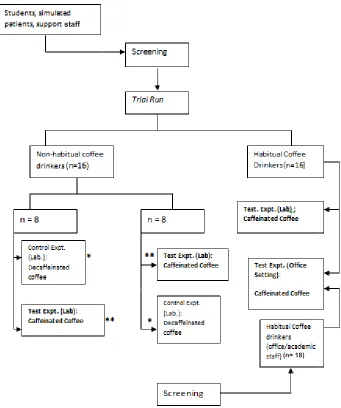
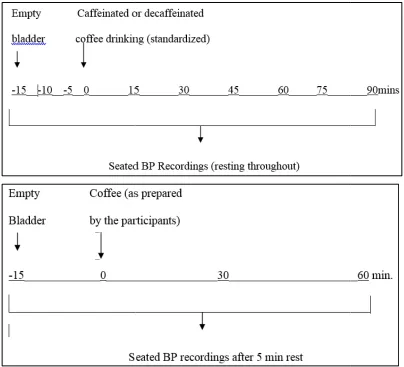
designed to see whether these laboratory findings could be extrapolated to everyday life setting. Pre-coffee and post-coffee BPs of habitual coffee drinkers (n =18), taken in one of the learning rooms near their office, were compared. Here, the subjects consumed self-prepared coffee and carried on with routine work between the BP measurements. (Figs. 1 and 2)
2.5 Experimental Sessions
(1) Orientation sessions were done in the rooms where the respective experimental sessions were to be carried out. Subjects completed a brief demographic, health and lifestyle questionnaire, after which seated BPs were measured on both arms, in the same way these would be measured in the experimental sessions. The arm with consistently higher readings (3 times) was noted down for future BP measurements. Those who consumed coffee daily or on regular basis were classified as habitual coffee drinkers while those who did not, rarely or occasionally consume coffee and other caffeinated drinks were classified as non-habitual coffee drinkers. Experimental procedures were explained, and informed consent was obtained from the volunteers who were eligible for the study. The project had been approved by the Joint Research and Ethical Committee of the University (B Pharm 4.8/JCM21/2009).
drinkers (but not the habitual drinkers) were asked to abstain from consumption of caffeine-containing food and beverages (the list of which was provided) for three days prior to the day of the experiment; (ii) On arrival at the laboratory (8.00
am), a light breakfast consisting of biscuits and water was given to minimize
hypoglycaemia-induced sympathetic
effects on the BP; (iii) The subjects were asked to visit the toilet to relieve the bladder as bladder distension could affect the BP [20]; (iv) Two BP recordings (each
Fig. 1. Flow chart showing the experimental design. versa denotes a cross-over design.
comprised 16 participants.
staff
Wai et al.; BJMMR, 6(10): 965-977, 2015; Article no.
drinkers (but not the habitual drinkers) were asked to abstain from consumption of containing food and beverages list of which was provided) for three days prior to the day of the experiment; (ii) On arrival at the laboratory (8.00 – 11.00 am), a light breakfast consisting of biscuits and water was given to minimize
induced sympathetic
P; (iii) The subjects were asked to visit the toilet to relieve the bladder as bladder distension could affect ; (iv) Two BP recordings (each
in triplicates) were taken 15 min. apart and the mean of the second set of triplicates was taken as the baseline BP; coffee or decaffeinated coffee (prepared after the first measurement) was drunk within 5 min. at the end of second measurement; (v) Once the subject finished drinking, the BP was measured every 15 min. until 90
In between BP measuremen
subjects were encouraged to relieve their bladder (as there could be caffeine induced diuresis).
Flow chart showing the experimental design. Switching from block*to block** and vice over design. Adding up, block* comprised 16 participants and block ** comprised 16 participants. Expt., experiment; Lab., Laboratory
(n= 18)
; Article no.BJMMR.2015.273
in triplicates) were taken 15 min. apart and the mean of the second set of triplicates baseline BP; coffee or decaffeinated coffee (prepared after the first measurement) was drunk within 5 min. at the end of second measurement; (v) Once the subject finished drinking, the BP was measured every 15 min. until 90th min. In between BP measurements, the subjects were encouraged to relieve their bladder (as there could be
Fig. 2. Time-points for BP measurements in
office setting protocol (lower panel)
2.6 Office-Setting Sessions
At appointed time during office hours, the habitual coffee drinkers (n=18, mostly lecturers and some office staff) were called by phone to come to one of the learning rooms located near their office. After completing the questionnaire, their pre-coffee BP was taken. They were then requested to visit the staff room to make their own coffees which were to be drunk within 5 m after which they were contacted by phone to visit the same room for measurement of 30 min. 60 min.- post-coffee BPs. In between the measurements, they went on with their work in their own offices or elsewhere.
2.7 Statistical Analysis
The results are expressed as mean ± standard deviation (SD). The significance level was set at
Wai et al.; BJMMR, 6(10): 965-977, 2015; Article no.
points for BP measurements in laboratory setting protocol (upper panel) and office setting protocol (lower panel)
At appointed time during office hours, the habitual coffee drinkers (n=18, mostly lecturers called by phone to come to one of the learning rooms located near their office. After completing the questionnaire, coffee BP was taken. They were then requested to visit the staff room to make their own coffees which were to be drunk within 5 min. after which they were contacted by phone to visit the same room for measurement of 30 min. - and In between the hey went on with their work in
results are expressed as mean ± standard deviation (SD). The significance level was set at
P≤0.05. One-way analysis of variance (ANOVA) followed by Dunnett test was used for the comparison of parameters among the groups; one-way repeated measures ANOVA f
Dunnett test was used for the BP and heart rate changes from the baseline after intervention within each group.
3. RESULTS
3.1 Baseline Characteristics of Participants
The majority of the participants were local Malaysians (Malay, Chinese, Indian and others) and also several international participants (none were of African descent). There were no significant differences among the three groups of participants as regards body mass index (BMI), baseline heart rate (HR) and BPs, though
; Article no.BJMMR.2015.273
protocol (upper panel) and
way analysis of variance (ANOVA) followed by Dunnett test was used for the comparison of parameters among the groups;
way repeated measures ANOVA followed by Dunnett test was used for the BP and heart rate changes from the baseline after intervention
Baseline Characteristics of the
Wai et al.; BJMMR, 6(10): 965-977, 2015; Article no.BJMMR.2015.273
office setting group was older, the majority being lecturers (Table 1). Among habitual coffee drinkers recruited for laboratory setting protocol, 12 subjects drank coffee 1-2 cups daily, while 4 drank 2-3 cups daily. Among those recruited for office setting protocol, 10 drank 1-2 cups daily, 5 drank 2-3 cups daily and 3 drank 3-4 cups daily.
3.2 Blood Pressure Responses to Standardized Coffee (Laboratory Setting)
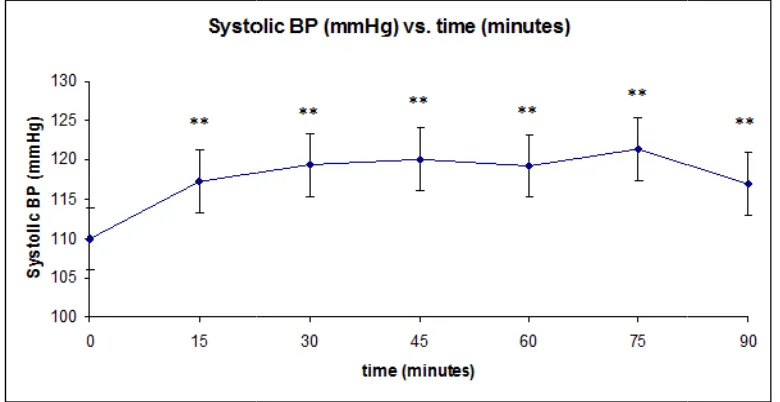
In both groups (habitual and non-habitual coffee drinkers, n=16 each), the SBP increased significantly at 15 min after drinking coffee, and remained significantly elevated until 90 min. when the experimental session ended (Figs. 3 and 4). Compared with the pressor responses of habitual drinkers, the SBP of the non-habitual drinkers were higher (+4.88±4.2vs +11.38±8.2 at 75 min. for habitual and non-habitual drinkers respectively) but the difference did not reach statistical significance. As for DBP, the significant increases at all time-points after coffee drinking were observed in non-habitual drinkers (Fig. 5) but not in habitual coffee drinkers (+2.06±6.3vs. +11.38±8.2 at 75 min. for habitual and non-habitual drinkers respectively). Thus, after drinking a strong cup of coffee, both the SBP and DBP significantly increased in non-habitual coffee drinkers while an increase in SBP only was observed in habitual coffee drinkers. The maximum SBP and DBP increments in non-habitual coffee drinkers were 10.06±4.8 mmHg and 10.75±5.7 mmHg respectively while those for habitual coffee drinkers were 6.19±7.6 mmHg and 3.13±7.3 mmHg respectively.
3.2.1 Heart rate (HR) responses to standardized coffee (laboratory setting)
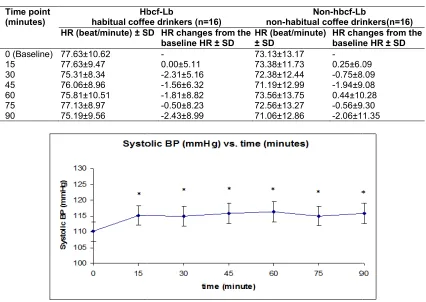
After drinking coffee, no significant changes in HR were found in either group (Table 2).
3.3 Blood Pressure Responses to decaffeinated Coffee (Laboratory Setting)
At all time-points up to 90 min after drinking decaffeinated coffee, no significant changes in B.P. (Fig. 6) nor in heart rate(not shown) were observed in non-habitual drinkers.
3.4 The Effects of Drinking Self-Prepared Coffee on Habitual Coffee Drinkers in the Office Setting Protocol
After drinking self-prepared coffee, there was no significant increase in SBP while the DBP
increased significantly (P<0.05) from baseline value of 76.22±11.37 mmHg to 79.44±11.77 and 79.94±12.18 mmHg at 30th and 60th min. after drinking coffee.
4. DISCUSSION
review [15] on caffeine’s acute effect on blood pressure reported changes of 3
systolic and 4-13 mm Hg diastolic, typically occurring within 30 minutes, peaking in 1 hours, and persisting for more than 4 hours. our study we did not look into the effect of age, gender and menopause on the coffee’s press effect. In this regard, Farag and co
did a randomized, cross-over study on 165 healthy subjects, and reported that ingestion of caffeine (250 mg) in the laboratory setting resulted in an average increases (at 45 to 60 min.) in SBP and DBP of 4 mm Hg regardless of
Table 1. Baseline characteristics of the participants
Parameters Laboratory setting
Habitual coffee drinkers (HbCf (n=16)
Age (years) ± SD 27.94±7.30 (19
Gender 8 males, 8 females
Body Mass Index ± SD (kg/m²) 22.94±4.25
BP ± SD (Systolic/ Diastolic mmHg)
110.13 76.56±7.78 Heart Rate ± SD
(beats/minute)
77.63±10.62
Mean arterial pressure** ± SD (mmHg)
87.64±8.81
Pulse Pressure**± SD (mmHg) 33.56±8.39
* P<0.05, One-Way ANOVA followed by the Dunnett’s test (versus other 2 groups) ** Mean arterial pressure (calculated) = DBP +1/3
Fig. 3. The systolic blood pressure (SBP) responses (mean±SE) to standardized coffee in the non
** P≤0.01, One-way repeated measures ANOVA followed by Dunnett’s test (versus baseline value) Wai et al.; BJMMR, 6(10): 965-977, 2015; Article no.
on caffeine’s acute effect on blood rted changes of 3-15 mm Hg 13 mm Hg diastolic, typically occurring within 30 minutes, peaking in 1-2 hours, and persisting for more than 4 hours. In our study we did not look into the effect of age, gender and menopause on the coffee’s pressor Farag and co-workers [16] over study on 165 healthy subjects, and reported that ingestion of caffeine (250 mg) in the laboratory setting resulted in an average increases (at 45 to 60 of 4 mm Hg regardless of
age, gender, menopause, or hormonal
(oestrogen) status.
Moreover, coffee does not seem to have significant effect on the plasma levels of sex steroids and their binding globulins [26]. Although the reported magnitude of pressor re
varied among different studies, the results from our study and those of others suggest that coffee (or caffeine) could acutely increase the blood pressure and therefore is an issue to be considered in evaluation of blood pressure readings across age and gender groups.
Baseline characteristics of the participants
Laboratory setting Office setting
Habitual coffee drinkers (HbCf-Lb) (n=16)
Non-habitual coffee drinkers (Non-HbCf-Lb)
(n=16)
Habitual coffee drinkers (HbCf-Of) (n=18)
27.94±7.30 (19-39) 26.25±8.63 (20-49) 39.28±9.57* (21
8 males, 8 females 11 males,5 females 9 males, 9 females
22.94±4.25 22.30±4.11 23.74±3.12
110.13±12.63/ 76.56±7.78
109.94±16.02/ 72.81±12.78
115.50±14.37 76.22±11.37
77.63±10.62 73.13±13.17 74.56±6.15
87.64±8.81 89.18±11.82 85.06±13.43
33.56±8.39 39.28±8.23 37.13±7.87
Way ANOVA followed by the Dunnett’s test (versus other 2 groups) ressure (calculated) = DBP +1/3 (Pulse Pressure) where pulse pressure = SBP
The systolic blood pressure (SBP) responses (mean±SE) to standardized coffee in the non-habitual coffee drinkers (n=16)
way repeated measures ANOVA followed by Dunnett’s test (versus baseline value) ; Article no.BJMMR.2015.273
age, gender, menopause, or hormonal
Moreover, coffee does not seem to have significant effect on the plasma levels of sex steroids and their binding globulins [26]. Although the reported magnitude of pressor responses varied among different studies, the results from our study and those of others suggest that coffee (or caffeine) could acutely increase the blood pressure and therefore is an issue to be considered in evaluation of blood pressure
e and gender groups.
Office setting Habitual coffee drinkers
Of)
28±9.57* (21-54) 9 males, 9 females 23.74±3.12 115.50±14.37/ 76.22±11.37 74.56±6.15
85.06±13.43
37.13±7.87
(Pulse Pressure) where pulse pressure = SBP-DBP
The systolic blood pressure (SBP) responses (mean±SE) to standardized coffee in
Table 2. The heart rate (HR) responses to standardized coffee in habitual and non
Time point (minutes)
Hbcf
habitual coffee drinkers HR (beat/minute) ± SD
0 (Baseline) 77.63±10.62
15 77.63±9.47
30 75.31±8.34
45 76.06±8.96
60 75.81±10.51
75 77.13±8.97
90 75.19±9.56
Fig. 4. The systolic blood pressure (SBP) responses (mean±SE) to standardized coffee in the habitual
* P≤0.05, One-way repeated measures ANOVA followed by Dunnett’s test (versus baseline value)
Fig. 5. The diastolic blood pressure (DBP) responses (mean±SE) to standardized coffee in the non
* P≤0.05, One-way repeated measures ANOVA followed by Dunnett’s test (versus baseline value) Wai et al.; BJMMR, 6(10): 965-977, 2015; Article no.
responses to standardized coffee in habitual and non coffee drinkers
Hbcf-Lb
habitual coffee drinkers (n=16)
Non-hbcf-Lb non-habitual coffee drinkers HR (beat/minute) ± SD HR changes from the
baseline HR ± SD
HR (beat/minute) ± SD
HR changes from the baseline HR ±
- 73.13±13.17 -
0.00±5.11 73.38±11.73 0.25±6.09
-2.31±5.16 72.38±12.44 -0.75±8.09
-1.56±6.32 71.19±12.99 -1.94±9.08
-1.81±8.82 73.56±13.75 0.44±10.28
-0.50±8.23 72.56±13.27 -0.56±9.30
-2.43±8.99 71.06±12.86 -2.06±11.35
The systolic blood pressure (SBP) responses (mean±SE) to standardized coffee in the habitual coffee drinkers (n=16)
way repeated measures ANOVA followed by Dunnett’s test (versus baseline value)
The diastolic blood pressure (DBP) responses (mean±SE) to standardized coffee in the non-habitual coffee drinkers (n=16)
way repeated measures ANOVA followed by Dunnett’s test (versus baseline value) ; Article no.BJMMR.2015.273
responses to standardized coffee in habitual and non-habitual
Lb
coffee drinkers(n=16) changes from the baseline HR ± SD
0.25±6.09 0.75±8.09 1.94±9.08 0.44±10.28
0.56±9.30 2.06±11.35
The systolic blood pressure (SBP) responses (mean±SE) to standardized coffee
way repeated measures ANOVA followed by Dunnett’s test (versus baseline value)
The diastolic blood pressure (DBP) responses (mean±SE) to standardized coffee
Wai et al.; BJMMR, 6(10): 965-977, 2015; Article no.BJMMR.2015.273
Since the pressor effects were observed after drinking caffeinated but not decaffeinated coffee, we can infer that the pressor effect of coffee is most likely to be due to its caffeine content. However, it is surprising that Corti el al. [18] reported rises in SBP (but not DBP) at 30 and 60 minutes (by 5.5+ 2.5 mm Hg and 12+ 3 mmHg respectively) after administration of decaffeinated coffee, despite the absence of a rise in plasma caffeine concentration. One study [24] reported a small but significant rise in DBP after decaffeinated coffee drinking compared with regular coffee which significantly increased both SBP and DBP to a greater extent.
However, other studies [21,27,28] did not find any acute pressor effect of decaffeinated coffee. In a randomized double-blind, crossover trial involving healthy habitual coffee drinkers, switching over to decaffeinated coffee for the subsequent weeks was reported to result in a significant but small decrease in ambulant SBP and DBP [12]. Even if decaffeinated coffee of some preparations under certain circumstances does have some pressor effect, it would not have mattered as far as the objective of the present study is concerned as recent ingestion of any coffee could have any how raised the blood
pressure, making coffee drinking a
methodological issue in routine BP
measurement.
In the present study, we compared the cardiovascular responses of habitual and non-habitual coffee drinkers to the same dose of coffee in identical experimental setting. The systolic but not the diastolic BP of habitual coffee drinkers were significantly but modestly raised (about 5 mm Hg) at all time-points until the 90 min. while non-habitual coffee drinkers exhibited significantly greater systolic and diastolic pressor responses. Corti et al. [18] have shown that coffee drinking increased BP in non-habitual coffee drinkers but not in habitual coffee drinkers. This is not surprising as habitual coffee drinking could lead to tolerance. In a study on 338 young women, drinking coffee on the testing day caused elevated SBP whereas no association was found with habitual coffee intake [29]. Near complete tolerance to caffeine’s pressor effect was reported to have developed over the first 1-4 days of caffeine [30]. A report on cardiovascular effects of 67 and 133 mg of caffeine on 12 healthy habitual coffee drinkers [19] indicated that habitual coffee drinking does not lead to complete tolerance to caffeine. Again, it can be said that regardless of being an occasional or a
habitual coffee drinker, recent coffee drinking could elevate the BP, more so for the former than the latter, thereby rendering recent coffee drinking an issue in routine blood pressure measurement methodology.
Are the pressor effects of coffee ingestion in normotensive individuals also found in people with hypertension, who require more frequent blood pressure measurements by way of monitoring? A single oral dose of caffeine equivalent to 2 to 3 cups of coffee was reported to increase SBP for 3 hr in mildly hypertensive men as well as in their normotensive counterparts but the former group showed more persistent elevation in DBP than the latter [31]. The same dose of caffeine administered to borderline hypertensive men was reported to increase DBP 2 to 3 times larger than that in normotensive controls [32] and the strongest pressor effect of caffeine was observed in the diagnosed hypertensive group compared with high-normal BP group. A recent systemic review and meta-analysis [33] of the controlled trials showed that in hypertensive individuals, caffeine or coffee intake produces acute elevation in SBP by 8 mm Hg and DBP by 5.7 mm Hg, with the BP increases occurring in the first hour after caffeine intake and lasting up to or more than 3 hr. Coffee drinking can therefore said to be a greater issue in routine sphygmomanometric monitoring of hypertensive individuals.
Now that we have shown that drinking strong coffee increased the SBP of habitual coffee drinkers under laboratory conditions, we need to see whether these findings could be extrapolated to real life setting where a person who has enjoyed a cup of coffee prepared to his own liking is about to have his blood pressure measured. Will the pressor effect of coffee be lost in this noise of everyday life, particularly in hectic work environment (office setting)? Our results on free moving volunteers (office and academic staff) show that DBP (but not SBP) responses to drinking various strengths of coffee (self- prepared) were significantly raised at all measured time points (30 and 60 min). Coffee increases sympathetic nerve activity [18] and
plasma catecholamines [17] and high
Wai et al.; BJMMR, 6(10): 965-977, 2015; Article no.BJMMR.2015.273
controlled laboratory setting where standardized strong coffee was administered, coffee drinking in everyday life (work place) setting can raise the BP to make it an issue in BP measurement, particularly in a doctor’s office where there could be white coat effect [35].
For obvious practical reasons, we cannot wait for 3 hrs to measure the BP if the subject has taken coffee. As stated earlier, the guidelines on blood pressure measurement by various bodies either did not address this issue or addressed it inadequately despite alerting signals from some workers [15]. On the part of health care providers, one practical way of tackling this problem is to make one’s own patients aware of this issue. Public could be educated not to consume coffee (and to avoid other confounders
as recommended in the guidelines) for at least 3 hours before the scheduled blood pressure measurement. For a non-habitual coffee drinker, this information is all he needs so that he would refrain from taking coffee or other caffeinated drinks even if the occasion arises. For a habitual drinker who is taking home-BP measurements, this means he should have his morning coffee only after taking the BP measurement. For a habitual drinker who has an appointment with his doctor, this translates to the understanding that he is to skip morning coffee for a morning appointment and lunch time coffee for an afternoon appointment. This shouldn’t be too hard on the patients as they are used to overnight fasting for determination of fasting blood sugar or lipid profile.
Fig. 6. The systolic blood pressure (SBP) responses (mean±SE) (upper panel) and the diastolic blood pressure (DBP) responses (mean±SE) (lower panel) to standardized decaffeinated coffee
in the non-habitual coffee drinkers (n=16) Systolic BP (mmHg) vs. time (minutes)
100 105 110 115 120 125 130
0 15 30 45 60 75 90
time (minutes)
S
y
s
tol
ic
B
P
(
m
m
H
g)
Diastolic BP (mmHg) vs. time (minutes)
60 65 70 75 80 85 90
0 15 30 45 60 75 90
time (minutes)
D
ia
st
ol
ic
B
P
(
m
m
H
Wai et al.; BJMMR, 6(10): 965-977, 2015; Article no.BJMMR.2015.273
Addressing the neglected issue in an area with high public health impact, along with taking the mean of the three measurements at one-minute intervals for every BP and HR data, and supplementation of the laboratory protocol with on-the-job (office setting) protocol could be considered as strengths of this study.
5. LIMITATIONS OF THE STUDY
As evidenced by high variability in some of the responses, the sample size of this study could have been larger for more robust conclusions. From the calculation using the non-centrality function [36,37] for a cross-over study (with repeated measures) where the outcome is a measurement, the power is 0.8, the standard deviation of the difference between the two values for the same subject is 6 (mm Hg), and the minimal biologically meaningful detectable difference in means is 4 (mm Hg), the sample size would be 20. At power 0.9, the sample size jumps up to 26. Compared with these, the sample sizes of the present study for the two protocols, 16 and 18, were smaller.
We did not take into account the smoking status of the participants because the study protocol (the self-control cross–over design and the use of non-smoking venues) excluded or minimized the influence of acute effects of cigarette smoking on the measured cardiovascular parameters. Nevertheless, in view of the well-established vascular and metabolic effects of cigarette smoking [38], excluding the habitual smokers from this study could have reduced variability in the responses to coffee drinking.
For office-setting protocol, we did not do a control study because of logistic reasons (being lecturers or office workers, the volunteers could hardly give time for another on-the-job experimental session). Not analysing caffeine contents of the beverages could be another limitation. But then, the primary objective of the study was to find out the effect of drinking coffee per se on the BP.
6. CONCLUSION
The results suggest that drinking strong regular coffee but not decaffeinated coffee under controlled laboratory conditions significantly increased both the systolic and diastolic blood pressures (by 7-11 mm Hg) as soon as 15 min. and until up to at least 90 min. in normotensive non-habitual drinkers. Smaller but significant
increases in SBP (by 5-6 mm Hg) were observed in habitual drinkers under comparable conditions. In the office setting, despite being habitual coffee drinkers ingesting varying coffee doses (self-prepared), significant rises in DBP (3-4 mm Hg) were observed. However, caution should be exercised in drawing conclusions because of the small sample size and other study limitations. Having had a cup of coffee can said to be potentially a methodological issue in routine sphygmomanometry, particularly with non-habitual coffee drinkers consuming strong coffee. This issue should be taken into account in educating patients in preparation for sphygmomanometry and in interpretation of the BP readings.
ACKNOWLEDGEMENTS
We thank IMU B. Pharm Committee for the financial support.
COMPETING INTERESTS
Authors have declared that no competing interests exist.
REFERENCES
1. Campbell NRC, McKay DW. Accurate blood pressure measurement: Why does it
matter? Canadian Med Assoc J.
1999;161:277-278.
2. Perkovic V, Huxley R, Wu Y, Prabhakaran D, Mac Mahon S. The burden of blood pressure-related disease- A neglected priority for global health. Hypertension 2007;50:991.
3. Lawes CMM, Hoorn SV, Rodgers A. Global burden of blood-pressure-related disease, 2001. Lancet. 2008;371:1513-18. 4. Beevers G, Lip GYH, O’Broen E. ABC of
hypertension: Blood pressure
measurement. Brit Med J. 2001;322:1043-1047.
5. Pickering TG, Hall JE, Lawrence J. et al. Recommendations for blood pressure
measurement in humans from the
6. Tholl U, Forstner K, Anlauf M. Measuring
blood pressure: Pitfalls
recommendations. Nephrology Dialysis Transplantation. 2004;19:766
7. O’Brien E, Asmar R, Beilin
MallionJ-M, Mancia G et al. On behalf of the European Society of Hypertension Working Group on Blood Pressure
Monitoring: European Society of
Hypertension recommendations for
conventional, ambulatory and home blood pressure measurement. J Hypertens. 2003;21:821–848.
8. Chobanian AV, Bakris GL, Black HR, Cushman WC, Green, LA, Joseph L al.The seventh report of the Joint National Committee on prevention, detection, evaluation and treatment of high blood pressure. The JNC Report.
Assoc. 2003;289:2560–2572.
9. Perloff D, Grim C, Flack J, Frohlich ED, Hill M, Mc Donald M, Morgenstern BZ.
blood pressure determination by
sphygmomanometry. Circulation 88:2460-2470.
10. Parati G, Stergiou GS, Roland Asmar R al. European Society of Hypertension guidelines for blood pressure monitoring at home: A summary report of the Second International Consensus Conference on Home Blood Pressure Monit
Hypertens. 2008;26:1505-1530.
11. Recommendations for routine blood pressure measurement by indirect cuff sphygmomanometry. American Society of Hypertension Public Policy Position Paper. Am J Hypertension. 1992;5:207
12. Dusseldorp M, Smits P, Thien
MB. Effect of decaffeinated versus regular coffee on blood pressure. A 12 double-blind trial. Hypertension. 1989; 14:563-569.
13. Gilbert RM. Caffeine consumption. Clin Biol Res. 1984;158:185-213.
14. Economics and social development department, Food and Agriculture Organization of the United Nations Medium term prospects of agricultural commodities.FAO Corporate document repository. Rome; 2003. Accessed: September 2011.
Available:http://www.fao.org/docrep/006/y5 143e/y5143e0v.htm
15. Mort JR, Kruse HR. Timing of blood pressure measurement related to caffeine
consumption. Ann. Pharmacother.
2008;42:105-110.
Wai et al.; BJMMR, 6(10): 965-977, 2015; Article no.
Tholl U, Forstner K, Anlauf M. Measuring Pitfalls and commendations. Nephrology Dialysis
766-770.
O’Brien E, Asmar R, Beilin L, Imai Y, et al. On behalf of the European Society of Hypertension Working Group on Blood Pressure
Monitoring: European Society of
Hypertension recommendations for
conventional, ambulatory and home blood pressure measurement. J Hypertens.
Chobanian AV, Bakris GL, Black HR, Cushman WC, Green, LA, Joseph L, et al.The seventh report of the Joint National vention, detection, evaluation and treatment of high blood The JNC Report. J Am Med
2572.
, Frohlich ED, Hill Donald M, Morgenstern BZ. Human
blood pressure determination by
Circulation. 1993;
Parati G, Stergiou GS, Roland Asmar R, et al. European Society of Hypertension guidelines for blood pressure monitoring at summary report of the Second International Consensus Conference on Home Blood Pressure Monitoring. J
1530.
Recommendations for routine blood pressure measurement by indirect cuff sphygmomanometry. American Society of Hypertension Public Policy Position Paper.
1992;5:207-209. Dusseldorp M, Smits P, Thien T, Katan
Effect of decaffeinated versus regular coffee on blood pressure. A 12-week, blind trial. Hypertension. 1989;
Caffeine consumption. Prog 213.
Economics and social development Food and Agriculture Organization of the United Nations: Medium term prospects of agricultural commodities.FAO Corporate document Accessed: 15
http://www.fao.org/docrep/006/y5
Mort JR, Kruse HR. Timing of blood pressure measurement related to caffeine
consumption. Ann. Pharmacother.
16. Farag NH, Whitsett TL, McKey BS, Wilson MF, Vincent AS, Everson
Lovallo WR. Caffeine and blood pressure response: Sex, age and hormonal status. J Womens Health (Larchmt).
1176.
17. Smits P, Thien T, Van’tlaar. cardiovascular effects of regular and decaffeinated coffee. Br. J. Clin. Pharmac. 1985;19:852-854.
18. Corti R, Binggeli C, Sudano I, Spieker L, Hänseler E, Ruschitzka F, Chaplin WF, Lüscher TF, Noll G. Coffee acutely increases sympathetic nerve activity and blood pressure independently of caffeine content; role of habitual versus nonhabitual drinking. Circulation. 2002;106:2935 19. Mc Mullen MK, Whitehouse
Towell A. Habitual coffee and tea drinkers experienced increases in blood pressure after consuming low to moderate doses of caffeine; these increases were larger upright than in the supine posture. Funct. 2011;2:197-203.
20. Fagius J, Karhuvaara S. Sympathetic activity and blood pressure increases with
bladder distension in humans.
Hypertension. 1989;14:511-517.
21. Karatzis E, Papaioannou TG, Aznaouridis K, Karatzi K, Stamatelo- Poulos
effects of caffeine on blood pressure and wave reflections in healthy subjects: Should we consider monitoring
blood pressure? Int J
2005;98:425-430.
22. Gilbert RM, Marshman JA, Schweider M, Berg R. Caffeine content of beverages as consumed. CMAJ (Canadian Med J). 1976;114:205-208.
23. Ohnmar, Nyunt Wai, Htay Htay, Lay Htar.The acute cardiovascular effects of coffee drinking in Myanmar Subjects. Myanmar Med. J.
1999;43:4-24. Nurminen M-L, Niittynen L, Korpela R, Vapaatalo H. Coffee, caffeine and blood pressure: A critical review. European J Clin Nutr. 1999;53:831-839.
25. James JE. Critical Review of Dietary
Caffeine and Blood Pressure: A
Relationship That Should Be Taken More Seriously. Psychosomatic Medicine 2004;66:63–71.
26. Wedick NM, Mantzoros CS, Ding EL et al.
The effects of caffeinated and
decaffeinated coffee on sex hormone binding globulin and endogenous sex hormone levels: A randomized controlled
; Article no.BJMMR.2015.273
Farag NH, Whitsett TL, McKey BS, Wilson MF, Vincent AS, Everson-Rose SA, Caffeine and blood pressure and hormonal status. J
2010;19:1171-Smits P, Thien T, Van’tlaar. The cardiovascular effects of regular and decaffeinated coffee. Br. J. Clin. Pharmac.
Corti R, Binggeli C, Sudano I, Spieker L, uschitzka F, Chaplin WF, Coffee acutely increases sympathetic nerve activity and blood pressure independently of caffeine content; role of habitual versus nonhabitual 2002;106:2935-2940. Mullen MK, Whitehouse JM. Shine G,
Habitual coffee and tea drinkers experienced increases in blood pressure after consuming low to moderate doses of caffeine; these increases were larger upright than in the supine posture. Food
aara S. Sympathetic activity and blood pressure increases with
bladder distension in humans.
517.
, Papaioannou TG, Aznaouridis Poulos K. Acute on blood pressure and wave reflections in healthy subjects: we consider monitoring central Int J Cardiol.
Gilbert RM, Marshman JA, Schweider M, Berg R. Caffeine content of beverages as consumed. CMAJ (Canadian Med Assoc
Htay, Lay Thet .The acute cardiovascular effects of coffee drinking in Myanmar Subjects.
-7.
L, Niittynen L, Korpela R, Coffee, caffeine and blood critical review. European J Clin
James JE. Critical Review of Dietary
Caffeine and Blood Pressure: A
Relationship That Should Be Taken More Seriously. Psychosomatic Medicine
Wedick NM, Mantzoros CS, Ding EL et al.
The effects of caffeinated and
decaffeinated coffee on sex hormone-binding globulin and endogenous sex
Wai et al.; BJMMR, 6(10): 965-977, 2015; Article no.BJMMR.2015.273
trial. Nutrition Journal. 2012;11:86. (Accessed 7-12-14). DOI: 10.1186/1475-2891-11-86
27. Mahmud A, Feely J. Acute Effect of Caffeine on Arterial Stiffness and Aortic
Pressure Waveform. Hypertension
2001;38:227-231.
28. Prakash R, Vidya S, Kaushik VS. Acute Effect of Decaffeinated Coffee on Heart Rate, Blood Pressure, and Exercise Performance in Healthy Subjects. J Natl Med Assoc. 1988;80:71–74.
29. Höfer I, Bättig K. Coffee consumption, blood pressure tonus and reactivity to physical challenge in 338 women. Pharmacol Biochem Behav. 1993;44:573-576.
30. Robertson D, Wade D, Workman R, Woosley RL, Oates JA. Tolerance to the humoral and hemodynamic effects of caffeine in man. J Clin Invest. 1981;67:1111-1117.
31. Sung BH, Whitsett T, Lovallo WR, al'Absi M, Pincomb GA, Wilson MF. Prolonged increase in blood pressure by a single oral dose of caffeine in mild hypertensive men. Am J Hypertension. 1994;7:755-758. 32. Pincomb GA, Lovallo WR, McKey BS,
Sung BH, Passey RB, Everson SA, Wilson MF. Acute blood pressure elevations with caffeine in men with borderline systemic hypertension. Am J Cardiol. 1996;77:270-274.
33. Mesas AE, Leon-Muñoz LM, Rodriguez-Artalejo F, Lopez-Garcia E. The effect of
coffee on blood pressure and
cardiovascular disease in hypertensive individuals: A systematic review and meta-analysis. Am J Clin Nutr. 2011;94:1113-1126.
34. Fauvel JP, Quelin P, Ducher M, Rakotomalala H, Laville M. Perceived job stress but not individual cardiovascular reactivity to stress is related to higher blood pressure at work. Hypertension. 2001;38:71–75.
35. Cohen DL, Townsend RR. How significant is white coat hypertension? J Clinical Hypertension. 2010;12:625–626.
36. Glantz SA. Primer of biostatistics.6th ed. McGraw-Hill, New York; 2005.
37. Schoenfeld DA. Massachusetts General Hospital Mallinckrodt General Clinical Research Centre: Statistical considerations for clinical trials and scientific experiments. (Accessed 8-12-14)
Available:http://hedwig.mgh.harvard.edu/s ample_size/size.html
38. Cryer PE, Haymond MW, Santiago JV, Shah SD. Norepinephrine and epinephrine release and adrenergic mediation of smoking-associated hemodynamic and metabolic events. N Engl J Med. 1976;295:373-377.
© 2015 Wai et al.; This is an Open Access article distributed under the terms of the Creative Commons Attribution License (http://creativecommons.org/licenses/by/4.0), which permits unrestricted use, distribution, and reproduction in any medium, provided the original work is properly cited.
Peer-review history: