a Corresponding author: [email protected]
A strange program for LHCb
Diego Martínez Santos1,a, on behalf of LHCb
1Instituto Galego de Física de Altas Enerxías (IGFAE) Rúa de Xoaquín Díaz de Rábago, s/n Campus Vida
Universidade de Santiago de Compostela E-15782 Santiago de Compostela, Spain
Abstract. The LHCb experiment is expanding its physics program towards studies of rare decays of strange particles. In this talk, we reviewed the published results by LHCb in 𝐾𝐾𝑆𝑆0→ 𝜇𝜇+𝜇𝜇− and 𝛴𝛴+→ 𝑝𝑝𝜇𝜇+𝜇𝜇− decays, as well as sensitivity studies and prospects for other strangeness decays.
1 Introduction
The Standard Model (SM) of particle physics is very successful at describing accelerator data, but it is known to be incomplete as it fails to explain gravity, dark matter, or neutrino masses. For this reason, dynamics Beyond the Standard Model (BSM) is being searched for. Direct searches at LHC are limited to few TeV by the maximum energy of the accelerator, while precise measurements of flavour decays can a priori access higher energy scales. This is particularly true for models with new sources of flavour violation, in which the CKM matrix is not the only source of flavour and CP violation. In such context, 𝑠𝑠 → 𝑑𝑑 quark transitions are central, because they have the strongest CKM suppression. Examples of these are kaon oscillations, rare decays such as 𝛫𝛫 → 𝜋𝜋𝜈𝜈𝜈𝜈̅ , being searched for in NA62, or 𝐾𝐾𝑆𝑆0→ 𝜇𝜇+𝜇𝜇−, which is being searched for at
LHCb. Here we review the status and prospects for strangeness decays at the LHCb.
2
The LHCb experiment and
strangeness trigger
The LHCb detector at the LHC [1] is a single-arm forward spectrometer covering the pseudorapidity range 2< η< 5, designed for the study of particles containing b
or c quarks. It has collected an integrated luminosity of 1fb-1 at √𝑠𝑠 = 7 𝑇𝑇𝑇𝑇𝑇𝑇 in 2011 and 2 fb-1 at √𝑠𝑠 = 7 𝑇𝑇𝑇𝑇𝑇𝑇 in 2012. In 2015 it started its second Run (hereafter Run-II) of data taking, and expects to collect up to 8 fb-1 √𝑠𝑠 = 13 𝑇𝑇𝑇𝑇𝑇𝑇 by the end of 2018. The LHCb Upgrade, scheduled to start by 2021, is expected to collect 50 fb-1 at √𝑠𝑠 = 14 𝑇𝑇𝑇𝑇𝑇𝑇 by the end of 2029. Finally, an
Expression of Interest for a Phase-II Upgrade, aiming to collect ~300 fb-1 has been submitted to the LHC Council [2].
Due to its optimization for b and c decays, the trigger efficiency for strangeness decays in its first years of data taking has been very low (1-2% for kaons with dimuon final-states, to be compared with 80-90% for dimuon B-decays). Yet, the strangeness corssection at LHC is very large, with ~1013 𝐾𝐾
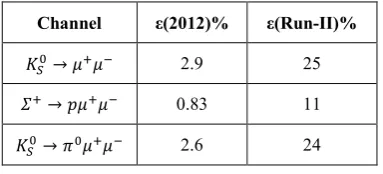
𝑆𝑆0 produced in the LHCb acceptance per fb-1, and it allowed the publication of world best results in rare decays of strange particles. The flexibility of the software trigger (HLT) allowed increasing significantly the trigger efficiency for strangeness decays to dimuons for Run-II data [3], as shown in Table 1. Since in the LHCb upgrade there will be no hardware trigger (L0) and all the trigger steps will be software based, the trigger efficiency is expected to be as high as for B decays. Table 1. Approximate trigger efficiencies for benchmark 𝑠𝑠 → 𝑑𝑑𝜇𝜇+𝜇𝜇− transitions at LHCb for 2012 and Run-II.
Numbers obtained from [3]. The efficiency in 2011 data is lower than in 2012 data, being approximately ~1%. The maximum efficiency that can be achieved, taking into account L0 constraints, is 30%.
Channel ε(2012)% ε(Run-II)%
𝐾𝐾𝑆𝑆0→ 𝜇𝜇+𝜇𝜇− 2.9 25
𝛴𝛴+→ 𝑝𝑝𝜇𝜇+𝜇𝜇− 0.83 11
𝐾𝐾𝑆𝑆0→ 𝜋𝜋0𝜇𝜇+𝜇𝜇− 2.6 24
3
Results
3.1. 𝑲𝑲𝑺𝑺𝟎𝟎 → 𝝁𝝁+𝝁𝝁−
In the SM, the 𝐾𝐾𝑆𝑆0→ 𝜇𝜇+𝜇𝜇− decay is long-distance dominated, with subdominant short-distance
EPJ Web of Conferences 179, 01013 (2018) https://doi.org/10.1051/epjconf/201817901013
contributions from Z-penguin and W-box. Yet, the long-distance contribution is still very small in absolute terms, and the decay rate is very supressed [4] [5] [6]:
𝐵𝐵𝐵𝐵(𝐾𝐾𝑆𝑆0→ 𝜇𝜇+𝜇𝜇−)𝑆𝑆𝑆𝑆=
= (5.18 ± 1.50𝐿𝐿𝐿𝐿± 0.18𝑆𝑆𝐿𝐿) × 10−12.
Therefore, small BSM contributions and BSM/SM interferences can sizably modify the branching fraction. This has been proven to be the case in leptoquark models [7] [8] as well as supersymmetric models [9], despite of other experimental constraints.
The 2011 LHCb data allowed improving by a factor of thirty [10] the world best upper limit prior to LHC [11]. Recently, the analysis of the full Run-I data has been published [12], corresponding to an integrated luminosity of 3fb-1 and improved reconstruction, trigger and selection. The analysis uses a Boosted Decision Tree (BDT) to separate signal from combinatorial background and dedicated particle identification to separate 𝐾𝐾𝑆𝑆0→ 𝜇𝜇+𝜇𝜇− decays from misidentified
𝐾𝐾𝑆𝑆0→ 𝜋𝜋+𝜋𝜋− decays. The mass shift on the 𝐾𝐾𝑆𝑆0 peak caused in the 𝜋𝜋±→ 𝜇𝜇± misidentification is also crucial for the analysis, since it separates the 𝐾𝐾𝑆𝑆0→ 𝜋𝜋+𝜋𝜋− peak away from the signal, and only the tail of the distribution leaks into the region in which genuine
𝐾𝐾𝑆𝑆0→ 𝜇𝜇+𝜇𝜇− decays are expected. This can be seen in Figure 1 (top), where the invariant mass distribution of the dimuon candidates is shown, for one of the most sensitive BDT bins. A simultaneous maximum likelihood fit of the dimuon invariant mass spectrum of all the BDT bins is performed, yielding no significant signal. A Bayesian upper limit (see Figure 1 bottom) is derived by integrating the likelihood times a flat prior on the BR, resulting in an upper limit
𝐵𝐵𝐵𝐵(𝐾𝐾𝑆𝑆0→ 𝜇𝜇+𝜇𝜇−)𝐸𝐸𝐸𝐸𝐸𝐸< 8(10) × 10−10
The extrapolated sensitivity as a function of the integrated luminosity times trigger efficiency is shown in Figure 2. The trigger efficiency for Run-II is estimated to be 25%, while for the LHCb upgrade is expected to be close to 100%. It can be seen that the LHCb upgrade can explore a good part of the 10-11 region, and a Phase-II upgrade could get very close to the SM prediction.
Figure 1. Top: Invariant mass distribution of the dimuon candidates in one of the most sensitive BDT bins. The green dashed line shows the contribution from misidentified 𝐾𝐾𝑆𝑆0→ 𝜋𝜋+𝜋𝜋− decays. The red dotted line shows the
contribution from combinatorial background. No significant signal (which would have shown as a nearly-Gaussian peak at ~500 MeV/c2) has been found. Bottom: cumulative function
of the posterior probability of the branching fraction. The intersections with (upper limit) 90% and 95% credible intervals are shown with dashed red lines.
Figure 2. Expected LHCb sensitivity to 𝐵𝐵𝐵𝐵(𝐾𝐾𝑆𝑆0→ 𝜇𝜇+𝜇𝜇−) as a
function of the integrated luminosity (times trigger efficiency). The trigger efficiency for Run-II is estimated to be ~25%, while for LHCb upgrade is expected to be close to
0 50 100 150 200 250 300
1E-3 0.01 0.1 1
BR (K
S
->
) limi
t at
95
%C
L [
x10
-9 ]
TRIGL [fb
-1]
Dark Matter, Hadron Physics and Fusion Physics
the 100%. The black band shows the SM prediction with its uncertainty. The width of the green band shows an estimated uncertainty on the sensitivity prediction, including model systematics and statistical subtraction of the 𝐾𝐾𝐿𝐿0→ 𝜇𝜇+𝜇𝜇−contribution.
3.2 𝜮𝜮+→ 𝒑𝒑𝝁𝝁+𝝁𝝁−
The 𝛴𝛴+→ 𝑝𝑝𝜇𝜇+𝜇𝜇−decay is a flavour-changing neutral-current process, allowed only at loop level in the SM. The process is dominated by long-distance contributions for a predicted branching fraction of [13]
1.6 × 10⁻⁸< 𝐵𝐵𝐵𝐵(𝛴𝛴+→ 𝑝𝑝𝜇𝜇+𝜇𝜇−)𝑆𝑆𝑆𝑆< 9.0 × 10⁻⁸ ,
while the short-distance SM contributions are suppressed at a branching fraction of about 10-12. Evidence for this decay was seen by the HyperCP experiment [14] with a measured branching fraction
𝐵𝐵𝐵𝐵(𝛴𝛴+→ 𝑝𝑝𝜇𝜇+𝜇𝜇−)
𝐸𝐸𝐸𝐸𝐸𝐸𝐻𝐻𝐻𝐻𝐻𝐻𝐻𝐻𝐻𝐻𝐻𝐻𝐸𝐸 = (8.6−5.4+6.6± 5.5) × 10−8, which is compatible with the SM prediction. Remarkably, the three observed decays have almost the same dimuon invariant mass of mX0 = 214.3 0.5 MeV/c2, which lies close to the kinematic limit. This result is sometimes referred to as “the Hyper-CP anomaly”, since it suggests a potential BSM particle at a mass of ~214 MeV/c2.
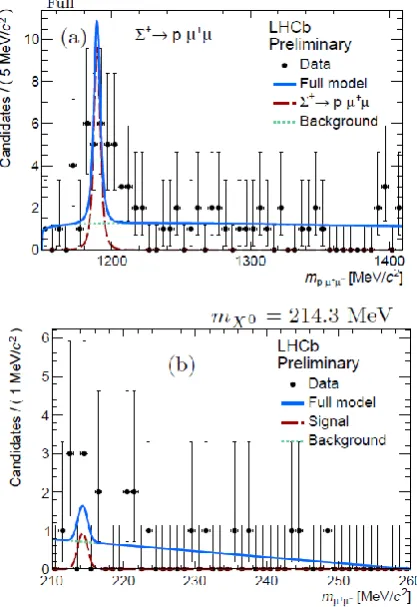
The LHCb collaboration has recently published [15] a preliminary search for the 𝛴𝛴+→ 𝑝𝑝𝜇𝜇+𝜇𝜇− decay, showing a strong evidence for this decay with a significance of four standard deviations (see Figure 3, top). The dimuon invariant mass distribution does not show evidence for a low mass resonance, disproving the HyperCP-anomaly (see Figure 3, bottom). This measurement was based on Run-I data with no trigger path dedicated to this channel. In the time between the FCCP workshop and the write-up of the proceedings, the search has been published into a paper [16], providing in addition a branching fraction measurement
𝐵𝐵𝐵𝐵(𝛴𝛴+→ 𝑝𝑝𝜇𝜇+𝜇𝜇−)
𝐸𝐸𝐸𝐸𝐸𝐸𝐿𝐿𝐻𝐻𝐻𝐻𝐿𝐿= (2.1−1.2+1.6) × 10−8.
Figure 3. Top: Invariant mass distribution of the 𝛴𝛴+→ 𝑝𝑝𝜇𝜇+𝜇𝜇− candidates. The green dotted line represents the background, and the red dashed line the 𝛴𝛴+→ 𝑝𝑝𝜇𝜇+𝜇𝜇−signal, with a significance of four standard deviations. Bottom: dimuon mass distribution of the candidates. The green dotted line represents an exponential continuum, and the red dashed line a potential 𝑋𝑋0→ 𝜇𝜇+𝜇𝜇−signal, which is found to be not significant.
4 Sensitivity studies
4.1 𝑲𝑲𝑺𝑺𝟎𝟎→ 𝝅𝝅𝟎𝟎𝝁𝝁+𝝁𝝁−
The 𝐾𝐾𝑆𝑆0→ 𝜋𝜋0𝜇𝜇+𝜇𝜇− decay is another 𝑠𝑠 → 𝑑𝑑𝜇𝜇+𝜇𝜇− transition with a very low branching fraction, predicted at the 10-9 level in the SM. The closely related 𝐾𝐾𝐿𝐿0→ 𝜋𝜋0𝜇𝜇+𝜇𝜇− decay has been shown to have sensitivity to BSM dynamics, such as Extra Dimensions [17] or leptoquarks [8]. Its sensitivity is limited by the uncertainty on the SM contribution, which is dominated by the experimental precision on the 𝐾𝐾𝑆𝑆0 mode, the NA48 measurement of 𝐵𝐵𝐵𝐵(𝐾𝐾𝑆𝑆0→ 𝜋𝜋0𝜇𝜇+𝜇𝜇−) [18]:
𝐵𝐵𝐵𝐵(𝐾𝐾𝑆𝑆0→ 𝜋𝜋0𝜇𝜇+𝜇𝜇−)
𝐸𝐸𝐸𝐸𝐸𝐸= (2. 9−1.2+1.5± 0.2) × 10−9
Hence, improvements on the experimental measurement of 𝐵𝐵𝐵𝐵(𝐾𝐾𝑆𝑆0→ 𝜋𝜋0𝜇𝜇+𝜇𝜇−) translate into improved BSM search potential of 𝐾𝐾𝐿𝐿0→ 𝜋𝜋0𝜇𝜇+𝜇𝜇−. The LHCb experiment has evaluated its sensitivity to 𝐵𝐵𝐵𝐵(𝐾𝐾𝑆𝑆0→ 𝜋𝜋0𝜇𝜇+𝜇𝜇−) [19] with two different reconstruction strategies: explicit requirement of the
EPJ Web of Conferences 179, 01013 (2018) https://doi.org/10.1051/epjconf/201817901013
𝜋𝜋0→ 𝛾𝛾𝛾𝛾 decay (FULL), and reconstruction based on
the dimuon information only (PARTIAL). In both cases the LHCb upgrade is expected to overtake the precision of NA48, as shown in Figure 4. The sensitivity as a function of the dimuon mass has not been evaluated yet.
Figure 4. Expected LHCb sensitivity to 𝐵𝐵𝐵𝐵(𝐾𝐾𝑆𝑆0→ 𝜋𝜋0𝜇𝜇+𝜇𝜇−)
as a function of the integrated luminosity (times trigger efficiency). The trigger efficiency for Run-II is estimated to
be ~24%, while for LHCb upgrade is expected to be close to 100%.
4.2 𝑲𝑲𝑺𝑺𝟎𝟎→ 𝝅𝝅+𝝅𝝅−𝒆𝒆+𝒆𝒆−
Although most of the efforts have been put in dimuon modes, sensitivities to final states with electrons, such as 𝐾𝐾𝑆𝑆0→ 𝜋𝜋+𝜋𝜋−𝑒𝑒+𝑒𝑒−, [20] are also under study,
showing that an LHCb strangeness program with electrons is also possible.
4.3 Other analyses
It must be noted that the LHCb capabilities are not restricted to the four channels discussed above. Indeed, other measurements such as K+ mass, 𝐾𝐾
𝑆𝑆0→ 𝛾𝛾𝜇𝜇+𝜇𝜇−,
kaons from Φ decays, Lepton Flavour Violation, Lepton Universality Violation, and semileptonic decays of hyperons could be feasible and are under study.
4 Conclusions
Results and prospects of the LHCb experiment in rare decays of strange particles have been discussed. These include updated limits in 𝐵𝐵𝐵𝐵(𝐾𝐾𝑆𝑆0→ 𝜇𝜇+𝜇𝜇−) as well as
the disproval of the Hyper-CP anomaly in 𝛴𝛴+→
𝑝𝑝𝜇𝜇+𝜇𝜇− decays. Future prospects have also been
discussed, showing the potential to reach 𝐵𝐵𝐵𝐵(𝐾𝐾𝑆𝑆0→
𝜇𝜇+𝜇𝜇−) at nearly the SM level, as well as to overtake
NA48 in the determination of 𝐵𝐵𝐵𝐵(𝐾𝐾𝑆𝑆0→ 𝜋𝜋0𝜇𝜇+𝜇𝜇−).
References
1. LHCb Collab., "The LHCb detector at the LHC", JINST 3 (2008) S08005.
2. LHCb Collab., "Expression of Interest for a Phase-II LHCb Upgrade: Opportunities in flavour
physics, and beyond, in the HL-LHC era", CERN-LHCC-2017-003.
3. F. Dettori et al.," Low-p T dimuon triggers at LHCb in Run 2", LHCb-PUB-2017-023 .
4. G. Ecker and A. Pich, “The Longitudinal muon polarization in KL->μμ,” Nucl. Phys.B366 (1991)
189–205.
5. G. Isidori and R. Unterdorfer, "On the short-distance constraints from K_{L,S} -> mu^+
mu^-",JHEP 0401 (2004) 009, arXiv:hep-ph/0311084.
6. G. D’Ambrosio and T. Kitahara, “Direct CP Violation in K0->μμ”, Phys. Rev. Lett. 119 no. 20,
(2017) 201802, arXiv:1707.06999 [hep-ph].
7. I.Dorsner et al., "Limits on scalar leptoquark interactions and consequences for GUTs", JHEP
1111 (2011) 002, arXiv:1107.5393 [hep-ph] ].
8. C. Bobeth, A. J. Buras, "Leptoquarks meet ε ′ /ε ", arXiv:1712.01295 [hep-ph].
9. V. Chobanova et al., "Probing SUSY effects with KS->μμ", arXiv:1711.11030v1 [hep-ph].
Submitted to JHEP.
10. LHCb Collaboration, JHEP 01 (2013) 090, [ arXiv:1209.4029 [hep-ex] ].
11. S. Gjesdal et al., "Search for the decay K0S->2μ", Phys. Lett. B 44 (1973) 217.
0 20 40 60 80 100
0.0 0.5 1.0 1.5 2.0 2.5 3.0
NA48(-)
STAT
[10
-9 ]
TRIG L [fb-1]
NA48(+)
FULL channel
0 20 40 60 80 100
0.0 0.5 1.0 1.5 2.0 2.5 3.0
NA48(-) STAT
[10
-9 ]
TRIGL [fb-1]
NA48(+) PARTIAL channel
12. LHCb Collab., "Improved limit on the branching fraction of the rare decay K 0 S →μ + μ -", Eur.
Phys. J. C, 77 10 (2017) 678.
13. X.-G. He, J. Tandean, and G. Valencia," The Decay Σ -> pμμ within the standard model", Phys.
Rev. D72 (2005) 074003, arXiv:hep-ph/0506067.
14. HyperCP collaboration, H. Park et al.," Evidence for the decay Σ->pμμ", Phys.Rev. Lett. 94
(2005) 021801, arXiv:hep-ex/0501014.
15. LHCb Collab.,"Evidence for the decay Σ->pμμ", LHCb-CONF-2016-013.
16. LHCb Collab., "Evidence for the decay Σ->pμμ", arXiv:1712.08606 [hep-ex] .
17. M. Bauer et al, JHEP 1009:017,2010, arXiv:0912.1625 [hep-ph].
18. NA48 Collab.,"Observation of the rare decay K_S -> pi^0mu^+mu^-", Phys. Lett. B599
197-211,2004. [ arXiv:hep-ex/0409011 ].
19. V. Chobanoba et al.," Sensitivity of LHCb and its upgrade in the measurement of B(K 0 S →π 0
μ + μ − )", LHCb-PUB-2018-017.
Dark Matter, Hadron Physics and Fusion Physics
12. LHCb Collab., "Improved limit on the branching fraction of the rare decay K 0 S →μ + μ -", Eur.
Phys. J. C, 77 10 (2017) 678.
13. X.-G. He, J. Tandean, and G. Valencia," The Decay Σ -> pμμ within the standard model", Phys.
Rev. D72 (2005) 074003, arXiv:hep-ph/0506067.
14. HyperCP collaboration, H. Park et al.," Evidence for the decay Σ->pμμ", Phys.Rev. Lett. 94
(2005) 021801, arXiv:hep-ex/0501014.
15. LHCb Collab.,"Evidence for the decay Σ->pμμ", LHCb-CONF-2016-013.
16. LHCb Collab., "Evidence for the decay Σ->pμμ", arXiv:1712.08606 [hep-ex] .
17. M. Bauer et al, JHEP 1009:017,2010, arXiv:0912.1625 [hep-ph].
18. NA48 Collab.,"Observation of the rare decay K_S -> pi^0mu^+mu^-", Phys. Lett. B599
197-211,2004. [ arXiv:hep-ex/0409011 ].
19. V. Chobanoba et al.," Sensitivity of LHCb and its upgrade in the measurement of B(K 0 S →π 0
μ + μ − )", LHCb-PUB-2018-017.
20. C. Marin Benito et al.," Feasibility study of KS-->ππee in LHCb", LHCb-PUB-2016-016.
EPJ Web of Conferences 179, 01013 (2018) https://doi.org/10.1051/epjconf/201817901013