Reduced RECTANGLE-80
Jinyong Shan1,2, Lei Hu1,2, Ling Song1,2, Siwei Sun1,2, and Xiaoshuang Ma1,2
1
State Key Laboratory of Information Security, Institute of Information Engineering, Chinese Academy of Sciences, Beijing 100093, China
2
Data Assurance and Communication Security Research Center, Chinese Academy of Sciences, Beijing 100093, China
{jyshan12,hu,lsong,swsun,xshma13}@is.ac.cn
Abstract. RECTANGLE is a newly proposed lightweight block cipher which allows fast implementations for multiple platforms by using bit-slice techniques. It is an iterative 25-round SPN block cipher with a 64-bit block size and a 80-bit or 128-bit key size. Until now, the results on analyzing the cipher are not too much, which includes an attack on the 18-round reduced version proposed by the designers themselves. In this paper, we find all 15-round differential characteristics with 26–30 ac-tive S-boxes for given input, output and round subkey differences, which have a total probability 2−60.5. Based on these differential characteristic-s, we extend the corresponding distinguisher to 2 rounds backward and forward respectively, and propose an attack on the 19-round reduced RECTANGLE-80 with data complexity of 262plaintexts, time
complex-ity of about 267.42 encryptions and memory complexity of 272. TThese data and time complexities are much lower than that of the designers for the 18-round reduced RECTANGLE-80.
Keywords: RECTANGLE block cipher, Mixed-integer linear program-ming, Related-key differential attack.
1
Introduction
Lightweight block ciphers can be widely used in small embedded devices such as RFIDs and sensor networks. They are becoming more and more popular, and this can be seen from the phenomena that many lightweight algorithms were proposed in recent years, including PRESENT [6], LED [10], LBlock [23], PRINCE [7], Zorro [9], and two lightweight block ciphers designed by the U.S. National Security Agency, Simon and Speck [1]. Very recently, a new lightweight block cipher called RECTANGLE was proposed by Zhang et al. [24], which is an iterative 25-round SPN block cipher with a 64-bit block size and a 80-bit or 128-bit key size to allow fast implementations on multiple platforms by using bit-slice techniques.
There are many variants of differential analysis, such as related-key differential attack [2], truncated differential attack [11] and impossible differential attack [3], and essentially, all of these differential attacks study the differential behavior of the target cipher.
A differential characteristic with high probability can be used to construct a distinguisher or recover some secret keys. In general, for SPN block ciphers, the probability of a differential characteristic can be characterized by the num-ber of active S-boxes in the corresponding differential characteristic. Therefore, counting the number of active S-boxes is a useful and interesting problem. On one hand, if the minimum number of active S-boxes is large, it proves that the cipher can resist against the differential attack. On the other hand, a differential characteristic with fewer active S-boxes can be used to construct a distinguisher. The problem of counting active S-boxes of a word-oriented symmetric cipher was transformed to be a mixed-integer linear programming (MILP) problem by Mouha et al.[16]. They proposed a series of inequalities or equalities over inte-gers to describe some operations over finite fields with characteristic 2, such as XORs and linear transformations. Two word-oriented symmetric ciphers, AES and Enocoro-128v2, were then considered along this line, and they proved that Enocoro-128v2 is secure enough to resist against differential and linear cryptanal-ysis. Subsequently, Sunet al.proposed a method to obtain a series of inequalities over integers for describing an S-box and generalized Mouhaet al.’s method to apply to bit-oriented symmetric ciphers [20, 21]. In [21], it was proved that the cipher PRESENT-80 is secure enough to resist against standard relatekey d-ifferential attack and the lower bound of probabilities of related-key dd-ifferential characteristics of the full-round LBlock is upper bounded by 2−56. Very recently,
by using the method proposed by Mauhaet al.and Sunet al., Qiaoet al.proved that the cipher FOX is strong enough to resist against single-key differential attack [17] and Ma et al. showed that 18 and 39 rounds are sufficient for the block cipher MIBS to resist against the single-key and related-key differential attacks, respectively [14]. Besides, Sun et al. proposed a method for automat-ic enumeration of all (related-key) differential characteristautomat-ics with given input or/and output differences [22].
Some results of security analysis on RECTANGLE have been proposed by the designers in their design document [24]. The designers completed described a 18-round differential attack by two 14-round differential characteristics with the same input and output differences. The time, data and memory complexities are 278.69, 264and 272, respectively. For other attacks, the designers pointed out
that the amplitude of the correlation coefficients of the best linear character-istic is 2−37, and asserted that RECTANGLE has enough security against the
statistical saturation attack [8], impossible differential cryptanalysis [3], integral cryptanalysis [13] and key schedule attacks [2, 5]. Recently, Selvamet al.reduce the key research space from 280 to 288 by the differential power analysis [19].
Our contribution.In this paper, we apply the methods proposed by Mouha
differences, we find out all 15-round differential characteristics with 26-30 active S-boxes by using the method proposed in [22]. The number of the differential characteristics is 1254 and the total probability is 2−60.5. Based on these dif-ferential characteristics, we extend the corresponding distinguisher to 2 rounds backward and forward respectively and propose an attack on the 19-round re-duced RECTANGLE-80. The data complexity of our attack is 262 plaintexts,
the time complexity is about 267.42 19-round encryptions and the memory
com-plexity is 272. Compared with the designers’ differential analysis, we can attack
one more round, and the data and time complexities are much better.
A difficult point in our attack is that there is a large number of active S-boxes in the extended 2 rounds backward and forward. By a general method, the number of the key counters is more than 280, here the method we use is to guess a lot of bits in the 0th round subkey, and then more bits in the 1st, 18th and 19th round subkeys are determined according to the key schedule. Thereby, we can reduce the number of the key counters to 272.
Organization of this paper.In Section 2, we briefly describe the RECT-ANGLE block cipher. In Section 3, we introduce the MILP based methods pro-posed by Mouha et al. and Sun et al. The related-key differential attack on the round reduced RECTANGLE is proposed in Section 4. Finally, Section 5 concludes this study.
2
A Brief Description of RECTANGLE
In this section, we briefly describe the block cipher RECTANGLE and refer the readers to [24] for more details.
RECTANGLE is a lightweight block cipher with an SPN structure proposed by Zhanget al.[24] in 2014. It allows fast implementations on multiple platforms by using bit-slice techniques. Its block length is 64 bits, while two versions of the key length, 80 bits and 128 bits, are provided. In this paper, we only consider the version with 80-bit secret keys.
For convenience, we introduce a notation for a 4l-bit block throughout this paper. Let B= (b4l−1,· · · , b3l,· · ·, bl−1, b0) be a 4l-bit block, it can be written
as a 4×16 rectangle
bl−1 bl−2 · · · b2 b1 b0 b2l−1b2l−2· · · bl+2 bl+1 bl
b3l−1b3l−2· · · b2l+2b2l+1b2l
b4l−1b4l−2· · · b3l+2b3l+1b3l
.
it is viewed as a 4×16 rectangle
w15w14· · · w2 w1 w0 w31w30· · · w18w17w16 w47w46· · · w34w33w32 w63w62· · · w50w49w48
.
The master key and the round subkeys (k79, k78,· · ·, k0) are viewed as 4×20
rectangles below.
k19k18· · · k2 k1 k0 k39k38· · · k22k21k20 k59k58· · · k42k41k40 k79k78· · · k62k61k60
.
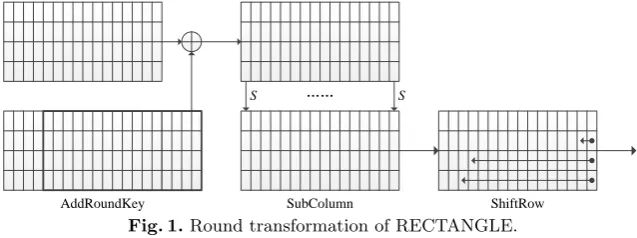
The cipher has 25 rounds of iterations. Each round consists of three steps: AddRoundkey, SubColumn and ShiftRow (Please see Figure 1). In the first step
AddRoundKey
S …… S
SubColumn ShiftRow Fig. 1.Round transformation of RECTANGLE.
AddRoundkey, the cipher state is XORed the rightmost 64-bit of the round subkey. In the second step SubColumn, parallelly apply the S-box S to each column of the cipher state, where the S-boxS used in RECTANGLE is a 4-bit to 4-bit permutation as described in the following table in hexadecimal notation:
x 0 1 2 3 4 5 6 7 8 9 A B C D E F
S(x) 9 4 F A E 1 0 6 C 7 3 8 2 B 5 D
In the third step ShiftRow, the last three rows are left rotated 1 bit, 12 bits and 13 bits, respectively. After 25 rounds of iterations, there is a final subkey XOR. For the key schedule for the 80-bit key version, it also consists of three steps described in Figure 2. The S-box is the same as in a round transformation. The rows are left rotated 7 bits, 9 bits, 11 bits and 13 bits, respectively. The round constants RC[i] (0 ≤ i ≤ 24) are generated by a 5-bit LFSR with the initial state RC[0]=(0,0,0,0,1). At each roundi >0, the round constant RC[i] = (ri,4,· · ·, ri,1, ri,0) is equal to (ri−1,3,· · · , ri−1,0, ri−1,4⊕ri−1,2).
S
RC[i]
Fig. 2.Key schedule of RECTANGLE.
3
Description of the Extended MILP
In this section, we introduce the MILP based methods proposed by Mouha et al.and Sunet al.The mixed integer linear programming (MILP) problem is an optimization problem derived from linear programming with some or all variables restricted over integers. It can be described as:
MILP: Find a vectorx∈Zk×
Rn−k ⊂Rn withAx≤b, such that the
linear function c1x1+c2x2+· · ·+cnxn is minimized (or maximized), where (c1, c2,· · ·, cn)∈Rn, A∈Rm×n andb∈Rm.
To count the minimum number of active S-boxes for some ciphers, Mouha et al. transformed it to an MILP problem [16]. To this end, some operations over finite fields with characteristic 2 are described by several linear constraints over integers. The following two operations were considered by Mouhaet al.
(i) XOR operation ⊕: Fw
2 ×Fw2 → Fw2. Assume that a = (a0,· · ·, aw−1), b= (b0,· · ·, bw−1) and c= (c0,· · · , cw−1) are the input and output differences
of the XOR operation, i.e.,ai⊕bi=ci for all 0≤i≤w−1. Then the equality can be described by the following inequalities over integers:
ai+bi+ci≥2di,
di≥ai,
di≥bi,
di≥ci,
(1)
wheredi∈F2is a dummy variable and 0≤i≤w−1.
Note that the description on the operation XOR above is not complete. For example, if (ai, bi, ci, di) = (1,1,1,1), it is easily checked that (ai, bi, ci, di) sat-isfies inequalities (1), but not satsat-isfies the operation XOR since 1⊕1 = 0. An additional inequality over integersai+bi+ci ≤2,combining with inequalities (1), can equivalently describe the operation XOR.
(ii) Linear transformation L: Fm
2w → Fm2w, where m is the word size. The branch numberBL ofLis defined as
BL= min
x6=0{wt(x) + wt(Lx) : x∈F
m
2w},
where the Hamming weight wt(x) is the number of the nonzero components of
input and output differences ofL, then∆xL=∆y. The linear constraints ofL
over integers are
m−1 P
i=0
(∆xi+∆yi)≥ BLdL,
dL≥∆xi, 0≤i≤m−1,
dL≥∆yi, 0≤i≤m−1, wheredL∈F2 is a dummy variable.
Subsequently, Sunet al.proposed two methods to obtain linear constraints of an S-box based on logical condition modelling and computational geometry [20, 21].
(iii) S-boxS:Fw2 →Fw2. The input and output differences ofSare denoted as ∆α= (∆α0, ∆α1,· · ·, ∆αw−1) and∆β= (∆β0, ∆β1,· · ·, ∆βw−1), respectively.
Letδdenote whether the S-boxS is active or not, i.e.,
δ=
0,(∆α0, ∆α1,· · · , ∆αw−1) = 0,
1,otherwise.
The equivalent description over integers betweenδ and∆αis
δ−∆αi≥0, 0≤i≤w−1,
∆α0+∆α1+· · ·+∆αw−1−δ≥0.
(2)
Additionally, for an invertible S-box, since the input difference is nonzero if and only if the corresponding output difference is nonzero, the constraints described over integers are as follows:
(∆α0+∆α1+· · ·+∆αw−1)w−(∆β0+∆β1+· · ·+∆βw−1)≥0,
(∆β0+∆β1+· · ·+∆βw−1)w−(∆α0+∆α1+· · ·+∆αw−1)≥0.
(3)
Finally, similarly as the description of linear transformation, the branch number of an S-boxS, denoted byBS, is defined as
BS = min
∆α6=0{wt(∆α) + wt(∆β)|#(∆α, ∆β)>0},
where #(∆α, ∆β) = #{x∈Fw2 |S(x)⊕S(x⊕∆α) =∆β}. The linear constraints
ofS over integers are
w−1 P
i=0
(∆αi+∆βi)≥ BSdS,
dS ≥∆αi, 0≤i≤w−1,
dS ≥∆βi, 0≤i≤w−1,
(4)
wheredS ∈F2 is a dummy variable.
based on computational geometry to obtain linear constraints of an S-box, where the constraints are selected from the H-representation of the convex hull of all differential characteristics [21].
H-representation of convex hull.The convex hull of a setX is the min-imum convex set containing X, where X is a set of some discrete points in Rn.
The convex hull can be regarded as the feasible solutions of a system of linear equalities and inequalities. There are a number of algorithms for computing the convex hull for a finite set of points. For ann×nS-boxS, all differential char-acteristics can be regarded as some discrete points inR2n, by using the SAGE computer algebra system, the convex hull consisting of several inequalities can be obtained.
In general, the number of equalities and inequalities in the convex hull of a set X ⊂ Rn increases rapidly as n increases. There are several hundreds of inequalities for a 4×4 S-box. To make an MILP problem solvable in practical time, one needs to select a small number of inequalities in the convex hull. Sun
et al.utilized a greedy algorithm to choose some “good” inequalities [21]. We refer the readers to [16, 20, 21] for more information on an MILP prob-lem and linear constraints describing several operations over finite fields with characteristic 2.
4
Differential Attack on RECTANGLE-80
In this section, we firstly introduce some notations used in the next subsections for convenience. Let P (P0), C (C0), ∆P and ∆C denote the plaintext, the ciphertext, and the differences of the plaintext and ciphertext, respectively. Let
Ki (Ki0),Ii (Ii0) andOi (O0i) denote the round subkey, the input and output of the operation SubColumn in theith round, respectively. Similarly, let∆Ki,∆Ii and∆Oi denote the differences of the round subkey, the input and output of the operation SubColumn in the ith round, respectively.
With the preparations above, we will propose a related-key differential attack on 19-round RECTANGLE-80. To this end, we find a huge number of 15-round differential characteristics from the 2nd round to the 17th round with the same input, output and round subkey differences. Subsequently, a related-key differen-tial attack on 19-round RECTANGLE-80 is obtained by respectively extending 2 rounds backward and forward.
4.1 Differential characteristics
In this subsection, we use the methods proposed by Mouhaet al.and Sunet al.
to obtain several differential characteristics with high probabilities.
“∆k0+∆k1+· · ·+∆k79≥1”. The objective function is that “minPδ”, where δ denotes that the corresponding S-box is active or not introduced by (2) in Section 3. The process above is implemented to generate a “.lp” file which is an MILP instance containing an objective function and linear constraints. Then the Gurobi optimizer is used to solve the MILP instance.
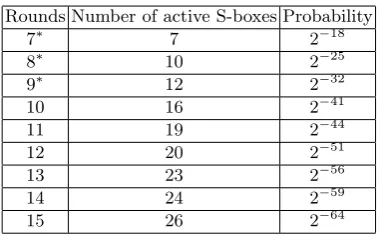
The differential distributions of the S-box in RECTANGLE is showed in Table 1. According to Table 1, we can compute the probability for a specific differential characteristic. The results of related-key attacks on the n-round re-duced RECTANGLE are showed in Table 2, where 7≤n≤15. The values of the column “Probability” in Table 2 are the probabilities of specific differential characteristics which correspond to the numbers of active S-boxes in Table 2. When the numbers of the rounds are 7, 8 and 9 marked by “ * ”, the values in the column “Number of active S-boxes” correspond to the minimal numbers of active S-boxes for all possible differential characteristics. When the numbers of the rounds are 10, 11, 12, 13, 14, 15, the values in the column “Number of active S-boxes” correspond to the minimal numbers of active S-boxes for some possible differential characteristics.
0 1 2 3 4 5 6 7 8 9 A B C D E F 0 16 0 0 0 0 0 0 0 0 0 0 0 0 0 0 0 1 0 0 0 0 0 2 2 0 2 2 0 4 0 2 0 2 2 0 0 0 0 0 0 4 4 0 0 0 0 0 0 4 4 3 0 2 0 2 4 0 0 0 2 0 0 2 0 0 2 2 4 0 0 0 0 0 4 2 2 0 0 0 0 4 0 2 2 5 0 0 0 0 0 2 0 2 2 2 4 0 0 2 2 0 6 0 4 2 2 0 0 0 0 0 4 2 2 0 0 0 0 7 0 2 2 0 4 0 0 0 2 0 2 0 0 0 2 2 8 0 0 2 2 0 4 0 0 0 0 2 2 4 0 0 0 9 0 0 0 4 0 2 0 2 2 2 0 0 0 2 2 0 A 0 0 2 2 0 0 0 0 0 0 2 2 4 4 0 0 B 0 2 0 2 4 0 2 2 2 0 0 2 0 0 0 0 C 0 0 2 2 0 0 2 2 0 0 2 2 0 0 2 2 D 0 0 4 0 0 2 2 0 2 2 0 0 0 2 0 2 E 0 4 0 0 0 0 0 0 0 4 0 0 4 4 0 0 F 0 2 2 0 4 0 2 2 2 0 2 0 0 0 0 0
Table 1.Differential distributions of the S-box in RECTANGLE
We find a 15-round differential characteristic with probability 2−64. In this
differential characteristic, the input difference of the operation SubColumn in the 2nd round and the output difference of the operation SubColumn in the 16th round are
∆I2=
0000010000001000 0000010000000000 0000000000000000 0000000000000000
and ∆O16=
0000001000000000 0000000000000000 0000000000000000 0000000000000000
Rounds Number of active S-boxes Probability
7∗ 7 2−18
8∗ 10 2−25
9∗ 12 2−32
10 16 2−41
11 19 2−44
12 20 2−51
13 23 2−56
14 24 2−59
15 26 2−64
Table 2.n-round differential characteristics with fewer active S-boxes and the differences of the 2nd round and the 16th round subkeys are
∆K2=
00000000000000000000 00000000000000000000 00001000000000000000 00000000000000000000
and ∆K16=
00000000000000000000 00000000000000000000 00000000001000000000 00000000000000000000
.
By fixing ∆I2, ∆O16, ∆K2 and ∆K16, we obtain all 15-round differential
characteristics with 26, 27, 28, 29 and 30 active S-boxes by using the method proposed in [22], and the results are listed in Table 3. The total probability of all the differential characteristics in Table 3 is 2−60.5. This high differential
probability with given∆I2, ∆O16, ∆K2 and ∆K16 can be used to construct a
distinguisher and recover partial secret keys. We propose the attack progress in the next subsection.
Number of active S-boxes Number of differential characteristics Total probability
26 4 2−62
27 30 2−62
28 119 2−62.82
29 324 2−64.31
30 777 2−65.97
Table 3.All 15-round differential characteristics with 26 – 30 active S-boxes
4.2 A related-key differential attack on RECTANGLE-80
In this subsection, we will give a related-key differential attack on RECTANGLE-80 by using the differential characteristics in Subsection 4.1 and respectively extending 2 rounds backward and forward. To this goal, we assume that the 19-round reduced RECTANGLE consists of 19 rounds of iterations and a final subkey XOR. We number the rounds from 0 to 19. The 0th round subkey K0
is the master key and the final subkey is denoted byK19. Next we propose our
We focus on illustrating how to extend 2 rounds backward and extending 2 rounds forward is similar. By the differences∆I2and∆K2, the output difference ∆O1 of the operation SubColumn in the 1st round is obtained by the inverse
operations AddRoundKey and ShiftRow, which is listed below
∆O1=
0000010000001000 0000001000000000 0000000000001000 0000000000000000
. (5)
By the differential distributions of the S-box in Table 1, we find that only when the input difference of the S-box is 1100, 0110, 1110, 1101, 0111 or 1111, the output difference of the S-box is 1000 for the 10th column, and similar observa-tions are found for the 3rd and 9th columns. Therefore, the input difference∆I1
of the operation SubColumn in the 1st round must have the following form
∆I1=
00000??00000?000 000001?000000000 00000??00000?000 00000??00000?000
,
where the mark “?” denotes an undetermined value 0 or 1. Further, ∆I1 has
6×7×6 = 27.98 cases in total. For a candidate ∆I
1 in the 27.98 cases, the
probability of∆O1 in (5) is equal to 16×17×16 = 2−7.98. By the key schedule,
the difference of the 1st round subkey is
∆K1=
00000000000000000000 00000000000000000000 00000000000000010000 00000000000000000000
.
Similarly as the analysis of the 1st round, the output and input differences of the operation SubColumn in the 0th round are
∆O0=
00000??00000?000 0000001?00000000 0??00001?0000000 00??00000?000000
and ∆I0=
0???0?????00?000 0???0?????00?000 0???0?????00?000 0???0?????00?000
.
Note that there are 27.98 cases for∆O
0 and 236 cases for ∆I0. Therefore, for
a random input difference ∆I0, the probability of the output difference ∆O0
belonging to the 27.98 cases is 2−28.02. Besides, the differences of the 0th round
subkey and the plaintexts are
∆K0=
00000000000000000000 00000000000000000000 00000010000000000000 00000000000000000000
and ∆P =
0???0?????00?000 0???0?????00?000 0???0?????00?000 0???0?????00?000
.
Similarly, we can also extend 2 rounds forward. Since the difference of the 17th round subkey is
∆K17=
00000000000000000000 00000000000000000000 00000000000000000001 00000000000000000000
the input and output differences of the operation SubColumn in the 17th round are
∆I17=
0000001000000000 0000000000000000 0000000000000001 0000000000000000
and ∆O17=
000000?00000000? 000000?00000000? 000000?000000001 000000?00000000?
.
By the differential distributions of the S-box in Table 1, if the input differ-ence of the S-box is ∆IS = 0010, the output difference of the S-box ∆OS ∈ {1010,0110,1110,0011,0111,1111}. Therefore, the difference of the 18th round subkey is
∆K18=
000000000000*0000000 0000000000*000000000 00000000100000000000 000000*0000000000000
,
where **1*∈ {1010,0110,1110,0011,0111,1111}. In our attack, we assume that the difference∆K18 is determined, because we can use our attack six times for
each value in the set{1010,0110,1110,0011,0111,1111}. Then the differences of the operation SubColumn in the 18th round are
∆I18=
000000?0*000000? 00000?*0000000?0 0001100000?00000 00?000000?000000
, ∆O18=
00?????0???000?? 00?????0???000?? 00?11??0???000?? 00?????0???000??
,
where the mark “*” denotes a determined value in {0,1} for a specific attack and the mark “?” determined an undetermined value in {0,1}. The number of
∆O18 at most is 226.54. Since the difference of the final subkey
∆K19=
00000*00000000000000 0*000000000000000000 00000000000000000100 0000000000000*000000 is determined, the number of the difference of the ciphertext
∆C =
0*?????0???000?? 0?????0???000??0 00??00?11??0???0 0??00?????0???00
at most is 226.54. Therefore, the probability of the ciphertext difference satisfying
the form∆C is 2−37.46.
-Data Collect Phase. Choose 2x structures. In each structure, there are 236
plaintexts with fixing the values in the 0th, 1st, 2nd, 4th, 5th, 11th and 15th columns and traversing the values in the 3rd, 6th, 7th, 8th, 9th, 10th, 12th, 13th and 14th columns. The 236 plaintexts can generate about 272 ordered pairs.
Combining with the probabilities in the 1st and 0th rounds, the probability that a pair of plaintexts in a structure can result in the expected input difference∆I2
is 2−35.77. Therefore, the expected number of the plaintext pairs corresponding to∆I2 and∆O16 is 2x+72−36−60.5= 2x−24.5.
– Step 1. Guess the value of a part of subkey bits ofK0:
• (a). GuessK0(3), and compute the output difference of the 3rd S-box for each remaining plaintext pair, i.e.,
S(P(3)⊕K0(3))⊕S(P0(3)⊕K0(3)⊕∆K0(3)).
If the difference do not have the form ?000, discard the pair. Then the number of expected remaining pairs is 2x+31.54.
• (b). Repeatedly guess K0(6), K0(7), K0(8), K0(9), K0(10), K0(12), K0(13) and
K0(14), there are 2x+8.54 right pairs left.
– Step 2. Guess the value of a part of subkey bits ofK1by guessing some bits
ofK0 orK1:
• (a). Since many bits ofK1are obtained fromK0directly by shifting and
adding constant, we only need to guess some bits for a column in K1.
For the 3rd column ofK1, by the key schedule we have
(K1(0,3), K1(1,3), K1(2,3), K1(3,3)) = (K0(0,16), K0(1,14), K0(2,12), K0(3,10)).
Therefore, we only need to guessK0(0,16)=K1(0,3). Then the number of expected remaining pairs is 2x+4.54.
• (b). Guess the bitsK0(1,1),K0(2,19),K0(3,17), and then check up whether
S(I1(10)⊕K1(10))⊕S(I10(10)⊕K1(10)⊕∆K1(10)) = 1000,
since (K1(0,10), K1(1,10), K1(2,10), K1(3,10)) = (K0(0,3), K0(1,1), K0(2,19), K0(3,17)). On average, there are 2x+0.54right pairs left.
• (c). Similarly as Step 2(b), guess the bits K0(0,2), K1(1,9), K0(2,18) and
K0(3,16), then there are 2x−3.46right pairs left on average. – Step 3. Guess the value of a part of subkey bits ofK19:
• (a). For the 11th column of O18, the secret bitsK (0,11) 19 , K
(1,12) 19 , K
(2,7) 19
and K19(3,8) of K19 are involved. Guess the bits K (0,18)
0 , K
(3,2)
0 , K
(1,2)
0 ,
K0(0,19) and K0(3,1), then combining with the guessed bits from Step 1 to Step 2, the involved secret bitsK19(0,11),K19(1,12),K19(2,7),K19(3,8) ofK19
are determined. Then by using the method in Step 1.a, there are 2x−7.46
right pairs left on average. Further, the bitsK19(0,12),K19(1,13), K19(2,8) and
K19(3,9)are also determined, which are related to the 12th column ofO18.
Then there are 2x−11.46 right pairs left on average.
• (b). GuessK0(1,16),K0(2,4) andK0(1,11), then combining with the guessed bits from Step 1 to Step 3(a), the secret bitsK19(0,1),K19(1,2), K19(2,13) and
K19(3,14)are determined, which are related to the 1st column ofO18. Then
the number of remaining expected pairs is 2x−14.46.
• (c). Similarly as Steps 3(a) and 3(b), we respectively guess the bitsK0(0,1),
for the 7th column, the bit K19(2,12) for the 0th column, the bitsK19(0,9),
K19(2,5), K0(0,17), K0(1,19) and K0(2,1) for the 9th column, the bits K19(2,6)
andK19(3,7)for the 10th column, the bitsK19(0,5),K19(1,6)andK19(3,2)for the 5th column, and the bitsK19(0,13),K19(1,14)andK19(2,9)for the 13th column. Then the number of remaining expected pairs is 2x−36.46.
– Step 4. The involved secret bits ofK18have guessed in Steps 1-3, and we do
not need to guess any other secret bits. There are 2x−44.46right pairs left on
average. Add one to the corresponding counter, if there is a right pair left. – Step 5. If the counter is larger than 1, keep the guess of the subkey bits as
the candidates of the right subkeys. For each survived candidate, compute the seed key by doing an exhaustive search for other secret bits.
-Complexity Analysis.Since the expected number of the plaintext pairs cor-responding to ∆I2 and ∆O16 is 2x+72−36−60.5 = 2x−24.5, we take x= 26 such
that the expected number can reach to 3. Therefore, the data complexity is 262.
To analyze the time complexity, we will analyze the time complexity in each step. In the encryption phase, the time complexity is 26319-round encryptions. In Step 1.a, the time complexity is 2×2x+34.54×24× 1
16× 1 19≈2
x+29.5419-round
encryptions. In Step 1.b, the time complexity is
2×2x+39.54+ 2x+40.54+ 2x+41.54+ 2x+42.54+ 2x+43.54 +2x+44.54+ 2x+45.54+ 2x+46.54× 1
16× 1 19≈2
x+40.54.
In Step 2, the time complexity is 2× 2x+45.54+ 2x+44.54+ 2x+44.54
× 1 16×
1 19 ≈
2x+39.54 19-round encryptions. In Step 3, the time complexity is
2×2x+45.54+ 2x+41.54+ 2x+40.54+ 2x+40.54+ 2x+40.54+ 2x+37.54 +2x+39.54+ 2x+38.54+ 2x+38.54+ 2x+38.54× 1
16× 1 19 ≈2
x+38.54.
In Step 4, the time complexity is about 2x+28.5419-round encryptions. Therefore, the total time complexity is 267.42. The memory complexity is 272key counters.
5
Conclusions
In this paper, we used the methods proposed by Mouha et al. and Sun et al.
A number of related-key differential characteristics with high total proba-bility for more rounds may help to attack RECTANGLE for more rounds. It is meaningful to determine a lower bound of the number of active S-boxes for some rounds which can illustrate whether this cipher is security enough to resist against the standard related-key differential attack.
References
[1] Beaulieu, R., Shors, D., Smith, J., Treatman-Clark, S., Weeks, B., Wingers, L.: The simon and speck families of lightweight block ciphers. Cryptology ePrint Archive. Available athttps://eprint.iacr.org/2013/404.pdf [2] Biham, E.: New types of cryptanalytic attacks using related keys. Journal
of Cryptology 7(4), 229-246 (1994)
[3] Biham, E., Biryukov, A., Shamir, A.: Cryptanalysis of Skipjack reduced to 31 rounds using impossible differentials. In: Advances in Cryptology-Eurocrypt’99, ser. Lecture Notes in Computer Science, vol. 1592, pp. 12-23. Springer, Berlin (1999)
[4] Biham, E., Shamir, A.: Differential cryptanalysis of DES-like cryptosystems. Journal of Cryptology 4(1), 3-72 (1991)
[5] Biryukov, A., Wagner, D.: Slide attacks. In: FSE 1999, ser. Lecture Notes in Computer Science, vol. 1636, pp. 245-259. Springer, Berlin (1999) [6] Bogdanov, A., Knudsen, L., Leander, G., Paar, C., Poschmann, A.,
Rob-shaw, M., Seurin, Y., Vikkelsoe, C.: PRESENT: An ultra-lightweight block cipher. In: CHES 2007, ser. Lecture Notes in Computer Science, vol. 4727, pp. 450-466. Springer, Berlin (2007)
[7] Borghoff, J., Canteaut, A., G¨uneysu, T., Kavun, E., Knezevic, M., Knud-sen, L., Leander, G., Nikov, V., Paar, C., Rechberger, C., Rombouts, P., Thomsen, S., Yal¸cın, T.: PRINCE–A low-latency block cipher for pervasive computing applications. In: Advances in Cryptology-ASIACRYPT 2012, s-er. Lecture Notes in Computer Science, vol. 7658, pp. 208-225. Springer, Berlin (2012)
[8] Collard, B., Standaert, F.: A statistical saturation attack against the block cipher PRESENT. In: Topics in Cryptology-CT-RSA 2009, ser. Lecture Notes in Computer Science, vol. 5473, pp. 195-210. Springer, Berlin (2009) [9] G´erard, B., Grosso, V., Naya-Plasencia, M., Standaert, F.: Block ciphers that are easier to mask: how far can we go? In: CHES 2013, ser. Lecture Notes in Computer Science, vol. 8086, pp. 383-399. Springer, Berlin (2013) [10] Guo, J., Peyrin, T., Poschmann, A., Robshaw, M.: The LED block cipher. In: CHES 2011, ser. Lecture Notes in Computer Science, vol. 6917, pp. 326-341. Springer, Berlin (2011)
[11] Knudsen, L.: Truncated and higher order differentials. In: FSE 1995, ser. Lecture Notes in Computer Science, vol. 1008, pp. 196-211. Springer, Berlin (1995)
[13] Knudsen, L., Wagner, D.: Integral cryptanalysis. In: FSE 2002, ser. Lecture Notes in Computer Science, vol. 2365, pp. 112-127. Springer, Berlin (2002) [14] Ma, X., Hu, L., Sun, S., Qiao, K., Shan, J.: Tighter security bound of MIBS
block cipher against differential attack. In: NSS 2014, 518-525 (2014) [15] Matsui, M.: Linear cryptanalysis method for DES cipher. In: Advances in
Cryptology-EUROCRYPT’93, ser. Lecture Notes in Computer Science, vol. 765, pp. 386-397. Springer, Berlin (1994)
[16] Mouha, N., Wang, Q., Gu, D., Preneel, B.: Differential and linear cryptanal-ysis using mixed-integer linear programming. In: Inscrypt 2011, ser. Lecture Notes in Computer Science, vol. 7537, pp. 57-76. Springer, Berlin (2012) [17] Qiao, K., Hu, L., Sun, S., Ma, X.: Improved MILP modeling for automatic
security evaluation and application to FOX. To appear in IEICE Transac-tions on Fundamentals of Electronics CommunicaTransac-tions and Computer Sci-ences
[18] Sel¸cuk, A.: On probability of success in linear and differential cryptanalysis. Journal of Cryptology 21(1), 131-147 (2008)
[19] Selvam, R., Shanmugam, D., Annadurai, S.: Side channel attacks: vulner-ability analysis of PRINCE and RECTANGLE using DPA. Cryptology ePrint Archive. Available athttp://eprint.iacr.org/2014/644.pdf [20] Sun, S., Hu, L., Song, L., Xie, Y., Wang, P.: Automatic security evaluation
of block ciphers with S-bP structures against related-key differential attack. In: Inscrypt 2013, 39-51 (2013)
[21] Sun, S., Hu, L., Wang, P., Qiao, K., Ma, X., Song, L.: Automatic Security Evaluation and (Related-key) Differential Characteristic Search: Applica-tion to SIMON, PRESENT, LBlock, DES(L) and Other Bit-Oriented Block Ciphers. Advances in Cryptology-ASIACRYPT 2014, volume 8873 of Lec-ture Notes in Computer Science, pages 158-178. Springer Berlin Heidelberg, 2014.
[22] Sun, S., Hu, L., Wang, M., Wang, P., Qiao, K., Ma, X., Shi, D., Song, L.: Automaticenumeration of (related-key) differential and linear charac-teristics with predefined properties and its applications. Cryptology ePrint Archive. Available athttp://eprint.iacr.org/2014/747.pdf
[23] Wu, W., Zhang L.: LBlock: a lightweight block cipher. In: ACNS 2011, ser. Lecture Notes in Computer Science, vol. 6715, pp. 327-344. Springer, Berlin (2011)