Article
1
The development of a 1-D integrated
hydro-2
mechanical model based on flume tests, to unravel
3
different hydrological triggering processes of debris
4
flows
5
Theo W.J. van Asch 1,2, Bin Yu 2 , Wei Hu 2
6
1. Faculty of Geosciences, Utrecht University, P.O. Box 80115, 3508 TC, Utrecht, the Netherlands.
7
2. State Key Laboratory of Geohazard Prevention and Geoenvironment Protection, Chengdu University of
8
Technology, Chengdu, Sichuan, 610059, P.R. China; [email protected] ; [email protected].
9
* Corresponding author: Th.W.J. van Asch Nachtegaalstraat 6 4116 BP Buren The Netherlands;
10
[email protected]: 00 31 344 571449
11
12
Abstract: Many studies, which try to analyze conditions for debris flow development, ignore
13
the type of initiation. Therefore this paper deals with the following questions: What type of
hydro-14
mechanical triggering mechanisms for debris flows can we distinguish in upstream channels of
15
debris flow prone gullies? Which are the main parameters controlling the type and temporal
16
sequence of these triggering processes and what is their influence on the meteorological thresholds
17
for debris flow initiation? A series of laboratory experiments were carried out in a flume, 8 m long
18
and with a width of 0.3 m. to detect the conditions for different types of triggering mechanisms. The
19
flume experiments show a sequence of hydrological processes triggering debris flows, namely
20
erosion and transport by intensive overland flow and by infiltrating water causing failure of
21
channel bed material. On the basis of these experiments an integrated hydro-mechanical model was
22
developed, which describes Hortonian and Saturation overland flow, maximum sediment
23
transport, through flow and failure of bed material. The model was calibrated and validated using
24
process indicator values measured during the experiments in the flume. Virtual model simulations,
25
carried out in a schematic hypothetical source area of a catchment show that slope angle and
26
hydraulic conductivity of the bed material determine the type and sequence of these triggering
27
processes. It was also clearly demonstrated that the type of hydrological triggering process and the
28
influencing geometrical and hydro-mechanical parameters may have a great influence on rainfall
29
intensity-duration threshold curves for the start of debris flows.
30
Keywords: triggering of debris flows; overland flow; infiltration; laboratory experiments;
31
modelling; rain intensity-duration threshold curves.
32
33
1 Introduction
34
A debris flow is one of the most dangerous types of mass movement because depending on the
35
rheology and topography it can reach a very high speed and large run-out distance. Important
36
study aspects are the mechanism and boundary condition of the initiation process of a debris flow,
37
because it determines the meteorological threshold conditions and further evolution and it will
38
provide clues for future mitigation strategies [1].
39
One can make different classifications of initiation mechanisms based on different viewpoints
40
[1] It was among others [2-3], who stressed the importance of the infiltration capacity of the soil as a
41
key factor for either the development of shallow landslides or surficial erosion and transport of
42
material by overland flow, that might create different types of flow like mass movements. Effective
43
overland flow driven triggering processes are mainly concentrated in channels where high water
44
discharges, severe erosion and transport lead to high solid concentrations generating debris flows
45
[4-9]. Material is supplied to these debris flows by detachment and transport of the bed material but
46
also through lateral erosion of the channel bed. The channel can be partly or totally blocked by
47
landslide dams. High run off discharges eroding these landslide dams can also lead to initiation
48
and rapid grow of debris flows ([10-12]. Landslide damming can also be initiated by rapid incision
49
of the channel bed destabilizing the side walls [13]. With infiltrating driven triggering mechanisms,
50
shallow landslides are generated, which may or may not transform into debris flows. This failure
51
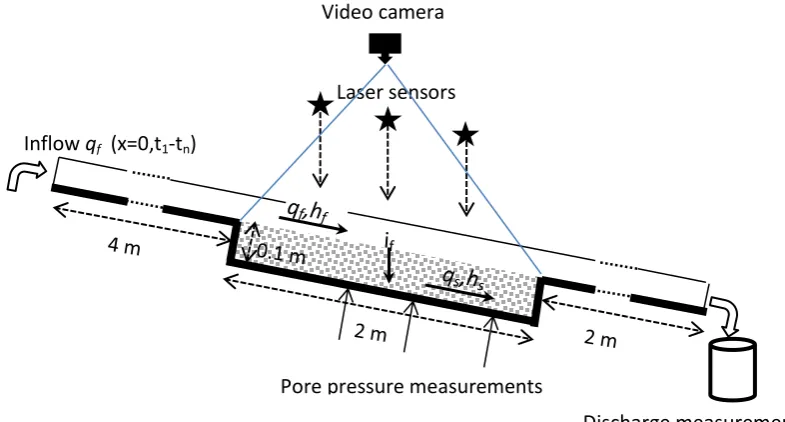
mechanism by infiltrating water can occur in channel beds filled with loose material [14] and on
52
planar slopes where shallow landslides can also transform into debris flows [15-18]. The
53
transformation of a failed mass into a debris flow is rather complex and depends on various
hydro-54
mechanical processes related to pore pressure development and supply of abundant overland flow
55
water further mobilizing the failed mass ([19-23].
56
Several authors analyzed partly the role of hydro-mechanical and morphometric factors
57
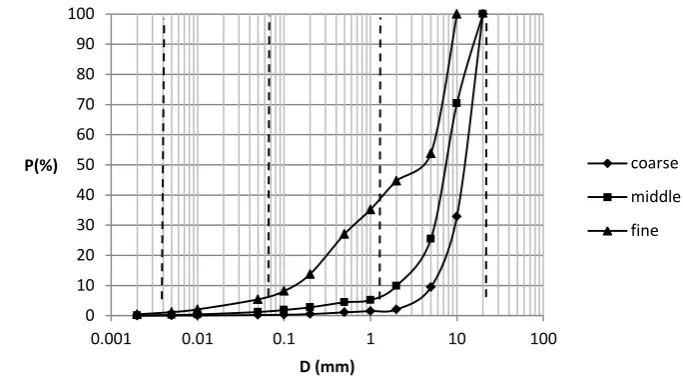
controlling the type of initiation of debris flows. Berti [24] analyzed the hydrological factors for the
58
generation of debris flows in typical source areas in the Italian Alps by modelling channel overland
59
in the channel bed from a source area as a response to rainfall impulses. Kean [25] proposed an
60
integrated hydro-geotechnical dynamic model to describe sediment transport by overland flow and
61
consequent mass failure transforming into debris flow surges. Hu [26] highlighted the initial soil
62
moisture and thus infiltration capacity as a controlling factor for the type of initiation: wet soils
63
created mainly surficial run-off and erosion and incision, bank failure, damming and debris flow
64
development while dry soils showed mainly infiltration and landslide failure and debris flow
65
initiation .[1] Zhuang focused more on the slope gradient as a controlling factor for different types
66
of initiation. Their flume studies revealed that at gentler slope gradients around 100 ± 20 , incision
67
and bank failure is dominant, creating channel damming and dam failure, inducing debris flows.
68
At intermediate slopes around 150 ± 30 erosion of bed material occur at high discharges. The high
69
sediment transport capacity with high sediment concentrations is sufficient to create debris flows.
70
At steeper slopes around 210± 40 bed failure by infiltrating overland flow water with debris flow
71
formation is the most dominant process.
72
Meteorological thresholds for the initiation of debris flows are closely related to the process of
73
initiation. In many studies about these meteorological thresholds, no clear distinction was made
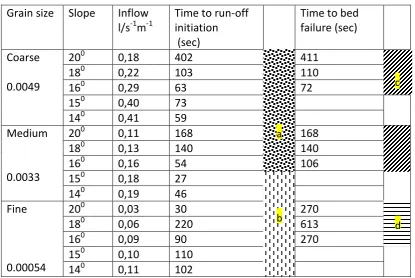
74
between the types of triggering ([27]. The assessment of these thresholds in relation to various
75
morphometric and geological factors was made in most cases using statistical techniques [28-30].
76
Until now only isolated aspects of the hydrological triggering system of debris flows has been
77
studied. There is a need for a comprehensive frame work which gives insight in the controlling
78
factors for the evolution of different triggering systems in upstream channels of debris flow gullies.
79
Therefore this paper will try to give answers on the following questions:
80
1. What type of hydro-mechanical triggering mechanisms for debris flows can we
81
distinguish in upstream channels of debris flow prone gullies?
82
2. Which are the main parameters and in what way are they controlling the type and
83
temporal sequence of these triggering processes?
84
3. What is the influence of hydro-mechanical parameters and related triggering processes
85
on the meteorological thresholds for debris flow initiation?
86
In order to answer these questions we have carried out a number of flume tests to detect the
87
conditions for different types of hydro-mechanical triggering mechanisms of debris flows (Section
88
2). Based on the process information revealed by these experiments we will develop an integrated
89
hydro-mechanical model describing these triggering processes (Section 3). The model will be
90
calibrated and validated using indicator values obtained from the processes measured in the flume
91
(Section 4). Virtual model simulations will be carried out in a schematic hypothetical source area of
92
a catchment to make a frame work of the type and sequence of these triggering processes as a
93
function of slope angle and the hydraulic conductivity of the bed material (Section 5). The model
94
will also be used for sensitivity analyses to study the influence of important geometrical and
hydro-95
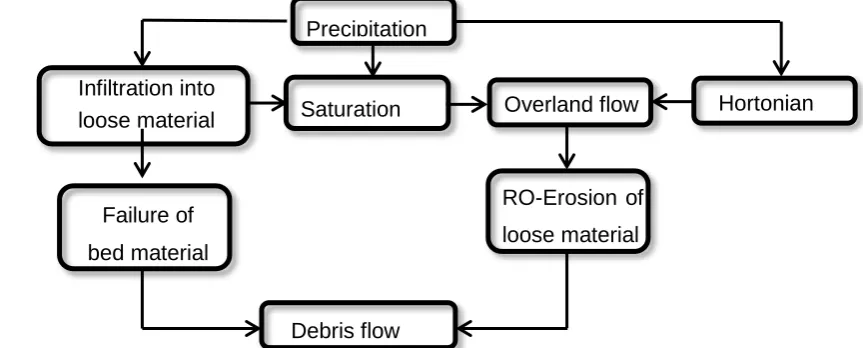
mechanical parameters and the related type of initiation process on rainfall intensity-duration
96
threshold curves, for the start of debris flows (Section 6).
98
99
.
2 Flume tests to reveal types of debris flow triggering
2.1 Set up of the flume experiments
100
A flume was designed to see whether we could simulate in an1D frame work the initiation of
101
debris flows by different hydro-mechanical triggering mechanisms. (Figure 1). The flume has a
102
length of 8 m and a width of 0.3 m. The material simulating the channel bed with a thickness of 0.1
103
m and a width of 0.3 m is positioned at a distance of 4 m from the top of the flume and has a length
104
of 2 m. The material was brought into the flume in layers of about 2 cm and was slightly compacted
105
(dry density see Table1). There is an outflow at a distance of 2 m from the lower end of the channel
106
bed (Figure 1). The water is entered at the upper end of the flume with a controlled discharge
107
,simulating run on water from an upstream area.
108
Figure 1: Design of the flume test. For explanation of the parameters see text
109
Particle size class
Friction
(o)
Densit y
kNm-3
Hydraulic
conductivity (m s-1)
D30 (mm) D50 (mm)
D90 (mm)
Coarse 34.6 15.4 4.91E-03 9 11 18
Medium 33.7 16.3 3.28E-03 4 6 16
Fine 29.2 19.5 0.54E-03 0.7 1.6 8
Table I. Hydro-mechanical characteristics of three types of bed material, used in the flume tests.
110
Friction means friction angle of the material in degrees. D30/50 means that 30/50% of the sample has a
111
lower diameter than what is indicated in the column.
112
Three types of material were used in the experiments with different grain size distributions
113
(Figure 2). We could vary the slope angle of the flume between 140 and 200. The initial moisture
114
content of the flume material was more or less dry. The initial moisture content is important for the
115
infiltration capacity but since we used in the laboratory a large influx of water from above into
116
coarse bed material, we ignored the effect of the Sorpetivity (related to the initial moisture content)
117
on the infiltration capacity of the bed material.
118
Inflow
q
f (x=0,t1-t
n)
Discharge measurements
Pore pressure measurements
119
Figure 2: Cumulative grain size distribution of the three bed materials, used in the flume tests
120
The friction of the three materials was measured with the conventional direct shear apparatus
121
[31]. The hydraulic conductivity of saturated cylindrical soil samples of the three grainsizes was
122
measured with a constant head gradient between the upper and lower end of the sample ([32].
123
Table I gives further information about the friction, hydraulic conductivity and gradient of the
124
materials used for the experiments.
125
Pore pressure was measured at three places (Figure 1) at the bottom of the flume. The pore
126
pressure sensors, type :YP4049, were produced by Yom Technology Company. The measuring
127
range of pore pressure is from -100kPa to +100kPa.
128
Laser sensors (ZLDS100 ZSY Group; resolution 0.03 % FS) at three points with a spacing of 0.5
129
m (Figure 1) were used to monitor topographical heights, especially with the aim to monitor abrupt
130
changes in relief due to bed failure.
131
In addition video-recordings were performed (Figure 1) to follow the sequence of processes in
132
the course of the experiments. During the process of overland flow erosion, samples were taken six
133
times for more or less steady state conditions at the outlet of the Flume (Figure 1). The discharge of
134
water with sediments was collected in baskets during 5 seconds. The sediments were sieved, dried
135
and weighted to measure the concentration of the fluid.
136
An integrated model (Section 3) for surface and sub surface flow, sediment transport and bed
137
slope stability was developed to describe the processes in the flume, which was used later to
138
analyze the sequence of different initiation processes at the field scale.
139
2.2 Observations on different types of hydrological triggering mechanisms in flume tests.
140
The flume tests were carried out in order to reveal different types of hydrological triggering
141
mechanisms, which may create debris flows and to establish indicators related to these triggering
142
processes which will be used to calibrate and validate our theoretical model (Section 4) During the
143
flume tests with the three bed materials under different slope angles, observation were carried out
144
by means of video images and the laser sensors. Some of the observed process indicators are given
145
in Table II
146
147
148
0 10 20 30 40 50 60 70 80 90 100
0.001 0.01 0.1 1 10 100
P(%)
D (mm)
Grain size Slope
Inflow
l/s
-1m
-1Time to run-off
initiation
(sec)
Time to bed
failure (sec)
Coarse
0.0049
20
00,18
402
411
18
00,22
103
110
16
00,29
63
72
15
00,40
73
14
00,41
59
Medium
0.0033
20
00,11
168
168
18
00,13
140
140
16
00,16
54
106
15
00,18
27
14
00,19
46
Fine
0.00054
20
00,03
30
270
18
00,06
220
613
16
00,09
90
270
15
00,10
110
14
00,11
102
149
Table II. Observed time to overland flow and bed failure, overland flow type and failure mode in
150
flume experiments for three types of bed material and for different bed slope angles: a) Saturation
151
overland flow; b) Hortonian overlandflow; c) slow continuous bed failure; d) rapid failure; nf: no
152
failure.
153
In slope hydrology two types of overland flow can be distinguished: Saturation overland flow
154
and Hortonian overland flow [32]. These two types could be distinguished during the different
155
flume experiments (Table II). Saturation overland flow was characterized, after complete saturation
156
of the soil, by a more or less spatially randomly ponding of water at the soil surface, while
157
Hortonian overland flow, which occurs when the rainfall intensity or supply of overland flow water
158
is larger than the infiltration capacity of the soil, showed a more concentrated continuous flow over
159
the length of the flume bed. According to these visual indicators we could establish a boundary
160
between Saturation overland flow and Hortonian overland flow, which in our flume tests was
161
found in the medium grain size materials at a slope gradient of 160 (Table II). This could be verified
162
with our model simulation (see below Section 4.2). For courser materials (Ks values of 4.19E-03 and
163
3.28E-03 m s-1 ) and higher slope angles (> 160 ) the time to Saturation overland flow is immediately
164
followed by failure or with a small delay until 9 seconds. Also one can clearly observe that the time
165
to Saturation overland flow (and thus failure) is decreasing with decreasing slope angle (Table II) .
166
Hortonian overland flow [32].was initiated in most cases on the finer sediments, which is
167
ascribed to the lower infiltration capacity (Ks = 0.54E-03 m s-1). Bed failure in this case occurred a
168
certain time after the start of Hortonian overland flow with a time lag ranging between 35 and 160
169
seconds (Table II), because in this case, due to the lower percolation rate it takes time to bring the
170
groundwater in the bed material to a critical failure level.
171
Bed failure initiation is controlled by the bed gradient and the internal friction of the material
172
and occurred in our experiments on slopes of approximately 16 degrees and higher. At lower slope
173
angles no bed failure occurred (nf in Table II) and sediment delivery occurred only by overland
174
flow erosion
175
The medium and course materials show bed failure characterized by slow movements over the
176
total depth combined with fast surficial entrainment of grains by saturated overland flow.
177
Movement of bed material is slow and continuous or sometimes intermittent showing a surging
178
a
b
pattern (Table II). Instead of the slow and more flow like movements observed for the medium and
179
coarse sediments, failure of the fine sediments occurred suddenly with a very rapid surge of more
180
or less coherent blocks followed by fluidization, (Table II).
181
Sediment transport by overland flow on these steep slopes reached volumetric concentrations
182
between 0.46 and 0.64, which is characteristic for debris flows
183
184
185
186
187
188
Fig 3. Schematic diagram showing the different initiation processes of debris flows in channels
189
We can conclude on the basis of these observations that the flume tests carried out with the
190
three materials revealed three types of processes, which created debris flows in these range of
191
slopes gradients namely debris flow Initiation by Hortonian Overland flow Erosion (RhE-I),
192
Saturation Overland flow Erosion (RsE-I) and by Bed Failure (BF-I). The occurrence and sequence
193
of these processes seems to be controlled by slope gradient and hydraulic conductivity of the bed
194
sediment. Figure 3 gives a schematic overview of these process types.
195
3 Integrated model (1D) for debris flow initiation in upstream channels
196
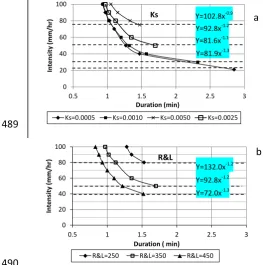
The flume tests observations brought us to the concept of the triggering of debris flows caused
197
by Hortonion and Saturation overland flow initiating surficial erosion of bed material. Bed failure
198
and entrainment of material was initiated by infiltration and subsurface flow leading to instability.
199
First we have to simulate the hydrological component of the triggering mechanisms of debris flows.
200
For that we need the mass balance equation for overland (Eq.(1a)) and through flow (Eq.(1b)) ,
201
which is given by :
202
𝜕𝑞𝑓
𝜕𝑥 + 𝜕ℎ𝑓
𝜕𝑡 = 𝐵1 (1a)
203
𝜕𝑞𝑠
𝜕𝑥 + 𝜕ℎ𝑠
𝜕𝑡 = 𝐵2 (1b)
204
205
where qf is overland flow discharge per unit width (m3m-1s-1); qs is subsurface discharge per unit
206
width (m3m-1s-1); hfis thickness of overland flow (m); hs (m) is thickness of subsurface flow, 𝜕x (m) is
207
distance along the slope 𝜕t is the time (s) and B1-2 are terms (m s-1) describing the inflow or outflow
208
of water from the flow system, which is defined as follows:
209
𝐵1= [
𝑟 − 𝑖𝑓 (𝑎) 0 − 𝑖𝑓 (𝑏)
] (2a)
210
𝐵2= 𝑖𝑓 (2b)
211
212
where r (m s-1) describes the external input of rain into and if (m s-1) the outflow of water by
213
infiltration out of the overland flow system (Eq. (2a)) (see also Figure 1). When there is no supply of
214
rain, like in our flume experiments: r=0. In the case of subsurface flow if in Eq.(2b) is considered
215
now as an inflow term of the subsurface flow system. If hf/t is larger than the infiltration capacity
216
Ks (m s-1) of the bed material the latter one is the limiting factor. Therefore the infiltration term if of
217
Precipitation
Overland flow
RO-Erosion of
loose material
Debris flow
Infiltration into
loose material
Failure of
bed material
-1) and the current water depth
218
Eq. (2)is the minimum (min) value of the infiltration capacity Ks (m s(hf), which can infiltrate in one time step t into the bed material:
219
𝑖𝑓 = min (𝐾𝑠, ℎ𝑓/∆𝑡) (3)
220
221
We introduce here a general momentum equation for the water flow processes [33]:
222
ℎ𝑓= 𝛼𝑓𝑞𝑓𝛽𝑓 (4a)
223
ℎ𝑠= 𝛼𝑠𝑞𝑠𝛽𝑠 (4b)
224
225
For turbulent overland flow the parameters fand f in Eq.(4a) can be defined as follows :
226
𝛼𝑓= ( 𝑛 𝑆00.5)
0.6
and 𝛽𝑓 = 0.6 (5)
227
where n is Manning’s n and S0 the slope gradient of the bed material.
228
For subsurface flow we can write according to Darcy’s law:
229
𝑞𝑠= 𝐾𝑠 sin 𝜃 ℎ𝑠→ ℎ𝑠= 1
𝐾𝑠 sin 𝜃𝑞𝑠 (6)
230
231
where qs is the amount of subsurface flow water per unit width (m3m-1s-1); is slope angle (degrees)
232
and hs is the height of the flowing water component in the soil matrix (m). By comparing Eq.(6) with
233
the general momentum Eq. (4b) we can define the parameters
234
sand s for subsurface flow:
235
𝛼𝑠= 1
𝐾𝑠 𝑠𝑖𝑛𝜃 and 𝛽𝑠= 1 (7)
236
237
A combination of the mass balance Eq.(1) with Eq.(4) delivers an expression for overland flow
238
or subsurface flow discharge (qf,qs) [33]:
239
𝜕𝑞𝑓
𝜕𝑥 + 𝛼𝑓𝛽𝑓𝑞𝑓
(𝛽𝑓,𝑠−1) 𝜕𝑞𝑓
𝜕𝑡 = 𝐵1 (8a)
240
𝜕𝑞𝑠
𝜕𝑥 + 𝛼𝑠𝛽𝑠𝑞𝑠
(𝛽𝑠−1) 𝜕𝑞𝑠
𝜕𝑡 = 𝐵2 (8b)
241
242
The 1D model is implemented in a fixed Eulerian frame where the variation in water flow
243
variables is described at fixed coordinate points at a distance x along the slope as a function of
244
time step t. A numerical solution for Eq.(8) is given by [33]:
245
𝑞𝑥+1𝑡+1 =
∆𝑡 ∆𝑥𝑞𝑥
𝑡+1+𝛼𝛽𝑞 𝑥+1𝑡 (𝑞𝑥+1
𝑡 +𝑞𝑥𝑡+1
2 )
𝛽−1
+∆𝑡(𝐵𝑥+1𝑡+1 +𝐵𝑥+1
𝑡
2 )
∆𝑡 ∆𝑥+𝛼𝛽(
𝑞𝑥+1𝑡 +𝑞𝑥𝑡+1
2 )
𝛽−1 (9)
246
247
where qx, and should be read as qf,s f,s and f,s respectively.
248
To simulate the initiation of debris flows by mass failure we used the equation for the infinite
249
slope equilibrium model [31], which is the trigger for failure:
250
𝐹 =( 𝛾𝑠𝑧 𝑐𝑜𝑠 𝜃−𝑝) 𝑡𝑎𝑛 𝜑
𝛾𝑠𝑧 𝑠𝑖𝑛 𝜃 (10a)
251
𝑝 = 𝛾𝑤ℎ𝑠cos 𝜃 (10b)
252
253
where F is the safety factor; failure occurs when F=1; s and w are the saturated bulk density of the
254
material and water respectively; is friction angle of the material; z and hsare the thickness of the
255
soil and the height of the groundwater layer respectively hs can be solved with Eq. (9) and Eq.(6)
256
respectively.
257
The overall stability of the bed material expressed with the safety factor (F) for the infinite
258
slope model is calculated as an average of the safety factor of the different nodes. The inflow of
259
water into the flume is coming from upstream and therefore the pore pressure gradient is
260
decreasing downstream. This means that the safety factor is always increasing downstream and
261
therefore the average approach of the safety factor over the length of the sample in the flume seems
262
a reasonable approximation of the overall safety factor.
For estimating the transport capacity on steep slopes Rickenmann [34-35] proposed a bedload
264
transport equation based on a shear stress approach, where discharge, bed slope gradient and
265
material grading are used as parameters to characterize flow hydraulics.
266
For steeper slopes, in the range of 0.03<S<0.2 (1.7o-11.3o) Rickenmann [34] performed a
267
regression analysis with the steep flume data on bed load transport obtained at ETH Zurich that
268
resulted in the equation:
269
𝑞𝑠𝑜𝑙𝑖𝑑= 12.6 (𝑑𝑠−1)1.6(
𝐷90 𝐷30)
0.2
(𝑞𝑓− 𝑞𝑐)𝑆2 (11)
270
271
where D90 and D30 are grain sizes at which 90% and 30% respectively by weight of the material are
272
finer; dsis the mass density of the solids and S is the slope gradient and qc is the critical flow
273
discharge for bed load entrainment. The experimental slopes were in the range of 0.03>S>0.20. (1.70
-274
11.30) and the D90 of the material ranged between 0.9>and2 cm and D30 between 0,06 and 1 cm with
275
inflow rates of 10-30 l/s In the section below we will calibrate Eq.(11) for the steeper slopes in our
276
flumes.
277
The integrated model developed in this section is able to describe the different types of
hydro-278
mechanical triggering mechanisms for debris flows. It delivers us the physical parameters, which
279
controls these processes, which will be applied in our virtual simulations in Section 5 and 6
280
In the next section (4) we will calibrate our model on some process indicator values obtained from
281
our flume tests.
282
4. Calibration and validation of the theoretical model on the basis of flume test results
283
. We will use here a number of process indicator values measured during the flume
284
experiments to calibrate and validate the outcomes of our theoretical model. These are: Saturation
285
or Hortonian overland flow, time to overland flow, maximum pore pressure, time to bed failure
286
and solid concentration by overland flow erosion. Hortonian overland flow and the time to
287
Hortonian overland flow in the model is declared when surface water hfreaches the lower end of
288
the bed material while the bed material is still not saturated (hs < Zs) .Saturation overland flow and
289
the time towards it, is declared when hs = Zs over the entire bed. Pore pressure is calculated each
290
time step according to Eq (10b). The discharge of hf + hs is reported each time step at the end of the
291
flume. Bed failure is declared as said before when the average Safety factor F over the bed length
292
reaches the value of 1.
293
For the flume simulations the distance between the nodes (x) was 0.1 m and the time interval
294
(t) was 0.2 seconds.
Figure 4. Observed and calculated time to Saturation overland flow (black symbols) and Hortonian
296
overland flow (open symbols)
297
Figure 4 shows the relation between observed and calculated time to overland flow for the
298
different flume tests. There is a moderate 1:1 correlation between observed and predicted time to
299
overland flow for the medium and coarse sediments and for the fine sediments, showing Hortonian
300
overland flow, there is no correlation at all. However the model was able to predict the type of
301
overland flow according to what was observed during the flume tests (see Table II).
302
Despite the malfunctioning of some pore pressure sensors we were able to make a 1:1
303
comparison between the average maximum measured pore pressure for the three sensors (Figure 1)
304
and the average calculated maximum pore pressure (Figure 5).
305
306
Fig 5. Maximum pore pressure measured during flume tests in relation to calculated pore pressures.
307
The Figure shows that in many cases there is a slight overestimation of the calculated pore
308
pressure. Time series of measured pore pressure of the three sensors compared to modelled
309
temporal pore pressure development showed thatin most cases the onset towards maximum pore
310
pressure for the three sensors is more irregular compared to the calculated development of the pore
311
pressures (Figure 6). This can be ascribed to the heterogeneity of the sediment or (and) the
312
imperfect response of the sensors.
313
0 0.2 0.4 0.6 0.8 1 1.2 1.4
0.6 0.7 0.8 0.9 1
p
c
al
cu
late
d
(
kPa)
p measured (kPa)
1:1 line
0 20 40 60 80 100 120 140 160 180
0 50 100 150 200
Ti
m
e
t
o
o
ve
rl
an
d
fl
o
w
b
ser
ve
d
(sec
)
Time to overland flow Calculated (sec)
coarse
medium
314
Fig 6 Example of the rise in pore pressure (measured /calculated) due to infiltration of run-on water
315
in the bed material (Test:Medium grain size /200)
316
In relation to pore pressure development we compared the time to failure for the different test
317
runs on the different materials. Since the time towards average maximum calculated and measured
318
pore pressure coincided more or less, one would expect also corresponding calculated and
319
measured failure times. Table II and Figure 7 show that the match between observed and calculated
320
failure time is reasonable except for two outliers (coarse-200 ;fine-180). Further we can observe that
321
the calculated time to failure is underestimated for the coarse material and overestimated for
322
practically all the tests on the medium and fine materials. The deviations between calculated and
323
observed values must be ascribed to heterogeneity of the material, deviating friction values, and
324
incorrect assessment of the overall safety factor.
325
326
Figure 7: Observed and calculated time of failure of bed material during the flume tests.
327
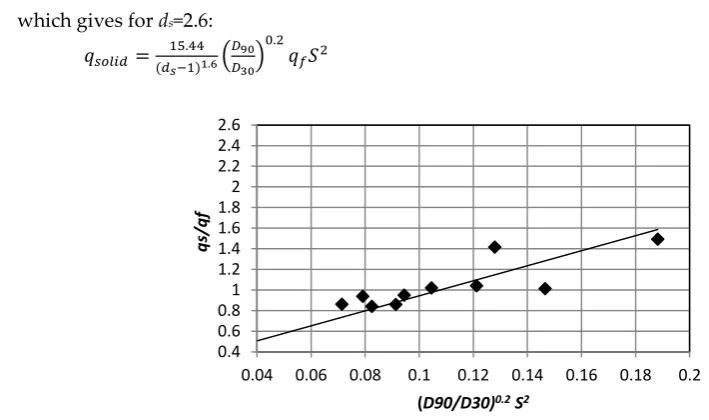
We calibrated also the parameters of the Rickenmann [35] equation, (Eq.11) on our flume tests,
328
which were carried out on slopes ranging between 0.25>S>0.36 (140-200), with grain sizes for
329
0.9>d90>2 and 0,05>d30>1 cm and with flow rates 0,5>qf>15 l s-1 m-1. Figure 8 shows the best linear fit
330
between qsolid/qf and (d90/d30)0.2S2, which delivered the following modified equation for slopes
331
between 140 and 200:
332
𝑞𝑠𝑜𝑙𝑖𝑑 = 7.28 ( 𝐷90
𝐷30) 0.2
𝑞𝑓𝑆2 (12a)
333
0 0.1 0.2 0.3 0.4 0.5 0.6 0.7 0.8
0 50 100 150 200 250 300 350 400 450
Por
e
p
re
ssur
e
kPa
Time seconds
Calculated
Observed
0 100 200 300 400 500 600 700
0 100 200 300 400 500 600 700
Ti
m
e
t
o
fai
lu
re
c
al
cu
late
d
(
s)
Time to failure observed (s)
coarse
medium
which gives for ds=2.6:
334
𝑞𝑠𝑜𝑙𝑖𝑑= 15.44 (𝑑𝑠−1)1.6(
𝐷90
𝐷30) 0.2
𝑞𝑓𝑆2 (12b)
335
336
Figure.8. Calibration of Rickenmann’s bedload equation for steeper slopes in our flume tests
337
between 14 and 20 degrees.
338
The calibration revealed that qc in Eq.(11) becomes zero or practical zero in Eq.(12). At slopes
339
larger than 150 the down slope component of the grain weight may reduce the critical shear stress c
340
which in our case obviously reduced to nearly zero.
341
We may conclude that the model is able to predict in a reasonable way essential process
342
indicators for different hydrological triggering processes of debris flows in upstream channels. In
343
the next section we will apply the model on the field scale to predict hydro-mechanical triggering
344
patterns for debris flows as a function of the hydrological conductivity of the bed material and the
345
channel slope gradient.
346
5. Hydro-mechanical triggering patterns for debris flows in relation to hydrologic conductivity
347
of bed materials and channel gradient
348
5.1. The design of a schematic source area at the field scale.
349
First we will design a virtual landscape of a potential debris flow source area where our model
350
can be applied to analyze the influence of terrain parameters on the type of triggering mechanisms
351
(Section 5.2) and the meteorological thresholds of debris flows (Section 6).
352
Figure 9 shows this virtual source area, which is linked to an upstream channel filled with bed
353
material receiving surface water from the surrounding slopes to initiate a potential debris flow. This
354
geomorphological setting resembles more or less the source areas described among others by Coe
355
[7] and Berti [24]. The upstream area of our hypothetical catchment has a radius R. The channel is
356
further surrounded by lateral slopes with a length L. The length of the channel bed is Lx , the width
357
W and the slope angle is .The hydraulic conductivity of the bed material is Ks, the porosity Por
358
and the friction angle . (Figure 9).
359
0.4 0.6 0.8 1 1.2 1.4 1.6 1.8 2 2.2 2.4 2.6
0.04 0.06 0.08 0.1 0.12 0.14 0.16 0.18 0.2
qs/qf
360
Figure 9: Morphometric and hydro-mechanical parameters, which were used for model simulations
361
of debris flow initiation. For an explanation see Table 3 and text. D90/D30: 90% and 30% lower than
362
grainsize D90 and D30 respectively :
friction angle; Ks: hydraulic conductivity; Por :porosity; Zs:363
depth of material; : slope angle, qup: water that flows into the upper end of the channel bed; R:
364
radius of source area above the channel; Lx and W: length and width of the channel bed; L: length of
365
lateral contributing slope; latin: lateral inflow of water to the channel; CN: curve number value for
366
the soil hydrological and land use characteristics of the contributing slopes.
367
The sink term B in (1) and (8) is now adapted to the field scene and given by:
368
𝐵 = 2𝑙𝑎𝑡𝑖𝑛 + 𝑟 − 𝑖𝑓 (13)
369
370
where latin (m s-1) is the lateral inflow of overland flow water from the slopes along the channel
371
(Figure 9) , r direct rain intensity input to the channel bed and ifinfiltration rate into the bed (see
372
Eq.(3)). The lateral inflow is calculated for these sensitivity analyses in a simple way, assuming
373
steady state conditions in the mass balance equation for overland flow:
374
𝑙𝑎𝑡𝑖𝑛 =𝑟𝑐𝑛𝐿
𝑊 (14)
375
376
rcn (m/s) is calculated using the Curve Number method [36], L is the length of the lateral slope
377
and W the width of the channel (see Figure 9). In our simulations we selected overland flow
378
supplying slopes with soils with moderate to slow infiltration rates and a poor condition grass
379
cover, which corresponds to a Curve Number(CN) of about 80. The CN number, reflecting the
380
hydrological soil characteristics, land use and antecedent soil moisture conditions that we can
381
expect in high mountainous areas, was chosen arbitrarily and was kept constant in our simulations.
382
The overland flow water that flows into the upper end of the channel bed, which is given by qup (m2
383
s-1) (Figure 9)
384
𝑞𝑢𝑝=
𝑟𝑐𝑛0.5𝜋𝑅2𝑐𝑜𝑠𝜃
𝑊 (15)
385
5.2 The influence of the hydraulic conductivity (Ks) and slope () of the channel bed on the type and sequence
386
of hydrologic triggering processes for debris flows
387
In the flume we could observe the effect of slope angle and hydraulic conductivity on the type
388
and sequence of triggering processes, which may lead to the initiation of debris flows. In this
389
section we will investigate with our theoretical model the effect of these two factors at the
390
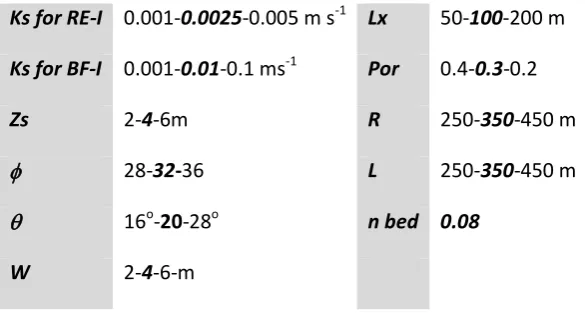
catchment scale. The values of the other factors used in our model simulations are shown in bold as
391
default parametric values (Zs,,W,Lx,Por.R.L,n bed) in Table III (see also Figure 9).
Ks for RE-I
0.001-0.0025-0.005 m s
-1Lx
50-100-200 m
Ks for BF-I
0.001-0.01-0.1 ms
-1Por
0.4-0.3-0.2
Zs
2-4-6m
R
250-350-450 m
28-32-36
L
250-350-450 m
16
o-20-28
on bed 0.08
W
2-4-6-m
Table III. Default values (bold italic) and maximum and minimum values of input parameters for
394
Overland flow Erosion (RE-I) and Bed Failure (BF-I) triggering debris flows. Ks: saturated hydraulic
395
conductivity; Zs: thickness of bed material;friction angle of material; slope angle of channel
396
bed; W and Lx :width and length of channel bed respectively; Por: available volumetric pore space;
397
R radius of source area ; L: length of lateral slopes ; n: Manning’s n of bed material.
398
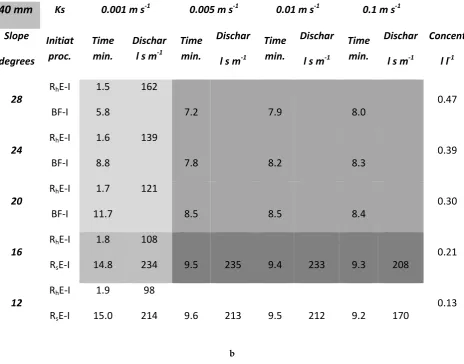
Table IV gives the range in Ks values (first row) and bed slope angles (first column), which
399
were used in our simulations to study the effect of these parameters on the hydro-mechanical
400
process development at the catchment scale. For these simulations two rain scenarios were used
401
with an intensity of 80 mm (Table IVa) and 40 mm per hour (Table IVb) respectively. The Tables
402
show domains with different shades of gray with various combinations of hydro-mechanical
403
triggering processes. In the white sections no debris flow initiation is expected to develop in the
404
source area because of a too low sediment concentration of the overland flow. Table IVa shows that
405
in the domain 280-200 and Ks= 0.001-0.005 m s-1, the debris flow is initiated in the first stage by
406
Hortonian overland flow erosion (RhE-I). The overland flow discharge reaches a steady state after a
407
certain relatively short time. During the steady state groundwater will rise by infiltration of run-on
408
water until failure of the bed material, which happens between 1.7 and 11.2 minutes depending on
409
the slope and Ks. In Table IVa we see a dramatic drop in discharge between slopes with Ks =0.001
410
and 0.005. The last Ks-value reaches a significant boundary which determines whether or not a
411
debris flow can be initiated by Hortonian overland flow transport.
412
80 mm
Ks
0.001 m s
-10.005 m s
-10.01 m s
-10.1 m s
-1Slope
degrees
Initiat
proc.
Time
min.
Dischar
l s m
-1Time
min.
Dischar
l s m
-1Time
min.
Dischar
l s m
-1Time
min.
Dischar
l s m
-1Concent
l l
-128
R
hE-I
BF-I
1.0
5.4
912
1.3
1.7
139
2.4
3.0
0.47
24
R
hE-I
BF-I
1.0
8.4
783
1.3
2.3
119
2.8
3.1
0.39
20
R
hE-I
BF-I
1.1
11.2
683
1.4
2.9
104
3.1
3.1
0.30
16
R
hE-I
R
sE-I
1.1
14.2
606
732
1.5
3.7
92
733
3.7
732
3.6
705
0.21
12
R
hE-I
R
sE-I
1.2
14.8
550
666
1.5
3.9
83
665
3.8
664
3.6
646
0.13
a
414
40 mm
Ks
0.001 m s
-10.005 m s
-10.01 m s
-10.1 m s
-1Slope
degrees
Initiat
proc.
Time
min.
Dischar
l s m
-1Time
min.
Dischar
l s m
-1Time
min.
Dischar
l s m
-1Time
min.
Dischar
l s m
-1Concent
l l
-128
R
hE-I
BF-I
1.5
5.8
162
7.2
7.9
8.0
0.47
24
R
hE-I
BF-I
1.6
8.8
139
7.8
8.2
8.3
0.39
20
R
hE-I
BF-I
1.7
11.7
121
8.5
8.5
8.4
0.30
16
R
hE-I
R
sE-I
1.8
14.8
108
234
9.5
235
9.4
233
9.3
208
0.21
12
R
hE-I
R
sE-I
1.9
15.0
98
214
9.6
213
9.5
212
9.2
170
0.13
b
416
Table IV. Time sequence of different initiation processes RhE-I and RsE-I,(erosion by Hortonian and
417
Saturation overland flow respectively) and BF-I (bed failure) in relation with hydraulic conductivity
418
(Ks) and slope angle of bed material. Further are given the discharge (Discharg) and solid
419
concentration (Concent) during RhE-I and RsE-I. Table 4a and 4b: simulated rain intensities of 80 mm
420
and 40 mm respectively.
421
It is confirmed by Table IVb with a lower rain input (40 mm) where at Ks ≥ 0.005, no initiation
422
by Hortonian overland flow is possible anymore.
423
Going back to Table IV-a: in the domain 160-120 and Ks= 0.001-0.005 ms-1 slope failure does
424
not occur. The debris flow is initiated by overland flow. First by Hortonian overland flow and later
425
when the groundwater has reached the surface by Saturation overland flow. Discharge is relatively
426
low when there is Hortonian overland flow, while obviously discharge dramatically increases at
427
Saturation overland flow. However due to the lower slope angles, the volumetric sediment
428
concentration is low (0.21 at 160 and 0.13 at 120, (Table IV-a last column ), which means the flow
429
changes from a hyper concentrated flow into a water flood with conventional suspended load and
430
bed load.
431
At higher conductivities in the domain Ks=0.01-0.1 m/s and 28o-20o, bed failure seems the
432
most dominant process (Table IVa). Due to the larger Ks values, infiltration into the bed is more
433
important than overland flow discharge. The bed material turns out to be partly saturated in the
434
upper part due to the larger upstream inflow, creating partly Saturation overland flow and
435
Hortonian overland flow. However within one minute after the run off discharge reached the lower
436
end of the bed, failure of the bed material occurred already. Therefore the contribution of overland
437
flow to the transport of debris by overland flow can be ignored.
In the domain Ks=0.01-0.1 m/s and lower slope gradients (16o-12o ) there is no slope failure
439
but only Saturation overland flow, (Table IVa ) with low sediment concentrations in most cases not
440
enough to call it a debris flow.
441
Table IV-b shows the simulation results with an intensity of 40 mm per hour. The domains
442
with a specific combination of hydro-mechanical triggers still exist. There is only a shift of the
443
boundary for the Ks -values with no Hortonian overland flow (>0.005 m/s) to the left. The Tables
444
IVa and b show a decrease in overland flow discharge and increase in time to bed failure with a
445
decreasing slope angle. Around 16 degrees the channel bed is stable but still steep enough to have
446
transport capacities with concentrations in the domain of a hyper concentrated flow. These are
447
induced by Hortonian and Saturation overland flow at lower Ks values and only Saturation
448
overland flow at higher Ks values. At lower slope angles (see slopes around 12 degrees) sediment
449
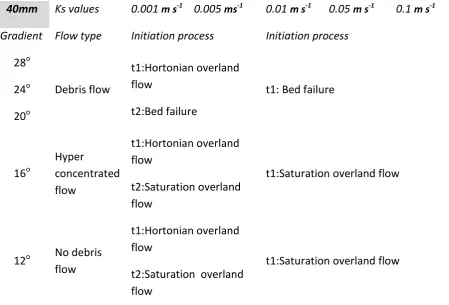
concentrations are too low to call it a debris flow. Table V gives a summary of the type and
450
sequence of initiation processes related to different Ks and slope angle values.
451
40mm
Ks values
0.001
m s
-10.005
ms
-10.01
m s
-10.05
m s
-10.1
m s
-1Gradient Flow type
Initiation process
Initiation process
28
oDebris flow
t1:Hortonian overland
flow
t2:Bed failure
t1: Bed failure
24
o20
o16
oHyper
concentrated
flow
t1:Hortonian overland
flow
t2:Saturation overland
flow
t1:Saturation overland flow
12
oNo debris
flow
t1:Hortonian overland
flow
t2:Saturation overland
flow
t1:Saturation overland flow
Table V: Sequence of different initiation processes for debris (hyper concentrated) flows in relation
452
to the hydraulic conductivity and slope of the channel bed material. Simulated rain intensity is 40
453
mm.
454
We designed a framework, which gives insight in what kind of debris flow initiation can be
455
expected for a given slope gradient and hydraulic conductivity of the material. In the next section
456
we will give an impression how different hydro-mechanical parameters of triggering processes can
457
influence meteorological thresholds for debris flows..
458
459
460
462
463
6. Sensitivity analyses for parameters influencing the rain Intensity-Duration (I-D) threshold
464
curves for different initiation processes of debris flows
465
In the foregoing we revealed the influence of Ks and bed slope gradient on the sequence of
466
processes mechanisms involved in the initiation of debris flows. We want to investigate here the
467
effect of the other parameters (including Ks and slope gradient) on rainfall thresholds in terms of
468
Intensity Duration (I-D) curves for the triggering of debris flows by two main process mechanism:
469
initiation by Hortonian overlandflow (RhE-I) and bed failure (BF-I). As we have seen in Table IV
470
and V, debris flow initiation by Saturation overland flow (RsE-I) can only take place around 16
471
degrees At lower slope angles sediment concentrations are too low to call it a debris flow (Table IV).
472
At higher slope angles we have bed failure before Saturation overland flow can take place.
473
Figure 10 shows the effect of different parameters on the I-D curves for debris flows initiated
474
by Hortonian overland flow. The intensity and duration value of a rain event which creates
475
overland flow that just reaches the end of the channel bed with a sediment concentration of >0.2, is
476
defined by us as a threshold rain event for debris flow initiation. The intensity and duration values
477
for a variety of different critical rain events were plotted in a graph with on the y-axis the intensity
478
and on x-axis the duration. In this way an Intensity Duration (ID) curve can be constructed. Table
479
III gives an overview of the range of the different parameters and the default values (in bold italic),
480
which were used in the simulation and which give a realistic representation of geometric and
481
geotechnical parameters for source area conditions The threshold curves for debris flow initiation
482
by Hortonian overland flow are shown in Figure 10. In this figure the threshold curves, which are
483
constructed, using the default values given in table III, are depicted with open rectangular markers.
484
They are equal in all the sub-figures. This enables one to compare for the different parameters the
485
difference between the ultimate curves and the default curve. For each selected parametric value
486
there is an ultimate minimum rain intensity below which not enough overland flow and thus a
487
debris flow can be initiated, irrespective
488
489
490
0 20 40 60 80 100
0.5 1 1.5 2 2.5 3
In
te
nsi
ty
(m
m
/hr
)
Duration (min)
Ks
Ks=0.0005 Ks=0.0010 Ks=0.0050 Ks=0.0025
0 20 40 60 80 100
0.5 1 1.5 2 2.5 3
In
te
n
si
ty
(m
m
/hr
)
Duration ( min) R&L
R&L=250 R&L=350 R&L=450
a
b
0204060 80100 0.511.522.53
Intensity (mm/hr)
Duration ( min) R&L R&L=250R&L=350R&L=450
Y=102.8x-0.9 Y=92.8x-1.2 Y=81.6x-1.1 Y=81.9x-1.3
491
492
493
494
Figure 10. I-D curves for debris flow initiation by Hortonian overland flow in relation to different
495
geometrical and hydrological parameters. For the definition of parameters see Table III.
496
the duration (D) of the rain event (see horizontal dotted lines). The simulations show that at
497
intensities below this critical dotted line the overland flow water never reach the lower end of the
498
bed due to a too high infiltration rate on its pathway compared to the supplied amount of water (
499
direct rain input and surrounding overland flow) and finally bed failure may be the primary
500
triggering process.
501
The most obvious selected parameter for overland flow initiation is the hydraulic conductivity
502
Ks . Other parameters are related to geometry of the source area (see Figure 6) like length of the
503
0 20 40 60 80 1000.5 1 1.5 2 2.5 3
In te n si ty (m m /hr )
Duration ( min)
16 20 28
0 20 40 60 80 100
0.5 1 1.5 2 2.5 3
In te n si ty (m m /hr )
Duration ( min)
Lx
Lx=50 Lx=100 Lx=200
0 20 40 60 80 100
0.5 1 1.5 2 2.5 3
In te n si ty (m m /hr )
Duration ( min)
n
n=0.06 n=0.08 n=0.10
0 20 40 60 80 100
0.5 1 1.5 2 2.5 3
In te n si ty (m m /hr )
Duration ( min)
W
W=2 W=4 W=6
c
f
0
20
40
60
80
100
0.5
1
1.5
2
2.5
3
I
D
W
d
e
0
20
40
60
80
100
0.5
1
1.5
2
2.5
3
I
D
n
0
20
40
60
80
100
0.5
1
1.5
2
2.5
3
I
D
n
0 20406080 100 0.511.522.53Intensity (mm/hr)
Duration ( min)
lateral slopes along the channel (L ), radius of the upstream area of the channel (R) Length (Lx) and
504
width (W) of the channel bed , channel bed gradient ( and further Manning’s n of the bed
505
material.
506
We saw in the forgoing that Hortonian overland flow plays a dominant role for Ks values <
507
0.005 m s-1. Figure 10 a shows the influence of the Ks value on the I-D threshold curves for run off
508
erosion initiation (RhE-I). The range of Ks values is chosen between 0.0005 and 0.005 m s-1 The
509
Figure shows that for Ks values lower than 0.001 m s-1 there is nearly no effect of Ks on the position
510
of the I-D curve but there is a difference in the minimum intensity values (dotted lines) below
511
which no debris flow can occur. A slight difference can be observed for lower intensities (<60 mm
512
hr-1)..Higher Ks values (> 0.001 m s-1) have a larger influence on the I-D curves. (Figure 10a)
513
The simulations show that the scale of the source area and lateral slopes (R&L), the length of
514
the river bed (Lx) and the width of the bed (W) have the largest effect on the position of the
515
threshold curve for the initiation of debris flow by Hortonian overland flow (Figure 10 b,d,f
516
respectively). The threshold curves are less sensible for the effect of the slope gradient and
517
Manning’s n of the bed material (Figure 10 c,e respectively).
518
519
520
521
522
y = 171.0x-0.6
0 20 40 60 80 100
0 5 10 15 20 25 30 35 40 45 50 55 60 65 70 75 80
In
te
n
si
ty
(m
m
/hr
)
Duration ( min)
Ks
Ks=0,001m/s Ks=0,01 ms-1 Ks=0,1 m/s
y = 236.1x-0.6
y = 171.0x-0.6
y = 127.8x-0.6
0 20 40 60 80 100
0 5 10 15 20 25 30 35 40 45 50 55 60 65 70 75 80
In
te
n
si
ty
(m
m
/hr
)
Duration ( min) R&L
R&L=250m R&L=350m R&L=450m
y = 165.0x-0.7
y = 209.1x-0.7
y = 171.0x-0.6
0 20 40 60 80 100
0 5 10 15 20 25 30 35 40 45 50 55 60 65 70 75 80
In
te
n
si
ty
(m
m
/hr
)
Duration ( min)
Por
Por=0.2 Por=0.3 Por=0.4
a
b
c
523
524
525
526
y = 118.4x-0.6
y = 171.0x-0.6
y = 245.3x-0.6
0 20 40 60 80 100
0 5 10 15 20 25 30 35 40 45 50 55 60 65 70 75 80
In
te
n
si
ty
(m
m
/hr
)
Duration ( min)
Lx
Lx=50m Lx=100m Lx=200m
y = 139.8x-0.6
y = 171.0x-0.6
y = 194.5x-0.6
0 20 40 60 80 100
0 5 10 15 20 25 30 35 40 45 50 55 60 65 70 75 80
In
te
n
si
ty
(m
m
/hr
)
Duration ( min)
28 32 36
y = 121.8x-0.6
y = 171.0x-0.6
y = 204.1x-0.6
0 20 40 60 80 100
0 5 10 15 20 25 30 35 40 45 50 55 60 65 70 75 80
In
te
n
si
ty
(m
m
/hr
)
Duration ( min) W
W=2m W=4m W=6m
y = 212.2x-0.6
y = 171.0x-0.6
y = 92.1x-0.6
0 20 40 60 80 100
0 5 10 15 20 25 30 35 40 45 50 55 60 65 70 75 80
In
te
n
si
ty
(m
m
/hr
)
Duration ( min)
16 20 28