R E S E A R C H
Open Access
Improved and weighted sum rate maximization
for successive zero-forcing in multiuser MIMO
systems
Robert C Elliott
1,2and Witold A Krzymie
ń
1,2*Abstract
We propose an improved algorithm for optimizing the transmit covariance matrices for successive zero-forcing (SZF) precoding in multiple-input multiple-output systems. We use a conjugate gradient projection method to solve the optimization problem. Our algorithm improves upon the existing method twofold. First, the existing covariance optimization method, with higher SNRs or more simultaneously supported users, can yield a lower sum rate than when using block diagonalization (BD), when theoretically SZF should never be inferior to BD. In
comparison, our method consistently provides a higher throughput than BD. Several simulations demonstrate our algorithm’s enhanced performance, which exceeds the existing method’s sum rate by up to 12% in the examined cases. Second, our proposed algorithm also supports the maximization of a weighted sum rate with SZF, to incorporate quality of service (QoS). To our knowledge, no other work in the literature considers a weighted sum rate and/or QoS with SZF.
1. Introduction
The topic of multiple-input multiple-output (MIMO) broadcast channels has drawn much research interest for several years. MIMO spatial multiplexing is poten-tially a key enabling technique to achieve increased throughput and quality of service (QoS) in commercial fourth-generation cellular and other future broadband wireless networks. The downlink of a MIMO system can be modeled as a broadcast channel (BC), where a base station transmits different data streams simulta-neously to several users. It is known that the capacity of a MIMO BC can be reached through the use of dirty paper coding (DPC) [1,2]. DPC takes advantage of non-causal knowledge of each user’s signal at the base sta-tion. Non-causally knowing the signal for each user, the base station can then successively encode the signal for each userksuch that the effect of interference of thek -1 previously encoded users is removed. The transmit covariance matrices for the users must then be opti-mized to minimize the remaining interference between users.
Unfortunately, one significant drawback of DPC is that it is highly non-linear. Due to its resulting extreme com-plexity, its implementation will remain impractical for the foreseeable future, even in a simplified approximate form not requiring non-causal knowledge of transmitted signals. For this reason, reduced complexity linear pre-coding methods are of interest to mitigate multiuser interference (MUI). Examples of such methods include zero-forcing beamforming (ZFB) [3] for systems with single-antenna users, and block diagonalization (BD) [4] for systems with multiple-antenna users. ZFB and BD are techniques that completely null the interference between users by requiring that the signal transmitted to each user falls in the null space of the channels for all other users. Thus, all MUI is removed at the base station. However, the nulling also imposes a constraint that the total number of receive antennas be no larger than the number of transmit antennas. There is, there-fore, a reduction in both the system performance and the number of simultaneously supportable users com-pared with DPC.
In [5], the authors propose a scheme known as suc-cessive zero-forcing (SZF). This scheme nulls multiuser interference similarly to BD, but as opposed to nulling all interference between users, it instead only * Correspondence: [email protected]
1
Electrical and Computer Engineering, University of Alberta, Edmonton, AB T6G 2V4, Canada
Full list of author information is available at the end of the article
successively nulls the interference of a given user kon the previousk- 1 users. In a sense, it is similar in con-cept to DPC, but with a reverse user ordering, and with MUI removal through nulling instead of non-linear cod-ing. It is shown in [5] that the sum-rate throughput of SZF is no worse than that of BD, and often quite better; thus, the complete removal of MUI as in BD is not necessarily always beneficial. Additionally, the less strict null space requirements mean that the transmit and receive constraints relative to BD are relaxed, and hence SZF can sometimes serve a higher number of users simultaneously than BD.
The main drawback to SZF is that its resulting sum rate is non-convex. Thus, it is difficult to find the globally optimum transmit covariance matrices that achieve the capacity. In [5], the authors propose a suboptimal covar-iance method based on the duality between the BC and the multiple access channel (MAC). This method first solves the less-constrained BC capacity problem by instead solving the dual MAC, which is convex, and thus for which efficient numerical methods exist (e.g., [6]). The BC covariance matrices can then be obtained from the MAC results via duality transformations [2]. Finally, SZF covariance matrices are obtained by projecting the BC matrices into the null spaces of the users’channels.
The primary impetus for this work was based on observations made during our related work on schedul-ing for BD [7] and SZF [8,9]. We found that, unexpect-edly, the performance of our SZF scheduling algorithms was worse than for BD at high SNR. This was eventually found to be due to the SZF covariance method rather than the scheduling algorithms. Additionally, the exist-ing covariance optimization method can only be used for sum-rate maximization. However, it is often desir-able to be desir-able to maximize a weighted sum rate. The weights on each of the user rates can account for QoS parameters to introduce more fairness into the system. A pure sum-rate maximization can result in throughput starvation for users in poorer channel conditions. Per-haps the most well-known example of weighted sum-rate maximization is the proportional fairness criterion [10,11], where the weights are the inverse of each user’s average throughput.
In this paper, our contributions are twofold. First, we propose a new algorithm for optimizing the SZF covar-iance matrices based on a conjugate gradient projection (CGP) method. This new algorithm, while still globally suboptimal, improves significantly upon the sum-rate performance of the existing method. Second, our pro-posed method also enables the maximization of a weighted sum rate. This allows QoS parameters to be incorporated with the SZF precoding. To the best of our knowledge, no existing work in the literature yet
considers fairness or weighted sum rates in conjunction with SZF.
The remainder of this paper is organized as follows. Section 2 describes the system model and the pertinent details of BD and SZF precoding. Section 3 describes the SZF covariance optimization problem, the existing method and the problems it faces in more detail, and outlines our proposed CGP method. Simulation results are provided in Section 4, and concluding remarks are given in Section 5.
2. System model and overview
To begin, we outline the notation used in this paper. Italic variables represent scalars, while lowercase and uppercase boldface variables denote vectors and matrices, respectively. ⌈·⌉ is the ceiling function. In
denotes the n × n identity matrix. A*, AT, and AH
denote the conjugate matrix, matrix transpose, and con-jugate (Hermitian) transpose ofA, respectively. Tr(A) is the trace of A, whileA2F denotes the squared
Frobe-nius norm of A. For a square matrix A, |A| is the
matrix determinant,A-1 is the matrix inverse, andA-1/2
is the matrix inverse square root.A≽0 denotes thatA
is positive semidefinite.
In this paper, we consider the downlink of a multiuser
MIMO system. There exists a base station with MT
transmit antennas and a transmit power constraint ofP. The base station transmits toK0 users out of a pool of
Kmultiple-antenna users requesting service, each with
Nkreceive antennas. LetHk∈CNk×MTdenote the
down-link channel matrix of the kth user,k = 1, 2, ...,K. We assume that at all times, the transmitter has perfect knowledge of the channel state information of all users (perfect CSIT), and that each user knows its channel perfectly. The data vector of userk,sk∈CNk×1, is
pre-processed at the transmitter with the precoding matrix Wk∈CMT×Nk to yield the transmitted signal vector xk∈CMT×1. TheNk× 1 received signal vector of thekth user can be expressed as
yk=Hk K0
j=1
Wjsj+nk (1)
where nk∈CNk×1denotes zero mean additive white
Gaussian noise with EnknHk
=σ2
nINk. We assume
herein without loss of generality thatσn2= 1.
A. Block diagonalization
The following is a quick review of BD. First consider the aggregate channel matrix ofK0 users:
Then, for each user k, remove its channel matrixHk
Block diagonalization then removes MUI by designing
Wkto fall in the null space ofH˜k, so thatHjWk=0for all k≠jand 1≤(j,k)≤K0. This gives the effective channel
matrix a block diagonal structure, thereby decomposing the multiuser channel into parallel equivalent single-user channels. The received signal vector (1) for each user becomesyk=HkWksk+nk. The above implies that the rank of the null space for eachH˜kmust be greater than
zero, which in turn imposes constraints on the total num-ber of receive antennas or users that can be supported. Let
˜
.K0users can then be supported using BD
if [4]max r˜1,˜r2,. . .,r˜K0
<MT. If each user’s channel
matrix is full rank, the above constraint is then equivalent
toK0
k=1,k=jNk
<MTfor allj, 1≤j≤K0. Furthermore, ifNk =N,∀k, this further simplifies toK0=⌈MT/N⌉.
Let the singular value decomposition (SVD) ofH˜kbe
denoted as H˜k=U˜k
diagonal matrix˜kcontains the ˜rknon-zero singular
values ofH˜k.V˜
0
k holds theMT− ˜rkright singular vectors,
which form a basis for the null space ofH˜k.
Construct-ing the precodConstruct-ing matrixWk with the columns of V˜0k will satisfy the zero MUI condition. The decoupled, non-interfering, equivalent single-user MIMO channels can be expressed as
Hk,e=HkV˜
0
k (4)
With the transmit power constraintP, the achievable
throughput of BD is
RBD= max
matrix for the equivalent channel of userk. The solution of (5) is obtained by performing the water-filling power allocation over the singular values of the block-diagonal matrixHe= diag H1,e,H2,e,. . .,HK0,e
Unlike BD, SZF does not completely pre-eliminate the multiuser interference. As the name implies, precoding
in SZF is successive, and hence a user precoding order must be defined. For a given set of users with an order π, for each userkÎ{1, ...,K0} the received signal can be
In SZF, the precoding matrixWπ(k)is designed such
that it lies in the null space of the aggregate channelH¯k
of the k- 1 previously precoded users’ channels
(com-pared with all other users with BD):
¯
With this null space constraint, the third term in (6) is cancelled. Then, (6) reduces to
yπ(k)=Hπ(k)
SZF of K0 users’ channels is possible if
MT>rank (H¯K0−1).
right column vectors, which define a basis for the null space ofH¯k. V¯01is defined as IMT. The precoding matrixWπ(k)is constructed from the
col-umns ofV¯0k.
Assuming the transmitted signal vectors to be Gaus-sian distributed [4,5], for a given set of K0 users and a
specific ordering π= πiof those users, the maximum
achievable rate of each user is given by
Rπi(k)= log2
where the precoder input covariance matrices Bπi(k)
and the channel input covariance matrices Qπi(k)
of the users are defined such that
Qπi(k)=Wπi(k)W
The maximum achievable sum rate RSZFof SZF
pre-coding is then obtained by maximizing (11) over allK0!
possible user orders:
RSZF= max
πi,i=1,2,...,K0! Rπi
SZF (12)
C. Further comments on SZF
We note that for both BD and SZF, it is possible to sup-port additional users beyond what is described above by
not transmitting the maximum number of streamsNkto
certain users. However, due to the zero-forcing con-straints, it is insufficient to simply reduce the number of data streams alone. For example, say a user is to receive data in a null space of rank two, but is only sent one data stream. It will, in general, be optimal to send that sole data stream using a linear combination of both null space basis vectors rather than just using one of the vec-tors. Thus, in such a case, the number of supportable users would still be unchanged. Instead, the transmitter requires some knowledge about the receive processing at the users; this will increase the rank of the effective null space for other users through consideration of the effectivedk×MTchannel matricesHeff,k =RkHk, where Rk∈Cdk×Nk is the receive-processing matrix of userk,
anddk is the number of data streams sent to userk. In other words, the effective rank of a user’s channel would be reduced, thus allowing further users to be scheduled. For example, the system could use coordinated beam-forming with joint design of the transmit precoding and receive-processing matrices [4,12]. Research has indi-cated that such a joint consideration is in fact necessary to truly maximize the (weighted) sum rate of the MIMO BC under linear precoding (see for example [13]). How-ever, this also requires a great deal of additional com-plexity. As mentioned, the transmitter must know how each receiver is processing its data, or at least make some assumption on its part regarding that processing. For example, a receiver with linear processing may pos-sibly use receive antenna selection [13,14], SVD-based processing [3,14] ([15] also uses this to reduce the rank of effective channels), or minimum mean-squared error processing [12]. Alternately, the transmitter could calcu-late processing matrices/filters for the receivers [16,17]. Either way, there would generally be a significant amount of additional overhead to calculate and/or signal this information between the transmitter and receivers, above and beyond that required to obtain channel state information. With a large pool of active users, this also would increase the complexity of scheduling, as the base station would now also have to optimize the allocation of data streams as well as the selection of users and their ordering. Nevertheless, the SZF optimization method we propose later would also work in this case if
the users’channel matrices were replaced with their
effective channel matrices, which incorporate the receive-processing matrices.
In theory, a better overall system performance could possibly be obtained by a general linear precoding scheme without the zero-forcing constraints of SZF. Those constraints do result in a restriction on the degrees of freedom that the transmitter has to transmit data to users. However, from a practical standpoint, we wish to note that often when linear precoding is imple-mented in practice, the base station may be restricted in its choice of precoding vectors and/or covariance matrices. For instance, the base station may have to per-form precoding based on selections from a codebook [18,19]. ZFB and BD are then approximated at the base station by selecting beamforming vectors for a given user that are aligned with that user’s channel, but are not aligned with (i.e., near-orthogonal to) the channels of the other scheduled users. SZF can thus also be approximated in much the same way, with about the same complexity. The difference is that instead of select-ing vectors unaligned with all other users, the base sta-tion would instead select ones that are unaligned with only the previously considered users.
It is lastly worth noting that SZF can also be com-bined with DPC to remove MUI. The precoding of DPC partially removes MUI, while the zero-forcing con-straints of SZF remove the remaining MUI. This is referred to as SZFDPC in [5], and is a generalization of zero-forcing DPC [20] to users with multiple receive antennas. SZFDPC is known to asymptotically achieve the sum rate of DPC in the low and high SNR regimes, at low SNR with optimal ordering, and at high SNR for any ordering. We do not consider SZFDPC in this paper, though; we restrict our focus to just the linear precoding of SZF.
3. SZF Covariance Optimization
Attempting to solve (10)-(12) to determine optimal cov-ariance matrices for the SZF sum rate is quite complex. The optimization in (11) is non-convex, unlike that of
BD, where the complete decoupling of the users’
dualities and transformations, such as mean-squared-error duality [21], signal-to-interference-plus-noise ratio (SINR) duality [12,22], and rate duality [23], which also account for linear precoding. However, the results for these dualities indicate that even if the null space con-straints can be accounted for in the transformations (which is not necessarily guaranteed), the problem on the dual MAC would still be a non-convex problem. Thus, regardless of operating on the MAC or the BC, finding the global optimum would remain difficult. Finding a local optimum solution is somewhat easier, although how far that solution is from the global opti-mum may be uncertain.
A. Existing method
For a given user order π, the authors in [5] have
pro-posed a suboptimal DPC-based numerical technique to solve (11). This technique makes use of the duality between the MIMO BC and MAC. The proposed tech-nique uses the following steps [5]:
1. Using some optimization method for the MAC, such as the one in [6], find optimal MAC covariance matrices Pπ(k)for the transmit power constraintP.
2. For the given order π, convert the MAC
covar-iance matrices Pπ(k)to BC DPC covariance matrices
Dπ(k)using the transformation method described in
[2] (assuming user 1 is encoded last in DPC). 3. For users π(1),π(2), ...,π(K0 - 1), where userπ(1)
is ordered first in SZF, project the DPC matrices
Dπ(k)to the SZF null space constraints by
Qπ(k)=V¯ 0
k(V¯
0
k)HDπ(k)V¯ 0
k(V¯
0
k)H (13)
4. For userπ(K0),
(a) Find a new Dπ(K0)by waterfilling over the effective channel matrix
Heff=
I+Hπ(K0) K0−1
i=1
Qπ(i)
HHπ(K0)
−1/2
×Hπ(K0)V¯
0
K0(V¯
0
K0) H
(14)
with the power constraintPπ(K0)=P− K0−1
k=1 Tr(Qπ(k)).
(b) ObtainQπ(K0)from (13) with the newDπ(K0).
We note that the sum-rate expression for DPC is essentially the same as that for SZF, except without the null space constraints, and for a reversed ordering. Thus, the DPC optimization is basically a relaxation of
the SZF optimization. As noted in [5], if the projections in (13) were unitary, the optimal SZF waterfilling solu-tion would be obtained. Unfortunately, V¯0k(V¯0k)H is gen-erally not unitary.
B. Problems with existing method
The above suboptimal method performs reasonably well. The sum rate of SZF exceeds that of BD in the simulation results provided in [5]. However, we have found two main deficiencies with the existing method. The first was discovered during our related work on scheduling for BD in [7] and SZF in [8,9]. We found in one case at high SNR, our scheduling algorithms for SZF performed sig-nificantly worse than the equivalent ones for BD at the same SNR. To isolate the problem, we ran an optimal exhaustive search scheduling algorithm. It was found that even with optimal scheduling, the throughput for SZF was worse than that for BD. This does not make sense; the BD optimization problem is a more constrained ver-sion of the SZF optimization problem. Any solution that satisfies the BD constraints also satisfies the SZF con-straints. Therefore, the performance of SZF must always be no worse that of BD. With the problem lying not in the scheduling algorithm, we were able to determine the deficiency to be in the SZF covariance optimization method. Subsequent work, which we shall describe later in this paper, showed that the existing method becomes increasingly suboptimal as the number of supportable
users K0 and/or the SNR increase. The authors in [5]
acknowledge that their method is suboptimal, and that better methods can likely be found, but to date, we are unaware of any results in the literature examining exactly how suboptimal the existing method is.
The second deficiency is that the existing covariance method only accounts for maximization of a pure (unweighted) sum rate. However, the method cannot be directly applied to a weighted sum-rate (WSR) maximi-zation; i.e., to maximize Pkwπ(k)Rπ(k), wherewπ(k)is a
weight for user π(k) and Rπ(k) is as defined in (10). It
maximize the WSR for SZF is the same ordering required for the MAC/BC.
In the following section, we propose a new method for SZF covariance optimization that addresses both of these issues.
C. Proposed conjugate gradient projection method We propose a CGP algorithm to optimize the covar-iance matrices for SZF. CGP methods are particularly useful in MIMO systems, as the solutions can be found using gradients and functions of complex-valued matrix variables. Some other optimization methods are only well defined for functions of real-valued vectors, so in those circumstances the covariance matrices and func-tions would have to be decoupled and expressed in terms of those vectors. CGP algorithms or gradient pro-jection algorithms have been used for covariance optimi-zation in other similar circumstances. For example, CGP is used in a weighted MAC sum-rate maximization in [25] and [26], and a gradient projection method is used for MIMO interference systems in [27] and for the MIMO MAC in [28]. We model our CGP algorithm after the one in [26], which operates on transmit filter
matrices Tu instead of on the covariance matrices Qu
directly. This method has the advantage of guaranteeing a positive semidefinite covariance matrix Qu=TuTHu
(this is a Cholesky decomposition [29]). Operating on
Qudirectly would require a projection during each itera-tion to ensure the soluitera-tion is in the set of positive semi-definite matrices (cf. [25]).
Let us rewrite and combine (10) and (11) to account for a weighted sum rate. Without loss of generality, we assumeπ(k)= kfor brevity of notation: transmit power constraint onBkas onQk.
Let us further define Bk=TkTHk, where Tk is a
¯
vk×min(v¯k,Nk)matrix. Thus,Wk=V¯
0
kTk. Defining Tk in such a manner helps reduce the complexity of the optimization by reducing the number of optimization variables [5]. The power constraint can also be
re-expressed as
kTk
2
F≤P, sinceTk2F = Tr(Bk). The
CGP algorithm that operates onTkis described as Algo-rithm 1 in the following.
Algorithm 1 CGP Algorithm for SZF covariance optimization
Initialize:Tk;Sk=0,∀k;r= 1;a= 1.
CalculateWSRfrom (15).
repeat
Store Tk_old =Tk, ∀k; Sk_old = Sk, ∀k; rold =r; WSRold=WSR.
Calculate gradients:Gk,∀kfrom (16)
Normalize gradients:G¯k=
Calculate Frobenius norm:ρ=
k||Gk||
2
F
Determine search directions:Sk=Gkˆ + ρ
ρold
Sk old,∀k
Step in search directions: Tˆk=Tk old+αSk,∀k
Normalize transmit filter sum-power:
Tk=
Calculate WSRfrom (15).
SetLoopCounter= 0.
whileWSR<WSRolddo Decrease step sizea. SetSk=Gˆk,∀k.
LoopCounter=LoopCounter+ 1
ifLoopCounter=LoopThreshthen
SetWSRold=WSR. Resetato 1.
end if
RecalculateTˆk,Tk, andWSR.
end while
untildesired accuracy reached
Because the SZF WSR maximization problem is not convex, the CGP algorithm may not necessarily find the
global optimum. Furthermore, the optimal Tk is not
necessarily unique, sinceBkis positive semidefinite. (For
example, multiply Tk by any unitary matrix, and the
newTkwill yield the sameBk, and thus the same WSR.) The local optimum that the algorithm finds is also to
some degree dependent on the initial values for Tk.
Often, when optimizing covariance matrices, an initial choice of a scaled identity matrix is used, but this in
general cannot be done here, as generally Tk is not a
square matrix. Furthermore, even if the algorithm was operating on Bkinstead of Tk, a scaled identity would still not be an appropriate starting point, as the rank would likely be too large; the rank of Bk would be v¯k
min(v¯k,Nk)×min(v¯k,Nk) identity matrix, vertically
concatenating copies of the rows of that identity matrix until there are v¯k rows, then finally multiplying by
P/K0/¯vk. For example, if Tk was 3 × 2, entries (1,1), (2,2), and (3,1) of Tk would be initialized to
P/K0/3,
while the remaining entries would be 0.
The gradient can be calculated using matrix calculus from the partial differential of (15) with respect to THk
[30]. Specifically, ∇k= 2∂
the gradients will be normalized, leading constants can be left off. It can be shown that the gradient for userk
is proportional to
The above gradients seem quite complex at first glance. However, some computational savings can be obtained by a successive calculation of part of the
gradi-ents. To begin, the sumsi=
avoid calculating these sums multiple times. Next, we can defineZkas
Then, each gradientGkcan be calculated starting from
k = K0 downwards, using a running sum for Zk. For
In [26], the authors define aggregate matricesG,S, and
T, which are the horizontal concatenation of the matrices
Gu,Su, andTu, respectively. This primarily allows them to
avoid the summation of squaredF-norms and traces in
the notation for their algorithm. For example, in the
gradi-ent normalization step,
u||Gu||
2
Fcan be represented
more compactly as||G||2F. This notation, strictly speaking, is not possible with our adaptation for SZF, as the gradi-entsGkand matricesTkare generally of different dimen-sions for eachk. An equivalent notation could still be used by instead defining aggregate matrices as a block-diagonal formation of the component matrices instead of a horizon-tal concatenation. However, this could potentially require additional memory and computational complexity unless the algorithm can account for the sparseness of the aggre-gate matrices (i.e., the many matrix entries after
block-diagonalization that equal zero), and is not strictly neces-sary in the first place.
In the“step in search directions” portion of the algo-rithm, it is possible to find an approximately best step size, for example via an inexact line search like Armijo’s Rule [31]. However, we find just as in [26] that it is gen-erally sufficient to simply reduce the step size by a fac-tor if there is no increase in the WSR. For example, we
had good results when using equal weights of wk = 1,
∀k, by simply multiplyingaby about 0.8. We did, how-ever, notice on rare occasions when the algorithm did not converge properlya. This is likely due to the non-convexity of the problem; the algorithm is likely stalling near a saddle point in these cases. Repeated decreases in
a did not result in an increase in the WSR, and often
led to a small decrease in the WSR. This may also be due to the fact that when a non-linear function is being optimized, an inexact line search (or lack of one, in our case) can lead to the search not being in the correct direction [31]. For example, if a function is being maxi-mized, although the search should be in a direction of ascent, the search direction may actually be in one of descent. Thus, we implement the addition of a loop counter to compensate for these rare cases. If the loop counter reaches a certain threshold (we use a threshold of 100), the previous best WSR is set to the currently found value for the WSR, anda is resetbto 1. Since this updated value is often smaller than the previous value, there is a guaranteed larger value that the algorithm can head towards. This slight decrease in WSR and resetting of ais generally enough for the algorithm to get suffi-ciently far enough away from wherever it has stalled to continue finding a better solution (i.e., even better than where it stalled). If the algorithm’s WSR still does not increase notably at this point, then it means the algo-rithm has found a local solution to the problem, as the change in WSR should be less than the desired accu-racy. Thus, the algorithm can stop and return the cur-rent solution.
While we found that a decrease in the step sizeaby a factor of 0.8 worked well for our simulations, this value can likely be tuned depending on the specific system parameters and/or channel experienced by the users, to improve the convergence of the algorithm. The loop threshold, however, is best made dependent on the step size factor and the numerical precision of the system, and also optionally on the desired accuracy of the WSR. For instance, with our values of 0.8 and 100, note that 0.8100≈
that are quite insignificant and likely below whatever accuracy of the solution that would be required in prac-tice. Thus, our loop threshold of 100 is reasonably logi-cal in conjunction with the step size factor of 0.8.
We lastly wish to note that the proposed algorithm, like the existing method from [5], is meant to find cov-ariance matrices for a given selection of users and their order. The problem of user scheduling and the selection of an order is a complicated issue in and of itself, and for the most part outside the scope of this paper. Where scheduling is involved herein, we generally consider an optimal exhaustive search. The goal of this paper is rather to provide an improved algorithm that applies to whatever selection and order that the scheduler may wish to examine. The capability of examining alternative choices might be desired by the scheduler to, for exam-ple, meet certain QoS guarantees for the users, such as a minimum throughput.
D. Discussion of complexity
In [8,9], we calculate the complexity of the method for calculating covariance matrices from [5] in terms of the number of flops (floating point operations) required. It was found that the existing method has complexity orderO(K0M3T), assuming all users have the same
num-ber of receive antennasN. That is also the order of find-ing the null space basis vectors for SZF. Since our CGP algorithm also requires these vectors, it too must have a complexity order of at leastO(K0M3T). This in fact is
exactly the order of complexity of the CGP algorithm, as the other steps have no greater complexity.MTis the largest matrix dimension encountered, but it is never
necessary to multiply two MT ×MTmatrices together
(with complexityO(M3T)[32]) for allK0users. Each
gra-dient requires a matrix inversion, but this is of anNk× Nkmatrix, which would have a complexity orderO(Nk3)
[32]. The only other comparable order term is the mul-tiplication of(V¯0k)HZkfor each user with complexity
O(v¯kM2T), which when summed over allK0 users also
works out toO(K0M3T).
In fact, any precoding method that requires calculating an SVD, a QR decomposition, or a pseudoinverse of an
M×NorN×Mmatrix for each ofK0 users (for
exam-ple, to find beamforming vectors for the precoder) will have complexity orderO(K0M2N), whereM is the
lar-ger matrix dimension [32]. As a comparison, again assuming all users haveNreceive antennas, the
regular-ized BD method of [15] performs an SVD of a (K0-1)N
×MTmatrix for each user. As generally a system will be looking to schedule as many users and/or send as many data streams as possible, the product K0Nis of the same
order as MT, so the method of [15] is also
approximately of orderO(K0M3T). The efficient WSR
method of [16] is also technically a scheduling algo-rithm, so there would be a factor ofKin its complexity. However, to compare it on equal terms, we will ignore the complexity of determining the best user to allocate a data stream to, and just assume that decision has been
made. At each stepiof the method, when allocating the
ith stream, the method calculates the pseudoinverse of
ani ×MTcomposite channel matrix to perform
water-filling. In the case where the base station transmits the
maximum of MTdata streams, the total order of
com-plexity would theoretically then be
OMT
i=1M
2
Ti
=O M4T. However, some complexity
savings might be possible if the pseudoinverse can be recursively calculated as each row is added to the com-posite channel matrixc. We are uncertain what the exact order of complexity would be in such a case, however.
In fairness, we note that while the precoding methods compared above scale with around the same order of complexity as our proposed CGP algorithm, the power allocation for those methods is of closed form instead of the iterative power allocation of our algorithm. Thus, there would be a smaller constant on the highest order term for those algorithms compared with the CGP algorithm.
4. Simulation results
In this section, we begin by presenting simulation results comparing the performance of our proposed SZF CGP covariance optimization method with the existing method. For comparison, we also present the perfor-mance when using BD, and for DPC to provide an upper bound on the achievable performance of the MIMO BC. We consider the case for which the transmitter has no knowledge of the receive-processing matrices of the users, and thus the maximum number of supported users for both BD and SZF isK0=⌈MT/N⌉. This is the same as that considered in [5].
tell certain users to switch off given antennas; only the indices of the antennas would need to be sent. Given the notably increased complexity of having to search over all possible selections of antennas, we limit the comparison to the very simple scenarios also considered in [15] and [16]. (This increased scheduling complexity is also partially why we do not consider receive proces-sing for the scenarios described in the previous para-graph, in addition to the extra signalling overhead.)
For all the simulations, we assume a spatially uncorre-lated flat Rayleigh fading channel model, i.e., the ele-ments ofHkare independent and identically distributed complex Gaussian random variables with a variance of 0.5 per dimension. Quasi-static block fading is assumed, such that the channel remains fixed for a given trans-mission interval, and changes independently between intervals. All users are assumed to have the same num-ber of receive antennas. The SNR is defined asP/σn2.
A. Comparison with existing method
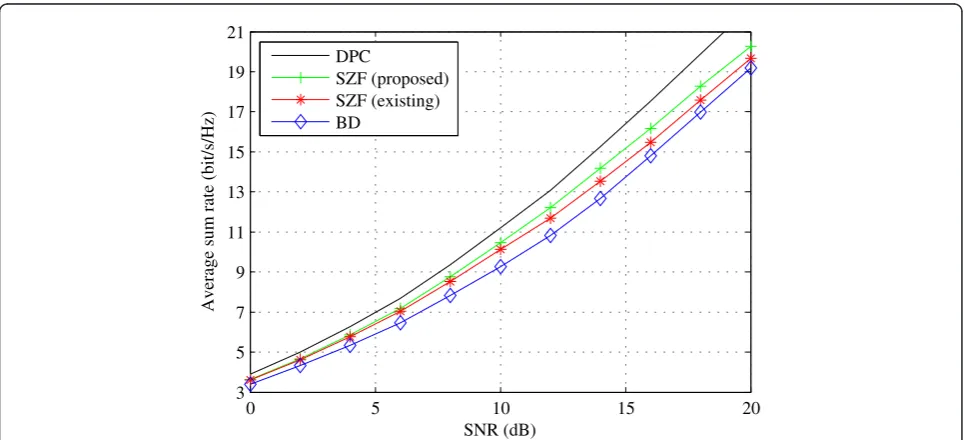
We begin by comparing two simple cases also examined in [5]. The average sum rate is determined through a Monte Carlo simulation. Figure 1 shows the unweighted sum rate (i.e., all users have a weight of 1) for BD and the existing and proposed SZF covariance optimization methods. In this first case,MT= 4,K=K0= 2, andN1=
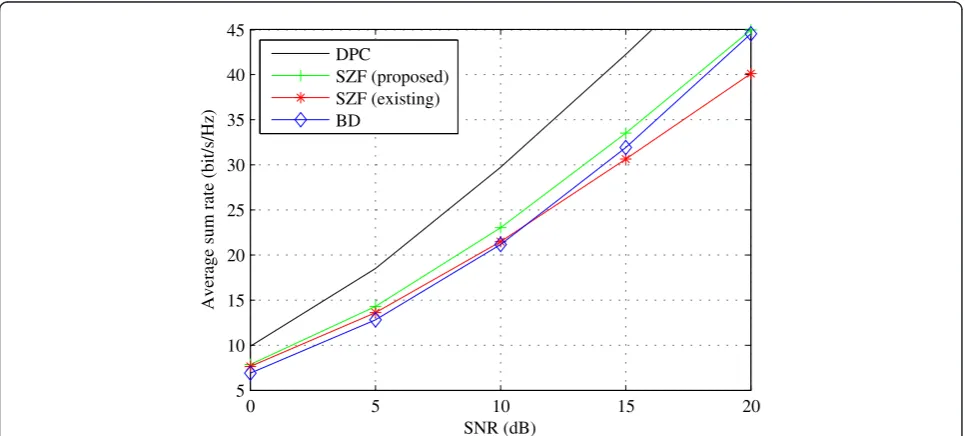
N2 = 2. Figure 2 shows a second unweighted case with
MT= 6,K=K0 = 3, andN1 =N2=N3 = 2. In both of
these cases, strictly speaking scheduling is not necessary, as the number of available usersKequals the number of
simultaneously supportable usersK0. However, we do
still consider all possible subsets of those users, and all possible orders of those users for SZF, to find the ordered selection that gives the maximum sum rate.
It can be seen that at low SNR, there is essentially no difference between our proposed CGP algorithm and the existing SZF covariance optimization method from [5]. However, as the SNR increases, there is an increas-ing gain in the throughput of our proposed algorithm relative to the existing algorithm. In Figure 1, the gains are rather modest; the sum rate is about 0.35 bit/s/Hz larger at 10 dB, about 0.65 bit/s/Hz larger at 14 dB, and about 0.6 bit/s/Hz larger at 20 dB. These represent per-centage gains of about 3.5, 5, and 3%, respectively. How-ever, the gains are much more significant in Figure 2. The throughput increase is about 0.75 bit/s/Hz at 10 dB, and about 2.45 bit/s/Hz at 20 dB. This is a percen-tage gain of over 5 and 9%, respectively. More impor-tantly, we note that the performance of the original method is worse than that of BD above an SNR of 16 dB. This result was not visible in [5], as the graph for
MT= 6,K= 3 in that paper only went up to 16 dB. In
comparison, our proposed CGP algorithm performance is consistently above that of BD. We can thus see that the performance gains increase both with the number of supported users and with the SNR.
In Figure 3, we present a somewhat more complicated scenario more related to our scheduling work in [8,9]. In this case, we consider a larger user pool size ofK=
16 with MT = 8. Each user in the pool has Nk = 2
receive antennas, so at mostK0 = 4 users can be served
simultaneously. We use an exhaustive search for
0 5 10 15 20
3 5 7 9 11 13 15 17 19 21
SNR (dB)
Average sum rate (bit/s/Hz)
DPC
SZF (proposed) SZF (existing) BD
Figure 1Average sum rate versus SNR with proposed and existing SZF covariance optimization methods and BD;MT= 4,K=K0= 2,
scheduling that considers all possible subsets of users and all possible user orders for those subsets. This decouples the effect of the specific scheduling algorithm and allows us to focus on the performance of the SZF covariance optimization methods.
For the existing numerical covariance optimization method [5], the average sum rate for SZF quickly becomes less than that of BD, at just above 10 dB. How-ever, the average sum rate for SZF using our CGP
algorithm remains higher than that of BD at least up to an SNR of 20 dB. The improvement in performance over the existing algorithm is about 0.68 bit/s/Hz (about 5%) at 5 dB, about 1.5 bit/s/Hz (about 7%) at 10 dB, and about 4.85 bit/s/Hz (about 12%) at 20 dB.
We note, though, that the gain in throughput relative to BD starts to decrease at higher SNR. The throughput may likely become less than that of BD at an SNR somewhere larger than 20 dB. This would serve to
0 5 10 15 20
4 6 8 10 12 14 16 18 20 22 24 26 28 30
SNR (dB)
Average sum rate (bit/s/Hz)
DPC
SZF (proposed) SZF (existing) BD
Figure 2Average sum rate versus SNR with proposed and existing SZF covariance optimization methods and BD;MT= 6,K=K0= 3,
N1=N2=N3= 2.
0 5 10 15 20
5 10 15 20 25 30 35 40 45
SNR (dB)
Average sum rate (bit/s/Hz)
DPC
SZF (proposed) SZF (existing) BD
demonstrate that our CGP algorithm, though improved, is still globally suboptimal. However, a worse perfor-mance than BD can be avoided with our algorithm. Rather than the round-robin initialization described in Section 3-C, instead the matricesTk can be initialized based on the BD-optimal covariance matrices. For example, at 20 dB, the difference in the average sum rate between the round-robin initialization and the BD-optimal initialization is about 0.01 bit/s/Hz, which is negligible. Obtaining the BD-optimal matrices will require some additional complexity, due to an additional set of null space basis vector calculations and waterfill-ing. The added complexity may be partially offset, though, as the CGP algorithm might have to run for fewer iterations. Nevertheless, this for the most part should be unnecessary, as that extremely high of an SNR (or SINR, in the case of interference-limited cellu-lar systems) is unlikely to be seen in practice.
We have also noticed that, while the existing SZF cov-ariance method is worse than our proposed CGP method,
the covariance matricesQk,oprovided by the existing
method sometimes provide a better starting point for our CGP than the round-robin initialization. This is particu-larly the case at high SNR. For example, in Figure 2, the
average throughput for our CGP at 20 dB usingQk,ofor
initialization increases from about 29.3 bit/s/Hz to about 29.7 bit/s/Hz. This extra throughput represents on aver-age about an additional 1.4% increase. However, in most cases, this small additional throughput is likely not worth the added computational complexity. To get that extra percent, in effect, two optimizations must be run. The first is on the MAC (followed by transformations and
projections) to findQk,o, then a second with our CGP
algorithm usingQk,ofor initialization.
Furthermore, as K increases, this effect seems to
essentially disappear. If we consider now the scenario from Figure 3, there is virtually no difference in the average sum rate between the two initialization meth-ods. Our simulations only showed an improvement of about 0.03 bit/s/Hz at 20 dB, which is certainly negligi-ble and within the error margin of the simulation. It appears that the larger user pool and scheduling have the effect of mostly removing any initialization-based gains. In part, this is because the larger user pool means that the scheduled users’channels are closer to orthogo-nal. The larger pool also means that the scheduling algorithm has more options to choose a different set of users or encoding order that may negate any effect from the different initialization point.
B. Comparison of weighted sum rate
We now consider a simple scenario for a weighted sum
rate. We examine the case whereMT= 8, K=K0 = 4,
and Nk = 2, ∀k. We set the weight for each user
proportional to that user’s index, i.e., wk = k/
P
k wk. (The sum in the denominator is just for normalization and does not affect the rates the scheduled users receive.) Such a scenario might arise in practice if each user belongs to a different class of service, such as if they are carrying different types of traffic, or they have paid for higher average data rates. Figure 4 shows the WSR performance of our proposed CGP method rela-tive to a WSR using BD. All possible user subsets and orderings are considered. Recall that there exists no prior method for weighted SZF covariance optimization, so we cannot compare our performance with any such algorithm. We observe that the WSR of SZF is larger than that when using BD. The SZF algorithm performs better than BD in this scenario by about 0.5 dB in SNR.
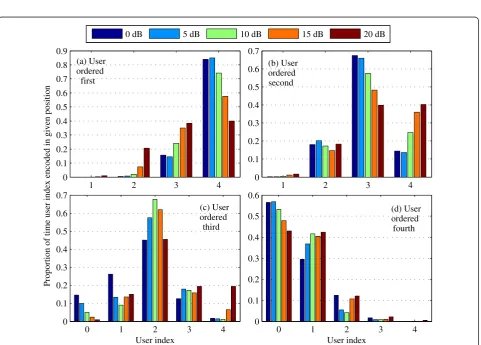
Our simulations for this scenario also indicate only a minor correlation between the best user ordering and the relative sizes of the weights. Figure 5 shows a histo-gram of how often each user index is ordered in a given position for the best obtained WSR. A user index of 0 indicates that no user has been encoded in that position (i.e., transmitting to less than the maximum supportable number of users maximizes the WSR). It can be seen that there is somewhat of a tendency to order the users in the decreasing order of their weights. This trend is strongest at lower SNRs. However, as the SNR increases, this trend diminishes. At 20 dB, for example, it is approximately equally likely that users 3 and 4 (with weights 0.3 and 0.4, respectively) will be ordered first. User 2 is ordered first about half as often as 3 or 4, but also ordered second about half as often as 3 or 4. Thus, there is no hard rule to determine the optimal user ordering for a WSR for SZF. This is in stark contrast to the MAC or when using DPC on the BC; e.g., on the MAC users should always be decoded in the increasing order of their weights.
We also note that even at high SNR, it is often best in terms of maximizing the WSR to not transmit to the maximum possible number of users. In this scenario, with the limited user pool to choose from, it is better to transmit to less than the maximum number about 43-57% of the time. We made a similar observation in [8,9] for unweighted sum rates when scheduling to small user pools. The likelihood of scheduling the maximum possi-ble number of users increases with the size of the user
pool K, due to multiuser diversity and the increased
chance of finding users with orthogonal channels. This fact is unlikely to change using our proposed CGP opti-mization algorithm here.
C. Comparison with other precoding methods
We now compare the performance of our SZF CGP algorithm to some other precoding methods. We start
0 5 10 15 20 1
2 3 4 5 6 7 8 9 10 11
SNR (dB)
Average weighted sum rate (bit/s/Hz)
DPC
SZF (proposed) BD
Figure 4Average weighted sum rate versus SNR with proposed SZF covariance optimization method and with BD;MT= 8,K=K0= 4,
Nk= 2,∀k, wk=k/10.
1 2 3 4
0 0.1 0.2 0.3 0.4 0.5 0.6 0.7 0.8 0.9
(a) User ordered first
1 2 3 4
0 0.1 0.2 0.3 0.4 0.5 0.6 0.7
(b) User ordered second
0 1 2 3 4
0 0.1 0.2 0.3 0.4 0.5 0.6 0.7
User index
(c) User ordered third
Proportion of time user index encoded in given position
0 1 2 3 4
0 0.1 0.2 0.3 0.4 0.5 0.6
User index
(d) User ordered fourth
0 dB 5 dB 10 dB 15 dB 20 dB
Figure 5Proportion of time that user index is ordered in a given position to maximize SZF weighted sum rate, where user weights equal 1/10 of user indices (wk=k/10);MT= 8,K=K0= 4,Nk= 2 for each user. Index“0”indicates no user encoded in that position. (a)
withNk = 4 receive antennas, served by a base station
with MT = 4 transmit antennas. Without considering
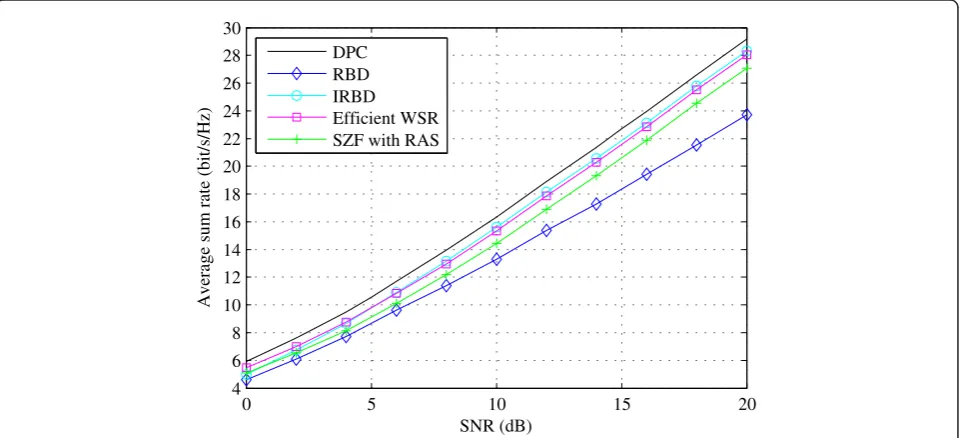
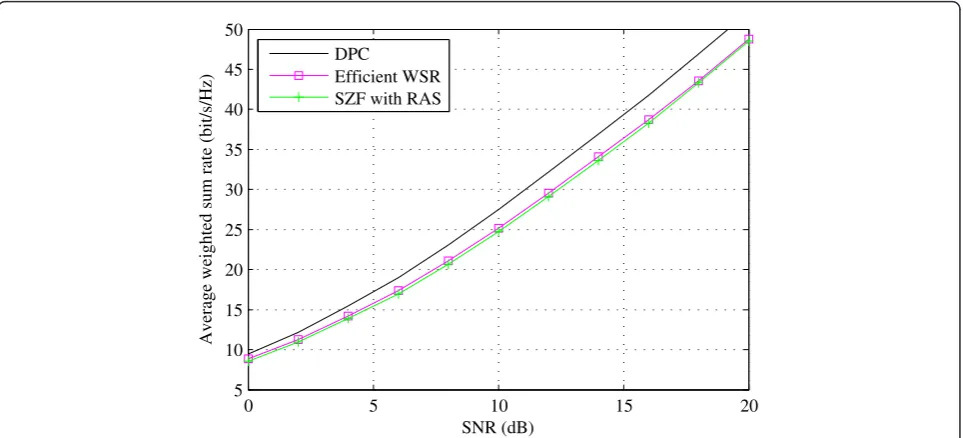
receive processing, the system could only support one user at a time with BD or SZF. However, with receive processing, all three users could potentially be supported at once by transmitting a single stream to each of them (with one single user potentially receiving two streams). We consider RBD and IRBD from [15], the WSR method of [16] (with equal user weights of 1), and our SZF CGP algorithm with RAS and an exhaustive search over all user subsets, orders, and antennas. We also include the performance with DPC as an upper bound. The simulation results are shown in Figure 6.
It can be seen that both IRBD and the efficient WSR methods provide very similar performance, both yielding a throughput very close to that of DPC. IRBD is slightly better at higher SNR by about 0.3 bit/s/Hz. The perfor-mance of our CGP algorithm for SZF with RAS provides a lower throughput by about 1.2 bit/s/Hz, or with a loss of just under 1 dB in SNR. However, we note that RAS, though simple, is also a suboptimal receive-processing method. Were we to consider a better method of gener-ating an effective channel matrix for the users, the per-formance would almost certainly improve. RBD is the worst of the methods examined by a significant margin, as unlike IRBD, it does not iteratively optimize the transmit filters for the users to account for their unused channel subspaces.
Furthermore, we compare the WSR performance in a scenario used in [16], with K= 4 users, each withNk=
3 receive antennas, served by a base station withMT=
4 transmit antennas. Users 1 and 2 have weights ofw1=
w2= 2, while users 3 and 4 have weights ofw3 =w4= 1.
For this scenario, we cannot compare the performance of RBD or IRBD, since those methods do not support the maximization of a weighted sum rate. The simula-tion results are shown in Figure 7.
It can be seen that there is virtually no difference in the WSR achieved by the method of [16] and our SZF CGP algorithm with RAS in this scenario. This is despite the suboptimality of RAS. Both precoding meth-ods achieve a weighted sum rate reasonably close to that of DPC, giving about 92-94% of the WSR of DPC, or with a loss of at most about 1.3 dB in SNR.
It is lastly interesting to note that the covariance matrices generated by the method of [16] satisfy null space constraints for their effective channels. Thus, those same matrices, and the selection of users and their effective channel matrices, can also be used as an initialization point for our SZF CGP algorithm. It is then only necessary to find the best ordering of the selected users for SZF. The CGP algorithm would operate on the effective channel matrices, but would not change the incorporated receive filter matrices, only the transmit covariance matrices. However, such an initialization only results in a negligible increase in the (weighted) sum rate beyond that already provided by the efficient WSR method. For example, in the sce-nario of Figure 6, the sum rate increases by less than 0.1 bit/s/Hz. For the scenario of Figure 7, the increase in WSR is less than 0.2 bit/s/Hz. We have used an exhaustive search to find the best user order in both cases.
0 5 10 15 20
4 6 8 10 12 14 16 18 20 22 24 26 28 30
SNR (dB)
Average sum rate (bit/s/Hz)
DPC RBD IRBD Efficient WSR SZF with RAS
5. Conclusions
We have proposed and analyzed an improved method based on CGP for optimizing the covariance matrices in SZF precoding. This proposed method outperforms the existing method from [5] by up to an additional 12% in sum rate for the cases analyzed. It was also seen that there is an increasing gain in the performance of our method over the prior method both with increasing SNR and with higher numbers of simultaneously
sup-portable users K0. Our proposed method also
consis-tently ensured a throughput larger than that when using BD; the throughput of the existing SZF covariance opti-mization scheme was seen to drop below that of BD at higher SNR andK0.
Our CGP method also supports the maximization of a WSR using SZF. Such a weighted sum rate is important in various applications. To our knowledge, there is no prior method for WSR maximization using SZF in the literature. We demonstrated with a simple case that even when considering a WSR, our proposed method still provided a higher weighted throughput than when using BD.
We further compared SZF employing our CGP cov-ariance optimization method with other precoding methods in the literature that can allocate data to users on a per-data-stream basis. For this comparison, we also incorporated RAS in the simulation of our method to adjust the size of the SZF null spaces avail-able for users to receive data in. It was seen that our CGP algorithm provided comparable, though slightly worse, performance to those existing methods. The
inferior performance was in part due to the suboptim-ality of RAS compared with the receiver filters and/or effective channel formations used in the other meth-ods. We have also found that our CGP algorithm scales with about the same order of complexity as the other methods, though since those methods employ a closed-form power allocation compared with our itera-tive algorithm, the constant on the highest order com-plexity term for the other methods is smaller than for our CGP method.
The improvements on the SZF WSR we have seen herein with our proposed method have been for a rela-tively simple channel model of uncorrelated quasi-static Rayleigh fading and with perfect channel knowledge. Future work should also consider the effects of a more realistic scenario, including imperfect channel knowl-edge and temporal and/or spatial correlation.
Although our proposed method improves on the per-formance of the existing method, our method is still not globally optimal. Since the SZF optimization problem is non-convex, finding the global optimum is very difficult. It is thus hard to say how far away our scheme is from the global optimum for SZF. There are a few global optimization techniques which could find the best over-all solution. For example, a branch-and-bound with reformulation linearization technique such as that described in [33,34] may assist in finding the global optimum. However, such techniques may be extremely complex and not meant for real-time implementation in practical systems. Nonetheless, the global optimization problem remains as possible future work.
0 5 10 15 20
5 10 15 20 25 30 35 40 45 50
SNR (dB)
Average weighted sum rate (bit/s/Hz)
DPC
Efficient WSR SZF with RAS
Endnotes
a
During our simulations, these rare cases seemed to pri-marily occur at low SNR.
b
This is similar and related in concept to the notion of “restarting” the CGP search during non-linear optimiza-tions, as discussed in [31].
c
A similar reduction in complexity may also be possi-ble for SZF by recursively calculating the null space basis vectors. However, we have not investigated this further, since the vectors only need to be calculated once when starting the CGP algorithm, and then used repeatedly during the iterations. Thus, any complexity savings would be minor.
Acknowledgements
The authors would like to thank Dr. Shreeram Sigdel for his comments on the paper. Our work made use of the infrastructure and
computational resources of Academic Information and Communication Technologies (AICT) at the University of Alberta, and of the Western Canada Research Grid (WestGrid). The authors also gratefully acknowledge funding for this research provided by TRLabs, the Rohit Sharma Professorship, and the Natural Sciences and Engineering Research Council (NSERC) of Canada.
Author details 1
Electrical and Computer Engineering, University of Alberta, Edmonton, AB T6G 2V4, Canada2TRLabs, Edmonton, AB T5K 2M5, Canada
Competing interests
The authors declare that they have no competing interests.
Received: 1 November 2010 Accepted: 14 October 2011 Published: 14 October 2011
References
1. MHM Costa, Writing on dirty paper. IEEE Trans Inform Theory29(3), 439–441 (1983). doi:10.1109/TIT.1983.1056659
2. S Vishwanath, N Jindal, A Goldsmith, Duality, achievable rates, and sum-rate capacity of Gaussian MIMO broadcast channels. IEEE Trans Inform Theory
49(10), 2658–2668 (2003). doi:10.1109/TIT.2003.817421
3. T Yoo, A Goldsmith, On the Optimality of Multiantenna Broadcast Scheduling Using Zero-Forcing Beamforming. IEEE J Select Areas Commun.
24(3), 528–541 (2006). doi:10.1109/JSAC.2005.862421
4. QH Spencer, AL Swindlehurst, M Haardt, Zero forcing methods for Downlink spatial multiplexing in multiuser MIMO channels. IEEE Trans Signal Processing52(2), 461–471 (2004). doi:10.1109/TSP.2003.821107
5. AD Dabbagh, DJ Love, Precoding for multiple antenna Gaussian Broadcast channels with successive zero-forcing. IEEE Trans Signal Processing55(7), 3837–3850 (2007). doi:10.1109/TSP.2007.894285
6. N Jindal, W Rhee, S Vishwanath, SA Jafar, A Goldsmith, Sum power iterative water-filling for multi-antenna Gaussian broadcast channels. IEEE Trans Inform Theory51(4), 1570–1580 (2005). doi:10.1109/TIT.2005.844082 7. S Sigdel, RC Elliott, WA Krzymień, M Al-Shalash, Greedy and genetic user
scheduling algorithms for multiuser MIMO systems with block diagonalization, inProc IEEE Veh Technol Conf (VTC’09-Fall), 1–6 (2009). doi:10.1109/VETECF.2009.5378984
8. RC Elliott, S Sigdel, WA Krzymień, M Al-Shalash, ACK Soong, Genetic and greedy user scheduling for multiuser MIMO systems with successive zero-forcing, inProc 5th IEEE Broadband Wireless Access Workshop (2009 IEEE GLOBECOM Workshops), 1–6 (2009). doi:10.1109/GLOCOMW.2009.5360758 9. RC Elliott, S Sigdel, WA Krzymień, Low complexity greedy, genetic, and
hybrid user scheduling algorithms for multiuser MIMO systems with successive zero-forcing. [Submitted in March 2011 for publication inEur. Trans. Telecommun. under review]
10. FP Kelly, AK Maulloo, DKH Tan, Rate control for communication networks: shadow prices, proportional fairness, and stability. J Oper Res Soc.49(3), 237–252 (1998). doi:10.1057/palgrave.jors.2600523
11. A Jalali, R Padovani, R Pankaj, Data throughput of CDMA-HDR a high efficiency-high data rate personal communication wireless system, inProc IEEE Veh Technol Conf (VTC’00-Spring).3, 1854–1858 (2000). doi:10.1109/ VETECS.2000.851593
12. M Codreanu, A Tölli, M Juntti, M Latva-aho, Joint design of Tx-Rx beamformers in MIMO downlink channel. IEEE Trans Signal Processing.
55(9), 4639–4655 (2007). doi:10.1109/ICC.2007.825
13. BC Lim, WA Krzymień, C Schlegel, Efficient sum rate maximization and resource allocation in block-diagonalized space-division multiplexing. IEEE Trans Veh Technol.58, 478–484 (2009). doi:10.1109/TVT.2008.924973 14. F Boccardi, H Huang, A near-optimum technique using linear precoding for
the MIMO broadcast channel, inProc IEEE Int Conf Acoustics, Speech and Signal Process. (ICASSP’07).3, III-17–III-20 (2007). doi:10.1109/
ICASSP.2007.366461
15. V Stankovic, M Haardt, Generalized design of multi-user MIMO precoding matrices. IEEE Trans Wireless Commun.7(3), 953–961 (2008). doi:10.1109/ LCOMM.2008.060709
16. C Guthy, W Utschick, R Hunger, M Joham, Efficient weighted sum rate maximization with linear precoding. IEEE Trans Signal Processing58(4), 2284–2297 (2010). doi:10.1109/TSP.2009.2040016
17. C-B Chae, D Mazzarese, T Inoue, RW Heath Jr, Coordinated beamforming for the multiuser MIMO broadcast channel with limited feedforward. IEEE Trans Signal Processing56(12), 6044–6056 (2008). doi:10.1109/ TSP.2008.929869
18. M Trivellato, F Boccardi, H Huang, On transceiver design and channel quantization for downlink multiuser MIMO systems with limited feedback. IEEE J Select Areas Commun.26(8), 1494–1504 (2008). doi:10.1109/ JSAC.2008.081015
19. IH Kim, DJ Love, On the capacity and design of limited feedback multiuser MIMO uplinks. IEEE Trans Inform Theory54(10), 4712–4724 (2008). doi:10.1109/TIT.2008.928997
20. G Caire, S Shamai (Shitz), On the achievable throughput of a multiantenna Gaussian broadcast channel. IEEE Trans Inform Theory49(7), 1691–1706 (2003). doi:10.1109/TIT.2003.813523
21. R Hunger, M Joham, W Utschick, On the MSE-duality of the broadcast channel and the multiple access channel. IEEE Trans Signal Processing
57(2), 698–713 (2009). doi:10.1109/TSP.2008.2008253
22. M Codreanu, A Tölli, M Juntti, M Latva-aho, Uplink-downlink SINR duality via Lagrange duality, inProc IEEE Wireless Commun Netw Conf (WCNC’08), 1160–1165 (2008). doi:10.1109/WCNC.2008.209
23. R Hunger, M Joham, A general rate duality of the MIMO multiple access channel and the MIMO broadcast channel, inProc IEEE Global Telecommun Conf (GLOBECOM’08), 1–5 (2008). doi:10.1109/GLOCOM.2008.ECP.178 24. H Viswanathan, S Venkatesan, H Huang, Downlink Capacity Evaluation of
Cellular Networks With Known-Interference Cancellation. IEEE J Select Areas Commun.21(5), 802–811 (2003). doi:10.1109/JSAC.2003.810346
25. J Liu, YT Hou, HD Sherali, On the Maximum Weighted Sum-Rate of MIMO Gaussian Broadcast Channels, inProc IEEE Int Commun Conf (ICC’08), 3664–3668 (2008). doi:10.1109/ICC.2008.689
26. R Böhnke, K-D Kammeyer, Weighted Sum Rate Maximization for the MIMO-Downlink Using a Projected Conjugate Gradient Algorithm, inProc Int Workshop on Cross Layer Design (IWCLD’07), 82–85 (2007). doi:10.1109/ IWCLD.2007.4379043
27. S Ye, RS Blum, Optimized Signalling for MIMO Interference Systems with Feedback. IEEE Trans Signal Processing51(11), 2839–2848 (2003). doi:10.1109/TSP.2003.818339
28. R Hunger, DA Schmidt, M Joham, W Utschick, A general covariance-based optimization framework using orthogonal projections, inProc IEEE 9th Workshop on Signal Process. Advances in Wireless Commun. (SPAWC’08), 76–80 (2008). doi:10.1109/SPAWC.2008.4641573
29. RA Horn, CR Johnson,Matrix Analysis(New York, NY: Cambridge University Press, 1985)
30. KB Petersen, MS Pedersen, The Matrix Cookbook, (Technical University of Denmark, 2008) http://www2.imm.dtu.dk/pubdb/p.php?3274. [Version 20081114]
32. GH Golub, CF Van Loan,Matrix Computations, 3rd edn. (Baltimore, MD: The John Hopkins Univ Press, 1996)
33. J Liu, YT Hou, Y Shi, HD Sherali, S Kompella, On the capacity of multiuser MIMO networks with interference. IEEE Trans Wireless Commun.7(2), 488–494 (2008). doi:10.1109/TWC.2008.060732
34. J Liu, YT Hou, HD Sherali, Optimal power allocation for achieving perfect secrecy capacity in MIMO wire-tap channels, inProc 43rd Conf on Inform Sciences and Systems 2009 (CISS’09), 606–611 (2009). doi:10.1109/ CISS.2009.5054790
doi:10.1186/1687-1499-2011-133
Cite this article as:Elliott and Krzymień:Improved and weighted sum rate maximization for successive zero-forcing in multiuser MIMO systems.EURASIP Journal on Wireless Communications
and Networking20112011:133.
Submit your manuscript to a
journal and benefi t from:
7Convenient online submission
7 Rigorous peer review
7Immediate publication on acceptance
7 Open access: articles freely available online
7High visibility within the fi eld
7 Retaining the copyright to your article