R E S E A R C H
Open Access
Rectified fractional order iterative learning
control for linear system with initial state shift
Lei Li
**Correspondence: [email protected] Department of Applied Mathematics, School of Mathematics and Statistics, Xi’an Jiaotong University, Xi’an, P.R. China
Abstract
In this paper, a new rectifying action is combined into different
proportional-α-order-derivative-type iterative learning control algorithms for a class of fractional order linear time-invariant systems. Unlike the existing fractional order iterative learning control techniques, the proposed algorithms allow the initial state value of a fractional order iterative learning control system at each iteration to shift randomly. By introducing the Lebesgue-pnorm and using the method of fractional integration by parts and the generalized Young inequality of convolution integral, the tracking performances with respect to the initial state shift under the proposed algorithms are analyzed. These analyses show that the tracking errors are incurred by such a shift and improved by tuning the rectifying gain. Numerical simulations are performed to demonstrate the effectiveness of the proposed algorithms.
Keywords: initial state shift; rectifying action; fractional order iterative learning control; Lebesgue-pnorm
1 Introduction
Iterative learning control (ILC) has become one of the most active fields in intelligent con-trol methodology since the early study for robotic systems trajectory tracking in [1]. The mechanism of the ILC is that, for a control system which repeatedly operates over a finite time interval, in order to enable the system to achieve perfectly tracking as the iteration number increases successively, the ILC unit utilizes the information from the previous operation to modify an unsatisfactory control input signal. One of the important advan-tages of the ILC is that it requires less prior knowledge to generate iteratively a sequence of control input signals [2–6].
The fractional order iterative learning control (FOILC) is the latest trend in ILC re-search, it not only retains the advantages of the classical ILC, but also offers potential for better performances in a variety of complex physical processes [7–9]. Even since the above literature suggested this good learning performance, there have been made some efforts to synthesize a better FOILC updating law for various types of fractional order systems, and we have witnessed some progress in the following 16 years [10–16]. However, there still remain some restrictions which hinder further applications of the FOILCs in practice. The obvious restriction of FOILCs is about the initial state value of the controlled frac-tional order system. It should be noted that perturbed initial state would degrade the track-ing performance [17–19]. In the existtrack-ing literature, requirements are that the initial state
value should be equal to the desired one at each iteration. However, due to the effect of un-avoidable noise or unidentified friction in practical engineering, the system cannot guar-antee the initial value of state to the desired point. That means the initial state shift exists in the practice system, which motivates us for our study.
Besides, in the existing literature, the tracking error is analyzed in the sense ofλ-norm. However, Lee and Bien [20] reported that the so-called λ-norm may not be a satisfac-tory measure of error in application. This is because of theλ-norm is a time decreas-ing weighted sup-norm, although the error becomes larger and larger near the terminal time, itsλ-norm still decreases. In other words, theλ-norm may conceal the maximum absolute magnitude of the error signal, which would be very detrimental to engineering systems [21]. In order to avoid the above-mentioned phenomenon, for the Lebesgue-p norm it was reported in [22] that it is more suitable for error measure on performance than theλ-norm. Consequently, it is crucial to investigate the error measure with re-spect to Lebesgue-pnorm in FOILCs. Recall that, for a time-varying vector function f : [0,T]→Rm,f(t) = [f1(t), . . . ,fm(t)]T, theλ-norm is defined as [18]
f(·)λ= sup
0≤t≤Te
–λtmax
1≤i≤mf
i(t), λ> 0,
and the Lebesgue-pnorm is defined as
f(·)p=
T
0
max
1≤i≤mf
i(t)pdt
1
p
, 1≤p≤ ∞.
Motivated by the limitation of the initial state value of FOILCs and the mentioned draw-back of theλ-norm, in this paper, we address the initial state shift problem for a more real-istic situation by alleviating the requirement so that the initial statexk(0) at each iteration klies in a neighborhood of a random initial pointx0. The main contribution of this paper
is to consider the initial state shift for a class of fractional order linear systems, and then incorporate a rectifying action into various proportional-α-order-derivative-type ILC al-gorithms to alleviate the tracking error caused by such a shift. The alal-gorithms include the first- and second-order as well as feedback-based proportional-α-order-derivative-type ILCs. It is also important to note that many new theoretic analysis methods are explored to analyze the tracking performance in the sense of the Lebesgue-pnorm.
The remainder of this paper is organized in five parts. In Section 2, the definitions and some properties of fractional order derivatives and some lemmas are revisited. In Sec-tion 3, FOILC schemes with rectifying acSec-tion are presented and the main result on the tracking performance of the proposed schemes are discussed. In Section 4, numerical ex-amples are given to illustrate the performance of the proposed schemes. Finally, a brief conclusion is given in Section 5.
2 Preliminaries
Definition 2.1([23]) For an arbitrary integrable functionf(t) : [0,∞)→R, the left-sided and the right-sided fractional integrals are defined as
0Itαf(t) = 1 (α)
t
0
f(τ)
(t–τ)1–αdτ, t∈[0,∞), tITαf(t) =
1 (α)
T
t
f(τ)
where(·) is the Gamma function and(α) = 0∞xα–1e–xdx;
0Itα,tITαare the left-sided and right-sided fractional integral of orderα(α> 0) on [0,t], [t,T], respectively.
Property 2.1([23]) Ifα> 0, then0Itαtγ = (γ+1)
(γ+1+α)t
γ+α,γ > –1,t> 0.
Definition 2.2([23]) For a given numberα> 0, the left-sided and the right-sidedα-order Caputo-type derivatives of the functionf(t) : [0,∞)→Rare defined as
C
0D
α tf(t) =
1 (n–α)
t
0
f(n)(τ)
(t–τ)α–n+1dτ, n– 1 <α<n,t∈[0,∞),
C
tDαTf(t) = (–1)n 1 (n–α)
T
t
f(n)(τ)
(τ–t)α–n+1dτ, n– 1 <α<n,t∈[0,∞),
where nis an integer and f(n)(t) = ddtnnf(t);C0Dαt, CtD α
T are the left-sided and right-sided Caputo-type derivatives of orderαon [0,t], [t,T], respectively.
For convenience, we denote0Dαt =C0Dαt andtDαT=Ct DαTin the following.
Property 2.2 ([23]) If α> 0,f(t) is continuous on [0,∞), then0Dtα(0Itαf(t)) =f(t) and tDαT(tI
α
Tf(t)) =f(t).
Property 2.3([16]) If 0 <α< 1,f(t) is continuous on [0,∞), then0Dt1–α0Dαtf(t) =f(1)(t), wheref(1)(t) = d
dtf(t).
Definition 2.3([23]) A single-parameter Mittag-Leffler function is defined by
Eα(z) = ∞
k=0
zk
(kα+ 1), α> 0,z∈C n×n.
A two-parameter Mittag-Leffler function is defined by
Eα,β(z) =
∞
k=0
zk
(kα+β), α> 0,β> 0,z∈C n×n.
It is obvious thatEα(z) =Eα,1(z) andE1,1(z) =ez.
Lemma 2.1([16]) The series Eα,β(z) (α> 0,β> 0)is absolutely convergent onz<∞. Lemma 2.2([23], Fractional integration by parts) For continuous functions f(t),g(t)on [0,T],the derivatives0Dαtf(t)and0Dαtg(t)exist at every point t∈[0,T]and are continuous. Then we have
T
0
0Dαtf(t)
g(t) dt=
T
0
f(t)tDαTg(t)
dt.
Lemma 2.3([24], Generalized Young inequality of convolution integral) For Lebesgue in-tegrable scalar functions g,h: [0,T]∈R,the generalized Young inequality of their convolu-tion integral is
where1≤p,q,r≤ ∞satisfy1r=1p+1q– 1.Particularly,when r=p and thus q= 1,then the inequality of convolution integral is
g∗h(·)p≤g(·)1h(·)p.
Lemma 2.4([25]) Let{ak,k= 1, 2, . . .}be a real sequence defined as ak≤ρ1ak–1+ρ2ak–2+· · ·+ρMak–M+dk, k≥M+ 1, with initial conditions
a1=a¯1, a2=a¯2, . . . , aM=a¯M,
where dkis a specified real sequence.Ifρ1,ρ2, . . . ,ρMare nonnegative numbers satisfying
ρ= M
j=1
ρj< 1.
Then:
(1) dk≤ ¯d,k≥M+ 1implies thatak≤max{¯a1,a¯2, . . . ,a¯M}+1–d¯ρ,k≥M+ 1,
(2) limk→∞supdk≤d∞implies thatlimk→∞supak≤1–d∞ρ.
3 Rectifying action-based proportional-
α
- order-derivative-type (PDα-type) ILCsConsider the followingα-order (0 <α< 1) linear time-invariant systems:
⎧ ⎨ ⎩
0Dαtxk(t) =Axk(t) +Buk(t),
yk(t) =Cxk(t), t∈[0,T], (1)
wherekis thekth repetitive operation symbol,0Dαt is the Caputo derivative with lower limit zero of orderα and [0,T] is an operation time interval, xk(t)∈Rn, uk(t)∈Rand yk(t)∈Rare the state vector, control input and output of the system, respectively.A,B andCare matrices with appropriate dimensions and it is assumed thatCBis a full-rank matrix.
The solution of the fractional order system (1) can be written in the following form [26]:
xk(t) = α,1(t)xk(0) +
t
0
α,α(t–τ)Buk(τ) dτ,
where α,β(t) =tβ–1Eα,β(Atα) (α> 0,β> 0) stands for the state transition matrix of
frac-tional order system (1).
In this paper, the initial state value satisfiesxk(0)∈N(x0), whereN(x0) is a neighborhood
ofx0. Specifically, it is assumed that the initial state value satisfies the following condition:
1 k
k
i=1
xi(0) –x0
p
≤βo
1 k
, (2)
It is noted that the proportional-α-order-derivative-type (PDα-type) ILC algorithm (3) which has been investigated in [8],
uk+1(t) =uk(t) +Lpek(t) +Ld0Dαtek(t), (3)
can ensure the system outputyk(t) to track a desired trajectoryyd(t) precisely as the oper-ation numberkgoes to infinity with the initial state being resettable. But it cannot guar-antee the precisely tracking with the initial state shift. Here, Lp andLd are termed the proportional andα-order derivative learning gains, respectively. The expressionek(t) = yd(t) –yk(t) denotes the tracking error of the fractional order system (1).
Then, in order to generate an upgraded control inputuk(t) to stimulate the systemyk(t) to track a desiredyd(t) as precisely as possible, we adopt a rectifying action to compen-sate for the proportional-α-order-derivative-type (PDα-type) ILCs to suppress the track-ing error caused by the initial state shift. The adopted rectifytrack-ing actionδk(t) is an iteration-dependent function sequence as follows:
δk(t) =
⎧ ⎨ ⎩
t1–α
εk , 0≤t≤εk; 0, εk<t≤T,
for engineering applicability, it is assumed that the sequence obeys|δk(t)| ≤1/εαk ≤M, whereMis the tolerance of the system input capability.
To this end, the rectifying first- and second-order as well as the feedback-based proportional-α-order-derivative-type (PDα-type) ILC algorithms are considered and we suppose thatyd(0)=Cx0.
The rectifying action-based first-order proportional-α-order-derivative-type (PDα -type) ILC algorithm is used of the latest historical tracking error and itsα-order derivative, which is given as follows:
uk+1(t) =uk(t) +Lp1ek(t) +Ld10D
α
tek(t) +Kδk(t)
yd(0) –Cx0
. (4)
Here,Lp1andLd1are termed the first-order proportional andα-order derivative learning
gains, respectively.Kis the rectifying gain.
The rectifying action-based second-order proportional-α-order-derivative-type (PDα -type) ILC algorithm is used of control inputs, tracking errors and theirα-order derivatives of the latest two adjacent operations, given by
uk+1(t) =c1
uk(t) +Lp1ek(t) +Ld10D
α tek(t)
+c2
uk–1(t) +Lp2ek–1(t) +Ld20D
α tek–1(t)
+Kδk(t)yd(0) –Cx0
. (5)
Here, Lp2 andLd2 denote the second-order proportional andα-order derivative
learn-ing gains, respectively. The weighlearn-ing coefficients c1 and c2 satisfy 0≤c1,c2 ≤1 and
It is observed that, whenc2is null, the rectifying second-order algorithm (5) degenerates
to the rectifying first-order algorithm (4). Due to the algorithm (4) being a special case of the algorithm (5), we only analyze the tracking performance of the algorithm (5) in the following.
The rectifying action-based proportional-α-order-derivative-type (PDα-type) ILC algo-rithm with feedback information is used of the latest historical and current tracking errors and theirα-order derivatives, given by
uk+1(t) =uk(t) +Lp1ek(t) +Ld10D
Here,Lp0andLd0 denote the feedback learning gains, respectively.
Before showing the effect of the initial state shift, we need the following lemmas.
Lemma 3.1 τD1–t α( α,1(t–τ)) = α,α(t–τ), 0 <α< 1.
Proof It is obtained from Lemma 2.1 that the series α,1(t–τ) is absolutely convergent for
all 0≤t,τ<∞. Then we can differentiate the series α,1(t–τ) with respect to the variable
τ term by term.
It is easy to see from the definition of the right-sided Caputo derivative that
τD1–t α(t–τ)kα= –
Lemma 3.2 ddτ α,1(t–τ) = – α,α(t–τ)A,α> 0.
Proof
d
dτ α,1(t–τ) = d dτ
∞
k=0
Ak(t–τ)kα (kα+ 1) = –
∞
k=1
kαAk(t–τ)kα–1
(kα+ 1)
= –(t–τ)α–1
∞
k=1
Ak–1(t–τ)(k–1)α ((k– 1)α+α)
A= – α,α(t–τ)A.
This completes the proof.
Now, the effect of initial state shift for the rectifying second-order and feedback-based proportional-α-order-derivative-type (PDα-type) ILC algorithms will be shown.
3.1 Rectifying action-based second-orderPDα-type ILC
Theorem 3.1 Suppose that the rectifying action-based second-orderPDα
-type ILC algo-rithm(5)is applied to the fractional order system(1)and that the initial state at each iteration satisfies the condition(2).If the system matrices A,B,C and the orderαtogether with the learning gains Lp1, Ld1,Lp2 and Ld2 satisfy the following conditions ρ1< 1and
ρ2< 1,then we get
lim
k→∞supek+1(·)p≤ 2
1 –ρ¯,
where
ρ1=|1 –CBLd1|+C α,α(·)(BLp1+ABLd1)1,
ρ2=|1 –CBLd2|+C α,α(·)(BLp2+ABLd2)1,
¯
ρ=c1ρ1+c2ρ2,
2=C α,1(·)B(c1Ld1+c2Ld2) –CHk(·)BK(2 –α)1yd(0) –Cx0p.
Proof From the solution of the fractional order system (1) and algorithm (5), the output error fork+ 1 can be written as
ek+1(t) =yd(t) –yk+1(t)
=c1
yd(t) –yk(t)+c2
yd(t) –yk–1(t)
–yk+1(t) –c1yk(t) –c2yk–1(t)
=c1ek(t) +c2ek–1(t) –C
xk+1(t) –c1xk(t) –c2xk–1(t)
=c1ek(t) +c2ek–1(t) –C α,1(t)
xk+1(0) –c1xk(0) –c2xk–1(0)
–C
t
0
α,α(t–τ)B
uk+1(τ) –c1uk(τ) –c2uk–1(τ)
=c1ek(t) +c2ek–1(t) –C α,1(t)
Then, from Lemma 3.1, fractional integration by parts, Property 2.3 and Lemma 3.2, the second last term in the right side of (7) is rearranged as
–C
Substituting (8) into (7) yields
Then we consider the last term in the right side of equality (9). By Lemma 3.1 and fractional integration by parts, we have
C
Then, considering the facts of (12) and (13), the above equality (10) is
Substituting (14), (15) and (16) into (9) yields
ek+1(t) =c1(1 –CBLd1)ek(t) +c2(1 –CBLd2)ek–1(t)
Taking the Lebesgue-pnorm on both sides of (17) and adopting the generalized Young inequality of convolution integral, we get
ek+1(·)p≤c1ρ1ek(·)p+c2ρ2ek–1(·)p
then, from equality (20), we have
lim
k→∞C α,1(·)
xk+1(0) –xk(0)p
≤ lim
k→∞C α,1(·)1xk+1(0) –x0p+xk(0) –x0p
. (21)
Therefore
lim
k→∞C α,1(·)
xk+1(0) –xk(0)p= 0. (22)
In this analogy, we can easily get
lim
k→∞C α,1(·)Bc1Ld1C
xk(0) –x0p= 0,
lim
k→∞C α,1(·)Bc2Ld2C
xk–1(0) –x0p= 0,
lim
k→∞C α,1(·)
xk+1(0) –c1xk(0) –c2xk–1(0)p= 0.
(23)
It is obvious thatρ¯=c1ρ1+c2ρ2under the assumption thatρ1< 1,ρ2< 1, then, from (23)
and Lemma 2.4, inequality (18) leads to
lim
k→∞supek+1(·)p≤ 2
1 –ρ¯. (24)
This completes the proof.
Remark 3.1 Inequality (24) shows that the FOILC scheme (5) is able to drive the tracking error into a bound. It is worth noting that the upper bound is mainly determined by the parameterρ¯and the term2=C α,1(·)B(c1Ld1+c2Ld2) –CHk(·)BK(2 –α)1yd(0) –
Cx0p. Therefore, the upper bound can be confined to a smaller level by two steps. The first
step is to choose the learning gainsLp1,Ld1,Lp2,Ld2, so thatρ¯is sufficiently small. The
sec-ond step is to select the rectifying gainKso thatC α,1(·)B(c1Ld1+c2Ld2)–CHk(·)BK(2–
α)1is sufficiently small.
Remark 3.2 Regarding the selection of the rectifying gainK, it is easy to observe that the definition ofHk(t) is close to the function α,1(t). Thus, we can choose the rectifying
gainK so as to approximate c1Ld1+c2Ld2
(2–α) , with the result thatC α,1(·)B(c1Ld1 +c2Ld2) –
CHk(·)BK(2 –α)1is sufficiently small.
Remark 3.3 In the case whenc2 is null, the proposed rectifying second-order scheme
(5) degenerates to the rectifying first-order scheme (4). Thus, the convergent condition becomesρ1< 1 and the upper bound of output error is1–ρ11, where1=C α,1(·)BLd1–
CHk(·)BK(2 –α)1yd(0) –Cx0p. We can find that the second-order scheme (5) has
more freedom in choosing the learning gains to makeρ¯and2is smaller thanρ1and1,
with the result that the upper bound 2
1–ρ¯ is smaller than 1 1–ρ1.
Remark 3.4 It is obvious that, for the case whenyd(0) =Cx0, the deduction of
3.2 Rectifying action-basedPDα-type ILC with feedback informantion
Theorem 3.2 Suppose that the algorithm(6)is applied to the system(1)and the initial state value at each iteration satisfies the condition(2).If the system matrices A,B,C and the orderαtogether with the learning gains Lp1and Ld1,feedback gains Lp0 and Ld0 satisfy
Proof Consider the formulation of rule (6) and the dynamic system (1), we get thek+ 1th output error
Then, from Lemma 3.1, fractional integration by parts, Property 2.3 and Lemma 3.2, the second last term in the right-hand side of (25) can be rearranged as follows:
–C
t
0
d dτ
α,1(t–τ)
BLd1ek(τ) +Ld0ek+1(τ)
dτ
=CBLd1ek(t) +CBLd0ek+1(t) –C α,1(t)BLd1ek(0) –C α,1(t)BLd0ek+1(0)
+C
t
0
α,α(t–τ)AB
Ld1ek(τ) +Ld0ek+1(τ)
dτ. (26)
Similar to the proof of Theorem 3.1, one can easily get
(1 +CBLd0)ek+1(t)
= (1 –CBLd1)ek(t) –C
t
0
α,α(t–τ)(BLp1+ABLd1)ek(τ) dτ
–C
t
0
α,α(t–τ)(BLp0+ABLd0)ek+1(τ) dτ
–C α,1(t)
xk+1(0) –xk(0)
–C α,1(t)BLd1
Cxk(0) –Cx0
–C α,1(t)BLd0
Cxk+1(0) –Cx0
+C α,1(t)BLd1+C α,1(t)BLd0–CHk(t)BK(2 –α)
yd(0) –Cx0
. (27)
Taking the Lebesgue-pnorm on both sides of (27) and adopting the generalized Young inequality of the convolution integral, we get
|1 +CBLd0|–C α,α(·)(BLp0+ABLd0)1ek+1(·)p
≤|1 –CBLd1|+C α,α(·)(BLp1+ABLd1)1ek(·)p +C α,1(·)
xk+1(0) –xk(0)p+C α,1(·)BLd1
Cxk(0) –Cx0p
+C α,1(·)BLd0
Cxk+1(0) –Cx0p+0, (28)
then inequality (28) can be rewritten as
ek+1(·)p≤ ˜ρek(·)p+ρ0C α,1(·)
xk+1(0) –xk(0)p
+ρ0C α,1(·)BLd1
Cxk(0) –Cx0p
+ρ0C α,1(·)BLd0
Cxk+1(0) –Cx0p+ρ00. (29)
Similar to the derivation of the (23), it is easy to get
lim
k→∞C α,1(·)BLd0C
xk+1(0) –x0p= 0.
From the assumption thatρ˜< 1 and Lemma 2.4, we have
lim
k→∞supek+1(·)p≤ ρ00
1 –ρ˜. (30)
Remark 3.5 Inequality (30) shows that the limit superior of the output error is controlled depends on the magnitudeρ˜and the term0=C α,1(·)B(Ld1+Ld0) –CHk(·)BK(2 –
α)1yd(0) –Cx0p. Hence, the reduction of the output error should be done based on the suitable choice of learning gainsLp1,Ld1,Lp0,Ld0leading toρ˜being sufficiently small.
In addition, it is observed that theHk(t) is approximate to the function α,1(t).
There-fore, the properly selection of the rectifying gainK leads toKbeing closer to the value Ld1+Ld0
(2–α) . It leads to0=C α,1(·)B(Ld1+Ld0) –CHk(·)BK(2 –α)1yd(0) –Cx0p
be-ing small enough and thus the superior limit of the output errors is also sufficiently small concurrently.
Remark 3.6 In the case when Lp0 =Ld0 = 0, the proposed rectifying feedback-based
scheme (6) degenerates to the rectifying first-order scheme (4), with the result that the convergent condition becomesρ1< 1 and the upper bound of the output error is1–ρ11. It is
found that if the learning gainsLp0,Ld0 are chosen in such a way thatρ0< 1 and0<1,
then we have an upper bound ρ00
1–ρ˜ that is smaller than 1 1–ρ1.
4 Numerical simulations
In this simulation, we consider the fractional order linear system with the Caputo deriva-tive (fractional orderα= 4/5),
⎧ ⎨ ⎩
A=–2 –30 1, B=10,
C= [0 1], (31)
the desired trajectory isyd(t) = 12t2(1 –t),t∈[0, 1] and the beginning control input set as u1(t) = 0,t∈[0, 1].
The random initial state are produced as
⎧ ⎨ ⎩
x0= [0 0.1]T,
xk(0) =x0+0.1k2(rand– 0.5),
where ‘rand’ stands for a randomly generated scalar number on the interval (0, 1). The rectifying function is set as
δk(t) =
⎧ ⎨ ⎩
t1/5
0.1–0.05
k2
, 0≤t≤0.1 –0.05k2 ,
0, 0.1 –0.05k2 <t≤1.
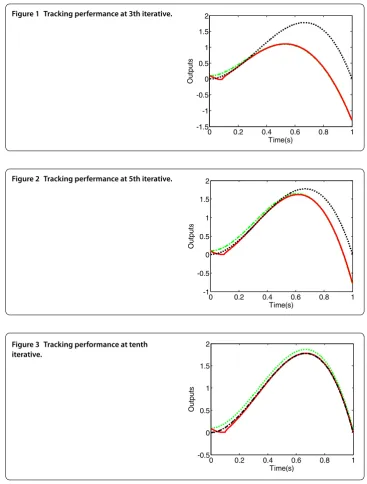
To better illustrate the rectifying action of our proposed PD4/5-type ILC scheme (4) by comparison, first, the PD4/5-type ILC without a rectifying action (3) is used. We set first-order learning gainsLp1= 0.1,Ld1= 1.2, respectively. The rectifying gainK= 1.1. We
cal-culate thatρ1= 0.7491 < 1. Figures 1-3 present the tracking performances of the rectifying
Figure 1 Tracking perfermance at 3th iterative.
Figure 2 Tracking perfermance at 5th iterative.
Figure 3 Tracking performance at tenth iterative.
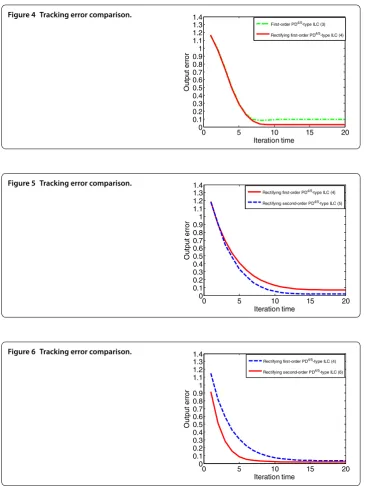
is shown that the rectifying action-based first-order scheme (4) is able to stir the system output to track the desired trajectory much better than the PD4/5-type scheme without a rectifying action (3). Figure 4 shows tracking errors of the above schemes in the sense of the Lebesgue-2 norm. It is shown that the rectifying action can suppress the tracking error incurred by the initial shift effectively.
In order to compare the tracking errors of the rectifying first-order scheme (4) with the rectifying second-order scheme (5), the first- and second-order learning gains are chosen as Lp1 = 0.9, Ld1 = 0.3,Lp2 = 1.7 andLd2 = 0.9, respectively. The rectifying gain
isK= 0.9 and the weighting coefficients are chosen asc1= 0.2,c2= 0.8. It is calculated
that ρ1= 0.8216 < 1,ρ2= 0.1689 < 1 and thus ρ¯=c1ρ1+c2ρ2= 0.2994 < 1. The
Figure 4 Tracking error comparison.
Figure 5 Tracking error comparison.
Figure 6 Tracking error comparison.
in Lebesgue-2 norm is shown in Figure 5. It is shown that asymptotic tracking error of the rectifying second-order scheme (5) is smaller than the rectifying first-order scheme (4).
In terms of the comparison of the tracking errors of the rectifying first-order scheme (4) and the rectifying feedback-based scheme (6), the first-order learning gains are identically chosen asLp1 = 0.9,Ld1 = 0.3, and the feedback gains are chosen asLp0 = 1,Ld0 = 0.3,
respectively. It is computed that ρ1= 0.8704 < 1, ρ0= 0.8216 < 1 and thus ρ˜=ρ0ρ1=
5 Conclusion
In this paper, a new rectifying action was introduced into various PDα-type ILC schemes and the tracking performances against the initial state shift were investigated for a class of fractional order linear systems. The proposed PDα-type ILC schemes were shown to be an extended form of first- and second-order as well as feedback-based PDα-type ILC schemes. The tracking performances were analyzed in the form of the Lebesgue-pnorm by the technique of the generalized Young inequality of the convolution integral and frac-tional integration by parts. These analyses show that effect of the initial state shift can be more effectively controlled in various ways and the tracking performances can be im-proved according to the proper choice of the learning gains.
Competing interests
The author declares that she has no competing interests.
Authors’ contributions
The author contributed solely to the writing of this paper. She read and approved the manuscript.
Publisher’s Note
Springer Nature remains neutral with regard to jurisdictional claims in published maps and institutional affiliations.
Received: 25 July 2017 Accepted: 31 December 2017 References
1. Arimoto, S, Kawamura, S, Miyazaki, F: Bettering operation of robots by learning. J. Robot. Syst.1, 123-140 (1984) 2. Park, KH, Bien, ZA: Generalized iterative learning controller against initial state error. Int. J. Control73, 871-881 (2000) 3. Xu, JX, Tan, Y: Robust optimal design and convergence properties analysis of iterative learning control approaches.
Automatica38, 1867-1880 (2002)
4. Ahn, HS, Chen, YQ, Moore, KL: Iterative learning control: brief survey and categorization. IEEE Trans. Syst. Man Cybern., Part C, Appl. Rev.37, 1099-1121 (2007)
5. Longman, RW: Iterative learning control and repetitive control for engineering practice. Int. J. Control73, 930-954 (2007)
6. Li, XD, Chow, TWS, Ho, JKL: Iterative learning control with initial rectifying action for nonlinear continuous systems. IET Control Theory Appl.3, 49-55 (2009)
7. Chen, YQ, Moore, KL: OnDα-type iterative learning control. In: Decision and Control, Proc. of the 40th IEEE
Conference on. IEEE, Orlando, pp. 4451-4456 (2001)
8. Lazarevic, MP:PDα-type iterative learning control for fractional LTI system. In: Proceedings of International Congress
of Chemical and Process Engineering, 0359 (2004)
9. Li, Y, Chen, YQ, Ahn, HS: Fractional-order iterative learning control for fractional-order linear systems. Asian J. Control
13, 54-63 (2011)
10. Li, Y, Chen, YQ, Ahn, HS: A generalized fractional-order iterative learning control. In: 2011 50th IEEE Conference on Decision and Control and European Control Conference, pp. 5356-5361 (2011)
11. Li, Y, Chen, YQ, Ahn, HS: On thePDα-type iterative learning control for the fractional-order nonlinear systems. In:
Proceedings of the American Control Conference San Francisco, pp. 4320-4325 (2011)
12. Li, Y, Chen, YQ, Ahn, HS: A survey on fractional-order iterative learning control. J. Optim. Theory Appl.156, 127-140 (2013)
13. Lan, YH, Zhou, Y:Dα-Type iterative learning control for fractional-order linear time-delay systems. Asian J. Control15,
669-677 (2013)
14. Lazarevi´c, MP, Tzekis, P: Robust second-orderPDα-type iterative learning control for a class of uncertain fractional
order singular systems. J. Vib. Control22(8), 2004-2018 (2014)
15. Liu, S, Wang, JR: Fractional order iterative learning control with randomly varying trial lengths. J. Franklin Inst.354, 967-992 (2017)
16. Li, L: Lebesgue-pnorm convergence of fractional-order PID-type iterative learning control for linear systems. Asian J. Control (2017). https://doi.org/10.1002/asjc.1561
17. Sun, M, Wang, D: Brief iterative learning control with initial rectifying action. Automatica38, 1177-1182 (2002) 18. Bien, ZZ, Ruan, X: Pulse compensation for PD-type iterative learning control against initial state shift. Int. J. Syst. Sci.
43, 2172-2184 (2012)
19. Park, KH: An average operator-based PD-type iterative learning control for variable initial state error. IEEE Trans. Autom. Control50, 865-869 (2005)
20. Lee, HS, Bien, Z: A note on convergence property of iterative learning controller with respect to sup norm. Automatica33, 1591-1593 (1997)
21. Park, KH, Bien, Z: A study on iterative learning control with adjustment of learning interval for monotone convergence in the sense of sup-norm. Asian J. Control4, 111-118 (2002)
23. Samko, SG, Kilbas, AA, Marichev, O: Fractional Integrals and Derivatives. Gordon & Breach, Yverdon (1993) 24. Pinsky, MA: Introduction to Fourier Analysis and Wavelets. Brooks/Cole, Pacific Grove (2002)
25. Park, KH, Bien, Z: Intervalized iterative learning control for monotonic convergence in the sense of sup-norm. Int. J. Control78, 1218-1227 (2005)