R E S E A R C H
Open Access
Multi-quasi-synchronization of coupled
fractional-order neural networks with delays
via pinning impulsive control
Xiaoli Ruan
1and Ailong Wu
1,2,3**Correspondence: [email protected] 1College of Mathematics and Statistics, Hubei Normal University, Huangshi, 435002, China 2Institute for Information and System Science, Xi’an Jiaotong University, Xi’an, 710049, China Full list of author information is available at the end of the article
Abstract
We investigate the collective dynamics of multi-quasi-synchronization of coupled fractional-order neural networks with delays. Using the pinning impulsive strategy, we design a novel controller to pin the coupled networks to realize the
multi-quasi-synchronization. Based on the comparison principle and mathematical analysis, we derive some novel criteria of the multi-quasi-synchronization. Moreover, we discuss the effects of coupling strength and pinning control matrix. Finally, some simulation examples show the effectiveness of the presented results.
Keywords: multi-quasi-synchronization; fractional-order neural networks; comparison principle; pinning impulsive control
1 Introduction
In the past decades, fractional-order derivatives have been drawn wide attention. Com-pared with integer-order derivatives, it has a greater advantage in describing the memory and hereditary properties of manifold materials and processes (see [–]). It is better to de-scribe many practical problems by fractional-order dynamical systems instead of integer-order ones. They are extensively applicable in many areas, such as physics, polymer rhe-ology, electrical circuits, and engineering optimization [–]. In addition, the fractional differentiation has been extended to the computational methods involved to traveling-wave transformation [–]. Yang et al. [] investigated exact traveling-traveling-wave solutions of nondifferentiable type with the generalized functions for the local fractional Korteweg-de Vries equation. Exact traveling-wave solution for the local fractional Boussinesq equation in fractal domain was studied in []. Yang et al. [] analyzed the exact travelling-wave solutions for a family of the local fractional two-dimensional Burgers-type equation.
As one of the mostly important collective behaviors of complex dynamic networks, syn-chronization has been extensively investigated [–]. The problem of synsyn-chronization of coupled fractional-order neural networks has been well studied. For instance, Ma and Zhang [] showed that two coupled networks can achieve a hybrid synchronization by some proper conditions. Later, Ma and Zhang [] studied a new hybrid projective syn-chronization of two different-size coupled fractional-order complex networks. A general-ized chaos synchronization of coupled Mathieu-Van der Pol and coupled Duffing-Van der Pol systems using fractional-order derivatives was shown in []. In addition, a general
chaotic synchronization of fractional chaotic maps based on the stability condition was investigated in [].
Various control techniques have been adopted to realize synchronization, such as pin-ning control [], feedback control [], impulsive control [, ], adaptive control [], intermittent control [], and so on. Jajarmi et al. [] analyzed a hyperchaotic financial system and its adaptive control and synchronization. However, in real world, it is too costly and impractical if all the nodes are controlled []. To reduce the control cost, it is ex-tremely effective to control a complex network by controlling a certain time and pinning part of nodes [, ]. Recently, some researchers have combined the advantages of pin-ning control and impulsive control to investigate the synchronization problem. He et al. [] studied the synchronization of coupled delayed dynamical networks via pinning im-pulsive control. However, the above results are only concerned with complete synchro-nization. Due to the external disturbances and internal uncertainty in networks, it is more realistic that for nodes in each subgroup, only a quasi-synchronization can be achieved. Just a few papers investigated multi-quasi-synchronization of coupled networks [, ]. To the best of our knowledge, there are no results on the multi-quasi-synchronization of coupled fractional-order networks with delays via pinning impulsive control. Motivated by the above discussion, in this paper, we investigate the multi-quasi-synchronization of coupled fractional-order neural networks with delays via pinning impulsive control.
The main contributions of this paper can be summarized as follows:
• Developing the multisynchronization concept. Multi-quasi-synchronization generalizes quasi-synchronization, cluster synchronization, etc.
• A new pinning impulsive control method is proposed to deal with the multi-quasi-synchronization problem.
• By using the comparison principle and inequality techniques some weaker conservative conditions are derived.
This paper is composed as follows. Section describes some preliminaries. The main results are presented in Section . Some examples are given in Section . Finally, some conclusions are drawn in Section .
2 Preliminaries and model description
2.1 Preliminaries about fractional-order calculus
In the following, we introduce some notation, definitions, and lemmas.
The superscriptT represents the transpose.Rndenotes then-dimensional Euclidean space,Rn×nis the set ofn×nreal matrices,R+andZ+ denote the sets of nonnegative real numbers and positive integers, respectively, andDindicates the number of elements of a finite setD. For any vectord∈Rn and constantσ
> ,M(d,σ) ={x| x–d<
σ}denotes the set of vectors whose distance todis less thanσ.A⊗Brepresents the
Kronecker product of matricesAandB. We write that a real symmetric matrixY> (Y< ,Y≥,Y≤) ifY is positive definite (negative definite, positive semidefinite, negative semidefinite). For any matrixA,λmax(A) denotes its maximum eigenvalue, and its spectral
Definition .([]) (·) denotes the gamma function. The Caputo fractional derivative of orderα> for a functionf(t) is defined as
cDα t,tf(t) =
(n–α) t
t
(t–s)(n–α–)f(n)(s)ds, t≥t,
wheren– <α<n,n∈Z+.
Definition .([]) The fractional integral of orderα> for a functionf(t) is defined as
Itα,tf(t) =
(α) t
t
(t–s)α–f(s)ds, t≥t.
Definition .([]) The one-parameter Mittag-Leffler function is defined as
Eα(z) = +∞
k= zk
(kα+ ),
whereα> ,z∈C.
The two-parameter Mittag-Leffler function is defined as
Eα,β(z) = +∞
k= zk
(kα+β),
whereα> ,β> , andz∈C.
2.2 Model
In this paper, we consider a delayed fractional-order neural network consisting ofN iden-tical nodes, which is described by
cDα
t,txi(t) = –Axi(t) +Bfi
xi(t)+Cfi
xi(t–τ)+ N
j=
Gijxj(t) +J, ()
wherei= , , . . . ,N,N≥ is the number of subnetworks;xi(t) = (xi(t),xi(t), . . . ,xin(t))T denotes the state vector of theith neural network;A=diag{a,a, . . . ,an}> represents the self-feedback term of thejth neuron;B= (bpq)n×nandC= (cpq)n×n(p,q= , , . . . ,n) are the connection weight matrix and the delayed connection matrix, respectively;fi(xi(t)) = (fi(xi(t)),fi(xi(t)), . . . ,fin(xin(t)))T wherefij(·),j= , , . . . ,n, is the activation function;τ represents the transmission delay;G= (Gij)N×N is the coupling matrix defined as follows: if there is a link from nodejto nodei, thenGij> and otherwiseGij= , the diagonal elements are defined asGii=
N
j=,j=i–Gij; =diag{γ,γ, . . . ,γn}, which represents the inner coupling matrix; andJ= (J, . . . ,JN) is a constant external input vector.
Assumption . The activation functionsfi(·) are continuous, and there existi> such that, for any vectorsx,y, we have
Suppose that if for any initial state x(s) = (xT
(s),xT(s), . . . ,xTN(s))T with xi(s) ∈ C([–τ, ],R),i= , , . . . ,N, there exists a solutions(t) for any initial condition, then all trajectories of network nodes fulfilllimt→∞xi(t) –s(t)= ,i= , , . . . ,N. Then the net-work is said to be completely synchronized []. Moreover, if for error boundσ> , there existsT> such that, for any initial state and allt>T,xi(t) –s(t)<σ,i= , , . . . ,N, then the network is said to be uniformly quasi-synchronized [].
Next, we give the definition of the multi-quasi-synchronization.
Definition . ([]) For any complex network with N nodes, let {C,C, . . . ,Cm} be a disjoint division of the node set, that is, mk=Ck = {, , . . . ,N}, Ck = {lk,lk, . . .}, and Ck ∩Cu =∅ for k =u. Suppose that there exists a series of reference solution
{s(t),s(t), . . . ,sm(t)}. The network is said to be multi-quasi-synchronized with an error vectorδ={δ,δ, . . . ,δm}T> under any initial condition if for any small enough constant
ε> , there existsT such that, for allt>T, the nodes satisfyxi(t)∈M(sk(t),σk) fori∈Ck, andM(sk(t),σk)=M(su(t),σ¯u) foru=k.
Remark . Ck=ζkmeans that the groupCkhasζknodes andζk= .
Remark . From Definition . we know that, for all of the nodes in groupCk,sk(t) is the shared reference trajectory.
The desired trajectory ofs˜i(t) satisfies
cDα
t,ts˜i(t) = –As˜i(t) +Bf˜i
s˜i(t)
+Cf˜i(s˜i(t–τ) +J, ()
wheres˜i(t) =sk(t) ifxi(t)∈M(sk(t),σk),i= , , . . . ,N,k= , , . . . ,m. Define the error signal ei(t) =xi(t) –s˜i(t),i= , , . . . ,N. The pinning impulsive controller is designed as
ui(t) = ⎧ ⎨ ⎩
+∞
h=θkei(t)δ(t–th), i∈Dk(th),Dk(th) =ωk,
, i∈/Dk(th), ()
whereth(h= , , , . . .) are the impulsive instants satisfying =t<t<· · ·<th<· · ·, and
limth→+∞th= +∞,δ(·) is the Dirac impulsive function, andθkis the impulsive gain. Let m
k=Dk(th) ={D(th),D(th), . . . ,Dm(th)} ⊂ {C,C, . . . ,Cm} ⊂ {, , . . . ,N}denote the set of pinned nodes att=th, and let <ωk≤ζk,k= , , . . . ,m, that is,Dk(th) is the subset of Ckindicating the set of pinned nodes att=th. We also assume that the error vectorei≥ ei≥ · · · ≥ein. Under the proposed impulsive control (), the error system is formulated as
⎧ ⎪ ⎪ ⎨ ⎪ ⎪ ⎩
cDα
t,tei(t) = –Aei(t) +Bf¯i(ei(t)) +C¯fi(ei(t–τ)) + N
j=Gijej(t), t=th, ei(t+
h) =ei(t–h) +θkei(th–), i∈ m
k=Dk(th), ei(th+) =ei(t–h), i∈/
m
k=Dk(th),
()
where h= , , , . . . ,f¯i(ei(t)) =fi(xi(t)) –f˜i(s˜i(t)), f¯i(ei(t–τ)) =fi(xi(t–τ)) –f˜i(s˜i(t–τ)), ei(t+h) =limt→t+
hei(t), andxi(t –
The initial condition of () is defined as
ei(s) =φi(s), τ≤s≤, ()
whereφi(s)∈C([–τ, ],Rn),i= , , . . . ,N.
Definition . The pinning ratio att=this defined as
i∈Dk(th)e T
i(th–)ei(t–h)
i∈Cke T
i(t–h)ei(th–) =ηk.
The pinning ratio is time-varying and related to impulsive instants. We will determine a lower bound ofηk.
Lemma .([]) Let x(t)∈Rnbe a continuous and differentiable vector function.Then, for any time instant t≥t,we have the relationship
cDα t,t
xT(t)Px(t)≤xT(t)PcDαt,tx(t)
for allα∈(, ),where P∈Rn×nis a constant symmetric positive definite matrix.
Lemma .([]) For any vector x,y∈Rn,scalar> ,and positive definite matrix Q∈
Rn×n,we have the inequality
xTy≤xTQx+–yTQ–y.
Lemma .([]) Consider the system with time delay ⎧
⎨ ⎩
cDα
t,tV(t)≤–aV(t) +bV(t–τ), t> ,
V(s) =(s), s∈[–τ, ],
and the linear fractional-order differential system with time delay
⎧ ⎨ ⎩
cDα
t,tW(t) = –aW(t) +bW(t–τ), t> ,
W(s) =(s), s∈[–τ, ],
where V(t),W(t)∈Rare continuous everywhere except at some points tk,k= , , . . . ,and
(s)≥is continuous in[–τ, ].If a> and b> ,then V(t)≤W(t),t∈[, +∞).
Inspired by Lemma ., we can get the following lemma.
Lemma . Consider the system with time delay ⎧
⎨ ⎩
cDα
t,tVk(t)≤–KVk(t) +KVk(t–τ), t> ,i∈Ck,
and the linear fractional-order differential system with time delay
Next, suppose thatVk(t)≤Wk(t),k= , , . . . ,m, fort∈[(l– )τ,lτ]. Then we have
System () can be represented as
Wk(t) = () can be represented as follows:
Vk(s) =k(s), s∈[t–τ,t),
Wk(s) =k(s), s∈[t–τ,t).
So, dividing the [, +∞) into a union of all subsets [,t)∪[t,t)∪ · · · ∪[tk–,tk)∪ · · ·, we prove thatVk(t)≤Wk(t) fort∈[, +∞).
3 Main results
In this section, we derive several synchronization criteria. Under the impulsive control, in any groupCk∈ {C,C, . . . ,Cm}, fori∈Ck, the network () is able to synchronize with sk(t)∈ {s(t), . . . ,sm(t)}and realize multi-quasi-synchronization.
By Assumption . and Lemma ., for positive definite diagonal matricesand,
From () it follows that
i∈Ck
eTi(t) j∈Ck
Gijej(t) = eT(t)(G⊗P)e(t)≤. ()
Substituting ()-() into () yields
From ()-() we have
To distinguish the imaginary unitifrom the subnetwork subscripti, we denote the imag-inary unitibyˆi.
By Corollary in [] the characteristic equation of () can be written as
If () has no purely imaginary roots andK>√K, then the zero solution of equation () is Lyapunov globally asymptotically stable, that is,limt→+∞Wk(t) = withk(s) > . Suppose that equation () has a purely imaginary rootϑk=wkˆi=|wk|(cosπ +ˆisinπ), wherewkis a real number; ifwk> , thenϑk=wkˆi=|wk|(cosπ +ˆisinπ), and ifwk≤, thenϑk=wkˆi=|wk|(cosπ –ˆisinπ).
Submittingϑk=wkˆiinto equation (), we obtain
(wkˆi)α+K–Ke–τwkˆi= ,
that is,
(wkˆi)α+K=Ke–τwkˆi,
|wk|α+ Kcos
απ
|wk|α+K=|Kcoswkτ+Ksinwkτ|
≤(K).
()
Let
gk(xk) =xk+ Kkcos
απ
xk+ (K)– (Kcoswkτ)– (Ksinwkτ).
Then
gk()≥K– (K).
SinceK>
√
K,K> , andK> , we haveK– (K)> andgk() > . We know thatgk is a polynomial of order , so thatg(|wk|α) > , a contradiction with (). This means that equation () has no solution, which implies that equation () has no purely imaginary roots, that is,limt→+∞Vk(t) = .
So for anyε> , there existsTksuch that, for allt>Tk,
Vk(t) <λmax(P)ε, t>Tk, ()
that is,
λmin(P)ei(t)
<λmax(P)ε, ()
and thus
ei(t)≤
λmax(P)ε λmin(P)
<σk, ()
where i∈Ck andmk=Tk={T,T, . . . ,TN}. Therefore, for any arbitrary small positive valueσk> , there exitsT=max{T,T, . . . ,TN}such that, for allt>T, <xi(t) –sk(t) ≤
Remark . Theorem . presents a general result on multi-quasi-synchronization of fractional-order neural networks, and meanwhile the error level is clearly expressed. In the existing literature, very few results have been reported about multi-quasi-synchronization of coupled fractional-order neural networks. Unlike analytical methods in [–], model () is a fractional-order system rather than the integer-order model in [–]. Obviously, the method of analysis and design for integral-order systems cannot be referred to deal with fractional-order systems.
Remark . Multi-quasi-synchronization contains quasi-synchronization. Whenm= , there is just one shared reference trajectory, and then the multi-quasi-synchronization degenerates to the quasi-synchronization.
Remark . Jajarmi et al. [] solved synchronization problems via adaptive control scheme. In this paper, to achieve pinning impulsive control, we just need to control par-tial nodes into a bounded neighborhood of its shared reference trajectory. It is possible to pin nodes with low-norm value if the control cost is reachable. In real world, nodes with smaller error norm are preferred for a fast convergence. Then it is better to choose nodes with smaller error norm.
4 Illustrative examples
In this section, we provide three numerical examples to substantiate the theoretical re-sults.
Example . Consider the delayed fractional-order neural network
cDα and two neurons in every subnetwork. In more detail, the parameters of the subnetwork are given as
Letm= andτ= . Two shared reference trajectories can be expressed as
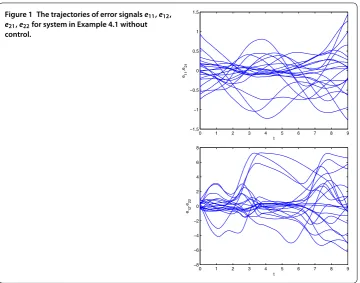
Figure 1 The trajectories of error signalse11,e12, e21,e22for system in Example 4.1 without
control.
the MATLAB LMI Toolbox we get the matrices
P=
. . . .
, =
. . . .
,
=
. . . .
,
and λmin(P)
λmax(P)= .,σ= .,σ= .. Set the pinning ratioηk= .. Then system () can
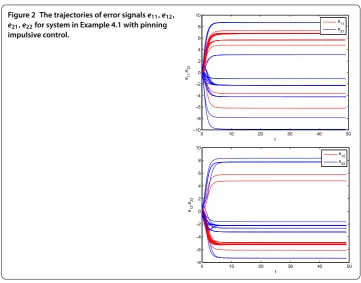
achieve multi-quasi-synchronization. Figure shows the disorganized behavior of error signalsei(t) andei(t) (i= , ) without controller. From Figure we can obtain that the whole network exhibits irregular behavior without controller. Based on Figure , it shows that the error signalsei(t) andei(t) (i= , ) always converge to different shared reference trajectories with the proposed pinning impulsive control.
Example . Consider the delayed fractional-order neural network
cDα
t,txi(t) = –Axi(t) +Bfi
xi(t)
+Cfi
xi(t–τ)
+
N
j=
Gijxj(t) +J, ()
subnet-Figure 2 The trajectories of error signalse11,e12, e21,e22for system in Example 4.1 with pinning
impulsive control.
work are given as
A=
, B=
– –.
, C=
.
, J=
,
G= ⎛ ⎜ ⎜ ⎜ ⎝
–.
–. .
.
– –
⎞ ⎟ ⎟ ⎟ ⎠.
Letm= andτ= . Four shared reference trajectories can be expressed as
cDα
t,tsk(t) = –Ask(t) +Bfk
sk(t)+Cfk
sk(t– )+J, k= , , , ,
wherefk(sk(t)) =tanh(sk(t)),k= , , , ,α= .,
A=
, B=
– –.
, C=
.
, J=
.
We choose=diag(, ), impulsive gainθ= –.,θ= –.,ρ= .,ρ= .,η= .,
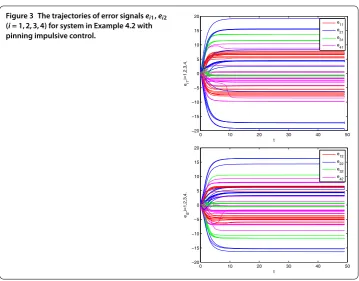
Figure 3 The trajectories of error signalsei1,ei2
(i= 1, 2, 3, 4) for system in Example 4.2 with pinning impulsive control.
MATLAB LMI Toolbox we get the matrices
P=
. . . .
, =
. . . .
,
=
. . . .
,
and λmin(P)
λmax(P)= .,σ= .,σ= .. Set the pinning ratioηk= .. Then system () can
achieve multi-quasi-synchronization, and Figure depicts the simulation results with random initial values.
Example . Consider Chua’s circuit system as an isolated node of the dynamical net-work, which is described as follows:
Dαt,tx(t) =ς
x(t) –x(t) –gx(t),
Dαt,tx(t) =x(t) –x(t) +x(t),
Dα
t,tx(t) = –ςx(t),
()
withα= .,t≥t, the nonlinear function
gx(t)
=
(–)x(t) + –x(t) – ,
Figure 4 Chaotic behaviors of Chua’s system. Theorem . we get the matrices
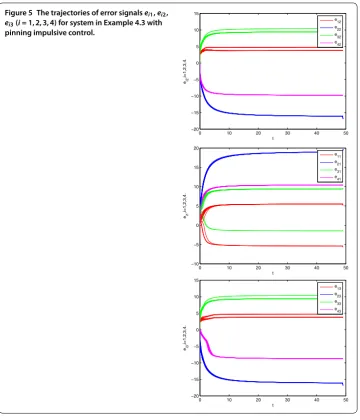
P= , , , ) with random initial values are depicted in Figure . Based on our analysis, the effectiveness of the designed pinning impulsive control is verified.
5 Concluding remarks
Figure 5 The trajectories of error signalsei1,ei2, ei3(i= 1, 2, 3, 4) for system in Example 4.3 with
pinning impulsive control.
Acknowledgements
The work is supported by the Natural Science Foundation of China under Grants 61640309 and 61773152.
Competing interests
The authors declare that they have no competing interests.
Authors’ contributions
Both authors contributed equally to the writing of this paper. Both authors read and approved the final manuscript.
Author details
1College of Mathematics and Statistics, Hubei Normal University, Huangshi, 435002, China.2Institute for Information and System Science, Xi’an Jiaotong University, Xi’an, 710049, China.3School of Automation, Huazhong University of Science and Technology, Wuhan, 430074, China.
Publisher’s Note
Springer Nature remains neutral with regard to jurisdictional claims in published maps and institutional affiliations.
Received: 1 June 2017 Accepted: 31 October 2017
References
1. Li, CP, Zhang, FR: A survey on the stability of fractional differential equations. Eur. Phys. J. Spec. Top.193, 27-47 (2011) 2. Koeller, R: Applications of fractional calculus to the theory of viscoelasticity. J. Appl. Mech.51, 299-307 (1984) 3. Gallegos, JA, Duarte, MA: On the Lyapunov theory for fractional order systems. Appl. Math. Comput.287-288,
4. Wu, AL, Zeng, ZG: Boundedness, Mittag-Leffler stability and asymptoticalω-periodicity of fractional-order fuzzy neural networks. Neural Netw.74, 73-84 (2016)
5. Wu, AL, Zeng, ZG, Song, XG: Global Mittag-Leffler stabilization of fractional-order bidirectional associative memory neural networks. Neurocomputing177, 489-496 (2016)
6. Yang, XJ: Fractional derivatives of constant and variable orders applied to anomalous relaxation models in heat-transfer problems. Therm. Sci.21, 1161-1171 (2017)
7. Yang, XJ, Srivastava, HM, Tenreiro Machado, JA: A new fractional derivative without singular kernel: application to the modelling of the steady heat flow. Therm. Sci.20, 753-756 (2016)
8. Yang, XJ, Tenreiro Machado, JA: A new fractional operator of variable order: application in the description of anomalous diffusion. Phys. A, Stat. Mech. Appl.481, 276-283 (2017)
9. Yang, XJ, Tenreiro Machado, JA, Baleanu, D, Cattani, C: On exact traveling-wave solutions for local fractional Korteweg-de Vries equation. Chaos26, 084312 (2016)
10. Yang, XJ, Tenreiro Machado, JA, Baleanu, D: Exact traveling-wave solution for local fractional Boussinesq equation in fractal domain. Fractals25, 1740006 (2017)
11. Yang, XJ, Gao, F, Srivastava, HM: Exact travelling wave solutions for the local fractional two-dimensional Burgers-type equations. Appl. Math. Comput.73, 203-210 (2017)
12. Lu, JG: Chaotic dynamics and synchronization of fractional-order Arneodo’s systems. Chaos Solitons Fractals26, 1125-1133 (2005)
13. Yuan, LG, Yang, QG, Wu, RC, Sun, J, Ma, TD: Parameter identification and synchronization of fractional-order chaotic systems. Commun. Nonlinear Sci. Numer. Simul.17, 305-316 (2012)
14. Wang, GS, Xiao, JW, Wang, YW, Yi, JW: Adaptive pinning cluster synchronization of fractional-order complex dynamical networks. Appl. Math. Comput.231, 347-356 (2014)
15. Yang, LX, Jiang, J: Adaptive synchronization of drive-response fractional-order complex dynamical networks with uncertain parameters. Commun. Nonlinear Sci. Numer. Simul.19, 1496-1506 (2014)
16. Wong, WK, Li, HJ, Leung, SYS: Robust synchronization of fractional-order complex dynamical networks with parametric uncertainties. Commun. Nonlinear Sci. Numer. Simul.17, 4877-4890 (2012)
17. Bao, HB, Cao, JD: Projective synchronization of fractional-order memristor-based neural networks. Neural Netw.63, 1-9 (2015)
18. Velmurugan, G, Rakkiyappan, R: Hybrid projective synchronization of fractional-order memristor-based neural networks with time delays. Nonlinear Dyn.83, 419-432 (2016)
19. Chen, JJ, Zeng, ZG, Jiang, P: Global Mittag-Leffler stability and synchronization of memristor-based fractional-order neural networks. Neural Netw.51, 1-8 (2014)
20. Ma, TD, Zhang, J: Hybrid synchronization of coupled fractional-order complex networks. Neurocomputing157, 166-172 (2015)
21. Ma, TD, Zhang, J: Adaptive hybrid projective synchronization of two coupled fractional-order complex networks with different sizes. Neurocomputing164, 182-189 (2015)
22. Giresse, TA, Crepin, KT: Chaos generalized synchronization of coupled Mathieu-Van der Pol and coupled Duffing-Van der Pol systems using fractional order derivative. Chaos Solitons Fractals98, 88-100 (2017)
23. Wu, GC, Baleanu, D, Xie, HP, Chen, FL: Chaos synchronization of fractional chaotic maps based on the stability condition. Phys. A, Stat. Mech. Appl.460, 374-383 (2016)
24. Yu, WW, Chen, GR, Lu, JH: On pinning synchronization of complex dynamical networks. Automatica45, 429-435 (2009)
25. Wang, T, Ding, YS, Zhang, LK, Hao, R: Adaptive feedback synchronisation of complex dynamical network with discrete-time communications and delayed nodes. Int. J. Syst. Sci.47, 2563-2571 (2016)
26. Zhang, W, Tang, Y, Miao, Q, Fang, JA: Synchronization of stochastic dynamical networks under impulsive control with time delays. IEEE Trans. Neural Netw. Learn. Syst.25, 1758-1768 (2013)
27. Sun, W, Hu, TS, Chen, Z: Impulsive synchronization of a general nonlinear coupled complex network. Commun. Nonlinear Sci. Numer. Simul.16, 4501-4507 (2011)
28. Jajarmi, A, Hajipour, M, Baleanu, D: New aspects of the adaptive synchronization and hyperchaos suppression of a financial model. Chaos Solitons Fractals99, 285-296 (2017)
29. Xia, WG, Cao, JD: Pinning synchronization of delayed dynamical networks via periodically intermittent control. Chaos
19, 013120 (2009)
30. Liu, B, Liu, XZ, Chen, GR, Wang, HY: Robust impulsive synchronization of uncertain dynamical networks. IEEE Trans. Circuits Syst. I, Regul. Pap.52, 1431-1441 (2005)
31. Song, Q, Cao, JD: On pinning synchronization of directed and undirected complex dynamical networks. IEEE Trans. Circuits Syst. I, Regul. Pap.57, 672-680 (2010)
32. Wang, YL, Cao, JD, Hu, JQ: Stochastic synchronization of coupled delayed neural networks with switching topologies via single pinning impulsive control. Neural Comput. Appl.26, 1739-1749 (2015)
33. He, WL, Qian, F, Cao, JD: Pinning-controlled synchronization of delayed neural networks with distributed-delay coupling via impulsive control. Neural Netw.85, 1-9 (2017)
34. He, DX, Ling, G, Guan, ZH, Hu, B, Liao, RQ: Multisynchronization of coupled heterogeneous genetic oscillator networks via partial impulsive control. IEEE Trans. Neural Netw. Learn. Syst. (2016). doi:10.1109/TNNLS.2016.2619907 35. Wang, YW, Yang, W, Xiao, JW, Zeng, ZG: Impulsive multisynchronization of coupled multistable neural networks with
time-varying delay. IEEE Trans. Neural Netw. Learn. Syst.28, 1560-1571 (2017)
36. Liu, XY, Chen, TP, Cao, JD, Lu, WL: Dissipativity and quasi-synchronization for neural networks with discontinuous activations and parameter mismatches. Neural Netw.24, 1013-1021 (2011)
37. Duarte-Mermoud, M, Aguila-Camacho, N, Gallegos, JA, Castro-Linares, R: Using general quadratic Lyapunov functions to prove Lyapunov uniform stability for fractional order systems. Commun. Nonlinear Sci. Numer. Simul.22, 650-659 (2015)
38. Pan, LJ, Cao, JD: Stochastic quasi-synchronization for delayed dynamical networks via intermittent control. Commun. Nonlinear Sci. Numer. Simul.17, 1332-1343 (2012)
40. Morgado, ML, Ford, NJ, Lima, PM: Analysis and numerical methods for fractional differential equations with delay. J. Comput. Appl. Math.252, 159-168 (2013)
41. Miller, KS, Samko, SG: Completely monotonic functions. Integral Transforms Spec. Funct.12, 389-402 (2001) 42. Deng, WH, Li, CP, Lü, JH: Stability analysis of linear fractional differential system with multiple time delays. Nonlinear
Dyn.48, 409-416 (2007)
43. Lin, D, Wang, XY, Nian, FZ, Zhang, YL: Dynamic fuzzy neural networks modeling and adaptive backstepping tracking control of uncertain chaotic systems. Neurocomputing73, 2873-2881 (2010)