R E S E A R C H
Open Access
Maximizing throughput gain via resource
allocation in D2D communications
Yucheng Wu
*, Xiaocui Liu, Xiang He, Qiong Yu and Weiyang Xu
Abstract
By reusing the cellular resources, device-to-device (D2D) communication is becoming a very promising technology that greatly enhances the spectrum utilization. To harvest the benefits that D2D communications can offer, efficient resource allocation strategy is required to guarantee the demands of quality of service (QoS) for both cellular and D2D users. This paper proposes a resource allocation scheme to alleviate the performance deterioration of the D2D communications with spectrum reuse. To maximize the overall throughput gain, the proposed scheme is designed to reduce the rate loss of cellular users and improve the rate of D2D users simultaneously in a two-step manner. Specifically, it first calculates the reuse gain for a single D2D pair and a single cellular user. Next, a maximum weight bipartite matching is further proposed to select the reuse pair to maximize the overall network throughput gain. Numerical results demonstrate that the proposed resource allocation scheme can significantly improve the network throughput performance with average user rate guaranteed.
Keywords: D2D communications, Resource allocation, Optimization, Throughput gain, Rate loss
1 Introduction
The device-to-device (D2D) communication is widely rec-ognized as one of the key technology of the evolving 5G architecture due to the enhanced cellular spectrum utilization [1]. In the D2D scenario, the terminals can communicate directly with one another without the base station (BS) [2]. Therefore, the end-to-end latency can be decreased; also, the area spectral efficiency can be improved simultaneously. Therefore, the network is able to accommodate more users [3, 4].
It is worth noting that D2D communications rely on the reuse of cellular spectrum resources; thus, the per-formance of the cellular system will be subject to the interference incurred as a consequence. This key problem has drawn much attention from both the academic and industrial fields. In references, methods in [4–7] suggest to mitigate the interference that cellular users suffer by either limiting the D2D user’s transmit power or choosing the D2D users only in the interference limited area. How-ever, the two approaches mentioned above cannot fully enhance the performance of D2D communications.
*Correspondence: [email protected]
Chongqing University, No. 174 Shazhengjie, Shapingba, 400044 Chongqing, China
On the other hand, the motivation of works in [8–11] is to increase the network throughput. In [8], a single D2D pair is allowed to reuse a single cellular user’s resource to maximize the throughput, and also, a closed expres-sion of the optimal power allocation is given. In [9], the overall network throughput is maximized via reusing cel-lular users’ resources by multiple D2D pairs where the optimization problem is solved in three steps, i.e., access control, power allocation, and channel allocation. More-over, the literatures in [10, 11] still consider the resource allocation with the goal of maximizing the throughput while taking the throughput gain as the access control cri-terion. Unfortunately, none of the above studies take into account the performance loss of cellular users incurred by the spectrum reuse. In [12], the authors propose a power management scheme for an adjacent femtocell net-work and formulate a non-convex optimization problem in order to maximize the capacity under the power con-straints. The joint uplink subchannel and power allocation in cognitive small cells using cooperative Nash bargaining game theory is investigated in [13], where the cross-tier interference mitigation, minimum outage probability requirement, imperfect CSI, and fairness are considered. In [14], the authors propose an iterative gradient user association and power allocation approach with attention
to load balance constraints, energy harvesting by base stations, user quality of service requirements, energy effi-ciency, and cross-tier interference limits. More recently, [15] analyzes the characteristics of optimal joint power control and D2D matching strategy, based on which an energy-efficient iterative algorithm for D2D communica-tions is proposed.
For the future evolution of cellular networks, it is sig-nificant to maintain the quality of service (QoS) of both cellular and D2D users. To this end, this paper pro-poses a resource allocation algorithm that maximizes the throughput gain while reducing the rate loss of cellular users and increasing the rate of D2D users at the same time. It is demonstrated that the resource allocation in this study can be modeled as a mixed integer nonlinear programming (MINLP) optimization problem. To find a tractable solution, the original MINLP problem is decom-posed into two subproblems, where the optimal solutions are able to be obtained in a two-step manner without reducing the feasible domain. Specifically, the first sub-problem is to obtain the maximum reuse gain when a single D2D user shares a single cellular user’s resource and determine whether it is eligible for spectrum reuse. More-over, the second subproblem determines the best pairing between D2D and cellular users and finally maximizes the overall network throughput.
The rest of the paper is organized as follows. The system model and optimization problem description are given in Section 2. Then, in Section 3, the optimal resource allocation algorithm is investigated in detail. Numerical results are presented in Section 4 to demonstrate the performance of the proposed scheme. Finally, Section 5 concludes this paper.
2 System model and problem formulation
2.1 Introduction of system model
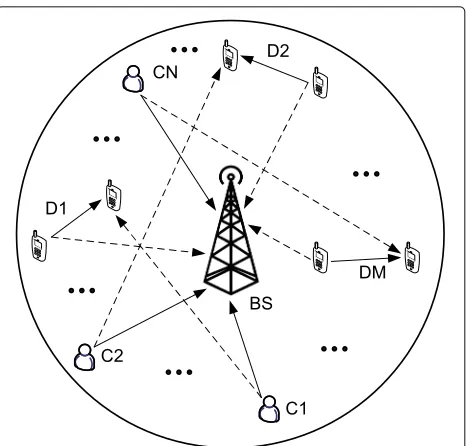
In the time-division duplexing (TDD) system, D2D users are enabled to access time-frequency resources of the cel-lular networks. As a result, both D2D and celcel-lular users are subject to the interference from each other. As shown in Fig. 1, the receiver of the D2D pair D1 is interfered by the cellular user C1, also the BS is interfered by the transmitter of the D2D pair D1. Assuming that there are Navailable orthogonal frequency resource blocks (RB) in one cell, the BS allocates resources to N cellular users with the traditional algorithm. Here, we assume that the number of cellular users is fixed, the case of varying num-bers can refer to [16]. Let C = {1, 2,. . .,N} andD =
{1, 2,. . .,M} denote the sets of cellular and D2D users, respectively. Furthermore, only one or zero D2D user is allowed to share the same RB with the cellular usern. At last, it is assumed that the BS has the knowledge of the channel state information (CSI), which is kept constant during the coherence time and changes independently in
Fig. 1The illustration of interference between D2D and cellular users
different coherence intervals. Furthermore, the proposed algorithm is based on a generic model in device-to-device and cellular hybrid network, which could be applicable in content sharing, gaming, connectivity extension, traffic offloading, disaster relief, etc.
The path loss model in [5] is employed in this paper. Specifically, the path gain between the terminals iandj (j=1 represents the BS) can be modeled as:
gi,j=Kβi,jηi,jd−αi,j (1)
whereK is a system-related constant,βi,j represents the
multipath gain of the link between terminals i and j, which follows the exponential distribution,ηi,jdenotes the
shadow gain of the link, following the logarithm distribu-tion,di,jindicates the distance of the link, andαindicates
the path-loss factor. In order to distinguish different links in the system model, we adopt the following rules:Dm,m
indicates the D2D linkmand the corresponding path gain isgDm,m,Cn,Bindicates the link between cellular usernand BS and the path gain is represented asgCn,B,Dm,Bdenotes the link between the transmitter of D2D pair m to BS and the path gain is gDm,B, andCn,m represents the link between the cellular usernto the receiver of the D2D pair m, whereas the path gain is expressed asgCn,m.
2.2 Problem formulation
users under the same transmit power constraint. Thus, the rate loss can be formulated as follows:
Rloss=log2
1+ξnno−log2(1+ξn) (2)
whereRlossis the rate loss andξnandξnnoindicate the
sig-nal to interference plus noise ratio (SINR) in the case of sharing resources with D2D users or not, respectively. The expressions ofξnandξnnoare
wherePnandPmindicate the transmission power of the
cellular user and D2D user, separately, andσ2denotes the variance of the additive white Gaussian noise (AWGN).
On the other hand, this study is proposed to mini-mize the rate loss of the cellular user while ensuring the rate gain of the D2D user. Specifically, when the same time-frequency resource is shared between a single D2D pair and a cellular user, the optimization problem can be described as:
whereξmis the SINR obtained after D2D users access the
cellular resources, i.e.,ξm=PmgDm,m/ Equation (4) is a multi-objective optimization prob-lem, where the non-inferior solution can be solved by the weighted evaluation function method [17]. We use the linear weighting method to construct the evaluation function, which can be written as follows:
max
The target function should be converted to the maxi-mum problem without any bias. Letλ1=1 andλ2= −1,
so that the evaluation function is obtained. The purpose of this function is to maximize the system throughput gain. A suboptimal solution could be given to the original opti-mization problem, thus maximizing the system through-put gain can take into account the performance gain of the D2D user and at the same time the performance loss of the cellular user.
Considering that there are multiple D2D links and cellular links in the cell, the optimization problem is described as:
where DA(DA∈D) represents the subset of D2D users
that can access the cellular network,ξn,minandξm,minare
the minimum SINR requirements for cellular users and D2D users, respectively, andξm represents the SINR of
D2D user with interference caused by the cellular user. According to the expressions ofξnandξnno, it can be found
that when ξn ≥ ξn,min, it is straightforward to derive
thatξnno ≥ ξn,min, thus the constraint ofξnno ≥ ξn,min is
not required.xm,nis the identifier of the resource reuse,
i.e., when the D2D userm reuses the resource of cellu-lar user n, then xm,n = 1; otherwise, xm,n = 0. Since
the optimization problem contains the integer variable xm,n and the objective function is nonlinear, it can be
considered as a mixed integer nonlinear programming problem which is difficult to directly obtain the optimal solution. Alternatively, this optimization procedure can be decomposed into two subproblems without changing the feasible domain of the original problem. After that, the corresponding optimal solutions to subproblems are obtained separately. The next section will present the detailed description of solving the optimization problem.
3 Resource allocation for throughput gain
maximization
3.1 Joint access control and power allocation based on multiplexing gain
In order to maximize the overall network throughput gain, it is necessary to determine the subset of D2D users that can access the cellular network. First, we need to estab-lish the optimal objective function for maximizing the throughput gain with constraints of QoS and transmit power. Then, by solving the objective function, the opti-mal power allocation and maximum throughput gain can be obtained. Finally, we can obtain the subset of D2D users DAby judging whether the maximum throughput gain is
greater than zero.
From the analysis of the Section 2, it can be found that Eq. (6) becomes the optimization problem of maximiz-ing the throughput gain when λ1 = 1 and λ2 = −1.
Accordingly, the expression is
P∗n,P∗m=arg max
Pn,Pm
log2(1+ξn)+log2(1+ξm) −log21+ξnno
s.t. ξn=
PngCn,B
σ2+PmgD
m,B
≥ξn,min;
ξm=
PmgDm,m
σ2+PngC
n,m
≥ξm,min;
0≤Pn≤Pn,max;
0≤Pm≤Pm,max
(7)
whereξnno=PngCn,B/σ2.
Obviously, Eq. (7) is a nonlinear programming problem. When the equal sign of QoS constraint is established, it can be converted to a function ofPnandPmseparately, i.e.,
lc: Pn=
gDm,Bξn,min
gCn,B
Pm+ ξn,minσ
2
gCn,B
ld: Pn=
gDm,m
gCn,mξm,min
Pm− σ
2
gCn,m
(8)
wherelcrepresents the QoS constraint of cellular usern
and the power allocation which is larger thanlccan
sat-isfy cellular usern’s QoS. Whereasldrepresents the QoS
constraint of D2D userm, the power allocation which is smaller than ld can satisfy D2D user m’s QoS. In
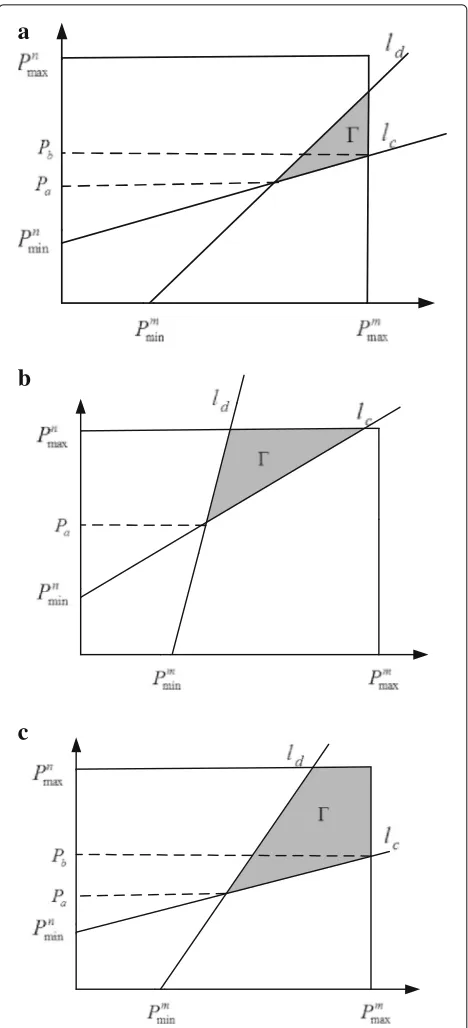
addi-tion, the power allocation should follow the maximum and minimum power constraint of cellular users and D2D users. Thus, the area enclosed by straight lines lc and
ld and power constraints is the feasible solution range
of power allocation, which is the represented by and shown as the shadow area in Fig. 2. In order to solve the nonlinear programming problem of Eq. (7), we need to apply the following conclusion:
a
b
c
Fig. 2The admissible area according to power and QoS constraints. aThe scope of solution 1.bThe scope of solution 2.cThe scope of solution 3
Theorem 1The power distribution exists at the lower boundary of the feasible solution domain, i.e., a straight line PngCn,B =ξn,min
σ2+P
mgDm,B
Proof First, the following relationship can be obtained
Evidently,g(Pn,Pm)is a monotonically decreasing
func-tion of Pn, and it can be proved that h(Pn,Pm) is a
monotonically increasing function with respect to Pn.
Consequently, we can get ξn < ξnno for any Pm = 0.
For anyκ >1, we can have the following:
tonically decreasing function with respect to Pn; thus,
the optimal solution corresponds to the lower bound-ary of constraint domain , i.e., PngCn,B = ξn,minσ2+
PmgDm,B. Therefore, the power distribution exists at the
lower boundary of the feasible solution domain, and the theorem is proved.
When applying Theorem 1 to the original optimization problem, the feasible solution range can be reduced to the lower boundary. As a result, the original optimization problem can be transformed into the following equation:
Pm=
PngCn,B−ξn,minσ2
ξn,mingDm,B
(13)
It is necessary to point out that a constant after con-version of log21+ξm,min
, which does not affect the solution to the problem, can be safely removed in Eq. (13). Consequently, the original optimization problem is con-verted to
Thus, we have the partial derivative as
∂Q
One of the poles is negative and another is positive; thus, in the range Pn ∈ (0,Pn,max], the positive
solu-tionPncould be its extreme points. Due to the fact that 4AC(AE−DB)(2BC)2, then the extreme value of the solution can be simplified as:
Pn = 2BC+
1. When the feasible solution domain is shown as in the case of Fig. 2a, c, the range ofPnis fromPatoPb,
wherePb=ξn,min
σ2+g
Dm,B
/gCn,B
2. When the feasible solution domain is shown as in the case of Fig. 2b, the range ofPnis fromPatoPn,max
The optimal power distribution pair Pn∗,P∗m can be obtained by Eq. (19). It is necessary to confirm whether the multiplexed pair can bring the throughput gain. Hence,
Pn∗,Pm∗will be substituted into Eq. (21) to obtainRGainn,m , which can be defined as
RGainn,m =log2(1+ξn)+log2(1+ξm)−log2
1+ξnno (20)
IfRGainn,m is greater than zero, it comes to the conclusion that D2D usermis actually qualified to reuse the resource of cellular usern.
Algorithm 1 The maximize throughput gain (MTG) resource allocation algorithm
1: Parameter initialization;
2: C= {C1,C2,. . .,CN},D= {D1,D2,. . .,DN};
3: CM : reuse candidate sets for D2D userm; 4: for alln∈C,m∈Ddo
5: CalculateP∗n,P∗mandRGainn,m P∗n,P∗m; 6: ifRGainn,m Pn∗,Pm∗≥0then
7: n∈Cm; 8: end if
9: end for
10: getX=xm,n=1
form Kuhn-Munkres algorithm.
3.2 Multiple D2D users multiplex multiple cellular users’ resources
After the D2D user setDAand the maximum reuse gain
of the reused pair are obtained, it is next required to determine the best pairing which could maximize the overall network throughput gain when multiple D2D users reuse multiple cellular users’ resources. The problem can be modeled as the weighted matching of the weighted
bipartite graphs in graph theory, which is represented as follows:
max
xm,n
n∈Cm,m∈D
xn,mRGainn,m
s.t.
m
xm,n≤1, xm,n∈ {0, 1}, ∀m∈DA
n
xm,n≤1, xm,n∈ {0, 1}, ∀n∈C
(21)
whereDrepresents the set of accessible D2D users and Cm denotes the set of cellular users of which the resources that D2D usersmcan reuse. Figure 3 shows the bipartite graph optimal matching problem of Eq. (21) withDA = {1, 2,. . .,M1}, whereM1is the maximum number of D2D
pairs allowed to access the cellular spectrum. When the D2D usermreuses the resource of the cellular usern, it establishes a connection and takesRGainn,m as a weight.
The solution to the above problem can be solved by the Kuhn-Munkres algorithm in [18], and the details is beyond the scope of this paper. The pseudo-code of the maximizing throughput gain via resource allocation is summarized in Algorithm 1.
4 Simulation results and discussion
In order to verify the performance of our scheme, the resource allocation algorithm based on maximized sys-tem throughput proposed in [5] is used as the benchmark. The throughput gain in [5] is defined as the maximum throughput increase after the introduction of D2D, shown as follows:
RGainn,m =Rmaxn,m −Rmaxn (22)
The throughput gain in this paper is defined as the gain obtained by the power distribution according to the maximum throughput gain:
RGainn,m =Rmax,gainn,m (23)
In order to compare with fairness, the rate gain in the reference [5] is modified. The formula is as follows:
RGainn,m =Rmaxn,m −Rnon (24)
whereRnon is the rate of cellular user without interference under the same transmit power constraint.
Table 1Simulation parameters
Parameters Value
Cell radio/m 500
Uplink bandwidth/MHz 20
RBs 100
The maximum CU TX power/dBm 24
The maximum D2D TX power /dBm 24
D2D user SINR/dB U[0, 25]
Cellular user SINR/dB U[0, 25]
Number of cellular users 100
Number of D2D users 10, 20,. . ., 100% of CUE
Multi-path fadingλ/dB 1
Shadowingμ=0 /dB 8
Pathloss exponentα 4
Noise power spectrum density/(dBm/Hz) −174
The simulation parameters are listed in Table 1. Specifically, the multipath fading follows the exponen-tial distribution, and shadow fading follows a log-normal distribution.
Figure 4 shows the relationship between the system throughput gain and the number of D2D pairs for a cell multiplexing with the D2D users. MT denotes the maxi-mum throughput algorithm in [5]. It can be observed that the throughput gain increases when the number of D2D users increases. As the maximum transmission distance of D2D users increases, the throughput gain reduces con-sequently. However, the gain of the proposed algorithm is significantly higher than that of the MT scheme, since the purpose of optimization taken in this paper is to maximize the throughput gain.
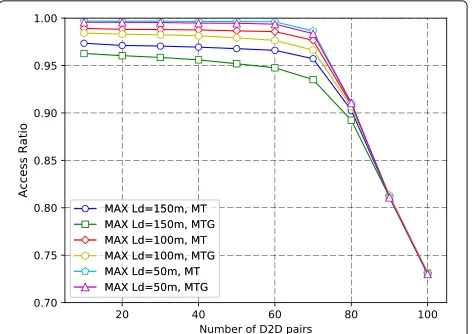
Figure 5 demonstrates the access rate, which is defined as the ratio of the actual number of access D2D users to
Fig. 4The relationship between the access rate and the number of D2D pairs
Fig. 5The relationship between the total rate loss of cellular users and the number of D2D pairs
the total number of D2D users. The access rates of the two algorithms decrease as the D2D user increases and decreases with the maximum transmission distance of the D2D user. In this paper, the access rate based on the mul-tiplexing gain access control is slightly lower than the MT algorithm. The reason behind is that the access control is based on the throughput gain, and to ensure the access quality, D2D users who can not bring the gain are not permitted to access the cellular spectrum.
The total rate loss of cellular users is shown in Fig. 6. The rate loss of both the proposed algorithm and MT is independent of the distance of D2D users and the number of D2D pairs. The total rate loss of cellular users of the proposed allocation is much lower than that of the MT algorithm, which reduces the cost of resource sharing for cellular users.
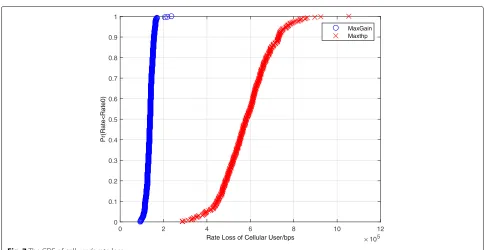
Fig. 7The CDF of cell user’s rate loss
Figure 7 shows the cumulative distribution function (CDF) of average rate loss of cellular users. It is observed from this figure that the rate loss of cellular users using this method is much lower than that of MT algorithm and the loss range is more concentrated. Therefore, one can come to the conclusion that the proposed algorithm reduces not only the rate loss, but also the cost of spec-trum sharing between the cellular and D2D users.
5 Conclusions
Aiming at reducing the performance loss caused by the reuse of cellular resources by D2D users, the concept of reuse cost is proposed to measure the rate loss of cellular users. The multi-objective optimization problem of maximizing the gain of D2D users and minimizing the loss of cellular users is established and transformed into single-objective optimization problem by construct-ing evaluation function. To solve the optimization prob-lem, the original mixed integer nonlinear programming is divided into two sub-problems, and the optimal solution of the sub-problems is given. The simulation results show that the proposed algorithm can maximize the through-put gain and reduce the rate of loss of cellular users while ensuring the QoS requirements of D2D users and cellular users.
In this study, we assume the perfect CSI while the chan-nel estimation can never be error-free in practice [19]. Therefore, the effect of imperfect CSI on the resource allo-cation scheme in D2D communiallo-cation is worth studying further.
Acknowledgements
The authors would like to thank Dr. Wenjiang Feng of Chongqing University for providing the code of the maximum throughput algorithm.
Funding
This work is supported by the National Natural Science Foundation of China under Grant 61201177.
Availability of data and materials
All data are fully available without restriction.
Authors’ contributions
YW, XL, and XH contributed to the main idea, designed and implemented the algorithms, and drafted the manuscript. QY and WX designed and carried out the simulation and analyzed the results. All authors read and approved the final manuscript.
Competing interests
The authors declare that they have no competing interests.
Publisher’s Note
Springer Nature remains neutral with regard to jurisdictional claims in published maps and institutional affiliations.
Received: 21 September 2017 Accepted: 14 December 2017
References
1. K Doppler, M Rinne, C Wijting, CB Ribeiro, K Hugl, Device-to-device communication as an underlay to TE-advanced networks. IEEE Commun. Mag.47(12), 42–49 (2009)
2. A Asadi, Q Wand, V Mancuso, A survey on device-to-device communication in cellular networks [J]. IEEE Commun. Surv. Tutorials.
16(4), 1801–1819 (2013)
3. J Liu, N Kato, J Ma, et al., Device-to-device communication in
LTE-advanced networks: a survey [J]. IEEE Commun. Surv. Tutorials.17(4), 1–1 (2014)
5. H Mim, J Lee, S Park, et al., Capacity enhancement using an interference limited area for device-to-device uplink underlaying cellular networks [J]. IEEE Trans. Wirel. Commun.10(12), 3995–4000 (2011)
6. X Wang, XJ Li, HY Shwe, et al., inInternational Conference on Information, Communications and Signal Processing. Interference-aware resource allocation for device-to-device communications in cellular networks [C] (IEEE, Singapore, 2015), pp. 1–5
7. J Sun, T Zhang, X Liang, et al., inIEEE Vehicular Technology Conference (VTC Spring). Uplink resource allocation in interference limited area for D2D-based underlaying cellular networks [C], (Nanjing, 2016), pp. 1–6 8. CH Yu, O Tirkkonen, K Doppler, et al., inIEEE International Conference on
Communications. Power optimization of device-to-device communication underlaying cellular communication [C], (Dresden, 2009), pp. 1–5 9. D Feng, L Lu, Y Wu,et al, Device-to-device communications underlaying
cellular networks [J]. IEEE Trans. Commun.61(8), 3541–3551 (2013) 10. B Wang, L Chen, X Chen, et al., inIEEE Vehicular Technology Conference
(VTC Spring). Resource allocation optimization for device communication underlaying cellular network [C], (Budapest, 2011), pp. 1–6
11. X Chen, RQ Hu, Y Qian, inIEEE Global Communications Conference. Distributed resource and power allocation for device-to-device communications underlaying cellular network [C], (Austin, 2014), pp. 4947–4952
12. G Zhang, X Ao, P Yang, M Li, Power management in adjacent cognitive femtocells with distance-dependent interference in full coverage area [J]. EURASIP J. Wirel. Commun. Netw.1(1) (2016)
13. H Zhang, C Jiang, NC Beaulieu, X Chu, X Wang, TQ Quek, Resource allocation for cognitive small cell networks: a cooperative bargaining game theoretic approach [J]. IEEE Trans. Wirel. Commun.14(6), 3481–3493 (2015)
14. H Zhang, S Huang, C Jiang, K Long, VCM Leung, HV Poor, Energy efficient user association and power allocation in millimeter-wave-based ultra dense networks with energy harvesting base stations [J]. IEEE J. Sel. Areas Commun.35(9), 1936–1947 (2017)
15. J Hu, W Heng, X Li, J Wu, Energy-efficient resource reuse scheme for D2D communications underlaying cellular networks [J]. IEEE Commun. Lett.
21(9), 2097–2100 (2017)
16. G Zhang, H Liu, K Lin, F Ke, Terminal density dependent resource management in cognitive heterogeneous networks [J]. Wirel. Netw.23(5), 1509–1522 (2017)
17. K Deb,Multi-objective optimization using evolutionary algorithms [M]. (Wiley, Chichester, 2001), pp. 49–81
18. D West,Introduction to graph theory [M]. (Prentice-Hall, Inc., Englewood Cliffs, 2001), pp. 125–13
19. H Zhang, Y Nie, J Cheng, VC Leung, A Nallanathan, Sensing time optimization and power control for energy efficient cognitive small cell with imperfect hybrid spectrum sensing [J]. IEEE Trans. Wirel. Commun.