
R E S E A R C H
Open Access
Efficient idle channel discovery
mechanism through cooperative parallel
sensing in cognitive radio network
Irfan Latif khan, Riaz Hussain
*, Atif Shakeel, Adeel Iqbal, Junaid Ahmed, Shakeel Alvi, Qadeer ul Hasan
and Shahzad A. Malik
Abstract
Finding holes from the underutilized portion of spectrum at various times and locations is the most important function in cognitive radio networks (CRNs). This requires efficient sensing policy at the MAC layer that can discover more idle channels in less time. Whereas, the sensing policy depends on the channel sensing order that decides how a secondary user senses the primary user band in minimum period of time. Spectrum sensing policies for searching idle channels from the underutilized primary band can significantly affect the performance of secondary user in terms of throughput, reliability, and energy efficiency. In this paper, we have analyzed MAC protocol structure for ad hoc radio networks which used random channel sensing. This results in poor performance, either due to the channels being skipped or the time for sensing the band being significantly longer. We propose a parallel sensing scheme with sequential channel selection order as part of MAC protocol, which can discover all the free channels in the primary user band in less time. For the proposed scheme, we have performed analysis over the number of channels sensed and the number of idle channels discovered. Furthermore, energy efficiency and throughput of the system have also been evaluated. The results show considerable improvement for the proposed scheme when compared with the contemporary scheme.
Keywords: Cognitive radio network, Sensing order, Distributed network, MAC layer
1 Introduction
Spectrum demand has increased over the years due to exponential growth in the wireless technologies and appli-cations. Also, the existing spectrum has limited space to accommodate future services as it has already been allo-cated to different services, thus resulting into spectrum scarcity [1]. However, the studies show that the existing spectrum is not being fully utilized as there are poten-tial opportunities in the form of spectrum holes in space and time [2,3]. Cognitive radio has emerged to gain ben-efits from the underutilized spectrum resources [4]. In a cognitive radio network (CRN), depending on the activ-ity of primary users, the number of channels available to secondary users (SUs) always varies in time and space, whereas, in traditional networks it remains fixed [5].
*Correspondence:[email protected]
COMSATS Institute of Information Technology, Islamabad, Pakistan
Cognitive radio exploits the spectrum opportunities in the existing underutilized licensed and unlicensed bands, which improves the overall spectral efficiency [6]. For example, the IEEE 802.22 standard for CRN opportunis-tically uses the existing TV band for transmission; both networks coexist without any noticeable disturbance [7]. Therefore, CRN is treated as a secondary network in waiting with low priority; where, secondary user (SU) opportunistically accesses the spectrum holes or vacant channels of the primary user (PU) from the underuti-lized primary network band. CRN is required to sense the primary user band for spectrum holes by protecting the PUs; however, the aim is to discover maximum number of spectrum holes accurately and quickly.
Sensing is an important function of cognitive radio, mostly implemented at physical layer; however, some of its features such as determining the sensing time, sensing order, and method of sharing sensing results among con-tending SUs are carried out at MAC layer [8]. Designing
a MAC protocol which could accurately sense and utilize the spectrum opportunities for optimal network perfor-mance is a challenging task [9]. The ultimate goal of the MAC layer sensing is to maximize the pool of available resources to CRN’s SUs, with minimal delay yet with accu-racy. This requires efficient sensing policies with optimal sensing period and order. Sensing order represents the sequence in which the channels of primary network are searched by SUs to discover the opportunities. Proper and well-defined sensing order can improve the perfor-mance of SUs in terms of throughput, delay, and energy efficiency [10].
In CRN, available spectrum holes in PU band are the most precious resource. When SUs sense the PU band, then missing the discovery of the vacant PU channels, such as due to inefficient sensing mechanism, would tan-tamount to missed opportunity. Therefore, by using opti-mal sensing scheme in multiple channel and single radio environment, the secondary users can maximize the pool of available resources under the constraints of detection accuracy and latency. Which, in turn, improves the overall performance of CRN MAC protocol in terms of through-put, delay, and energy efficiency. Therefore, finding better sensing scheme and channel selection order in CRN MAC protocol has been a problem of interest in the literature [11–14].
In [15], spectrum sensing schemes are proposed with adaptive sensing window and BER-assisted detection that improve probability of detection and spectrum utilization. However, comparison of these schemes are only given with the fixed sensing window and adaptive sensing win-dow. In [16], authors propose a cooperative spectrum sensing MAC protocol that optimizes the sensing and access parameters and compares this with non-optimized design for better throughput. In both schemes, compari-son is not given with the other relevant schemes.
In [17], parallel cooperative spectrum-sensing is pro-posed for infrastructure-based CRNs, wherein a number of SUs simultaneously sense multiple channels from the spectrum. Each SU is assigned to sense a particular chan-nel, and when SU finds that channel occupied by PU, it sends sensing message request to base station (BS). Through coordination, base station selects different SUs, such that each SU senses the channels in parallel and reports back the status of that channel to BS. Similarly in [18], cooperative parallel spectrum sensing is proposed for a centralized CRN; all the SUs send their sensing results to a central node and the central node allocates channel to each SU based on gathered information and previous history.
In [19], efficient spectrum hole discovery with MAC layer sensing is proposed wherein the delay in finding the idle channels is minimized by optimizing the sens-ing period. Also, more idle channels in the PU band
are discovered by channel sequencing algorithm taking into consideration the ON/OFF channel usage patterns. Comparative analysis with and without optimized sensing period is performed for different performance scenarios. Performance analysis with and without optimal chan-nel sequencing is also performed for different scenarios. However, the comparative analysis with any other scheme is not given.
In [20], a channel sensing order for a multichannel CRN has been proposed in which the channels are sensed in descending order according to their achievable data rates, but with unknown free probabilities of the primary user channels. This results in efficient use of available channels during SU spectrum access. In [21], authors have devised an optimal sensing order for the CRN with cooperative centralized sensing, where sensing and access decisions are sequentially made by the central coordinator. The optimal sensing order with and without SU rate adapta-tion is calculated. Cognitive throughput is compared for the two cases when coordinator uses random sensing and intuitive sensing order; however, this requires knowledge of primary channel free user probabilities.
Authors in [22] propose a collision-free adaptive chan-nel sensing order for a distributed CRN. Here, without any coordination, every SU goes through a phase and finally selects different channel sensing order. The unique sens-ing order for each SU in the network ensures that different channels are sensed, thus increasing the overall num-ber of channels searched by the CRN and consequently increasing the probability of finding more idle channels. Discovery of higher number of holes improves the per-formance of CRN, particularly, the throughput and data delivery time. Although, the authors have explained how to achieve collision-free sensing order, but have not pro-vided any information on how different CR nodes may communicate with each other and have also assumed zero probability of misdetection. In [20–22], sensing order is based on PU probabilities, SU’s achievable data rates and random permutations of available channels. How-ever, the scheme lacks in energy efficiency and has higher computational complexity.
by PU or channel busy by SU of other CRN. The pro-posed sensing algorithm can distinguish between the two busy states. Contention-based multichannel MAC (CBM-M) protocol for a distributed CRN separates the sensing mechanism from SUs by placing separate sensor nodes [25]. Accuracy in the sensing mechanism during PU reap-pearance for non-slotted CRN has been emphasized in [26].
In [27–29], the sensing and sharing phase are combined and divided into time slots which exactly map the chan-nels in the PU band. Each SU randomly selects a channel, senses its availability, and shares the information in the same time slot. Despite cooperative sensing among SUs through common control channel, there remain channels which are not sensed by any SU and there are some chan-nels sensed by multiple SUs simultaneously, as shown in Fig.1. In the former case, opportunities are missed and in the later case energy is unnecessarily wasted by multiple scans for the same channel. Besides waste of the resources in sensing and sharing phase; in [27], it is also noticed that the waste of resources occurs in the contention phase due to collisions and unattempted slots. In order to reduce waste of resources due to contention, an enhancement is introduced in [28] that allows an SU to reattempt random access during the same cycle by back-off algorithm. In another scheme, introduced in [29], a collision-free chan-nel access mechanism is devised to reduce this waste of
resources. The sharing of sensing results, in the above mentioned CRN MAC schemes [27–29], are carried out by sending 1/0 tone signal on the second and third sub-slots of the sensing and sharing phase, as shown in Fig.1. However, in all these schemes, sensing is considered per-fect and the probabilities of false alarm and misdetection have not been taken into account.
In this paper, we propose an efficient spectrum sens-ing scheme for a distributed CRN MAC. It considerably reduces the overall sensing and sharing phase time to extend the data transmission time for SUs in a given transmission cycle. Additionally, it minimizes the chan-nel skipping problem during sensing, which maximizes the pool of available resources. Building upon the works in [27–29], we can enhance the efficiency in sensing. We separate the sensing and sharing phases in such a way that sharing phase starts after the sensing phase is complete. We present the idea of forming SU groups according to their IDs, and the SU groups are assigned equal portion of spectrum for parallel sensing. In our proposed sens-ing scheme, SU groups simultaneously sense the assigned portion of the PU band in parallel and share the sensing results among the SUs in a separate sharing phase. Thus, the total time of the sensing phase is reduced as every SU group has to sense an assigned portion of the spec-trum in parallel and share the sensing result sequentially
on the common control channel. This results in maxi-mum number of vacant PU channels being discovered in shorter period of time, consequently, increasing the overall throughput by leaving extended time for data transmission and improving energy efficiency.
The remaining paper is organized as under. Section2.1 describes the system model. Section 2.2 presents the detailed description of proposed sensing scheme. Perfor-mance is analyzed in Section3. Numerical and simulation results are discussed in Section 4. Finally, the work is concluded in Section5.
2 Parallel sensing scheme with sequential order
in CRN MAC
In this section, we present our proposed parallel sens-ing scheme for an ad hoc CRN MAC protocol and discuss its salient features. Performance analysis of the proposed scheme has also been discussed. First, we describe the system model and working of the CRN MAC protocol.
2.1 System model
We consider a primary network with time slotted access, where a PU occupies these slots synchronously during fixed timeτ or remains idle. The primary traffic pattern is assumed to be Poisson distributed as in [30]. We con-sider a distributed secondary network, which by a sensing mechanism, discovers ‘M’ available channels out of ‘N’ pri-mary channels, such thatM ≤ N. One common control channel is assumed to be available forNsusecondary users at all times, this channel has enough capacity to handle all the messages required for coordination and sharing the sensing results among the SUs. Therefore, after synchro-nization, such as in [23], each SU has full knowledge of vacant channels available in the PU band.
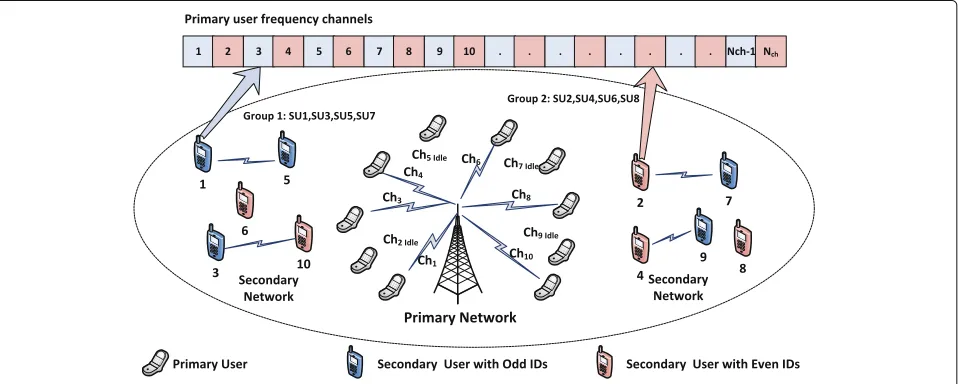
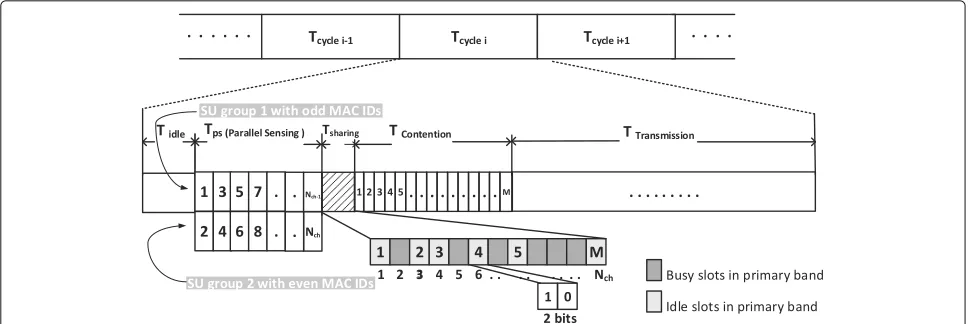
We have considered the case where SUs cannot trans-mit or receive at the same time as they are equipped with a single antenna; as such, they are only capable of sensing multiple channels one by one. The goal of a cog-nitive user is to accurately sense as many idle channels as possible from the underutilized primary band with due consideration of the energy consumption during sensing and sharing. Starting with the simplest case of sensing groups, we have divided the SUs into two groups, based on their user IDs. The primary band is also equally divided into the same number of portions, portion 1 contains odd numbered channels(1, 3, 5, 7, 9, ..,Nch−1)and portion 2 contains even numbered channels(2, 4, 6, 8, 10, ..,Nch)as shown in the Fig.2. Each group of SUs has the responsi-bility to sense one portion of the PU band, thus reducing the sensing load of each SU. Cognitive users can access data channel for transmission after successfully passing through series of phases, such as idle phase(Tidle), par-allel sensing phaseTps
, sharing phase(Tshar), and con-tention phase(Tcont)as shown in Fig.3. InTps, each SU belonging to a particular group senses the allotted por-tion of the primary band in sequential order. Since all the SU groups sense the designated portion of PU band in parallel, the overall sensing time is reduced without channel skipping. The contention and data transmission phases of our scheme are similar to those in SMC-MAC protocol [27].
SUs detect the primary signal duringTpsthrough simple energy detection scheme, such that
x(t)=
y(t)+n(t) Channel busy
n(t) Channel free, (1) where,y(t)is the PU’s signal andn(t)is the white noise.
Details of the proposed sensing scheme are discussed in the following section.
Fig. 3Simple frame structure of proposed parallel sensing scheme protocol, showing only two user groups
2.2 Proposed sensing scheme
The sensing and sharing phase of the proposed CRN MAC protocol are shown in Fig.3, where one cycle(Tcycle)of a common control channel is divided into different phases, i.e,Tidle,Tps,Tshar,Tcont, andTtran.
In parallel sensing phaseTps, SUs sense the idle channels from the primary band in such a manner that improves spectrum utilization, throughput, and energy efficiency by squeezing the overall sensing time. The sensing order is designed such that two groups of SUs, according to their IDs, sequentially search the primary band in the reduced time. The basic idea is to form SU groups by using their IDs. For example, two groups of SUs are formed as shown in Fig.2; an SU with even numbered ID falls in first group and one with odd numbered ID in the second group. Like-wise, more SU groups (Ng) can be formed and an SU’s
group ID(Gid)is obtained as follows:
Gid=
UidmodNg
+1, (2)
where, mod represents the modulo operation which gives the remainder andUidis the user ID of the SU.
The total number of channels assigned to each group is
Ngch=
Nch
Ng
. (3)
The following two types of IDs can be used for grouping the SUs:
1. Temporary IDs assigned to SUs after joining the network.
2. Using MAC address as SU ID.
A unique temporary ID can be assigned to an SU when joining the network through coordination messages over the common control channel. However, this method is not viable as it saturates the common control channel due to the excessive messaging, when the number of SUs enter-ing or leaventer-ing the network grow. Therefore, it is more
appropriate to use MAC addresses as user IDs for sec-ondary nodes in CRN, without extra burden on common control channel. Algorithm 1 in next the section also describes the process of parallel sensing scheme.
The following benefits are achieved in our proposed parallel sensing scheme as compared to the available schemes in the literature.
1. Reduced sensing phase.
2. Discovering more idle channels in PU band. 3. Energy efficient sensing.
2.2.1 Reduced sensing phase
ForNchPU channels there are Nch/Ngslots in the
sens-ing phase(Tps)of the transmission cycle. In each slot of the sensing phase,Ngchannels are sensed simultaneously,
in parallel. For example, when we divide the SUs into two groups then two PU channels are sensed simultaneously in parallel. Each group member senses all the channels assigned to the group sequentially one by one. The first group of SUs with odd IDs sequentially senses the alter-nate PU channels starting from channel 1 and the second group of SUs with even IDs senses the alternate PU chan-nels starting from channel 2, as depicted in Fig.3. Thus, with respect toTssas in [27] and also shown in Fig.1, in oneTcyclethese two SU groups now sense the PU band in half time. In this manner, the sensing phase timeTpscan be further reduced by creating more groups
Tps=
Tss
Ng
, (4)
whereTssis the sensing and sharing time for SMC-MAC protocol [27].
2.2.2 Discovering more idle channels in PU band
The price of leaving out a vacant channel is too high in CRN, as the overall network performance is highly depen-dent on discovering the opportunities and then tapping them efficiently. So, ideally it is desirable to scan all the channels to find their availability or otherwise. However, this leads to more power consumption in the sensing phase, which is not desirable in a wireless network with nodes having limited battery at their disposal. Also, it extends the sensing phase time, leaving less time for actual data transmission in the transmission cycleTcycle.
The proposed parallel sensing scheme has the capabil-ity to exploit the maximum available opportunities in the PU band, as each SU group simultaneously senses the specific portion of the PU band in sequence without skip-ping any PU channels. In the considered example of two groups of SUs, all members of an odd ID SU group will sense channels 1, 3, 5, 7, ...,Nch−1 and the members of the other group will sense channels 2, 4, 6, 8, ...,Nch, as shown in Fig.3. In this case, the probability of an idle PU chan-nel left out is low; only when all members fall in the same group. This probability diminishes as the number of SUs grow in the CRN. Increased number of users in a group increases the accuracy of the system, i.e., reduced false alarm and misdetection. However, even if there is a single member in a group, all channels assigned to the group will be sensed, thus, the proposed sensing scheme maximizes the pool of available resources in the CRN.
2.2.3 Energy efficient sensing
When an SU senses more channels in PU band it con-sumes more energy. The energy conservation during the sensing phase requires that fewer channels in the PU band be sensed. But at the same time, it is desirable that collec-tively all SUs sense all the primary channels to maximize the pool of idle channels available to SUs. In the proposed parallel sensing scheme, the energy conservation can be achieved by forming more SU groups. When we cerate more SU groups, then it implies that every SU has to sense less number of primary channels, thus saving energy dur-ing the parallel sensdur-ing phase. For example, if there are 5 SU groups in the CRN then primary band channels are also divided into 5 portions and each group has the onus of only 1/5th of the band, thus saving the SU energy by a factor of 5.
The parallel sensing scheme is more efficient as it saves time, energy and discovers more number of idle channels for CRN from the PU band; however, it requires a delicate trade-off among contradicting requirements.
2.3 Sharing scheme
In the proposed protocol, the sharing phase follows the sensing phase. Channels can be sensed in parallel, but the status, idle, or otherwise as sensed by SUs, cannot be
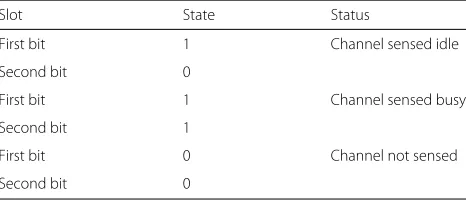
shared in parallel. So, sharing phase has the same num-ber of time slots as the numnum-ber of PU channelsNch, i.e., one-to-one mapping. All time slots in the sharing phase are further divided into two sub-slots, and each sub-slot has a duration of only one bit. The first sub-slot is used to represent whether the channel has been sensed or not and the second sub-slot is used to communicate the busy or idle PU channel status, as in [27]. Whether the PU chan-nel is idle or busy, its information is shared by every SU in the corresponding mapped time slot ofTshar. When an SU senses idle PU channel during parallel sensing phase, then it shares the results in the corresponding slot of the shar-ing phase by sendshar-ing tone 1 in the first sub-slot and 0 in the second. Similarly, when an SU senses busy PU chan-nel during the parallel sensing phase, then it shares the results in the corresponding sharing slot by sending tone 1 in both sub-slots, as shown in Table1. The final decision about the availability of a PU channel is made on the basis of collective information received.
In our proposed protocol, contention phase(Tcont)and data transmission phase(Ttran)are similar to [27]; where, after parallel sensing(Tps)and sharing phase(Tshar), M slots are available in the contention phase for the SUs.
3 Performance analysis
To evaluate the performance of the proposed parallel sensing scheme, we analyze the number of idle chan-nels sensed, energy consumption during sensing, and the throughput gain.
The Tcycle for the SUs to sense the PU is derived from the primary user channel model in the network as described in [30]. The distribution of PU arrival is assumed to be exponential with rateλ. When the inter-arrival time (Tint) of PU is less than or equal toTcycle, the probability Pi that SU will interfere with the PU is
evaluated by using the cumulative distribution function.
Pi=PTint≤Tcycle=1−e−λTcycle (5) EvaluatingTcyclefrom (5)
Tcycle= −
ln(1−Pi)
λ (6)
Table 1Status of the sharing sub-slots in sharing phase
Slot State Status
First bit 1 Channel sensed idle
Second bit 0
First bit 1 Channel sensed busy
Second bit 1
First bit 0 Channel not sensed
3.1 Idle channel analysis in parallel sensing scheme
LetKbe the number of idle channels out ofNchchannels in the PU band and the probability of busy channels isγ, then the probability ofkidle channels is [27]
pK(k)=
Thus, the average number of idle channels is
E[K]=
Nch
k=0
k.pK(k) (8)
In our proposed parallel sensing scheme, there are
Ng parallel groups andNsu secondary users select these groups for sensing on the basis of their user IDs. The aver-age number of channels sensed(S)byNsusecondary users in the parallel sensing scheme is
E[S]= Nch
From (9), the average number of idle channels discov-ered by a single SU will be
E[Sidle]= channels out of total available idle channels in PU is derived as follows:
η= E[Sidle]
E[K] (11) whereE[Sidle] is the discovered idle channels in PU band by a single SU and E[K] is the total number of idle channels in PU band.
3.2 Energy consumption analysis in parallel sensing scheme
The energy consumption by the SU duringTcycle can be expressed as
ESU= Eps+Eshar+Econt+Etran (12) where,Eps,Eshar,Econt, andEtranare the energy consumed in parallel sensing, sharing, contention, and data transmis-sion. Energy consumed during the sensing phase depends upon the sensing algorithm [31]. Since, we are only inter-ested in energy consumption during the parallel sensing phase, which is given as
Eps= Pps.Tps, (13) where Pps is the total power consumed during parallel sensing phase. From (13), the energy consumed by a single SU during parallel sensing phaseTpsis found as
Eps=pτ.τps.
Nch
Ng
, (14)
whereτpsis the time spent by a single SU to sense a sin-gle channel andpτ is the power consumed during sensing of single channel. The sensing duration(τps)for a single
channel is 1 ms [32] .
3.3 Throughput analysis in parallel sensing scheme
One cycle is divided intoTidle,Tps,Tshar,Tcont, andTtran. The data transmission time is evaluated as
Ttran=Tcycle−
Tidle+Tps+Tshar+Tcont (15) and can be increased by minimizing the overhead delay
Tps=τps
Nch
Ng
, (16)
whereτpsis the sensing duration of each channel andNg
is the number of parallel sensing groups.
Results of PU channel status after sensing in Tps are shared inTshar, which can be evaluated as
Tshar=Nch.τshar, (17) whereτshar is the time taken by SU to share the sensing results of each primary channel. The outcome of the shar-ing phase isMidle channels out ofNchPU channels. Now,
Mchannels are available for the contention phase. Time taken by theTcontis evaluated as
Tcont=M
T(CR−RTS)+T(CR−SIFS)+T(CR−CTS), (18)
whereT(CR−RTS)andT(CR−CTS)is the time taken by SU to send and receive the CR-RTS and CR-CTS messages.
In general, transmission time can be increased by reduc-ing the sensreduc-ing, sharreduc-ing, and contention phase time; however, reliable discovery requires increased sensing duration. This will increase the number of discovered idle channels, which in turn increases the number of contention slots (M) in the contention interval, thus decreasing the transmission time per cycle. So, there are trade-offs involved and require optimization of involved parameters to maximize the throughput. In our pro-posed sensing scheme, while keeping the sameτpswithout compromising on reliability, the overall sensing time is reduced by forming more parallel SU groups(Ng). This
in turn not only neutralizes the effect of increased con-tention phase time but also more than compensates by leaving more time for transmission, thereby, providing improved throughput.
In parallel sensing scheme, the throughput is obtained by
Th(ps)=
E[Sidle] .Ttran.R.Nsu
Tcycle
whereE[Sidle] is the average number of idle channels dis-covered by a single SU and R is the data rate of each channel. The above equation can be expressed as
Th(ps)=
Nch= Number of channels in primary band
M= Number of sensed idle channels in primary band
Nsu= Number of secondary users
Ng= Number of parallel groups where SU sense
sequen-tially
LoadP= Traffic in the primary band [0–1]
Step 2.Discovering idle channels from primary band
through parallel sensing
fori=1 to 10 // primary traffic range, i.e, LoadP do
Nchstatus= Generate traffic forNchchannels SUids= Assign random ID to each node
SUgrp= Create parallel SU groups based on SUids forj=1 ToNchdo
ifNchstatus(j) <LoadP then
Set channel status to 1, the channel is busy
else ifNchstatus(j) >LoadPthen
Set channel status to 0, the channel is idle
end if end for
forj=1 ToNchdo
ifNchstatus(j)= 0 // idle channels in PU bandthen Find the SU in relevant groupNgby taking mod
of (Nch,Ng) and then counting the total number
of idle channels
end if end for end for
4 Analytical and simulation results
In this section, we present the numerical and simula-tion results of the proposed parallel sensing scheme and compare it with the SMC-MAC protocol [27].
The major simulation parameters for the evaluation of our proposed scheme are summarized in Table 2. Whereas, the basic parameters are the same as in IEEE 802.11 MAC [33]. The deployment of SUs is random, and it is assumed that they are within the transmission range of each other.
Table 2Simulation parameters
Parameters Value
Number of primary channels(Nch) 100
Primary traffic load(γ ) 0 –1
Number of secondary users(Nsu) 1–50
Number of SU groups(Ng) 1–15
Tidle 54μs
Slot duration in sensingτps ms
Slot duration in sharingτshar 37ns
T(CR−SIFS) 16μs
T(CR−RTS) 24μs
T(CR−CTS) 24μs
4.1 Sensed and discovered idle channels
First, we will analyze the average number of channels sensed in parallel sensing scheme by the SUs, when there are 100 channels (Nch) in the PU band and number of parallel groups(Ng)are 1 to 10 as shown in Fig.4. Here,
we can see that the parallel sensing scheme senses all the channels in the PU band when there is only one group. When the number of groups is increased, then the num-ber of sensed channels by the SUs decreases. However, despite increased parallel groups(Ng), by increasing the
number of SUs will discover more channels in the PU band. For example, we see that when there are 10 parallel groups(Ng)and 30 SUs, the average discovered or sensed
channels will be nearly 95 out of 100.
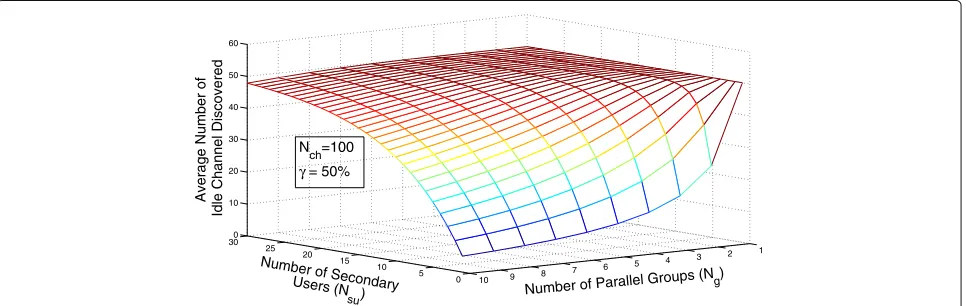
Figure5shows the average number of idle channels dis-covered by the SUs when load on the primary band is 50%. Here, we see that 48 out of 50 channels are discovered idle when load on primary is 50%. So, it is evident that in par-allel sensing scheme, the average number of idle channels discovered by the SUs is high, whereas missed or skipped idle channels are rare.
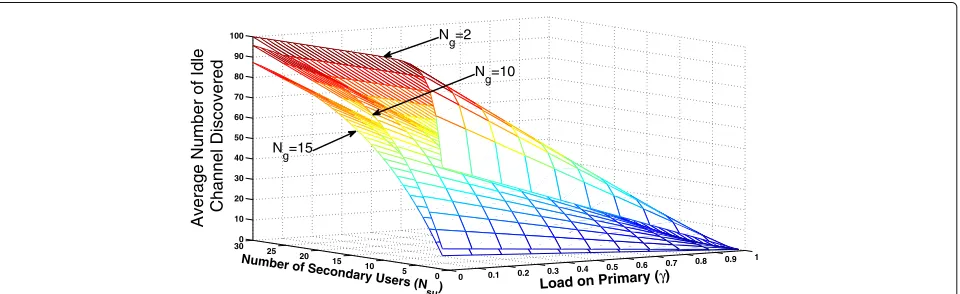
Figures6and7show the average number of idle chan-nels discovered by the SUs when the traffic load on pri-mary(γ )varies from 0 to 1 for different configurations of parallel groups (Ng) and number of secondary users
(Nsu). For average number of idle channels discovered by the SUs, Fig.6shows two planes representing number of secondary users, i.e.,Nsu = 30 andNsu = 10 that con-verge at pointNg = 1 and diverge towardsNg = 10 . It
is observed that whenNsu = 30, then at pointNg = 10
and γ = 0, 96% idle channels are discovered. But, for
Nsu = 10 at the same point, i.e.,Ng = 10 andγ = 0,
75 idle channels are discovered. Figure 7 shows three planes representing parallel number of groupsNg = 2,
Ng = 10, andNg =15, where 100, 96, and 88 idle
Fig. 4Average number of channel sensed in parallel sensing scheme by the SUs
Now, we present the simulation results of the proposed parallel sensing scheme and find out the average number of discovered idle channels by the SUs and then compare it with the sensing scheme discussed in the SMC-MAC [27] protocol.
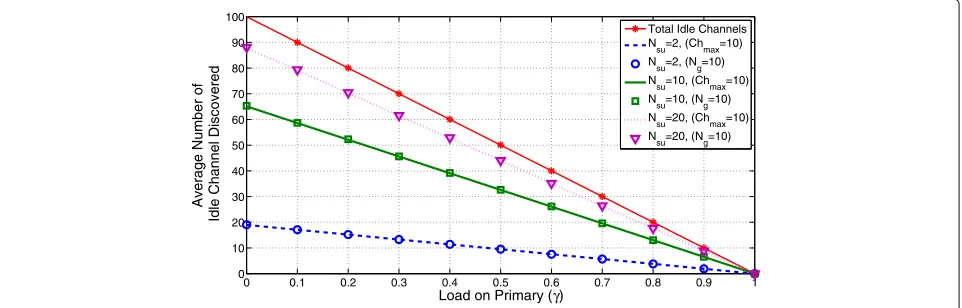
Figures 8 and 9 show simulation results of proposed parallel sensing scheme and comparison with the sens-ing scheme in the SMC-MAC protocol [27] by employ-ing different configurations of parallel number of groups (Ng)and maximum random number of channels(chmax) selected. Where, Ng represents the number of
paral-lel groups of SUs that simultaneously sense the PU band sequentially according to their IDs in the pro-posed parallel sensing scheme, whereas chmax repre-sents the random number of channels selected by each SU from the primary band in SMC-MAC [27] sens-ing scheme. Here, we can see that the average num-ber of idle channels discovered varies linearly with PU traffic load.
Proposed and reference schemes are compared for dif-ferent values of chmaxandNg. Now, for the ease of
analy-sis, we take only one scenario where number of secondary
users areNsu = 2. So, in Fig. 8a, with chmax = 5 and
Ng = 2, our proposed parallel sensing scheme
dis-covers 66% more idle channels from the PU band than the reference sensing scheme at 0 load on primary. In Fig.8b, with chmax = 2 and Ng = 2 proposed parallel
sensing scheme discovers 72% more idle channels. Simi-larly, in Fig.8c, with chmax = 2 andNg = 5 proposed
parallel sensing scheme discovers 32% more idle channels from the PU band. Moreover, in Fig.8d, with chmax = 2 and Ng = 5 proposed sensing scheme discovers 26%
more idle channels from the PU band. It is observed that for each configuration given in Fig. 8, our scheme out-performs the reference scheme by discovering more idle channels from the PU band. However, in terms of average number of idle channels discovered, we can equate these two different sensing schemes by taking chmax = 10 and
Ng=10 as shown in Fig.9.
Figure10shows the simulation and analytical results of our proposed parallel sensing scheme. The average num-ber of idle channels discovered by the SUs, when the traffic load on primary band varies form 0 to 1 is verified by the simulation results for different number of parallel
Fig. 6Average number of idle channels discovered by SUs with variations in the number of parallel groups and traffic load on the primary band
groups (Ng = 2, 5, 10) and for fixed number of secondary
users, i.e.,Nsu = 20 . 4.2 Energy consumption
Figure11shows the energy consumption analysis of SUs during the proposed parallel sensing phase (Tps). We observe that when the number of parallel groups(Ng)are
increased, then the saving in energy consumption is sig-nificant. For example, whenNg = 2 and Nsu = 30 then the total energy consumption during the parallel sensing phase (Tps) is 2.2 J. Similarly, when Ng = 5
andNsu = 30 then the total energy consumption dur-ing the parallel sensdur-ing phase(Tps)is 0.7 J. Finally, when
Ng = 10 andNsu = 30, then the total energy con-sumption during the parallel sensing phase(Tps)is 0.4 J. It is observed that when the parallel groups are increased (from Ng = 2 to Ng = 5) then 68% energy
sav-ing in senssav-ing is achieved. Similarly, 81% of energy is saved in sensing when parallel groups are increased from
Ng = 2 toNg = 10.
The energy consumption comparison of parallel sens-ing scheme and senssens-ing scheme of SMC-MAC [27] is also shown in Fig.11. It is observed that when chmax = 10
(random channel selection scheme in SMC-MAC [27]) and Ng = 10, then both the sensing schemes will
consume same amount of energy during sensing phase. However, when we further increase the parallel number of groups beyondNg = 10 then our parallel sensing scheme
outperforms the reference sensing scheme.
4.3 Throughput gain
Figure 12depicts the maximum throughput of the sys-tem versus traffic load on the primary channels, when
Ng is 2 and 5 and the number of secondary users are 5
and 30. It is observed here that when there are 2 paral-lel groups with 5 to 50 SUs, the maximum throughput is 4.7 to 4.8 Gbps. Because, in parallel sensing scheme, when there are less number of groups, the effect of increasing the number of SUs on number of idle channel discovery is marginal. But we can see that when there are 10 num-ber of parallel groups with 5 to 50 SUs, the maximum throughput is 2.1 to 5.2 Gbps, which is 60% higher in comparison to the reference scheme. Because, in parallel sensing scheme, when there are large number of groups, the effect of increasing the number of SUs on idle channels discovery is significant. Large number of parallel groups
a
b
c
d
Fig. 8Comparison of average number of idle channels discovered by SUs whenachmax = 5 andNg = 2,bchmax = 2 andNg=2,cchmax = 2 andNg=5,dchmax = 5 andNg = 5
also reduces the overall sensing phase time, leaving more time for the transmission.
Figure13shows that from Nsu = 1 toNsu = 11, the throughput of the system with two parallel groups is higher. Whereas, from Nsu = 13 toNsu = 35 the throughput of the system with five parallel groups is higher. Moreover, fromNsu = 37 toNsu = 50 the throughput of the system with 10 parallel groups is higher. It is evident that the large number of parallel groups are only efficient when there are the large number of SUs in the system and vice versa.
Figure14shows the comparison of maximum through-put of the system between proposed sensing scheme with
Ng = 10 and reference sensing scheme in SMC-MAC
[27] with chmax = 10, when the primary traffic load varies from 0 to 1. Here, we can see that at each point of the primary traffic, the throughput of the system for parallel sensing scheme always surpasses the reference sensing scheme. For example, at a point where the pri-mary load is 0 , the maximum throughput of the sys-tem is 1 Gbps for the parallel sensing scheme, whereas at the same point, maximum throughput of the system
Fig. 10Analytical and simulation comparison of average number of idle channels discovered by SUs whenNsu = 10
Fig. 11Energy consumption analysis during parallel sensing phase forNg = 2,Ng = 5, andNg = 10 and its comparison, when chmax = 5, chmax = 10, and chmax = 15
Fig. 13Maximum throughput of the system in parallel sensing scheme versus number of secondary users whenNg=2, 5, and 10
Fig. 14Comparison of the maximum throughput of the system between parallel sensing scheme and SMC-MAC [27], with parametersNg = 10, chmax = 10,Nsu = 2, andNch = 100
for SMC-MAC [27] is 0.8 Gbps. Figure 15 also shows the comparison of maximum throughput of the system between proposed sensing scheme withNg = 10 and
sensing scheme in SMC-MAC [27] with chmax = 10, where the number of secondary users vary from 1 to 50. It is observed here that at each value of Nsu, the maxi-mum throughput of the system for parallel sensing scheme always exceeds the reference sensing scheme. For exam-ple, at a point whereNsu = 30, the maximum through-put of the system is 3.7 Gbps for the reference sensing scheme and 4.6 Gbps for the proposed parallel sensing scheme.
It is apparent from the above results that the proposed parallel sensing scheme outperforms the reference sens-ing scheme because it discovers more idle channels, which leads to higher throughput. Also in the parallel sensing scheme, the sensing phase time is reduced by increasing the number of parallel groups which leaves more time for the transmission that also contribute towards higher throughput.
5 Conclusions
In this work, we have proposed a parallel sensing scheme for the cognitive radio ad hoc networks that efficiently dis-covers more idle channels from the primary user band, consequently leading to improved spectrum utilization, lower power consumption, and higher throughput. We have investigated the performance of proposed paral-lel sensing scheme through both mathematical analy-sis and simulations. Comparison with the SMC-MAC protocol [27] shows that the proposed parallel sensing scheme outperforms the SMC-MAC sensing scheme by finding more idle channels from the primary user band and also improves energy efficiency during the sens-ing phase by increassens-ing the number of parallel groups. Most importantly, the proposed scheme provides higher system throughput as the duration of sensing phase is reduced through parallel sensing, resulting in increased transmission time for the SUs in a given cycle. The pro-posed parallel sensing scheme is particularly suitable for delay-sensitive applications in ad hoc cognitive radio net-works as it discovers higher number of idle channels in less time, consumes lower energy, and affords enhanced throughput.
Acknowledgements
There are no other participants in the research except those in the authors’ list.
Funding
There is no funding involved in this research.
Authors’ contributions
ILK and RH conceptualized the idea and designed the experiments. AS, AI, and SA provided the data curation. JA and QuH contributed in writing and draft preparation and SAM supervised the research. All authors read and approved the final manuscript.
Competing interests
The authors declare no competing interests.
Publisher’s Note
Springer Nature remains neutral with regard to jurisdictional claims in published maps and institutional affiliations.
Received: 11 August 2017 Accepted: 18 March 2018
References
1. A De Domenico, E Calvanese Strinati, M-G Di Benedetto, A survey on mac strategies for cognitive radio networks. IEEE Commun. Surv. Tutorials.
14(1), 21–44 (2012)
2. M Powell, JS Adelstein, inFacilitating opportunities for flexible, efficient, and reliable spectrum use employing cognitive radio technologies. Notice of proposed rule making and order, (Washington D.C., 2003), pp. 1–53 3. MA McHenry, NSF spectrum occupancy measurements project summary.
Shared Spectr. Co. Rep., 1–58 (2005)
4. S Haykin, Cognitive radio: brain-empowered wireless communications. IEEE J. Sel. Areas Commun.23(2), 201–220 (2005)
5. AL Sukkar, GMN Al-Damluji, I Mansour, A MAC protocol with an improved connectivity for cognitive radio networks. EURASIP J. Wirel. Commun. Netw.2016(1), 116 (2016)
6. IF Akyildiz, W-Y Lee, MC Vuran, S Mohanty, Next generation/dynamic spectrum access/cognitive radio wireless networks: A survey. Comput. Netw.50(13), 2127–2159 (2006)
7. IEEE Standard for Information technology– Local and metropolitan area networks– Specific requirements– Part 22: Cognitive Wireless RAN Medium Access Control (MAC) and Physical Layer (PHY) specifications: Policies and procedures for operation in the TV Bands, inIEEE Std 802.22-2011, (2011), pp. 1–680.https://doi.org/10.1109/IEEESTD.2011. 5951707
8. A De Domenico, E Calvanese Strinati, MG Di Benedetto, A survey on mac strategies for cognitive radio networks. IEEE Commun. Surv. Tutorials.
14(1), 21–44 (2012)
9. Z Qing, T Lang, A Swami, inNew Frontiers in Dynamic Spectrum Access Networks, 2005. DySPAN 2005. 2005 First IEEE International Symposium on. Decentralized cognitive mac for dynamic spectrum access (Elsevier North-Holland, Inc., New York, 2005), pp. 224–232
10. J Han, Y Ma, Y Xu, Z Wang, in2016 IEEE Advanced Information Management, Communicates, Electronic and Automation Control Conference (IMCEC). Sensing order optimization in wideband spectrum sensing (IEEE, Xi’an, 2016), pp. 1043–1047
11. A Ewaisha, A Sultan, T ElBatt, inWireless Communications and Networking Conference (WCNC), 2011 IEEE. Optimization of channel sensing time and order for cognitive radios (IEEE, Cancun, 2011), pp. 1414–1419
12. H Shokri-Ghadikolaei, C Fischione, in2014 IEEE International Conference on Communications (ICC). Distributed random sensing order analysis and optimization in cognitive radio systems (IEEE, Sydney, 2014), pp. 1543–1548
13. S Park, J Kim, G Hwang, JK Choi, in2016 Eighth International Conference on Ubiquitous and Future Networks (ICUFN). Joint optimal access and sensing policy on distributed cognitive radio networks with channel aggregation (IEEE, Vienna, 2016), pp. 253–258
14. S Senthilmurugan, TG Venkatesh, Optimal channel sensing strategy for cognitive radio networks with heavy-tailed idle times. IEEE Trans. Cogn. Commun. Netw.3(1), 26–36 (2017)
15. Y Lu, D Wang, M Fattouche, Cooperative spectrum-sensing algorithm in cognitive radio by simultaneous sensing and BER measurements. EURASIP J. Wirel. Commun. Netw.2016(1), 136 (2016)
16. LT Tan, LB Le, Joint cooperative spectrum sensing and MAC protocol design for multi-channel cognitive radio networks. EURASIP J. Wirel. Commun. Netw.2014(1), 101 (2014)
17. S Xie, Y Liu, Y Zhang, R Yu, A parallel cooperative spectrum sensing in cognitive radio networks. IEEE Trans. Veh. Technol.59(8), 4079–4092 (2010)
19. K Hyoil, KG Shin, Efficient discovery of spectrum opportunities with mac-layer sensing in cognitive radio networks. IEEE Trans. Mob. Comput.
7(5), 533–545 (2008)
20. HT Cheng, W Zhuang, Simple channel sensing order in cognitive radio networks. IEEE J. Sel. Areas Commun.29(4), 676–688 (2011)
21. R Misra, AP Kannu, inCommunications (ICC), 2012 IEEE International Conference on. Optimal sensing-order in cognitive radio networks with cooperative centralized sensing (IEEE, Ottawa, 2012), pp. 1566–1570 22. Z Khan, JJ Lehtomaki, LA DaSilva, M Latva-aho, Autonomous sensing order selection strategies exploiting channel access information. IEEE Trans. Mob. Comput.12(2), 274–288 (2013)
23. J Juncheng, Z Qian, S Xuemin, Hc-mac: A hardwareconstrained cognitive mac for efficient spectrum management. IEEE J. Sel. Areas Commun.
26(1), 106–117 (2008)
24. Z Yanxiao, S Min, X Chunsheng, inINFOCOM, 2013 Proceedings IEEE. Fmac: A fair mac protocol for coexisting cognitive radio networks (IEEE, Turin, 2013), pp. 1474–1482
25. S Debroy, S De, M Chatterjee, Contention based multichannel mac protocol for distributed cognitive radio networks. IEEE Trans. Mob. Comput.13(12), 2749–2762 (2014)
26. C Wenchi, Z Xi, Z Hailin, Full-duplex spectrumsensing and mac-protocol for multichannel nontime-slotted cognitive radio networks. IEEE J. Sel. Areas Commun.33(5), 820–831 (2015)
27. L Seyoun, L Tae-Jin, A self-scheduling multi-channel cognitive radio mac protocol based on cooperative communications. IEICE Trans. Commun.
94(6), 1657–1668 (2011)
28. S Pandit, G Singh, Backoff algorithm in cognitive radio mac protocol for throughput enhancement. IEEE Trans. Veh. Technol.64(5), 1991–2000 (2015)
29. JSP Singh, MK Rai, Cognitive radio intelligentmac (cr-i-mac): channel-diverse contention free approach for spectrum management. Telecommun. Syst, 1–14 (2016)
30. D Willkomm, S Machiraju, J Bolot, A Wolisz, Primary user behavior in cellular networks and implications for dynamic spectrum access. IEEE Commun. Mag.47(3), 88–95 (2009)
31. EF Orumwense, TJ Afullo, VM Srivastava, inAFRICON, 2015. Secondary user energy consumption in cognitive radio networks (IEEE, Addis Ababa, 2015), pp. 1–5
32. C Cordeiro, M Ghosh, D Cavalcanti, K Challapali, inCognitive radio oriented wireless networks and communications, 2007. CrownCom 2007. 2nd International Conference on. Spectrum sensing for dynamic spectrum access of tv bands (IEEE, Orlando, 2007), pp. 225–233



![Fig. 15 Comparison of the maximum throughput of the system between parallel sensing scheme and SMC-MAC [27], with parameters Ng = 10,chmax = 10, γ = 10, and Nch = 100](https://thumb-us.123doks.com/thumbv2/123dok_us/922508.1111797/13.595.58.540.87.254/comparison-maximum-throughput-parallel-sensing-scheme-parameters-chmax.webp)