Volume 2008, Article ID 291365,18pages doi:10.1155/2008/291365
Research Article
Secure and Efficient Data Transmission over
Body Sensor and Wireless Networks
Narasimha Challa, Hasan C¸am, and Madhur Sikri
Computer Science and Engineering Department, Arizona State University, Tempe, Az 85287, USA
Correspondence should be addressed to Hasan C¸am,[email protected]
Received 16 June 2007; Revised 4 December 2007; Accepted 20 February 2008
Recommended by Yang Xiao
This paper addresses the transmission of medical and context-aware data from mobile patients to healthcare centers over het-erogeneous wireless networks. A handheld device, called personal wireless hub (PWH), of each mobile patient first gathers and aggregates the vital sign and context-aware data for various telemedicine applications. PWH transmits the aggregated data to the remote healthcare center over multiple wireless interfaces such as cellular, WLAN, and WiMAX. The aggregated data contain both periodic data and those nonperiodic unpredictable emergency messages that are sporadic and delayintolerant. This paper addresses the problem of providing QoS (e.g., minimum delay, sufficient data rate, acceptable blocking, and/or dropping rate) by designing a packet scheduling and channel/network allocation algorithm over wireless networks. The proposed resource-efficient QoS mechanism is simple and collaborates with an adaptive security algorithm. The QoS and security are achieved mainly with the collaboration of differentiator, delay monitor, data classifier, and scheduler modules within the PWH. This paper also discusses secure data transmission over body sensor networks by introducing key establishment and management algorithms. Simulation results show that the proposed framework achieves low-blocking probability, meets delay requirements, and provides energy-efficient secure communication for the combination of vital signs and context-aware data.
Copyright © 2008 Narasimha Challa et al. This is an open access article distributed under the Creative Commons Attribution License, which permits unrestricted use, distribution, and reproduction in any medium, provided the original work is properly cited.
1. INTRODUCTION
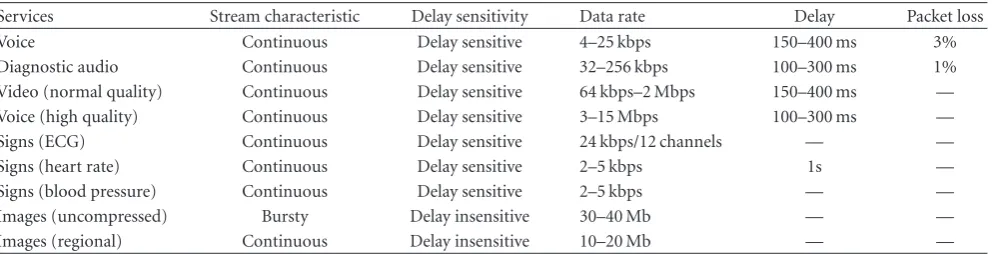
Future generation wireless networks are expected to experi-ence huge demands from mobile telemedicine applications. Mobile telemedicine allows patients to do their daily activ-ities while they are monitored continuously anytime, any-where. Typical telemedicine applications include transmis-sion of electro-cardiogram (ECG) signals from a mobile pa-tient to a doctor, voice conversation between the doctor and the personnel in the emergency vehicle, transmission of X-rays, live video, and medical images from the emergency ve-hicle or the patient to the doctor at the healthcare center. These applications require communication between a mobile patient and a healthcare center. Further, these telemedicine applications have different QoS requirements that are speci-fied in terms of the desired loss rate, delay, and bandwidth. Table 1shows the typical telemedicine applications and their QoS requirements [1]. Mobile telemedicine applications will have to deal with the characteristics of wireless networks
such as low bandwidth, channel fluctuations, and coverage changes. In addition, a single network alone may not be able to meet the bandwidth requirements of applications at all lo-cations. In this paper, the mobile applications are enabled to take advantage of both the coverage and bandwidth provided by different wireless networks through multiple wireless in-terfaces in achieving their QoS objectives.
Table1: QoS requirements.
Services Stream characteristic Delay sensitivity Data rate Delay Packet loss
Voice Continuous Delay sensitive 4–25 kbps 150–400 ms 3%
Diagnostic audio Continuous Delay sensitive 32–256 kbps 100–300 ms 1%
Video (normal quality) Continuous Delay sensitive 64 kbps–2 Mbps 150–400 ms —
Voice (high quality) Continuous Delay sensitive 3–15 Mbps 100–300 ms —
Signs (ECG) Continuous Delay sensitive 24 kbps/12 channels — —
Signs (heart rate) Continuous Delay sensitive 2–5 kbps 1s —
Signs (blood pressure) Continuous Delay sensitive 2–5 kbps — —
Images (uncompressed) Bursty Delay insensitive 30–40 Mb — —
Images (regional) Continuous Delay insensitive 10–20 Mb — —
time can be determined. However, reserving bandwidth for emergency data is not efficient in terms of resource usage. At the same time, emergency data should be delivered on time without delay. To solve this problem, our proposed scheme differentiates the periodic data, and if the differences in the periodic data exceed a threshold, patient’s personal wireless hub (PWH) reserves bandwidth on the wireless networks in order to ensure the availability of wireless bandwidth for the emergency data. This scheme reduces the wastage of band-width resources by not reserving bandband-width for emergency data all the time. At the same time, by predicting the occur-rence of an emergency situation and reserving resources be-forehand based on the prediction, it improves the probability of bandwidth availability under emergency situations.
In this paper, we consider the scenario of a mobile telemedicine device that has multiple wireless interfaces and that is capable of supporting multiple telemedicine applica-tions. The mobile patient with a portable telemedicine de-vice, called PWH in this paper, is considered to be in a low mobility, densely populated area such as a shopping mall as shown inFigure 1. The vital sign data of a mobile patient are transmitted in wireless medium from the patient’s body sen-sors to PWH, where the body sensen-sors form a body sensor network (BSN). In addition to body sensors, PWH is also capable of communicating simultaneously with other works such as wireless sensor network (WSN), cellular net-work, and WLAN. Note that WSN provides context-aware data (e.g., temperature, location, and humidity level) to the patient’s PWH, which helps interpret accurately the patient medical data. This paper addresses some security and/or channel allocation/reservation aspects of data transmission from body sensors to PWH (over BSN) as well as from PWH to hospital data centers (over wireless networks).
The sensors implanted on the human body to monitor parts of the body are called biosensors. These biosensors form a network and collectively monitor the health condi-tion of their carrier or host. Health monitoring involves col-lection of data about vital body parameters known as bio-metric signals or biobio-metric data, from different parts of the body and making decisions based on them [2]. As seen from Figure 1, remote patient monitoring uses body sensors to sense vital sign data for performing real-time health moni-toring of patients. Because the system involves transmission of sensitive medical data, it should provide basic level of
se-curity. Key distribution is central to any security mechanism based on cryptographic techniques. Symmetric key cryptog-raphy requires establishment of a secret session key between the communicating parties. Since biosensors are placed on the human body, we can use them to derive the required inputs for security mechanism from the body. The estab-lishment of this session key should be designed to conserve the limited energy resources of the body sensor. In this pa-per, we proposes an energy efficient secure key establishment and authentication (SKEA) protocol to establish a symmet-ric key between the body sensors and PWH using the bio-metric signals (e.g., heart rate interval, blood flow) of pa-tients. This eliminates the use of expensive key generating functions and, therefore, the computational overhead is re-duced.
Owing to its super-short communication range, the main security challenges faced by BSN include the following: (i) eavesdropping of data by a third party, unknown to the source as well as the receiver and (ii) modification and injec-tion of data by third party without knowledge of the source and the destination. As sensors of BSN are expected to be in-terconnected on or in the human body, the body itself can form an inherently secure communication pathway that is unavailable to all other kinds of wireless networks. Biomet-rics recognition is based on “who you are” as opposed to/in conjunction with “what you know” (PIN)or “what you have”
Motion sensor Pulse oximeter
Mobile patient
ECG Personal wireless
hub (PWH)
Cell phone
Cellular network
Doctor
Hospital data center
Lab
Internet HGS
(healthgrid station) Patient A
Patient B Patient C
Sensor node Smart mall
Figure1: A mobile patient can communicate with hospital data center and/or physician through wireless networks (e.g., cellular and sensor
networks), health grid station (HGS), and personal devices such as PWH.
A major concern with using biometrics for cryptographic purposes is the degree of randomness. Unless the biometric is random enough, an attacker can guess and compromise it, leading the false acceptance rate to be increased, where the false acceptance rate refers to the probability that the biomet-ric security system allows an access attempt by an intruder. The level of randomness of any quantity is defined by the level of entropy [4]. The entropy can further be increased using a combination of readings at more than one instance of time because the search space is further increased. Some candidate biometrics and their ranges are shown inTable 2 [2,5]. The ranges are mentioned for normal as well as ab-normal conditions.
The contributions of this paper include the following: (i) a channel allocation and reservation algorithm that re-serves bandwidth for emergency telemedicine data by mea-suring the vital signs and predicting the status of the patient, (ii) an adaptive priority and security assignment scheme to meet the delay of emergency medical data, (iii) a dynamic packet scheduling scheme that schedules packets on multiple interfaces based on the instantaneous QoS requirements of packets and channel conditions, and (iv) security algorithms for key establishment, confidentiality, and authentication be-tween body sensors and PWH. The proposed channel and reservation algorithm differs from existing work in that it adapts the amount of resources reserved for emergency data based on the variations in patient’s health conditions. In the proposed adaptive priority and security assignment scheme, when a patient is in critical situation, the strength of secu-rity is increased in data transmission from the PWH to the healthcare center if the patient is in good condition. A set of modules such as the classifier, scheduler, and channel allo-cator are used together to schedule packets of various
appli-cations through multiple interfaces and channels of different wireless networks.
The rest of the paper is organized as follows.Section 2 presents the related work. Section 3 presents the system model used in the paper. The proposed framework for adap-tive secure channel allocation is presented inSection 4. The call admission control algorithm that reduces the call drop-ping probability of medical calls is presented in Section 5. Section 6 presents the secure data transmission algorithm over body sensor networks. The performance analysis is presented in Section 7. Concluding remarks are made in Section 8.
2. RELATED WORK
Third generation (3G) and beyond cellular networks provide support for multimedia data transmission [6]. For instance, 3G networks support a data rate of up to 144 kbps for ve-hicular users and a data rate of up to 2 Mbps for pedestrian users. In addition to providing higher data rates, 3G net-works also have the advantage of providing continuous cov-erage in both urban and rural areas. Therefore, they are well suited for telemedicine applications that require continuous connectivity (periodic data). However, one disadvantage of 3G networks is that in hot spot areas such as airports, shop-ping malls, they may not have enough capacity to support all users because of heavy loads. Therefore, allocating some channels from alternative networks in hot spot areas would be required.
Table2: Candidate biometrics with their ranges.
Biometric Range
Blood glucose 64–140 mg/dL (varies with activity)
Blood pressure 120–160 mmHg (systolic) (range is from hypotension to hypertension) Temperature 97.0–105.0 F (range across ages and normal and abnormal conditions) Hemoglobin 12.1–17.2 g/dL (varies between male and female and age and altitude)
Blood flow Greater than 0.9 ABI (normal)
Less than 0.5 ABI (abnormal)
Further, WLANs provide higher data rates of up to 54 Mbps (802.11g). However, WLANs have very limited coverage. IEEE 802.16/WiMAX technology provides broadband con-nectivity in a wireless metropolitan area network (WMAN) environment for to both fixed and mobile users [8]. To pro-vide flexibility for different applications, the standard sup-ports two major deployment scenarios. In the last-mile sce-nario, broadband wireless connectivity is provided to home and business users in a WMAN environment. The operation is based on a point-to-multipoint single-hop transmission between a single base station (BS) and multiple subscriber stations (SSs). Backhaul networks is a multihop (or mesh) scenario where a WiMAX network works as a backhaul for cellular networks to transport data/voice traffic from the cel-lular edge to the core network (Internet) through meshing among IEEE 802.16/WiMAX base stations.
A notion for QoS for telemedicine multimedia data is presented in [9]. The authors elaborate on several synchro-nization protocols to achieve key multimedia telemedicine data synchronization requirements. In [10,11], the telecom-munication and QoS requirements of various telemedicine applications are presented. They also discuss how various technologies can be chosen to support the QoS require-ments of telemedicine applications. But, they do not address how the various technologies can be integrated to support the QoS requirements of telemedicine applications. Integra-tion of the networks is essential to support high bandwidth telemedicine applications. In [12], the transmission of visual sensor data is adapted based on the changes in patient’s state. Bandwidth allocation for telemedicine applications and bandwidth aggregation is addressed in [1, 13, 14] to en-sure their QoS guarantees. However, these schemes do not consider bandwidth aggregation over multiple wireless net-works. In [15–21], the authors propose to take advantage of bandwidth aggregation to meet the QoS requirements of bandwidth intensive telemedicine applications when the bandwidth of a single network is not sufficient to meet all the QoS requirements. In [15], a packet scheduling scheme where latency sensitive packets are sent over low latency timeslots is presented. Also, in [17], only a random way to find a schedule that maximizes the system utility is sug-gested. Another scheduling algorithm, called Earliest Deliv-ery Path First (EDPF) in [18], schedules each path on the ear-liest delivery path, with the objective of reducing delay due to reordering and hence the delay and jitter experienced by the applications. The combination of Weighted Fair Queue-ing (WFQ) with EDPF is presented in [19] to ensure a fair
share of the bandwidth among different applications. How-ever, they do not address the multiple class traffic scenario. In [22], the authors propose a scheme to adapt the quality and security of transmitted video based on the channel sta-tus and patient stasta-tus. Basically, a higher level encryption is used when the patient’s status is urgent as compared to that used when the patient’s status is normal. On the other hand, a higher level compression scheme is used when the chan-nel quality gets poorer. These approaches ensure that the de-lay and the video quality of the telemedicine data are met in all circumstances. However, in our paper, we do not modify the security of the patient’s data even when the patient is in urgent situation, since reducing the encryption strength can affect the reliability of the patient’s data.
In [20], the authors propose a QoS-Aware Wireless Band-width Aggregation (QAWBA) scheme where mobile nodes use multiple independent paths through other mobile nodes to receive data from the base station. QAWBA integrates on-demand proxy discovery, bandwidth reservation and mainte-nance, and hop-by-hop routing to achieve this. The solution proposed is specific to 802.11 networks and does not con-sider heterogeneous networks. In [21], the presented scheme does not consider traffic of different traffic classes.
The ultimate aim of BSN is to provide a truly per-sonalized monitoring platform that is pervasive, intelligent, context-aware, and invisible to the patient, thereby avoid-ing activity restriction or behavior modification. It should be noted that it is required by law that individual biomet-ric data are kept in privacy [23]. Most of the research in the area of security for sensor networks is involved with generic sensor networks [24], which is not applicable to body sen-sor networks due to the fact that body sensen-sors operate with extremely stringent constraints. For medical care, a sensor network platform is presented in [25], and the need for secu-rity in medical environment is addressed by considering ECC [26]. But all the security requirements are not adequately presented. Their ECC implementation over binary fieldF2163
(i.e., key length of 163 bits) takes about 34.2 seconds to com-pute a public-private key pair and another 32.4 seconds to compute a shared key via ECDH [26].
distributed to each sensor node. In this, there is no need for a central authority but if an attacker compromises sufficiently many nodes, he could reconstruct the complete pool of keys and break the scheme. The proposed SKEA scheme uses no such pool and hence protects against such kind of attacks. Undercoffer et al. [29] present a scheme similar to [30] with the addition of addressing multihop communications. They use different keys to encrypt different parts of the packet like header and payload to ensure end-to-end security. Using dif-ferent keys would incur overhead in terms of storage and computation which is not the case in the scheme proposed in this paper. Gupta et al. [31] create a web server implement-ing an ECC version of SSL runnimplement-ing on server motes. The re-sults indicate that it takes less than 4 s to complete an entire SSL handshake. However, this scheme uses ECDH to derive a shared key, which requires both the client and the server to have public keys. The work presented here does not assume the same.
With the growth of personal area networking (WPAN) technologies, the interest in healthcare monitoring, smart homes, and similar applications has grown significantly. Zig-Bee [32,33] is the first industrial standard WPAN technology that provides short range, low power, and low data rate com-munication, and supports mesh networking and multihop-ping. Most of the existing systems lack two key features: (i) reliable wireless operation that conforms to standards, and (2) compatibility with smart home systems [34]. Established standards for wireless applications, such as Bluetooth and IEEE 802.11, allow high-transmission rates, but at the ex-pense of high power consumption, application complexity, and cost. ZigBee networks, on the other hand, are primarily intended for low duty-cycle sensors, those active for less than 1% of the time. ZigBee is best described by referring to the 7-layer OSI model for 7-layered communication systems. ZigBee gives the freedom to the developers to build custom applica-tions which use the services provided by the lower layers of the 7-layer structure. It should be noted that the ZigBee uses an already existing data link and physical layers specification such as IEEE 802.15.4 standards for low-rate personal area networks.
3. SYSTEM MODEL
We assume that a number of body sensors forming a BSN are attached to a patient. Each patient is equipped with a portable device called PWH that is capable of gathering vi-tal signs and context-aware data, processing and aggregat-ing them, and transmittaggregat-ing them through its multiple wire-less interfaces. PWH receives the context-aware data from nonmedical body sensors and wireless stationary sensors de-ployed in the area where patients roam. PWH is able to trans-mit and receive data to/from hospital data center via various wireless networks. PWH receives feedback from the wireless interfaces about the channel conditions. Based on the pri-ority of the applications and the channel conditions, PWH schedules data packets on the appropriate interface so that the QoS requirements are met. Hence, PWH performs many operations including data aggregation, priority assignment, packet scheduling, and rate control.
Within PWH, data packets are transmitted from multi-ple application streams onto multimulti-ple wireless interfaces. We assume that an application flowFconsists of a set ofm sub-flows fi, denoted byF= f1< f2 <· · ·< fm, for 1≤i≤m.
The subflow fiis transmitted only if those subflows whose
indices are smaller than iare transmitted. The subflow f1
provides the lowest quality for the application and each ad-ditional subflow improves the quality of the application. The rate requirements of the application can therefore be speci-fied asR =r1 < r1+r2 <· · · < r1+r2+· · ·+rm, where
riis the data rate requirement for subflowi. When the
net-work bandwidth is available, we provide the rate requirement r1+r2+· · ·+rm. When the network bandwidth is not
avail-able, we relax the rate requirement of the application. As for security model, we consider a multilevel security model sim-ilar to the one in [35]. Each security level corresponds to a different encryption and authentication scheme.
Though it is desirable to meet both the minimum de-lay and maximum rate requirements at the same time, it is not always possible to do so because of network load and channel dynamics. Whenever the minimum delay cannot be met for some subflows, the higher-order subflow need not be transferred. This reduces the delay, but at the same time reduces the quality of the application transmitted. Thus re-ducing the rate reduces the delay and vice versa. Similarly, reducing the security level reduces the delay encountered by a packet. In this paper, we adapt the security level used for transmission to meet the delay requirement of application in situations where QoS is more important than quality of pro-tection (QoP).
We also assume that a patient exists in one of three states at a given moment with respect to a particular vital sign. At any given time, a patient’s health status sign would begood,
fair, orcritical. A patient’s health status is treated asgoodif the vital signs are stable and within normal limits. A patient’s health status treated asfair if the vital signs show slight in-stability and the patient may be uncomfortable. For a patient whose vital sign data are unstable and not within normal lim-its, the patient’s status is treated ascritical.
4. PROPOSED FRAMEWORK
whereas it can be GOOD with respect to blood pressure at the same time. This allows theclassifiermodule of the frame-work to give higher priority (static priority) to CRITICAL and FAIR flows over GOOD flows and thus provide better QoS to more urgent flows.
Although the assignment of a static priority based on the status of a flow allows the transmission of more urgent flows first, different flows of the same status can achieve dif-ferent delays when they are transmitted on different wireless channels. Therefore, it becomes essential to prioritize further among flows of the same status based on their delay perfor-mance. To achieve this, theschedulermodule assigns a dy-namic priority to each flow based on its delay performance. The dynamic priority of all flows is set to 0 at their initia-tion. If the number of delay violations of a flow fi exceeds
the threshold DT1i, then the flow’s dynamic priority is
in-cremented by 1. Simply increasing the dynamic priority of a given flow in an unbounded manner will affect the perfor-mance of other flows with the same status. To address this issue, we reduce the strength of the security, thereby reduc-ing the delays caused by the security schemes that are part of the end-to-end delay of a packet. Therefore, if the number of delay violations of flow fiexceeds the threshold DT2i, then
the security level of a flow is reduced by 1 as long as such a reduction is possible.
The total priority of a flow is determined by summing up both the static priority and dynamic priority. The flows are then sorted in nondecreasing order of their total prior-ity. Since the PWH can transmit the data on multiple wire-less interfaces over multiple wirewire-less networks, the wirewire-less channel with the lowest end-to-end delay among the avail-able set of channels is determined. The head-of-line packet of a flow with highest priority is sent on the channel with the lowest end-to-end delay. Thechannel allocator module re-ceives the delay feedback of each packet from the network and provides that information to thedelay monitormodule. Thedelay monitorcomputes the average delay, which is used by theschedulermodule in determining the dynamic priority of packets of a flow.
The overall operation of the algorithm that executes on the PWH is shown inAlgorithm 1. The algorithm takes as its input the data from various sensors, audio and video sources. Reference values REFithat represent the value used as
refer-ence for vital signiare also given as input. A set of thresh-olds VTi and NCTi for each vital sign iis also given as an
input to the algorithm. These thresholds are used to moni-tor the changes in patient’s health conditions with respect to a particular vital sign. The value of these thresholds is usu-ally set by a doctor at the healthcare center. A pairwise key exists between the PWH and the healthcare center. Since the algorithm that runs on the PWH adapts the security levels to meet delay and other QoS requirements, the security al-gorithm is used and the strength of the encryption key is ex-changed between the PWH and the healthcare center using this pairwise key.
The algorithm uses two countersecounti and ncounti.
Counterecounticounts the number of times that vital sign
valueiexceeds the reference value, whereasncounticounts
the number of times that vital sign valueidoes not exceed
the reference value. The counters are all initialized to 0 on Lines 1 and 2. Lines 5 to 26 update the status of a patient’s vital sign based on the values ofecounti andncounti. The
current value of vital sign is obtained on Line 6. On Lines 7 and 8, the value ofecountiis incremented if the current value
of vital sign is greater than the reference value. Otherwise, the value ofncountiis incremented on Lines 9 and 10. The status
of the patient’s vital signiis changed to CRITICAL when the value of [ecounti/(ecounti+ncounti)] exceeds the threshold
VTi. Lines 13 to 16 handle the case when the patient’s status
with respect to vital signichanges to CRITICAL. On Line 16, the PWH sends instructions to the body sensor network to update the period of measurement and security for vital signi. Lines 18 to 20 handle the case when the patient’s sta-tus with respect to vital signichanges to FAIR. In this case, the patient still does not have CRITICAL data to transmit, but predicts the amount of additional bandwidth that would be required in case the patient enters into the CRITICAL state. This is done on Line 20. Lines 22 and 23 handle the case when the patient’s state is GOOD. In this case, any addi-tional bandwidth that was reserved in the FAIR state or used in the CRITICAL state is made free. Procedure SCHEDULE() is then called to schedule the packets on wireless channels.
The motivation behind reserving the additional band-width only in case of a patient’s state becoming FAIR or CRITICAL is as follows. Under most circumstances, the PWH needs to send regular measurements from the body and send it to the healthcare center. The bandwidth re-quired for this data is predictable and therefore it can be reserved ahead on these networks without incurring any re-source wastage. Under CRITICAL situations, the PWH needs to send more measurements and even detailed images au-dio and video to the healthcare center. These applications re-quire higher bandwidth and since they occur in such a spo-radic fashion, reserving the resources for them all the time would cause huge wastage of resources. On the other hand, not reserving any bandwidth will decrease the probability of obtaining the additional bandwidth by a patient in a CRITI-CAL situation. Therefore, in order to provide a tradeoff be-tween the above two cases, we start reserving the bandwidth when the patient’s state becomes FAIR with respect to to a vital sign. The amount of reservation can be modified based on the predicted amount of bandwidth required and the probability of moving from the FAIR state to the CRITICAL state. This reduces the resource wastage and also increases the chances of obtaining bandwidth when the patient is in CRITICAL state. InSection 5, we present an algorithm that reduces the probability of call blocking when medical calls request additional bandwidth.
Procedure CLASSIFY is shown inAlgorithm 2. The pro-cedure checks if the flow has already been classified on Line 1. If the flow is not classified, it is assigned a security level on Lines 2 to 8. PRIO1, PRIO2, PRIO3 are integers such that
PRIO1 <PRIO2 <PRIO3, ands1, s2, s3are security levels
such thats1< s2< s3. The security level assigned to a flow is
Healthcare Center Personal wireless hub (PWH)
Cellular WLAN WiMAX
Network and channel allocation Delay
monitor
Scheduler (priority and rate assignment) Classifier-split a flow into sub-flows (classes)
and assign delay and security to each class Data differentiator
Communication interface to BSN Vital signs
from BSN Voice Video Images
Context aware data
Figure2: Modules that constitute a PWH. Operation of the PWH.
sign dataithat is CRITICAL state is assigned a higher value of static priority spi.
Procedure SCHEDULE shown inAlgorithm 3assigns a dynamic priority to the packet flows based on the delay viola-tions and computes the total priority. The dynamic priority is initially set to zero and is incremented if the delay violations exceed threshold DV1i on Lines 1 and 2. If the delay
viola-tions exceed threshold DV2i, the security level of the flow is
reduced to better meet the delay requirements. In this case, the dynamic priority is reset to zero. This procedure also de-termines the channel that is allocated to each packet. On Line 13, packet pwith the maximum priority apiis determined. On Line 14, the channelcwith lowest delay is determined. The packetpis sent on channelcon Line 15. The delay feed-back is obtained and sent to the delay monitor. The delay feedback is used in determining the dynamic priority.
5. CALL ADMISSION CONTROL
We now present the dynamic channel allocation algorithm that is invoked whenever bandwidth is not available to sat-isfy a medical data call request for emergency data in a cellu-lar network. The dynamic channel allocation algorithm pre-sented here dynamically requests and migrates bandwidth from neighboring base stations. The base stations are respon-sible for bandwidth allocation. The load on all base stations is not going to be uniform. Also, every possible attempt should
be made in order not to drop a medical data call. Therefore, a dynamic and adaptive channel allocation scheme is essen-tial, where channels are shared dynamically by various base stations of the same network access technology by adapting to the requirements of the clients.
We present the following scenario that would require the transmission of medical video/images. Consider a patient who is under NORMAL circumstances. Only vital sign data such as ECG data are transmitted from the patient to the healthcare center. However, when the patient is in a CRIT-ICAL state, he will probably be taken to the hospital in an ambulance. In this situation, high bandwidth data such as diagnostic medical images and videos need to be transmitted from the patient to the healthcare center. These data can be acquired either on an ambulance or by the patient himself using a camera. However, the focus of this paper is not about data acquisition. The transmission of these high bandwidth data without violating their QoS requirements requires the reservation of additional bandwidth.
Input:A PWH with multiple network interfaces receives medical data from body sensors of the patient and other sources such as video and audio. A set of REFivalues that denote the reference values for each vital signi. A set of thresholds
VTiand NCTifor each vital signi. Threshold VTirepresents the minimum number of times that vital sign valuei
has to exceed the reference value REFifor that vital sign status to be changed to CRITICAL. Threshold
NCTirepresents the minimum number of times that vital sign valueihas to be below the reference value REFifor
that vital sign status to be changed to GOOD from CRITICAL. Pairwise key between PWH and healthcare center.
Output:Medical data packets are assigned channels on appropriate network interfaces based on the channel conditions, QoS requirements, and urgency of the medical data packet.
begin
(1)ecounti←0 for alli.
(2)ncounti←0 for alli.
(3)P←PINIT, wherePINITis the initial periodicity of measurement for vital sign data from the body sensors.
(4)forevery perioddo
(5) forevery vital signido
(6) curri←current value of vital sign datai.
(7) if(curri>REFi)then
(8) ecounti+ +.
(9) else
(10) ncounti+ +.
(11) end if
(12) if(ecounti/(ecounti+ncounti)>VTi)then
(13) statusi←CRITICAL.
(14) Get data from external sources. (15) Call CLASSIFY(i, CRITICAL). (16) Decrease periodP.
(17) else if(curri>REFi) AND (ecounti/(ecounti+ncounti)≤VTi)then
(18) statusi←FAIR.
(19) Call CLASSIFY (i, FAIR).
(20) Make additional bandwidth reservationri.
(21) else
(22) statusi←GOOD.
(23) Call CLASSIFY (i, GOOD).
(24) Free additional bandwidth reservation. (25) end if
(26) end for
(27) Call SCHEDULE(). (28)end for
end
Algorithm1: Algorithm PWH.
of high bandwidth telemedicine applications. The reduc-tion in call blocking and dropping probabilities ensures that telemedicine applications do not experience any variation in QoS achieved.
The adaptive dynamic channel allocation (ADCA) algo-rithm presented in this section does the channel allocation to a medical or a nonmedical call. A base station uses a dif-ferent frequency, time slot, or code for each connection with a client. We also assume that each BS knows its neighboring BSs, that is, the network is already established and it remains fixed. The base stations do not move, however the wireless clients can move from the coverage area of one base station to another. The ADCA scheme proposed supports both med-ical and nonmedmed-ical traffic. It is possible that some of base stations may become more loaded than the others. In such a situation, some channels have to be transferred from one base station to another.
Input:Flow idfiof the vital sign dataiand statusiof the patient w.r.t vital signi. CLASSIFIEDiis FALSE for all flows
initially. PRIO1, PRIO2, PRIO3are integers such that PRIO1<PRIO2<PRIO3.s1, s2, s3are security levels such
thats1< s2< s3.
Output:Assigns a static priority spito flowibased on the statusiof the vital signiof the patient. begin
if(CLASSIFIEDi==FALSE)then
(2) CLASSIFIEDi←TRUE
if (statusi==CRITICAL)then
(4) securityi←s1.
else if (status==FAIR)then
(6) securityi←s2.
else
(8) securityi←s3.
end if
(10) end if
if(statusi==CRITICAL)then
(12) spi←PRIO3.
else if(status==FAIR)then
(14) spi←PRIO2.
else
(16) spi←PRIO1.
end if end
Algorithm2: Procedure CLASSIFY.
Input:Static priorities spiassigned by classifier and the delay feedback dfifrom the delay monitor. Two delay violation
thresholds DV1iand DV2i, such that DV1i<DV2i. Dynamic priority of each flow dpiis initially set to zero. Output:Computes aggregate priority apiby adding a dynamic priority to the static priority of each packet. begin
if(dfi>DV1i and (dfi≤DV2i))then
dpi+ +.
(3)else if(dfi>DV2i)then if(securityi> s1)then
securityi− −; (6) dpi←0.
end if else
(9) if(dpi>0)then
dpi− −.
end if
(12)end if
api←spi+ dpifor alli.
whilethere are unscheduled packets and unassigned channelsdo
(15) Determine the packetpwith the maximum priority api.
Determine the channelcwith the lowest delay. Send packetpon channelc.
(18) Determine one-way delaypth delay for packetpfrom the PWH to the healthcare center based on the feedback received from the healthcare center.
Sendpth delay to the Delay Monitor; The Delay Monitor updates a database of averagepth delays as delay feedback dfifor each vital sign data flowfi.
end while end
Input:A wireless network hasNchannels andMbase stations. Initially, each BS is assigned an equal number of channels.
Output:Based on the blocking probabilities of medical and nonmedical calls, channels are dynamically assigned among BSs. Channels are allocated to reduce the blocking and dropping probabilities of medical calls.
begin
(1)foreach base station, BSido
(2) base station BSifirst computes the blocking probabilities of medical and nonmedical calls and sends
this information along with the list of occupied channels to the neighboring base stations.
(3) Using the information of blocking probabilities in the local and the neighboring base stations, base station BSidecides
whether a request should be made to move an appropriate free channel from neighboring base stations, and then implements its decision.
(4) if(number of free channels under base station, BSi>TFC) and (a neighboring base station requests a free channel) then
(5) An appropriate free channel is moved from base station BSito the neighboring base station requesting a free channel.
(6) else if(a medical data call arrives)then
(7) if(a free channel is available)then
(8) Assign a free channel to the medical data call. (9) end if
(10) else if(a nonmedical data call arrives)then
(11) if(number of free channels under base station BSi≥TGC)then
(12) Assign a free channel to the new call. (13) end if
(14) end if
(15)end for end
Algorithm4: Algorithm ADCA.
A nonmedical call is allocated a channel only if the number of free channels is greater than the threshold of guard channels, TGC.
The ADCA algorithm makes use of two thresholds while assigning channels to a patient data or a nonpatient data call. This is similar to the scheme used in our earlier work [36] where the purpose of the two thresholds is to reduce the handoffcall dropping probability. In this paper, the ob-jective is to ensure low call blocking probability for patient data calls. Every base station maintains two thresholds, TFC and TGC, where TFC is the threshold of free channels and TGC is the threshold of guard channels for medical data calls (TFC>TGC). Every base station periodically sends the call blocking probabilities of patient and nonpatient calls to its neighbors. A nonmedical call is assigned a channel only when the number of free channels under the base station is greater than TGC, that is, TGC number of channels is always re-served for patient data calls. In situations when a patient data call cannot be allocated a channel even from the set of guard channels, the algorithm attempts to transfer a channel from a neighboring base station. A base station is allowed to transfer a channel only when the number of free channels under that base station is greater than TFC. Since TFC is greater than TGC, this transfer of channels does not affect the call block-ing probability of patient data calls under the base station that transfers the channels.
6. SECURITY WITH BIOMETRICS IN BSN
This section presents the algorithm SKEA to securely estab-lish symmetric keys between the body sensors of BSN and
PWH. The main concern when dealing with security within sensor networks is to securely generate and distribute the ses-sion key for secure communication. In this regard, we first state our assumptions.
6.1. Assumptions
(1) At the point of deployment, the body sensors are em-bedded with a common global key,KCG, and
authen-ticated at a secure place. This key is assumed not to be compromised at the start. This key is initially used to set up the session key at a secure place and then deleted. New current common global key can be estab-lished using thekey chaining using reconciliationphase proposed.
(2) The biometrics used to establish the session key pro-vide good degree of randomness so that an attacker would not be able to guess it and compromise the se-curity of the system.
(3) A body sensor is assumed not to be compromised when initially attached to the patients body.
(4) The matching of two biometric signals is based on the confidence value used. In this paper, we assume a con-fidence value of 90%.
(5) An intruder either eavesdrops or injects false data but cannot physically destroy the body sensor.
6.2. Source authentication
an intruder is not forging the data. We propose the use of physiological signals from the biometrics along with a voting mechanism to achieve the same. After establishment of a se-cure session key, we need to provide data confidentiality and data integrity for the transmitted data from the body sensors to the PWH. We can provide data confidentiality by encrypt-ing the data with the session key established. To provide data integrity, we use HMACS with a key as an input. To make it more secure from intruders, the key used for data confiden-tiality should be different from the key used to establish data integrity (to calculate the HMAC). Using this scheme, an in-truder will need to have the knowledge of both keys in order to spoof the PWH.
6.3. Using ECG signals
ECG sensors placed at different places on the body send their analog signals to the personal wireless hub (PWH) where they are combined and only one ECG signal is produced. Authors in [37] present the PQRST wave for an ECG signal under normal and abnormal circumstances. Also in [38], au-thors present a table with values of ECG signals under nor-mal conditions and under hypertension. For a given patient under normal circumstances, an ECG signal exhibits the fol-lowing characteristics [39].
(1) Normal characteristics of thePwave
(a) smooth and rounded
(b) no more than 2.5 mm in height (c) no more than 0.11 sec in duration
(d) positive in leads I, II, aVF, andV2throughV6.
(2) Normal characteristics of the ORS complex
(a) normal duration of the QRS complex in an adult varies between 0.06 and 0.10 second
(b) a normalQwave is less than 0.04 second in du-ration and less than 1/3 of the amplitude of theR wave in that lead.
(3) Normal characteristics of theTwave
(a) slightly asymmetric
(b)T waves are not normally more than 5 mm in height in any limb lead or 10 mm in any chest lead;Twaves are not normally less than 0.5 mm in height in leads I and II.
At the time of deployment, the ECG signal of the pa-tient is recorded under normal status and stored in the PWH. For every subsequent ECG signal generated at the PWH, it is compared with the stored ECG signal, and the decision re-garding the status of the patient is made based on the com-parison.
6.4. MAC and subMAC
Keyed-hash message authentication codes or HMACs are used to ensure authenticity of the data received. We pro-pose to use keyed MACs which in addition to providing data authenticity also provide data integrity. The TinyOS data
packet structure [40] includes 29-byte payload. In the pro-posed scheme, HMAC is calculated over the data to be trans-mitted and the calculated HMAC is transtrans-mitted along with the data. The calculated HMAC is 16 bytes long. Thus, us-ing HMACs introduces communication overhead of 16 bytes for every message transmitted. This kind of overhead is not desirable in an already resource constraint body sensor. In order to reduce the same, we propose the use of subMAC. A subMAC is constructed by selecting some bits of an HMAC. With the use of subMAC, we reduce the overhead by trans-mitting only a part of the actual HMAC rather than the entire HMAC. For calculation of keyed-hash MAC, we assume the transmitter and the receiver have a shared common global secret key,KCG.
To form a subMAC from an HMAC, certain bits are se-lected. To select these bits, we assume that each sensor node has the same pseudo random number generator (PRNG) [41]. This generator is used to generate random numbers be-tween 1 and 32. The sensor nodes initiate their PRNG using their current global key as the seed. The sensor nodeSifirst
computes the HMAC of the data using the current global key KCGwhich is embedded into every sensor at the point of
de-ployment. To select certain bits from the HMAC,Siruns its
PRNG eight times which results in eight random numbers between 1 to 32. Each random number indicates the index of a bit location in HMAC, and the bits of those selected loca-tions constitute the subMAC. The transmitter then sends this subMAC to the intended receiver. To verify this subMAC, the receiver similarly computes HMAC of received message and runs its PRNG eight times with the current global key as the seed to generate the subMAC. If the subMACs match, the message is said to be authenticated by the receiver. There is a tradeoffwith using subMACs. While transmitting less num-ber of HMAC bits, we help reduce the transmission overhead but at the same time we also compromise the security level in terms of authentication strength. An intruder can more eas-ily forge a 1 byte HMAC than a 16 byte HMAC. The desired level of security can be achieved by running the PRNG more number of times to select more of the HMAC bits to form the subMAC. Hence the size of the subMAC is directly related to the strength of the authentication process and the communi-cation overhead. A balance needs to be achieved between the desired security level and the transmission overhead.
6.5. Key chaining using reconciliation
It is assumed in the proposed algorithm that there exists a common global key,KCG, which is available at the start of the
S1 S2
Event detected in overlapping sensing region
Figure3: Overlapping sensing region for key reconciliation.
Consider the scenario shown inFigure 3. We have two sensors sayS1andS2which detect the same event. These two
sensors can communicate with each other and zero in a se-cret key based on the sensed event. In the proposed scheme, the PWH requests two sensor nodes for their sensed biomet-ric signals. Sensors S1 andS2, having their sensing regions
overlapping, send the sensed biometric signal to PWH. Upon receiving the signal, PWH compares them with its original signal and prepares the index where the signals match, that is, they have a confidence value greater than 90%. PWH encrypts these indices and sends them back to the sensors where decryption takes place. Sensors upon reading the in-dices send by the PWH, compute the new current common global key which is used from next session onwards.
6.6. Algorithm SKEA
At the start, two body sensors sayS1 andS2 perform
mu-tual authentication with PWH with the help of nonce(s) and subMACs. Now say if sensorS3wants to communicate with
PWH, it establishes a symmetric session keyKSwith PWH.
Any body sensor requesting for a session key communicates with any other two body sensors which already have per-formed mutual authentication with the PWH. Here we as-sume that sensors S1, S2, andS3 have overlapping sensing
regions and can sense the same event or the same biomet-ric signal. The steps for the same event are as follows and are given inAlgorithm 5.
Step 1. SensorS1sends its biometric readingH1to the
per-sonal wireless hub (PWH) along with the subMAC of the message.
Step 2. PWH on receiving the biometric reading calculates the subMAC of the message to establish integrity of the mes-sage. PWH then comparesH1with its predefined value and
stores the indices asI1where they match (calculation of
con-fidence value). PWH then deletes this reference to make sure that if the value of the biometric changes, it does not use the old reference value. This reference value is changed dynami-cally using the most recent data transmission from the body sensor.
Step 3. Sensor S2 sends its biometric reading H2 to PWH
along with the subMAC of the message.
Step 4. PWH on receivingH2calculates the subMAC of the
message to establish message integrity. It then checks the val-ues at indicesI1and picks the indices where the values match
(calculation of confidence value).
Step 5. PWH sends these indices to all body sensors, and the sensors pick up values at those indices which form the com-mon session key. The selected keys are expanded in order to form a 64-bit long session key.
Step 6. Sensors use this session key to communicate with the PWH. Sensors also compute per sensor session key by combining the common session key with the pairwise key es-tablished during the initial authentication phase. In order to hide data from other sensors, a sensor can use its per sensor session key to communicate with the PWH.
Step 7. With the transmission of actual data, PWH keeps storing the actual biometric signal measurement as the ref-erence for establishment of the next session key as this stored value will have a high correlation with the biometric reading used by the sensor to establish the next session key.
6.7. Secure data transmission
Once a session key is securely established between the body sensors and the PWH, the body sensors can use this session key for transmitting the data securely to the PWH. The estab-lished session key is known globally by all the body sensors and the PWH. Each body sensor also establishes a pairwise key with the PWH which is only known to the corresponding sensor and the PWH. Each body sensor provides data con-fidentiality by encrypting the data with the session key and uses the pairwise key for data authentication.
6.8. Security analysis
The use of confidence values helps prevent forging of the data. Using this value, PWH can make out if the message is send by a legitimate sensor or an intruder. The use of con-fidence values helps in reducing the crosstalk interference among body sensors of different subjects. The intermediate session key established is based on both the confidence val-ues and hence in order to forge this value, the intruder has to compromise both nodes generating the confidence value.
Body sensorsS1, S2, andS3form a three-party
commu-nication scheme. In the proposed protocol, sensorsS1andS2
authenticateS3using the biometric signal ofS3. While
estab-lishing the intermediate session key,S1 andS2 authenticate
each other and finallyS3authenticatesS2using the original
nonce. Only sensorS1is not authenticated byS3.
Considering a situation where one of these two body sen-sors, eitherS1orS2gets compromised. If sensorS2gets
com-promised, when it send its confidence value toS1, S1
Input:SID: ID of the body sensor which wants to communicate with PWH. Its length is 5 bits.
HID: Biometric signal sensed by sensorSID.
S1andS2: Two sensors we assume to have already been authenticated by PWH.
KCG: System-wide symmetric key embedded at the point of deployment which is deleted after initial session key is established.
Its length is 64 bits.
Ki: Pairwise key between the body sensor and PWH established during initial authentication phase. Its length is 64 bits.
Vthreshold: Threshold to calculate the confidence value.
Output:KS: A session key of 64 bits is established betweenSIDand PWH.
begin
(1) At body sensorS1generates a random number,n1to be used as a nonce forS1and measure the biometric trait sayH1.
(2) Prepare the message as [S1, PWHID,EKCG(H1⊕K1,n1), subMACKCG(S1, PWHID,n1)] and send it to PWH.
(3) At body sensorS2generates a random number,n2to be used as a nonce forS2and measure the biometric trait sayH2.
(4) Prepare the message as [S2, PWHID,EKCG(H2⊕K2,n2), subMACKCG(S2, PWHID,n2)] and send it to PWH.
(5) At PWH, decrypt the message fromS1andS2, calculate subMAC, and compare with the received subMACs from sensors
S1andS2. Compare the received biometric trait,H1andH2with the reference biometric,Hrefto calculate the confidence
value,VConf. By comparing the three biometric readings, prepare indices where the three match.
(6) Prepare message [PWHID,S1,EKCG(indices⊕K1,n1, PWHID), subMACKCG(S1, PWHID,n1,nPWH)] and send toS1.
(7) Prepare message [PWHID,S2,EKCG(indices⊕K2,n2, PWHID), subMACKCG(S2, PWHID,n2,nPWH)] and send toS2.
(8) AtS1receive the message form PWH, decrypt usingEK1and extract the indices, noncen1andnPWH. Calculate and
compare received subMAC to establish data integrity.
(9) AtS1compare the received nonce with the one sensorS1send in its original message to protect against replay attacks.
(10)if((subMAC check ok) and (nonce matches))then
(11) Calculate session key,KSby picking values at indices send by PWH from the biometric reading. Expand the session key
to make it into a 64 bit session key. (12)end if
(13) AtS2receive the message form PWH, decrypt usingEK2and extract the indices, noncen2andnPWH. Calculate and
compare subMAC to establish data integrity.
(14) AtS2compare the received nonce with the one sensorS2send in its original message to protect against replay attacks.
(15)if((subMAC check ok) and (nonce matches))then
(16) Calculate session key,KSby picking values at indices send by PWH from the biometric reading. Expand the session key
to make it into a 64-bit session key. (17)end if
(18) AtS1, calculate the per sensor session keyKS1=KS⊕K1.
(19) AtS2, calculate the per sensor session keyKS2=KS⊕K2.
end
Algorithm5: SKEA: symmetric session key establishment.
or not, and if compromisedS1can send a message to PWH
stating the compromised state of S2 and PWH can further
broadcast the same eliminating the body sensorS2from any
further communications.
In a case where sensorS1gets compromised, it will try to
send a compromised intermediate session key to PWH. Since S2is not compromised, it will send the correct intermediate
session key toS3. Now, since both sensorS3 and PWH will
compute different session key, PWH upon receiving the mes-sage from legitimate sensor,S3will not be able to decrypt the
message and hence we can conclude that it was given a wrong intermediate session key by sensorS1concluding that it has
been compromised. PWH then can broadcast a message stat-ing the compromised state of sensorS1so that it can be
ex-cluded from any further communications.
In case that both the sensorsS1andS2are compromised,
they can collaborate and send compromised intermediate session key to both sensorS3and the PWH. In such a case,
the security of the proposed scheme can be broken, but it is highly unlikely that both the sensors chosen to form the
in-termediate session key are compromised as they previously have been authenticated by the PWH.
7. PERFORMANCE EVALUATION
7.1. Blocking probability
second. To evaluate the proposed algorithms, multiple simu-lation runs are performed.
The blocking probability of medical and nonmedical calls is used as the performance metrics. These two metrics are compared for different values of TFC and TGC. The objec-tive of the performance evaluation is to identify the impact of TFC and TGC on the blocking probabilities at different loads and then to identify the best values of TFC and TGC at each load so that the blocking probability of medical calls is reduced significantly without affecting the blocking prob-ability of nonmedical calls much.
The blocking probability is calculated as the ratio of dropped calls to the arrived calls in the entire network. The proposed algorithm works for any network. For example, the bandwidth resources that are transferred from one base sta-tion to another are timeslots in the case of a GSM network, whereas they are CDMA codes in the case of a WCDMA or CDMA-2000 network. Thus the algorithm is very generic and can be applied to any network that partitions bandwidth based on timeslots, codes, or frequencies.
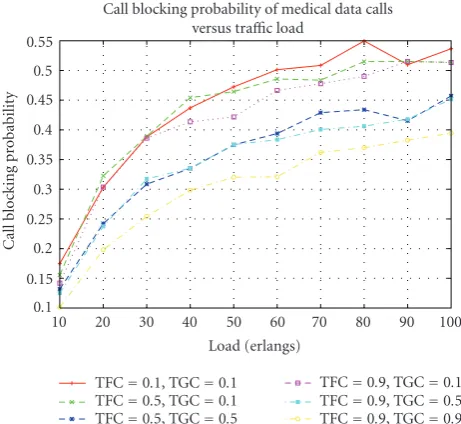
Figure 4shows blocking probabilities of nonmedical calls against offered traffic load for different values of TFC and TGC. For almost all of the values of TFC and TGC, the blocking probability remains low at very low loads of about 20 erlangs and it starts to increase significantly after that and stays almost constant and close to 1 after that. Call blocking probability is the highest when TFC and TGC are high and is low for lower values of TGC.Figure 5shows blocking proba-bilities of medical calls against offered traffic load for diff er-ent values of TFC and TGC. The value of call blocking prob-ability for medical calls is minimum when TFC and TGC are large, that is, 0.9. This is because of reserving channels for medical calls, and allowing a higher value of TFC allows less channels to be borrowed from neighbors. Also it is evident from the figure that TGC affects the blocking probability of medical calls more than TFC. For the same value of TGC, a higher value of TFC results in lower call blocking proba-bility.Figure 6shows the traffic blocking probability against offered traffic load. The reason for showing the traffic block-ing probability is because unlike conventional systems, the calls here have different rates and so blocking a call does not directly correspond to a proportional amount of traffic to be blocked.
7.2. Average delay and delay violations
Figure 7shows the average delay experienced by the pack-ets. The proposed scheme in this paper is labeled as PWH and is compared with earliest delay path first (EDF) algo-rithm. The EDF algorithm schedules the packet with the ear-liest deadline on the channel with the lowest delay. As can be seen from the figure, the proposed scheme achieves lower delay than the earliest-deadline-first policy. The adaptive se-curity scheme allows the AHM scheme to achieve lower de-lay than the EDF scheme. Figure 8 shows the delay viola-tions experienced by packets. The delay deadline is set to 500 milliseconds. Again, because of the reduction in the en-cryption delay, AHP achieves lower delay violations than the EDF scheme.
Call blocking probability of non-medical data calls versus traffic load
Figure4: Call blocking probability of nonmedical calls versus
traf-fic load.
Call blocking probability of medical data calls versus traffic load
Figure5: Call blocking probability of medical calls versus traffic
load.
7.3. Communication overhead for algorithm SKEA
The SKEA algorithm is simulated using TinyOS [40] and PowerTOSSIM [43,44]. The proposed SKEA algorithm uses keyed MACs for authentication purposes. In particular, we use MD5 [45] for calculating the keyed MAC with common global key, KCG, which contributes to the communication
10 20 30 40 50 60 70 80 90 100
Traffic blocking probability of medical data calls versus traffic load
Figure6: Traffic blocking probability of medical calls versus traffic
load.
Figure7: Average delay versus load.
payload size. With the use of keyed subMACs, we ensure data integrity and authenticity with minimal overhead.
Comparing with ALARM-NET, we see that for providing authentication only with a payload of 29 bytes, ALARM-NET reports to have a percentage overhead of 115% [46]; whereas using SKEA with subMAC of 1 byte we see an overhead of 3.45%. Figure 9shows the percent overhead for ALARM-NET and SKEA with variable subMAC sizes of 16, 8, and 1 byte.
7.4. Energy consumption for algorithm SKEA
Since body sensors have stringent power constraints, any protocol designed for body sensors must use the available energy efficiently. Our aim is to provide desired level of
se-10 20 30 40 50 60 70 80 90 100
Figure8: Delay violations versus load.
ALARM-NET SKEA-16 bytes
Figure9: Message authentication percentage overhead
(ALARM-NET versus SKEA).
curity while utilizing the least amount of additional energy as overhead. Energy consumption is a very important perfor-mance metric for analysis of any security algorithm in wire-less sensor networks. The SKEA algorithm is simulated using TinyOS [40] and PowerTOSSIM [43,44].
We now analyze the energy consumption overhead of using HMAC authentication with SKEA protocol for the symmetric key establishment phase. We simulate two sce-narios, first in which we perform key establishment using SKEA (with HMAC authentication) and the second key es-tablishment using modified SKEA (without HMAC authen-tication). We analyze the overhead that is caused by using HMAC authentication in terms of energy consumption.
5 10 15
SKEA-session key establishment using HMAC SKEA-session key establishment-no HMAC
Figure10: Total energy required per sensor to establish session key
using SKEA (with and without HMAC authentication).
% overhead in
Figure11: Percentage energy overhead using SKEA—Symmetric
session key establishment (with and without HMAC authentica-tion).
We observe that for all scenarios the total energy per sensor node for using HMAC authentication with SKEA is slightly higher (about 5%) than the case of not using HMAC authentication. Thus the proposed algorithm provides data integrity and authenticity using keyed MACs with a minimal overhead of about 5% in terms of energy consumption.
The percentage overhead in terms of radio energy, CPU energy, and total energy spent using the symmetric session key establishment scheme with HMAC authentication in SKEA is depicted in Figure 11. This figure shows that the SKEA scheme with HMAC authentication results in an en-ergy overhead of 4%–5% in terms of CPU, radio, and total energy. But using keyed MAC, data integrity and authentic-ity are supported and, therefore, the small overhead is justi-fiable.
8. CONCLUSION
This paper has presented channel allocation algorithm and packet scheduling algorithms that collaborate with an adap-tive security scheme. Since wireless channels exhibit highly
varying channel conditions and have limited capabilities, mobile telemedicine applications in the proposed algorithms take advantage of all the available wireless networks to be able to meet their QoS requirements. The main feature of the proposed priority assignment technique is to update priori-ties dynamically and adapt security based on whether pack-ets meet their delay over networks with different characteris-tics. Due to the importance of patient calls, base stations of wireless networks reserve some channels for patients calls de-pending on those thresholds that can cause minimal degra-dation in performance for nonpatient calls. The paper uses data differentiation to determine the status of the patient and predict the additional bandwidth that may be required by the patient in future. Using this scheme, the paper provides a higher channel availability for emergency medical data with-out reserving the network resources all the time.
This paper has also presented an energy efficient key es-tablishment scheme SKEA for body sensor networks. SKEA uses biometric signals to generate a session key. The scheme uses keyed message authentication codes for authentication purposes. The use of biometrics to generate the session key eliminates the need of computationally expensive key gen-erating functions. Moreover, biometrics reduces crosstalk in-terference between different subjects and avoids possibility of reflection attacks in a challenge-response protocol.
REFERENCES
[1] J. R. G´allego, A. Hern´andez-Solana, M. Canales, J. Lafuente, A. Valdovinos, and J. Fern´andez-Navajas, “Performance analy-sis of multiplexed medical data transmission for mobile emer-gency care over the UMTS channel,”IEEE Transactions on In-formation Technology in Biomedicine, vol. 9, no. 1, pp. 13–22, 2005.
[2] S. Cherukuri, K. K. Venkatasubramaniam, and S. K. S. Gupta, “BioSec: a biometric based approach for securing communi-cation in wireless networks of biosensors implanted in the hu-man body,” inProcedings of the 32nd International Conference on Parallel Processing Workshops (ICPPW ’03), p. 432, Kaohsi-ung, Taiwan, October 2003.
[3] C. C. Y. Poon, Y.-T. Zhang, and S.-D. Bao, “A novel biomet-rics method to secure wireless body area sensor networks for telemedicine and m-health,”IEEE Communications Magazine, vol. 44, no. 4, pp. 73–81, 2006.
[4] November 1995, Cryptographic Random Numbers Standard P1363: Appendix E.
[5] US National Library of Medicine, “Mediline plus medi-cal encyclopedia,” http://www.nlm.nih.gov/medlineplus/ encyclopedia.html.
[6] H. Holma and A. Toskala,WCDMA for UMTS, John Wiley & Sons, New York, NY, USA, 2002.
[7] S. Mangold, S. Choi, P. May, O. Klien, G. Hiertz, and L. Stibor, “IEEE 802.11 e wireless LAN for quality of service,” in Proceed-ings of the European Wireless, vol. 18, pp. 32–39, Florence, Italy, February 2002.
[8] A. Ghosh, D. R. Wolter, J. G. Andrews, and R. Chen, “Broad-band wireless access with WiMax/802.16: current performance benchmarks, and future potential,” IEEE Communications Magazine, vol. 43, no. 2, pp. 129–136, 2005.