Volume 2011, Article ID 643920,10pages doi:10.1155/2011/643920
Research Article
Network Coding-Based Retransmission for
Relay Aided Multisource Multicast Networks
Quoc-Tuan Vien,
1Le-Nam Tran,
2and Een-Kee Hong
31School of Engineering & Computing, Glasgow Caledonian University, Cowcaddens Road, Glasgow G4 0BA, UK
2Signal Processing Laboratory, ACCESS Linnaeus Center, KTH Royal Institute of Technology, 100 44 Stockholm, Sweden 3School of Electronics and Information, Kyung Hee University, Yongin, Gyeonggi-do 446-701, Republic of Korea
Correspondence should be addressed to Een-Kee Hong,[email protected]
Received 7 April 2010; Revised 24 January 2011; Accepted 13 February 2011
Academic Editor: Michael Gastpar
Copyright © 2011 Quoc-Tuan Vien et al. This is an open access article distributed under the Creative Commons Attribution License, which permits unrestricted use, distribution, and reproduction in any medium, provided the original work is properly cited.
This paper considers the reliable transmission for wireless multicast networks where multiple sources want to distribute information to a set of destinations with assistance of a relay. Basically, the reliability of a communication link is assured via automatic repeat request (ARQ) protocols. In the context of multisource multicast networks, the challenge is how to retransmit the lost or erroneous packets efficiently. In traditional approaches, the retransmission of lost packets from a single source is treated separately, and thus it may cause a considerable delay. To solve this problem, we propose the relay detects, combines, and forwards the packets which are lost at destinations using network coding. In the proposed ARQ protocol, the relay detects packets from different sources and combines the lost packets using NC. In particular, two packet-combination algorithms are developed to guarantee that all lost packets are retransmitted with the smallest number of retransmissions. Furthermore, we analyze the transmission bandwidth and provide the numerical results to demonstrate the superior performance of the proposed ARQ protocol over some existing schemes.
1. Introduction
Recently, relay communication has been extensively inves-tigated as a promising technique to extend the coverage of wireless networks by exploiting the spatial diversity gains [1–3]. Generally, the use of relays does not immediately increase the network throughput since packets traverse along the relays via store-and-forward manner. For some particular network topologies such as two-way relay channels, relay-assisted broadcast channels, and multicast channels, the net-work throughput can be dramatically improved by applying network coding (NC) at the relays [4–9]. The basic idea of NC is that the relays are allowed to perform algebraic linear operations on the received packets from multiple sources and forward the combined packet in the subsequent transmission.
In this paper, we consider the reliable transmission over multisource-multicast networks [10] with assistance of a relay, where multiple sources want to transmit their messages
to a set of intended destinations. This network model is widely applicable in various scenarios, in particular wireless ad hoc networks, where a set of sources needs to transmit data to a set of destinations through relays. One way to deliver information reliably over error-prone channels is to employ automatic repeat request (ARQ) protocols [11], in which, if a packet cannot be decoded, it is discarded and retransmitted. Applying the traditional ARQ techniques to multicast or broadcast networks may cause considerable delay for two reasons: (i) the lost packets of different destina-tions are retransmitted individually and (ii) the retrans-mission will be repeated until all destinations receive all packets correctly. To reduce the number of retransmissions, ARQ schemes based on NC have been proposed in [12,13]. The relay may XOR the disjointedly erroneous packets of different destinations and retransmit them to all the involving destinations.
S1
S2
D1
D2
R
Figure1: Multisource-multicast network model.
scenario where a source distributes information to multiple intended destinations, as in [5,14]. The problem of designing a retransmission mechanism for multisource-multicast net-works that can achieve a high network throughput efficiency has received less interest. The NC-based ARQ strategies for multicast networks proposed in [12] can be reused for multicast network by viewing a multisource-multicast network as a superposition of several multisource-multicast networks. More specifically, the lost packets in the same information flow can be XORed using the NC-based ARQ strategies for multicast networks. Here, The information flow is defined as the data transmission from a source to multiple destinations. However, this traditional NC-based ARQ may result in a poor throughput efficiency since the information flows from distinct sources are treated independently.
In this paper, we propose a new NC-based ARQ protocol for multisource-multicast networks, in which the relay de-tects, combines, and sends the lost packets from different sources to the destinations. To achieve the best performance, multiuser detection (MUD) techniques, such as optimum detector, linear decorrelating detector, decision-feedback detector, and successive interference cancellation. [15–19] are employed at the relay and destinations.
Thus, many lost packets from different sources can be combined and retransmitted. We need to develop an ARQ protocol to retransmit these lost packets in a systematic and efficient way. First, we classify lost packets into two types: Type-I includes the packets that are lost at the destinations but successfully received at the relay, and Type-II packets are lost at both destinations and the relay. Obviously, the sources must handle the retransmission of Type-II packets. The retransmission algorithm based on NC for sources can be easily designed since these packets are in the same flow, and thus it becomes the classical application of NC. The problem is how the relay efficiently retransmits Type-I packets that can come from different sources.
Dealing with that problem, we propose an algorithm at the relay to retransmit Type-I packets and an algorithm at the source to retransmit Type-II packets. Particularly, the algorithm for the retransmission at the relay is proposed based on an integration of NC and packet detection from two different sources.
1 2 3 4 5 6 7 8 9 10 1 2 3 4 5 6 7 8 9 10
1 2 3 4 5 6 7 8 9 10 1 2 3 4 5 6 7 8 9 10
1 2 3 4 5 6 7 8 9 10 1 2 3 4 5 6 7 8 9 10
1 5 8
1 4
4 9
1 2 3 6 7 8 10
3 9 5
1 2 7 8 8 10 3 5 6
3 5
1 5 2 10 8 1 7 2 6 8
2
3
2
⊕ ⊕ ⊕
⊕
⊕
⊕
⊕ ⊕ ⊕ ⊕
S1−→R
S2−→R
S1−→D1
S2−→D1
S1−→D2
S2−→D2
R
R
S1
S2 R S1 S2 RT protocol
Proposed protocol
Traditional NC-based ARQ protocol
Transmission phase
Retransmission phase
Figure2: Retransmission with RT, traditional NC-based ARQ, and our proposed protocol.
Unlike the traditional NC-based ARQ, the proposed method can combine the packets from different flows and thus can improve the network throughput for multisource-multicast networks. As we show later in an example (Figure 2), with our proposed ARQ protocol, the number of retransmissions is significantly reduced, comparing with other ARQ-based protocols. As a second contribution of the paper, we compare our proposed method with other ARQ-based protocols for multisource-multicast networks by evaluating the transmission bandwidth with theoretical analysis and numerical results. In fact, three protocols are taken into account: direct transmission (DT), relaying transmission (RT), and the traditional NC-based ARQ. DT protocol denotes the case when multiple sources simultane-ously transmit information to destination without relaying technique. RT protocol represents the model where relay participates in the transmission but NC is not performed at the relay (e.g., decode-and-forward relaying technique [2]).
The rest of this paper is organized as follows. InSection 2, we describe the system model of a multisource-multicast network. Different retransmission protocols are also pre-sented in this section, and their transmission bandwidths are derived inSection 3. We provide the numerical results in Section 4andSection 5concludes this paper.
2. System Model and Transmission Protocols
The system model under investigation is shown inFigure 1. The data delivery from two sources S1 and S2 to two
destinations D1 and D2 is assisted by a relay R. This is a
numbers of sources and destinations are 2 and 2, respectively. The generalization to cope with more than two sources and two destinations is straightforward.
In this paper, we assume that the sources send data in the form of packets (i.e., packet-based transmission) and each packet must be received correctly by all destinations after several transmissions and retransmissions. The packet loss of transmission from Sito R, fromSitoDj, and fromR toDjfollows Bernoulli trial with parameterspsir,psidj, and
prdj, respectively. We also assume that the sources and the relay are equipped with sufficient signal processing modules to be able to perform NC, that is, algebraic operation such as bitwise XOR operation.
Receiving the information data from multiple sources along with the feedback from the destinations, the relay knows what destinations are waiting for the lost packets to be retransmitted and then decides how to combine and forward the data to the intended destinations. In the following, we introduce some protocols that allow the relay to resend the lost packets to the destinations. The two fundamental DT and RT protocols are presented first, and our proposed protocol is followed.
2.1. DT Protocol. In this protocol, the sources send data directly to two destinations. The transmission is carried out with the traditional ARQ scheme and completed if two destinations receive correctly the data from two sources.
2.2. RT Protocol. This protocol is different from DT protocol in that the relay participates in the transmission. When one or two destinations do not receive the packet correctly, whereas the relay receives this packet successfully, the relay can help the source to forward the correctly received packet to the erroneously received destinations in the next time slot. The retransmission at the relay will be continued until its transmitted packet is correctly received by the intended destinations. In case that one or two destinations and the relay fail to receive the same packet from the sources, it is obvious that the sources need to resend that lost packet.
2.3. Proposed Protocol. Instead of resending the lost packet as soon as the destinations fail to receive it, the retransmission in the proposed ARQ protocol will happen afterNpackets.
The buffer of lengthNis required at two sources, whereas the buffer of length 2N is required at the relay and two destinations since they receive packets from two different sources. To improve the network throughput, the relay retransmits the packets of Type-I, and the sources deal with the retransmission of Type-II packets. What is particular in the proposed ARQ strategy is that the relay can mix the packets from different data flows.
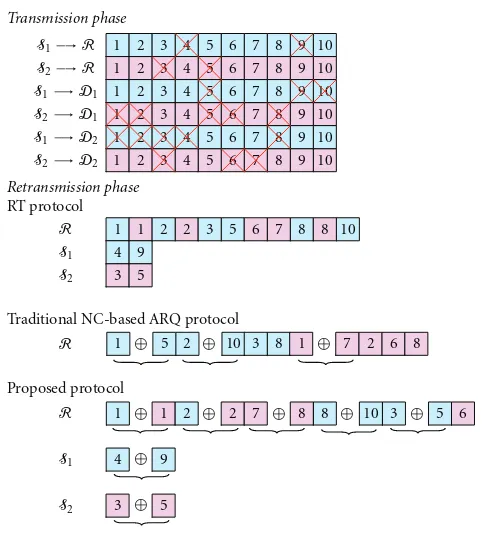
Let us describe the proposed protocol by examining an example shown in Figure 2, where Si wishes to deliver 10 packetssi[1],si[2],. . .,si[10] toD1andD2.
The packets with a crossover sign represent the lost or erroneous packets. Without loss of generality, we assume that, for the data flow from S1, the erroneous
packets received at R, D1, and D2 are {s1[4],s1[9]},
{s1[5],s1[9],s1[10]}, and{s1[1],s1[2],s1[3],s1[4],s1[8]},
re-spectively. Similarly, the erroneous packets received at R, D1, and D2 from S2 are assumed to be {s2[3],s2[5]},
{s2[1],s2[2],s2[5],s2[6],s2[8]}, and {s2[3],s2[6],s2[7]},
re-spectively.
As shown in Figure 2, R needs to retransmit 11
packets if applying RT protocol. The number of re-transmissions can be significantly reduced with the
tradi-tional NC-based ARQ scheme where R would transmit
{s1[1] ⊕ s1[5],s1[2] ⊕ s1[10],s1[3],s1[8]}, and {s2[1] ⊕ s2[7],s2[2],s2[6],s2[8]}. In this scheme, we could not
com-bine s1[3] and s1[8] since both of them are corrupted at
D2. Similarly, there is no way to combine s2[2], s2[6],
and s2[8] since s2[2] and s2[8] are simultaneously lost
at D2 and s2[6] is lost at both D1 and D2. Thus, 8
retransmissions are totally required for the traditional NC-based ARQ scheme. That helps R save 3 retransmissions. Not stopping at that, we can further reduce the number of retransmissions with our proposed scheme if packets from different data flows are detected in parallel at R,D1, and
D2. As in our above definition, packets{s1[1],s2[1],s1[2], s2[2],s1[3],s1[5],s2[6],s2[7],s1[8],s2[8],s1[10]} are Type-I
packets. To improve the network throughput,R forwards {s1[1]⊕s2[1],s1[2]⊕s2[2],s2[7]⊕s2[8],s1[8]⊕s1[10],s1[3]⊕ s1[5],s2[6]}in the retransmission phase. The details of this
combination algorithm are presented inAlgorithm 1. That means, the proposed ARQ requires 6 retransmissions and thus can save 2 further retransmissions comparing with the traditional NC-based ARQ scheme.Rretransmits these packets until they are successfully received by bothD1 and
D2.
We can see thats1[4],s1[9],s2[3], ands2[5] are lost atR
and also lost atD1 and/orD2. These packets are classified
as Type-II packets. Obviously, the relay has no way to resend such packets, and thus the sources must resend these packets. In the example,S1andS2retransmit the combined
packets{s1[4]⊕s1[9]}and{s2[3]⊕s2[5]}, respectively. The
destinations are able to recover the corrupted packets by XORing their correctly received packets with the XORed packets received from the relay or sources.
The generalization of the above example for the arbitrary buffer size is summarized in Figure 3. In this protocol, the combination algorithms at the relay and sources are presented in Algorithms1and2, respectively.
3. Transmission Bandwidth Analysis
In this section, we study the transmission bandwidth of different transmission protocols in multisource-multicast networks consisting of two sources, one relay, and two destinations. The transmission bandwidth is defined as the average number of transmissions that is required to successfully transmit two packets from two sources to two destinations.
Rchecks received packets
Rdecides which packets should be sent toD1and D2, and how to combine these packets in an
effective way based on Algorithm 1
D1andD2
Is there any left lost packets inD1andD2? protocol and in an effective way based
on Algorithm 2
S1andS2sendN
successive packets
Figure3: Block diagram of proposed protocol.
relay and network coding. The transmission bandwidth is given by
transmissions required forSi to send data to bothD1 and
D2and is calculated as [13]
n(si)
3.2. RT Protocol. In this protocol, the relay helps two sources in sending data to two destinations, but no NC is applied at the relay. The transmission bandwidth required to successfully transmit two packets fromS1and S2 toDi, i=1, 2, is given by
RT denotes the average number of transmissions to
send a packet fromSitoDjwith the help ofRand is found as [12]
Finally, the transmission bandwidth of this protocol is
nRT=max
3.3. Traditional NC-Based ARQ Protocol. The relay in this protocol combines the lost packets in the same flow based on NC in the retransmission phase. The transmission bandwidth is given by
nNCA=max
transmissions to transmit fromSito bothD1 andD2with
the help of R in the traditional NC-based ARQ (NCA) protocol. Note that the data delivery fromSitoD1andD2
throughR resembles the system model in [12]. However, the analysis of transmission bandwidth presented in [12] is difficult to follow. Here, we introduce a simple way to calculate the transmission bandwidth.
In this protocol, there are three steps to transmit data fromSitoD1andD2throughR.
Step 1. SitransmitsNpackets. Step 2. Rretransmits Type-I packets. Step 3. Siretransmits Type-II packets.
Letn(si,j)
NCA,i ∈ {1, 2}, j ∈ {1, 2, 3}, denote the number of
(1) Let 1and 2denote the ordered set of correctly received packet atRtransmitted fromS1
andS2, respectively:1= {s1[i1],s1[i2],. . .,s1[im]}, wherei1< i2<· · ·< im∈ {1, 2,. . .,N}, 2= {s2[j1],s2[j2],. . .,s2[j
n]}, wherej1< j2<· · ·< jn∈ {1, 2,. . .,N}. DefineΩ=1∪2and divideΩinto 3 groups:
(i) GroupΩ1includes packets thatRreceives successfully from bothS1andS2, that is, Ω1= {(s1[i],s2[j])|i=j}. In the preceding example, (s1[1],s2[1]), (s1[2],s2[2]),
(s1[6],s2[6]), (s1[7],s2[7]), (s1[8],s2[8]), and (s1[10],s2[10]) belongs toΩ1,
(ii) GroupΩ2includes packets thatRreceives successfully fromS1but fails to receive from
S2, that is,Ω2= {s1[i]|i /∈ {j1,j2,. . .,jn}}. InFigure 2,Ω2includess1[3] ands1[5].
(iii) GroupΩ3includes packets thatRreceives successfully fromS2but fails to receive from
S1:Ω3= {s2[j]|j /∈ {i1,i2,. . .,im}}. InFigure 2,Ω3includess2[4] ands2[9].
(2) For packets inΩ1, if one packet is correctly received atD1, lost atD2, while another packet is
correctly received atD2, lost atD1, we can combine these two packets.
Thus, there are 3 possibilities:s1[k1]⊕s2[k2] ors1[m1]⊕s1[m2] ors2[n1]⊕s2[m2]. Start from left to right in the group of packets inΩ1, and choose the suitable combination
(e.g.,s1[1]⊕s2[1],s1[2]⊕s2[2],s2[7]⊕s2[8], ands1[8]⊕s1[10] in the above example) (3) For packets inΩ2andΩ3, similarly if one packet is correctly received atD1, lost atD2,
while another packet is correctly received atD2, lost atD1, we can combine these two packets
in only one ways1[m1]⊕s1[m2] (forΩ2) ors2[n1]⊕s2[m2] (forΩ3). (e.g.,s1[3]⊕s1[5]
in the above example)
(4) For the remaining lost packets atD1andD2thatRreceives successfully but cannot perform
the combination, they are normally resent without using NC (e.g.,s1[6] in the above example)
Algorithm1: Algorithm at relay to retransmit Type-I packets.
(1) Through the feedback fromD1,D2, andR,Sidetermines the number and the position of remaining lost packets at destinations thatRalso fails in receiving them.
(2) Combine the packets for retransmission by NC with the condition that only one packet in the combined packet should be correctly received by only one destination, similar to the combination performed for packets inΩ2andΩ3explained inAlgorithm 1. In the preceding
example,S1resendss1[4]⊕s1[9] andS2resendss2[3]⊕s2[5].
(3) For the remaining lost packets atD1andD2thatSicannot perform the combination, they are resent without using NC.
Algorithm2: Algorithm at source to retransmit Type-II packets.
The average number of transmissions to send fromSito both D1andD2is calculated by
n(si)
NCA=
n(si,1)
NCA+n
(si,2)
NCA+n
(si,3)
NCA
N , (7)
where the number of transmissions inStep 1is simply given by
n(si,1)
NCA=N. (8)
The number of transmissions in Step 2 and in Step 3 is calculated by
n(si,2)
NCA=
N
k=0 CNkpN−ksir
1−psir
k En(si,2)
NCA|K=k
, (9)
n(si,3)
NCA=
N
k=0 CkNpN−ksir
1−psir
k
En(si,3)
NCA|K=k
, (10)
respectively, whereE[·] denotes the expectation,CN k is the total number of subsets consisting ofkelements in a set of
N elements, and K is a random variable representing the number of packets that R successfully receives in the first step.
Given that K = k packets are successfully received at Rin the first step, the number of transmissions atRusing traditional NCA protocol in the second step can be computed by
En(sis,2)
NCA |K=k
= k
i=0
k
j=0 Ck
ipisisd1
1−psisd1 k−i
Ck jp
j sisd2
1−psisd2 k−j
×mini,jnDT(r)+i−jnrda
,
(11)
whereis∈ {1, 2},n(DTr)is the average number of transmissions
otherwise. The term [min{i,j}n(DTr) +|i−j|nrda] in (11) is derived based on the fact that there are min{i,j} packets that the relay can combine with NC, and thus the number of transmissions is given by min{i,j}n(DTr). Then, the relay
transmits the remaining|i−j|packets to the corresponding destination depending on the relation ofiand j, that is, if
i > j, then R transmits (i− j) packets to D1, otherwise in the first step,Siis required to retransmit with the number of transmissions nrdaare given by (5) and (12), respectively.
3.4. Proposed Protocol. The relay in the proposed protocol combines the lost packets of different flows. Since the total of 2Npackets is transmitted fromS1andS2, the transmission
bandwidth is expressed as
n=n(1)+n(2)+n(3)
2N , (15)
wheren(i)denotes the number of transmissions in theith step
of the proposed protocol including the following steps.
Step 1. Each ofS1andS2transmitsNpackets.
Step 2. Rretransmits Type-I packets.
Step 3. S1and/orS2retransmit Type-II packets.
In Step1, bothS1andS2sendNpackets toR,D1, andD2,
and thus
n(1)=2N. (16)
The number of transmissions in Step2 and Step3are given by
respectively, whereK,L,Mare random variables represent-ing the number of packets thatRsuccessfully receives from Ω1,Ω2, andΩ3, respectively.
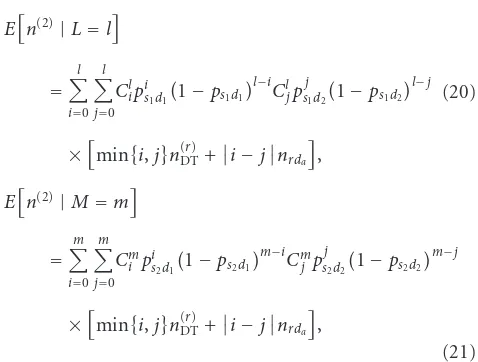
Given thatK =kpackets are successfully received atR in the first group, the number of transmissions atR based on the proposed algorithm (i.e.,Algorithm 1) for the packets inΩ1in the second step can be computed by
×Ck
transmissions is calculated by
En(2)|L=l In Step 3 where the relay fails to receive packets of the first group in the first step, the sources are required to retransmit these remaining lost packets with the number of transmissions
RT are given by (5) and (3), respectively.
For the second group and the third group inStep 3, the number of transmissions is computed by
En(3)|L=l
1, 2, denotes the number of transmissions to transmit data fromSito bothD1andD2throughRthat can be computed
In this section, we compare the transmission bandwidth of different protocols considered in our work by analytically evaluating the expressions inSection 3. In fact, the simula-tion and analytical results drawn inFigure 4demonstrate a strong agreement. Consequently, it is sufficient to show the analytical results in Figures5–7.
Figure 4 plots the transmission bandwidth of various ARQ protocols versusps1r, the packet error rate (PER) of the wireless link fromS1 to R. Both numerical and analytical
results are included. The range ofps1r is from 0.04 to 0.2 to characterize a wide range of wireless applications. To study the effect of the channels from the sources to the relay on the overall performance, we assume that ps1r = ps2r. The value of other PERs is arbitrarily set at ps1d1 = ps2d2 = 0.2,
0.04 0.06 0.08 0.1 0.12 0.14 0.16 0.18 0.2 1
1.2 1.4 1.6 1.8 2 2.2
ps1r
DT (simulation) DT (analytical) RT (simulation) RT (analytical)
Traditional NC-based ARQ (simulation) Traditional NC-based ARQ (analytical) Proposed (simulation)
Proposed (analytical)
T
ransmission
band
w
idth
Figure 4: Transmission bandwidth of different protocols over
ps1r = ps2r with ps1d1 = ps2d2 = 0.2, ps1d2 = ps2d1 = 0.3, and
prd1=prd2=0.1.
if ps1r is small, we have more Type-I packets inΩ1 than in
Ω2 and Ω3. For packets in Ω1, our proposed scheme can
save the number of retransmissions by mixing the packets from different flows. When ps1r is high (i.e., the channel from sources to relay is in bad condition), the relay mostly obtains the lost packets of Type-II. Consequently, the sources should retransmit these packets. In other words, there is little benefit in applying NC at the relay in this scenario. As a result, the performance of our proposed protocol converges to that of the traditional approach. Additionally, it can be seen that the analytical results are quite matched with the simulation results, and thus, in the following, we only show the analytical results.
Figure 5 compares the transmission bandwidth of our proposed protocol with that of the traditional NC-based ARQ protocol for different values of PER of the channels from sources to destinations. The simulation setting is similar to that in Figure 4. For a given value of psidj, our proposed approach always shows better performance than the traditional NC-based ARQ protocol. What is particular in Figure 5 is that the transmission bandwidth of our proposed protocol converges to a certain value at low ps1r regardless ofps1d1and ps1d2. That means, when ps1ris small, the reliability of the channels from sources to destinations has little impact on the transmission bandwidth of the proposed protocol. In fact, a small value ofps1rdenotes the case whereRcertainly detected the packets fromS1andS2
successfully. As a result, the lost packets at the destinations belong to Type-I. Thus, the relay handles the retransmission of these packets, and the impact of the direct channels from sources to destinations is negligible.
0.04 0.06 0.08 0.1 0.12 0.14 0.16 0.18 0.2
ps1r 1
1.2 1.4 1.6 1.8 2
T
ransmission
band
w
idth
Traditional NC-based ARQ (ps1d1=0.2,ps1d2=0.3)
Traditional NC-based ARQ (ps1d1=0.3,ps1d2=0.4)
Traditional NC-based ARQ (ps1d1=0.4,ps1d2=0.5)
Proposed (ps1d1=0.2,ps1d2=0.3)
Proposed (ps1d1=0.3,ps1d2=0.4)
Proposed (ps1d1=0.4,ps1d2=0.5)
Figure5: Transmission bandwidth comparison of traditional NC-based ARQ and our proposed protocol for different values ofpsidj.
0.1 0.15 0.2 0.25 0.3 0.35 0.4 1
1.2 1.4 1.6 1.8 2 2.2 2.4 2.6
ps1d1
DT RT
Traditional NC-based ARQ Proposed
T
ransmission
band
w
idth
Figure 6: Transmission bandwidth of different protocols over
ps1d1 = ps2d2 with ps1d2 = ps2d1 = ps1d1+ 0.1,ps1r = ps2r =0.1, andprd1=prd2=0.1.
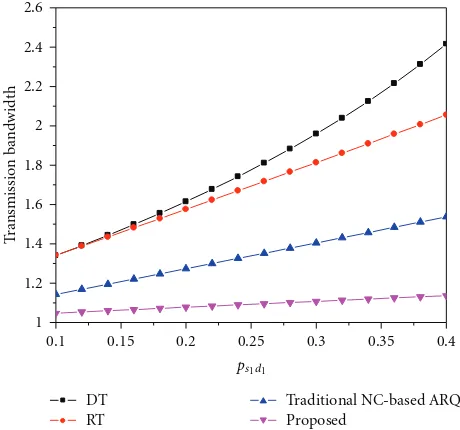
In Figures6and7, we show the transmission bandwidth of various ARQ protocols with respect tops1d1. The PERs of the channels from the sources to the relay and from the relay to the destinations are fixed. The values ofps1d2andps2d1are adjusted accordingly tops1d1by the relation ps1d2 = ps2d1 =
0.1 0.15 0.2 0.25 0.3 0.35 0.4
ps1d1
1 1.1 1.2 1.3 1.4 1.5 1.6
Traditional NC-based ARQ (prd1=0.1,ps1r=0.1) Traditional NC-based ARQ (prd1=0.1,ps1r=0.05) Traditional NC-based ARQ (prd1=0.05,ps1r=0.05) Proposed (prd1=0.1,ps1r=0.1)
Proposed (prd1=0.1,ps1r=0.05) Proposed (prd1=0.05,ps1r=0.05)
T
ransmission
band
w
idth
Figure7: Transmission bandwidth of traditional NC-based ARQ and our proposed protocol overps1d1 =ps2d2withps1d2= ps2d1 =
ps1d1+ 0.1 and differentps1r=ps2r,prd1=prd2.
we conclude that the performance of our developed ARQ scheme is not sensitive to the quality of the channels from the sources to the destinations. The channelsSi → Rand R →Diare more important than the channelsSi →Dj.
5. Conclusion
In this paper, we propose a new reliable transmission scheme for wireless multisource-multicast networks based on NC. For a specific case of multisource-multicast networks with two sources and two destinations, we present two pack-et-combination algorithms to retransmit the lost packets efficiently. The transmission bandwidth of various ARQ protocols is analyzed. Furthermore, we provide numerical results with different simulation settings to demonstrate the effectiveness of our proposed scheme in saving the trans-mission bandwidth. For future works, one could possibly investigate the performance of fading channels with path loss and placement of the nodes.
Acknowledgment
This paper was partly supported by the IT R&D program of MKE/KEIT (KI001814, Game Theoretic Approach for Crosslayer Design in Wireless Communications) and this work 2010-0025926 was partly supported by Mid-career Researcher Program through NRF grant funded by the MEST.
References
[1] A. Sendonaris, E. Erkip, and B. Aazhang, “User cooperation diversity—part I: system description,”IEEE Transactions on Communications, vol. 51, no. 11, pp. 1927–1938, 2003. [2] J. N. Laneman, D. N. C. Tse, and G. W. Wornell, “Cooperative
diversity in wireless networks: efficient protocols and outage behavior,”IEEE Transactions on Information Theory, vol. 50, no. 12, pp. 3062–3080, 2004.
[3] B. Nazer and M. Gastpar, “Compute-and-forward: harnessing interference through structured codes,” inProceedings of IEEE International Symposium on Information Theory (ISIT ’08), pp. 772–776, Toronto, Ontario, Canada, July 2008.
[4] R. Ahlswede, N. Cai, S. Y. R. Li, and R. W. Yeung, “Network information flow,”IEEE Transactions on Information Theory, vol. 46, no. 4, pp. 1204–1216, 2000.
[5] R. Koetter and M. M´edard, “An algebraic approach to network coding,”IEEE/ACM Transactions on Networking, vol. 11, no. 5, pp. 782–795, 2003.
[6] S. Katti, D. Katabi, W. Hu, H. Rahul, and M. Medard, “The importance of being opportunistic: practical network coding for wireless environments,” inProceedings of the 43rd Annual Allerton Conference on Communication, Control and Computing (Allerton ’05), Montecillo, Ill, USA, September 2005.
[7] S. Zhang, S. C. Liew, and P. P. Lam, “Hot topic: physical-layer network coding,” in Proceedings of the 12th Annual International Conference on Mobile Computing and Networking (MOBICOM ’06), pp. 358–365, New York, NY, USA, Septem-ber 2006.
[8] S. Katti, S. Gollakota, and D. Katabi, “Embracing wireless interference: analog network coding,” in Proceedings of the ACM Conference on Applications, Technologies, Architectures, and Protocols for Computer Communications (SIGCOMM ’07), pp. 397–408, Kyoto, Japan, August 2007.
[9] S. Katti, H. Rahul, W. Hu, D. Katabi, M. Medard, and J. Crowcroft, “XORs in the air: practical wireless network coding,”IEEE/ACM Transactions on Networking, vol. 16, no. 3, pp. 497–510, 2008.
[10] P. Larsson, “Multicast multiuser ARQ,” inProceedings of the IEEE Wireless Communications and Networking Conference (WCNC ’08), pp. 1985–1990, Las Vegas, Nev, USA, March 2008.
[11] S. S. L. Chang, “Theory of information feedback systems,”
IEEE Transactions on Information Theory, vol. 2, no. 3, pp. 29– 40, 1956.
[12] P. Fan, C. Zhi, C. Wei, and K. B. Letaief, “Reliable relay assisted wireless multicast using network coding,” IEEE Journal on Selected Areas in Communications, vol. 27, no. 5, pp. 749–762, 2009.
[13] D. Nguyen, T. Tran, T. Nguyen, and B. Bose, “Wireless broad-cast using network coding,”IEEE Transactions on Vehicular Technology, vol. 58, no. 2, pp. 914–925, 2009.
[14] S. Y. R. Li, R. W. Yeung, and N. Cai, “Linear network coding,”
IEEE Transactions on Information Theory, vol. 49, no. 2, pp. 371–381, 2003.
[15] S. Verdu, Multiuser Detection, Cambridge University Press, Cambridge, UK, 1998.
[17] R. Lupas and S. Verdu, “Linear multiuser detectors for synchronous code-division multiple-access channels,” IEEE Transactions on Information Theory, vol. 35, no. 1, pp. 123– 136, 1989.
[18] A. Duel-Hallen, “Decorrelating decision-feedback multiuser detector for synchronous code-division multiple-access chan-nel,”IEEE Transactions on Communications, vol. 41, no. 2, pp. 285–290, 1993.
[19] P. Patel and J. Holtzman, “Analysis of a simple successive interference cancellation scheme in a DS/CDMA system,”