R E S E A R C H
Open Access
Self-coordination of parameter conflicts in
D-SON architectures: a Markov decision
process framework
Jessica Moysen
*and Lorenza Giupponi
Abstract
We consider a distributed SON (D-SON) architecture where the interaction of different self-organizing network (SON) functions negatively affect the performances of the system. This is referred to in 3rd Generation Partnership Project (3GPP) as a SON conflict, which needs to be handled by means of a self-coordination framework. We focus on a functional architecture and a theoretical framework based on the theory of Markov decision process (MDP) for the self-coordination of different actions taken by different SON functions. In order to cope with the complexity of the overall SON problem, we subdivide the global MDP modeling the long-term evolution (LTE)-enhanced node base station (eNB) onto simpler subMDPs modeling the different SON functions. Each sub-problem is defined as a subMDP and solved independently by means of reinforcement learning (RL), and their individual policies are combined to obtain a global policy. This combined policy can execute several actions per state but can introduce policy conflicts. We focus on the specific SON conflict generated by the concurrent execution of coverage and capacity optimization (CCO) and inter-cell interference coordination (ICIC) SON functions, which may require to update the same parameter, i.e., the transmission power level. The coordination among the different actions selected by the conflicting use cases is achieved by means of a coordination game where the players are the subMDPs and the actions and rewards are those provided by means of a RL approach. Performance evaluation is carried out in a ns3 release 8 compliant LTE system simulator, and it shows that our self-coordination approach provides satisfying solutions in terms of system performances for both the conflicting SON functions.
Keywords: Self-organizing network; SON conflicts; Self coordination; Markov decision process; Reinforcement learning; Coordination games; Long-term evolution; Inter-cell interference coordination function; Coverage and capacity optimisation function
1 Introduction
A promising approach, which is receiving significant interest from industrial and research communities, to maximize total performance in cellular networks, is to bring into them intelligence and autonomous adaptabil-ity. This is referred to as self-organizing network (SON). This concept has been introduced by 3rd Generation Partnership Project (3GPP) in release 8 and it has been expanding across subsequent releases. The main objec-tive of SON is to reduce the costs associated with network operations, by diminishing human involvement, while
*Correspondence: [email protected]
Centre Tecnològic de Telecomunicacions de Catalunya, Av. Carl Friedrich Gauss 7, 08860 Castelldefels, Spain
enhancing network performance, in terms of network capacity, coverage, and service quality. The main moti-vation behind the increasing interest in the introduction of SON is twofold. On the one hand, from the techni-cal perspective, the complexity and large stechni-cale of future radio access technologies imposes significant operational challenges due to the multitude of tuneable parameters and the intricate dependencies among them. In addi-tion, the advent of new heterogeneous kind of nodes like femto, pico, relays, etc., is expected to make tremendously increase the number of nodes in this new ecosystem, so that traditional network management activities based on, e.g., classic manual and field trial design approaches are not viable anymore.
Different architectural solutions have been designed, ranging from a centralized SON (C-SON), where the self-organizing algorithms reside in the network management system, in the operation and maintenance center (OMC) or in the network management systems (NMS), to a dis-tributed SON (D-SON) solution, where the SON func-tions are distributed, in the control plane, across the edges of the network, typically in the enhanced node base sta-tions (eNB). C-SON can take into consideration data from all nodes in the network to identify and address network-wide issues. However, centralized systems may respond too slowly in the emerging world of small cells that expe-rience very transitory traffic loads. On the other hand, D-SON functionalities are designed for near real-time response in seconds or milliseconds, which makes the SON functions highly dynamic and enables the network to adapt to local changes more rapidly. The main challenge in a D-SON implementation is that, it is more vulnera-ble than C-SON against network instabilities caused by the concurrent operation of SON functions with conflict-ing objectives. In particular, multiple SON functions, or instances of the same function running in neighboring cells, can be executed in parallel and may then interact such that the originally intended operation from one func-tion is affected, and the related system performance may be different from what was intended to be. In 3GPP, this kind of negative interactions, which affect the system per-formances, is referred to as SON function conflict, and the general framework to solve them is referred to as self-coordination. The literature on SON mainly focuses on individual SON function design, [1-3] while some ini-tial work on self-coordination functions can be found in [4-6] and [7] where the authors focused on the identifica-tion and classificaidentifica-tion of different conflict types. Algorith-mic solutions [8,9] and implementation challenges [10] have been recently discussed in literature.
In this paper, we target the self-coordination problem in a small cell network. As a result, in the context of a D-SON architecture, we propose a theoretical framework and a functional architecture, which can be easily implemented for self-coordination in 3GPP networks. We propose to map the multiple eNBs in the scenario onto a multia-gent system, where each entity is a self-organized amultia-gent capable of making autonomous decisions. The multiple agents interact among each other through their actions and operate within an environment, which in our case is the wireless setting. We propose that the theoretical model behind each agent is the theory of Markov decison process (MDP), able to model a dynamic process which evolves through stages, as a result of stochastic actions. In each stage, the MDP chooses one of several actions, and the system stochastically evolves to a new state based on the current state and the chosen action. The solution to a MDP determines a policy which specifies the action to
be selected at each time step, such that a certain objective function is maximized. The eNBs have to be capable of executing the multiple standardized SON functions, each one resulting in a different action, e.g., increasing trans-mission power, modifying the antenna tilt, altering the handover parameters, etc. While in [8], the authors focus on the interactions of two SON functions and on the solu-tion of the MDP obtained as the result of their concurrent execution, we consider that this approach is not scalable, when more SON functions and their instances across mul-tiple cells are running in parallel. The global SON problem including all the standardized SON functions and related instances would become extremely complex. To solve it, we should rely on multi-objective optimization frame-works, which do not allow real-time solutions [11]. As a result, we propose to subdivide the proposed Markov decision problem into several simpler subproblems repre-sented by the different SON functions and their instances. This results in a MDP organized onto multiple tasks which are theoretically modeled by different Markov decision sub-processes (subMDP). Each subMDP can be solved independently through the theory of reinforcement learn-ing (RL), which has already been proposed in the literature of self-organization and heterogeneous networks (Het-Nets) as a valid solution [12], and which allows to make decisions taking into account the past experience. The solution to each subMDP provides a local policy. The mul-tiple solution policies are then combined to obtain a global solution, such that the actions of each subMDP can be executed concurrently. In MDP literature, this approach is referred to asconcurrent actionsmodel [13,14].
are the solutions to the specific subMDPs, i.e., the out-put of the actor critic algorithm, and the rewards are those provided by the solution of the individual sub-MDPs. Coordination games have been proven to correctly model the coordination problems that arise when there is a conflicting interest, i.e., when two or more persons prefer different equilibrium outcomes. This is why we consider that they are appropriate to model the problems that the coordination function has to face. The self-coordination framework aims then at founding a Nash equilibrium through the coordination game, maximizing the average reward. The proposed approach is validated through system level simulations based on the release 8 compliant platform LTE-EPC network simulator (LENA), available in ns3.
The outline of the paper is organized as follows. Section 2 discusses the work related to this paper from standardization, market, and academic perspec-tives. Section 3 provides the details of the system model. Section 4 describes the MDP framework for the execu-tion of concurrent SON funcexecu-tions. Secexecu-tion 5 presents a functional architecture for the solution of SON conflicts. Section 6 defines the global SON problem modeling it through a MDP, and its decomposition through subMDPs modeling the different SON functions. Section 7 describes the CCO and ICIC conflict case study. Section 8 describes the details of the simulation platform and scenarios, as well as meaningful simulation results. Finally, Section 9 concludes the paper.
2 Related work
SON functionalities are often designed as stand-alone functionalities, by means of control loops. When they are executed concurrently in the same or different network elements, the impact of their interactions is not easy to
be predicted, and unwanted effects may occur. The risk of unacceptable oscillations of configuration parameters or undesirable performance results increase with the num-ber of SON functions, so that it is considered necessary to define and implement a self-coordination framework [3,4,8].
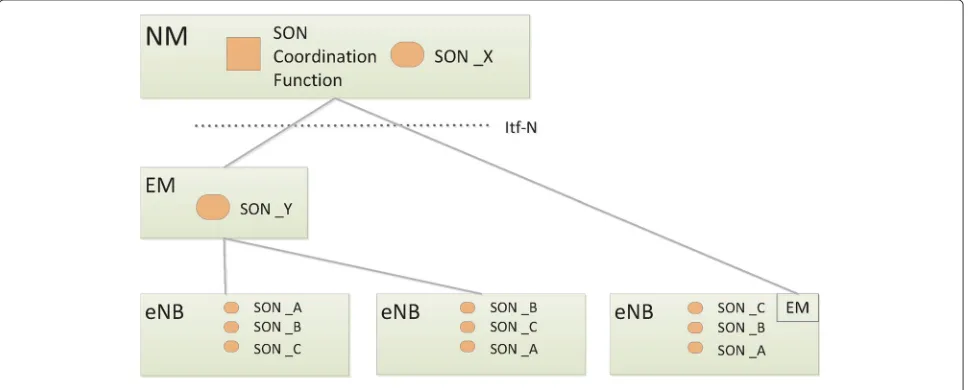
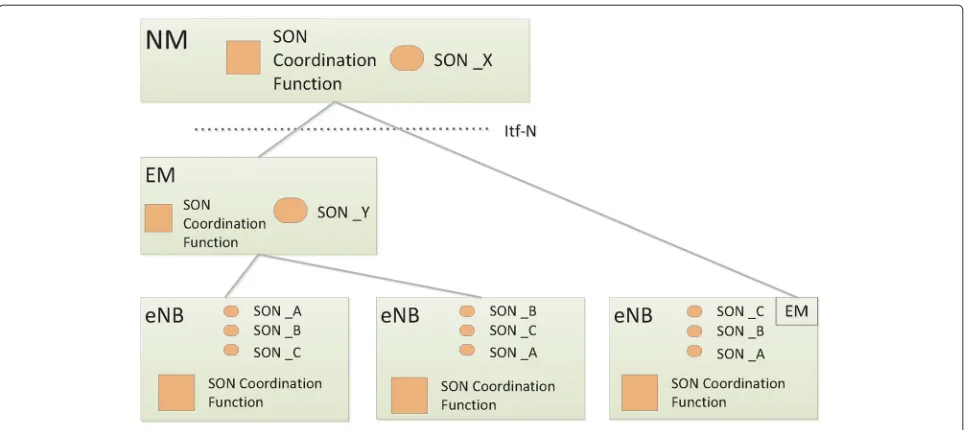
3GPP has proposed different architectures for SON implementation, ranging from centralized C-SON to dis-tributed D-SON, as it is shown in Figures 1 and 2, and the choice of the architecture has a strong impact on the efficiency of the self-coordination framework. If C-SON is used, SON functions are implemented in the OMC or in the NMS, as part of the operation and support system (OSS). This implementation benefits from global infor-mation about metrics and key performance indicators (KPIs), as well as computational capacity to run powerful optimization algorithms involving multiple variables or cells. However, it suffers from long timescales. In order to avoid oscillations of decision parameters, 3GPP requires [17] that each SON function asks for permission before changing any configuration parameter. This means that a request must be sent from the SON function to the SON coordinator and a response has to be returned. In C-SON, all these requests must pass through the interface-N, which is not suitable for real-time commu-nication, so that there is no possibility to give priority to SON coordination messages over other operations, administration, and maintenance (OAM) messages. If in turn, distributed coordination is used, the interaction between the SON function and the local SON coordi-nator will be over internal vendor-specific interfaces, with much lower latency characteristics. This makes the D-SON architecture much more flexible and adequate for small cell networks, which experience very transitory traffic loads, thus requiring high reactivity to propagation
Figure 2D-SON self-coordinator implementation.
and traffic conditions. Market implementations of C-SON are offered by vendors like Celcite (acquired by AMDOCS), Ingenia Telecom, and Intucell (acquired by Cisco), while D-SON solutions have traditionally been more challenging to implement and vendor specific, not allowing for easy interaction of products from differ-ent vendors, so that a supervisory layer is commonly still needed to coordinate the different instances of D-SON across a much broader scope and scale. Only recently, vendors like Qualcomm or Airhop have started proposing D-SON as a SON mainstream, as small cells and HetNets require the millisecond response times of D-SON.
The topic of conflicts resolution and coordination has been receiving growing interest also from academic com-munity. In [6,7,15], the authors focus on the classifica-tion of potential SON conflicts and on discussing the valid tools and procedures to implement a solid self-coordination framework. Examples of centralized and distributed implementations of SON coordination are offered in [18] and [19], respectively. A preventive coor-dination mechanism that uses policy-based decision-making has been proposed in [10]. Guard functions have been proposed in [4] to detect undesirable network behav-iors and trigger countermeasures. Decision trees have been proposed in [20] for properly adjusting remote elec-trical tilt (RET) and transmission power. Q-learning, as a RL method, has been proposed in [8] to take advantage of experience gained in past decisions, in order to reduce the uncertainty associated with the impact of the SON coor-dinator decisions when picking an action over another to resolve conflicts.
3 System model
We consider a heterogeneous wireless network composed of a set ofMmacrocells that coexist withF small cells. The M= |M| macrocells form a regular hexagonal net-work layout with inter-site distance Dand provide cov-erage over the entire network, comprising both indoor and outdoor users. The F= |F| small cells are placed indoors within the macro-cellular coverage area follow-ing the 3GPP dual strip deployment model. Both macro and small cells operate in the same frequency band, which allows to increase the spectral efficiency per area through spatial frequency reuse.
An orthogonal frequency division multiple access (OFDMA) downlink is considered, where the system bandwidthBW is divided intoBresource blocks (RBs). A RB represents one basic time-frequency unit that occupies the bandwidthBWRB over timeT. In particular, in LTE systems, each frame has a duration of 10 ms, divided into equally sized transmission time interval (TTI), which have a duration of 1 ms. The bandwidthBis divided intoBRB= 180 kHz physical RBs which are grouped in resource block group (RBG) of different sizes determined as a function of the transmission bandwidth configuration in use. Asso-ciated with each macro and small cell base station (BS) areUMmacro andUFsmall cell users, respectively. The multiuser resource assignment that distributes theBRB among theUMmacro andUFfemto users is carried out by a proportional fair scheduler.
PmaxM , withPFmaxPMmax, such thatBr=0pmr,t ≤ PMmax,m∈M andBr=0pfr,t≤PF
max,f∈F.
We analyze the system performance under different perspectives. First of all, we consider the signal-to-interference and noise ratio (SINR). Assuming perfect synchronization in time and frequency, the SINR of macrouserumwho is allocated RBbof macrocellm∈M amounts to: wherehmub,t accounts for the link gain between the trans-mitting macro BSmand its macrouserum; whilehnub,tand hfub,trepresent the link gain of the interference that BSsn andf imposes on macrouserum, respectively. Finally,σ2 denotes the thermal noise power.
Likewise, the SINR of small cell uservf who is allocated
in RBbby small cellf∈Fis in the form: andmand small cell uservf, respectively.
We also use as a meaningful indicator of quality per-ceived by users the channel quality indicator (CQI). This is computed based on the spectral efficiency per user, using the mapping function as indicated in [21], where the block error rate (BLER) BLER=1−explog(1−TBSBLER), should be smaller or equal to 10%, and the transport block size (TBS) for the estimated CQI is calculated as reported in [21]. As a system metric, we also use the reference signal received quality (RSRQ) from the serving cells, which is defined as the number of RBs multiplied by the reference signal received power (RSRP) over the system bandwidth BW multiplied by reference signal strength indication (RSSI). Finally, the throughput per user is achieved by user data protocol (UDP) client application.
4 Theoretical model of SON conflicts: a Markov decision process framework
We propose a framework where the decision makers are the 3GPP eNBs. The learner or decision maker is called agent, and it interacts continuously with the so-called environment. The agent selects actions and the environ-ment responds to those actions and evolves into new situations. In particular, the environment responds to the actions through rewards, i.e., numerical values that the agent tries to maximize over time.
The agent has to exploit what it already knows in order to obtain a positive reward, but it also has to explore in
order to take better actions in the future. We assume that the environment is the wireless cellular scenario, with all its realistic characteristics, in terms of mobility of users, channel variations, and users’ activity patterns. The prob-lem is then defined by means of a Markov decision process
{S,A,T,R}, whereS, is the set of possible states of the environmentS = {s1,s2,. . .,sn},Ais the set of possible
actionsA= {a1,a2,. . .,aq}that each decision maker may
choose,T is the probability of moving to states+1 when actiona is taken in state s, andRis a reward function
R(s,a), which specifies the immediate return when taking actiona in states. The interactions between the multi-agent system and the environment at each time instantt consist of the following sequence.
• Agentisenses the statesit=s∈S.
• Based ons, agentiselects an actionait=a∈A.
• As a result, the environment makes a transition to the new statesit+1=v∈S.
• The transition to the statevgenerates a reward rti=r∈R.
• The rewardris fed back to the agent and the process is repeated.
In the following, we remove the notation indicating the specific agenti, for the sake of simplicity. The solution to a MDP is based on the RL framework [22]. At each time step, the agent implements a mapping from states to prob-abilities of selecting each possible action. This mapping is the agent’spolicy. The objective of each learning process is to find an optimal policyπ∗(s)∈Afor eachs, to max-imize some cumulative measure of the rewardrreceived over time. Almost all RL algorithms are based on estimat-ing a so-calledvalue function, which is a function of the states estimating how good it is for an agent to be in a given state. The quantification of this is defined based on the expected future rewards. Of course, the rewards that an agent can expect to receive in the future depend on what actions it will take. As a result, the value of a state s under a policyπ, and denoted Vπ(s), is the expected return when starting insand followingπthereafter:
Vπ(s)=Eπ
whereEstands for the expectation operator,tis any time step, and 0≤γ ≤1 is a discount factor.
space during each iteration. As a result, the temporal com-plexity of these solution methods can be very large when they are applied to complex problems represented by big state-action spaces. In order to reduce the complexity of MDPs, the literature proposes three approaches: factor-ization [24], abstraction [25], and decomposition [26]. The idea behind thefactorizationapproach is to address the complexity of the problem by identifying variables, which determine the state of the environment and the specific actions which have an effect on them, under certain con-ditions. In this framework, a state is implicitly described by an assignment to a set of state variablesX= {x1, ...,xn},
where the state at time tis now represented as a vector Xt = x1,t, ...,xn,t, where Xi,tdenotes theith state
vari-able at timet[27]. Furthermore, the rewards can often also be decomposed as a sum of rewards related to individ-ual variables. Theabstraction approach, in turn, creates an abstract model that aims at generating an equivalent simplified MDP by mapping a group of states, sharing a local behavior, onto a single state. Finally, the decom-position approach subdivides the complex problem into smaller tasks. Each task is modeled by means of a sub-MDP and the value function and optimal policy for the MDP associated to each subtask are computed and then combined.
We rely then on the so-called decomposition approach [13], which subdivides the autonomous decision making process into multiple tasks represented by the individ-ual SON functions. This results in a MDP organized onto multiple tasks which are theoretically modeled by dif-ferent subMDPs. Each subMDP is solved independently through actor critic (AC), as described in the next section, and the resulting policies are combined to obtain a global solution.
4.1 Learning the optimal policy
We have modeled the eNBs as decision makers through a MDP, which we propose to factor onto as many sub-MDPs as SON functions the eNB needs to execute in parallel. The solution of a MDP passes through the the-ory of RL, which offers different alternatives depending on the peculiarities of the problem to solve. A possible solution could be based on the theory of dynamic pro-gramming. However, in the complex wireless environment where the decision makers are operating, it is not possible to evaluate the probabilities of transition from one state to another, as a result of a given set of actions, as it would be necessary to apply this kind of solutions. Another group of potential solutions is based on time-difference learning methods, which allow to make decisions online and self-adapting to the natural evolution of the wire-less environment as a function of the mobility of users, traffic patterns, propagation characteristics, etc. Numer-ous embodiments of temporal difference (TD) learning
exist (Q-learning, SARSA, actor critic, etc.), where we concentrate on the actor critic approach, which in its very nature is suited for dynamical wireless systems, for its capability of learning from experience and its compu-tational complexity. These kinds of methods are able to learn directly from experience, without a model of the environment’s dynamics.
RL solutions based on time difference algorithms such as Q-learning [28] or some actor critic approaches [29] can be proven to converge to the optimal policy when only one agent/decision maker is present in the sce-nario. It is worth mentioning, anyway, that the eventual convergence to the optimal is reassuring in theory, but could be useless in practical terms, as an agent that quickly reaches the 99% of optimality is preferable in most applications compared to another agent guaranteed of eventual optimality, but with a very low learning rate [30]. When more agents are present in the scenario, as it is the case in our setting, the standard convergence proof of time difference algorithms does not hold any-more, as the Markov transition models depend also on the unknown policies of the other learning agents. How-ever, in practice, these learning schemes have been shown to provide successful results also in multiagent scenar-ios [31]. The generalization of the MDP problem to a multiagent system is a stochastic game. In this case, we cannot prove the eventual optimality, but we can prove the existence of a Markov perfect equilibrium [32], which also is a challenging problem in decentralized wireless networks.
AC methods are TD methods that have a separate mem-ory structure to represent the policy independently of the value function. The policy structure is known as theactor, since it is used to select the actions, while the estimated value function is known as thecritic. The critic learns and critiques whatever policy is currently being followed by the actor and takes the form of a TD errorδ, which is used to determine ifatwas a good action or not.δis a scalar
sig-nal, which is the output of the critic and drives the learning procedure. After each action selection, the critic evalu-ates the new state to determine whether things have gone better or worse than expected, as it is defined by the TD error:
δt=rt+γVt(st+1)−Vt(st) (4)
where V is the current value function implemented by the critic to evaluate the actionattaken inst. If the TD
error is positive, it suggests that the tendency to select at should be strengthened for the future, whereas if the
TD error is negative, it suggests that the tendency should be weakened. We identify this tendency with a preference function P(st,at), which indicates the tendency or
the strengthening or weakening described above can be implemented by increasing or decreasingP(st,at)by:
P(st,at)←P(st,at)+β δt (5)
whereβis a positive learning parameter. This is the most simple implementation of a AC algorithm. The variation that we consider for implementation is to add different weights to different actions, for example, based on the probability of selecting actionatin statest, i.e.,π(st,at),
which results in the following update rule:
P(st,at)←P(st,at)+β δt(1−π(st,at)) (6)
In this implementation, AC directly implements the Boltzmann exploration method to select actions as fol-lows:
π(st,at)=
eP(st,at)
at∈Ae
P(st,at)/τ (7)
This means that the probability to select an actiona in statesat timetdepends on the temperature parameterτ and on the preference valuesP(st,at)at timet. In this kind
of exploration, actions that seem more promising, because of higher preference values, have a higher probability of being selected.
5 Functional architecture
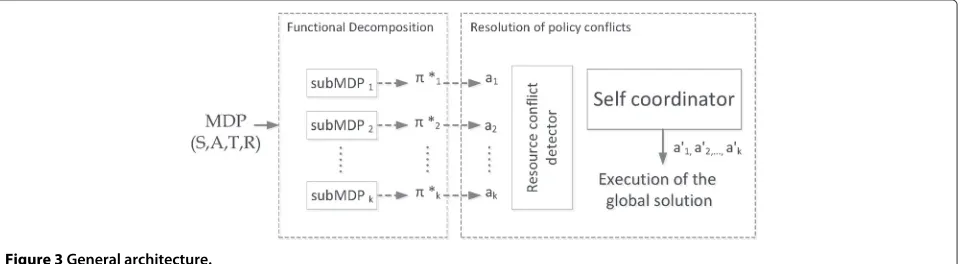
We model the self-organized decision-making process of the eNB, characterized by the multiple parallel SON func-tions, by means of a MDP. The problem, involving all the radio access autonomous functions, is so complex that it cannot be handled by means of classical approaches. We rely on the decomposition approach, which subdi-vides the autonomous decision-making process into mul-tiple tasks represented by the simpler SON functions’ decision-making processes. This results in a MDP orga-nized onto multiple tasks which are theoretically mod-eled by different subMDPs. Each subMDP is solved independently, and their policies are combined to obtain a global solution, such that the actions of each subMDP can be executed. This is illustrated in Figure 3.
If the tasks are independent, the policies can be exe-cuted without incurring into conflicts. However, if it is not the case, and the selected actions for each task are executed concurrently and not serially, conflicts among local policies may arise, which may result in undesir-able behaviors. In order to solve SON conflicts, we propose a functional architecture based on two main functions:
• Functional decomposition: It is the function in charge of breaking the complex problem into tasks. The complex MDP is subdivided intoksubMDPs, which are solved locally.koptimal policies π∗
1,. . .,πk∗are obtained so that at each time stept
actionsa1,. . .,akcan be selected.
• Resolution of policy conflicts: It is the function in charge of detecting and solving potentially conflicting policies, which are to be executed concurrently. The resource conflict detector entity, represented in Figure 3, evaluates whether two or more of the actionsa1,. . .,akaim at modifying the same
parameter. In this case, the conflict is detected and theself-coordinator entity is activated to solve the conflict. The result is the execution of the global solutiona1,. . .,ak.
The next sections describe these two functions with fur-ther details.
5.1 Functional decomposition
This module is responsible for breaking the global MDP
{S,A,T,R}intok tasks. Each task is characterized by a specific objective and is modeled by a subMDP, which is solved independently to find a policyπthat maps states to actions to maximize the expected reward. Each subMDP i is characterized by its own state, action set, transi-tion probability, and reward functransi-tions and is denoted by subMDPi= {Si,Ai,Ti,Ri}.
The setS = {s1,s2,. . .,sn}of states of the global
prob-lem is modeled by means of a set ofmvariables of possible states of the environmentX = {x1,x2,. . .,xm}. For each
subMDP, we consider a decomposed representation, so that the subMDP state space is modeled by a set ofvstate variables:Xi = {x1,x2,. . .,xv}, wherev < m. The state
space of the global problem is fully modeled when thek subMDPs include all themvariables, i.e.,X = ∪ki=1Xi. If
the global problem is not modeled in a decomposed rep-resentation, the union of all space states of the subMDPs must be equal to the state space of the global problem, i.e., S = {S1∪S2∪,. . .,∪Sk}. Each subMDP is solved
independently to obtain the value function Vi∗ for any π∗
i. The global problem is then defined by k subMDPs,
subMDP1, subMDP2,. . ., subMDPk, such that:
• The global state spaceSis modeled in a decomposed form, in such a way that the total state variableXis the union of theksets of state variables
X=X1∪X2∪,. . .,∪Xk.
• The action spaceA= {A1,A2,. . .,Ak}.
• The transition functionT = {T1,T2,. . .,Tk}
• The reward functionR= {R1+R2+,. . .,+Rk}
5.2 Resolution of policy conflicts
In this section, we deal with the conflicts, which may arise from the combination of local solutions of individual subMDPs. We focus on the parameter conflict gener-ated by different subMDPs, which occurs when two or more subMDPs may request different values for the same parameter. If there are no conflicts, the set of actions to be selected in a generic states,A= {π1∗(s)=a1,π2∗(s) = a2,. . .,πk∗(s) = ak} is executed simultaneously and the
solution is optimal. Otherwise, the subMDPs with con-flicts are detected and solved. In the following, we propose a solution based on the theory of coordination games, which have already been proven in literature good to solve coordination problems which arise when there is a con-flicting interest. The classic example of application is the ‘battle of the sexes’ game, where the man prefers to attend a baseball game and the woman prefers to attend an opera, but both would rather do something together than go to separate events. The question is, if they cannot commu-nicate, where they would go. We consider that this game perfectly fits our coordination game in case of conflicting
interests between two SON functions. This game has two pure strategy Nash equilibria, one where both go to the opera and another where both go to the football game. There is also a mixed strategies Nash equilibrium, where the players go to their preferred event more often than the other.
For the sake of simplicity, we model the conflict between two subMDPs, subMDP1 and subMDP2, by means of a two-player coordination game. However, the conflict betweennsubMDPs is scalable to an-player coordination game.
• Sis the set of possible states of the environment, which is the same as the one defined for the global MDPS= {s1,s2,. . .,sn}.
• A= {α,β}is the action set, whereαandβare the actions selected bysubMDP1andsubMDP2,
respectively, and they belong to the corresponding action sets, i.e.,α∈ {asubMDP11,. . .,asubMDP1q1}and
β∈ {asubMDP21,. . .,asubMDP2q2}.
• The reward matrix associated with each state at time tis denoted byR.
The self-coordinator module receives as input the actions selected by each subMDP, and based on that, the possible situations to face are the following:
1. The subMDPs choose the same action (α=β). 2. The subMDPs choose different actions, with different
rewards, i.e.,α=βwithrα =rβ.
3. The subMDPs choose different actions, but with the same reward, i.e.,α=βwithrα =rβ.
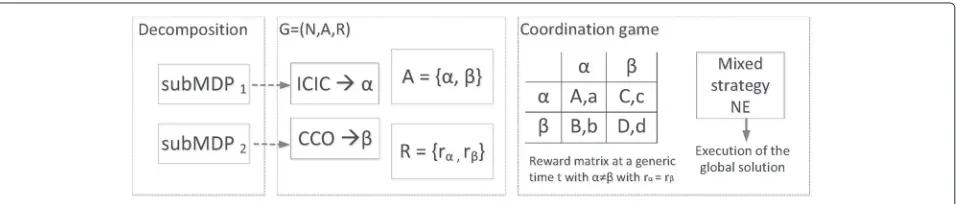
If the actions are the same, the coordinator just exe-cutes the action, otherwise, the conflict is solved by mixed strategies through the reward matrix depicted inside the coordination box in Figure 4, where A, a, are the rewards of subMDP1and subMDP2, respectively, when executing for both subMDP α; B, b, are the rewards of subMDP1 and subMDP2, respectively, when executing actionαfor subMDP2and actionβfor subMDP1; C, c, are the rewards of subMDP1and subMDP2, respectively, when executing
actionα for subMDP1 and actionβ for subMDP2; D, d, are the rewards of subMDP1and subMDP2, respectively, when executing for both subMDPs actionβ.
This game has mixed strategy Nash equilibria given by probabilitiesp=(d−b)/(a+d−b−c)to playαand 1−p to playβfor player 1 (rows) andq = (D−C)/(A+D− B−C)to playαand 1−qto playβfor player 2 (columns). Hence, each player is not actually choosingα,β directly, but choosing a probability with which a player will play α. A given numberpmeans that player 1 will playαwith probabilitypandβ with probability 1−p. Similar con-siderations can be done for player 2. Since d > b and d−b<a+d−b−v,pandqare always between 0 and 1, so the existence is assured.
The algorithm for solving resource conflict is described in Algorithm 1.
compute and executea =α
else
compute and executea =β
end if
6 Functional decomposition of the general 3GPP self-optimization use case
In this section, we provide an example about how the pro-posed functional architecture can be used to deal with the conflicts generated by the concurrent execution of multiple SON functions. The objective of this section is to show that the proposed approach is general enough to model all the SON functions and their derived con-flicts. For this purpose, we focus on the self-optimization functionality and on all the associated SON functions,
as defined in [15] and [21], i.e., mobility load balancing (MLB), mobility robustness optimisation (MRO), CCO, ICIC, cell outage compensation (COC), energy saving (ES), and random access channel (RACH) optimization. We first introduce these SON functions in the context of the general SON architecture, together with high-level examples of how they may interfere. Then, we define the state and action spaces of the global MDP that models the self-optimization procedure of the overall radio access network (RAN) segment. Finally, we show that the global self-optimization problem can be decomposed onto as many subMDPs as SON functions. We define the different subMDPs, with state and action spaces and tentative pro-posals for reward functions. References in literature will show that these self-optimization problems can be solved using reinforcement learning functionalities. We consider that this demonstrates the generality of our approach to solve conflicts in 3GPP SON architectures.
6.1 Overview of 3GPP self-optimization functions
In the following, we quickly describe the main self-optimization functions. We describe the main informa-tion these funcinforma-tions rely on and the main parameters they aim to tune.
The MLB is a SON function where cells with conges-tion can transfer load to other cells. The main objective is to improve end-user experience and achieve higher sys-tem capacity by distributing user traffic across syssys-tem radio resources. The implementation of this function is generally distributed and supported by the load estima-tion and resource status exchange procedure. The mes-sages containing useful information for this SON function (resource status request, response, failure, and update) are transmitted over the X2 interface [33]. MLB can be implemented by tuning the cell individual offset (CIO) parameter. The CIO contains the offsets of the serving and the neighbor cells that all UEs in this cell must apply in order to satisfy the A3 handover condition [21].
3 filter coefficients. In idle mode, it tunes the offset values, such as the Qoffset for the intra-RAT, intra-carrier case. CCO is a SON function, which aims to provide capac-ity and coverage optimization. The targets that can be optimized may be vendor dependent and include cover-age, cell throughout, edge cell throughput, or a weighted combination of the above.
CCO reacts to changes in the environment depend-ing on diverse origins: seasonal changes, changes in the surrounding infrastructures, changes in the network plan-ning, daily variations of traffic, etc. It can be imple-mented in both centralized (in the network manager or element manager) and distributed architectures. Useful information is generally extracted from UE measure-ments. Parameters that may be tuned are the transmission power, the pilot power, and antenna parameters (azimuth and tilt).
ICIC is a SON function, which aims to minimize inter-ference among cells using the same spectrum. It involves the coordination of physical resources between neighbor-ing cells to reduce interference from one cell to another. ICIC can be done in both uplink and downlink for the data channels physical downlink shared channel (PDSCH) and physical uplink shared channel (PUSCH) or uplink con-trol channel physical downlink concon-trol channel (PDCCH). ICIC can be static, semi-static, or dynamic. Dynamic ICIC relies on frequent adjustments of parameters, supported by signaling among cells over X2 interface. To support proactive coordination among cells, the high interfer-ence indicator (HII) and the relative narrowband transmit power (RNTP) indicators have been defined, while to sup-port reactive coordination, the overload indicator (OI) has been introduced [33]. Parameters that may be tuned are the transmission power, the pilot power, antenna param-eters (azimuth and tilt), and the support of coordinated almost blank subframes (ABS).
COC is applied to alleviate the outage caused by the loss of a cell from service. For this use case, an adequate reaction is vital for the continuity of the service so vendor-specific cell outage detection (COD) schemes have to be designed. Parameters to tune to try to compensate the out-ages are the transmission power and antenna parameters of the cells neighboring the fault.
ES aims at providing the quality of experience to end users with minimal impact on the environment; the objec-tive is to optimize the energy consumption by designing network element (NE)s with lower power consumption and temporarily shutting down unused capacity when not needed. The most common action is to switch on/off the appropriate cells.
RACH optimization aims at optimizing the random access channels in the cells based on UE feedback and knowledge of its neighboring eNBs RACH configuration. RACH optimization can be done by adjusting the power
control (Pc) parameter or change the preamble format to reach the set target access delay.
The independent execution of these individual SON functions affects parameters or performances that can end up in conflict. For example, the ICIC may decide to reduce the transmission power to reduce inter-cell interference, while the CCO may decide on increasing it to improve coverage. These conflicting actions affect the borders of the cell and consequently the performances of the MLB function of the same cell and its neighbors. To compen-sate for the actions taken by ICIC and CCO, the MLB may decide to modify some handover parameters, which then have impact on the handover and MRO performances, etc.
6.2 Definition of the global MDP and of the decomposed subMDPs
We consider a heterogeneous wireless network composed by M+F 3GPP (H)eNBs, as defined in Section 3. Each eNB has to be capable of executing the N standardized SON functions, where NSON is the number of imple-mented SON functions. As an example, in this paper, we will consider the following functions: CCO, COC, ICIC, MLB, MRO, ES, RACH. We can model the global self-optimization problem defined by the NSON SON func-tions through a MDP, as it consists of a multi-objective, multi-parameter decision-making/optimization process where the outcomes are partly random and partly under the control of the decision maker. The global problem is then defined by:
• State. The state spaceSis defined by a set of state variablesXdefined, among others, by: (1) the allocation of users to RBs, (2) the values of CQI, (3) UE measurements in terms of RSRP and the values of RSRQ, (4) resource status information, (5) handover and RLF statistics and information, and (6)
interference coordination information in terms of HII, OI, and RNTP.
• Actions. The action setAconsists of all the possible actions that can be taken by tuning, among others, the following parameters: (1) transmission power, (2) pilot power, (3) antenna parameters, in terms of tilt and azimuth, (4) CIO, (5) handover parameters in terms of event offsets, TTT, Qoffset, etc.
• Reward. The rewardRis defined based on the following rationale. If the combination of the selected actions gives, e.g., an intercell interference below a threshold or an outage probability above a threshold, RLF statics above a threshold or throughput
The global MDP including the NSON SON functions is extremely complex. To solve it, we should rely on multi-objective optimization frameworks, which do not provide real-time solutions [11]. As a result, the global SON problem is subdivided into multiple tasks repre-sented by the simplerN = 7 SON functions described before. Other functional decomposition approaches may be possible but they would not be aligned with the 3GPP SON architecture, and consequently, they are not interesting for our problem. Here, each subMDPi is characterized by its own state, action set, transition probability, and reward functions and is denoted by subMDPi= {Si,Ai,Ti,Ri}.
We define the state and action spaces, together with one of the possible reward functions of each subMDP as follows:
1. CCO
• State: The stateS1is defined based on the result
of the scheduling scheme, which defines (1) the allocation of users to RBs, (2) the values of CQI of each user in the corresponding RB, and (3) UE measurements (e.g., RSRP, RSRQ, etc.)
• Actions: The action setA1is based on (1) the
set of eligible actions that are a finite set of downlink transmission power levels, which can be allocated to the RBs assigned to the users, and (2) the finite set of available tilt, and azimuth values, which can be assigned to the gain of the vertical plane of the antenna model.
• Reward : If the CQI is greater or equal than 1, the reward will be positive, otherwise, will be negative. The threshold is set in order to support the SINR values for multiple-input multiple-output (MIMO) transmissions.
The subMDP representing this SON function can be solved through reinforcement learning, as for example has been done before in [34].
2. ICIC
• State: The stateS2is defined based on the result
of the scheduling scheme, which defines (1) the allocation of users to RBs, (2) the values of SINR of each user in the corresponding RB, and (3) UE measurements (e.g., RSRP, RSRQ, etc.)
• Actions: The set of eligible actionsA2are
defined based on (1) the finite set of downlink transmission power levels, which can be allocated to the RBs assigned to the users and (2) the finite set of available tilt and azimuth values, which can be assigned to the gain of the vertical plane of the antenna model.
• Reward : If the SINR is greater or equal than 0 dB, the reward will be positive, otherwise will be negative. The threshold is set in order to support the SINR values for MIMO transmissions.
Also, the subMDP modeling this SON function can be solved through reinforcement learning as it is done for example in [35].
3. COC
• State: The stateS3is defined based on the result
of the scheduling scheme, which defines (1) the allocation of users to RBs and (2) UE
measurements (e.g., RSRP, RSRQ, etc.)
• Actions: The set of eligible actionsA3are
defined based on (1) the finite set of downlink transmission power levels, which can be allocated to the RBs assigned to the users and (2) the finite set of available tilt and azimuth values, which can be assigned to the gain of the vertical plane of the antenna model.
• Reward : If the SINR is greater or equal than 6 dBs, the reward is positive, otherwise is negative. The threshold is set in order to support the lowest modulation and coding scheme (MCS).
A complete solution for COC by adjusting the gain of the antenna due to the electrical tilt and the
downlink transmission power of the surrounding eNBs can be founded in [36], and this solution is based on reinforcement learning tools.
4. ES
• State: The stateS4is defined based on (1) the
resource status information of the cell and its neighbors, (2) the expected demand of traffic, and (3) the energy available to the network element.
• Actions: The action setA4consists of switching
on/off the cell.
• Reward : If the resource usage and the energy available for consumption (in case we are in an energy constrained system) are below a certain threshold, the reward is negative, otherwise it is positive.
The subMDP modeling this use case can also be solved through reinforcement learning, as it is demonstrated in [37].
5. MLB
• State: The stateS5is defined based on the
• Actions: The action setA5is defined based on
the update of the CIO value, by a finite set of fixed values.
• Reward : If the change of CIO removes overload with minimal negative handover (HO) effects the reward will be positive, otherwise will be negative.
A solution for the subMDP modeling, this function can also be based on reinforcement learning tools [8]. 6. MRO
• State: The stateS6is defined based on handover
and RLF reports and statistics.
• Actions: The action setA6is defined based on
the update of the cell’s handover event offsets, TTT, and layer 1/layer 3 filter coefficients.
• Reward : If the users affected by the RLF in the cell after the HO parameter setting is completed are lower than a threshold, the reward will be positive, otherwise will be negative.
A solution for the subMDP modeling this function can also be based on reinforcement learning tools [8].
7. RACH optimization
• State: The stateS7is defined based on the
resource status information.
• Actions: The action setA7is defined based on
the update of the power control parameter or of the preamble format to reach the set target access delay.
• Reward : If the users achieve lower data rate than the agreed guaranteed bit rate (GBR), the reward will be negative, otherwise, will be positive.
This can also be solved through reinforcement learning strategies, as shown in [38].
Ifnpolices are in conflict, the coordination is handled through a n-player coordination game, as discussed in Section 5.2.
7 Case study: self-coordination for ICIC and CCO function conflict
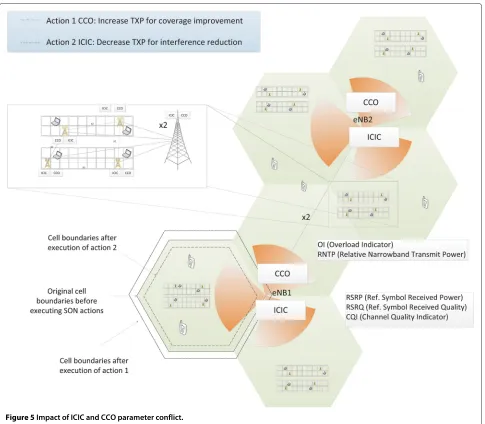
Among the different SON functions defined by 3GPP, we focus our attention on CCO and ICIC. The CCO is in charge of optimizing the capacity and coverage of the area of influence of the particular eNB. As a result, it aims to decrease the outage probability at the border of the cell. The ICIC is in charge of minimizing the interfer-ence among different cells. We will focus on the conflict generated by ICIC and CCO SON functions, as both of them aim at modifying the transmission power. In par-ticular, while the CCO may decide to increase the power, e.g., to improve the coverage or the capacity, the ICIC
may decide to decrease the power to reduce the interfer-ence. Figure 5 shows the actions taken by the two different SON functions, in the D-SON architecture implemented in a heterogeneous scenario. The impact of the concurrent execution of two conflicting actions is highlighted for cell boundaries of one cell. In this section, we describe how to solve the independent subMDPs characterizing the ICIC and CCO functions through TD learning and the actor critic algorithm in particular. Once each SON function has found the optimal policy by means of the AC algo-rithm, if the actions are different, ICIC and CCO play a game with conflicting interests. We define a two-player gameG = {N,A,R}, where theN = 2 players are the SON functions, A = {α,β} is the action set consisting of the actions selected by CCO,α = {pCCO1,. . .,pCCOR},
and ICIC, β = {pICIC1,. . .,pICICR}. The reward matrix
associated with each state is denoted by R, represented in Figure 4, inside the coordination game box. Here, the rows correspond to the ICIC and the columns to the CCO.
7.1 AC-based solution for CCO function
The CCO SON function aims to provide capacity and coverage optimization. In this scenario, the uncovered planned cell area is the coverage holes that need to be opti-mized by the coverage and capacity optimization [39]. We measure this by decreasing the outage probability. As an indicator, we consider the CQI, which is a measurement of the communication quality of wireless channels. We define the state and action spaces and the reward function as follows.
• State: The state is defined based on the result of the scheduling scheme, which defines: (1) the allocation of users to RBs(RB1, RB2,. . ., RBR)to theNusers,
(2) the values of CQI of each user in the corresponding RB.
• Actions: The set of eligible actions are the finite set of downlink transmission power levels, which can be allocated to the RBs assigned to the users. The selected values are 0 to 46 dBm per RB with 0.5 dBm granularity.
Figure 5Impact of ICIC and CCO parameter conflict.
7.2 AC-based solution for ICIC function
The ICIC SON function aims to minimize interference among cells using the same spectrum. In this scenario [39], we define the state and action spaces and the reward function as follows.
• State: The state is defined based on the result of the scheduling scheme, which defines: (1) the allocation of users to RBs(RB1, RB2,. . ., RBR)to theNusers
and (2) the values of SINR measured for each user in the corresponding RB.
• Actions: The set of eligible actions are the finite set of downlink transmission power levels, which can be allocated to the RBs assigned to the users. The selected values are 0 to 46 dBm per RB with 0.5 dBm granularity.
• Reward :
r(st,at)=
1 , if SINR≥0 0 , otherwise
Where the threshold is set in order to support the SINR values for multiuser MIMO transmission mode [21]. MIMO can be used to increase the SINR, i.e., the capacity increases logarithmically with the SINR.
8 Simulation platform, scenario, and results
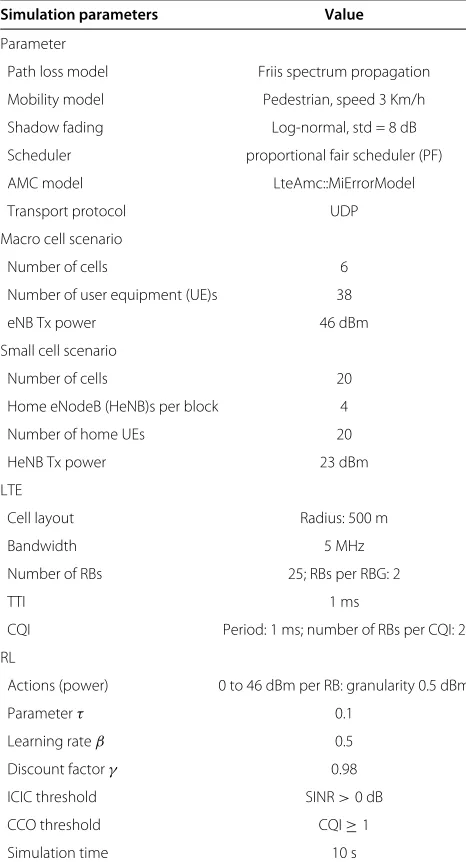
2 to 160 ms for the CQI and every 120 ms - 160 ms for the UE measurements [41]. The parameters used in the simulations for CCO and ICIC are given in Table 1.
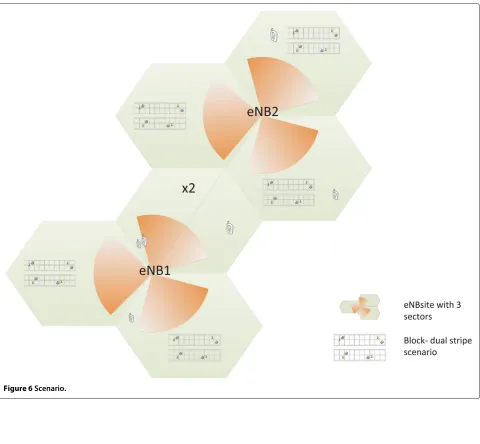
The scenario that we set up consists of 2 eNBs, each one with three sectors, which results in 6 cells and 38 UEs. The small cell network is based on the dual stripe scenario with one block of two buildings. Each building has one floor, with 20 apartments, which results in 40 apartments per block, as depicted in Figure 6. The number of blocks is equal to 5. The HeNB activation factor is 0.5 and the deployment ratio is 0.2, which results in 20 HeNBs, each one located in an independent apartment. Each HeNB provides service to one user in the scenario, which results in 20 HeNB users.
Table 1 Simulation parameters
Simulation parameters Value
Parameter
Path loss model Friis spectrum propagation
Mobility model Pedestrian, speed 3 Km/h
Shadow fading Log-normal, std = 8 dB
Scheduler proportional fair scheduler (PF)
AMC model LteAmc::MiErrorModel
Transport protocol UDP
Macro cell scenario
Number of cells 6
Number of user equipment (UE)s 38
eNB Tx power 46 dBm
Small cell scenario
Number of cells 20
Home eNodeB (HeNB)s per block 4
Number of home UEs 20
HeNB Tx power 23 dBm
LTE
Cell layout Radius: 500 m
Bandwidth 5 MHz
Number of RBs 25; RBs per RBG: 2
TTI 1 ms
CQI Period: 1 ms; number of RBs per CQI: 2
RL
Actions (power) 0 to 46 dBm per RB: granularity 0.5 dBm
Parameterτ 0.1
Learning rateβ 0.5
Discount factorγ 0.98
ICIC threshold SINR>0 dB
CCO threshold CQI≥1
Simulation time 10 s
In the scenario, users are randomly distributed, and after the related IP traffic session ends, the UE appears in another location and starts a new session. In addition, in order to test the quality of service (QoS) performance, we use a UDP client application, which takes care of the generation of radio link control (RLC) protocol data units (PDUs) allowing multiple flows belonging to different QoS classes. The parameters used in the simulations, for both the cellular scenario and the learning algorithm, are given in Table 1.
We first show in Figure 7 the time evolution of the aver-age SINR reported by UEs when the two SON functions are executed independently and for different values of the CQI and UE measurements reporting periodicity (i.e., CQI feedback every 2/120/160 ms and RSRQ feedback every 120 ms). We observe that both the AC algorithms implementing the two SON functions after a first training phase converge in a stable manner to a situation where no user is in outage. This is achieved even if the proposed sce-nario is characterized by the dynamism typical of realistic wireless networks; as the UEs move around, the HeNBs are characterized by random activation factors, the chan-nel model includes shadow and fading effects, etc. We observe as well that the time of convergence depends on the periodicity of feedback to the (H)eNBs from the users. In Figure 8, we compare performances in terms of time evolution of the SINR provided by the proposed coor-dination game framework and by the approach that is suggested by 3GPP in [17]. Here, it is proposed that every time that a SON function is willing to modify a transmission parameter, it asks for permission to the self-coordination entity, which handles the queues of requests for parameter modifications. We consider then an implementation of ICIC and CCO characterized by similar reporting periodicity, i.e., 120 ms, for each SON function. We observe in Figure 8 that while the self-coordination framework based on the proposed coordi-nation game actually selects the most appropriate action to execute based on a compromise between conflicting interests, the 3GPP-proposed approach handles the con-flict by properly scheduling in time the different actions. In this case, due to the execution of both actions, the 3GPP scheme generates unnecessary oscillations and poorer performances in terms of average-achieved SINR for the UEs in the scenario.
Figure 6Scenario.
0 500 1000 1500 2000 2500 3000 3500 4000
−35 −30 −25 −20 −15 −10 −5 0 5
time(msec)
Av. SINR(dB)
CCO (CQI − 2ms) ICIC (RSRQ − 120ms) CCO (CQI − 120ms) CCO (CQI − 160ms)
0 5000 10000 15000 −6
−4 −2 0 2 4 6 8 10
time(msec)
Av. SINR(dB)
3GPP self−coordination coordination game
Figure 8Time evolution of the average SINR of UEs in the scenario.For the self-coordination frameworks based on coordination game and 3GPP approaches.
−100 −5 0 5 10 15 20 25 0.1
0.2 0.3 0.4 0.5 0.6 0.7 0.8 0.9 1
SINR(dB)
CDF
ICIC CCO
coordination game
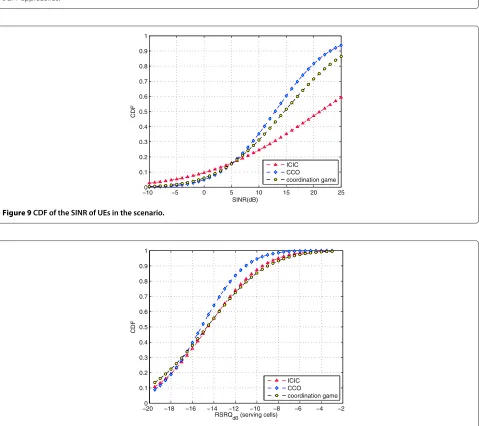
Figure 9CDF of the SINR of UEs in the scenario.
−200 −18 −16 −14 −12 −10 −8 −6 −4 −2 0.1
0.2 0.3 0.4 0.5 0.6 0.7 0.8 0.9 1
RSRQdB (serving cells)
CDF
ICIC CCO
coordination game
0 2 4 6 8 10 12 0
0.1 0.2 0.3 0.4 0.5 0.6 0.7 0.8 0.9 1
Throughput (Mbps)
CDF
ICIC CCO
coordination game
Figure 11CDF of the UE average throughput.
the capacity and coverage features of the scenario. On the other hand, the ICIC function performs better than the CCO for higher values of SINR, as it aims at min-imizing the effect of inter-cell interference in the whole scenario, thus improving interference performances for all users. When executing the two SON functions in parallel, conflicts may arise, so we need the support of a self-coordination function. When implementing it, we achieve a compromise between the conflicting objectives of the two SON functions. On the one hand, at the cell edge, we are reducing the outage probability with respect to the results obtained by ICIC, while we are maintain-ing the outage with respect to results obtained by CCO. On the other hand, inside the cell, the self-coordination framework obtains better performances in terms of out-age, compared to previous results of the CCO, while it increases the outage compared to ICIC independent results. The reason behind this behavior is to be found in the compromise achieved by means of the mixed strategy equilibrium, which consists in an equilibrium where there is a percentage of time during which ICIC gets less reward than CCO and the rest of the time when the CCO achieves a higher reward than ICIC.
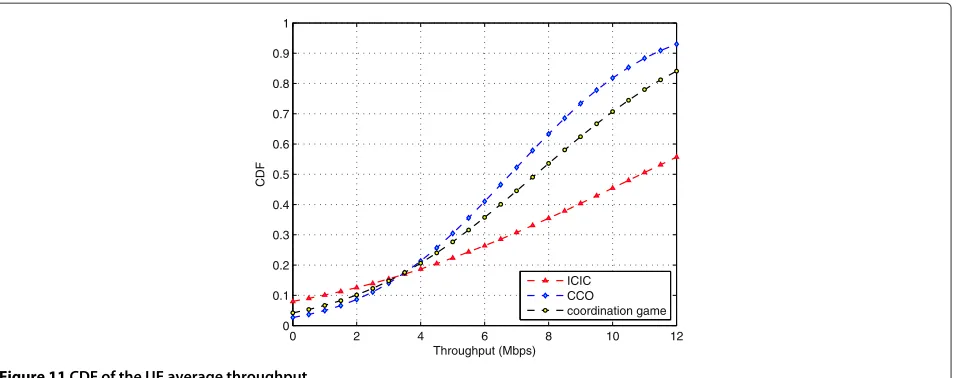
Figure 10 shows the RSRQ from the serving cell, which is one of the UE measurements periodically reported by the same UE indicating its performance rate. We observe a similar behavior as discussed for Figure 9. However, here, the self-coordinator performs more similarly to ICIC inside the cell and more similarly to CCO at the cell edge, thus managing to get the best out of each SON func-tion. Finally, the same desirable behavior is also confirmed in Figure 11, which depicts the CDF of each UE average throughput. The considered traffic uses a RLC saturation mode (SM), which takes care of the generation of RLC PDUs allowing multiple flows belonging to different QoS classes.
9 Conclusions
In this paper, we have discussed the challenging problem that arises when multiple concurrent SON functions are executed by the same node, or different instances of the same or different SON functions are executed in neigh-boring cells. Without loss of generality, we have focused on the conflicts between two different SON functions, which aims at updating the same (H)eNB transmission parameter in a D-SON architecture, more suitable for a small cell scenario. We have proposed then a general framework to support the modeling of SON functions and their conflicts when they are executed in parallel. We have shown that the global SON problem can be mod-eled through a MDP, which can be organized onto simpler subproblems to favor scalability and modeled by means of subMDP. Due to the dynamic nature of the wireless environment and to the autonomous characteristic of the SON functions, we solve the subMDPs by means of RL. RL algorithms provide solution policies to the different SON functions which can be in conflict, so that these require a self-coordinator framework. We have shown that this framework can be modeled by means of a coordination game, where the subMDPs are the players and their solu-tion policies the acsolu-tions. Simulasolu-tion results obtained in a release 8 compliant LTE network simulator which demon-strates that the proposed scheme provides a convenient compromise among conflicting actions, taking the best result among the conflicting solution policies.
Competing interests
The authors declare that they have no competing interests.
Acknowledgements
Received: 1 August 2014 Accepted: 2 March 2015
References
1. M Amirijoo, L Jorguseski, T Kurner, R Litjens, M Neuland, L Schmelz, U Turke, in6th International Symposium on Wireless Communication Systems ISWCS. Cell outage management in LTE networks (Tuscany, 7-10 Sept. 2009), pp. 600–604
2. M Amirijoo, L Jorguseski, R Litjens, R Nascimento, inIEEE Consumer Communications and Networking Conference (CCNC). Effectiveness of cell outage compensation in LTE networks (Las Vegas, NV, 9-12 Jan. 2011), pp. 642–647
3. SOCRATES-Self-Optimisation and self-ConfiguRATion in wirelEss networkS. http://www.fp7-socrates.eu/index.html@q=node%252F35. html
4. LC Schmelz, M Amirijoo, A Eisenblaetter, R Litjens, M Neuland, J Turk, in
IFIP/IEEE International Symposium on Integrated Network Management (IM). A coordination framework for self-organisation in LTE networks (Dublin, 23-27 May 2011), pp. 193–200
5. MMS Marwangi, N Fisal, SKS Yusof, RA Rashid, ASA Ghafar, FA Saparudin, N Katiran. Challenges and practical implementation of self-organizing networks in LTE/LTE-Advanced systems (Kuala Lumpur, 14-16 Nov. 2011), pp. 1–5
6. T Jansen, M Amirijoo, U Turke, L Jorguseski, K Zetterberg, R Nascimiento, LC Schelz, J Turk, I Balan, inIEEE 69th Vehicular Technology Conference (VTC, Spring). Embedding multiple self-organisation functionalities in future radio access networks (Barcelona, 26-29 April 2009), pp. 1–5
7. HY Lateef, A Imran, A Abu-dayya, inIEEE 24th International Symposium on Personal Indoor and Mobile Radio Communications (PIMRC). A framework for classification of self-organising network conflicts and coordination algorithms (London, United Kingdom, 8-11 Sept. 2013), pp. 2898–2903 8. O Iacoboaeia, B Sayrac, S Ben, inIEEE Wireless Communications and
Networking Conference Workshops (WCNCW). Jemaa, Bianchi, P, SON coordination for parameter conflict resolution: a reinforcement learning framework (Istanbul, 6-9 April 2014), pp. 196–201
9. R Combes, Z Altman, E Altman, in11th International Symposium on Modeling & Optimization in Mobile, Ad Hoc & Wireless Networks (WiOpt). Coordination of autonomic functionalities in communications networks (Tsukuba Science City, 13-17 May 2013), pp. 364–371
10. T Bandh, H Sanneck, R Romeikat, inIEEE 73rd Vehicular Technology Conference (VTC Spring). An experimental system for SON function coordination (Yokohama, 15-18 May 2011), pp. 1–2
11. CA Coello, GB Lamont, DA Van Veldhuizen,Evolutionary Algorithms for Solving Multi-Objective Problems, 2nd ed. (Springer, Genetic and Evolutionary Computation Series, New York, NY, 2007) 12. H Claussen, LTW Ho, LG Samuel, inWireless Telecommunications
Symposium (WTS). Self-optimization of coverage for femtocell deployments (Pomona, CA, 24-26 April 2008), pp. 278–285
13. E Corona-Xelhuantzi, LE Sucar, EF Morales, inIEEE Symposium on Adaptive Dynamic Programming and Reinforcement Learning (ADPRL). Executing concurrent actions with multiple Markov decision processes (Nashville, TN, April 2 2009 March 30 2009), pp. 82–89
14. A Rocha-Rocha, EM de Cote, SP Hernandez, ES Succar, Conflict resolution in multiagent systems: balancing optimality and learning speed. Artificial Intelligence (MICAI), 2012 11th Mexican International Conference on, 32–37
15. S Hämäläinen, H Sanneck, C Sartori,LTE Self-Organising Networks (SON): Network Management Automation for Operational Efficiency. (John Wiley & Sons Ltd, The Atrium, Southern Gate, Chichester, West Sussex, PO19 8SQ, United Kingdom, 2012)
16. S Weidenholzer, Coordination Games and Local Interactions: A Survey, of the Game Theoretic Literature. In Games.1(4), 551–585 (2010) 17. 3GPP TSG SA WG5 (Telecom Management), Meeting 85, Study of
implementation alternative for SON coordination. Tech. Rep. S5-122330 18. J Chen, H Zhuang, B Andrian, Y Li, inIEEE 75th Vehicular Technology
Conference (VTC Spring). Difference-based joint parameter configuration for MRO and MLB (Yokohama, 6-9 May 2012), pp. 1–5
19. A Tall, R Combes, Z Altman, E Altman, Distributed coordination of self-organizing mechanisms in communication networks. Orange labs (2013)
20. R Romeikat, B Bauer, T Bandh, G Carle, H Sanneck, L-C Schmelz, inNext Generation Mobile Networks (NGMN 2010). Policy-driven workflows for mobile network management automation (Caen, France, June 2010), pp. 1111–1115
21. 3GPP TS 36.213, Technical Specification Group Radio Access Network; Evolved Universal Terrestrial Radio Access (E-UTRA); Physical layer procedures, Release 12, Sep. 2014. Tech. Rep
22. RS Sutton, AG Barto,Reinforcement Learning: An Introduction. (The Press, MIT, Cambridge, Massachusetts London, England, 1998). [Online]. Available: http://webdocs.cs.ualberta.ca/~sutton/book/ebook/the-book. html
23. R Bellman,Dynamic Programming. (Princeton University Press, 1957) 24. C Boutilier, R Dearden, M Goldzmidt, inInter Joint Conference on Artificial
Intelligence (IJCAI). Exploting structure in policy construction (Montreal, August, 1995), pp. 1104–1113
25. NK Jong, P Stone, inJoint Conference on Artificial Intelligence. State abstraction discovery from irrelevant state variables (Edinburgh, Scotland, UK, 2005), pp. 752–757
26. P Laroche, Y Boniface, R Schott, inSAC ’01 Proceedings of the 2001 ACM symposium on Applied computing. A new decomposition technique for solving Markov decision process. (New York, NY, USA), pp. 12–16 27. T Dean, R Givan, inAAAI of the Fourteenth National Conference on Artificial
Intelligence. Model minimization in Markov decision process (Rhode Island, 1997, pp. 106–111
28. C Watkins, P Dayan, inMachine Learning,vol. 8. Q-Learning Machine Learning, Kluwer Academic Publishers Boston, 1992), pp. 279–292 29. RH Crites, AG Barto,An actor/critic algorithm that is equivalent to
Q-Learning Advances in Neural Information Processing Systems 7. (Press, MIT, Cambridge MA, 1995)
30. LP Kaelbling, ML Littman, AW Moore, Reinforcement learning a survey. J Artif. Intelligence Res. (1996)
31. L Panait, S Luke, Cooperative multi-agent learning: the state of the art, autonomous agents and multi-agent systems. Autonomous Agents Multi-Agent Syst. Arch.11, 387–434 (2005)
32. Y Shoham, K Leyton-Brown,Multiagent Systems: Algorithmic,
Game-Theoretic, and Logical Foundations. (Cambridge University Press 32 Avenue of the Americas, New York NY 10013-2473, USA, 2008) 33. 3GPP TS 36.423, Evolved Universal Terrestrial Radio Access Network
(E-UTRAN); X2 Application Protocol (X2AP) (Realease 11, Sep 2013). Tech. Rep.
34. MN ul Islam, A Mitschele-Thiel,Reinforcement learning strategies for self-organized coverage and capacity optimization. (Wireless Commun. Networking Conference (WCNC), Shangai, 2012), pp. 2818–2823 35. A Galindo, L Giupponi, inIEEE 71st Vehicular Technology Conference (VTC
Spring). Distributed Q-learning for interference control in OFDMA-based femtocell networks (Taipei, 16-19, May 2010), pp. 1–5
36. J Moysen, L Giupponi, inIEEE 80th Vehicular Technology Conference (VTC Fall). A reinforcement learning based solution for self-healing in LTE networks (Vancouver Canada, 14-17 Sept. 2014), pp. 1–6
37. M Miozo, L Giupponi, M Rossi, P Dini, inIEEE ICC 2015 Workshop on Green Communications and Networks with Energy Harvesting, Smart Grids, and Renewable Energies. Distributed Q-Learning for Energy Harvesting Heterogeneous Networks (London (UK), 8-12 June 2015)
38. LM Bello, PD Mitchell, D Grace,Frame based back-off for Q-learning RACH access in LTE networks(VIC, Australasian, Southbank, 2014), pp. 176–181 39. 3GPP TR 32.521,Technical Specification Group Services and System Aspects;
Telecommunication Management; Self-Organizing Networks (SON) Policy Network Resource Model (NRM) Integration Reference Point (IRP); Requirements, (Release 10 Dec 2010). Tech. Rep.
40. Centre Tecnològic de Telecomunicacions de Catalunya (CTTC), The LENA ns-3 Module, LTE, Documentation Release v8. [Online]. Available: http:// lena.cttc.es/manual/