For Peer Review
Developing a real-time PCR assay based on multiplex high-resolution melt curve analysis: A pilot study in detection
and discrimination of soil-transmitted helminth and schistosome species
Journal: Parasitology
Manuscript ID PAR-2018-0132.R2 Manuscript Type: Research Article Date Submitted by the Author: n/a
Complete List of Authors: Cunningham, Lucas; Liverpool School of Tropical Medicine, Parasitology Stothard, J.; Liverpool School of Tropical Medicine, 2Department of Parasitology
Osei-Atweneboana, Mike; Council for Scientific and Industrial Research, Environmental Biology and Health
Armoo, Samuel; Council for Scientific and Industrial Research, Environmental Biology and Health
Verweij, Jaco; Elisabeth-TweeSteden Ziekenhuis, Microbiology and Immunology
Adams, Emily; LSTM, Parasitology
Key Words:
Schistosomiasis, Soil-transmitted helminths, Disease surveillance,
Monitoring and evaluation, Real-time PCR, Melt curve analysis, NTD, HRM, DNA
For Peer Review
Developing a real-time PCR assay based on multiplex high-resolution melt curve analysis: A pilot 1
study in detection and discrimination of soil-transmitted helminth and schistosome species 2
Lucas J. Cunningham1, J. Russell Stothard1, Mike Osei-Atweneboana2, Samuel Armoo2, Jaco J. 3
Verweij3 and Emily R. Adams1
4
1
Department of Parasitology, Liverpool School of Tropical Medicine, Liverpool, L3 5QA, UK; 2 5
Department of Environmental Biology and Health, Council for Scientific and Industrial Research - 6
Water Research Institute, P.O. Box M 32, Accra 102001, Ghana 3 Laboratory for Medical 7
Microbiology and Immunology, Elisabeth Tweesteden, Tilburg, the Netherlands. 8
9
10
11
12
13
14
15
16
17
18
19
20
21
22
23
24
25
26
27
For Peer Review
SUMMARY 29
With the push towards control and elimination of soil-transmitted helminthiasis and schistosomiasis 30
in low and middle-income countries, there is a need to develop alternative diagnostic assays that 31
complement the current in-country resources, preferably at a lower cost. Here, we describe a novel 32
high-resolution melt-curve assay with six PCR primer pairs, designed to sub-regions of the nuclear 33
ribosomal locus. Used within a single reaction and dye detection channel, they are able to 34
discriminate Ancylostoma duodenale, Necator americanus, Strongyloides stercoralis, Ascaris 35
lumbricoides, Trichuris trichiuria and Schistosoma spp. by high-resolution melt (HRM) curve analysis. 36
Here we describe the primers and the results of a pilot assessment whereby the HRM assay was 37
tested against a selection of archived faecal samples from Ghanaian children as characterised by 38
Kato-Katz and real-time PCR analysis with species-specific TaqMan hydrolysis probes. The resulting 39
sensitivity and specificity of the HRM was 80% and 98.6% respectively. We judge the assay to be 40
appropriate in modestly equipped and resourced laboratories. This method provides a potentially 41
cheaper alternative to the TaqMan method for laboratories in lower resource settings. However, the 42
assay requires a more extensive assessment as the samples used were not representative of all 43
target organisms. 44
45
Keywords: schistosomiasis, soil-transmitted helminthiasis, disease surveillance, monitoring and 46
evaluation, real-time PCR, melt curve analysis, SCH, STH, HRM, DNA 47
48
For Peer Review
INTRODUCTION 50
Soil-transmitted helminthiasis (STH) and schistosomiasis (SCH) are grouped within the neglected 51
tropical diseases (NTDs); each disease can cause chronic suffering, and in many low and middle-52
income countries is often linked to poverty (Hotez et al., 2006). With the announcement of the 53
London Declaration on NTDs and most recently the sustainable development goals, international 54
attention directed at control of these diseases has grown (WHO, 2018). Control of STH and SCH is 55
based upon preventive chemotherapy, typically by mass drug administration (MDA) campaigns, 56
offering donated anthelmintic medicines to children attending school (Weatherhead et al., 2017). 57
Although STH and SCH infections can be found in the majority of community members, 58
disease control programmes usually examine school age children as an indicator for the wider 59
community to determine the presence or absence of each disease. This in turn directs and informs 60
the control programme for the most appropriate MDA schedule, its frequency and if further disease 61
surveillance is necessary. For intestinal helminths (i.e. STH and Schistosoma mansoni infections), 62
field-based surveillance typically makes use of the Kato-Katz method; a low cost semi-quantitative 63
faecal concentration method (Katz et al., 1972). Owing to its affordability and scalability, the method 64
is recommended by WHO as an operational diagnostic, however, it is an imperfect standard due to 65
lack of sensitivity, and multiple stool samples should be taken; it is not the parasitological method of 66
alongside the continued use of Kato-Katz, alternative biomarkers have been investigated (Stothard, 70
2009; Stothard et al., 2014). These largely rely upon detection of parasite-specific DNA with real-71
time PCR and Taqman probes (Meurs et al., 2015). The need for more sensitive diagnostics is 72
particularly pertinent in light infection intensity and low transmission settings for the Kato-Katz 73
method becomes more misleading than informative due to low sensitivity (Al-Shehri et al., 2018). 74
Nonetheless novel methods also need to be both practical and cost-effective (Montresor et al.; 75
Savioli et al., 2015). A drawback of multiplex TaqMan probe technology, for example, is the expense 76
per reaction and need for thermal cycling machines with four or more reporting dye detection 77
channels. In more modestly resourced laboratories, such machines are often not available whereas 78
the technology entry standard, a two-dye channel machine, is available. 79
Here, we present an alternative multiplex real-time PCR assay based on melt curve analysis, which 80
For Peer Review
(18S) region for Ancylostoma duodenale, Necator americanus, Strongyloides stercoralis, Ascaris 85
lumbricoides, Trichuris trichiuria, Schistosoma haematobium and Schistosoma mansoni was 86
downloaded from the NCBI data base and aligned on Mega 6 (MEGA). Areas of high variability were 87
then selected and entered into Primer 3 in order to generate primers and products with a specific 88
melting temperature amenable for melt curve analysis. These primers were then checked for cross 89
reactivity using NCBI Primer 3 primer design tool. Species-specific primers were designed for each 90
helminth except for S. mansoni and S. haematobium where a generic primer pair was designed. The 91
primers, see Table 1, were checked for specificity using the NCBI Primer 3 tool and cross-checked 92
against the NCBI genomic data base. 93
94
Optimisation and assessment of primers
95
The primers were optimised using an annealing temperature gradient (Bio-Rad Chromo 4) from 50ᵒC 96
to 65ᵒC, this allowed for the assessment of which temperature the primers performed optimally at, 97
importance of establishing the optimum primer concentration to use is based on the possibility that 101
there may be differences in copy number and efficiency between the different primer pairs. The 102
identification of the minimum amount of primer required is essential when running a multiplex 103
reaction to ensure one primer pair does not out-compete others, as the resources in each reaction 104
are finite. The primers were tested and optimised as single plex and later as a multiplex on two qPCR 105
machines, the Chromo 4 (Bio-Rad Technologies) and Rotor Gene (Qiagen). To optimise the primers, 106
clinical samples that had been identified as positive by TaqMan for S. stercoralis, N. americanus and 107
A. duodenale were tested. For A. lumbricoudes, T. trichiuria and Schistosoma s.p., DNA was extracted 108
from LSTM collections of whole worms stored in 100% ethanol. These worms had been previously 109
collected from endemic regions around Lake Albert, Uganda, to supplement the materials used in 110
the teaching department at the Liverpool school of Tropical Medicine. DNA was extracted by a rapid 111
boil-and-spin method. In brief ~0.2g of worm tissue was isolated and washed three times in distilled 112
water to remove the ethanol. Following the wash steps the worm tissue was placed in 200µl of TE 113
For Peer Review
for two hours followed by an enzyme denaturation step of 90ᵒC for 10 minutes. The samples were 115
vortexed and spun down and approximately 180µl of supernatant was removed and stored at -20ᵒC. 116
Assessment of field samples
117
Having optimised the HRM primers and tested them in a multiplex assay, they were then tested on 118
the DNA extracts of 32 faecal, samples that had been collected in 2017; as part of an ongoing 119
longitudinal study screening for STH and SCH infections in Ghana. As part of the study, the samples 120
had been screened using both Kato-Katz (two slides per faecal sample). Later the samples 121
underwent a specific faecal DNA extraction method that incorporated a bead-beating stage, to 122
mechanically rupture the helminth eggs, allowing for the DNA to be more reliably extracted. This 123
method has previously been described (Cunningham et al., 2018). Following the DNA extraction 124
process the samples underwent a pentaplex TaqMan assay that targeted Hookworm (Verweij et al., 125
2007), Schistosoma s.p.(Obeng et al., 2008), S. stercoralis (Verweij et al., 2010), T. trichiuria (Liu et 126
al., 2013) and A. lumbricoides (Wiria et al., 2010). 127
Thermal cycling conditions
128
Optimisation 129
The following thermal cycle times were used, 95ᵒC for 30s followed by 35 cycles of 95ᵒC for 15s and 130
a temperature gradient 50ᵒC-65ᵒC for 15s. The melt curve ramped from 65ᵒC to 94ᵒC, rising by 0.5ᵒC 131
with a wait of 3 seconds. The supermix used was the SsoAdvanced™ universal SYBR® Green 132
Supermix from Bio-Rad and the primers were run in a single plex reaction at a final concentration of 133
250 nM in a 20µL reaction with 10µL of supermix and 2µL of DNA. 134
Testing of field samples 135
For the testing of the field samples the Type-it HRM PCR kit from Bioline was used with an initial 136
melt step of 95ᵒC for five minutes followed by 40 cycles of 96ᵒC for 10s, 60ᵒC for 30s and 72ᵒC for 137
10s. The HRM ramped from 60ᵒC to 95ᵒC, rising by 0.1ᵒC every two seconds. The difference in use of 138
supermix used in the optimisation and testing of field samples resulted from the development 139
process whereby the initial intention was to design the primers for use with SYBR green for a two-140
tube assay. Having optimised them they were then tested with the Type-it HRM kit to be run as a 141
single tube assay with the field samples. 142
RESULTS 143
Performance of assay
For Peer Review
60ᵒC was chosen as the optimum annealing temperature; during primer limiting assessment as all 145
primers performed equally well at this temperature. All primers also performed optimally at 200nM, 146
with the exception of the primers for Schistosoma which were found to be able to operate best at 147
100nM. When tested against non-target species it was found that the primers were highly specific 148
and did not cross react with non-target DNA. 149
150
<Insert Table 1 here> 151
152
The final primer selection is given in table 1, alongside their respective Tm and product size and melt 153
temperatures. The positions of each primer pair on the nuclear ribosomal DNA of the different 154
target helminths is shown in a diagrammatic form in Fig. 1. 155
<Insert Fig. 1 here> 156
157
158
The primers were tested as a multiplex reaction to determine the spread of the different melt peaks 159
with each target DNA tested in triplicate. The distribution of the melt peaks is shown below in Fig. 2. 160
The results show that the products amplified for each helminth species have a distinct Tm to allow 161
for separation of amplicons using the melt analysis process. There are also no other non-specific 162
peaks that would indicate cross reaction between the different primers and non-specific DNA 163
targets. 164
165
<Insert Fig. 2 here> 166
Analysis of field samples
167
From the field survey a total of 32 faecal samples were examined using the six-primer pair set, these 168
samples were positive by the TaqMan assay for hookworm, Schistosoma sp. and S. stercoralis; they 169
did not contain positive samples for T. trichiuria and A. lumbricoides. The prevalence of the three 170
helminth types present in the samples is given in Table 2. 171
172
For Peer Review
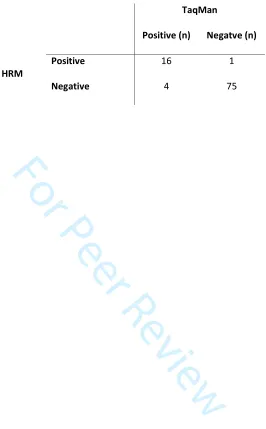
The sensitivity and specificity of the new HRM assay was assessed against the TaqMan assay for all 174
helminth positives, resulting in a sensitivity of 80% and a specificity of 98.6%, (Table 3.). 175
<Insert table 3 here> 176
DISCUSSION 177
Here we developed a novel HRM assay for the detection of STH and SCH our results show that the 178
new primers are capable of discriminating between the different helminth species being targeted. 179
Developing diagnostic assays appropriate for use in modestly equipped and financed laboratories 180
will expand the outreach of molecular surveillance approaches for STH and SCH. While traditional 181
PCR methods can be both sensitive and specific they require relatively long post amplification 182
analysis phases (e.g. gel electrophoresis) which increases the risk of cross-contamination. By using 183
real time PCR detection technology with TaqMan hydrolysis probes both hurdles are overcome but 184
although such assays are highly sensitive and specific, they are more expensive in both consumables 185
and in the type of real time PCR machine required for multiplexing, i.e. an increasing number of light 186
channels receptors. The initial cost of the probes used in the TaqMan assay was a total of £1087, at a 187
concentration of 20 nmol. Depending on the volumes of probe used per reaction this will equate to 188
an addition of ~18p, per-probe, per-reaction adding a total of ~£1.00 per reaction. In this study the 189
total cost per reaction for a single tube assay was £2.13 for a TaqMan reaction and £0.75 for an HRM 190
reaction. If the number of light channels in the qPCR platform is less than six or five, then it would be 191
necessary to run the TaqMan as a two-tube assay, doubling the cost of the reaction buffer required 192
and resulting in a cost of £3.05 per sample. However, it is important to note that the initial cost of 193
the DNA extraction process would remain the same for both assays. The cost of the DNA extraction 194
and purification process exceeds that of either the cost of the TaqMan assay or the HRM assay and 195
equates to approximately £5-£6 per sample. 196
In the present assay amplicons were designed to have characteristic melt profiles, based on 197
sequence length (i.e. number of bases) and the base-pair composition (i.e. the relative proportion of 198
purine and pyrimidine inter-strand bonding). Since the intercalating dye only fluoresces when bound 199
to double stranded DNA, the melting point (where the double stranded DNA disassociates into single 200
strands) is witnessed by a characteristic sharp drop in fluorescence which is detected by the machine 201
For Peer Review
the TaqMan and HRM assays failed to detect the four Kato-Katz hookworm positives, the TaqMan 207
assay also failed to amplify seven of the Kato-Katz SCH positives and the HRM assay failed to detect 208
eight of the Kato-Katz positives. For the hookworm samples the low number of helminth eggs likely 209
contributed to the two molecular methods failing to detect them. The SCH false negatives are harder 210
to explain as only three samples missed, by both assays, would be considered light infections, the 211
rest are all heavy infections. Failure to amplify DNA due to inhibitors is unlikely to be the reason as 212
the TaqMan assay included an internal positive control that successfully amplified in all samples, 213
within the expected Ct range. The heterogeneity of egg distribution within a faecal sample is a 214
possible cause for the false negatives observed. If the stool sample had not been correctly mixed so 215
as to more evenly distribute the eggs throughout then it is possible that the ~0.1g of faeces that 216
underwent the DNA extraction process may have contained too few eggs for the assay to detect, 217
despite high egg counts in the Kato-Katz readings. 218
The approach proposed in this paper capitalises on the sensitivity and specificity of the real 219
time PCR platform but it only operates on a single channel,(Excitation (nm): ~470 ± 10, Detection 220
(nm): ~510 ± 5), and does not require expensive probes. For these reasons it is much cheaper and 221
can be used on all real time PCR machines that can detect this spectrum. This assay has been 222
designed for use either with a high-resolution melt (HRM) kit and software or with SYBR Green and a 223
standard melt-curve analysis setting. The use of SYBR would allow for this method to be used on a 224
wider range of machines as not all have HRM capabilities, however it may require a two-tube assay 225
approach to properly differentiate between the peaks as SYBR has less resolution than the HRM dye 226
Limitations of the Study 231
The intention of this manuscript is to describe the initial results of a new diagnostic assay that may 232
prove to be more attractive to molecular laboratories in low cost settings, due to dispensing with the 233
need to buy expensive TaqMan probes. The assay can also work on less expensive qPCR 234
thermocyclers, as it only requires a single channel to detect up to six target helminths. However, as 235
previously mentioned the total cost including the DNA extraction protocol will equate to more than 236
£5-£6 per sample, making the use of either qPCR method an expensive option for a diagnostic 237
laboratory. To bring down the overall cost will require the development of a cheaper DNA extraction 238
For Peer Review
field of NTDs there were limited samples available for assay development resulting in a very limited 240
range of samples being used to run the validation assay. To fully assess the assay described in this 241
paper a wider range of positive samples will need to be screened to ensure that all target species are 242
represented. This weakness in the study raises the importance of establishing biobanks, particularly 243
for NTDs, whereby samples can be stored and catalogued and made available to research groups. 244
Finally, the method described in this paper is limited to well relatively well-equipped laboratories 245
and requires highly trained technicians to carry out the assay. These factors make the assay 246
unsuitable for use in the field as a point of care test, of which there are already some available for 247
schistosomiasis notably the CCA rapid diagnostic test. Alternative, more field friendly molecular 248
assays are also in development notably the isothermal methods such as LAMP (loop-mediated 249
isothermal amplification) and RPA (recombinase polymerase amplification) have been used for the 250
diagnosis of schistosomiasis (Fernandez-Soto et al., 2014; Rosser et al., 2015). These methods are 251
more field friendly and depending on the nature of the sample, such as urine over faeces, may have 252
simpler DNA isolation protocols. The multiplexing capabilities of these methods are often limited as 253
well as the cost for the RPA assay being relatively higher compared to both LAMP and qPCR (Minetti 254
et al., 2016). 255
Conclusion 256
To conclude we have developed a low-cost, potentially high through-put multiplex DNA assay useful 257
for detection of STH and SCH. This assay could be an appropriate DNA detection technique in 258
modestly equipped and resourced laboratories. Although current limitations to the study include 259
The authors would like to thank DFID UK, the Liverpool School of Tropical medicine and the Council 265
for Scientific and Industrial Research, Ghana for their support and contributions as well as Dr 266
Thomas Edwards and Chris Williams for their technical advice. 267
268
Financial support 269
This work was supported by the Department for International Development (DFID) grant number PO 270
6407. 271
For Peer Review
References 273
Primer 3. 274
Al-Shehri, H., Koukounari, A., Stanton, M. C., Adriko, M., Arinaitwe, M., Atuhaire, A., Kabatereine, 275
N. B. and Stothard, R. J. (2018). Surveillance of Intestinal Schistosomiasis During Control: A 276
Comparison of Four Diagnostic Tests Across Five Ugandan Primary Schools in the Lake Albert 277
Region. Parasitology. 278
Barenbold, O., Raso, G., Coulibaly, J. T., N'Goran, E. K., Utzinger, J. and Vounatsou, P. (2017). 279
Estimating sensitivity of the Kato-Katz technique for the diagnosis of Schistosoma mansoni 280
and hookworm in relation to infection intensity. Plos Neglected Tropical Diseases, 11. doi: 281
10.1371/journal.pntd.0005953. 282
Cunningham, L. J., Odoom, J., Pratt, D., Boatemaa, L., Asante-Ntim, N., Attiku, K., Banahene, B., 283
Osei-Atweneboana, M., Verweij, J. J., Molyneux, D., Stothard, R. J. and Adams, E. R. (2018). 284
Expanding molecular diagnostics of helminthiasis: Piloting use of the GPLN platform for 285
surveillance of soil transmitted helminthiasis and schistosomiasis in Ghana. Plos Neglected 286
Tropical Diseases, 12. doi: 10.1371/journal.pntd.0006129. 287
Fernandez-Soto, P., Arahuetes, J. G., Hernandez, A. S., Aban, J. L., Santiago, B. V. and Muro, A. 288
(2014). A Loop-Mediated Isothermal Amplification (LAMP) Assay for Early Detection of 289
Schistosoma mansoni in Stool Samples: A Diagnostic Approach in a Murine Model. Plos 290
Neglected Tropical Diseases, 8. doi: 10.1371/journal.pntd.0003126. 291
Hotez, P., Ottesen, E., Fenwick, A. and Molyneux, D. (2006). The neglected tropical diseases: The 292
ancient afflictions of stigma and poverty and the prospects for their control and elimination. 293
Hot Topics in Infection and Immunity in Children Iii, 582, 23-33. 294
Katz, N., Chaves, A. and Pellegrino, J. (1972). A Simple Device for Quantitative Stool thick-Smear 295
Technique in Schistosomiasis mansoni. Rev Inst Med Trop Sao Paulo, 14, 397-400. 296
Kongs, A., Marks, G., Verle, P. and Van der Stuyft, P. (2001). The unreliability of the Kato-Katz 297
technique limits its usefulness for evaluating S-mansoni infections. Tropical Medicine & 298
International Health, 6, 163-169. doi: 10.1046/j.1365-3156.2001.00687.x. 299
Liu, J., Gratz, J., Amour, C., Kibiki, G., Becker, S., Janaki, L., Verweij, J. J., Taniuchi, M., Sobuz, S. U., 300
Haque, R., Haverstick, D. M. and Houpt, E. R. (2013). A Laboratory-Developed TaqMan 301
Array Card for Simultaneous Detection of 19 Enteropathogens. Journal of Clinical 302
Microbiology, 51, 472-480. doi: 10.1128/jcm.02658-12. 303
MEGA Molecular Evolutionary Genetics Analysis Home Page. Vol. 2013. 304
Meurs, L., Brienen, E., Mbow, M., Ochola, E. A., Mboup, S., Karanja, D. M. S., Secor, W. E., Polman, 305
K. and van Lieshout, L. (2015). Is PCR the Next Reference Standard for the Diagnosis of 306
Schistosoma in Stool? A Comparison with Microscopy in Senegal and Kenya. Plos Neglected 307
Tropical Diseases, 9. doi: 10.1371/journal.pntd.0003959. 308
Minetti, C., LaCourse, J., Reimer, L. and Stothard, R. (2016). Focusing nuceleic acid-based molecular 309
diagnostics and xenomonitoring approaches for human helminthiases amenable to 310
preventive chemotherapy. Parasitology Open, 2. 311
Montresor, A., Crompton, D. W. T., Hall, A., Bundy, D. A. P. and Savioli, L. Guidelines for the 312
evaluation of soil-transmitted helminthiasis and schistosomiasis at community level. (ed. 313
WHO). 314
Obeng, B. B., Aryeetey, Y. A., de Dood, C. J., Amoah, A. S., Larbi, I. A., Deelder, A. M., 315
Yazdanbakhsh, M., Hartgers, F. C., Boakye, D. A., Verweij, J. J., van Dam, G. J. and van 316
Lieshout, L. (2008). Application of a circulating-cathodic-antigen (CCA) strip test and real-317
time PCR, in comparison with microscopy, for the detection of Schistosoma haematobium in 318
urine samples from Ghana. Annals of Tropical Medicine and Parasitology, 102, 625-633. doi: 319
10.1179/136485908x337490. 320
Rosser, A., Rollinson, D., Forrest, M. and Webster, B. L. (2015). Isothermal Recombinase 321
For Peer Review
oligochromatographic lateral flow detection. Parasites & Vectors, 8. doi: 10.1186/s13071-323
015-1055-3. 324
Savioli, L., Fenwick, A., Rollinson, D., Albonico, M. and Ame, S. M. (2015). An achievable goal: 325
control and elimination of schistosomiasis. Lancet, 386, 739-739. doi: 10.1016/s0140-326
6736(15)61536-7. 327
Stothard, J. R. (2009). Improving control of African schistosomiasis: towards effective use of rapid 328
diagnostic tests within an appropriate disease surveillance model. Transactions of the Royal 329
Society of Tropical Medicine and Hygiene, 103, 325-332. doi: 10.1016/j.trstmh.2008.12.012. 330
Stothard, J. R., Stanton, M. C., Bustinduy, A. L., Sousa-Figueiredo, J. C., Van Dam, G. J., Betson, M., 331
Waterhouse, D., Ward, S., Allan, F., Hassan, A. A., Al-Helal, M. A., Memish, Z. A. and 332
Rollinson, D. (2014). Diagnostics for schistosomiasis in Africa and Arabia: a review of present 333
options in control and future needs for elimination. Parasitology, 141, 1947-1961. doi: 334
10.1017/s0031182014001152. 335
Turner, H. C., Bettis, A. A., Dunn, J. C., Whitton, J. M., Hollingsworth, D., Fleming, F. M. and 336
Anderson, R. M. (2017). Economic Considerations for Moving beyond the Kato-Katz 337
Technique for Diagnosing Intestinal Parasites As We Move Towards Elimination. Trends in 338
Parasitology, 33, 435-443. doi: 10.1016/j.pt.2017.01.007. 339
Verweij, J. J., Brienen, E. A. T., Ziem, J., Yelifari, L., Polderman, A. M. and Van Lieshout, L. (2007). 340
Simultaneous detection and quantification of Ancylostoma duodenale, Necator americanus, 341
and Oesophagostomum bifurcum in fecal samples using multiplex real-time PCR. American 342
Journal of Tropical Medicine and Hygiene, 77, 685-690. 343
Verweij, J. J., Canales, M., Polman, K., Ziem, J., Brienen, E. A. T., Polderman, A. M. and van 344
Lieshout, L. (2010). Molecular diagnosis of Strongyloides stercoralis in faecal samples using 345
real-time PCR (vol 103, pg 342, 2009). Transactions of the Royal Society of Tropical Medicine 346
and Hygiene, 104, 378-378. doi: 10.1016/j.trstmh.2010.02.010. 347
Weatherhead, J. E., Hotez, P. J. and Mejia, R. (2017). The Global State of Helminth Control and 348
Elimination in Children. Pediatric Clinics of North America, 64, 867-877. doi: 349
10.1016/j.pcl.2017.03.005. 350
WHO (2018). Fact Sheets Relating to NTDs. Vol. 2018. 351
Wiria, A. E., Prasetyani, M. A., Hamid, F., Wammes, L. J., Lell, B., Ariawan, I., Uh, H. W., Wibowo, 352
H., Djuardi, Y., Wahyuni, S., Sutanto, I., May, L., Luty, A. J. F., Verweij, J. J., Sartono, E., 353
Yazdanbakhsh, M. and Supali, T. (2010). Does treatment of intestinal helminth infections 354
influence malaria? Background and methodology of a longitudinal study of clinical, 355
parasitological and immunological parameters in Nangapanda, Flores, Indonesia 356
(ImmunoSPIN Study). Bmc Infectious Diseases, 10. doi: 10.1186/1471-2334-10-77. 357
358
For Peer Review
Table 1. Final primer selection for each parasite with details of amplicon product size and Tm.
Primer name Target species Sequence (5'-3') Product size (bp) Product Tm (ᵒC)
mcAd_F
A. duodenale
CTGAATGACAGCAAACTCGTTG
100 79.4
mcAd_R ATTGCAAATAACAGAAACATCGT
mcStrongy_F
S. stercoralis
GATCATTCGGTTCATAGGTCGAT
105 81.7
mcStrongy_R TACTATTAGCGCCATTTGCATTC
mcNa_F
N. americanus
TGCACGCTGTTATTCACTACG
179 83.8
mcNa_R TTGCAAATGACACATCCACA
mcSCH_F
Schistosoma spp.
TGTCGTATGCCCTGATGGTG
180 85.1
mcSCH_R CCGGATCGCTTCAACAGTGT
mcAscaris_F
A. lumbricoides
TAATAGCAGTCGGCGGTTTC
208 86.8
mcAscaris_R CTCCACCTTTCATCGCTACC
mcTrich_F
T. trichiuria
ATTGGAGGGCAAGTCTGGTG
179 88.0
For Peer Review
Table 2. Percentage positive results of hookworm, Schistosoma s.p. and S. stercoralis for the following diagnostic assays: Kato-Katz, TaqMan and HRM, (n=number).
Assay conducted
Kato-Katz (n) TaqMan (n) HRM (n)
Helminth type
Hookworm 12.5 (4) 6.3 (2) 6.3 (2)
Schistosoma sp. 59.4 (19) 53.1 (17) 46.9 (15)
For Peer Review
Table 3. Numbers for sensitivity and specificity of the HRM assay using TaqMan as the gold standard for all helminth positives
TaqMan
Positive (n) Negatve (n)
HRM
Positive 16 1
For Peer Review
Fig. 1. Diagrammatic representation of the positions of the different primer pairs on the ribosomal DNA; “mc” stands for melt-curve.
For Peer Review
Fig. 2. A representative composite chromatogram of a single multiplex reaction showing the individual melt peaks for each primer pair and target parasite for: An. duodenale (Ad), N. americanus (Na), St. stercoralis
For Peer Review
Hookworm Schistosoma S. stercoralis
Sample
No TaqMan(Ct) Kato-Katz EPG Intensity HRM(Ct) TaqMan(Ct) Kato-Katz EPG Intensity HRM(Ct) TaqMan(Ct) Kato-Katz HRM(Ct)
1 Pos (30) 0 Pos (30) 0 Pos 72 light 0 0 0 0
2 Pos (33) 0 Pos (32) 0 Pos 60 light 0 0 0 0
3 0 Pos 36 light 0 0 0 0 0 0 0
4 0 Pos 72 light 0 0 0 0 0 0 0
5 0 Pos 36 light 0 0 0 0 0 0 0
6 0 Pos 48 light 0 Pos (34) Pos 336 medium Pos (30) 0 0 0
7 0 0 0 Pos (25) Pos 528 heavy Pos (23) Pos (37) 0 0
8 0 0 0 Pos (24) Pos 360 medium Pos (23) 0 0 0
9 0 0 0 Pos (31) Pos 816 heavy Pos (30) 0 0 0
10 0 0 0 Pos (19) Pos 2424 heavy Pos (19) 0 0 0
11 0 0 0 Pos (35) Pos 3948 heavy 0 0 0 0
12 0 0 0 Pos (25) Pos 264 medium Pos (26) 0 0 0
13 0 0 0 Pos (29) Pos 780 heavy Pos (30) 0 0 0
14 0 0 0 Pos (27) Pos 1152 heavy Pos (27) 0 0 0
15 0 0 0 Pos (31) Pos 504 heavy Pos (31) 0 0 0
16 0 0 0 Pos (35) Pos 528 heavy 0 0 0 0
17 0 0 0 Pos (30) Pos 216 medium Pos (29) 0 0 0
18 0 0 0 Pos (37) 0 0 0 0 0
19 0 0 0 Pos (27) 0 Pos (26) 0 0 0
20 0 0 0 Pos (32) 0 Pos (33) 0 0 0
21 0 0 0 Pos (31) 0 Pos (33) 0 0 0
22 0 0 0 Pos (31) 0 Pos (32) 0 0 0
23 0 0 0 0 Pos 3612 heavy 0 0 0 0
24 0 0 0 0 Pos 792 heavy 0 0 0 0
25 0 0 0 0 Pos 3300 heavy Pos (24) 0 0 0
26 0 0 0 0 Pos 12 light 0 0 0 0
27 0 0 0 0 Pos 432 heavy 0 0 0 0
28 0 0 0 0 0 0 0 0 0
29 0 0 0 0 0 0 0 0 0
30 0 0 0 0 0 0 0 0 0
31 0 0 0 0 0 0 0 0 0