MP-07.01
Safety of Intravesical Mycobacterial Cell Wall-DNA Complex Given Immediately Postsurgery in Patients with Non-muscle-invasive Bladder Cancer
Morales, Alvaro1; Jablonski, David2; Lihou, Christine3; Lang, Zig3;
Champagne, Monique4; Cohen, Zvi4
1Queen’s University, Kingston, ON, Canada; 2Winter Park Urology
Associates, Orlando, FL, United States; 3Endo Pharmaceuticals Inc, Chadds
Ford, PA, United States; 4Bioniche Life Sciences Inc, Pointe-Claire, QC,
Canada
Introduction and Objectives: Intravesical chemotherapy is recognized as effective immediately after transurethral resection of bladder tumor/biopsy, whereas bacillus Calmette-Guérin (BCG) is contraindicated for ≤2 weeks postsurgery. Mycobacterial cell wall-DNA complex (MCC), exhibits a dual mechanism of action (chemotherapeutic and immunostimulatory effects) and shown to reduce non-muscle-invasive bladder cancer (NMIBC) recur-rences after BCG failure. Clinical trial data in patients with BCG-refractory NMIBC were analyzed to determine whether MCC could be safely instilled immediately postsurgery.
Methods: Retrospective analysis identified patients who received an MCC dose immediately postsurgery. Patients received 6 weekly MCC instillations, followed by 3 instillations at 3, 6, 12, 18, and 24 months. At their discre-tion, some investigators instilled MCC ≤1 day postsurgery.
Results: 18 of 129 patients (14%) received a total of 32 instillations of MCC within one day of surgery. Adverse events (AEs) were experienced by 28% (5/18) of patients following 16% (5/32) of instillations (all in dif-ferent patients and when MCC given on the day of surgery). In 4 of these 5 instillations, AEs consisted of hematuria, urinary frequency, dysuria, and suprapubic cramps. All were mild to moderate in severity and not treatment related. 1 patient experienced rigor, nausea, and headache with moderate severity after 1 instillation (possibly related to MCC). No AEs resulted in treatment discontinuation. 3 of the 5 patients received an instillation on the same day of surgery at another time without experiencing AEs. 39% (7/18) of the patients were disease free at 1 year.
Conclusions: MCC was well tolerated when instilled intravesically imme-diately postsurgery in this group of patients. Further investigation is needed to determine if MCC can be administered in the immediate postoperative setting to prevent reimplantation of circulating tumor cells and potentially impact the rate of recurrence.
MP-07.02
The Impact of Concomitant Carcinoma in Situ on Upstaging Following Radical Cystectomy for Bladder Cancer
Yafi, Faysal A.1; Aprikian, Armen1; Chin, Joseph2; Fradet, Yves3; Izawa,
Jonathan2; Estey, Eric4; Fairey, Adrian4; Rendon, Ricardo5; Cagiannos, Ilias6;
Lacombe, Louis3; Lattouf, Jean-Baptiste7; Bell, David5; Drachenberg, Darrel8;
Kassouf, Wassim1
1McGill University, Montreal, QC, Canada; 2University of Western Ontario,
London, ON, Canada; 3Laval University, Quebec, QC, Canada; 4University of
Alberta, Edmonton, AB, Canada; 5Dalhousie University, Halifax, NS, Canada; 6University of Ottawa, Ottawa, ON, Canada; 7University of Montreal,
Montreal, QC, Canada; 8University of Manitoba, Winnipeg, MB, Canada
Introduction and Objectives: To evaluate the impact of concomitant CIS on upstaging and outcome in bladder cancer patients treated with radical cystectomy.
Methods: We collected and pooled a database of 2287 patients who have undergone radical cystectomy between 1998 and 2008 in 8 different centres
across Canada. Collected variables included patient age, gender, tumor grade, histology and presence of concomitant CIS with either cTa-1 or cT2 disease.
Results: Upstaging following radical cystectomy occurred in 47% and 58% of patients with cTa-1 and cT2 disease, respectively. On univariate analysis, patient age (p=0.016), mixed tumor histology (p=0.07) and the concomitant presence of CIS with cT2 disease (p<0.0001) were independent prognostic factors for upstaging while concomitant CIS with cTa-1 disease trended towards more upstaging (p=0.053). On multivariate analyses, the presence of concomitant CIS with both cTa-1 and cT2 tumors was independently associated with disease upstaging (p=0.0001 and 0.019, respectively). The presence of concomitant CIS on cystectomy specimens was not significantly associated with OS, RFS or DSS.
Conclusions: These results show that while the presence of concomitant CIS is not prognostic on cystectomy after accounting for pathologic stage, its concomitant presence on TUR specimens is significantly predictive of a higher rate of upstaging following radical cystectomy.
MP-07.03
Young Age Predicts Favorable Disease Characteristics and Outcomes among Patients with Urothelial Carcinoma of the Bladder
Izard, Jason1; Wright, Jonathan1; Black, Peter2; Porter, Michael1
1Department of Urology, University of Washington, Seattle, WA, United
States; 2Department of Urologic Sciences, University of British Columbia,
Vancouver, BC, Canada
Introduction and Objectives: The clinical characteristics and outcomes of patients under the age of 40 with urothelial carcinoma of the bladder are not well understood. The purpose of our study was to better describe the initial disease characteristics and outcomes of young patients with urothelial carcinoma of the bladder.
Methods: This was a retrospective cohort study using the Surveillance Epidemiology and End Results (SEER) database. All patients diagnosed with urothelial carcinoma of the bladder from 1988 - 2008 were identi-fied. Patients with non-urothelial histologies were excluded. Patients were categorized into age groups of <40, 40-49, 50-59, 60-69 and ≥70 years old. Differences between categorical variables were analyzed with Chi squared analysis. Disease specific mortality was calculated using multivariate cox regression analysis.
Results: Age <40 years old was associated with an increase in proportion of patients presenting with low grade and Ta tumors (Table 1). When control-ling for stage, grade, sex and race, there was a stepwise increase in cancer specific mortality with advancing age at diagnosis compared to those <40 years (HR from 1.76 [CI 1.41 - 2.18] for those aged 50-59 up to a HR of 3.71 [CI 3.02 - 4.55] for those aged ≥70 years). The cumulative risk of progression from Ta low grade tumors to muscle invasion were <1.5% for all age groups, but there was a stepwise decrease in the cumulative risk with each younger age group (p<0.001). Younger age is associated with increased use of cystectomy (p<0.001) and decreased use of radiation therapy (p<0.001) in the group with muscle invasive disease.
Conclusions: Young patients with urothelial carcinoma of the bladder tend to present with more favorable pathological characteristics than older patients. They experience lower rates of progression to muscle invasive disease and have superior cancer specific survival rates when controlling for both stage and grade at presentation compared to older patients.
MP-07.04
Evaluation of the Survival Benefit of Multidisciplinary Care in High Risk Bladder Cancer
Sandhu, Gurdarshan1; Nepple, Kenneth1; Schoenberg, Mark2; Strope,
Seth1
1Washington University School of Medicine, St. Louis, MO, United States; 2The James Buchanan Brady Urological Institute, The Johns Hopkins
Medical Institutions, Baltimore, MD, United States
Introduction and Objectives: The impact of multidisciplinary care (MDC) on outcomes in bladder cancer remains unexplored. We examined the survival benefit of MDC in a high risk bladder cancer cohort using popu-lation based data.
Methods: Using Surveillance, Epidemiology, End Results data linked to Medicare records, we identified patients with high risk, bladder cancer, who were diagnosed from 2004-2005 with follow-up through 2007. High risk patients included those treated with definitive surgery within 6 months of diagnosis or those managed non-surgically with at least muscle invasive disease. Patients were stratified into MDC groups based on specialty provider visit history: urology alone (U), urology and medical oncology (UM), and urology, medical oncology and radiation oncology (UMR). We further stratified the UM group based on a stricter definition of MDC: whether both consultations were within 1 month of each other (UM-1) or not (UM-2). Multivariable Cox proportional hazard regression models adjusting for demographic, socioeconomic and pathologic factors
Table 1. MP-07.03. Patient characteristics
Age
<40 40–49 50–59 60–69 ≥70
Stage/Grade
TaLG 1,536 (72.8%) 3,923 (56.4%) 10,210 (50.4%) 17,695 (45.6%) 37,061 (39.8%) TaHG 137 (6.5%) 586 (8.4%) 1,853 (9.2%) 3,992 (10.3%) 10,800 (11.6%) CIS 12 (0.6%) 60 (0.9%) 238 (1.2%) 523 (1.4%) 1,417 (1.5%) T1LG 157 (7.4%) 562 (8.1%) 1,623 (8.0%) 3,376 (8.7%) 7,480 (8.0%) T1HG 118 (5.6%) 696 (10.0%) 2,511 (12.4%) 5,411 (14.0%) 14,724 (15.8%) T2 80 (3.8%) 663 (9.5%) 2,199 (10.9%) 4,550 (11.7%) 14,209 (15.3%) T3/4 69 (3.3%) 464 (6.7%) 1,621 (8.0%) 3,222 (8.3%) 7,456 (8.0%)
Total 2,109 6,954 20,255 38,769 93,147
Table 1. MP-07.04
Multidisciplinary Care Group
U UM-1 UM-2 UMR
Surgical Group (n=1001) 175 (17.5) 264 (26.4) 487 (48.7) 75 (7.5)
Stage
Ta, Tis, T1 45 (25.7) 57 (21.6) 90 (18.5) 10 (13.3) T2 87 (49.7) 88 (33.3) 182 (37.4) 27 (36.0) T3 33 (18.9) 79 (29.9) 136 (27.9) 19 (25.3) T4 10 (5.7) 36 (13.6) 75 (15.4) 18 (24.0) Missing 0 (0) 4 (1.5) 4 (0.8) 1 (1.3)
Lymph Nodes
Lymph Nodes Negative 83 (47.4) 123 (46.6) 214 (43.9) 25 (33.3) Lymph Nodes Not Examined 76 (43.4) 93 (35.2) 179 (36.8) 37 (49.3) Lymph Nodes Positive 13 (7.4) 42 (15.9) 84 (17.2) 13(17.3) Total Missing 19
Neoadjuvant Chemotherapy 2 (1.1) 18 (6.8) 26 (5.3) 13 (17.3)
Neoadjuvant Radiation 0 (0) 1 (0.4) 2 (0.4) 14 (18.7)
U UM-1 UM-2 UMR
Non-surgical Group (n=1583) 233 (14.7) 387 (24.4) 515 (32.5) 448 (28.3)
Stage
T2 185 (79.4) 283 (73.1) 396 (76.9) 344 (76.8) T3 12 (5.2) 23 (8.7) 34 (6.6) 26 (5.8) T4 36 (20.6) 81 (20.9) 85 (16.5) 78 (17.4)
Initial Treatment
Initial Chemotherapy 17 (7.3) 101 (26.1) 132 (25.6) 35 (7.8) Initial Radiation 4 (1.7) 15 (3.9) 23 (4.5) 148 (33.0) Initial Chemotherapy and Radiation 0 (0) 10 (2.6) 30 (5.8) 211 (4.7) No Initial Therapy 212 (91.0) 261 (67.4) 330 (64.1) 54 (12.1)
and stratified by surgical versus non-surgical management were used to estimate the hazard ratio for bladder cancer specific survival (CSS) and overall survival (OS) by MDC group.
Results: There were 1001 surgically and 1583 non-surgically managed patients. Tumor stage and treatment for each of the MDC groups are illustrated in Table 1. Patients with MDC received more chemotherapy than non-MDC patients, with no difference between the strict and loose MDC groups. Use of MDC was associated with decreased OS and CSS in non-surgical patients (Table 2).
Conclusions: Worse outcomes with MDC among patients treated non-surgically likely reflect a selection bias whereby lower risk patients are treated exclusively by urologists. MDC did not appear to consistently improve outcomes in surgically managed high-risk bladder cancer patients, possibly related to the low use of neoadjuvant chemotherapy in this cohort.
MP-07.05
Increased Expenditures on Follow-up Care after Definitive Surgery for Bladder Cancer
Sandhu, Gurdarshan; Nepple, Kenneth; Grubb 3rd, Robert; Yang, Liu;
Strope, Seth
Washington University School of Medicine, St. Louis, MO, United States Introduction and Objectives: We describe temporal changes in expendi-tures on outpatient postoperative care, and evaluate which aspects of care contribute most to increased expenditures. Temporal changes in survival were correlated to changes in expenditures.
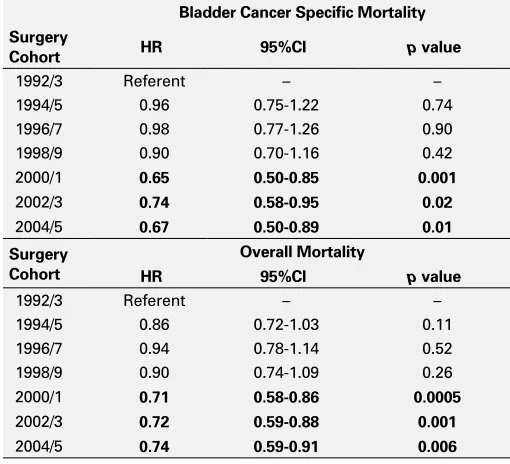
Methods: Using Surveillance, Epidemiology, End Results data linked to Medicare records, we identified 2408 patients aged ≥66 years with bladder carcinoma treated with definitive surgery between 1992 and 2005. Geography and time (2011) standardized outpatient Medicare expenditures on urine, laboratory, imaging investigations, and physician visits were evaluated for two years after surgery. Expenditure trends were assessed with linear regression. Multivariable Cox proportional hazard regression models were used to estimate mortality hazard ratios by sur-gical year.
Results: The average per patient expenditures during 2 years of follow-up after surgery increased from $1352 in 1992/3 to $2865 for patients in 2004/5 (p<0.0001). Expenditures on physician visits ($84 to $232), urine ($19 to $49) and imaging investigations ($1213 to $2538) increased significantly (p≤0.0001 for all), with no significant change in laboratory expenditures. Advanced imaging investigations appeared to drive the increased expenditures on follow-up care, with increased utilization also seen in these investigations (p<0.05 for all). After adjusting for demo-graphic, socioeconomic, comorbid conditions, treatment and pathologic factors, improved mortality outcomes were seen from 2000-2005 (Table 1). Conclusions: The increased utilization and associated costs of MRI and CT are largely driving the increased expense of follow-up care after sur-gery for bladder cancer. Increases in survival were seen in more recent years; whether this is the result of improved patient selection, treatment, or follow-up remains to be elucidated.
MP-07.06
Utilization of Perioperative Chemotherapy for Bladder Cancer: a Population-based Study
Siemens, D. Robert1; Rhee, Jonathan1; Tannock, Ian2; Peng, Yingwei1; Li,
Gavin1; Mackillop, William1; Booth, Chris1
1Queen’s University, Kingston, ON, Canada; 2Princess Margaret Hospital,
Toronto, ON, Canada
Introduction and Objectives: Evidence from clinical trials and inter-national guidelines support the use of perioperative chemotherapy for patients with muscle-invasive bladder cancer undergoing cystectomy, par-ticularly in the neoadjuvant (NACT) setting. Here we describe delivery of perioperative NACT as well as adjuvant chemotherapy (ACT) in the general population of Ontario, Canada.
Methods: Electronic records of treatment were linked to the population-based Ontario Cancer Registry to identify all patients who underwent cystectomy for bladder cancer in Ontario 1992-2006. Utilization was compared across 3 study periods: 1992-96, 1997-01, 2002-06. Logistic regression was used to analyze temporal trends in the use of perioperative chemotherapy, while controlling for changes in case mix.
Table 2. MP-07.04
Cancer Specific Survival Overall Survival
Surgical Group HR 95%CI p value HR 95%CI p value
UM-1 (versus U) 1.77 0.95–3.27 0.07 1.51 0.91–2.50 0.11 UM-2 (versus U) 1.52 0.85–2.73 0.16 1.61 1.01–2.57 <0.05
UMR (versus U) 1.8 0.84–3.84 0.13 1.70 0.93–3.12 0.08
Cancer Specific Survival Overall Survival
Non-Surgical Group HR 95%CI p value HR 95%CI p value
UM-1 (versus U) 1.93 1.45–2.56 <0.0001 1.78 1.44–2.19 <0.0001
UM-2 (versus U) 1.23 0.93–1.62 0.15 1.33 1.09–1.62 0.006
UMR (versus U) 1.67 1.17–2.37 0.005 1.76 1.36–2.28 <0.0001 U: urology; UM: urology and medical oncology; UMR: urology, medical oncology and radiation oncology; HR: hazard ratio; CI: confidence interval.
Table 1. MP-07.05. Multivariate Cox proportional hazards regression analysis for bladder cancer specific and overall survival.
Bladder Cancer Specific Mortality Surgery
Cohort HR 95%CI p value
1992/3 Referent – – 1994/5 0.96 0.75-1.22 0.74 1996/7 0.98 0.77-1.26 0.90 1998/9 0.90 0.70-1.16 0.42 2000/1 0.65 0.50-0.85 0.001
2002/3 0.74 0.58-0.95 0.02
2004/5 0.67 0.50-0.89 0.01 Surgery
Cohort
Overall Mortality
HR 95%CI p value
1992/3 Referent – – 1994/5 0.86 0.72-1.03 0.11 1996/7 0.94 0.78-1.14 0.52 1998/9 0.90 0.74-1.09 0.26 2000/1 0.71 0.58-0.86 0.0005
2002/3 0.72 0.59-0.88 0.001
Results: In 1992-2006, 4886 patients underwent cystectomy and the abso-lute number of surgical procedures done yearly nearly doubled over the study period. The overall survival of patients treated with radical surgery did not vary over the three study periods with a 3- and 5- year survival of 47.9% (45.6-50.1) and 39.5% (37.1-41.9) respectively during the most recent era. Of those undergoing cystectomy in Ontario, 736 (16%) received perioperative chemotherapy; NACT and ACT were used in 142 (3%) and 623 (14%) of cases respectively. While the use of NACT did not change over the 3 study periods, utilization of ACT increased a small degree with time (10%, 15%, 16%; p<0.001). Use of perioperative chemotherapy varied widely across catchment areas of provincial cancer centres (11% to 22%, p<0.001).
Conclusions: Despite accumulating evidence and guideline development over the study period, chemotherapy remains underutilized in Ontario. The observed variations in use of chemotherapy across geographic regions and SES, may represent opportunities for further outcomes research as a natural experiment and possibly to target future interventions to optimize utilization.
MP-07.07
Utilization and Predictors of Neoadjuvant Chemotherapy for Muscle-invasive Bladder Cancer in the Veteran’s Health Administration
Sandhu, Gurdarshan1; Luo, Suhong2; Zeringue, Angelique2; Carson,
Kenneth2; Nepple, Kenneth1; Strope, Seth1; Hudson, M’Liss2; Grubb 3rd,
Robert2
1Washington University School of Medicine, St. Louis, MO, United States; 2VA St. Louis Healthcare System, Department of Veterans Affairs, St. Louis,
MO, United States
Introduction and Objectives: The adoption of neoadjuvant chemotherapy in bladder cancer as a clinical paradigm has been slow despite level 1 evidence supporting a survival benefit with its use. We report trends in utilization of neoadjuvant chemotherapy and evaluate predictors of its use in a comprehensive, contemporary cohort in the Veterans Health Administration (VA).
Methods: Using the VA Clinical Cancer Registry, we identified all patients with clinically localized muscle invasive bladder cancer from 1997 to 2007. Receipt of neoadjuvant chemotherapy had been evaluated prospec-tively by cancer registrars. Patients who did not undergo definitive local therapy and were treated initially with chemotherapy alone were assumed to have been treated with neoadjuvant chemotherapy without subsequent local therapy. The trend in neoadjuvant chemotherapy use was evaluated with a Chi-square test. Predictors of neoadjuvant chemotherapy were evaluated using a multivariable logistic regression model incorporating demographic, comorbid and pathologic factors.
Results: There were 2297 and 2125 patients identified in the surgical and non-surgical groups, respectively. 4.8% and 8.3% of patients received neoadjuvant chemotherapy in the surgical and non-surgical group, respec-tively. Temporal trends in chemotherapy use showed an increase in neo-adjuvant chemotherapy use over time (p<0.0001); however the usage of neoadjuvant chemotherapy remained <11%. On multivariable analysis, older patients with advanced, localized disease, who were treated in more recent years, were more likely to receive neoadjuvant chemotherapy (Table 1). Charlson comorbidity was not predictive of neoadjuvant che-motherapy use.
Conclusions: While overall use of neoadjuvant chemotherapy in the VA population for bladder cancer remains low, analysis of temporal trends show increasing utilization. At the patient level, receipt of neoadjuvant chemotherapy was largely dictated by locally advanced disease.
MP-07.08
Laparoscopic Radical Cystectomy - Is There Evidence of Learning Curve? Experience of 60 Consecutive Cases Performed in a High Volume Tertiary Cancer Centre
Khan, Faisal; Abroaf, Ahmed; Jackson, M.; Durkan, G.C.; Heer, R.; Soomro, N.A.; Johnson, M.I.
NHS Freeman Hospital, Newcastle, United Kingdom
Introduction and Objectives: Radical cystectomy is recognized as a highly morbid procedure. Laparoscopic radical cystectomy (LRC) is potentially less invasive in comparison with open cystectomy; however it is a techni-cally challenging procedure with a significant learning curve. We describe our initial experience with LRC.
Methods: From May 2005 to November 2010 we performed sixty LRC for muscle invasive or non muscle invasive high grade bladder cancers. We compared our first 30 consecutive patients (group A) with the next 30 consecutive patients (group B). We prospectively collected patient demographic data, operative time, blood loss and length of stay along with complications recorded using the Clavien- Dindo classification. Results: All procedures were completed laparascopically. One patient had a neobladder in group A while the other patients had an ileal conduit. The mean BMI was 27 and median ASA grade of 2 in both groups. On average 11 lymph nodes were removed. One patient in each group has positive surgical margin however both patients had T3 and T4 disease on histology. We noted improvement in all domains in consecutive group including complications recorded, as per Clavien-Dindo classification (Table 1). Conclusions: Our results suggest that LRC is a safe procedure with out-come data comparable to open surgery. When we compared these 2 groups of patients it would appear that various outcome measures such as. Operative time, blood loss, length of stay and complications as per Clavien –Dindo classification do improve with increasing surgeon experi-ence. The factors behind this improvement are uncertain but along with increased surgical experience factors such as improved patient selection may also be important. We would expect that our outcomes may well
Table 1. MP-07.07. Multivariable predictors of
neoadjuvant chemotherapy utilization in the Veteran’s Health Administration
OR 95%CI p value
Age (per year older) 1.02 1.00–1.03 0.04
Tumor Stage (reference Ta, Tis, T1)
T2 3.32 2.14–5.14 <0.0001 T3, T4 2.17 1.35–3.51 0.002 Metastatic disease 2.55 0.92–7.07 0.07
Year of Diagnosis (reference 2003 and bfore)
2004 1.67 1.10–2.52 0.02 2005 1.52 1.00–2.31 0.048 2006 2.06 1.41–3.01 0.0002 2007 2.83 1.97–4.06 <0.0001
OR: odds ratio; CI: confidence interval.
Table 1. MP-07.08
improve with increasing numbers and we continue our prospective audit of outcomes using the Clavien-Dindo classification.
MP-07.09
Hypoxia Is Independently Associated with Poor Outcome in Urothelial Bladder Cancer Patients Treated with Radical Cystectomy
Bostrom, Peter J.1; Thoms, John1; van Rhijn, Bas W.G.1; Ahmed, Omer1;
Evans, Andrew1; Mirtti, Tuomas2; Sykes, Jenna1; Milosevic, Michael1;
Zlotta, Alexandre R.3; Bristow, Robert G1
1University Health Network, Toronto, ON, Canada; 2Helsinki University
Hospital, Helsinki, Finland; 3Mount Sinai Hospital, University Health
Network, Toronto, ON, Canada
Introduction and Objectives: Intra-tumoral hypoxia has been reported to be an independent prognostic marker for disease-free and overall survival in many tumor types following radiotherapy or surgery. We therefore tested whether the expression of hypoxia-associated biomarkers was a prognostic factor in muscle-invasive bladder cancer (MIBC) treated by RC. Methods: Two cohorts of MIBC patients (clinical T2/T3N0M0) treated with RC were studied following ethics approval (University of Toronto, Canada: n=99; University of Turku, Turku, Finland: n=186). An expert GU-pathologist reviewed all slides and tissue microarrays were con-structed. Using semi-quantitative immunohistochemistry, the expression of the hypoxia markers HIF-1α, GLUT-1, CA-IX, as well as the Ki-67 proliferation marker, was determined by three independent reviewers. Mean expression was used for outcome analyses. The association between each markers and disease-specific survival (DSS) were determined using univariate and multivariate analyses.
Results: In univariate analysis, GLUT-1 was a significant of predictor of DSS in patients operated by RC (p=0.01). Ki-67 at a 5% cut-off was also significantly associated with DSS (p=0.028).In multivariate analysis, GLUT-1 was highly significant for predicting DSS (p=0.004) as were con-ventional parameters like node status or pathological stage. HIF-1α and CA-IX were not prognostic.
Conclusions: GLUT-1 and Ki-67 are promising biomarkers for predicting outcome in patients with MIBC treated with RC. Our results should be confirmed in large validation cohorts. Novel treatment strategies which combat tumor hypoxia should continue to be explored.
MP-07.10
Heat Shock Protein 70 (HSP70) as a Recurrence Marker for PT1 Bladder Cancer
Stakhovskyi, Oleksandr1; Margel, David1; van der Kwast, Theodorus H.1;
van Rhijn, Bas W.G.1; Bostrom, Peter J.1; Bristow, Robert G.1; Fleshner,
Neil1; Jewett, Michael A.S.1; Bapat, Bharati2; Zlotta, Alexandre R.3 1University Health Network, Toronto, ON, Canada; 2Mount Sinai Hospital,
Samuel Lunenfeld Research Institute, Toronto, ON, Canada; 3Mount Sinai
Hospital, University Health Network, Toronto, ON, Canada
Introduction and Objectives: Heat shock proteins (HSPs) are overex-pressed in a wide range of human cancers and are implicated in tumor cell processes and recognition by the immune system. As HSPs proteins are among the most immunogenic reported molecules and BCG therapy is immune dependent, the role of HSPs in patients with BC treated with BCG warrants investigation. We evaluated HSP70 expression levels and its relationship to pathological, clinical parameters and FGRF3 mutation and protein overexpression in primary T1BC treated with BCG. Methods: 69 patients diagnosed with confirmed primary T1BC treated at the University Health Network, Toronto were studied. Microarrays were built and HSP70 protein expression was determined by standard immunohistochemistry. Slides were co-reviewed with an experienced uro-pathologist with staining scores dependent on the expression and intensity of the marker. HSP expression was correlated with pathological, clinical outcomes and with the expression of FGFR3. FGFR3 mutation status was examined by multiplex PCR-SNaPshot analysis. Kaplan-Meier method and multivariate Cox-regression analysis were used for data analysis. Results: Mean age of patients was 71.1 years (±8.5). HSP70 was found to be expressed in 29/53 (55%) high-grade and in 9/14 (64%) low-grade
tumors. Kaplan-Meier survival analysis demonstrated that the lack of HSP70 expression was a significant predictor for disease recurrence (p<0.05) but did not affect progression. In a multivariate model adjusting for grade, size and concomitant CIS, lack of HSP70 expression remained a significant predictor for recurrence (HR of 1.952, 95%CI 1.02-3.75;
p=0.045). HSP70 was shown to correlate with FGFR3 expression and mutation (p<0.05).
Conclusions: HSP70 is a promising marker in T1 BC treated with BCG. Both HSP70 and FGFR3 may play an important prognostic role in T1 BC identifying a group at lower risk of recurrence.
MP-07.11
How Should Locoregionally Recurrent or Advanced Primary Malignancies of the Bladder or Ureter Be Managed? Potential Role of Multimodality Therapy Incorporating Surgery and Intraoperative Radiotherapy
Choo, Richard; Hallemeier, Christopher; Haddock, Michael Mayo Clinic, Rochester, MN, United States
Introduction and Objectives: For patients with locoregionally (LR) recur-rent or advanced primary tumors of the bladder or ureter, there are limited therapeutic options. This is to report outcomes of multimodality therapy incorporating maximal surgical resection and intraoperative electron radiotherapy (IOERT) for such patients.
Methods: From 1983-2009, a total of 17 consecutive patients, consisting of 11 with LR recurrence after cystectomy for bladder carcinoma, 4 with LR recurrence after nephroureterectomy for ureteral carcinoma, and 2 with advanced primary bladder carcinoma were treated with a multimo-dality therapy. 8 patients had received prior treatment for LR recurrence and the multimodality treatment was a second salvage attempt. 16 patients received perioperative EBRT as part of the multimodality treatment with a median dose of 50.4 Gy. Extent of surgical resection was R0 (n=7), R1 (n=1), and R2 (n=9). After maximal resection was achieved, IOERT was delivered to residual disease or the area at the highest risk of residual disease. The median IOERT dose was 12.5 Gy. Overall survival (OS) and relapse patterns were estimated from the date of resection and IOERT, using the Kaplan-Meier method.
Results: The median follow-up for surviving patients was 3.6 years (range 1.1-10). OS at 1, 2, and 5 years was 53%, 31%, and 16%. Central (within the IOERT field), LR (tumor bed or regional lymph nodes), and distant relapse at 2 years were 15%, 49%, and 67%, respectively. On univari-ate analysis, resection of all gross disease (R0-1) was associunivari-ated with improved OS (p=0.03). Mortality within 30 days of surgery and IOERT was 0%. Two patients (12%) experienced NCI-CTCAE grade 4-5 late toxicity. Conclusions: In our cohort, the multimodality approach incorporating IOERT yielded a low rate of central recurrence within the IOERT field with acceptable toxicity. However, LR and distant relapse were common, indi-cating a need for better patient selection, LR therapy, and systemic therapy.
MP-07.12
Tumor Stage on Re-staging Transurethral Resection Predicts Recurrence and Progression Free Survival of High Risk Superficial Bladder Cancer
Bishr, Mohamed1; Lattouf, Jean-Baptiste2; Latour, Mathiew2; Saad, Fred2 1Centre de recherche du Centre hospitalier de l’Université de Montréal
(CRCHUM) and Institut du cancer de Montréal, Montreal, QC, Canada;
2Centre hospitalier de l’Université de Montreal (CHUM), Montreal, QC,
Canada
Introduction and Objectives: Debate in the management of high risk superficial bladder cancer between conservative (bladder-sparing) treat-ment and early cystectomy continues. Efforts are ongoing to determine helpful clinical and biological prognostic factors in decision making. Our objective was to evaluate the clinical variables that affect the outcome of patients with high risk superficial transitional cell carcinoma (TCC) who underwent re-staging transurethral resection (TUR) in terms of recurrence free-survival (RFS) and progression free-survival (PFS).
de Montréal (CHUM) from 2004 to 2010 were reviewed. Of these, 59 patients with high risk superficial TCC who underwent re-staging TUR and were not upstaged to muscle invasive disease were included in this analysis (Table 1).
Results: On re-staging TUR, 30 patients had no residual tumor (pT0) and 29 patients had residual tumors. Of the 30 patients with pT0, 13 (43.3%) had tumor recurrence (median time to recurrence: 13.3 months) and 2 (6.6%) had progressed to muscle invasive disease (median time to progression: 23 months) (Table 2). Of the 29 patients with residual tumor on re-staging TUR, 23 (79.3%) had a recurrence (median time to
recurrence: 5.4 months) and 9 (31%) had progressed to muscle inva-sive disease (median time to progression: 11 months). On multivariate analysis, re-staging TUR pathology and the regimen of BCG (induction versus maintenance) are independent predicting factors for RFS (p=0.001 HR: 1.85), (p<0.001 HR: 0.09) respectively while for PFS re-staging TUR pathology is the only independent predicting factor (p=0.019 HR: 1.89). Conclusions: Presence of pT0 on re-staging TUR is associated with better RFS and PFS. Patients with persistence of superficial cancer on restaging TUR require close follow-up and in some cases could be considered for early cystectomy.
Table 1. MP-07.12. Pathology on initial TUR compared to the pathology on re-TUR
Initial pathology Pathology of re-TUR
No. of patients T0, n (%) Ta low grade, n (%) Ta high grade, n (%) T1 high grade, n (%)
Ta low grade 6 2 (33%) 2 (33%) 1 (17%) 1 (17%) Ta high grade 17 11 (64%) 1 (6%) 5 (29%) 0 T1 high grade 36 17 (47%) 0 4 (11%) 15 (42%) Total 59 30 (51%) 3 (5%) 10 (17%) 16 (27%)
TUR: transurethral resection.
Table 2. MP-07.12. Correlation of pathology on re-TUR with tumor recurrence or progression
Pathology on re-TUR No. of patients Tumor recurrence n (%) recurrence (months)Median time to Tumor progression, n (%) progression (months)Median time to
T0 30 13 (43.3%) 13.3 2 (6.6%) 23 Residual tumor on re-TUR 29 23 (79.3%) 5.4 9 (31%) 11 Ta low grade 3 3 (100%) 9.1 0 – Ta high grade 10 8 (80%) 4.6 2 (20%) 31 T1 high grade 16 12 (75%) 6.1 7 (43.75%) 9.6 Total 59 36 (61%) 7.8 11 (18.6%) 13