R E S E A R C H
Open Access
Wireless information and power transfer in
two-way relaying network with non-coherent
differential modulation
Weikai Xu
1*, Zheng Yang
2, Zhiguo Ding
3, Lin Wang
1and Pingzhi Fan
2Abstract
In this paper, we consider a denoise-and-forward (DNF) two-way relay network (TWRN) with non-coherent differential binary phase-shift keying modulation, where a battery-free relay node harvests energy from the received radio frequency (RF) signals and uses the harvested energy to help the source nodes for information exchange. Based on the power splitting (PS) and time switching (TS) receiver architectures, power splitting relaying (PSR) and time switching relaying (TSR) protocols at relay are studied. In order to investigate the effect of power allocations on two source nodes, power splitting coefficient and time switching factor at relay on performance, the two proposed protocols are analyzed and the bit error rate (BER) expressions of end-to-end system are derived. Based on these expressions, the optimal power of sources, the power splitting ratio and the time switching factor are obtained via the numerical search method. The simulation and numerical results provide practical insights into the effect of various system parameters, such as the power splitting coefficient, the time switching factor, sources to relay distances, the noise power, and the energy harvesting efficiency on the performance of this TWRN. In addition, the results show that the PSR protocol outperforms the TSR protocol in terms of throughput under various network geometries.
Keywords: Two-way relay network; Differential modulation; Wireless information and power transfer; Denoise-and-forward, bit error rate
Introduction
As a common communication scenario, two-way relaying realizes information exchange between two nodes simul-taneously. Recently, the two-way relay network (TWRN) has attracted many attentions from both academic and industrial communities [1-5], due to its bandwidth effi-ciency and potential applications to cellular networks and peer-to-peer networks. Generally, the data transmission in TWRN can take place in either three or two phases. For the three-phase TWRN, network coding (NC) is the most popular relaying protocol [6]. In NC, two source nodes
S1andS2transmit to the relayRseparately over the first
two phases. After decoding the received signals, the relay
Rperforms bit-level exclusive OR (XOR) operations and then broadcasts the XOR-coded bits to the two source nodes in the third phase.
*Correspondence: [email protected]
1Department of Communication Engineering, Xiamen University, 422 Siming South Rd., 361005 Xiamen, Fujian, China
Full list of author information is available at the end of the article
It shows that the two-phase TWRN protocol can achieve a maximum throughput gain of one half over the three-phase TWRN. Therefore, various protocols for two-phase TWRN have been proposed in the literatures. Two way amplify-and-forward (AF) relaying was proposed in [7,8], where a relay directly amplifies and forwards the sum of received signals. Physical-layer network coding (PLNC) was proposed in [9,10], where self-information at source nodes is eliminated by XOR operations. In [11], the denoise-and-forward (DNF) protocol was proposed, where the relays apply a denoising function to map the receive signal into another quantized symbol that can be used by each source node to uniquely decode the symbol transmitted from the other end. The AF relaying proto-col has less complexity than that of PLNC and DNF at the relay since no decoding operation is required at the relay node. The AF relaying protocol requires perfect chan-nel state information (CSI) at the two source nodes to remove the self-interference. Most of the existing works assume that both the sources and the relay have perfect
CSI knowledge of all links. In a practical system, these CSIs need to be estimated at the receiver. It is more diffi-cult to estimate the CSIs in two-way relay networks than that in conventional point-to-point communication sys-tems. To mitigate the difficulties involved in estimating the CSI in TWRN, non-coherent or differential transmis-sion schemes have been proposed for TWRN [12-14]. In [13], the AF and decode-and-forward (DF) TWRN proto-cols using differential modulation were proposed. It shows that these schemes suffer from more than 3 dB perfor-mance loss compared with their coherent counterparts. In [14], Guan and Liu analyzed performance of TWRN with DNF relaying protocol using differential binary phase-shift-keying (DBPSK) modulation over fading channel. It is shown that the achievable diversity order of the pro-posed scheme is about half of the number of relays. The two-phase TWRN with non-coherent receiver not only achieve high spectral efficiency but also reduce the over-head of estimation of channel. Thus, it is a good option of information exchange for low cost wireless network, such as wireless sensor networks (WSNs).
The lifetime of the network is an important perfor-mance indicator in energy-constrained wireless networks, such as WSNs, since sensors are usually equipped with limited energy supplies. Harvesting energy from the envi-ronment is a promising approach to prolong the lifetime of the energy-constrained wireless networks. The basic idea of simultaneous wireless information and power trans-fer (SWIPT) was first proposed in [15,16], and a general receiver architecture was then developed in [17]. Then, the SWIPT was extended to various communication sce-narios such as the cellular system [18], the broadcasting system [19,20] with a single energy receiver and a sin-gle information receiver when they are separately located or co-located, the cooperative relay system [21-25], the two-way relaying system [26], and the interference chan-nel [27-29]. For broadcasting system, [19] investigated the R-E trade-off for a transmitter transferring energy and information to two separated/co-located information-decoding and energy harvesting receivers. And [20] optimized the beamforming designs of general broadcast-ing system where there are multiple separated/co-located information-decoding and energy harvesting receivers. For a DF cooperative network, [21] derives the outage probability of time switching relay receiver. In [22], the authors studied the outage probability and network capac-ity of end-to-end one-way relay system with a battery-free relay. For multiple source-destination pairs communica-tion system aided by a relay, [23] studied the relays’ strategies to distribute the harvested energy among the multiple users and their impact on the system perfor-mance. For multiple-input multiple-output relay channels, [24] proposed a low complexity dynamic antenna switch-ing between information decodswitch-ing and energy harvestswitch-ing
based on the principles of the generalized selection com-biner. In [25], the authors studied the relay selection problem in AF relay network with QoS and harvested energy constraints. In [26], the trade-off end-to-end out-age probability and power splitting coefficient are studied in a two-way AF relay system where two source nodes exchange data via an energy harvesting relay. In [28] and [29], the authors investigated joint wireless information and energy transfer in the two-user/multiple-user MIMO interference channel, in which each receiver either infor-mation decoding or energy harvesting.
As is mentioned above, almost of the aforementioned SWIPT protocols assume that the transmitted signal sat-isfies Gaussian distribution and do not consider the mod-ulation scheme. To the best of the authors’ knowledge, simultaneous wireless information and power transfer in the two-phase TWRN with differential modulation has not been addressed so far. Here, we study a two-phase TWRN using differential BPSK modulation, where a battery-free relay node harvests energy from the received RF signal and uses the harvested energy to exchange the two source nodes’ information. The main contributions of this paper are summarized as follows:
1) Based on the power splitting (PS) and time switching (TS) receiver architectures at relay node, we propose the PS-based relaying (PSR) and the TS-based relaying (TSR) protocols to enable wireless
information transferring and energy harvesting at the battery-free relay in a DNF-TWRN.
2) For PSR and TSR protocols, we deduce the maximum likelihood (ML) decoding algorithm at relay and source nodes. Then, we derive the end-to-end error performance and normalized throughput of the two proposed protocols. These derived expressions provide practical design insights into the effect of various parameters on the system performance. By maximizing end-to-end throughput of system, we can optimize the power on two source nodes, power splitting coefficient, time switching factor, and other system parameters.
3) Differing from convention two-way relaying
network, the numerical results show that locating the relay node closer to the source nodes yields larger throughput for both the TSR and the PSR protocols. By comparing PSR and TSR protocols, the numerical results also show that the throughput performance of the PSR protocol is superior to the TSR protocol.
discussions are presented in ‘Numerical results’ section. ‘Conclusions’ section concludes the paper.
System model
Here, we consider two relaying protocols for separate information decoding and energy harvesting at a battery-free relay node, namely,i) PS-based relaying PSR protocol andii) TS-based relaying TSR protocol [22]. In PSR pro-tocol, the relay uses a faction of the received power from two source nodes for energy harvesting and the remain-ing power for information decodremain-ing. In TSR protocol, the relay use a fraction of time for energy harvesting and the remaining time for information decoding.
PSR protocol
There are two sourcesS1andS2that want to exchange
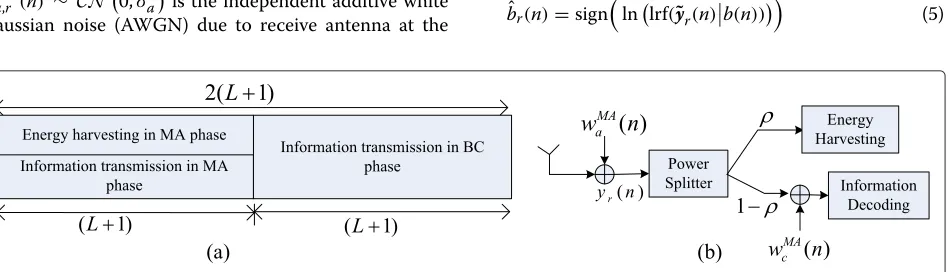
information with the help of a relayRin a TWRN. The key parameters of PSR protocol and receiver of relay are illus-trated in Figure 1. At the begin of multiple access (MA) phase,Si(i=1, 2)generates a sequence of uncoded BPSK
symbolsbi(n) ∈ {−1,+1} of lengthL(n = 1, 2,. . .,L).
Then, these raw symbols are re-encoded through differ-ential modulation, i.e., xi(n) = xi(n − 1) × bi(n) for n = 1, 2,. . .,L withxi(0) = 1 as the reference symbol.
Two sources then simultaneously send the whole differ-ential modulated block to the relay during MA phase. At the end of MA phase, thenth(n = 0, 1, 2,. . .,L)symbol received at the relay is
yr(n)=
P1h1,rx1(n)+
P2h2,rx2(n)+wMAa,r (n) (1)
wherePi = αiP is power of theith(i = 1, 2) source,P
is total power,αiis power ratio of theith source. Assume
that the channel gain isσi2,r = 1/dμi,r, where di,r is
dis-tance between source node to relay, μ is the path loss exponent. Thus, hi,r ∼ CN
0,σi2,r is the independent channel coefficient from theith(i = 1, 2)source to the relay during MA phase. It is also assumed that the chan-nels remain unchanged within one block of length(L+1).
wMAa,r (n) ∼ CN0,σa2is the independent additive white Gaussian noise (AWGN) due to receive antenna at the
relay within the nth (n = 0, 1,. . .,L) symbol interval during MA phase.
We assume that relay knows channel gainσi2,r but does not know channel coefficienthi,r. The basic idea of energy
harvesting relaying is that an energy constrained relay recharges its battery by using the energy from its obser-vations. For power splitting [17], letρ denote the power splitting coefficient for the relay, i.e.,ρ is the fraction of observations used for energy harvesting. Thus, at the end of the MA phase, the relay’s information receiver is based on the following observation
˜
yr(n)=
1−ρP1h1,rx1(n)+
P2h2,rx2(n)+wMAa,r (n)
+wMAc,r (n)
(2)
wherewMAc,r ∼ CN0,σc2is the sampled AWGN due to RF band to base-band signal conversion. The harvested energy in the first(L+1)symbols is
Eh=(L+1)ηρ
α1Pσ1,2r+α2Pσ2,2r+σa2
(3)
where 0< η≤1 is the energy conversion efficiency which depends on the rectification process and the energy har-vesting circuit. And power per symbol in the BC phase is
Pr=Eh/(L+1)=ηρ
α1Pσ1,2r+α2Pσ2,2r+σa2
(4)
To facilitate demonstrations, we define a sequence of auxiliary symbolsb(n) = b1(n)×b2(n) ∈ {−1,+1}to
indicate whether the two raw BPSK symbols have the same signs or not. With DNF [11,14], the relay just maps the nth received symbol to a BPSK symbol bˆr which
is used by each source to uniquely decode the symbol transmitted from the other end. Here, it can be regarded as an estimate of the auxiliary symbol b(n). As no CSI is available, we use the single-symbol ML decoder in [14], i.e.,
ˆ
br(n)=sign
lnlrf(y˜r(n)b(n)) (5)
Figure 1Power splitting protocol.(a)The parameters of the PSR protocol for energy harvesting and information decoding at the relay in TWRN.
where y˜r(n) = y˜r(n),y˜r(n−1) T, lrf
˜
yr(n)|b(n)is the likelihood ratio function (LRF) of y˜r(n) conditional on
b(n),
whereg(y,)is the probability density function (PDF) of y∼CN(0,)is given by
g(y,)= 1 π2||exp
−yHy (7)
Denote the channel signal-to-noise ratio (SNR), i.e., γi,r = (1−ρ)αiPσ
are two constant matrix.
In the terms of reference [14], the conditional covari-ance matrices are given by
⎧ variance of information decoding at relay. After decoding, the relay re-encodebˆr(n) intotr(n) = tr(n−1)× ˆbr(n)
forn = 1, 2,. . .,Lbased on reference symboltr(0) = 1. The relay then uses harvested energy in the MA phase for transmitting information in the broadcasting (BC) phase. Without considering the energy consumed by signal pro-cessing, from Equation 3, the harvested energy per symbol duration isPr, this is energy constraint of the relay in the
BC phase. Thus, at the end of BC phase, theith(i=1, 2) source will receive from the relay,
ri(n)=
independent but have the same variance, which is deter-mined by the distance between two terminals.wBCi (n) ∼ CN0,σa2+σc2 includes the antenna and conversion
AWGNs at theith(i = 1, 2)source within thenth(n =
0, 1, 2,. . .,L)symbol interval in the BC phase.
We again use the single-symbol ML decoder in BC phase, the received signal of theith source is
ˆ
ditional decoding error at the relay are assumed as follow,
PM,r =Pr(bˆr(n)= −1|b(n)= +1)
TSR protocol is shown in Figure 2. We assume that data rate of direction transmission isRˆ. In PSR, the data rate is alwaysRˆ. However, in TSR, data rate of two-way system is dependent on the time splitting factorα. In total symbol duration 2(L+1), we also assume that the total power constraint is same as PSR protocol in 2(L+1)symbols, i.e.,(L+1)P. Therefore, the power per symbol in energy harvesting and MA phase is
Figure 2Time switching protocol.(a)The parameters of the TSR protocol for energy harvesting and information decoding at the relay in TWRN.
(b)The block diagram of receiver at relay.
where Pi = αiP = 1α+iPα (i = 1, 2). Denote the chan-b(n)is the same as Equation 6 with the same conditional covariance matrices of PSR (see Equation 8) with σr2 = σ2
while the power per symbol in the BC phase is
Pr= source receives the signal from the relay is
ri(n)=
with the conditional covariance matrix
Utilizing Equation 12 and 13, the relay decoding error can be evaluated as
The two kinds of conditional decoding error of in Equation 12 and 13 are given by[14]
PM,r =h
In the BC phase, the two kinds of conditional decoding errors between the relay and the ith source are non-coherent DBPSK decoder [30], they are given by
Similar to Equation 12 and 13, the two kinds of con-ditional decoding error at the ith source are given as,
PMr ,Si=Pr
Therefore, the end-to-end error probability of the ith source node is
According to [14], the average BER of two sources can be approximated at high SNRs as
Pe≈ 1
a+σc2 is system SNR. Substituting Equation 27
and 28 into Equation 26, we can get the BER expression ofPePSRandPTSRe for the PSR and TSR protocol, respec-tively. We ignore the overhead of reference symbol in the differential modulation. Thus, the end-to-end normalized throughput are defined respectively as follow,
TPSR=
respectively, where PePSR and PTSRe are the end-to-end average error probability of the PSR and TSR protocol, respectively. The binary entropy functionH(x)is given by
H(x)= −xlog2(x)−(1−x)log2(1−x) (30) Therefore, through above expressions of throughput and BER, we are about to investigate that the power allo-cation (α1 and α2) among the two sources, the energy
harvesting factor ( ρ or α ) at the relay and other sys-tem parameters impact on the performance. In the next section, some numerical results will be illustrated based on these analyzed formulas.
Numerical results
In this section, we use the derived analytical results to provide insights into the various design choices. The opti-mal value of noropti-malized throughput for given distance between source and relay, optimal value of power split-ting ratioρin the PSR protocol and optimal value of time switching factorαin the TSR protocol are investigated for different values of the noise variances, the two source to relay distances,dS1RanddS2Rand energy harvesting
effi-ciency, respectively. Unless otherwise stated, we set the energy harvesting efficiency,η = 0.5, total source trans-mission power,P=0.1 mw, distance between two source nodes,d=dS1R+dS2Rand path loss exponentμ=2.5.
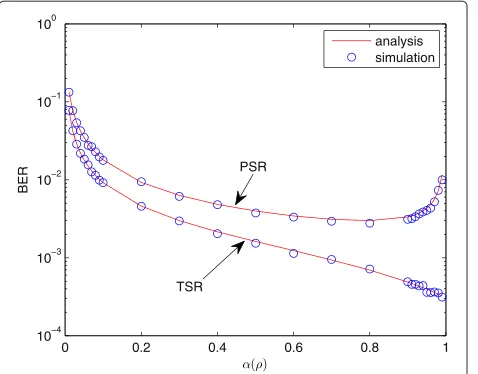
Figure 3BER versus PSR coefficientρ(TSR coefficientα).P=0.1 mw,σc2= −80 dBm,σa2= −90 dBm,dS1R=dS2R=7 m,μ=2.5, α1=α2=0.5, andη=0.5.
the PSR and the TSR protocols. The antenna noise vari-ance,σa2, and conversion noise variance,σc2, is set to−90 and−80 dBm, respectively. The two source nodes have the same power, i.e.,α1=α2=0.5, anddS1R=dS2R=7
m. It can be observed from Figure 3 that the analytical and the simulation results match well for all possible values of ρandαfor both the PSR and the TSR protocols. Figure 3 also demonstrates that the PSR has a power splitting coef-ficient to get minimum BER, but the TSR has not a energy harvesting time ratio to get minimum BER. The reason is that there is more energy harvesting time during MA phase, there is higher transmitted power of relay during the BC phase.
In order to further observe the effect of power splitting coefficient ρ and energy harvesting time ratioα on the two protocols, Figure 4 shows the normalized throughput of two protocols, which is got by Equation 28. Figure 4 demonstrates that both PSR and TSR has the value ofρ andα to get maximum normalized throughput. We also can see that the maximum throughput of PSR protocol is higher than that of the TSR protocol. The throughput of TSR increases asαincreases from 0 to maximum point, then starts decreasing quickly asαincreases to 1. On the contrary, the throughput of PSR protocol change slowly withρ. This is because there is only 1−αtime for informa-tion transmission in the TSR protocol, but all time is used for information transmission in the PSR protocol. There-fore, the TSR protocol achieves better BER performance, shown as in Figure 3, but it has lower throughput.
The optimal values in Figures 5, 6, 7, 8, and 9 are obtained through exhaustive search based on the expres-sions in the ‘Performance analysis’ section. Here, we set the step of parametersρ,αandα1is 0.01. Figure 5 shows
Figure 4Throughput versus PSR coefficientρ(TSR coefficientα). P=0.1 mw,σ2
c = −80 dBm,σa2= −90 dBm,dS1R=dS2R=7 m,
μ=2.5,α1=α2=0.5, andη=0.5.
the optimal throughput for the PSR and the TSR proto-cols for different values of the source node S1 to relay
distance,dS1R. The source nodeS2to destination distance, dS2Ris set todS2R = d−dS1Rwhered = 14 m and the
noise variances are kept fixed, i.e.,σa2 = −90 dBm and σ2
c = −80 dBm. It can be observed from figure 5 that for
both the TSR and the PSR protocols, the optimal through-put decreases asdS1Rincreases untildS1R=7 m, which is
the half of distance between source nodeS1andS2. From dS1R = 7 m, as increasing ofdS1R, the throughput of two
protocols are both increasing. It is important to note that, as illustrated in Figure 5, the worst relay location of the two energy harvesting protocols is at the middle of two source nodes.
Figure 6 shows the optimal values of ρ and α for the TSR and the PSR protocols, respectively, for different val-ues of the source nodeS1to relay distance,dS1R. Figure 6
states that both optimal power splitting coefficientρand time switching factorαare even symmetry withdS1R. The
value ofρ andα both reach to maximum when relay is at the middle of two source nodes. It is shown that relay need more harvested energy to forward data when relay is at middle of two source nodes. Figure 6 also illustrates smallα for all distance area. This is because the parame-terαimposes two sides effect on throughput. On the one hand, throughput is increased with more harvested energy (lower end-to-end BER), on the other hand, throughput is decreased quickly with increasing ofα.
Figure 7 shows the optimal value of power allocation coefficientα1of source nodeS1of two protocols for
dif-ferent values of the source nodeS1to relay distance. The
figure demonstrates that optimalα1is odd symmetry with
Figure 5Distance source nodeS1to relay,dS1R, versus optimal throughput for PSR and TSR protocol.P=0.1 mw,σc2= −80 dBm, σ2
a= −90 dBm,μ=2.5, andη=0.5.
Figures 8 and 9 show the optimal values of ρ and α for the PSR and the TSR protocols, respectively, for dif-ferent values of antenna noise variance σ2
a and different
values of conversion noise variance σ2
c. Figure 8
illus-trates that the optimal value of ρ increases by increas-ing σa2 and ρ decrease by increasing σc2. The reason is that for PSR protocol, the antenna noise wa,r(n) affects
both the signal√ρyr(n)used energy harvesting and the
signal √(1−ρ)yr(n) used information decoding in MA
phase, while the conversion noisewc,r(n)only affects the
Figure 6Distance source nodeS1to relay,dS1R, versus optimal PSR
coefficientρ(TSR coefficientα).P=0.1 mw,σ2
c = −80 dBm, σ2
a= −90 dBm,μ=2.5, andη=0.5.
Figure 7Distance source nodeS1to relay,dS1R, versus optimal power coefficient of source nodeS1.P=0.1 mw,σc2= −80 dBm, σ2
c = −90 dBm,μ=2.5, andη=0.5.
signal √(1−ρ)yr(n) used information decoding. In the BC phase, two noises impose same effects on the receiver. Thus, the trend for the optimal value ofρis different when curves are plotted with respect to the noise variancesσ2 a
orσc2. However, it shows in Figure 9 that the optimal value ofα has the same trends by increasingσa2orσc2. This is because for the TSR protocol, the antenna noisewa,r(n)
and the conversion noisewc,r(n)affect the received signal
in the same way.
Figures 10 and 11 show the maximum throughput for the TSR and the PSR protocols, respectively, for different
Figure 8Optimal values ofρfor the PSR protocol for different values of antenna noise variance.σ2
Figure 9Optimal values ofαfor the TSR protocols for different values of conversion noise variance.σc2andσa2= −80 dBm (fixed). Other parameters:P=0.1 mw,η=0.5, andμ=2.5.
values of antenna noise variance,σa2or conversion noise variance σc2. It can be observed from Figures 10 and 11 that the analytical results are agreement to the sim-ulations for both the PSR and the TSR protocols with different geometry scenarios. Figures 10 and 11 also show that the antenna noise and conversion noise have almost similar effects on the two relaying protocols in different geometrical scenario.
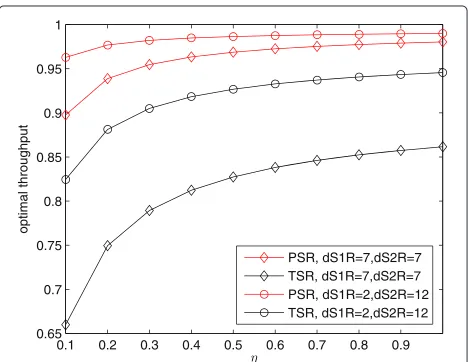
Finally, the optimal throughput for the PSR and the TSR protocols for different values of energy harvesting effi-ciency,η, are shown in Figure 12. It illustrates that the PSR protocol outperforms the TSR protocol for all the values of
Figure 10 Optimal throughput for the PSR protocol for different values of antenna noise variance.σ2
aandσc2= −80 dBm (fixed). Other parameters:P=0.1 mw,η=0.5, andmu=2.5. The real lines represent analytical results, and markers represent simulations.
Figure 11 Optimal throughput for the TSR protocol for different values of conversion noise variance.σc2andσa2= −80 dBm (fixed). Other parameters:P=0.1 mw,η=0.5, andmu=2.5. The real lines represent analytical results, and markers represent simulations.
ηin various geometry of the nodes. It also can be observed that the throughput of the two protocols is not sensitive the changing ofηwhenηis large enough.
Conclusions
In this paper, we have investigated two SWIPT proto-cols, called by PSR and TSR, in TWRN with non-coherent DBPSK modulation, where a battery-free relay node har-vests energy from the received RF signal and uses that harvested energy to exchange information between the two source nodes via the relay. We have developed ML decoder of this TWRN and analyzed BER expressions of the two proposed protocols. Based on end-to-end BER
Figure 12 Energy conversion efficiency versus optimal throughput. P=0.1 mw,σ2
and normalized throughput expressions of the TWRN, we have investigated the effect of power allocation on sources, time switching factor, power splitting coefficient, noise power, and other system parameters on the per-formance. Future work may focus on relay selection and schedule for extended energy harvesting TWRN with multiple battery-free relays network.
Competing interests
The authors declare that they have no competing interests.
Acknowledgements
This paper is partially funded by the European Union-FP7 (CoNHealth, Grant No. 294923), the Natural Science Foundation of Fujian Province of China (No. 2013J01256), the National Basic Research Program of China (973 Program No. 2012CB316100), the National Science Foundation of China (NSFC, No. 61032002), and the 111 Project (No. 111-2-14). The authors would like to express great appreciation to the reviewers of the paper for their valuable comments on improving the quality of this paper.
Author details
1Department of Communication Engineering, Xiamen University, 422 Siming
South Rd., 361005 Xiamen, Fujian, China.2Institute of Mobile Communications, Southwest Jiaotong University, 1 Jingqu Rd., 610031 Chengdu, Sichuan, China.3School of Computing and Communications, Lancaster University, InfoLab21, South Drive, LA1 4WA Lancaster, UK.
Received: 6 November 2014 Accepted: 17 April 2015
References
1. B Rankov, A Wittneben, inProceedings of International Symposium on
Information Theory. Achievable rate regions for the two-way relay channel
(IEEE, Seattle, 2006), pp. 1668–1672
2. B Rankov, A Wittneben, Spectral efficient protocols for half-duplex fading relay channels. IEEE J. Sel. Areas Commun.25, 379–389 (2007)
3. T Cui, T Ho, J Kliewer, Memoryless relay strategies for two-way relay channels. IEEE Trans. Commun.57, 3132–3143 (2009)
4. M Dai, H Wang, H Lin, S Zhang, B Chen, Opportunistic relaying with analog and digital network coding for two-way parallel relay channels. IET Commun.8, 2200–2206 (2014)
5. M Dai, P Wang, S Zhang, B Chen, H Wang, X Lin, C Sun, Survey on cooperative strategies for wireless relay channels. Trans. Emerging Telecommun. Technol.25, 926–42 (2014)
6. S Katti, H Rahul, W Hu, D Katabi, M Medard, J Crowcroft, XORs in the air: practical wireless network coding. IEEE/ACM Trans. Netw.16, 497–510 (2008)
7. P Popovski, H Yomo, Wireless network coding by amplify-and-forward for bi-directional traffic flows. IEEE Commun. Lett.11, 16–18 (2007) 8. H Gacanin, F Adachi, Broadband analog network coding. IEEE Trans.
Wireless Commun.9, 1577–1583 (2010)
9. C Feng, D Silva, F Kschischang, inProceedings of International Symposium
on Information Theory. An algebraic approach to physical-layer network
coding (IEEE, Austin, 2010), pp. 1017–1021
10. S Zhang, SC Liew, PP Lam, inProceedings of The Annual International
Conference on Mobile Computing and Networking. Hot topic: physical-layer
network coding (ACM, Los Angeles, 2006), pp. 358–365 11. P Popovski, H Yomo, inProceedings of International Conference on
Communications. The anti-packets can increase the achievable
throughput of a wireless multi-hop network (IEEE, Istanbul, 2006), pp. 3885–3890
12. L Song, Y Li, A Huang, B Jiao, A Vasilakos, Differential modulation for bidirectional relaying with analog network coding. IEEE Trans. Signal Process.58, 3933–3938 (2010)
13. T Cui, F Gao, C Tellambura, Differential modulation for two-way wireless communications: a perspective of differential network coding at the physical layer. IEEE Trans. Commun.57, 2977–2987 (2009)
14. W Guan, KJR Liu, Performance analysis of two-way relaying with non-coherent differential modulation. IEEE Trans. Wireless Commun.10, 2004–2014 (2011)
15. LR Varshney, inProceedings of International Symposium on Information
Theory. Transporting information and energy simultaneously
(IEEE, Toronto, 2008), pp. 1612–1516
16. P Grover, A Sahai, inProceedings of International Symposium on
Information Theory. Shannon meets Tesla: wireless information and power
transfer (IEEE, Austin, 2010), pp. 2363–2367
17. X Zhou, R Zhang, C Ho, Wireless information and power transfer: architecture design and rate-energy tradeoff. IEEE Trans. Commun.61, 4754–4767 (2013)
18. K Huang, VKN Lau, Enabling wireless power transfer in cellular networks: architecture, modeling and deployment. IEEE Trans. Wireless Commun.
13, 902–912 (2014)
19. R Zhang, CK Ho, MIMO broadcasting for simultaneous wireless information and power transfer. IEEE Trans. Wireless Commun.12, 1989–2001 (2013)
20. Q Shi, L Liu, W Xu, R Zhang, Joint transmit beamforming and receive power splitting for MISO SWIPT systems. IEEE Trans. Wireless Commun.
13, 3269–3280 (2014)
21. I Krikidis, S Timotheou, S Sasaki, Rf energy transfer for cooperative networks: data relaying or energy harvesting. IEEE Commun. Lett.16, 1772–1775 (2012)
22. AA Nasir, X Zhou, S Durrani, RA Kennedy, Relaying protocols for wireless energy harvesting and information processing. IEEE Trans. Wireless Commun.12, 3622–3636 (2013)
23. Z Ding, SM Perlaza, I Esnaola, HV Poor, Power allocation strategies in energy harvesting wireless cooperative networks. IEEE Trans. Wireless Commun.13, 846–860 (2014)
24. I Krikidis, K Kojiro, T Stelios, Z Ding, A low complexity antenna switching for joint wireless information and energy transfer in MIMO relay channels. IEEE Trans. Commun.62, 1577–1587 (2014)
25. D Michalopoulos, H Suraweera, R Schober, Relay selection for simultaneous information transmission and wireless energy transfer: a tradeoff perspective. IEEE J. Sel. Areas Commn.33, 1–14 (2015) 26. Z Chen, B Xia, H Liu, inProceedings of Signal and Information Processing.
Wireless information and power transfer in two-way amplify-and-forward relaying channels (IEEE, Atlanta, 2014), pp. 168–172
27. C Shen, W Li, T Chang, Wireless information and energy transfer in multi-antenna interference channel. IEEE Trans. Signal Process.62, 6249–6264 (2014)
28. J Park, B Clerckx, Joint wireless information and energy transfer in a two-user MIMO interference channel. IEEE Trans. Wireless Commun.12, 4210–4221 (2013)
29. J Park, B Clerckx, Joint wireless information and energy transfer in a k-user MIMO interference channel. IEEE Trans. Wireless Commun.13, 5781–5796 (2014)
30. J Proakis,Digital Communications, (McGraw-Hill, Newyork, 2001)
Submit your manuscript to a
journal and benefi t from:
7Convenient online submission
7Rigorous peer review
7Immediate publication on acceptance
7Open access: articles freely available online
7High visibility within the fi eld
7Retaining the copyright to your article