R E S E A R C H
Open Access
A distributed power control and mode
selection algorithm for D2D communications
Norbert Reider
1*and Gabor Fodor
2,3Abstract
Device-to-device (D2D) communications underlaying a cellular infrastructure has recently been proposed as a means of increasing the resource utilization, improving the user throughput and extending the battery lifetime of user equipments. In this article we propose a new distributed power control algorithm that iteratively determines the signal-to-noise-and-interference-ratio (SINR) targets in a mixed cellular and D2D environment and allocates transmit powers such that the overall power consumption is minimized subject to a sum-rate constraint. The performance of the distributed power control algorithm is benchmarked with respect to the optimal SINR target setting that we obtain using the Augmented Lagrangian Penalty Function method. The proposed scheme shows consistently near optimum performance both in a single-input-multiple-output and a multiple-input-multiple-output setting. We also propose a joint power control and mode selection algorithm that requires single cell information only and clearly outperforms the classical cellular mode operation.
Introduction
Device-to-device (D2D) communications in cellular spec-trum supported by a cellular infrastructure holds the promise of three types of gains. The reuse gain implies that radio resources may be simultaneously used by cellu-lar as well as D2D links thereby tightening the reuse factor even of a reuse-1 system [1-3]. Secondly, the proximity of user equipments (UE) may allow for extreme high bit rates, low delays and low power consumption [4]. Finally, thehop gainrefers to using a single link in the D2D mode rather than using an uplink and a downlink resource when communicating via the access point in the cellular mode. Additionally, D2D communications may increase the reli-ability of cellular communications [5] and also facilitate new types of wireless peer-to-peer [3,6,7] and multicast services [8].
Although the idea of enabling D2D communications as a means of relaying in cellular networks was proposed by some early works on ad hoc networks [9,10], the con-cept of allowing local D2D communications to (re)use cellular spectrum resources simultaneously with ongoing cellular traffic is relatively new [2,3,11,12]. Because the non-orthogonal resource sharing between the cellular and
*Correspondence: [email protected] 1Ericsson Research, Irinyi 4-20, Budapest H-1117, Hungary Full list of author information is available at the end of the article
the D2D layers has the potential of the reuse gain, proxim-ity gain and hop gain and at the same time increasing the resource utilization [13-15], D2D communications under-laying cellular networks has received considerable interest in the recent years.
A series of articles analyzes and evaluates the single (iso-lated) cell scenario in a single-input-single-output (SISO) system to provide some basic insight into the impact of power control and resource (e.g. OFDM resource block) allocation [16-19]. The multi-cell problem scenario is con-sidered in, for example [20], that assumes that the base station (BS) has all the involved channel state informa-tion (CSI) to select the optimal resource sharing mode (D2D mode reusing cellular resources, D2D mode using orthogonal resources and cellular mode in which the D2D pair communicates through the cellular BS). The heuris-tic mode selection (MS) algorithm proposed in [20] uses probing signals between the D2D transmitter and receiver to estimate the interference plus noise power and the BS has the task to estimate the transmit power, SINR and throughput in each possible communication modes on a small time scale matching with that of the transmission time interval. As stated by Doppler et al. [20], their pro-posed method has significant signaling load though it is expected to be feasible in low mobility scenarios. In other articles dealing with MS [15-17], the problem is addressed
as finding the optimal mode for communication in terms of highest achieved rate, which requires the evaluation of the rate in all of the considered communication modes. Xiao et al. [18] proposed heuristics for joint subcarrier allocation, power control and MS to minimize the total downlink transmission power in a single-cell SISO system. Gu et al. [21] studied a multi-cell system focusing on a SISO power control scheme that helps minimize the interference from the D2D layer to the cellular users and assuming that D2D users operate in D2D mode reusing cellular resources. D2D communication in MIMO sys-tems is considered in [22], where interference-avoiding precoding schemes are proposed for downlink MIMO transmissions in the presence of intra-cell D2D links. In [23], a new interference management strategy is proposed to enhance the overall capacity of cellular networks and D2D systems when the BS equipped with multiple anten-nas enables multiple cellular UEs to communicate simul-taneously with the help of MIMO spatial multiplexing techniques.
Since the main motivation and justification of allowing D2D communications in cellular spectrum is ultimately to harvest some capacity, sum-rate or sum-power gain, many articles apply optimization techniques to explore the potential of cellular D2D communications [14-16,19]. These works provide important reference cases when the assumption can be made that the BS is aware of the CSI not only between transmitter-receiver pairs, but also of the interference links, such as, for example the state of the link between the D2D transmitter and the cellular receiver (BS) and/or the cellular transmitter (e.g. cellular UE) and the D2D receiver.
Typically, state of the art works give priority to the cellu-lar users or avoids or constraints the interference caused by the D2D users to the cellular layer, see for example [15-17,22-26]. However, it can be argued that D2D traf-fic should be treated near equally to the cellular traffic as long as fairness between all cellular spectrum users (i.e. cellular and D2D users) are handled [27,28], since they all use cellular spectrum under operator controlled charging conditions.
In this article, our purpose is to propose and study the joint performance of a practically viable power control and MS algorithm applicable in multicell cellular systems supporting D2D communications, such that the algo-rithms use only limited CSI. To this end, we only require that the receiver nodes can estimate (measure) the covari-ance of the total received interference and feed it back to their respective transmitters. This piece of information is then used by the transmitters in a distributed fash-ion to adjust their respective transmit powers such that some predefined SINR targets are reached. Next, this basic algorithm can be optionally combined with an SINR tar-get setting algorithm that allows to minimize the overall
used power subject to some sum rate target such that a minimum link quality is also guaranteed for both the cellular and the D2D transmission links. Finally, we also propose a practical MS algorithm that only requires the CSI (specifically the large scale fading) information of the useful and interfering links in the own cell.
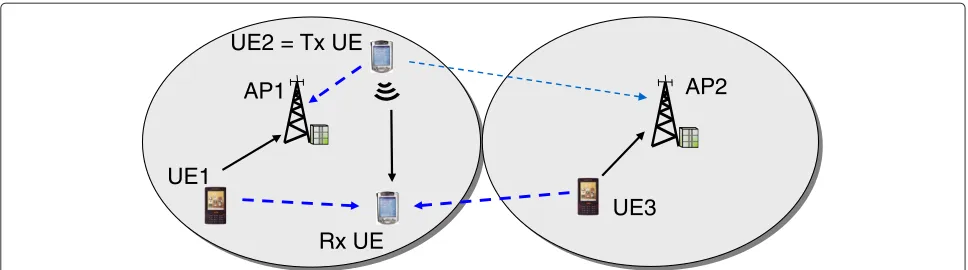
To gain insight into the behavior of the iterative dis-tributed power control scheme, we study a small system in which we calculate the local optimum power setting assuming full channel knowledge and compare the per-formance of the heuristic iterative method relying on the D2D geometry (i.e. large scale fading information) with that of the scheme that provides the local optimum. We are also interested in gaining insight in the potential gains of using the direct D2D link as compared to using cellular links between two communicating UEs (Tx UE–Rx UE) when employing such power control in both (i.e. cellular and D2D) operational modes. In particular, we focus on scenarios in which the same PRB may be used simultane-ously for a cellular and a D2D link tightening the reuse factor below 1 (as in Figure 1). For a particular UE pair, this sum power minimizing scheme may be combined with MS that determines whether a particular UE pair— theD2D candidate:Tx UE–Rx UE of Figure 1—should use the direct D2D link or they should communicate via the cellular access point [29]. Therefore, we compare the per-formance of these two communications modes when the positions of both the D2D pair and the interfering cellular UE vary within the cell.
The current article is a substantially revised and extended version of [30]a. First, we revised the distributed power control algorithm (Algorithm 1) such that it is based on the measured covariance of the total received interference and noise and investigate the impact of the measurement error. Second, the description of the opti-mum power allocation method using the augmented Lagrangian penalty function (ALPF) scheme has been revised and illustrated through a specific numerical exam-ple. Also, in this article, we provide the detailed deriva-tions of the steps needed in the SINR target setting scheme (Algorithm 2). Third, we introduce a practical MS algo-rithm that requires only average CSI information from the own cell. Furthermore, new numerical results are presented to evaluate the potential gains of D2D commu-nications under strong and weak intercell interference sit-uations. Finally, the performance of the distributed power control scheme with and without adaptive SINR target adjustment is evaluated jointly with the proposed MS algorithm in various parameter configurations of a 7-cell system.
UE1
AP1
AP2
UE2 = Tx UE
Rx UE
UE3
Figure 1Illustration of D2D communications, when a user equipment (UE1) and a D2D pair (Tx UE–Rx UE) may use the same OFDM PRB. Due to the D2D link, intracell interference as well as intercell interference between D2D and cellular links (UE3 to Rx UE) can be very high. (In this example assuming that the D2D link uses cellular UL resources).
we believe that our work can be an efficient complement to these resource allocation and pairing schemes.
We structure the article as follows. The next section describes our system model and formulates the D2D power control problem as an optimization task. Next, in Section “An iterative D2D power control scheme”, we propose an iterative power control scheme to meet pre-defined SINR targets. A second algorithm is presented in Section “Determining the optimum SINR target’’ that aims to set the SINR targets that help to minimize the overall used power in the system. In Section “Mode selection ’’, the proposed MS algorithm is presented that relies on single cell information and dynamically selects between cellular and D2D communication modes. Section “Numerical results” discusses numerical results and Section “Conclusions” highlights our findings.
Throughout the article, we use the following notations.
A−1, AT andAH denote the pseudo-inverse, the trans-pose and the conjugate transtrans-pose of matrix A, respec-tively. {A}(i,j) is the (i,j)th element of matrix A, while diag(a1,. . .,aN)denotes aN×Ndiagonal matrix whose diagonal elements are the scalars a1,. . .,aN. The abso-lute value of a real or complex numberzis denoted by|z|. Furthermore, trace(·)andE(·)represent the trace and the expectation operations of matrixA, respectively.
System model
Modeling the received signal
We focus on the case in which a cellular and a D2D link are multiplexed on the same uplink OFDM PRB.bDue to intercell interference, cellular or D2D links in neighbor-ing cells may cause additional interference to the received signal. Thus, the received signal at the kth receiver (i.e. cellular AP or the Rx UE of a D2D pair) can be modeled as:
yk =αk,kHk,kTkxk+
j=k
αk,jHk,jTjxj+nk, (1)
where
• Ntis the number of transmit antennas andNris the
number of receive antennas; • αk,j=
Pjd
−ρk,j
k,j χk,j/Ntis a scalar coefficient
depending on the total transmit powerPjfor userj,
the log-normal shadow fadingχk,jand distancedk,j
between thek th receiver and the j th transmitter with path loss exponentρk,j. The values ofρk,jandχk,j depend on the transmitter and receiver being a transmitter UE, a receiver UE or a cellular access point respectively, the specific environment (e.g. indoor or outdoor deployment, femto or macro type of access point), etc.
• xk ∈CNt×1is the data vector that is assumed to be
zero-mean, normalized and uncorrelated, Exkx†k
=INt;
• Hk,jdenotes the(Nr×Nt)channel transfer matrix;
and
• Tkis the UE-k (Nt×Nt)diagonal power loading
matrix. To keep the total transmit power constant, Tkmust satisfy
trace
TkT†k
= Nt
i=1
|{Tk}(i,i)|2=Nt ∀k;
• nkis aNr×1additive white Gaussian noise vector at
thekth receiver with zero mean and covariance matrixRnk =E
nkn†k
=σn2INr∀k.
We rewrite the signal model (1) in a compact form as
yk =αk,kHk,kTkxk+zk+nk, (2)
wherezk =
j=kαk,jHk,jTjxjdenotes the(Nr×1) inter-ference vector with covariance matrix
Rzk =E
zkz†k
=
j=k
α2k,jHk,jTjT†jH
†
For ease of notation, we define anequivalentnoise vec-tor that accounts for both the inter-cell interference and the background noise:
vk=zk+nk
It is easy to show that vk is zero-mean with covariance
Rvk =Rzk+Rnk.
MMSE receiver error matrix and the effective SINR
In what follows we revise and merge the methods followed by [34-36] to calculate the MMSE receiver error matrix and the effective SINR. We assume that the received signal both at the AP and the Rx UE is filtered through a linear MMSE receiver with weighting matrix Gk to obtain the estimate
To derive the stream-wise SINRs at BSk, we will need the diagonal elements of the error matrix of the MMSE fil-tered signal. To this end, the following known result (see e.g. [34-36] and ([37], Chapter 12)) is useful. (The deriva-tion is provided in Appendix 1). The MMSE estimaderiva-tion error matrix(Nr×Nr)for thekth BS is:
We are now in the position to calculate the SINR for the signal model (2) assuming a linear MMSE receiver. Using the linear MMSE weighting matrixGk, the MSE and SINR expressions can be rewritten, respectively as
MSEk,s {Ek}(s,s)=
In this section we defined the multicell MIMO received signal model (2) and, assuming a linear MMSE receiver, derived the associated effective SINR (γk,s) for each stream of the received signal. Equations (5) and (6) are impor-tant because they capture the dependence of the SINRs on the transmission powers of the own UEandthe interfer-ing UEs (both at an access point and at a receivinterfer-ing UE of a D2D pair) through theRHk’s and theRvk’s. Thus, these
relations serve as the basis for the optimization problems of the next section.
An iterative D2D power control scheme
From the signal model (1), when transmitter k uses a diagonal power loading matrixTk ∈ CNt×Nt withNs=t1
denotes the effective interference after MMSE processing and{·}(i,j)denotes the operation of acquiring the matrix
element of theith row of thejth column. In [36], a heuris-tic algorithm for distributing the transmit power over different streams was presented. By inverting Equation (7) for fixed SINR targets, the algorithm finds a near opti-mal (sum power minimizing) power loading matrix for these given SINR targets assuming perfect knowledge of the own and cross channel matricesHk,j.
Unfortunately, in the mixed cellular and D2D commu-nications scenario, the availability of the cross channel matrices at the transmitters cannot be assumed, because that would require extensive reference signal process-ing and channel quality information reportprocess-ing. Therefore, in this article, we relax the assumption on the knowl-edge of all the Hk,j channel matrices at all transmitters. Our assumption instead is that Receiver-kestimates the covariance of the total received signal and noise (k) and feeds it back to its transmitter. We further assume that Transmitter-k knows its channel to its receiver (Hk,k), which is reasonable considering that in practice a D2D pair typically communicates over a bidirectional channel and that the D2D link can be expected to operate in a time division duplex (TDD) mode [3,24].
Thek as measured by Receiver-kand fed back to the transmitter can then be expressed as:
from which Transmitter-k simply needs to subtract its own contribution, i.e.
Pkd−k,kρχk,kHk,kTkT†kH†k,k. (10) Transmitter-kcan then calculate the effective interference
ζ after the MMSE processing based on (8).
The covariance estimation based iterative power control algorithm is summarized by the pseudo code of Algorithm 1. (In practice, the receiver can estimate the covariance matrix of the received interference-plus-noise and feed back this reduced covariance matrixredk as defined in Algorithm 1.) Algorithm 1 iteratively adjusts the power loading matrix Tk such that the MIMO streams that suffer from higher effective interference ζ are allocated higher transmit power, since the given fixed SINR tar-get diag
γ1tgt,. . .,γKtgt
whereγktgt is the assumed given SINR target at Receiver-kis set equal to all streams of Transmitter-k. Without unequal power loading, when the “weakest” stream’s SINR is raised to the target, the stronger streams tend to overshoot the SINR target and thereby to waist transmit power. The transmit power itself (Pk) is determined by the MIMO stream that requires the highest transmit power (proportional to the effective interference and target SINR (γktgt)).
Algorithm 1 Iterative transmit power and power load-ing optimization
Given t = 0 (iteration number), Ptot, εgap and T(k0) =
INt ∀ k. {·}
(i,j) denotes the operation of acquiring the
matrix element of theithrow of thejthcolumn. Initialize SINR targets(0) = diagγktgt
, whereγktgt is the assumed given SINR target at Receiver-k, and initial transmit powersp(0).
Repeat
1. t=t+1. 2. fork=1to Kdo
Receiver-kmeasures thekas:
(kt)= Receiver-k feeds the estimated (measured)kback
to Transmitter-k ;
Transmitter-k calculates the reducedredk as:
kred,(t)=k(t)−Pk(t−1)dk−,kρχk,kHk,kT(kt−1)T
Transmitter-k calculates the effective interference ζk,sas:
Transmitter-k calculates the optimum loading matrixT(kt)andPkas:
In a practical implementation, Algorithm 1 could be executed on a slower time scale relaxing the require-ment on the receiver feedback. Studying the impact of the time scale for this algorithm as well as modeling delays and measurement errors are actually interesting future research topics. However, we have evaluated the perfor-mance of Algorithm 1 in one example scenario with tree transmitters and receivers (illustrated in Figure 2) when Gaussian measurement error is added to the covariance matrix estimation in (11) as(kt)=k(t)+E(Nt) impact of the measurement error on the performance of Algorithm 1 in the function of the number of iterations whencerris set to 0.2. The terms with “+ E” correspond to the cases when the measurement error is added to(kt). These curves show fluctuations around the curves with no error, but they still converge to the optimal values in this case. The convergence of Algorithm 1 is not analyzed in this article although the numerical results indicate that the algorithm converges within less than 10 iterations when the problem is feasible (see Sections “2-cell system results” and “7-cell system results”) even if measurement error is also considered (see Figure 3).
Determining the optimum SINR target
Figure 2One Monte Carlo realization is shown with two cellular BSs and one D2D pair.Cellular UE1 is dropped in interval(5·r, 6·r], wherer=25 m.
apply in this section. For larger systems, the distributed algorithm of the next section is more practical. We note that, in this section, we assume full and perfect channel knowledge at each transmitter.
Notation and assumptions for optimum SINR target setting
To formulate the SINR target setting task as an optimiza-tion problem stated in thestandard formof constrained minimization [38], we make the following considerations. First, we would like to express the sum transmit power as a closed form function of the SINR targets. To this end, the following result from [36] will be useful: by assum-ing equal power allocation for all streamss(i.e. no uplink beam forming,Tk = INt ∀k), the minimum stream SINR
at Receiver-k(a cellular access point or a D2D receiver) is lower bounded as
min s∈[1,Nt]
γk,s≥γk(p) (15)
wherep=P1. . .PK
T
is the power allocation vector, and
γk(p)= Pkd
−ρ
k,kχk,k
j=k
Pjdk−,ρjχk,jμmax(k,j,1)+Ntσk2μmax(k,j,2) .
(16)
Here,μmax(·)is the maximum eigenvalue operator for a Hermitian matrix, whilek,j,1andk,j,2are defined as
k,j,1=
H†k,kHk,k
−1
H†k,kHk,jH†k,jHk,k
H†k,kHk,k
−1 , (17)
k,j,2=H†k,kHk,k
−1
. (18)
This bound allows to associate a single SINR value
γk(p) min s∈[1,Nt]
γk,s (19)
with each MS-k. In what follows, we search for SINR targets γktgt which are feasible for the lower-bound (and hence for each individual stream) and
diag(γ1tgt. . . γKtgt).
Minimizing the sum power under predetermined fixed SINR targets
The above result is used in [36] to design power control schemes that maintain a predetermined fixed SINR target
γktgtat each Receiver-kby enforcingγ
k(p)≥γ tgt
k for each user. Specifically, to reach this SINR target, the transmit power of MS-kmust satisfy:
Pk≥γktgt
·
j=kPj·dk−,jρχk,jμmax(k,j,1)+σn2Ntμmax(k,j,2)
d−k,kρχk,k
(20)
We now make the following observation. Since the mini-mum user-stream SINR bound (15) allows to associate a single SINR target per user, one can regard each MS–BS or MS-D2D Rx connection as an equivalent SISO system
and model the minimum user-stream capacity as function of the power allocation with a Shannon-like expression (normalized to the bandwidth) as
ck
variance vector whosekth element isnk= N
tσn2μmax(k,j,2)
This observation is the basis for determining the SINR tar-gets such that the sum transmit power is minimized, as shown in the next section.
The problem of optimal SINR target selection
Let cm denote the target sum rate of all (cellular and D2D) links over all cells in the system andck denote the sustainable transmission rate of link-k. With the explicit relationship between the SINR targets and the transmit powers ((16) and (20)) in hand, we can now formulate the problem of setting the SINR targets (for each receiver in the mixed cellular/D2D environment) such that the sum power is kept at a minimum level and the overall system capacity (sum rate) targetcm is reached. This problem is formulated as follows: targets) andp(transmit power).
Solution approach: employing the ALPF
We propose to solve the problems formulated in Section “The problem of optimal SINR target selection ’’ through the ALPF method [38]. In this method, the con-strained non-linear optimization task is transformed into an unconstrained problem by adding a penalty term to the Lagrangian function as follows:
φ (,p,μ,ε)=L(,p,μ)+ε
whereμis the Lagrange multiplier andεis the so called penalty parameter.
It can be shown that if the optimum Lagrange multipli-ers are known, the solution to this unconstrained problem corresponds to the solution of the original problem (24) regardless of the value of the penalty parameterε, see e.g. ([38], Chapter 9). Since we obviously do not know the value of the Lagrange multiplier, we start with an arbitrary value (e.g. zero) and develop a procedure that moves the multiplier closer to its optimum value. This procedure is detailed in the following subsection.
Updating the lagrange multipliers
Updating the Lagrange multipliers in the ALPF method hinges on comparing the necessary conditions for the minimum of the Lagrangian function and the ALPF as fol-lows. By taking the derivative of the Lagrangian function, we obtain:
The derivative of the corresponding ALPF is:
φ
Thus, the updating rule during iterationtfor the Lagrange multiplier is straightforward:
In practice, the penalty parameterεis also updated in each iteration [38]. In each iteration, when the Lagrange multiplier and the penalty parameter are set, we solve the unconstrained minimization problem in the γktgt-s. The iterative procedure stops at iteration (t) when the following two conditions are met:
and
In this section we illustrate the iterative update procedure of the ALPF in a system of three transmitters and three receivers, that isK = 3. First, we need to find the power vector as the function of the target multi-cell capacity (sum rate)cmand the individual SINR targets (theγitgt’s):
p the Appendix 3. From the capacity constraint, it follows that (K − 1) SINR values can be freely selected while theKth SINR target value must be chosen such that the capacity constraint is fulfilled. In the case ofK =3:
γ3tgt
Using this relationship, the Mij parameters are expressed as the functions ofγ1tgtandγ2tgt(see Appendix 3). That is, for a specific capacity targetcm,pand the sum of its components are expressed as a two-variable func-tion ofγ1tgt andγ2tgt. Using (25), it is straightforward to find the stationary points of the unconstrained problem and,γ1tgtandγ2tgt. Using to find the local optimum solu-tions (that is, the local minimum points) of (24). In our
Mathematicaimplementation, we found that in all con-sidered practically relevant examples, a simple heuristic can then easily identify the near optimum solution (see also the numerical section).
In the following, we describe the steps of the complete optimization process implemented inMathematicaand detailed in Algorithm 4 (see Appendix 4). In Steps 1 and 2, we drop the cellular UE (UE1) and the D2D pair according to a surface uniform distribution. Then, the signal model is recalculated (see Steps 3–7) and the sum power vector is expressed in the function of the SINR targets (Steps 8 and 9). In Step 10, the ALPF optimization is executed using the
inits = 0vector as initial points. The variables maxIter and convTolerance denote the maximum number of iter-ations performed by ALPF and the convergence tolerance specifying the maximum value by which the constraints can be violated.
Step 11 executes an other optimization using the NMin-imize built-inMathematica method which applies the Nelder-Mead (also called as the downhill simplex) heuris-tic approach [39] (i.e., it is not a true global optimization
algorithm). As opposed to the gradient based ALPF, the Nelder-Mead technique is a direct search method which does not use derivative information and has the advan-tage to better tolerate the presence of noise in the function and constraints at the cost of slow convergence time [39]. We use the output of Step 11 as the starting points of another ALPF execution in Step 13. Then, we compare the solutions of Step 10 and 13, and accept the results if both ALPF optimizations converged within maxIter iter-ations and returned the same solutions (see Steps 14 and 15) otherwise the Monte Carlo drop is discarded and a new one is drawn.
We note that the optimization process of Algorithm 4 does not ensure true global optimum in all cases, though it turned out to be practically useful in finding reference points in all of the examined cases.
Table 1 summarizes the iterations of the ALPF method (Step 10 in Algorithm 3) in an exact numerical exam-ple when the UE1 is dropped in Position 6 (i.e., pos =
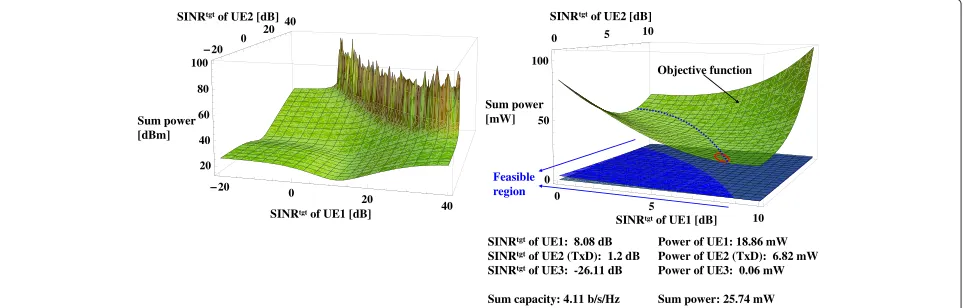
6 in Algorithm 3) in one particular Monte Carlo drop as illustrated in Figure 2. The objective function, the feasible region and the optimum point are depicted in Figure 4.
A distributed algorithm to set the SINR targets
The insight of the previous (and as we will see the numer-ical) section is that setting the SINR targets to a uni-form value that is suitable for both cellular and D2D links is non-optimal due to several reasons. First, due to the presence of D2D transmitters and receivers, the distances between any transmitter and receiver can vary between a close proximity and the cell diameter result-ing in extremely large SINR fluctuations. Note that this observation holds for both the D2D and the cellular traf-fic, since a D2D transmitter may get close to the cellular BS. Specifically, to minimize the sum power with respect to a sum capacity target, strong (low path loss) links must be granted high SINR targets, while weak links must be set to low values. Second, different services (e.g., voice or video streaming) have different quality of service (QoS) requirements and therefore maintaining a minimum (link specific) SINR target for any link is desirable.
Therefore, a practical SINR target setting algorithm must meet the following requirements:
• It should rely only on large scale fading information; • It should allow for setting a minimum link quality
(SINR target) value;
Table 1 Iterations of the ALPF optimization method in an example scenario
⎠ Objective function Lagrange multipliers Max. violation
0
loss, while “weak” links should be set to their respective minimum SINR target.
• It should not require a central entity, but it can assume the availability of large scale fading information to surrounding receivers.
When D2D communications is enabled in cellu-lar spectrum, it is expected that new types of ref-erence signals and associated measurement reporting schemes will be designed to facilitate various RRM algorithms. Therefore, the last assumption is
able, since it assumes large scale fading information only.
We propose an algorithm (Algorithm 2) that meets the above requirements by starting from a minimum SINR target and iteratively adjusting them for all links to reach a near optimal power allocation subject to a sum capac-ity constraint. Algorithm 2 tries to successively increase the SINR targets until a predefinedCsumcapacity target is reached. In each iteration it increases the SINR target of the one user that contributes the most to the sum capacity increase by calculating abenefit valuebk. More specifi-cally, in Step 1, it estimates a power value Pk that is needed to increase the SINR by avalue for linkk, and then calculates the capacity increase corresponding to this increased SINR. The calculation of the power increase is detailed in Appendix 2. Next, it computes a benefit value
bkthat indicates how beneficial it is to increase the power for link k in terms of bit/sec/Hz/mW, i.e., what is the gain of the increased SINR in capacity for that link. In Step 2, the transmitter can compose a vectorb contain-ing the benefit values for all links and then select the link to increase its SINR target which has the highest bene-fit value. These steps are repeated until the desired sum capacity targetCsumis reached.
Algorithm 2 Adaptive SINR target setting
Input: Csum, SINRmin>0, >1,ρ path loss exponent,
>0 andgk,j = d−k,jρχk,j,k = 1,. . .,K,j = 1,. . .,J, as in Equation (1) whereK andJare the number of receivers and transmitters, respectively.
Calculate the approximated transmit power required to increase SINR by(see Appendix 2) as:
P(kt)=
Calculate the capacity increase achieved by the increased SINR as:
2. Select user with the highest benefit value as: if|b(it)−b(jt)|< ,∀i,∀j,i=jthen
bestUE(t)=argmax{g1,1,. . .,gk,k}
elsebestUE(t)=argmax{b(t)}
3. Update SINR target for the user with the highest benefit as:
γ(t+1)
bestUE(t) =γ
(t)
bestUE(t)·.
4. Calculate current sum capacity as:
C(t+1)=
An important feature of this algorithm is that if the slow fading information (including path loss and shadowing) is available for all links at all transmitters (gk,j,∀k,j), i.e., if the kth cell is aware of the slow fading channel state between its receiver and all the transmitters of the net-work (gk,j,∀j), and all cells exchange this information using slow scale BS-BS communications, then each transmitter can execute this algorithm in a distributed fashion, since then each transmitter can calculate the benefit vector by itself. This algorithm is a network-wise optimization in the sense that it uses multi-cell channel knowledge (slow fading information) to determine the SINR target for a user.
An additional feature of this algorithm is that a min-imum SINR can be set for all links (SINRmin), which guarantees a minimum link quality. Setting this parameter to a higher value for all users prevents boosting the best channel only. Later, in Section “7-cell system results”, we will use this parameter to ensure that all UEs experience a certain QoS.
The convergence of this algorithm is not analyzed in this article. In practice, the maximum number of itera-tions would be limited and the target capacity could be adjusted. In the evaluated scenarios, the numerical results show that the proposed method converges.
Summary
Mode selection
In the development of the MS algorithm, we assume that exactly one cellular UE is allocated on an OFDM resource block, that is without D2D communications, intra-cell orthogonality is maintained. We also assume that at most one D2D link is allocated to a resource block that is used by a cellular UE, meaning that on any one OFDM resource block, there are at most two links (one cellular and one D2D) multiplexed.
It is intuitively clear that for a given D2D candidate the benefit of direct mode communication (as compared to communicating through the BS) depends on the geom-etry of the D2D pair and the UEs in the own cell and neighbor cells using the same resource blocks. MS is a D2D specific function that allows the BS to dynamically adjust the characteristics of the D2D link and to change the communication mode (cellular mode: via the BS or D2D mode: via the direct link) of two communicating UEs. MS plays a similar role for D2D communications as handover does for traditional cellular communications in the sense that the D2D transmitter can switch its transmission between the D2D receiver and its serving BS.
Based on these considerations, we formulate the requirements for the MS algorithm as follows:
• It should rely only on large scale fading information; • It should rely on information available in the own cell
only rather than trying to coordinate MS decisions among multiple cells. We justify this requirement by noting that intercell interference can be addressed by proper resource allocation (scheduling) and power control and by arguing that multicell MS would lead to unacceptable complexity in real systems.
• It should take into account the geometry of the D2D link and the cellular UE that are multiplexed onto the same resources (physical resource blocks), in terms of the large scale fading of the useful as well as
interfering links.
• It should preferably be executable independently of the transmit power setting to mitigate the complexity of joint power control and MS.
The third requirement suggests that a suitable MS algorithm should only require the following large scale fading (distance dependent path loss and shadowing) values:
• gBSl,CellUEl =d −ρ
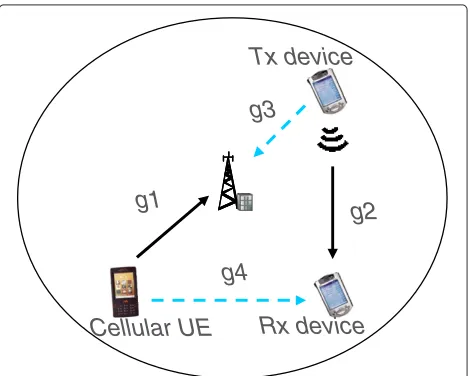
BSl,CellUEl·χBSl,CellUEl: Large scale fading between the cellular UE and its serving BS of Cell-l(see g1 link in Figure 5);
• gRxDl,TxDl =d −ρ
RxDl,TxDl·χRxDl,TxDl: Large scale fading between the D2D transmitter and receiver of Cell-l (see g2 link in Figure 5);
• gBSl,TxDl =d −ρ
BSl,TxDl·χBSl,TxDl: Large scale fading between the D2D transmitter and the BS of Cell-l (see g3 link in Figure 5);
• gRxDl,CellUEl =d −ρ
RxDl,CellUEl·χRxDl,CellUEl: Large scale fading between the cellular UE and the D2D receiver of Cell-l(see g4 link in Figure 5).
The fourth requirement implies that the MS algorithm should rely on SNR rather than SINR metrics, since the measured SINR at the receivers (D2D receiver or cellu-lar BS) depend on the transmit powers of the interferers (see also our proposed SNR metric in Algorithm 3). Finally we note that the proposed MS algorithm does not con-sider the hop gain that is described in the Introduction of this article. That is, the MS algorithm is somewhat biased towards favoring the cellular mode, since it disre-gards the potential hop gain of the D2D mode. Based on these requirements, in this article we propose a simple MS algorithm described by Algorithm 3.
Algorithm 3 Simple MS algorithm based on single-cell knowledge
Input: ,ρ,σn2,p = pmax, number of cells (L), and
gk,j = d−k,jρχk,j,k = 1,. . .,K,j = 1,. . .,J, as in Equation (1) whereKandJare the number of receivers and transmitters, respectively.
Output: Decision on which mode is preferred (D2D or
Cellular) for all cells:
useD2Dl∈ {True, False}, l=1,. . .,L.
Notations:
BSl- the cellular BS of celll, CellUEl- the cellular UE in celll, RxDl- the D2D receiver in celll,
g1
g2
g4
Tx device
Rx device
Cellular UE
g3
TxDl- the D2D transmitter in celll,
forl=1 to Ldo
1. The useful (u) signal path loss inCellular (C) mode is gBSl,CellUEl, hypothetical SNR
γlu,C= p·gBSl,CellUEl σ2
n ;
2. The useful signal path loss inD2D mode is gRxDl,TxDl, hypothetical SNR
γlu,D2D= p·gRxDl,TxDl σ2
n ;
3. The interfering (i) signal path loss inCellular mode is gBSl,TxDl, hypothetical SNR
γli,C= p·gBSl,TxDl σ2
n ;
4. The interfering signal path loss inD2D mode is gRxDl,CellUEl, hypothetical SNR
γli,D2D = p·gRxDl,CellUEl σ2
n ;
5. Select whether Cellular or D2D mode is beneficial to use as:
if(log2(1+γlu,D2D)+log2(1+γlu,C)−
log2(1+γli,D2D)−log2(1+γli,C) > )then
useD2Dl=True
elseuseD2Dl=False;
end
The proposed algorithm is based on the geometry of the UEs in the own cell, i.e., the geometry situations in the neighbor cells are not considered. Figure 5 illustrates the idea of Algorithm 3, where the useful and the interference path loss links are shown for a particular D2D candidate pair and a cellular UE in a specific Monte Carlo drop. The useful path loss links are denoted with bold black arrows (g1 and g2), while the interference path loss links (g3 and g4) are marked with dashed blue arrows. The algo-rithm first calculates hypothetical SNR values for each link according to Step 1–4. The proposed algorithm selects D2D mode for the D2D candidate if the useful links (g1 and g2) are stronger than the interfering links (g3 and g4). More specifically, D2D mode is selected if the hypothet-ical capacity values corresponding to the useful links are higher than the hypothetical capacity values correspond-ing to the interfercorrespond-ing links plus avalue (see Step 5 of Algorithm 3), which is a tunable system parameter mea-sured in bit/sec/Hz. The transmit power valuepin Step 1)– 4) is set to an arbitrary positive value. By increasing, the MS algorithm becomes more conservative and selects D2D communication more cautiously. Selecting a nega-tiveimplies a more frequent D2D MS. This algorithm
is not a network-wise optimization in the sense that it uses only single cell slow fading (distance dependent path loss and shadowing) information to determine the com-munication mode of a cell. An important feature of this algorithm is that it meets Requirement 4 by relying on SNR rather than SINR metrics.
Numerical results
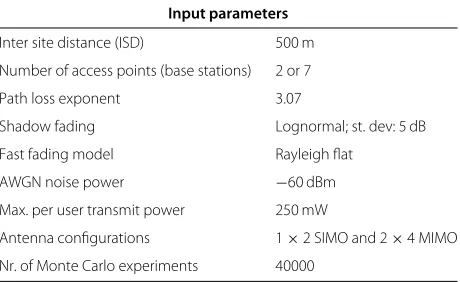
In this section we first discuss how the proposed algo-rithms can be deployed and executed in a real network. Then, we examine a 2-cell system (that primarily serves the purpose of benchmarking the target setting heuris-tic) and a 7-cell system that more realistically represents a multicell system. In the following, we use the solu-tion of the optimizasolu-tion problem of Secsolu-tion “The prob-lem of optimal SINR target selection” as a reference case which uses full channel knowledge including fast fad-ing (Rayleigh) information. In each simulation scenario, Algorithm 1 is used to adjust the power values where some fast fading knowledge (total received interference and noise covariance) is also exploited as detailed in Section “An iterative D2D power control scheme”. In numerical results based on Algorithms 2 and 3, only slow scale fading (distance dependent pathloss and shadowing) information is considered as also stated in Sections “Determining the optimum SINR target” and “Mode selection ’’, respectively (see Table 2 for the values of the simulation parameters).
System operation
In a practical system, the proposed distributed power con-trol scheme, the adaptive SINR target setting and the model selection algorithms should be executed in the following order.
1. Run the MS algorithm (Algorithm 3) in each cell to select between the cellular and D2D communication modes (i.e, to select the links for transmission) on the time scale of few hundred milliseconds based on large scale fading (distance dependent path loss and shadowing) information of the own cell.
Table 2 The input parameters used in the simulations
Input parameters Inter site distance (ISD) 500 m
Number of access points (base stations) 2 or 7
Path loss exponent 3.07
Shadow fading Lognormal; st. dev: 5 dB
Fast fading model Rayleigh flat
AWGN noise power −60 dBm
Max. per user transmit power 250 mW
Antenna configurations 1×2 SIMO and 2×4 MIMO
2. Execute the adaptive SINR target setting algorithm (Algorithm 2) on the transmission links (selected by MS) to minimize the sum transmit power. The time scale is the same as that of the MS.
3. Run the distributed power control scheme (Algorithm 1) to set the transmit power for each link in each transmission slot taking into account fast fading information as well.
The above operation of the system is reasonable, since MS should decide first which links are going to trans-mit in the next few transmission slots. As discussed, for instance, in [28], the time scale of MS should match that of handover and should rely on large scale fading information only (see also the requirements in Section “Mode selection”). The execution of the SINR target set-ting algorithm is optional, though significant power can be saved by tuning the SINR target according to the large scale channel conditions while maintaining some fairness criterion as well (see the numerical results of Sections “2-cell system results” and “7-cell system results”). Finally, the proposed distributed power control scheme combats against fast fading by measuring the covariance of the total received interference and noise in each transmission slot.
2-cell system results
We consider two sets of numerical results. The first set focuses on the performance of Algorithm 1 given a fixed set of SINR targets. The second set shows the gains when setting the SINR targets in an optimal or heuristic fashion.
Simulation scenarios
We consider two simulation scenarios as shown in Figure 6 (Scenarios 1 and 2 are illustrated on the left and right part of Figure 6, respectively), which are basically two instances of the scenario shown in Figure 1. In Sce-nario 1 the D2D pair is randomly dropped in an area that is “on the other side” of the access point than UE1. In Scenario 2, the D2D pair is randomly dropped in an area close to UE1. In both scenarios, UE1 moves from the cell center to the cell edge (Position 1 . . . Position 10). UE2 is the transmitting UE of the D2D pair. UE3 is a stationary interfering UE at a fixed position in the neighbor cell. We denote with UE1 the UE transmitting to its serving BS. We let UE1 move from a position close to the BS (UE1 Posi-tion 1) towards the cell edge (UE1 PosiPosi-tion 10). We use the UE1 position along thexaxis of all our plots. UE2 denotes the transmitting UE (Tx UE) of the D2D pair. Finally, UE3 denotes an interfering UE at a fixed position in a neighbor cell served by access point AP2. The D2D pair is dropped within the half circle areas denoted in Figure 6 in 40000 Monte Carlo experiments.
The D2D pair can communicate in two modes:
1. D2D mode: The two UEs of the D2D pair
communicate via a direct link. In this mode, the D2D link uses the same OFDM resource blocks as the UE1 uses to communicate with its serving AP. 2. Cellular mode: The two UEs of the D2D pair
communicate via the serving AP. In this case the UE1 and UE2 use orthogonal uplink resources (either in the time or in the frequency domain). For example, assuming a time domain separation, during the first period only UE1 transmits to AP1 followed by a period when only UE2 transmits to AP1. (The resources are split equally between UE1 and UE2).
The two performance measures of interest are the sum power for a given sum capacity target (UE1+UE2+UE3) and the probability that the (fixed or set) SINR targets are infeasible. Some of the simulation parameters are listed in Table 2. Recall that for the SINR target optimization, fast fading is taken into account in the reference (central-ized) case, whereas only distance dependent path loss and shadowing are considered in the distributed approach.
Results for predefined SINR targets
Figures 7 and 8 present results for the fixed SINR tar-get case and compare the performance of D2D mode and cellular mode between the D2D pair in terms of the per-formance measures of interest. The SINR target for D2D mode is set toγDtgt2D = 4 dB for all three links (UE1, UE2 and UE3). For the cellular mode, the SINR target is set such that the total capacity be the same as in the D2D mode. Since in cellular mode there is only one communi-cation link (apart from the interfering neighbor, UE3) at a time, the SINR target is set such that 3·log2(γDtgt2D+1)=
2·log2(γCelltgt +1)(that is:γCelltgt =7.47 dB).
The upper graph of Figure 7 shows the sum power results for the 1×2 SIMO case. As UE1 moves from its cell center position towards the cell edge, the average sum power (on the three links) required to reach their respec-tive SINR targets gradually increases both when the D2D pair communicates in D2D mode and when they com-municate in cellular mode. Recall that in cellular mode, we first assume that only UE1 transmits and then only UE2 transmits to the AP (when only UE2 transmits, the required power is obviously independent from the UE1 position, since UE1 does not transmit). What is impor-tant to notice here is that the sum power is always lower (roughly 30% of the average power used in cellular mode) in the D2D mode than in cellular mode due to the reuse and proximity gains in D2D mode.
Figure 62-cell simulation scenarios.In Scenario 1 (left) the D2D pair is randomly dropped in an area that is “on the other side” of the access point than UE1. In Scenario 2, the D2D pair is randomly dropped in an area close to UE1. In both scenarios, UE1 moves from the cell center to the cell edge (Position 1. . .Position 10). UE2 is the transmitting UE of the D2D pair. UE3 is a stationary interfering UE at a fixed position in the neighbor cell.
as UE1 moves towards the cell edge, but this probability is significantly lower (typically half or less) in D2D mode.
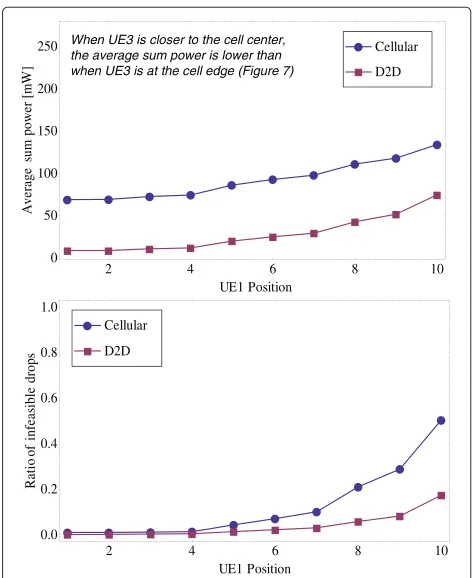
In Figure 9, we show the sum power and infeasibil-ity results in Scenario 1, but the stationary interfering UE (UE3) connected to AP2 is placed only to radius/2 distance from the cell center (in the same angle as in
Figure 7Sum power and infeasibility in Scenario 1 (1×2SIMO). Required sum power and probability of infeasibility are shown with fixed SINR targets (1×2 SIMO) in Scenario 1. When the D2D pair communicates in D2D mode, the average sum power is significantly lower than the average sum power in cellular mode. This SINR target is also more often feasible in D2D mode than in cellular mode.
Scenario 1), i.e., UE1 and UE3 are farther from each other. In this case, the sum power and infeasibility ratio are considerably lower than in Figure 7, since UEs in both cells generate lower interference to UE(s) in the neigh-bor cell, because (1) they are geographically farther from each other, i.e., signals experience higher attenuation at
Figure 9Sum power and infeasibility in Scenario 1 (1×2SIMO) when UE3 is closer to cell center.Required sum power and probability of infeasibility are shown with fixed SINR targets (1×2 SIMO) in Scenario 1 when the stationary interfering UE (UE3) is moved only to half-radius distance from the cell center (in the same angle as in Scenario 1). The sum power and infeasibility ratio is lower compared to Figure 7, since the sum interference is reduced in the system.
the neighbor receiver and (2) the UEs can transmit with reduced power to achieve the required SINR target.
Figure 8 shows the sum power and the probability of infeasibility in Scenario 1 for the 2×4 MIMO case and set-ting the SINR target per stream to 4 dB (that is setset-ting the sum capacity target to twice of that required in Figure 7). This high SINR per stream target is basically only feasible when UE1 is in the cell center. Similarly to the 1×2 case, the D2D mode between UE2 and its D2D pair is clearly superior to the cellular mode both in terms of sum power and feasibility.
Results for optimal and heuristic SINR targets
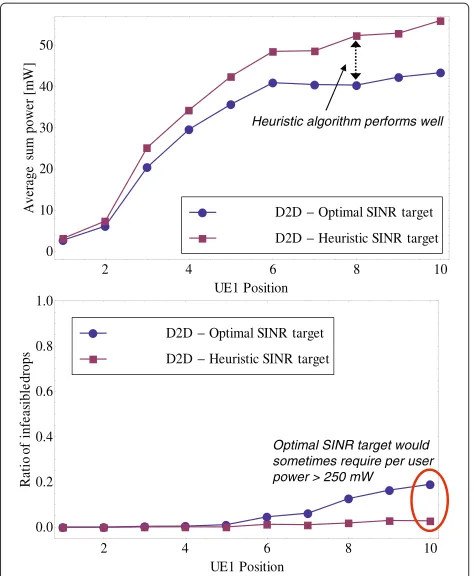
We discuss the results when the SINR targets are not fixed, but set optimally or by means of the proposed heuris-tic SINR target setting algorithm such that the sum rate capacity is the same as in the fixed SINR target case of the previous section (that is 5.44 bps/Hz in the 1×2 SIMO case and 2×5.44 bps/Hz in the 2×4 MIMO case).
First, we consider the results for the 1×2 SIMO case (Figure 10) in Scenario 1. In this case, the required sum
Figure 10D2D sum power and infeasibility in Scenario 1 (1×2 SIMO).Performance measures of interest are shown in D2D mode with optimized and heuristically set SINR targets (1×2 SIMO) in Scenario 1. The target sum rate is the same as in Figure 7, but the required sum power is just a fraction of that with fixed SINR targets (see Figure 7). In addition, the probability of infeasibility is very low, even when UE1 approaches the cell edge.
power is drastically lower than in the fixed SINR tar-get case. For example, when UE1 is at the cell edge, the required sum power in D2D mode is only around 30 mW (with optimal SINR targets) and around 40 mW (with heuristic SINR targets) as compared to 125 mW with the fixed SINR targets (of Figure 7). We also notice that vir-tually all drops turn out to be feasible, both with optimal SINR targets and with the proposed SINR target setting algorithm.
The results for the 2×4 MIMO case without and with power loading are shown in Figures 11 and 12, respec-tively. The lower graph of Figure 12 illustrates the average sum power results in Scenario 2 (see the right part of Figure 6). As expected, this scenario requires somewhat higher average sum power than Scenario 1, since the transmitting UEs are closer to each other, and thereby, the interference is higher in the system.
Figure 11D2D sum power and infeasibility in Scenario 1 (2×4 MIMO).Performance measures of interest are shown in D2D mode with optimized and heuristically set SINR targets (2×4 MIMO) without power loading optimization in Scenario 1. Compared with the results of Figure 8, we notice the dramatic decrease in the required power and the improved feasibility probability. Except for the UE1 cell edge positions, the same sum rate that is typically infeasible with fixed SINR targets becomes typically feasible with proper SINR target setting.
in the feasible drops becomes only a fraction of what is required in the fixed SINR case.
In both the 1×2 SIMO and the 2×4 MIMO case we also notice that D2D mode provides better performance than cellular mode.
7-cell system results
In this section we consider a 7-cell system as shown in Figure 13 (Scenario 3), where a D2D candidate pair and a cellular UE are dropped in each cell according to a surface uniform distribution in a series of Monte Carlo experi-ments. The dropping of the cellular UEs and the D2D pairs is independent from each other.
In this network, when all D2D candidates transmit directly, i.e., in D2D mode there are 14 simultaneous transmissions. In this case, we set the fixed SINR target for all links to 2 dB resulting in 19.18 b/s/Hz spectral effi-ciency. When each cell communicates in cellular mode, we have seven simultaneous transmissions in the whole system and the fix SINR target is set to 7.54 dB in order to achieve exactly the same sum capacity as with pure D2D mode.
Figure 12D2D sum power with power loading in Scenario 1 and 2 (2×4MIMO).Average sum power is illustrated in D2D mode with optimized and heuristically set SINR targets (2×4 MIMO) and with power loading optimization in Scenario 1 (upper) and Scenario 2 (lower). Power loading helps further reduce the required power to reach the sum rate target (the feasibility probability is roughly the same as without power loading (Figure 11) in both scenarios.) In Scenario 2, the average sum power is increased since UE1 and UE3 are closer to Rx UE and thus, the received interference is higher than in Scenario 1.
Recall from Section “Mode selection ’’, that we assume that there are at most two links (one cellular and one D2D) multiplexed on a single OFDM resource block. Therefore, just like e.g. [36], we focus on a single resource block (used by at most 3 users), since each resource block of the system bandwidth can be studied in isolation.
Potential of D2D communication
Figure 137-cell simulation scenario.Scenario 3 is a 7-cell system used for illustrating the performance aspects of D2D
communications. The D2D receiver and transmitter in each cell is marked with red square and red rhombus, respectively, while the UE communicating with the cellular BS is denoted by black triangle. The BS is marked with a grey square. The figure shows an instance of a series of Monte Carlo simulations.
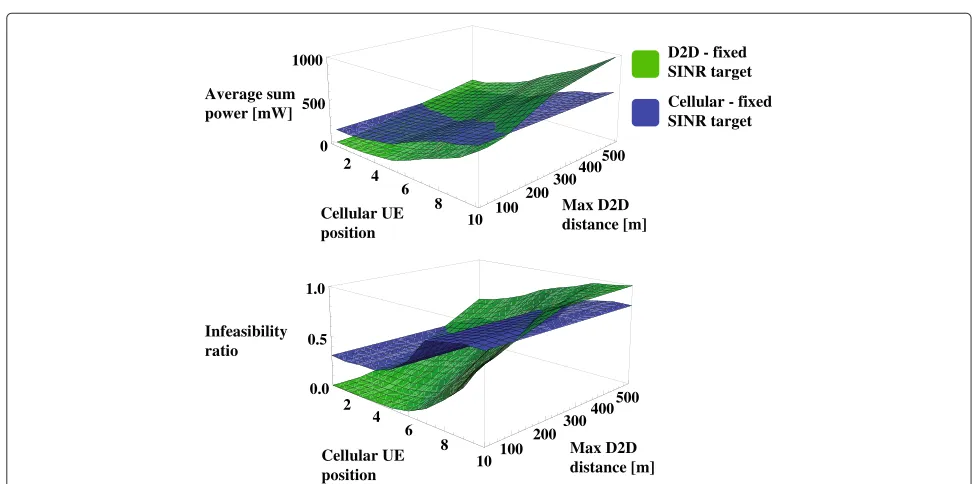
the cellular UE is close to the cell center is significantly better in D2D mode, both in terms of sum power and infeasibility probability.
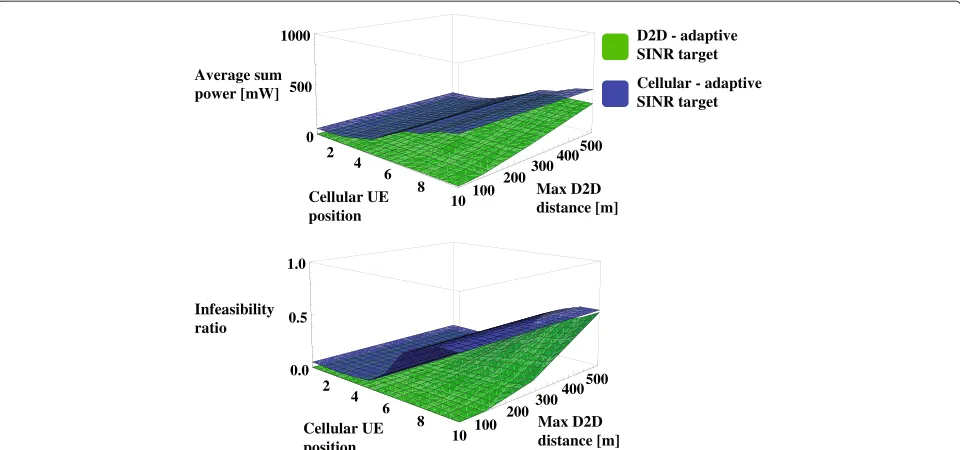
In Figure 15, the we illustrate the system performance when using the proposed adaptive SINR target setting algorithm. As we see in the figure, adaptive SINR tar-gets lead to a significant improvement both in D2D and cellular modes both in terms of sum power and infeasi-bility probainfeasi-bility. The reason for this is that the adaptive SINR target setting algorithm sets a higher SINR target for links with a low path loss value thereby the algo-rithm encourages allocating power on links with a high rate utility. More interestingly, D2D mode shows supe-rior performance even when the D2D distance is high and for all cellular UE positions. The reason for this improve-ment is that adaptive SINR targets are the key to fully exploit the proximity gain and at the same time control the interference between the D2D and the cellular layer.
Numerical results with MS
As shown in Figures 14 and 15, the benefit of the D2D communications much depends on the geometry of the UEs sharing the same resource block, which also indi-cates the need for the MS mechanism. We evaluate our proposed MS algorithm described in Section “Mode selec-tion” and present the results in Figure 16 where four other cases are compared to the performance of the MS algorithm.
The upper plot of Figure 16 compares the average sum power in different cases in Scenario 3 when we use a 1×2
Figure 15Potential of D2D with adaptive SINR targets.Average sum power and infeasibility probability are shown in Scenario 3 (7-cell system) using adaptive SINR targets. When the SINR targets are properly set, D2D communications has the potential to drastically reduce the average sum power as well as the probability of infeasibility over a wide range of D2D distances and cellular UE positions.
SIMO system and the D2D pair is dropped at most 100 m far away from each other (within one fifth of the ISD). The blue curve (“Cellular-Fixed SINR”) shows the system per-formance in Cellular mode, which can serve as a reference, since this curve corresponds to the currently deployed systems. When we apply D2D mode for the D2D candi-dates we obtain the dark red curve (“D2D-Fixed SINR”). We can see that there is significant gain compared to the Cellular mode when the cellular UE is close to the cellu-lar BS. The gain is decreasing as the cellucellu-lar UE moves toward the cell edge. If we use the heuristic SINR tar-get settings in D2D mode (yellow curve with rhombus symbols), we can observe that employing adaptive SINR targets in D2D mode provides very low sum power. This large sum power reduction comes at the price of setting very low SINR targets for some of the links, sometimes allocating close to zero power for some links as we will show later in Figures 17 and 18. This issue can be solved by setting a minimum SINR in the heuristic SINR target setting algorithm in order to avoid the cases when some links are in outage. An example for this is also shown in Figure 16 by the green curve (“D2D−adaptive SINR + F”) when the minimum SINR is set to 1 dB for all links in D2D mode with adaptive SINR targets. It still brings significant gain compared to the fixed SINR targets (dark red curve). The performance result of the MS algorithm together with 1 dB minimum SINR is shown by the light blue color (“Mode selection−adaptive SINR + F”). As it can be seen, the employment of MS gives some additional gains to D2D mode with minimum SINR. This gain comes from that
that the MS algorithm avoids using D2D mode in such cases when, for example, a cellular UE is placed very close to a D2D receiver and would suppress the transmission of the D2D transmitter. In Figure 16, it is clearly visible that MS combined with adaptive SINR target setting can pro-vide superior performance, even when a minimum SINR target is required on all links.
Looking at the lower plot of Figure 16, we can observe that the infeasibility probability is in line with the result of the average sum power results of the upper plot. These results highlight the importance of MS combined with adaptive SINR target setting.
Figure 19 shows the probability that D2D mode is selected by the MS algorithm when the maximum D2D distance is limited to 100 m in the function of the cel-lular UE position. As expected, as the celcel-lular UE is placed closer to the cell edge, the MS algorithm tends to select the cellular mode for the D2D candidate, but it is noteworthy that even in UE position 10, in 80% of the experiments, D2D mode is preferred for the D2D candidate since the maximum D2D distance is bounded and thus the link between the D2D candidate pair (g2) is “almost always” better than the interference links (g3 and g4). The remaining 20% of the drops cover such cases when e.g., the cellular UE is placed very close to the D2D receiver and would suppress the transmission of the D2D transmitter.
Figure 16Comparisons of performance results with maximum D2D distance of ISD/5.Comparisons of the average sum power and infeasibility ratio are illustrated in different cases when the D2D pair is dropped within ISD/5 distance from one another in Scenario 3 (7-cell system). When a minimum SINR target is required (denoted with “+F”, F indicating fairness), adaptive SINR target setting with MS provides superior performance. The average sum power is of course much lower when no minimum SINR is required (“lowest” curve).
proximity of the receiver of the other layer. This algorithm can be thought of as an additional sanity check to adapt to realistic situations and avoid using simultaneous trans-missions within a cell, i.e., D2D mode when high intra-cell interference can be expected.
Figure 17, presents empirical cumulative distribution functions (CDF) of the received SINR in different cases in Cell-1, which is the cell in the middle among the seven cells. In this figure the D2D candidate operates in D2D mode. This cell is in the worst situation, since it receives the most interference from the neighbors. We use a 1×2 SIMO system where the maximum D2D distance is also limited to 100 m. We focus on the cellular UE position 5, i.e., when the cellular UE is around the same distance from the BS as from the cell edge. We compare four dif-ferent cases, where the black curve shows the CDF of
Figure 17The empirical CDF of the received SINR is illustrated when operating in D2D mode and the D2D pair is dropped within ISD/5 distance from one another in Scenario 3 (7-cell system).The plot verifies that the fixed SINR target is maintained for all UEs in the cell (i.e. both the cellular UEs and the receiving device (RxD) of the D2D pair). The heuristic (adaptive) SINR targets are set such that SINR target on the D2D link (RxD) has a wide range of possible values throughout the Monte Carlo experiments, while the SINR targets for the cellular UEs are typically very low (essentially switching off the cellular link).
problem of adaptive SINR target is illustrated by the blue curve of Figure 17 (“Cellular BS-Adaptive SINR D2D”) where in the 90% of the cases, the SINR at thecellular BS
is around or below−10 dB. This means that the algorithm puts this link into outage. There is a need to introduce the concept of the minimum SINR to avoid situations in which one of the transmission links is practically muted.
The CDFs of the UE transmit power are plotted in Figure 18. We conclude that the cellular UE (red curve) consumes the most power to reach the 2 dB fixed SINR target. This can be expected, since this UE is in cellular
Figure 18The empirical CDF of the per UE transmit power is shown when adaptive SINR target setting is used with minimum SINR of−10dB and the D2D pair is dropped within ISD/5 distance from each other in Scenario 3 (7-cell system).The adaptive SINR setting algorithm allocates very low transmit power values to the cellular UE, therefore it achieves very low SINR also as shown in Figure 17.
UE position 5, which is around 125 m far from its serv-ing BS, but the D2D pair is placed at most 100 m from each other. In Figure 20, the same empirical CDF curves are plotted as in Figure 17 when the minimum SINR is set to 1 dB in order to avoid causing outage. As it can be observed, all of the SINR values are above 1 dB and for the fixed cases (black and red curves) the SINR is exactly 2 dB (“RxD-Fixed SINR-D2D” and “Cell BS-Fixed SINR D2D”). It is important to notice that when the SINR tar-gets are set adaptively, the D2D receiver can experience more than 2 dB SINR (green curve, “RxD-Adaptive SINR-D2D”) in about the 20% of the cases which provides the gain of adaptive SINR target setting together with mini-mum SINR compared to the predefined SINR target case, which causes a significant performance difference (both in terms of average sum power and infeasibility) between these two cases shown by the red and green curves of Figure 16.
Figure 19The probability that D2D mode is selected by the MS algorithm is shown when the maximum D2D distance is limited to 100 m (ISD/5) in Scenario 3 (7-cell system).
Computational complexity of the distributed SINR target setting algorithm
Algorithm 2 scales linearly in the number of transmis-sions, because Step 1) of Algorithm 2 (for loop) runs exactly as many times as the number of simultaneous transmissions in the whole system, e.g., in a 7-cell OFDM system, Step 1) runs 7 times in cellular and 14 times in D2D mode. The number of iterations (t) in Algorithm 2 depends on the values of parameter by which the SINR is increased in each iteration and parameterCsum. WhenCsum is fixed andis set to a higher value (e.g., 1–2 dB), the convergence is faster (see the left graph of Figure 23) but more inaccurate, since the sum capac-ity target is overshot by at most log2(1+) bit/s/Hz resulting in higher sum power consumption as illustrated
Min. SINR = 1 dB Gain of adaptive SINR target with minimum SINR
Figure 20The empirical CDF of the received SINR is illustrated when adaptive SINR target setting is used with a minimum SINR of 1 dB and the D2D pair is dropped within ISD/5 distance from one another in Scenario 3 (7-cell system).The figure verifies that the minimum SINR target setting guarantees a received SINR value (1 dB). Also, when using the adaptive SINR target setting algorithm, the D2D link SINR target can be set to significantly higher values.
Cellular UE consumes the most power
Figure 21The empirical CDF of the per UE transmit power is shown when adaptive SINR target setting is used with minimum SINR of 1 dB and the D2D pair is dropped within ISD/5 distance from each other in Scenario 3 (7-cell system).The figure shows that the cellular UE is the main contributor of the power consumption with both the fixed and the adaptive SINR targets.
in the middle graph of Figure 23. The number of itera-tions is also sensitive to the value of SINRmin, because the higher the value of this parameter the higher the achieved sum capacity in the beginning of the execu-tion, thus less capacity different must be worked off in the remaining iterations. The number of required itera-tions linearly decreases in the function of the minimum SINR (in logarithmic scale). More specifically, the reduc-tion in the number of iterareduc-tions equals the change in the minimum SINR required multiplied by the num-ber of simultaneous transmissions as also confirmed by the right graph of Figure 23. For example, when SINRmin=2 dB, the number of iterations is 38, while with SINRmin = 4 dB, it reduces to 24, i.e., the difference in the number of iterations equals 14=(4−2 dB)·7 simul-taneous transmissions. We note thatγk(0) in Algorithm 2 is set to the minimum SINR (SINRmin) required for all links (i.e.,∀k) and the initial power levels are calculated accordingly.
Conclusions
![Figure 2 One Monte Carlo realization is shown with two cellularBSs and one D2D pair. Cellular UE1 is dropped in interval (5 · r, 6 · r],where r = 25 m.](https://thumb-us.123doks.com/thumbv2/123dok_us/967413.1118739/6.595.57.291.85.295/figure-monte-carlo-realization-cellularbss-cellular-dropped-interval.webp)