R E S E A R C H
Open Access
Dynamic social cloud management scheme
based on transformable Stackelberg game
Sungwook Kim
Abstract
With the ubiquitous nature of social networks and cloud computing, we are starting to explore a new way to interact with and exploit these developing paradigms. Social cloud (SC) is a service or resource sharing framework on top of social networks and built on the trust-based social relationships. In recent years, the idea of SC has been gaining importance because of its potential applicability. This article introduces a novel SC management scheme with a view of game theory model and reciprocal resource sharing mechanism. In particular, we devise a new transformable Stackelberg game to coordinate the interdependence between social structure and resource availability for individual users. Our proposed scheme constantly monitors the current SC system conditions and adaptively exploits the available resources while ensuring mutual fairness. The simulation results show that the proposed method is effective in distributed SC environments and adaptively supports application executions timely and ubiquitously.
Keywords: Social cloud system, Transformable Stackelberg game, Dynamic resource sharing, Reciprocal fairness, Game theory
1 Introduction
Digital relationships between individual people become more and more embedded in our daily actions, and they can be powerful influences in our real-life. Moreover, we are now connected with all our social networks through mobile devices. The increasing ubiquity of social networks is evidenced by the growing popularity of social network services. A social network service consists of a representa-tion of each user, his or her social links, and a variety of additional services. Usually, social networks provide a plat-form to facilitate communications and resource sharing between users while modeling real-world relationships. Therefore, a variety of social network services have ex-tended beyond simple communication among users [1–3]. With the advent of social networks, cloud computing is becoming an emerging paradigm to provide a flexible stack of computing, software, and storage services. In a scalable and virtualized manner over networks, cloud users can access to fully virtualized hardware resources. The adoption of cloud computing technology is attractive; users obtain cloud resources, whose management is partly
automated and can be scaled almost instantaneously. However, with the rapid development of cloud com-puting, critical issues of cloud computing technology have emerged. In general, modern cloud applications are characterized by assuming a constant environment. But real-world environments are open, dynamic, and unpredictable [4–7].
In social networks, individual users are bound by finite resource capacity and limited capabilities. However, some users may have surplus resource capacity or capabilities. Therefore, the superfluous resource could be shared for a mutual benefit. Within the context of a social network, users may wish to share resources with-out payment and utilize a reciprocal credit based on the trust model [8, 9]. To satisfy this goal, a new concept, social cloud (SC) was introduced by combining the methodologies of social networks and cloud computing. SC is a novel scalable computing model where resources are beneficially shared among a group of social network users. From [8], we rehearse the formal definition of SC as follows:A social cloud is a resource and service sharing framework utilizing relationships established between members of a social network. Based on the cloud Correspondence:[email protected]
Department of Computer Science, Sogang University, 35 Baekbeom-ro (Sinsu-d ong), Mapo-gu, Seoul 121-742, South Korea
computing technique, SC model is used to enable virtualized resource sharing through service-based interfaces [8].
To construct the SC system in a real-world environ-ment, there are many challenges that need to be carefully considered. First of all, the concept of SC focuses on the sharing rather than sale of resources. Using sharing prefer-ences, the social context of exchange is accentuated along with the social ties of individual users [10]. However, social relationships are not simply edges in a graph. There are many different types of relationship; different users will associate different levels of trust to different relationship contexts and have different reliability, trustworthiness, and availability. Therefore, users may have very specific preferences with whom they interact. To design an effective SC control scheme, it is necessary to take into account the preferences and perceptions of users toward one another [10].
Under widely dynamic SC system conditions, end users can be assumed as intelligent rational decision-makers, and they select a best-response strategy to maximize their expected payoffs. This situation is well-suited for the game theory. Game theory is a field of applied mathematics that provides an effective tool to model interactions among independent decision-makers. It can describe the reac-tions of one set of decision-makers to another and analyze the situations in terms of conflict and cooperation. There-fore, game theory is really useful in analyzing the mutual interactions among multi-users. Thus, it can be a major paradigm to retain an equilibrium between different users that feature complex interactive relations [11].
In 1934, German economist H. V. Stackelberg pro-posed a hierarchical strategic game model based on two kinds of different decision-makers. Under a hierarchical decision-making structure, one or more players declare and announce their strategies before the other players choose their strategies. In game theory terms, the declar-ing players are called as leaders while the players who react to the leaders are called as followers. Originally, the Stackelberg game model was developed to explain the monopoly of industry. The leader is the incumbent monopoly of the industry, and the follower is a new entrant; it can be the static bilevel optimization model [11]. In this study, we have further extended the classical Stackelberg model and developed a novel game mode, called transformable Stackelberg (TS) game model. In the TS game, each player can be a leader or a follower as the case may be. Therefore, the position of game players is dy-namically transformable according to current conditions.
Motivated by the above discussion, we propose a new SC resource sharing scheme based on the TS game model. TS game model is a useful framework for designing decentralized mechanisms, such that users in SC systems can self-organize into the mutually satisfactory resource
sharing process. This self-organizing feature can add auto-nomics into SC systems and help to ease the heavy burden of complex centralized control algorithms. Especially, we pay serious attention to trust evaluation, repeated interac-tions, and iterative self-learning techniques to effectively implement our resource sharing process. In the proposed scheme, such techniques have been incorporated into the TS game model and work together toward an effective sys-tem performance. Therefore, we can induce all users to share their resources adaptively. The major contributions of the proposed scheme are (i) the adjustable dynamics considering the current SC environments, (ii) the inter-active learning process based on the iterative feedback mechanism, (iii) the sophisticated combination of the reciprocal relationship and incentive mechanism, and (iv) practical approach to effectively reach a desirable solution. Other existing schemes [8, 10, 12–16] cannot offer these attractive features.
1.1 Related work
The area of numerical methods or algorithms for effi-cient SC control problems has been extensively studied and has received considerable attention in recent years [8, 10, 12–16]. In [14], Lee et al. presented the design and development of the architecture of the just-in-time social cloud and experimental methods to measure the just-in-time social influences. Just-in-time social cloud service can better guide people toward their long-term goals by influencing their choices at the moment and potentially mitigating behavioral biases. They attempted to design a social platform that can be programmed to benefit human being’s long-term goals by mitigating the inter-temporal biases people have toward present [14]. The scheme in [8] was developed for leveraging the on-line relationships to form a dynamic social cloud, while enabling users to share heterogeneous resources within the context of a social network. The socially corrective mechanism was used to enable a cloud-based framework for long term sharing with lower privacy concerns and security overheads that were present in traditional cloud environments [8].
others such that they may get a higher utility. The basic idea in [16] was to add reputation deriving from social cloud as part of the utility.
The Social Compute Cloud (SCC) scheme [10] was developed for the SC interaction system. This scheme has presented a social compute cloud platform that enabled the sharing of infrastructure resources be-tween friends via digitally encoded social relation-ships. To construct a social compute cloud, the SCC
scheme accessed users’ social networks, allowed users to elicit sharing preferences, and utilized matching algorithms to enable preference-based socially aware resource allocation. The Incentive-based Social Cloud
(ISC) scheme [12] was designed to model the selfish behavior of the users who were supplying resources and aiming to maximize their own benefits. Based on the reputation-based pricing and collective punish-ment mechanism, the ISC scheme compelled suppliers to change their selfish strategies in a manner that im-proved the efficiency of the SC system.
TheReputation-based Social Cloud(RSC) scheme [13] added the concept of reputations as part of the utility. This scheme described the architecture and interaction between two rational parties in the social cloud, where two parties received their opponent’s trust or reputation from the social cloud. In theRSCscheme, the reputation was affected by the interactions with other parties in the social network. As mentioned above, numerous studies have shown how social networks create social influences on people’s choices across time and space. In this study, we compared the performance of the proposed scheme with the existing schemes in [10, 12] and [13] to confirm the superiority of our approach.
This paper is organized as follows. Section 2 de-scribes how insights from TS game model would help us to incorporate learning mechanism into the SC control scheme and to guide selfish users to achieve a globally desirable SC system performance. Afterwards, the main step of the proposed SC control algorithm is presented. In Section 3, performance evaluation results are presented along with comparisons with the schemes proposed in [10, 12] and [13]. Through simulation, we show the ability of proposed scheme to achieve high accuracy and promptness in dynamic SC environments. Finally, we end up with some con-cluding remarks in Section 4.
2 Proposed social cloud resource sharing algorithms
In this section, we introduce the proposed SC resource sharing scheme in detail. Based on the TS game model, our proposed scheme can approximate a globally desirable system performance while ensuring user cooperations.
2.1 Transformable Stackelberg game model
Social cloud is a form of community cloud and is designed to enable access to elastic compute capabil-ities contributed by socially connected community [10]. To avoid the social dilemma such as “Tragedy of the Commons”, social incentives motivate users to participate in, and contribute to, SC systems in different ways. Motivation is generally categorized as either intrinsic or extrinsic. Extrinsic motivation represents that users are motivated by an external reward, e.g., virtual currency. Therefore, they will contribute to the SC while the expected benefits ex-ceed the cost of contribution. Intrinsic motivation represents an internal satisfaction obtained from the task itself rather than the rewards or benefits. In realities, people incline to cooperate with others for reciprocation and altruism. These factors rationalize non-economic behaviors and motivates users to con-tribute to SC [8].
In this study, we leverage social incentives to create ad hoc clouds without incurring the overhead of cen-tral complex processes. To implement a fair-efficient resource sharing mechanism, we pay serious attention to contribution evaluation, repeated interactions, and iterative self-learning algorithms. In the proposed scheme, these techniques have been incorporated into the TS game model, which is developed to let dis-tributed players learn the best strategy in the step-by-step interactive online manner. This approach can induce all SC users to share resources as much as possible and ensure a good tradeoff between the implementation complexity for real-world SC opera-tions and an effective system performance. Therefore, the proposed scheme can be used to overcome one of the major limitations of traditional SC monitoring methods.
To characterize our proposed scheme, we design a new TS game model G for SC systems. In a realistic SC scenario, each user, i.e., network device, can be a resource supplier or demander. Suppliers make their decisions by considering the possible reactions of demanders. Demanders react dependently based on the decision of suppliers while attempting to maximize their satisfaction. Therefore, in our TS game model G, sup-pliers plays the role of leaders and demanders become followers. Based on these assumptions,G is defined as a tuple G = (ℕ, (Vi)i ∈ℕ, (Si)i∈ℕ, (Λi)i∈ℕ, (Ui)i∈ℕ,T) at each time periodtof gameplay.
ℕis the finite set of players, andℕ= {p1,…,pn} wherepi,1≤i≤nrepresents theith user. A player
Viis the amount of exchangeable resources of the
playeri. In this study,Vis the computing capacity, e.g., CPU cycles.
Siis the set of strategies with the playeri. If the
playeriis a supplier,Sican be defined as the
amount of sharing resource. If the playeriis a demander,Siis defined as the amount of
requested resource.
Λiis the contribution level of the playeriin
the SC community.
TheUiis the payoff received by the playeri. Traditionally, the payoff is determined as the obtained outcome minus the cost to obtain that outcome.
TheTis a time period. TheGis repeatedt∈T<∞ time periods with competitive and cooperative manner.
In the SC system, each network device has its own computation resources and executes elastic applications. Applications can be divided into two parts: one part runs locally and the other part can be executed on the cloud side. Therefore, applications in each network device can be computed either locally or remotely via computation offloading. In general, the main challenges to design an offloading mechanism are to decide what, when, and how to be offloaded. In the proposed scheme, available resources in suppliers are matched to demanders based on the supplier-demander inter-active relationship. According to the proposed TS game model, network devices can self-organize into the mutually satisfactory computation offloading decisions.
2.2 Resource sharing process in social cloud systems
Different users may pursue individually to maximize their profits. From the viewpoint of demanders, the pay-off corresponds to the resource sharing benefit minus the incurred cost to share the remote resource. There-fore, the utility function of demander i UD
i
where Xi is the requested resource amount, and ℬi(·) and Ci(·) are the benefit and cost functions for the demander i. Usually, elastic applications have concave benefit function, which provides monotone increasing values in proportion to the assigned resource amounts. According to the amount of assigned re-source, ℬi(·) and Ci(·) are given by
where bij is the assigned resource amount from the supplier j. ζ is a cost control parameter, and ℳX is the total resource amount to process the corresponding application.ℰ(ℳX) and ℰ bij are the energy
consump-tion to execute ℳX and bij amount resources, respect-ively. In this study, ℰ(·) is a linear function. Λi is the accumulated contributiveness of the demanderi. After the remote execution, Λi is decreased by bij, i.e., Λi¼Λi−bij.
Based on the expected payoffUD(·), demanders can try to find the best actions, i.e., the decision ofXiamount.
From the viewpoint of suppliers, the payoff also corre-sponds to the received benefit minus the incurred cost to assign the sharing resource. However, in contrast to the demanders’ interest, the sharing benefit is defined according to the reciprocal cooperation, more generally, the combination of evolution, altruism, and reciprocity. In this study, we assume that users can be altruistic toward others and react to other users’altruism. There-fore, the received benefit function is developed based on the simple reciprocal mechanism. By considering the service cost, the supplier j’s utility function to the
demanderi USjðÞÞ
is defined as follows:
USj Zj;Λj;i
¼Bj Zj;Λj;i
−ℂj Zj ð3Þ
where Zjis the amount of sharing resource of the sup-plier jand BjZj;Λj;i andℂj (Zj) are the benefit and cost functions for the supplierj, respectively. To get the optimal payoff, suppliers try to maximize their benefit function while minimizing their cost function. According to theZjandΛvalues,Bj(·) andℂj(·) are given by
jis the supplierj’s altruistic parameter to the demander i, and φj is the supplier j’s general altruistic propensity.
the supplier j’s total resource (T) and Zj, respectively.λ is the cost control parameter. After the resource sharing process,Λjis increased byZj, i.e.,Λj=Λj+Zj.
Under dynamically changing SC environments, a fixed altruistic propensity cannot effectively adapt to the current SC condition. Therefore, the φ value should be dynamically adjustable. In order to implement the φ value adjustment process, suppliers should learn how to perform well by interacting with demanders and dynam-ically adjust their φ levels. Based on the exponential weight learning algorithm [17], suppliers in our TS game model can constantly adapt eachφlevel to get an appro-priate attitude to their corresponding SC environments. Let K be the set of all possible altruistic propensity levels, i.e.,φ∈K. In the proposed learning algorithm, the probability of choosing the k’s propensity level in K at timet P φkð Þt is defined by
where γ ∈ [0,1] is an egalitarianism factor, which tunes the desire to pick an action uniformly at random. That is, if γ= 1, the weights have no effect on the choices at any step. k kK is the total number of propensity levels, and Ujðt−1Þis the obtained payoff USjðÞÞ
at timet−1.
According to the distribution ofP(t), suppliers can mod-ify their φ levels without any impractical rationality as-sumptions. During the step-by-step iteration, suppliers individually adjust the φvalue by using the dynamics of feedback-based repeated process. Therefore, under dynamic SC situations, the main advantage of our pro-posed approach is a real-world practicality.
During real-world SC operations, multiple demanders can request the resource sharing from the same supplier. In this case, the role of supplier is to distribute dynamic-ally the limited resource for each demander. To get a fair-efficient resource allocation, we develop a new resource distribution algorithm based on the relative utilitarian bargaining model [18]; it can be applicable and useful in a SC system with a frequently changing situation. In the proposed scheme, we consider each demanders’ Λ values as asymmetric bargaining powers. Therefore, our bargaining solution (ℛ_ℬ) for resource distribution is given by
ℛ ℬ¼ max
whereNj is the set of all resource requesting demanders
to the supplierj. ℛ_ℬ is a vector, which corresponds to the resource distribution amounts to each demander.
In general, traditional game models have focused on investigatingwhichdecisions are made orwhatdecisions should be made. Therefore, an equilibrium point is a well-known solution concept in classical game models. The strategy in equilibrium is the best response to the strategies of the other users. In the proposed TS game model, an equilibrium point of suppliers and demanders can be defined as follows:
UUD;US with single demanderi argmaxi∈N;Zi with multiple demandersN UD¼argmaxxi∈Si U
In recent decades, there had been many conceptual and empirical critiques toward the equilibrium concept. First, in the scenario of equilibrium, the players are assumed to be fully rational. This perfect rational assumption requires complete information; all factors of the game should be common knowledge. However, in reality, this assumption is actually disputable and rarely holds. In particular, the hypothesis of exact rationality does not apply to many interactive situations. Second, the idea of equilibrium has mostly been developed in a static setting. Under the dynamic changing SC environ-ments, it cannot capture the adaptation of players to change their strategies and reach equilibrium over time.
the iterative SC resource sharing problem with a recip-rocal consensus solution concept.
Definition CCE is a system status that can be ob-tained through repeating the TS game with receiving feedbacks. When all the accumulated contributiveness (Λ) of users are balanced, i.e., the relative contribution differences of users are less than a pre-defined max-imum bound ( ), this state is defined as the CCE. That is formally formulated as
where ΤMk is the maximum resource capacity of userk’s device. Therefore, the main idea of CCEis to minimize the maximum unbalanced behavior degree of users.
2.3 The main steps of proposed algorithm
In recent years, SC has captured the attention of organi-zations by offering elastic, scalable, and cost-effective network resource management. In this study, we present a new TS game model for the interaction of multiple users with elastic applications. In the proposed TS game, a sophisticated combination of the reciprocal relationship and incentive mechanism can provide much more suitable resource sharing algorithm. Based on the real-time inter-active feedback process, each user can adapt its behavior and act strategically to achieve a better profit. Usu-ally, the traditional optimal solutions need exponential time complexity. However, the proposed solution con-cept only needs polynomial time complexity. There-fore, our approach can offer a more realistic model for multiple users with limited rationality. The proposed algorithm is described by the following major steps.
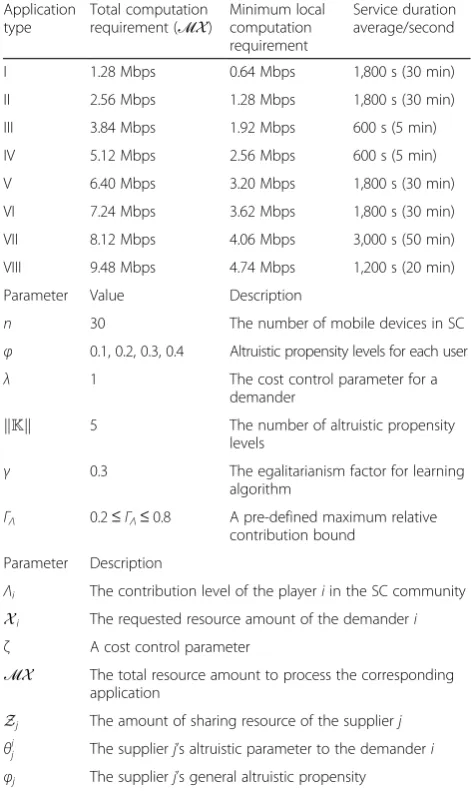
Step 1: At the start, allΛvalues are set to the relatively same initial values, e.g., zero, and each altruistic propensityφis randomly chosen fromK. When reciprocal interaction history is unavailable, it is a proper initialization. Control parameters, i.e., γ,λandΓΛ, are listed in Table1.
Step 2: When an individual device needs an additional
resource, it becomes a demander and asks thex amount resource to maximize the expected payoffUD(·) according to Eq. (1).
Step 3: If the neighboring nodes of a demander have
enough available resources, they can be suppliers. Suppliers provide theZamount resource to maximize the expected payoffUS(·) according to Eq. (3). When multiple demanders request the resource simultaneously, a supplier distributes the available resource using the Eq. (6).
Step 4: Using the simple two-sided matching algorithm,
a demander selects the most adaptable supplier, and the resource is effectively shared. After the resource sharing process,Λis adjusted
dynamically.
Step 5: In each game stage game,φof each mobile
device is periodically modified according to the exponential weight learning algorithm. Based on the adjustedPφk;k∈Kin Eq. (5), an actualφvalue of each device is selected stochastically.
Step 6: As game players, mobile devices are interrelated
with elastic applications, and interact with each other in the TS game. Under widely diverse SC environments, this iterative feedback procedure continues to reach theCCEstatus.
Step 7: Mobile devices self-monitors the current SC
situation in a distributed online manner; the next iteration resumes at step 2.
Table 1Application and system parameters used in the simulation experiment
VII 8.12 Mbps 4.06 Mbps 3,000 s (50 min)
VIII 9.48 Mbps 4.74 Mbps 1,200 s (20 min)
Parameter Value Description
n 30 The number of mobile devices in SC
φ 0.1, 0.2, 0.3, 0.4 Altruistic propensity levels for each user
λ 1 The cost control parameter for a
demander
K
k k 5 The number of altruistic propensity levels
γ 0.3 The egalitarianism factor for learning algorithm
ΓΛ 0.2≤ΓΛ≤0.8 A pre-defined maximum relative contribution bound
Parameter Description
Λi The contribution level of the playeriin the SC community Xi The requested resource amount of the demanderi ζ A cost control parameter
ℳX The total resource amount to process the corresponding application
Zj The amount of sharing resource of the supplierj
θi
j The supplierj’s altruistic parameter to the demanderi
3 Performance evaluation
In this section, we compare the performance of the pro-posed scheme with other existing schemes [10, 12, 13] and confirm the performance superiority of the proposed approach using a simulation model. Our simulation model is a representation of an SC system that includes social network users and the behavior and interactions of these users. In order to ensure that the model is sufficiently generic to be valid in the real-world, the assumptions used in our simulation model were as follows:
The simulated system consisted of 30 social network users for the SC platform.
We followed the traditional network topology, decentralized, and partially connected topology. In the network coverage area, network mobile
devices executed elastic applications. For each device, application service request was Poisson with rateρ(services/s) and the range of the offered service load was varied from 0 to 3.0.
Each mobile device has a different resource amount. There were five resource capacities for the devices and the devicei’s capacity (ℭi,i∈ℕ) wasℭi∈(10,
12.5, 15, 17.5, and 20 Mbps).
To reduce the computation complexity, the amount of resource allocation is specified in terms of basic units (BUs), where one BU is the minimum amount (e.g., 320 kbps in our system) for the resource sharing process.
The service durations of applications are
exponentially distributed with different means for different multimedia application types.
Network performance measures obtained based on 100 simulation runs were plotted as a function of the offered service load.
The performance criteria obtained through simulation were resource usability,CCE convergence ratio, and normalized system throughput.
Table 1 shows the system parameters used in the simulation. In order to emulate a real SC system and perform a fair comparison, we used the system parame-ters for a realistic simulation model.
In this paper, we compared the performance of the pro-posed scheme with existing schemes: the SCC scheme [10],ISCscheme [12], andRSCscheme [13]. These exist-ing schemes were recently developed as effective SC man-agement algorithms; all the schemes have polynomial time complexity. Compared to these schemes, we can confirm the superiority of our proposed approach.
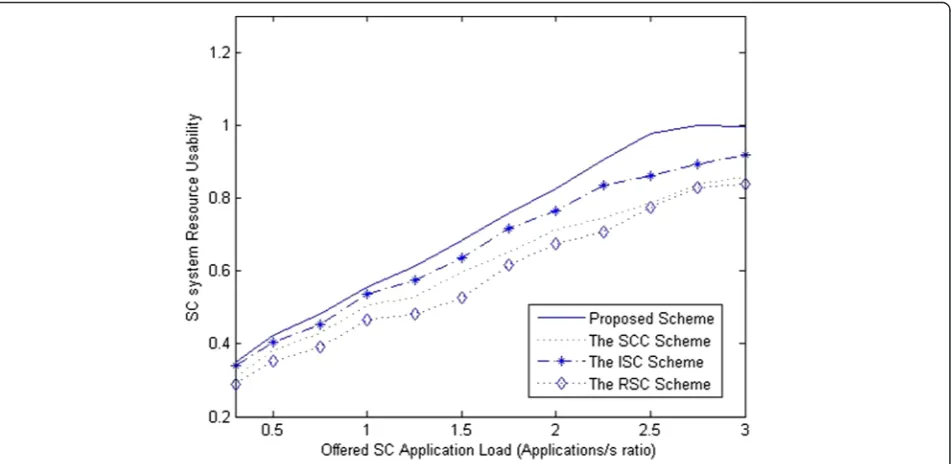
Figure 1 presents the performance comparison of each scheme in terms of resource usability in the SC systems. In this study, resource usability is a measure of how system resources are actually used. Traditionally, moni-toring how resources are used is one of the most critical aspects of SC management. During the SC system operations, all schemes produced similar resource us-ability. However, the suppliers in our proposed scheme adaptively distribute resources to the demanders while considering reciprocal fairness. Therefore, the resource usability produced by the proposed scheme was higher than the other schemes from low to heavy service load intensities.
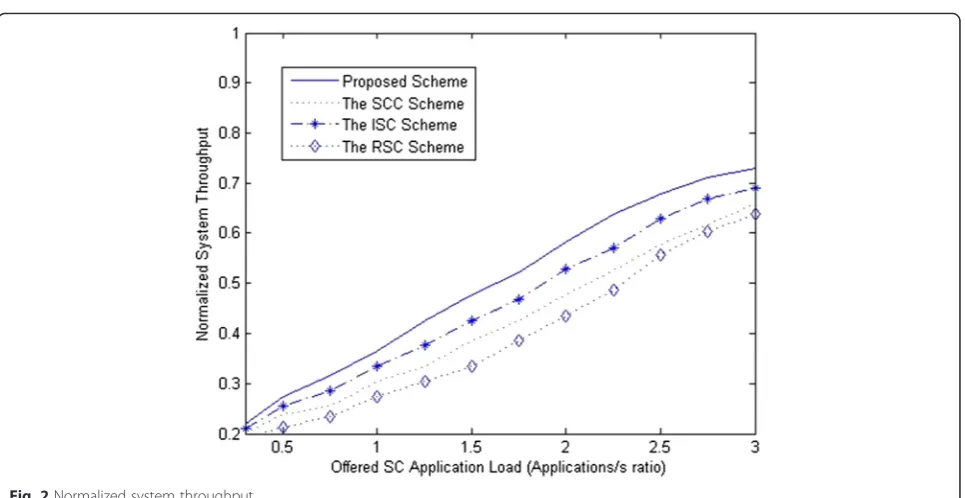
Figure 2 shows the normalized SC system throughput. From the simulation results obtained, it is observed that the proposed scheme can adapt to the current SC system situation and demonstrates better through-put owing to the iterative TS game approach. In general, excellent network throughput is a highly desirable property for real-world SC system opera-tions. Under different application service loads, the proposed scheme can provide a higher throughput than the other schemes.
The curves in Fig. 3 illustrate the CCE convergence ratio under different pre-defined maximum bounds (ΓΛ). If all users’ relative contribution differences are within theΓΛ,CCEis obtained, i.e.,CCEconvergence ratio is 1. Owing to the feedback-based reciprocal mechanism, the proposed scheme can interactively learn the best altruis-tic propensity strategy and adaptively adjust their φ levels to reach theCCEstatus. Due to the self-regarding feature, these control decisions are made by an entirely distributed fashion.
Fig. 2Normalized system throughput
As expected, CCE convergence ratio decreases while increasing service loads or decreasingΓΛvalues.
The simulation results presented in Figs. 1 and 2 dem-onstrate the performance of the proposed and other existing schemes and verify that the proposed scheme can provide attractive network performance. The proposed scheme constantly monitors the current conditions for an adaptive SC system management and successfully exhibits excellent performance. As expected, the performance en-hancements provided by the proposed scheme outper-formed the existing schemes [10, 12, 13]. The curves shown in Fig. 3 demonstrate theCCEconvergence ratio of our proposed scheme. This result is intuitively correct.
4 Conclusions
The ever increasing use of social networks and arrival of new computing paradigms like cloud computing has urged the need to integrate these platforms for the better and inexpensive usage of resources. Sharing cloud resources in such environments would be very helpful. This article addresses a new resource control algorithm for SC systems. Using the TS game model, users itera-tively observed the received payoffs and repeatedly modified their altruistic propensities to effectively manage SC resources. The proposed scheme enables the sharing of SC resources between users via reciprocal cooperative relationships and can effectively approach the CCE status using a step-by-step feedback process. Compared with the existing schemes, the simulation results confirmed that the proposed game-based method could improve the performance under dynamically chan-ging SC system environments whereas other existing schemes could not offer such an attractive performance. For future research, the SC paradigm presents a rich environment. One major area of future work is adapting the SC protocols that facilitate big data streaming from SC to Internet of Things (IoT). In addition, we are also looking further at QoS and QoE, as well as data security, privacy, and reliability issues. In parallel to these efforts, we plan to deploy the social storage cloud to provide a platform for further experimentation. In particular, we aim to explore system performance and user interactions on a much larger scale.
Competing interests
The author declares that he has no competing interests.
Acknowledgements
This research was supported by the MSIP (Ministry of Science, ICT and Future Planning), Korea, under the ITRC (Information Technology Research Center) support program (IITP-2015-H8501-15-1018) supervised by the IITP (Institute for Information & communications Technology Promotion) and was supported by Basic Science Research Program through the National Research Foundation of Korea (NRF) funded by the Ministry of Education (NRF-2015R1D1A1A01060835).
Received: 22 October 2015 Accepted: 1 February 2016
References
1. M Hemmati, N Sadati, M Nili,Towards a bounded-rationality model of multi-agent social learning in games. IEEE ISDA’2010, 2010, pp. 142–148
2. I Jang, D Pyeon, S Kim, H Yoon, A survey on communication protocols for wireless sensor networks. JCSE7(4), 231–241 (2013)
3. Z Shengbing,Influence of relationship strengths to network structures in social network. IEEE ISCIT’2014, 2014, pp. 279–283
4. D Ardagna, M Ciavotta, M Passacantando, Generalized Nash equilibria for the service provisioning problem in multi-cloud systems. accepted in IEEE Transactions on Services Computing.6(4), 429-422 (2013)
5. K Lee, I Shin, User mobility model based computation offloading decision for mobile cloud. JCSE9(3), 155–162 (2015)
6. Y Liu, Y Sun, J Ryoo, S Rizvi, AV Vasilakos, A survey of security and privacy challenges in cloud computing: solutions and future directions. JCSE
9(3), 119–133 (2015)
7. C Xu, Decentralized computation offloading game for mobile cloud computing. IEEE Trans Parallel Distrib Syst26(4), 974–983 (2015)
8. K Chard, K Bubendorfer, S Caton, OF Rana, Social cloud computing: a vision for socially motivated resource sharing. Services computing. IEEE Trans Serv Comput5(4), 551–563 (2012)
9. K Chard, S Caton, O Rana, K Bubendorfer,Social cloud: cloud computing in social networks. IEEE CLOUD’2010, 2010, pp. 99–106. In cloud computing 10. S Caton, C Haas, K Chard, K Bubendorfer, OF Rana, A social compute cloud:
allocating and sharing infrastructure resources via social networks. IEEE Trans Serv Comput7(3), 359–372 (2014)
11. Kim Sungwook,Game Theory Applications in Network Design. IGI Global. Pennsylvania, (2014)
12. Y Zhang, M van der Schaar, Incentive provision and job allocation in social cloud systems. IEEE J Sel Areas Commun31(9), 607–617 (2013)
13. Y Wang, C Guo, T Li, Q Xu,Secure two-party computation in social cloud based on reputation. IEEE 9th WAINA, 2015, pp. 242–245
14. K Lee, A Lippman, AS Pentland, P Maes,People’s just-in-time decisions: computational social platform to guide people’s just-in-time decisions. IEEE iThings/CPSCom, 2013, pp. 1259–1266
15. Z Ali, RU Rasool, P Bloodsworth,Social networking for sharing cloud resources. IEEE Cloud and Green Computing, 2012, pp. 160–166 16. W Yilei, G Chao, L Tao, X Qiuliang,Secure two-party computation in social
cloud based on reputation. IEEE WAINA, 2015, pp. 242–245
17. P Gajane, T Urvoy, F Clérot,A relative exponential weighing algorithm for adversarial utility-based dueling bandits. Proceedings of the 32nd International Conference on Machine Learning, 2015, pp. 218–227 18. S Kim, Intervenient Stackelberg game based bandwidth allocation
scheme for hierarchical wireless networks. KSII Trans Internet Inf Syst
8(12), 4293–4304 (2014)
Submit your manuscript to a
journal and benefi t from:
7Convenient online submission
7Rigorous peer review
7Immediate publication on acceptance
7Open access: articles freely available online
7High visibility within the fi eld
7Retaining the copyright to your article