Volume 2010, Article ID 648235,7pages doi:10.1155/2010/648235
Research Article
A Random Ant-Like Unicast Routing Protocol for Wireless Ad Hoc
Sensor Networks and Performance Evaluation
Yang Qin, Shenhao Liu, and Jinlong Wang
School of Computer Science and Technology, Harbin Institute of Technology Shenzhen Graduate School, Shenzhen 518055, China
Correspondence should be addressed to Yang Qin,[email protected]
Received 12 February 2010; Accepted 12 June 2010
Academic Editor: Jiangchuan Liu
Copyright © 2010 Yang Qin et al. This is an open access article distributed under the Creative Commons Attribution License, which permits unrestricted use, distribution, and reproduction in any medium, provided the original work is properly cited.
A random ant-like unicast routing (RAUR) protocol is proposed for wireless ad hoc sensor networks. In RAUR, when a source node needs to find a routing path to a destination, it does not flood the network. Instead, the source selects one of its neighbors to send out a route request packet. And the selected neighbor will also select one of its neighbors to forward the packet. The number of nodes to forward the searching message will be reduced. Hence, it could help to save the energy. In addition, the control overhead will be less. In this paper, our approximated mathematical analysis shows that the successful rate in finding a path with only one attempt is considerably high. Our research also shows that the RAUR will get higher successful rate through the larger number of hops. We study the performance of the network using the proposed RAUR by simulation of Glomosim and compare it with the routing protocols, DSR and AODV. The results show that RAUR could outperform in many metrics.
1. Introduction
A wireless sensor network consists of a large number of tiny sensing devices, deployed in a region of interest. Each has processing and wireless communication capabilities, which enable it to gather information from the environment and to generate and deliver report message to remote base nodes. Since wireless sensor networks have an ad hoc topology and there is no infrastructure in the networks, how to find a path to send message to the destination is a challenging issue and critical task in wireless sensor networks.
Existing major routing protocols for wireless sensor net-works includeLEACH [1],Directed Diffusion[2],Dynamic Source Routing (DSR) [3], Ad hoc on Demand Distance Vector (AODV)[4], Braided[5],MESH [6],Gossiping, and
SPIN. LEACH is built on the assumption that all sensor nodes can reach the sink node directly, which means single hop. Therefore, it is only applicable for networks with small geographical size. Gossiping follows the principle of randomness, it uses a randomly selected neighbor node to forward the data packet. Gossiping does not flood the network but extends the delivery time of data packet.SPIN
lets the source node flood ADV data packet and then send the data packet to the request node. InSPIN, when a node wants to send message, if all neighbor nodes do not need the
data, it will lead to the data can not be transmitted to other remote nodes.
ExceptLEACH, all the other protocols support multihop routing. Depending on how many copies of one data packet are forwarded to the destination simultaneously, these multihop routing protocols can be divided into two categories: single-path routing and multipath routing. In single-path routing, for each data packet, there is only one copy traveling along one path in the network. While in multipath routing, multiple copies of one packet are transmitted in parallel along different paths to the same destination. Among the above-mentioned multihop proto-cols, onlyMESHis explicitly claimed as multipath routing.
Braidedbuilds multiple paths for a data delivery, but only one of them is used, while others are maintained as backup paths.
Directed Diffusion can be single-path or multipath routing depending on how many paths are reinforced by sink node.
DSR, AODV, Gossiping, and SPIN are single-path routing protocols for ad hoc topology wireless sensor networks. Most of the above protocols use broadcast to do routing, which will cause high energy consumption and high control overhead.
it returns to the nest, laying down a pheromone trail that other ants may follow to its source, the food. Pheromones diffuse and evaporate; diffusion widens the trail, while evaporation provides a time limit on its availability. Ants interpret a wide trail, which is diffused and expanded by the pheromones of many ants, as being more significant than a narrow one, of course, no longer use an evaporated trail. The ants thereby establish a complicated organized behavior based solely on the relatively simple behavior of individuals without central control.
This communication model is appealing for wireless sensor networks. Basically, the ant mode considers the ant nest as information source (message origination) node, the food as an information sink (destination) node, and ants as messages (packets). The ground between nodes is considered a collection of intermediate nodes. For destination node to receive message in this model, it must first transmit messages advertising its presence. This advertisement message is passed from node to node in a random, unicast way. When the origination node sends a data message, it sends it to a random neighbor, which checks its routing table to see if it has a path to the destination. If not, it forwards the data message to a random neighbor. If this random neighbor has a path to the destination, it forwards the message to the neighbor according to the path to the destination. The message will be delivered to the destination node eventually if it is given enough time to forward.
However, the studies of ant-like routing algorithm on wireless sensor networks are not very sufficient, especially the performance evaluation and comparison with other algorithm are not enough. In this paper, we present a random ant-like unicast routing (RAUR) algorithm and provide performance comparison with other routing algorithms. We also conduct an approximated mathematical analysis for the RAUR to analyze its performance. RAUR is a source routing-based algorithm which is different from other ant-like algorithms. In RAUR, the path discovery process will be invoked only when the origination node does not have the path to the destination, or the intermediate node finds that the path from the source is fault. After the node finds the path, the data message (packet) will be sent according to the path found.
The rest of this paper is organized into the following sections. Section 2provides a brief description of the pro-posed algorithm, RAUR. This is followed by the explanation of the approximated analytical model for proposed scheme inSection 3. Sections4and5present simulation model, per-formance metrics and results from the simulations carried out respectively. This is followed by a conclusion to the paper and suggestions of areas where further work can be done in the last section.
2. Random Ant-link Unicast
Routing (RAUR)
This section describes RAUR, the proposed algorithm. Our scheme is a source routing-based protocol like DSR. It is simple and can be easily implemented.
We first state the information kept at the nodes and the types of control packets used in the algorithm are next defined. These are then followed by a description of the algorithm’s operation.
2.1. Information Kept at Nodes. Below are the information kept at any node, X, running RAUR. A brief description is given for each item
2.1.1. Routing Cache Table. The routing cache table holds the routes, a node discovered during route discovery or from overheard packets in the network. Each entry in the cache table holds a destination address, hop count, source route buffer,and entry’sinsertion time. All entries in the table are sorted by thedestination addressandhop count.
2.1.2. Data Packet Buffer. Data packets are buffered in node X’s data packet buffer when host X is performing route requests for the destinations of the data packets in order for these packets to be sent.
2.1.3. Neighbor List. The neighbor list of node X records the addresses of nodes that node X has learnt as its neighbors.
2.1.4. Route Request Table. The route request table records the route request information when the source node has initiated a route recovery to search for a destination node. Each entry inserted into the table has a source address,
destination address,nature of request,next-hop selected list,
andrequest time.
2.1.5. Table of Processed Route Requests. The table of pro-cessed route requests is a record of the route requests from other nodes recently processed by node X. Several records can be kept for each host initiating the requests. Each record consists of the address of the queried destination and an identification of the route request packet sent for that request.
2.2. Operation of the Algorithm. There are three kinds of control packets used in RAUR—route request packets (RREQ), route reply packets (RREPs), and route error packets (RERR).
To facilitate the routing of data packets in the network, it is necessary for nodes to conduct route discovery operations to look for routes that lead to desired destinations. This can happen in one of the following cases:
(1) a source node needs to find a path for a data packet for a desired destination,
(2) a node forwarding a data packet detects a fault between itself and the next-hop node specified in the packet header. The node will then need to find an alternative path to the specified destination.
or send message (RREQ). The route discovery, is designed to reduce the energy consumption and control overhead information in the network.
The route request operations function in a same manner in both the cases mentioned earlier. The operations will be described in detail in the next subsection for the second case, where they are used in the route discovery mechanism for intermediate nodes meet invalid paths. The described operations can also be applied to the first case, where a source node needs to find a path to a destination. The mechanisms that enable a more efficient route recovery are described in the last subsection of this section.
An example of flooding (broadcast) and point-to-point (unicast) packets transmission is explained in the following. The transmitting node sends packets to all nodes in flooding. In the case of point-to-point, the transmitting node sends packet to only one intended receiving node. As a result of this practice, some RREQs may not find a path to the destination if the given searching time is short. It is very interesting to study the efficiency of RAUR. What is the searching successful rate will be a critical metric to evaluate the routing algorithm. We will conduct an approximated analytical model simulation as a model to study the effectiveness of RAUR inSection 3.
2.2.1. Route Discovery Mechanism. The route discovery mechanism in RAUR typically involves conducting route requests. This subsection describes the operations involved in the route discovery mechanism.
RAUR differs from AODV and DSR in the way the RREQ is being sent. It uses unicast to send RREQ, whereas AODV and DSR use broadcast. In RAUR, a selection of the next hop has to be made before sending the RREQ. The choice of selecting a neighbor to receive RREQ in RAUR is crucial and critical to ensure data delivery, reasonable latency, and low bandwidth usage. Thus, RAUR routing protocol employs the following technique and criteria for selection of its neighbor during route discovery.
When selecting a neighbor, the neighbor must not be a node in the upstream route path. This check is part of the feature of source routing protocol to prevent looping in the network.
Before a source node sends an RREQ packet to its neigh-bor node to initiate route recovery, it updates the packet with thesource address,destination address,and its neighbor addresses into the route buffer in RREQ. It then selects a node from its neighbor table and forwards the RREQ to its neighbor.
As we know that the intermediate node in RAUR will generate RREQ for searching a path if it meets a “link” failure when forwarding a packet. After this intermediate node receives the RREP, it will send back to the source of the data upstream nodes. This enables the upstream nodes to update their routing tables with the new path corresponding to the “link” failure. Since RAURs inform the upstream nodes to update the routing table related to the failure link to provide correct route path in the future, we consider it having the function of “fault tolerance.”
Timeout of RREQ and Loop Free. When requesting for a new route, an RREQ originator sends the RREQ only to one of its neighbors that are randomly chosen. However, as a result of this practice, RREQs are not guaranteed to end up at the queried destination or at a node with a valid route to the destination.
To increase the possibility of finding a path to the destination, RREQs are given a timeout value so that another RREQ can be sent to another neighbor when the old one times out. When an originator does not receive any response to an RREQ after it times out, it sends another RREQ for the same destination to another randomly chosen neighbor. This is repeated as long as the allowable number of continuous route request attempts is not exceeded, and as long as the originator still has neighbors to forward the RREQ. Meanwhile, the old RREQ is considered expired. Nodes that encounter the expired RREQ will not process it and any RREPs received for it will be ignored.
Choosing a suitable timeout value for different kinds of network configuration may be a challenge if this approach is adopted. One possible solution to this is to have the hosts that keep track of the traffic condition and number of neighbors they have. They can then use an algorithm to dynamically compute a timeout value suitable for that particular situation. For example, such timeout could be set according to the Maximum number of hops we allow for each RREQ to be forwarded Let us denote, time-out as Tout and Maximum number of hops as Maxhop,
assuming the average waiting time at each hop is Wave. Then, we have Tout = Maxhop ×Wave. We would increase
the Maxhop by one if the previous RREQ failed and set
the Wave according to the average queuing delay from simulation.
The node that generated the RREP with the invalid path will realize the invalid path when it receives the data packet and tries to forward it according to the path found in its header. The data packet is treated like any data packet that cannot be forwarded at a node due to an invalid path in its header. The node carries out a route discovery operation, as described earlier, to find an alternative path for the data packet.
Since RAUR is a source routing algorithm, when the intermediate node tries to forward the RREQ, it can check the path in the RREQ’s header. In an RREQ, this records the path history. By checking the path in the RREQ’s header, RAUR can avoid forwarding the RREQ or packet to the nodes it traversed before, and then it can avoid loop.
3. Performance Analysis
The successful probability in finding a path to the queried destination is an important factor in evaluating the efficiency of the routing protocols. The traditional flooding routing protocols have the advantages that they normally have high success rate in finding the path to destination, however, flooding protocols always try to use all the resources to search, which cause bandwidth to be not enough for the data packets, further more it will consume more energy in the network as it involves more nodes to forward.
It is important for us to evaluate the efficiency of RAUR, since RREQ in RAUR may not find a path to the destination when the searching stops. We derive an approximated mathematical analysis to evaluate the success rate of route in RAUR. In the later section, we will also conduct the simulation to compare it with the analytical model.
We will make a simple analysis for the unicast scheme based on the average case, the neighbor is selected randomly. Let us use a matrixMof sizeN×N as the adjacent matrix of the network topology, where N is the number of hosts in the network.Msd is 1 if there is a one-hop path from s to d, otherwise it is 0.M2 = M×M, where the entryM2
sd
means the number of paths (of course, exclude the paths with loops), whose path length is 2 from node s to node d. Similarly,MN−1is the matrix saved all the number of paths
with path length ofN−1.
Of course, we exclude the paths with loops. It can be implemented by writing a program to check every node on each path, if there is any one node repeated within one path, it means a loop. Let us denote the maximum number of hops as MaxH. MaxHmeans the maximum number of hops each path can constrain.
We consider the worst case scenario; the network nodes have little information about other nodes. For example, no nodes will have the information for the destination node except the destination node itself. If it is given enough time to process all the RREQs, the probability of an RAUR RREQ to successfully find a path to the queried destination can be calculated in the following:
where MaxHi=1 MisD is the total number of successful paths with various paths length from source s to destination d. AndD∈N,D=/s,dMMaxsd His the total number of failure paths
when an RREQ terminates its searching at any other nodes except the queried destination node d while the RREQ has exceeded the maximum number of hops, MaxH, which can be set from 1 toN−1.
The above computation is done under worst case sce-nario that all the hosts have no route information about the other nodes except its neighbors. A further realistic analysis is proposed to model the query successful rate with every node having routing table and has the possibility of caching a valid route to the destination. We use the results of Rt obtained from previous computation as inputs to obtain
a more realistic results for query paths in a network of nodes with routing table.
Without losing generality, we take a specified destination as node D. We takeNas the total number of nodes in the network, we define the nodes that have valid routes to node D as Lucky nodes as L, where C is the number of nodes that has been covered by the query path and where MaxH is the maximum hops the query path can take. Thus, the probability of a query path does not pass any lucky nodes as the follows:
Rin(L)=MaxHC=1 ((N−C)−L)
(N−C) , (2)
whereNmust be greater thanC and ((N−C)− L) must be greater than 0. In this probability, if ((N−C)− L) is less than or equal to zero, it means that there are no more unlucky nodes in the network. Therefore every other node is a lucky node and the probability of getting an unlucky node is 0%. Thus in any route path, any node before it is covered by the query, is considered unlucky node. We defineRfinalto be the probability of the successful rate in finding a valid path to a destination. The results ofRin(L) are obtained from MinLto MaxLand are used to findRfinal
Rfinal=
MaxL
L=MinL(Rin(L)×Rt+ [1−Rin(L)]×100%)
MaxL−MinL ,
(3)
where 1−Rin(L) is the probability of reaching a lucky node, whereRt is the blind search rate given by (1). MaxLis the number of maximum lucky nodes for a specified destination. MinLis the number of minimum lucky nodes for a specified destination. However, the number for the lucky nodes in the network is very hard to estimate. We have to make some approximation. We consider the condition when a new node, say Node J, joins the network. At the beginning, no lucky nodes for it, as no other nodes have the valid route information to it. During the pause time, more packets are generated according to the uniform distributed destinations. Some nodes generate packets destine the new node J. The number of the packets which choose Node J as destination can be expressed as follows.
MaxL=λ×NP, (4)
Success rate (n=25,h=6)
0 20 40 60 80 100
(%)
0 20 40 60 80 100 120
Pause time (secs)
Analysis results Simulation results
Figure1: Success rate of finding path (n=25).
0 20 40 60 80 100
(%)
0 20 40 60 80 100 120
Pause time (secs)
Analysis results Simulation results
Success rate (n=49,h=6)
Figure2: Success rate of finding path (n=49).
4. Simulation Evaluation and Discussion
In this section, we will conduct a simulation experiment to present the comparison of analytical results with the simulation results and also present the comparison of the performance of different routing protocols, including DSR, and AODV with RAUR in simulation in the following sections. Since RAUR is a single-path routing protocol, hence we compare it with DSR and AODV which are also single-path routing protocol to evaluate its performance.
The simulation was conducted using Glomosim Network Simulator (v2.03) developed by UCLA. The simulation environment for project is set similar to those of simulation conducted by other papers [4]. The network is defined to have 2 Mbps bandwidth. The nodes are randomly placed in rectangular fields, 2200 m×600 m for different simulation. A rectangular field is chosen so that the transmission for faraway nodes can also be evaluated. The mobility model used is Modified Random Waypoint [11] with each node’s mobility rate randomly set between 0 and 20 meters per sec. As we think the node in sensor networks has relatively static property, the pause time is as high as 300 sec. The radio range for the node is 250 m. Every node in the network maintains two interface queues of with 64 packets size each. In the simulation, there are 40 source nodes will continuously generate packets at the packet rate to destinations. The packet rate is varying from 1 to 100 packets per second. The data packet size is fixed at 512 bytes.
49 nodes at arrival rate 20 pkt/s
70 75 80 85 90 95
(%)
5 6 7 8 9
Hops
Pause time 40 s Pause time 45 s Pause time 50 s
Pause time 55 s Pause time 60 s
Figure3: Success rate of finding path versus hops (n=49).
25 nodes at arrival rate 20 pkt/s
70 75 80 85 90 95 100
6 7 8 9 10 11 12 13 14 15 Hops
5
(%)
Pause time 10 s Pause time 15 s Pause time 20 s
Pause time 30 s Pause time 25 s
Figure4: Success rate of finding path versus hops (n=25).
The following are the performance metrics used in our simulations.
4.1. Percentage of Data Packets Successfully Delivered. The percentage of data packets successfully delivered is the percentage of data packets that are eventually delivered to their respective destinations over the total packets generated.
4.2. Average Packet Latency. The average packet latency is the average amount of time a packet that is successfully delivered to its destination spends in the network.
4.3. Energy Consumption. The energy usage is in arbitrary energy units, or eu. We assumed that a node consumes 0.03 eu/second when idle, 0.3 eu/second while receiving, and 0.6 eu/second while transmitting. These values are consistent with values measured on real-world wireless devices [12].
0
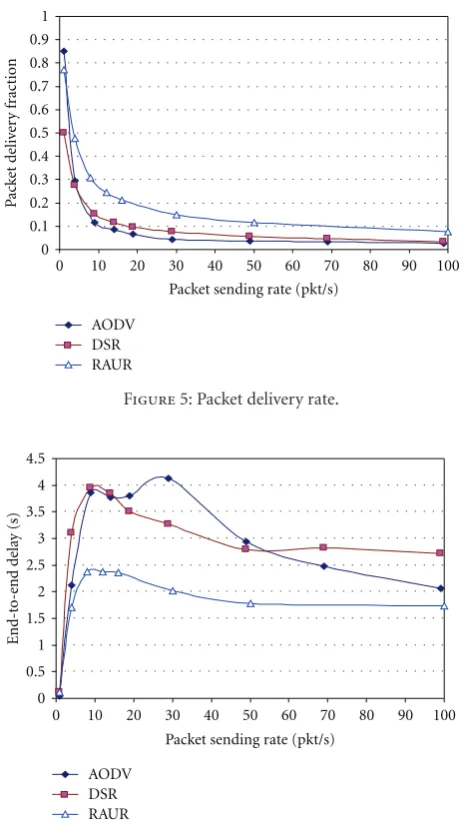
Figure5: Packet delivery rate.
0
any network, it is preferred to have a throughput as high as possible.
It is very important to investigate the effectiveness of pro-posed RAUR algorithm. Hence, we study the performance of RAUR in the success rate of finding a path using the proposed algorithm in this section. Figures1and2shows the comparison of simulation and analytical results of the success rate of finding a path in the 49-nodes network and 25-nodes network with number of hops is 6, plotted against the pause time. We can see that the approximated analysis is close to the simulation results and while the pause time increases, the success rate also increases. It is to be expected, since a larger pause time decreases the level of mobility. It demonstrates in both analytical and simulation results that RAUR could reach quite high success rate if it is given a big enough number of hops. Figures3and4show different success rate of finding a path versus number of hops at different pause time by analytical results. The results give out an insight of performance changing trends of RAUR routing scheme.
0
Then, we will present some simulation results from network of 2200 m×600 m, with 100 nodes in the following performance metrics: packet delivery, average delay, and throughput. The simulation results demonstrate the eff ec-tiveness of the proposed scheme.
4.5. Comparison of Percentage of Data Packets Successfully Delivery. Figure 5shows the packet successfully delivery of different protocols. It is observed that RAUR will outper-form DSR and AODV. The operational feature of RAUR contributing to its superior performance is: the route request operations that involve sending an RREQ to only one neighbor at a time.
By allowing only one RREQ to be forwarded at anytime during a route request operation, the control overhead is significantly reduced. With a lighter traffic in the network, both data and control packets experience lower delay.
4.6. Comparison of Average Packet Latency. RAUR showed better performance when the number of sending source increased to 40 inFigure 6. Of the three routing protocols, RAUR was able to perform better. The lower packet latency for RAUR is expected as a result of the route recovery mechanism used in the algorithm. RAUR generates fewer control overhead as it uses unicast scheme and could save bandwidth for the data packet. Since DSR and AODV generate more control overheads, it leads to a larger portion of bandwidth to be taken up by control overhead, hence, the data packets will experience longer delay.
4.7. Comparison of Throughput and Energy Consumption.
Figure 7show the variation of throughput with pause time in 2200 m×600 m wireless sensor network. Similarly, it is observed the RAUR has much better performance. InTable 1
Table1: Energy consumption comparison for RAUR, DSR, and AODV.
RAUR DSR AODV
Energy (eu) 3709 7689 4978
5. Conclusion and Future Work
One of the objectives of this paper is to investigate the motivation for deploying a unicast distributed routing algorithm in wireless sensor ad hoc networks.
The random ant-like unicast routing (RAUR) scheme is proposed and simulations were run to compare the network performance of networks running on RAUR and those running on DSR, AODV. RAUR outperforms in most of the simulations. With higher traffic load, RAUR has shown more tolerance to the increase of network traffic load, it is scalable as the routing load change is small and gradual even at higher number of sending sources. The advantages of RAUR are due to its unicast routing mechanism. We have also provided an approximated analytical model for RAUR to give out an insight of its performance changing trends.
In future studies, more realistic traffic, for example, TCP or UDP traffic application and multimedia traffic, will be used for further investigation of the performance of RAUR. Some other arbitrary network field with low node density will be used to examine the RAUR.
References
[1] W. R. Heinzelman, A. Chandrakasan, and H. Balakrish-nan, “Energy-efficient communication protocol for wireless microsensor networks,” in Proceedings of the 33rd Annual Hawaii International Conference on System Siences (HICSS ’00), p. 223, January 2000.
[2] C. Intanagonwiwat, R. Govindan, and D. Estrin, “Directed diffusion: a scalable and robust communication paradigm for sensor networks,” in Proceedings of the 6th Annual International Conference on Mobile Computing and Networking (MOBICOM ’00), pp. 56–67, Boston, Mass, USA, August 2000. [3] D. B. Johnson, et al., “Dynamic source routing in ad hoc wireless networks,” inMobile Computing, T. Imielinski and H. F. Korth, Eds., chapter 5, Kluwer Academic Publishers, Dodrecht, The Netherlands, 1996.
[4] C. E. Perkins and E. M. Royer, “Ad hoc on-demand distance vector routing,” inProceedings of the 2nd IEEE Workshop on Mobile Computing Systems and Applications, pp. 99–100, 1999. [5] D. Ganesan, et al., “Highly-resilient, energy-efficient mul-tipath routing in wireless sensor networks,” ACM Mobile Computing and Communications Review, vol. 5, no. 4, pp. 11– 25, 2001.
[6] F. Ye, S. Lu, and L. Zhang, “GRAdient Broadcast: a robust, long-lived sensor network,” Tech. Rep., UCLA, 2001,
http://irl.cs.ucla.edu/papers/grab-tech-report.ps.
[7] R. Schoonderwoerd, J. L. Bruten, O. E. Holland, and L. J. M. Rothkrantz, “Ant-based load balancing in telecommunica-tions networks,”Adaptive Behavior, vol. 5, no. 2, pp. 169–207, 1996.
[8] G. Li, S. Zhang, and Z. Liu, “Distributed dynamic routing using ant algorithm for telecommunication networks,” in
Proceedings of the IEEE International Conference on Commu-nications (ICC ’00), vol. 2, 2000.
[9] T. Michalareas and L. Sacks, “Link-state & ant-like algorithm behaviour for single-constrained routing,” inProceedings of the IEEE Workshop on High Performance Switching and Routing, pp. 302–305, May 2001.
[10] E. H. Callaway, Wireless Sensor Networks: Architectures and Protocols, Auerbach Publications, CRC Press, Boca Raton, Fla, USA, 2004.
[11] J. Yoon, M. Liu, and B. Noble, “Random waypoint considered harmful,” in Proceedings of the 22nd Annual Joint Confer-ence of the IEEE Computer and Communications Societies (INFOCOM ’03), pp. 1312–1321, April 2003.