Volume 2010, Article ID 726750,13pages doi:10.1155/2010/726750
Research Article
Analysis of the Tradeoff between Delay and Source Rate in
Multiuser Wireless Systems
Beatriz Soret, M. Carmen Aguayo Torres, and J. Tom ´as Entrambasaguas
Department of Ingenier´ıa de Comunicaciones, Universidad de M´alaga, 29071 M´alaga, Spain
Correspondence should be addressed to Beatriz Soret,[email protected]
Received 25 January 2010; Revised 23 May 2010; Accepted 3 August 2010
Academic Editor: Hyunggon Park
Copyright © 2010 Beatriz Soret et al. This is an open access article distributed under the Creative Commons Attribution License, which permits unrestricted use, distribution, and reproduction in any medium, provided the original work is properly cited.
This work addresses the limits on the information that can be transmitted over the wireless channel under the conditions stated by the MAC layer: a selected scheduling discipline and an ensured level of QoS. Based on the effective bandwidth theory, the joint influence of the channel fading, the data outsourcing process, and the scheduling discipline in the QoS metrics are studied. We obtain a closed-form expression of the vector of attainable users’ rates RuDt,εfor several scheduling algorithms, representing the
maximum constant rate that the uth user can transmit under the selected discipline and fulfilling a target Bit Error Rate (BER) and the delay constraint given by the pair (Dt,ε), whereDtis the target delay andεis the probability of exceedingDt.
1. Introduction
Providing Quality of Service (QoS) guarantees to different applications is an important issue in the design of next generation of high-speed networks. The QoS metrics of interest are likely to vary from one application to another, but are predicted to include measures such as throughput, Bit Error Rate (BER), and delay. Unlike traditional data com-munication, where system performance is largely measured in terms of the average overall throughput and loss rate, real-time communications may require QoS metrics expressed in terms of the mean delay or its variance (jitter).
Traditional networking approaches design separately, the physical and the medium access layer (MAC). Instead, in future wireless networks the physical knowledge of the wireless medium is shared with higher layers on a cross-layer basis [1], an increasingly important topic for the evolving wireless build-out.
User multiplexing for QoS guarantees is an active research topic [2] in wireless systems, under different names such as, subcarrier and slot allocation, resource allocation or scheduling. Exploiting both the source diversity and the variations in channel conditions can increase the system throughput. A scheduling scheme ideally should be able not only to handle the uncertainty of the channel but also to exploit it, that is, opportunistically serve users with good
channels. Using such an approach leads to a system capacity that increases with the number of users (multiuser diversity) [3].
Many questions regarding the performance of most used opportunistic algorithms are still open. For example, very few works consider the delay or study the treatment given to each user [4,5]. The main difficulty in obtaining analytical results comes from the fact that the classical queueing theory is no longer suitable. Moreover, the result is linked to the scheduling discipline and the analysis has to be done algorithm by algorithm. To the best of our knowledge, the papers with analytical results found in the literature either use simple channel models [6,7] or only provide bounds on the QoS metrics [8,9].
Within this context, we explore the limits on the informa-tion that can be transmitted over the wireless channel under the conditions stated by the MAC layer: an ensured level of QoS and a selected scheduling discipline. In particular, both the channel fading and the scheduling algorithm determine the maximum source rate to be transmitted under some statistical QoS guarantees.
Probabilistic Delay Constraint, becomes useful [11]. Then, rather than ensuring a deterministic delay, a probabilistic delay constraint is defined as the pair (Dt,ε), whereDtis the target delay andεis the probability of exceeding it.
On the other hand, in multiuser communications the capacity of the channel is no longer fully characterized by a single number. Instead, the capacity should be redefined to consider each user’s data rate separately. Thus, in a system with U users, the capacity should take the form of a U
dimensional vector representing rates allocated to the U
users [12]. A capacity region is then defined as the set of all
Udimensional rate vectors that are achievable in the channel. Furthermore, when a QoS constraint is imposed (in the form of a probabilistic delay constraint), the data rate attainable by each user will be closely linked to the scheduling strategy.
In this paper, we obtain a closed-form expression of the vector of users’ data rates RuDt,ε for several scheduling
algorithms, representing the maximum constant rate that theuth user can transmit under the selected discipline and fulfilling a target BER and the delay constraint given by the pair (Dt,ε). The total system capacity will be the sum of the individual users’ rates, where each user can have a different delay constraint and can experience a different channel. The procedure to obtain these rates, based on the effective bandwidth theory [13], is similar to some previous results in a single-user system [11]. Three simple and widely employed disciplines have been analyzed: Round Robin [14], Best Channel [3], and Proportional Fair [15]. For simplicity, the results are obtained for a CBR (Constant Bit Rate) data source but they can be extended to any other traffic model as explained in [16].
The remainder of the paper is organized as follows.
Section 2 describes the multiuser system model. Section 3
first details the derivation of the maximum users’ rates subject to a delay constraint for an uncorrelated Rayleigh channel (Section 3.1). Later on, the expressions are partic-ularized to Round Robin, Best Channel, and Proportional Fair disciplines in Sections 3.2, 3.3, and 3.4, respectively. The time-correlated channel is examined inSection 4, first of all the achievable rates (Section 4.1) and then the same three particularizations for the three examples of discipline (Sections 4.2, 4.3, and 4.4). The validation of the results by comparison with simulations is presented in Section 5. Finally, concluding remarks are given inSection 6.
2. Multiuser System Model
2.1. Queueing Model. Figure 1illustrates the system model considered in this paper. The channel is shared among
U users, whose incoming traffics are characterized by U
source processes, respectively. Each user has its own queue where the data are stored before being transmitted. The server represents the information transmitted to the shared channel, which is decided at each instant by the scheduler. The instantaneous response of the wireless channel is, in general, a time-variant and autocorrelated random process.
Physical time is divided into units, hereinafter referred to as symbol periods, which represent the transmission discrete
a1[n]
a2[n]
aU[n]
Q1[n]
Q2[n]
QU[n]
C[n]=U u=1Cu
[n] Scheduler
. . .
Figure1: Multiuser system model.
time unit,n. The channel response of each user is assumed to be constant over the symbol. Moreover, the scheduler allocates the channel to users in a symbol per symbol basis: every new symbol, a user is selected for transmission.
It is assumed that the transmitter employs adaptive techniques, so that the transmission rate is modified dynam-ically, seeking to adapt to the time-varying conditions of the physical channel.
Each incoming user traffic has an instantaneous rate
au[n]. On his side, the wireless channel transmits at an instantaneous ratec[n], that is, every symboln,c[n] bits can be transmitted by the channel.
Each user has a potential rateru[n], which represents the channel rate that he may use if the channel is assigned to him, and which depends on his channel conditions as explained in
Section 2.2. Moreover, the instantaneous channel rate of user
uth,cu[n], is given by
cu[n]= ⎧ ⎨ ⎩
ru[n] if channel is assigned to useru,
0 in other case. (1)
Since the channel is shared amongUusers,c[n] can be expressed as
c[n]=
U
u=1
cu[n]. (2)
Notice that in the sum above only one of the terms is nonzero, corresponding to the user allocated to the channel. The effective bandwidth analysis of the queueing system is done by means of the processes au[n] and cu[n]. The processes au[n] and cu[n] are not necessarily white and represent the amount of bits per symbol generated by user u and the amount of bits per symbol of the uth user transmitted by the server, respectively. In addition, the accumulated source rate Au[n] is the amount of bits generated by userufrom 0 to instantn−1:
Au[n]= n−1
m=0
And similarly the accumulated channel process of uth user is
Cu[n]= n−1
m=0
cu[m]. (4)
The queue size is assumed to be infinite and Qu[n] denotes the length of the queue at time n. The dynamics of the queueing system seen by user u is characterized by the equation Qu[n] = (Qu[n−1] +au[n]−cu[n])+, with (x)+max(0,x).
2.2. Channel Model. Every user experiences a flat Rayleigh channel with complex channel responsehu[n]. The envelope of the channel response is denoted by zu[n] = |hu[n]|. Furthermore, users are independent among them, that is, the channel response seen by one user is independent from the rest.
Let us defineγu[n] as the instantaneous Signal-to-Noise Ratio of useruat the receiver. With Additive White Gaussian Noise (AWGN),γu[n] is exponentially distributed:
fγu
= 1
γue
−γu/γu, (5)
whereγuis the average Signal-to-Noise Ratio of useru. Moreover,γu[n] is proportional to the square ofzu[n]:
γu[n]=zu[n]2Es
N0
, (6)
whereEsis the average energy per symbol andN0is the noise power spectral density.
We consider constant transmitted power and a continu-ous rate policy. Then, the potential channel rate of useru,
ru[n], is a function ofγu[n]:
ru[n]=log2
1 +βuγu[n]
, (7)
whereβu, under adaptive modulation, is a constant related to the target BER. Its value for uncoded QAM is [17]
βu ≈ (1.6/−log(5BERt)), where BERt is the target BER. Further, the value βu = 1 represents the upper bound corresponding to the evaluation of the AWGN channel capacity (in Shannon’s sense).
The variability of the channel over time is usually reflected through its autocorrelation function (ACF). This second-order statistic generally depends on the propagation geometry, the velocity of the mobile, and the antenna characteristics [18]. The autocorrelation function of the envelope of the channel response is denoted byRz(m). In
Section 3, the channel response of each user is assumed to
be uncorrelated, that is, Rz(m) is zero except form = 0. Later, in Section 4, the time-correlation is considered. In particular, a very simple model of correlation is employed: the ACF is assumed to decay exponentially with a parameter
ρ, 0< ρ <1:
Rz(m)=ρm. (8)
The use of the exponential model simplifies and speeds up the simulations and numerical evaluations along this paper without altering the conclusions. Nevertheless, any other correlation function can be used (i.e., the classical Jakes’ model [18]).
2.3. Effective Bandwidth Analysis. The asymptotic
log-moment generating function ofQu[n] is defined as [13]
Λu(υ)= lim n→ ∞
1
nlog E
eυQu[n] . (9)
Since au[n] and cu[n] are independent of each other,
Λu(υ) may be decomposed into two terms,Λu(υ)=ΛAu(υ) +
ΛCu(−υ), where ΛAu(υ) and ΛCu(υ) are the log-moment
generating functions of the accumulated source process and the accumulated channel process of useru, respectively.
If the source and channel processes are stationary and the steady state queue length exists, then the workload process
Qu[n] satisfies a Large Deviation Principle and the following steady state solution for the queue length exceeding Bu is satisfied [13]:
Pr{Qu(∞)> Bu} e−θBu, Bu−→ ∞, (10) where f(x) g(x) means that limx→ ∞f(x)/g(x) = 1 and θ, known as the QoS exponent, is the solution toΛAu(υ) +
ΛCu(−υ)|υ=θ=0
Defining the effective bandwidth function (EBF)αu(υ)=
Λu(υ)/υ, the equation to obtainθcan be expressed as
αu(υ)=αAu(υ)−αCu(−υ)υ=θ=0, (11) whereαAu(υ) andαCu(υ) are the effective bandwidth
func-tions of the source process and the channel process for the
uth user, respectively.
Letηube the probability that the queue of useruis not empty,ηu=Pr{Qu[n]>0}. By the inclusion of this term in the analysis, the following less conservative approximation for the tail probability of the queue is satisfied:
Pr{Qu(∞)> Bu} ≈ηu·e−θBu. (12) The delay of the bits leaving the queue of useruat symbol
nis denoted asDu[n]. For simplicity, assume that the source traffic from theuth user arrives to the buffer at a constant rate:
au[n]=λu. (13) It leads to a constant EBF for the following source process [19]:
αAu(υ)=λu. (14)
The procedure to generalize the results to other traffic sources can be found in [16].
As in the queue length process, the steady state solution for the delay process exists. In addition, for constant sources the delay at the queue of userucan be calculated:
Du[n]=Qu[n]
λu[n].
Thus, the probability of exceedingDt, denoted through-out this paper as target delay, can be written as follows [20]:
ε=PrDu(∞)> Dt
≈ηu·e−θ·λuD
t
, (16)
where the probability of exceeding the target delay Dt is denoted byε.
3. Uncorrelated Channel
We start the analysis of the multiuser system presented above with the case of users experiencing an uncorrelated Rayleigh channel (block fading model). Part of these results can be found in [21].
3.1. Achievable Users’ Rates with a Delay Constraint. Starting from (16), the set of individual users’ rates that accomplish a delay constraint can be calculated. Each user has his own delay constraint. The effective bandwidth of the channel is needed,αCu(υ).
With no time-correlation among samples, the accumu-lated transmission rate for the uth user, Cu[n], is simply the addition of n uncorrelated and identically distributed random variables. Asn → ∞, the Central Limit Theorem can be applied and Cu[n] can be considered a Gaussian random variable with average n · mu and variance n ·
σ2
u, where mu and σu2 are the mean and the variance of
cu[n], the instantaneous channel rate for theuth user. Then, the effective bandwidth function for the resulting Gaussian distribution ofCu[n] is computed as [19]
αCu(υ)= lim
n→ ∞
1
n·ulog E
eυCu[n] =m
u+u 2σ
2
u. (17) In a high load scenario, the probability that the buffer is not empty approaches one, that is,ηu → 1. Under this assumption, the delay constraint is worked out from (16):
−log(ε)
Dt =θ·λu. (18) Assume that the uncorrelated channel has parametersmu andσ2
u, then the QoS exponent is obtained by solving (11):
λu−αCu(−θ)=0=⇒θ(λu)θ
mu,σu2,λu
=2(mu−λu)
σ2 u
.
(19)
With (19) substituted into (18), the value ofλuis worked out and it is the achievable user rate that we were seeking. It represents the maximum source rate that may be supported for useruwith a probabilityεof exceeding a delay boundDt. We denote it by RuDt,ε:
RuDt,ε=
mu 2 +
1 2
m2 u−2σu2
−logε
Dt . (20) The delay constraint formed by the pair (Dt,ε) can be different for each user. Nevertheless, we maintain the
notation above for the sake of simplicity. Equation (20) shows explicitly the tradeoffbetween user source rate (RuDt,ε)
and delay requirements (Dt,ε). It can be observed that for highDt values orε → 1, the QoS requirement relaxes and RuDt,εapproachesmu. On the other hand, as the target delay
Dt orε become lower, the user has to transmit at a lower rate in order to guarantee its own delay constraint. Moreover, the influence of the scheduling algorithm and the channel conditions (SNR, target BER) are captured in the mean and the variancemuandσu2. Thus, the evaluation of the user rates comes down to obtaining the mean and the variance of the channel process seen by useru:
mu=E[cu[n]],
σ2 u=E
c2 u[n]
−m2 u.
(21)
These statistics depend on the distribution of cu[n] which in turn depends on the scheduling algorithm. Three scheduling disciplines will be detailed in next sections.
Finally, the total system capacity CDt, is obtained as the
sum of the individual user rates, each of them with its own delay constraint:
CDt, =
U
u=1
RuDt,ε, (22)
withDt andbeing the vectors with the target delays and probabilities of violation of each user, respectively.
3.2. Round Robin. First of all, the mean and the variance to compute RuDt,εunder a Round Robin strategy are calculated.
Round Robin (RR) [14] is a fixed cyclic algorithm without priorities, which dispenses the channel equally among the different flows independently of their priorities or radio channel conditions. Transmission at symbol n is assigned to the following user in a cyclic order and therefore,
cu[n]= ⎧ ⎨ ⎩
log21 +βuγu[n]
if mod (n,U)=u,
0 in other case. (23)
It is known that this strategy does not work well over varying channels and a low efficiency in terms of system capacity and QoS differentiation is expected.
The mean and the variance ofcu[n] are required. With only one user (U=1) and continuous rate policy, the mean
cu[n] matches up with the ergodic capacity of the channel. We denote itm1for convenience
m1=E
log21 +βγ =log2(e) exp
1
βγ
E1
1
βγ
, (24)
Likewise, the expression of the varianceσ12with only one user is [11]
σ2 1=E
log21 +βγ2
−m2 1
=log2(e)2e1/(βγ)¯
×
π2 6 +g
2+ 2glog
1
βγ
+ log2
1
βγ
−2
1
βγ
3
F3
[1, 1, 1], [2, 2, 2],− 1
βγ
−e1/(βγ)E21
1
βγ
,
(25)
wheregis the Euler constant andpFq(n,d,z) is the hyperge-ometric function.
WhenUusers share the channel under an RR discipline, we only need to take into account that the channel is equally divided among users. Thus, the expressions of mu andσu2 are written directly as a function of m1 and σ12, by just replacing with the average Signal-to-Noise Ratio of each user and dividing by the number of users:
mu=E
log21 +βuγu =m1
U,
σ2 u=E
log21 +βuγu 2
−m2 u=
σ2 1
U2.
(26)
The expressions above make it possible to evaluate the individual users’ rates in (20) under a Round Robin discipline.
An example is shown inFigure 2. Three users have been considered, with average SNR 5, 7 and 12 dB, respectively. The individual rates RuDt,εare plot as a function of the target
delayDt. The other parameter, the violation probabilityε, has been set to 0.1 for all users. The parameterβuis set to 1(Hereinafterβuis set to 1 in all the numerical evaluations.). The mean mu of each user is represented with solid line, whereas the dashed line is RuDt,ε. Both mu and RuDt,ε are
plotted for each user (users marked with triangles, squares and circles). Moreover, the system capacity normalized with the number of users, which corresponds to the “average” rate, is represented with no marks and thicker line.
First of all, let us observe the common behaviour of RuDt,εfor all the user. As presumed, the curve increases with
Dt (the more relaxed the QoS requirements, the higher the maximum attainable rate). Obviously, RuDt,ε is always below
mu. Moreover, values of the user rate equal to zero must be interpreted as QoS requirements that cannot be fulfilled with that channel conditions, number of users and discipline.
Observing the differences among users, those with better channel conditions obtain higher rates and can demand stringent QoS conditions, as it was expected. Thus, the best user in this example could fix a delay constraint with a target delay of 3 symbols in contrast to the 5 symbols of the worst user. On the other hand, if the same target delay is fixed for the three users the rate to be employed increases forbetter
0 0.2 0.4 0.6 0.8 1 1.2 1.4
0 5 10 15 20 25 30
mu
User 1
User 2 User 3 Average Dt(symbols)
R
u Dt,ε
(bits/sy
mbol)
Ru Dt,ε
Figure 2: Achievable users’ rates with Round Robin scheduling
in an uncorrelated channel. Three users with γu = 5, 7, 12 dB, respectively.ε=0.1.βu=1.
users (users with better channel conditions). For example, for 10 symbols user 1 can transmit 0.5 bits/symbol, user 2, 0.7 bits/symbol, and user 3, 1.1 bits/symbol.
3.3. Best Channel. Best Channel (BC) [3] strategy is adaptive to the channel state, giving priority to those users with higher potential transmission rate. The channel is assigned to the user that may transmit with the highest number of bits per symbol
cu[n]= ⎧ ⎨ ⎩
log21 +βγu[n]
ifγu[n]> γk[n] ∀k /=u,
0 in other case.
(27)
This algorithm maximizes the total system efficiency. However, under this strategy, good average SNR users get more average throughput than low SNR users.
Let us defineγmax
γmax=max u
γu
. (28)
The CDF ofγmaxcan be written as
Fγmax
γ=Prγmax< γ
=Prγ1< γ,γ2< γ,. . .,γU < γ
.
(29)
Since the users are i.i.d., it comes down to
Fγmax
γ=
U
u=1
1−exp
−γ
γu
Consider the following effective SNR for the uth user
U-dimensional vector, U is the set of all U-dimensional vectors with entries taking values 0 of 1, that is,Ucontains the 2Ubinary words of lengthU, andi
uis theuth component ofi.
From (32) it can be observed that the first addend will be zero in the required expectation and only the second term needs to be integrated:
fu
Substituting into the mean, it yields
mu= −
This integral is analogous to the single user case by simply defining 1/γ=b·i. The result is then Dt(symbols)
R
Figure 3: Achievable users’ rates with Best Channel scheduling
in an uncorrelated channel. Three users with γu = 5, 7, 12 dB, respectively.ε=0.1.βu=1.
Likewise, the calculation of the variance is similar to the single user case, obtaining.
σ2
The same evaluation example presented for RR is shown
inFigure 3, now for BC allocation.
The differences among users are much more noticeable than for RR. Thus, the best user is better offwith the change to BC allocation at the expenses of users with lower average SNR. Notice that not only the differences in the meanmu are remarkable (the asymptotic behaviour when relaxing the QoS constraint) but also the minimum target delays of each user move away. For example, the worst user cannot demand a target delay below 45 symbols for these channel conditions and scheduling, in contrast to the 2 symbols of the best user. As expected, the average rate is higher than for RR, since this algorithm maximizes the total system efficiency.
It is wellknown that by exploiting the multiuser diversity one can achieve higher system capacity as the number of users increases. This multiuser diversity gain is illustrated
inFigure 4. Lognormal shadowing is considered, so that the
0 100 200 300 400 500 600 700
Dt(symbols)
U
Figure 4: Multiuser diversity for BC and uncorrelated channel:
maximum achievable rate of the median user. Average SNR following lognormal shadowing with mean 10 dB and standard deviation 4 dB.ε=0.1.βu=1.
average 10 dB and standard deviation 4 dB. The violation probability is 0.1 for all users. The maximum achievable rate of the median user is plot, for 4, 7, and 10 users. It can be observed that as the number of users increases, the maximum achievable rate of the median user increases, due to multiuser diversity.
3.4. Proportional Fair. Proportional Fair (PF) [15] is a compromise-based scheduling algorithm. It is intended to improve Best Channel by maintaining a balance between two competing interests: maximizing the total wireless network throughput while allowing a minimum level of service to all users. Fair sharing will lower the total throughput over the maximum possible, but it will provide more acceptable levels to users with poorer SNR. Instead of using the instantaneous potential transmission rate of BC, PF uses as metrics the ratio
γu[n]/γu:
Therefore, we just need to do a change of variable in the previous results for BC. Let us defineΓmax:
Γmax=max
with1the all-onesU-dimensional vector.
The result for the meanmuis analogous to that of BC:
mu= −
Likewise, the calculation of the variance yields
σ2
In Figure 5, the maximum achievable users’ rates are
evaluated under the same conditions as it was done for RR and BC. The three users have average SNR 5, 7, and 12 dB and the violation probability is set to 0.1.
It can be observed that the differences among users reduce if we compare with the BC strategy. That is exactly the goal of this discipline: to maintain a balance between the total throughput and the level of service of all users. Obviously, the average rate reduces to increase the fairness. The achieved fairness is specially noticeable in the behaviour of the target delay, which is 10 symbols for the three users.
4. Correlated Channel
In this section, a time-correlated channel is considered, meaning that the channel response of each user follows the exponential ACF described in (8).
4.1. Achievable Users’ Rates with a Delay Constraint. To face the new problem, we split the accumulated transmission rate for theuth user,Cu[n], intobblocks of lengthksymbols:
0 10 20 30 40 50 60
Dt(symbols)
User 1
Figure5: Achievable users’ rates with Proportional Fair scheduling
in an uncorrelated channel. Three users with γu = 5, 7, 12 dB, respectively.ε=0.1.βu=1.
length, k large enough, independence among blocks may be assumed. The choice of k will be closely related to the correlation of the channel. If the channel is strongly correlated, longer blocks have to be defined in order to assume independent blocks. Whatever the value ofkis, there is a residual value of correlation between the last elements of one block and the first elements of next one. Nevertheless, this border correlation is negligible when the value of k
is large enough. Notice that a decreasing autocorrelation function is required, as it is the case in fading channels.
Under these conditions (sufficiently longkandn),Cu[n] is the sum of a sufficiently large number of independent random variables, and the Central Limit Theorem can be applied. Thus, Cu[n] approximates a Gaussian random variable with averageb·mkuand varianceb·σ
On the other hand, the Lilliefors test [23] is used in statistics to test whether an observed sample distribution is consistent with normality. In the numerical results and simulations conducted throughout this paper, the validity of the Gaussian approximation forCu[n] has been validated by testing for normality with the Lilliefors test for the selected values ofkandn.
The effective bandwidth function of the Gaussian distri-bution ofCu[n] yields
And the achievable rate ofuth user is
RuDt,ε=
Let us examine first the single user system, since this result will be needed later. With only one user (U =1) and continuous rate policy, the mean and variance of the blocks, denoted asmk1andσ
2
k1, are calculated as follows.
In the case of the mean, it is straightforward that
mk1=k·m1 (48)
For the variance, it can be written in terms of the autocovarianceKc(m) [24]:
The bivariate probability density function for Rayleigh distributed variables is needed. It can be expressed as follows in terms of the instantaneous SNR [25]:
fγγn,γn+m
whereI0(u) is the modified Bessel function of the first kind andRz(m) is the value of the ACF of the envelopez[n] for a time lagm. The expectation to be evaluated is
E[c[n]c[n+m]]
After some manipulations the autocovariance yields
Kc(m)=b
0
Dt(symbols)
User 1
Figure6: Achievable users’ rates with Round Robin scheduling in
a time-correlated channel with exponential ACF of parameter ρ. Three users withγu=5, 7, 12 dB, respectively.ε=0.1.βu=1.
The evaluation of RR in a correlated channel is presented
in Figure 6. There are three users with average SNR 5, 7,
and 12 dB, the parameter ε is set to 0.1, and βu is 1 for the three users. The correlation follows an exponential decay and two values ofρ are evaluated, 0.8 and 0.9. The previous result of the uncorrelated channel is also shown with black line. The qualitative behaviour is the same as in the uncorrelated channel. The influence of the parameterρ
is remarkable: as expected, the correlation is harmful to the delay performance, so that when the correlation increases (ρ
increases), the achievable users’ rates decrease. Moreover, it is observed that the differences among users increase with the time-correlation.
4.3. Best Channel. Similarly as done in RR, the calculation of the maximum attainable rates in the case of Best Channel strategy leads to the computation of the variance of the blocks (the evaluation of the mean of the blocks is straightforward), which comes down to the computation of the expectationE[cu[n]cu[n+m]].
The joint pdf and CDF of two correlated Rayleigh variates are needed. We have the expressions in terms of the envelope
of the channel responsezn. For normalized power, the pfd is given by [25] (page 142, equation 6.2.):
whereI0(u) is the modified Bessel function of 0th order. And the CDF of the envelope of the channel is [25] (page 143, (6.5))
This random variable, equivalent to the effective SNR defined in the uncorrelated channel, indicates the fact that the user only gets the channel if his instantaneous SNR is the highest among all the users. In contrast to the uncorrelated channel, we include the time through the subindexnsince it is needed to calculate the expectation evaluated in two different symbols.
Consider the following vector of decision:
Therefore, only the case in which the channel is assigned to useruin both symbolsnandmis required. The joint pdf is
fu
Gathering together the previous expressions, the expec-tation to be calculated is
E[cu[n]cu[m]]=E
The evaluation of the users’ rates is presented inFigure 7 for the same conditions as in RR. In this case, it is not straightforward to evaluate the variance in (61). Thus, it has been obtained by simulation methods. A long trace of the instantaneous transmission rate process is generated and the sample variance is got from it. The qualitative behaviour already observed in the uncorrelated channel is highlighted here: the differences among users increase significantly with the time correlation of the channel.
0
Dt(symbols)
User 1
Figure7: Achievable users’ rates with Best Channel scheduling in
a time-correlated channel with exponential ACF of parameterρ. Three users withγu=5, 7, 12 dB, respectively.ε=0.1.βu=1.
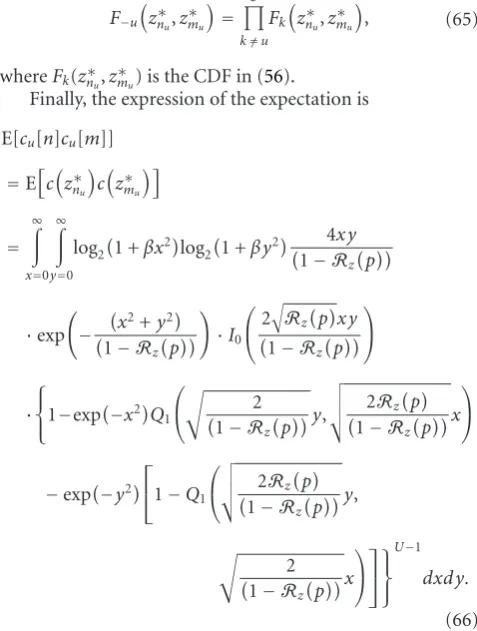
4.4. Proportional Fair. The calculation of the variance in the PF discipline is very similar to the BC algorithm. The effective envelope of theuth user yields
zn∗u=
Now the vector of decision simplifies
where fu(z∗nu,z
Finally, the expression of the expectation is
E[cu[n]cu[m]]
Figure 8shows the evaluation of the users’ rates for a PF
discipline and with the same parameters defined before. In the uncorrelated channel, the algorithm was able to equal the users in terms of minimum target delay. When the time-correlation of the channel comes on, the algorithm cannot maintain the fairness anymore and differences among users can be observed. Like in the other two algorithms, the minimum target delay that each user can demand is related to the quality of his channel. In spite of not maintaining the fairness among users anymore, it is still the fairest of them all.
5. Simulation Comparison
The analytical results presented in Sections 3 and 4 are validated by comparison with simulations. In particular, the queueing system inFigure 1is simulated. Each user sends bits to its buffer of queue length Qu[n] in thenth symbol. The selected user depends on the scheduling algorithm: Round Robin, Best Channel, or Proportional Fair.Dt,ε, andβ
uare fixed (the same for all the users, for simplicity) and the users’ rates are evaluated with (20). Then, the the arrival process of each user generates source data at the (constant) rate RuDt,ε.
The simulation is run and the tail probability of exceeding the target delay is measured based on the measurements of the delay suffered by bits leaving the queue. Notice that the expected value of this tail probability, Pr{D(∞)> Dt}, isε.
Dt(symbols)
User 1
Figure8: Achievable users’ rates with Proportional Fair scheduling
in a time-correlated channel with exponential ACF of parameterρ. Three users withγu=5, 7, 12 dB, respectively.ε=0.1.βu=1.
Figure9: Simulation comparison for uncorrelated channel. 5 users
withγu=8, 9, 10, 11, 12 dB, respectively.Dt=60 symbols.ε=0.10
(RR), 0.05 (BC) and 0.01 (PF).
8 9 10 11 12 10−3
10−2 10−1 100
SNR (dB)
Analysis Simulation RR
BC PF
Pr
{
D>
D
t}
Figure10: Simulation comparison for a time-correlated channel
with exponential ACF of parameterρ = 0.8. 5 users withγ =
8, 9, 10, 11, 12 dB, respectively.Dt =250 symbols.ε = 0.10 (RR),
0.05 (BC), and 0.01 (PF).
Pr{D(∞)> Dt}is measured and compared to the analytical
ε.
The results show that the QoS requirements are accu-rately reached with the result for RuDt,ε in (20). The users’
rates were obtained under the assumption thatηu=1, a high load scenario that constitutes an upper bound. It has been checked in the simulations that the measured probability of a nonempty queueηuis very close to one in our simulations.
5.2. Correlated Channel. Finally, a time-correlated channel has been simulated under the same conditions of the uncorrelated channel. The only difference is that the target delay is now 250 symbols and the correlation parameterρis
0.8.Figure 10plots the results.
The conclusions from the uncorrelated channel apply also here: the simulation results are satisfactory, approaching accurately the analytical results.
6. Conclusions
In this paper, we have obtained analytical expressions of the achievable users’ rates in a wireless system under the conditions stated by the MAC layer: a selected scheduling discipline and a QoS constraint given in terms of a delay constraint and a BER. The delay constraint consists of a target delayDtand the probability of exceeding it,ε. Three simple and widely employed disciplines have been analyzed: Round Robin, Best Channel and Proportional Fair. The method to calculate these rates is based on the effective bandwidth theory. The analysis is done first for an uncorrelated channel and later for a time-correlated channel. The evaluation of
the individual rates and the total capacity confirms the expected qualitative behaviour of the three algorithms. It is also observed that the correlation is harmful for the delay, as expected, and the maximum achievable rates decrease as the correlation increases. Moreover, the differences among users become more noticeable for more correlated channels. Finally, simulations of the algorithms were conducted to validate our outcomes.
Acknowledgments
This work has been partially supported by the Spanish Government and the European Union (Project TEC2007-67289) and the Andalusian Government (Project TIC-03226).
References
[1] S. Shakkottai, T. S. Rappaport, and P. C. Karlsson, “Cross-layer design for wireless networks,” IEEE Communications Magazine, vol. 41, no. 10, pp. 74–80, 2003.
[2] S. Chen and J. Cobb, “Wireless quality-of-service support,” Wireless Networks, vol. 12, no. 4, pp. 409–410, 2006.
[3] R. Knopp and P. A. Humblet, “Information capacity and power control in single-cell multiuser communications,” in Proceedings of the IEEE International Conference on Commu-nications (ICC ’95), vol. 1, pp. 331–335, Seattle, Wash, USA, June 1995.
[4] R. A. Berry and R. G. Gallager, “Communication over fading channels with delay constraints,”IEEE Transactions on Information Theory, vol. 48, no. 5, pp. 1135–1149, 2002. [5] J. T. Entrambasaguas, M. C. Aguayo-Torres, G. G´omez, and
J. F. Paris, “Multiuser capacity and fairness evaluation of channel/QoS-aware multiplexing algorithms,”IEEE Network, vol. 21, no. 3, pp. 24–30, 2007.
[6] L. Ying, R. Srikant, A. Eryilmaz, and G. E. Dullerud, “A large deviations analysis of scheduling in wireless networks,”IEEE Transactions on Information Theory, vol. 52, no. 11, pp. 5088– 5098, 2006.
[7] M. J. Neely, “Delay analysis for max weight opportunistic scheduling in wireless systems,”IEEE Transactions on Auto-matic Control, vol. 54, no. 9, pp. 2137–2150, 2009.
[8] M. J. Neely, E. Modiano, and C. E. Rohrs, “Power allocation and routing in multibeam satellites with time-varying chan-nels,”IEEE/ACM Transactions on Networking, vol. 11, no. 1, pp. 138–152, 2003.
[9] L. Georgiadis, M. J. Neely, and L. Tassiulas, “Resource alloca-tion and cross-layer control in wireless networks,”Foundations and Trends in Networking, vol. 1, no. 1, pp. 1–149, 2006. [10] E. Biglieri, J. Proakis, and S. Shamai, “Fading channels:
information-theoretic and communications aspects,” IEEE Transactions on Information Theory, vol. 44, no. 6, pp. 2619– 2692, 1998.
[11] B. Soret, M. Aguayo-Torres, and J. Entrambasaguas, “Capac-ity with explicit delay guarantees for generic sources over correlated rayleigh channel,” IEEE Transactions on Wireless Communications, vol. 9, no. 6, pp. 1901–1911, 2010.
[12] T. M. Cover and J. A. Thomas,Elements of Information Theory, Wiley Series in Telecommunications, 1st edition, 1991. [13] C. Chang and J. A. Thomas, “Effective bandwidth in
[14] M. R. Hanssen, “Opportunistic scheduling in wireless net-works,” Term Project Report, Department of Electronics and Telecommunications, NTNU, December 2004.
[15] S. Shakkottai and A. L. Stolyar, “Scheduling algorithms for a mixture of real-time and non-real-time data in HDR,” in Proceedings of the 17th International Teletraffic Congress (ITC ’17), Salvador da Bahia, Brazil, September 2001.
[16] B. Soret, M. C. Aguayo-Torres, and J. T. Entrambasaguas, “Capacity with probabilistic delay constraint for voice traffic in a Rayleigh channel,” inProceedings of the IEEE International Conference on Communications (ICC ’09), June 2009. [17] S. T. Chung and A. J. Goldsmith, “Degrees of freedom in
adaptive modulation: a unified view,”IEEE Transactions on Communications, vol. 49, no. 9, pp. 1561–1571, 2001. [18] T. S. Rappaport, Wireless Communications: Principles and
Practice, Prentice-Hall, New-Delhi, India, 2002.
[19] F. P. Kelly, “Notes on effective bandwidth,” in Stochastic Networks: Theory and Applications, F. P. Kelly, S. Zachary, and I. Zeidins, Eds., vol. 4, pp. 141–168, 1996.
[20] D. Wu.,Providing quality of service guarantees in wireless net-works, Ph.D. thesis, Department of Electrical and Computer Engineering, Carnegie Mellon University, August 2003. [21] B. Soret, M. C. Aguayo-Torres, and J. T. Entrambasaguas,
“Multiuser capacity for heterogeneous QoS constraints in uncorrelated Rayleigh channels,” inProceedings of the Informa-tion Theory Workshop (ITW ’09), October 2009.
[22] J. P´erez, J. Ib´a˜nez, and I. Santamar´ıa, “Exact closed-form expressions for the sum capacity and individual users’ rates in broadcast ergodic Rayleigh fading channels,” inProceedings of the 8th IEEE Signal Processing Advances in Wireless Commu-nications (SPAWC ’07), June 2007.
[23] D. J. Sheskin, Handbook of Parametric and Non-Parametric Statistical Procedures, Chapman and Hall/CRC Statistics, 3rd edition, 2004.
[24] A. Papoulis and S. U. Pillai,Probability, Random Variables and Stochastic Processes, McGraw-Hill, New York, NY, USA, 4th edition, 2002.