R E S E A R C H
Open Access
QoS-aware fuzzy rule-based vertical handoff
decision algorithm incorporating a new
evaluation model for wireless heterogeneous
networks
Kantubukta Vasu
1, Sumit Maheshwari
1, Sudipta Mahapatra
1*and Cheruvu Siva Kumar
2Abstract
Next generation networks are envisioned to be heterogeneous in nature with an increase in demand towards ubiquitous services in wireless networks. As various networks have widely different characteristics, it is difficult to maintain the quality of service (QoS) after executing a handoff from one network to another network. Maintaining the QoS, based on applications, during the handoff in an heterogeneous networks needs an intelligent handoff decision mechanism. This article proposes a QoS-aware fuzzy rule-based vertical handoff mechanism that makes a
multi-criteria-based decision, found to be effective for meeting the requirements of different applications in a heterogeneous networking environment. The QoS parameters considered are available bandwidth, end-to-end delay, jitter, and bit error rate. A new evaluation model is proposed using a non-birth–death Markov chain, in which the states correspond to the available networks. Simulation results show that compared to other vertical handoff algorithms, the proposed algorithm gives better performance for different traffic classes.
Introduction
Next generation heterogeneous wireless networks require seamless mobility amongst the different access networks while maintaining the required level of quality of service (QoS) for applications, namely, high-speed data services, audio, video and multimedia applications. In such net-works, it is necessary to employ efficient mobility man-agement strategies to meet different QoS requirements for various traffic classes while maintaining high or fair utilization of wireless resources. This is achieved with a good mechanism to handle handoff between two dis-similar networks, called vertical handoff. Vertical handoff mechanisms involve three different phases of operations: system discovery, handoff decision process and handoff execution.
In system discovery phase, the system periodically mon-itors the states of the networks to determine the network to which handoff can be carried out. Several strategies
*Correspondence: [email protected]
1Department of Electronics and Electrical Communication Engineering, IIT Kharagpur, Kharagpur, India
Full list of author information is available at the end of the article
are proposed for implementing the vertical handoff deci-sion process, which is crucial in carrying out handoff, with the help of the available information. A comparison between different vertical handoff algorithms is presented in [1]. The handoff decision generally depends on vari-ous parameters including available bandwidth, bit error rate (BER), jitter, average battery lifetime, access cost, transmit power and end-to-end delay (E2EDelay). Smaoui et al. [2] have proposed a new handoff scheme for reduc-ing handoff delay usreduc-ing the concepts of Received Signal Strength and threshold management. Considering reduc-tion of total interference in CDMA, a vertical handoff decision algorithm among the CDMA networks and wire-less local area networks (WLANs), is proposed in [3]. A combination of some of the criteria like bandwidth, RSSI and delay is also considered for making a handoff decision [4]. Such a multi-criteria-based handoff offers a number of advantages, especially in the presence of heterogeneous networks. Moreover, the wide variation in the characteris-tics of the networks involved motivates one to explore the field of fuzzy logic to develop a strategy for implementing multi-criteria-based handoff.
Literature reveals that a lot of work has been carried out with a view to improve the QoS in heterogeneous wireless networks [5-8]. Yang et al. [5] propose a new policy-based QoS-supporting system infrastructure and a QoS-aware routing algorithm that is based on the analy-sis of the basic architecture of an emerging heterogeneous wireless network. The policy-based QoS supporting sys-tem allows the network operators to adjust their policies easily to meet specific requirements arising in dynamic networks. However, the QoS requirements of various traf-fic classes vary according to the type of traffic. As we are moving towards new technologies, admission control needs to deal with many heterogeneous networks and admit new sessions to a network that is most appropriate to supply the requested QoS. Yang and Chen [7] propose a mobile QoS framework for heterogeneous IP multime-dia subsystem (IMS) interworking that reduces the service disruption time, supporting the IMS mobility based on the concept of session initiation protocol multicast. In this approach, the mobility of a User Equipment is modelled as a transition in the multicast group membership. To over-come mobility impact on service guarantees, UEs need to make QoS resource reservations in advance at neighbour-ing IMS networks, which they may visit durneighbour-ing the lifetime of an ongoing session.
Guo et al. [9] have proposed a multi-criteria-based approach for making the handoff decision using a fuzzy inference system (FIS) along with a modified Elman neural network. FIS considers bandwidth, velocity and number of users as decision parameters in the handoff process. The fuzzy logic-based vertical handoff decision procedure presented in [10] considers three main input parame-ters, namely, received signal strength, cost and bandwidth. These parameters are dynamically evaluated and com-pared to achieve optimal handover. However, the schemes proposed in [9,10] do not consider the QoS require-ments of the applications being serviced. A context-aware handover decision using knowledge about context of mobile devices, users and networks, such as user pref-erences, application requirements, network parameters, link quality for decision making and based on user per-ceived QoS trigger is presented in [11]. Kim et al. [12] propose a context-based network selection mechanism between WLAN and CDMA networks, where the con-text information is a combination of grade of service (GoS) and number of handoff attempts. GoS is a function of dropping and blocking probabilities. Handoff trigger is decided based on the RSS and distance. A velocity threshold is used to optimize the system performance. However, the context information used in this is not enough to maintain the required QoS for various kinds of applications, which might be having widely different QoS requirements in terms of data rates, delay bounds and BERs.
In [13-15], fuzzy logic-based vertical handover decision is applied by considering a combination of various param-eters such as price, RSS variation, traffic, sojourn time, available network bandwidth, monetary cost, user pref-erences, dwell time, etc. Fuzzy logic is even applied for interworking between LTE and WLAN where the authors consider the bandwidth, battery life, SNR and network load as system parameters for arriving at a handover decision [16]. As the QoS is a tradeoff among different parameters, maintaining the QoS for different kinds of applications is a critical task in VHO decision making. For example, unlike non-real-time data packets, video ser-vices are very sensitive to packet delivery delay, but can tolerate some frame losses and transmission errors. Due to the widely varying requirements of applications in wire-less networks, the scenario is changing from best effort to QoS aware networks. However, from the above discussion it is clear that none of the existing approaches take the application-specific QoS parameters into consideration while making the handoff decision.
The various strategies used for executing handoff may in general be classified into Mobile-Controlled Hand-off (MCHO), Network-Controlled HandHand-off (NCHO) and Mobile-Assisted Handoff (MAHO). In MCHO, the mobile node continuously monitors the signal of access points and initiates the handoff procedure when certain handoff criteria are satisfied. Although MCHO has a low complex-ity in terms of network equipment, latency and loss of packets during inter-subnet handoff can be high. NCHO is a centralized handoff protocol, in which a network takes handoff decisions based on the measurements of the sig-nal quality of a mobile station (MS) at a number of base stations (BS). In MAHO, the handoff process involves feedback from a mobile node reflecting the measured sig-nal strength of the surrounding base stations; but, fisig-nally it is the network which makes the handoff decision. Since in heterogeneous wireless access networks only the mobile nodes have specific knowledge about the kind of interfaces they are equipped with, the network dependency on the mobile node is high. Therefore, MCHO with some assis-tance from the networks is better suited for implementing vertical handoff.
represents the states for wireless networks. In [18,19], a similar approach is adopted for evaluating vertical hand-off schemes in wireless data networks where the authors propose a performance, availability and performability (a combination of performance and reliability) based model. For comparison between various vertical handoff decision algorithms in heterogeneous wireless networks, Stevens-Navarro and Wong [1] use a Markov model based on a birth–death process. In contrast to other works in the literature, in this article, we develop a simulation model to measure the performance of vertical handoff mechanisms in a heterogeneous wireless network environment. The power of this evaluation model is that the mobility char-acteristics are taken care of automatically by considering different state, and connection lifetimes in the simulation. Each network is assumed to be associated with different QoS parameter values.
The QoS-aware fuzzy rule-based handoff mechanism proposed in this article assumes MCHO and some assis-tance from the network. In this, a mobile periodically monitors the available networks and using a fuzzy rule-based algorithm determines the best network for making a handoff decision. This information is then communi-cated to the current network for executing the handoff. The evaluation model used in the simulation is a non-birth–death Markov chain where a state represents the available networks at any instant of time. The rest of the article is organized as follows: “QoS requirements and vertical handoff strategies” section briefly discusses the QoS requirements in heterogeneous wireless net-works and “Implementation issues for vertical handoff” section discusses the implementation issues for vertical handoff; the proposed algorithm is presented in “The proposed QoS-aware FRB vertical handoff decision algo-rithm” Section, followed by theoretical evaluation of the proposed model in “Evaluation model” section. “Results and discussions” section contains the simulation results and finally “Conclusions” section concludes this article.
QoS requirements and vertical handoff strategies
QoS requirements
It is difficult to maintain a steady customer-base with just a single type of network with the technological
advancements and economic changes in the market. So, wireless service providers (WSPs) are adopting a multi-tude of access technologies, operating on both licensed and unlicensed bands, to serve an increasing number of subscribers. Among the various applications, those involving real-time video are more delay sensitive than non-real-time services such as file downloads. In these kinds of applications, it is likely that numerous types of access networks will coexist to support wireless ser-vices with different QoS requirements. To harness the wide variability of coverage, bandwidth and reliability offered by different technologies, operating at different spectrum bands, WSPs are planning to deploy hetero-geneous access networks. These heterohetero-geneous networks are able to provide different sets of services with vary-ing QoS requirements. Accordvary-ing to the IMT2000 QoS Classes and Requirements (3GPP-TS 23.107), different applications have different QoS requirements as explained in Table 1 [20,21] with the help of linguistic terms.
From Table 1, some simple inferences can be made. For example, BER for conversational type of applica-tions need not be low which means that BER is not a prime requirement in voice-based applications. Whereas for such applications, E2EDelay and Jitter should be low, meaning that these parameters should have low values for better user perceived quality. For streaming kind of applications (including live streaming) Jitter should be low, Bandwidth should be high, and E2EDelay may be low to medium, but should not be high. Similar infer-ences can be made from this table regarding interactive and background applications.
Vertical handoff strategies
Vertical handoff decision mechanisms need to consider the QoS parameters important for a particular applica-tion. Various vertical handover decision mechanisms have been proposed in the past [22] including the following.
Simple additive weighted—SAW
While making a handoff decision, each of the networks involved is assigned a score, which is the weighted sum of all the attribute values. The score of each network is obtained by adding the normalized contributions from
Table 1 QoS requirements and traffic classes where the QoS parameters: BER, E2EDelay, Jitter, Bandwidth; and Traffic Classes: Conversational, Streaming, Interactive, Background
BER E2E delay Jitter Bandwidth
Conversational Need not be low Should be low Should be low Need not be high
Streaming Need not be low Should be low or medium Should be low Should be high
Interactive Should be low Medium or low Need not be low Need not be high
each metric rij multiplied by the importance weight wj
assigned to attributej. The selected networkA∗SAWis
A∗SAW=argmaxi∈M
N
j=1
wj∗rij
whereNis the number of parameters andMis number of candidate networks.
Technique for order preference by similarity to ideal situation—TOPSIS
The selected candidate network is the one which is the closest to the ideal solution (and the farthest from the worst case solution). The ideal solution is obtained by using the best values for each metric. IfCi∗denotes the rel-ative closeness (or similarity) of the candidate networkito the ideal solution, the selected networkA∗TOPis
A∗TOP=argmaxi∈MCi∗
Multiplicative exponential weighted—MEW
Using this technique, vertical handoff decision can be expressed as a matrix where each rowicorresponds to the candidate networkiand each columnjcorresponds to an attribute (Bandwidth, Delay, etc.). The scoreSiof network
iis
where xij denotes attribute j of candidate network i,wj
denotes the weight of attributejandNj=1wj=1.
wj is a positive power for benefit metrics (x wj
ij), and a
negative power for cost metrics (x−ijwj). Since the score is an upper bound, it is convenient to compare each network with the score of the positive ideal networkA∗∗. This net-work is defined as the netnet-work with the best values in each metric. (For a benefit metric, the best value is the largest. For a cost metric, the best value is the lowest.) The value of ratioRibetween networkiand the positive ideal is
Ri=
The selected networkA∗MEWis obtained as
A∗MEW=argmaxi∈MRi
The vertical handoff decision algorithms considered for comparison needs relative importance of each parameter which is usually given by the set of weightswj. The
ana-lytical hierarchical processing (AHP) method is used to determine the weights [23,24] by comparing a pair met-rics with the 1–9 AHP scale. The four traffic classes have
Table 2 Relative importance of different parameters using AHP
BER E2EDelay Jitter Bandwidth
Conversational
BER 1 1/9 1/9 1
E2EDelay 9 1 1 9
Jitter 9 1 1 9
Bandwidth 1 1/9 1/9 1
Streaming
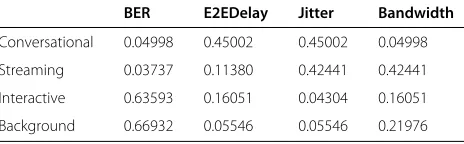
different QoS requirements. So, we assigned the differ-ent weights according to the importance of parameters in different traffic classes as shown in Table 2. The QoS parameters considered are available bandwidth, E2Edelay, BER and jitter with the corresponding importance weight for each traffic class shown in Table 3 [1].
Implementation issues for vertical handoff
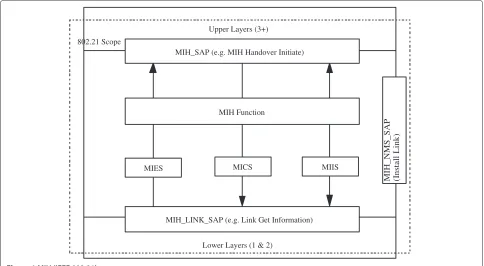
IEEE 802.21 is responsible for enabling handover and interoperability between heterogeneous network types including both 802 and non-802 networks. It provides information required for handover to and from a range of networks including cellular, GSM, GPRS, WiFi and Blue-tooth. The network handover enabling function is a part of the media-independent handover (MIH) function. The general reference model of MIH is as shown in Figure 1
Table 3 Importance weights derived using AHP
BER E2EDelay Jitter Bandwidth
Conversational 0.04998 0.45002 0.45002 0.04998
Streaming 0.03737 0.11380 0.42441 0.42441
Interactive 0.63593 0.16051 0.04304 0.16051
802.21 Scope
Upper Layers (3+)
Lower Layers (1 & 2) MIH_SAP (e.g. MIH Handover Initiate)
MIH Function
MIH_LINK_SAP (e.g. Link Get Information)
MIES MICS MIIS
P
A
S
_
S
M
N
_
HI
M
)
k
ni
L
ll
at
s
nI
(
Figure 1MIH (IEEE 802.21).
[25]. The MIH function consists of three elements, namely, the event service, command service and informa-tion service [26,27]. MIH funcinforma-tion (MIHF) is used for con-vergence of multiple heterogeneous access technologies to achieve seamless mobility and provides link layer infor-mation to the upper layers of the mobility management protocol stack using service access points (SAPs) [25]. In this MIH, theMIH−SAP(MIH−service−access−points) allows access from the upper layers, MIH−NMS−SAP (MIH−Network Management system−service) allows for management and MIH−LINK−SAP is used for the link layers. Each or any number of the access networks will interface directly with the MIHF using their own SAPs. Operation of MIH is as follows: When the mobile device notifies that the signal strength of the current network is going below the threshold, the MIH event service informs to MIHF of the mobile device. Then this infor-mation is passed on to the MIHF of the access point. The MIH command service in the access point informs the mobile device to initiate handover with a list of possible access points. The mobile device MIHF deter-mines the signal strength and achievable QoS parame-ters of each access network using the MIH information service. Once this information is obtained, it will be passed on to the handover decision module for decid-ing the best network. Once the best network is decided, the MIH command service informs the mobile device to commit for handover. Then, mobile IP protocols can
be used to switch over to the selected network. A sim-ilar kind of standard is proposed from the 3GPP as the generic access network (3GPP TS 43.318), which supports two modes of operation, namely GAN A/Gb mode and GAN Iu mode.
QoS information about the available networks within the range of the current network interface of a mobile node is obtained periodically by using the IEEE 802.21/GAN standard. This information is utilized by our proposed QoS-aware FRB vertical handover deci-sion mechanism. Internet Engineering Task Force IP Performance Metrics Working Group has standardized procedures for performance metrics such as available bandwidth and average delay for Internet services. After the handoff decision is taken, handoff is executed using mobility management protocols, e.g. the Host Identity Protocol.
Figure 2Typical heterogeneous wireless network environment (deployment mode).
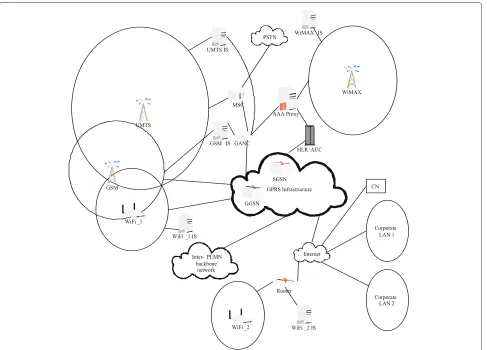
Node (SGSN) and Gateway GPRS Support Node (GGSN) gateway components. The SGSN is responsible for mobil-ity management and manages the end-user via the Base Station Controller/Radio Network Controller (BSC/RNC) in the radio network. It maintains the connected user’s context and integrates with other elements such as the Home Subscriber Server/Home Location Register (HSS/HLR) to manage allowed services and the GGSN to manage access to external IP networks. The GGSN is the IP access point for mobile users to the Internet, corporate Virtual Private Network (VPN) or other IP access networks. Static information about the QoS and energy is maintained by the information servers pro-vided at each network. WLAN infrastructure propro-vided by the operator can directly connect to the GPRS infras-tructure via WLAN gateways. A WLAN network can also connect to Internet via a router. A WiMAX net-work is connected to the GPRS infrastructure via an Access Service Network Gateway (ASN-GW) (data not shown in Figure 2). A critical component of any mobile WiMAX network is the ASN Gateway, which aggregates
subscriber and control traffic from base stations within an access network.
The correspondent node can be a streaming server or it can be any other mobile device to which the user is con-nected. The mobile client is also equipped with MIH client support and generic access network support. The mobile clients access the information about the network through MIH (IEEE 802.21) for non-3gpp networks and through the generic access network controller for 3gpp-based networks. The AAA server provides the authentication, authorization and accounting functions.
from the past knowledge. In the proposed scheme for implementing vertical handover, the mobile is switched to the best network by using the mobility management protocols.
The proposed QoS-aware FRB vertical handoff decision algorithm
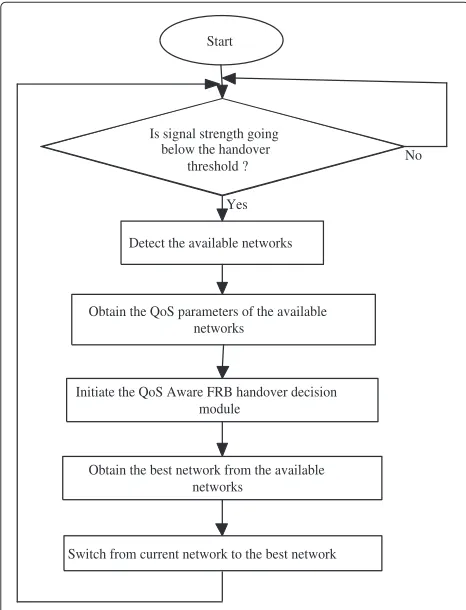
A method for an intelligent handover decision mechanism among different radio access networks where the available network set is obtained dynamically at the mobile client comprises four steps as explained by the flow chart in Figure 3. The mobile client periodically checks for the signal strength (RSSI) of the current network to moni-tor the condition for handover. When the RSSI of mobile client is going below the handover threshold, the available networks are examined at the mobile client. In the sec-ond step, the QoS parameters of the available networks are obtained either using MIH or GAN or both based on the available network set. In the third step, the best net-work is decided by using the proposed QoS-aware FRB vertical handoff mechanism based on the application QoS requirements obtained in the second step. Finally, the mobile is switched to the best network from the current
Start
Is signal strength going below the handover
threshold ?
Detect the available networks
Obtain the QoS parameters of the available networks
Initiate the QoS Aware FRB handover decision module
Obtain the best network from the available networks
Switch from current network to the best network
No
Yes
Figure 3Procedure for making QoS aware fuzzy rule based vertical handover.
network after making a decision using any mobility man-agement protocol.
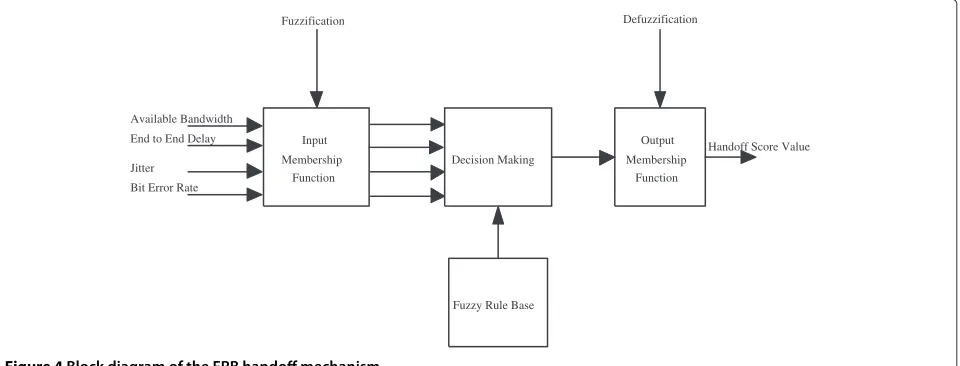
Unlike propositional logic where a set membership function takes a value from the set {0, 1}, fuzzy logic is associated with linguistic variables with membership functions that take values in the interval [0, 1]. A fuzzy set is a set with such a set membership function. The process of taking an observation and creating a fuzzy set from it is called fuzzification. In general, a Fuzzy Logic System is a nonlinear mapping of an input data (feature) vector into a scalar output. Fuzzy logic systems involve a large number of possibilities that lead to a lot many mappings [28]. Fuzzy linguistics descriptions are formal representations of systems made through fuzzy IF-THEN rules. They encode knowledge about a system in state-ments of the form ’IF (a set of conditions) are satisfied THEN (a set of consequents)’ [29,30]. A collection of rules referring to a particular system is known as a fuzzy rule base. Moreover, it is easier to take a crisp decision if the output is represented as a single scalar quantity. The con-version of a fuzzy set to a single crisp value is called defuzzification.
The FRB algorithm proposed here considers four QoS parameters, namely, available bandwidth, E2EDelay, jitter and BER. In heterogeneous networks, handoff between different networks is required to be more efficient while maintaining the QoS requirements for different traffic classes even after the handoff. Therefore, selecting the best network among the available networks is always an important task. The proposed QoS-aware FRB mecha-nism that gives a decision regarding the network to be selected is depicted in Figure 4. The input QoS param-eters considered are the available bandwidth, E2EDelay, Jitter and BER. The FRB system takes the input param-eter values of a network and evaluates its handoff score value as shown in Figure 4. The input crisp values are first given to fuzzification module where these input values are converted into membership values using member-ship functions. The membermember-ship functions are considered as triangular functions with three different regions: low, medium and high. The membership values are used for decision making to give an output membership value. The output membership value is converted to a crisp value using a defuzzification process. One of the well-known methods for defuzzification is the centroid method. This study proposes a QoS-aware FRB mechanism which uses the properties of simple fuzzy logic; the FRB is used to evaluate the score value corresponding to the input parameters for each network. The score value is compared to the other networks to obtain the best network to which the handover is to be carried out.
Input Membership
Function
Decision Making
Output Membership
Function
Fuzzy Rule Base
Fuzzification Defuzzification
Available Bandwidth End to End Delay
Jitter Bit Error Rate
Handoff Score Value
Figure 4Block diagram of the FRB handoff mechanism.
region points as {Med−Point1PN, Med−Point2PN, Med− Point3PN}; and for high region as {High−Point1PN, High−Point2PN, High−Point3PN}, where P ∈ {BER, E2EDelay, Jitter, BW}andN ∈ {UMTS, GPRS, WLAN}. In the fuzzification process, ifXis the input value for parameterPof networkNand falls in the low region then the membership value for low region will be calculated as explained below:
1=X−Low−Point1PN; 2=Low−Point2PN−X
and slope
S2= −
1
(Low−Point2PN−Low−Point3PN)
if ((1 ≤0)or(2≤0)) then the membership value for low region would be
Low−MemPN =0
else
Low−MemPN =min(2×S2, Max).
Low_ Point1
Low_ Point2 and High_ Point1
Med _ Point1 Med _ Point2 High_ Point2 Low_ Point3 Med _ Point3 High_ Point3
Membership Value
h g i H m
u i d e M w
o L
If Xfalls in the medium region then the membership value for medium region will be calculated as follows:
1=X−Med−Point1PN; 2=Med−Point2PN−X
and slope
S1=
1
(Med−Point3PN−Med−Point1PN);
S2= −1
(Med−Point2PN−Med−Point3PN)
if ((1≤0)or(2≤0)) then the membership value for medium region would be
Med−MemPN =0.
else
Med−MemPN =min(1×S1, 2×S2, Max).
And ifXfalls in the high region the membership values for high region would be:
1=X−High−Point1PN; 2=High−Point2PN−X
and slope
S1=
1
(High−Point3PN−High−Point1PN)
if ((1≤ 0)or(2≤0)) then the membership value for high region would be
High−MemPN =0
else
High−MemPN =min(1×S1, Max).
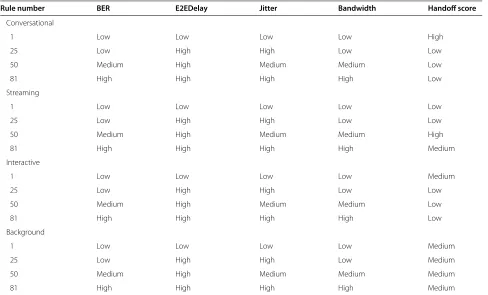
For 4 input parameters and 3 membership regions, there can be a total of 81 (3×3×3×3 = 81) possible rules as given in the sample fuzzy rule base in Table 4. For a particular networkN, the effective rule set will be main-tained by R =[R1,R2,R3,. . .,R81]. These rules will be maintained by Boolean value either 0 or 1 and the cor-responding membership values for each rule is calculated from the decision module by using max−min product form. The membership values of these rules are the out-put membership values. These values are defuzzified by using centroid method. Let us assume the center value of each effected output region isCN =[C1,C2,C3,. . .,C81] and output membership values of each effected rule is HN =[H1,H2,H3,. . .,H81]. The effected areas of out-put regions isAN =[A1,A2,A3,. . .,A81]. Then using the
Table 4 Sample FRB for illustrating the mechanism
Rule number BER E2EDelay Jitter Bandwidth Handoff score
Conversational
1 Low Low Low Low High
25 Low High High Low Low
50 Medium High Medium Medium Low
81 High High High High Low
Streaming
1 Low Low Low Low Low
25 Low High High Low Low
50 Medium High Medium Medium High
81 High High High High Medium
Interactive
1 Low Low Low Low Medium
25 Low High High Low Low
50 Medium High Medium Medium Low
81 High High High High Low
Background
1 Low Low Low Low Medium
25 Low High High Low Medium
50 Medium High Medium Medium Medium
centroid method of defuzzification, the output handoff score value is given by
X∗=
AN×CN
CN
The handoff score value of given set of input param-eters for each network is calculated by using the above proposed method, and then the best network among the available networks is the network whose handoff score value is highest than other networks.
The proposed scheme is illustrated by assuming the presence of three different types of networks. These are an UMTS network, a GPRS network and a WLAN. We considered these technologies due to the wide availabil-ity of typical parameter values in the literature. But the method and the simulation procedure is transparent to the technology. In the FRB method, the length of the rule set is based on the number of membership regions and
the number of QoS parameters considered. The rules are made according to the requirements of applications. So, it is transparent to the kind of technology used. The param-eters assumed for these networks, which are based on the standard possible data rates and typical delay values of the networks, are as follows [1]. Bandwidth vector for UMTS: [32, 64, 128, 256, 512, 1024, 2048] kbps, for GPRS: [21, 42, 64, 85, 107, 128, 149, 171] kbps and for WLAN: [1000, 2000, 5500, 11000] kbps; E2EDelay vector for these net-works are, respectively, [190, 160, 130, 100, 70, 40, 10], [185, 160, 135, 110, 85, 60, 35, 10] and [160, 110, 60, 10] ms. All networks are assumed to have the same set of jitter and BER vectors. The values for jitter and BER are taken to be [3, 5, 7, 9, 11] and [0.01, 0.001, 0.0001, 0.00001, 0.000001] ms, respectively.
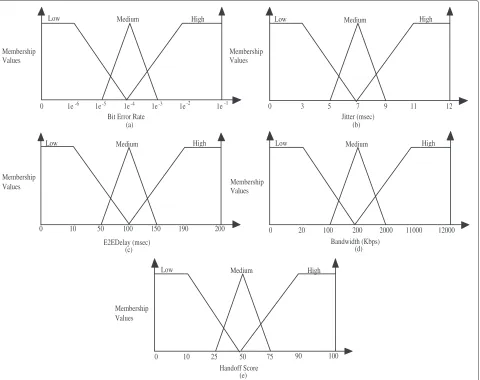
The membership functions for different input and out-put parameters are as shown in Figure 6. Membership region for BER is assumed to be low if it is in the range 0−1e−4, medium in the range 1e−5−1e−3, and high in
Low Medium High Low Medium High
Low Medium High Low Medium High
Low Medium High
Membership Values
Membership
Values MembershipValues
Membership Values
Membership Values Bit Error Rate
(a)
0 1e -6 1e-5 1e-4 1e-3 1e-2 1e-1
Jitter (msec) (b)
E2EDelay (msec) (c)
Bandwidth (Kbps) (d)
Handoff Score (e)
0 3 5 7 9 11 12
0 10 50 100 150 190 200 0 20 100 200 2000 11000 12000
0 10 25 50 75 90 100
the range 1e−4−1e−1. The parameters’ Jitter is assumed to be low if it is in the range 0–7 ms, medium in the range 5–9 ms, and high in the range 7–12 ms. Similarly, E2EDelay is assumed to be in the low region when it is in between 0 and 100 ms, medium in between 50 and 150 ms, and high in between 100 and 200 ms. For width, we can usually say that 0–200 kbps is a low band-width region, medium or enough bandband-width to be in the range of 100–2000 kbps, and the high bandwidth region to be between 200 and 12000 kbps. These membership regions describe more linguistic terms of the input param-eters. The basic purpose of considering these ranges is to include at least two different types of networks in each region. For example, the low region includes GPRS and UMTS, the medium region includes GPRS, UMTS and WLAN, and the high region includes UMTS and WLAN. The fuzzy rules are made as per the requirements of 3GPP QoS classes [20,21]. Eighty-one rules are made for each traffic class (for four input parameters and three membership regions, eighty-one possible combinations of rules can be made for each traffic class). For conver-sational traffic class, E2EDelay and Jitter should be low. For streaming classes, Jitter should be low and bandwidth should be high. Similarly, for interactive and background traffic classes, BER should be low. Moreover, background traffic needs at least a moderate amount of bandwidth. So, rules satisfying these requirements give the handoff score value in the high region. Rest of the rules for each traffic class have been made as per the requirements of the traf-fic classes. In Table 4, only four rules are shown for each traffic class for the sake of illustration.
The output is a handoff score value, which can be drawn from the rule base with the help of individual conse-quents of each rule, and is defined in the range of 0–100 with triangular membership functions of the three regions as shown in Figure 6. The centroid method is used for defuzzification [29]. When handoff is required, a mobile calculates the handoff score value for all the available net-works with a set of input parameters by using the FRB scheme proposed above, and selects the best one. The information about the best network is then communicated to the current network to execute the handoff.
Evaluation model
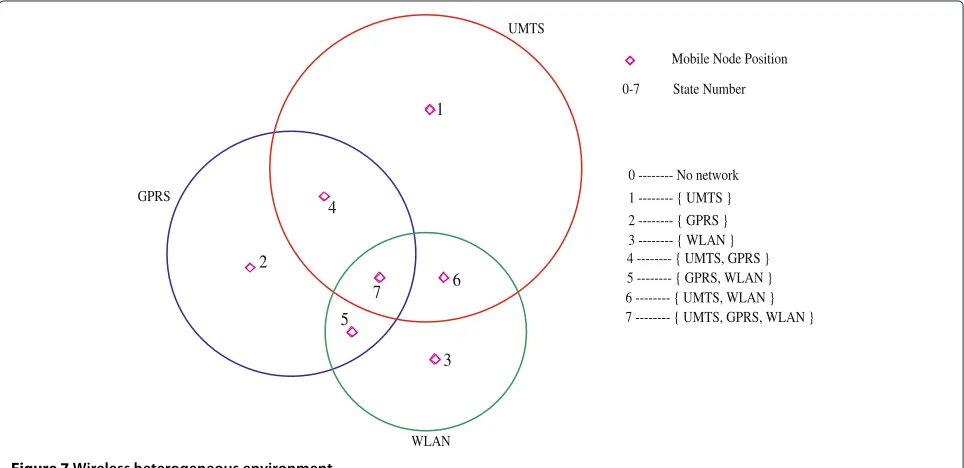
The performance measures extracted from a simulation model must be a good representation of the real network environment to model the heterogeneous environment. Some assumptions must be made about the real network in order to construct the heterogeneous environment model. Figure 7 shows a typical heterogeneous environ-ment where three different networks, that is, a WLAN, a GPRS network and a UMTS network are present. Based on n number of networks, we will get 2n number of states. Even though we considered three networks for easy understanding of the model, it can be extended ton num-ber of networks. It is assumed that the mobile is equipped with these three network interfaces and hence it is able to access each of the networks. If the mobile is moving in the region of these networks, it can acquire one of these net-work sets such as only UMTS,{UMTS and GPRS},{GPRS and WLAN}or{GPRS, UMTS and WLAN}. As there is a
1
2
3 4
5
6 7
Mobile Node Position
0-7 State Number
0 --- No network
1 --- { UMTS }
2 --- { GPRS } 3 --- { WLAN } 4 --- { UMTS, GPRS } 5 --- { GPRS, WLAN } 6 --- { UMTS, WLAN } 7 --- { UMTS, GPRS, WLAN } UMTS
GPRS
WLAN
possibility that no network is available at a particular time instant so we need to consider this also as a possible sce-nario. Ultimately, we have eight possible states for three different kinds of networks. We need to transform this real world environment to a logical model. This is the phase where mathematical techniques are used to simulate the heterogeneous environment. Transient behaviour of the heterogeneous environment will be simulated using the proposed model. The steady-state analysis of the model will be used to validate the results.
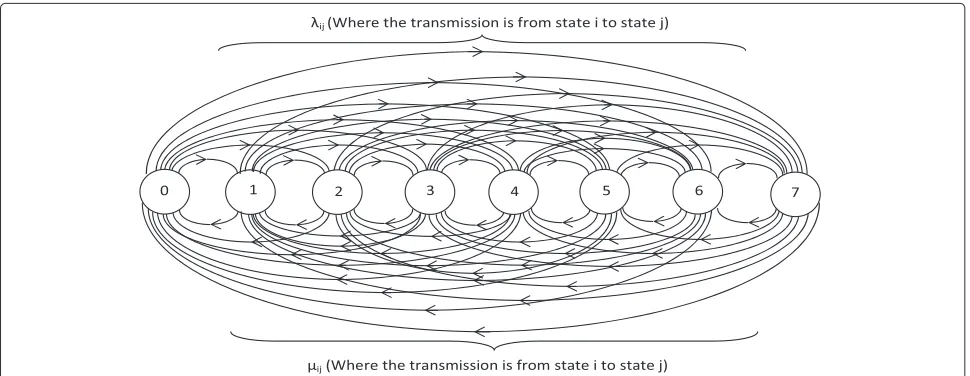
Among the modelling approaches, Markov models are suitable for modelling of dynamic system behaviour. Of these, a birth–death Markov chain can model the dynamic behaviour of mobiles where a system state is considered in such a manner that the mobile can move between two neighbouring states. For example, a state can represent the available number of transmission channels. Contrary to most of the existing work on vertical handover, in our model, we represent the system using a non birth–death Markov chain where a state corresponds to the available networks, including a state to represent the unavailability of any network. This in fact obliviates the need to consider other parameters such as velocity of mobiles, channel con-ditions, etc., and in a way simplifies the simulation of a heterogeneous wireless environment. The connection life-times of all the states are assumed to be independent identically distributed (i.i.d.) random variables. The pri-mary reason for considering a non-birth–death Markov chain is that a mobile device can be in a region having no network or one or more networks and go from a state to any other state as depicted in Figure 8 where a state represents the available networks at any time.
The simulation model is based on the following assumptions.
(1) A non-birth–death Markov chain is considered for simulation.
(2) A state represents the set of networks available at any instant of the time.
(3) State lifetimes are assumed to follow an exponential distribution with a meanλ.
(4) State transitions are instantaneous and do not incur any waiting delays.
(5) Within a state, connections follow an exponential distribution with a meanμ.
The state transition matrix for the above Markov chain is given byP, with matrix elementpij, 0≤i,j≤7 as shown
below.
State transition matrix P
=
The state transition probabilities are obtained after nor-malizing the generator matrix. Using the state balance equations under the equilibrium conditions the generator matrixGfor the above Markov chain is derived as shown in (1). Here,λijdenotes the state transition time from state itojandμijdenotes the connection lifetime from statei
tojwhere 0≤i,j≤7 (max number of networks).
Figure 8Non-birth–death Markov chain with state 0 ={no network}; state 1 ={UMTS}; state 2 ={GPRS}; state 3 ={WLAN}; state 4 =
G=
The state transition time or state lifetime depends on the state from where the mobile is migrating. Letλ0i = λ0, λ1i =λ1, λ2i =λ2,. . .,λ7i =λ7. Connection lifetime or reverse transition time depends on the state it is leav-ing. Let,μi0=μi, μi1=μi2=μi3=μi4=μi5=μi6= μi7 = μi. Also, it is assumed that all the state variables
are independent identically distributed random variables, then
λ0=λ1=λ2=λ3=λ4=λ5=λ6=λ7=λ
μ0=μ1=μ2=μ3=μ4=μ5=μ6=μ7=μ
Hence, the generator matrixGof the non-birth–death Markov chain is given in (2),
G=
After finding the generator matrixGas shown in (2), the state transition matrixT is calculated as shown in (3). State transition matrix
T =(G
q)+I (3)
whereq>max(|Gij|), 0≤i,j≤7,Iis the identity matrix
of size 8×8.
sum= 7 (min)
sum= 8 (min)
connection life time with mean value of 2 min
connection life time with mean value of 4 min
state life time
0 1 2 3 4 5 6 7 8 9 state lifetime (min)
Figure 9State lifetime and connection lifetime.
should be less than that state lifetime. State change occurs when this sum is more than the state lifetime. To which state it has to go is decided based on the state transition matrixT. We simulated heterogeneous networking envi-ronment to evaluate the performance of vertical handover decision mechanisms by using the simulation methodol-ogy explained in the following section.
Simulation method
The simulation method using the proposed non-birth– death Markov model explained above is as follows: In each state, the best network is selected from the available net-works and connections are assigned to that network. The connection lifetime of the mobile is assumed to follow an exponential distribution. The average connection life-time (μ) is varied from 1 to 10 min. State lifetime (state changing time) is also assumed to follow an exponential distribution with mean equal toλi(whereiis 1 for UMTS, 2 for GPRS and 3 for WLAN). The exponential distribu-tion is generally used to characterize an independent set of events. In this article also, we assumed the state and connection lifetimes to follow exponential distributions with different mean values, for illustrating the proposed approach. These lifetime values are chosen to represent the different scenarios. It is assumed thatλ1=4 min and λ2 = 3 min, whereas λ3 = 1 min [1]. Choice of differ-ent mean values for the state lifetimes helps in reflecting different sojourn times within the networks. As coverage area is different for various radio access technologies, we assumed different state lifetimes for different networks.
There are eight possible combinations of networks avail-able to the mobile at any instant of the time as explained in Figure 7. The Markov chain for simulation is shown in Figure 8. In the simulation, we assume that theλij = λi
where i is the network selected from the previous state andμij=μas explained by (2). The generator matrix for
the Markov chain is obtained by solving the equilibrium conditions [31]. The state changes evolve according to the Markov chain with the adaptive state transition matrixT, given by
state−transition T=(G
q)+I (4)
whereGis the generator matrix,q>max(|Gij|), 0≤i,j≤7,
Iis the identity matrix of size 8×8.
Algorithm 1 Pseudocode for state transitions insimulation
ran←rand(1); random function which generates a value between 0 to 1 current−state=From; the current state number is from ifsum−of−conn−lifetime>state−lifetimethen
sum−of−conn−lifetime=0; sum=0;
forTo = 0→7do To is the next state number
sum=sum+state−transition(From,To);state transition matrix T is used to calculate the probability
ifsum≥ranthen
next−state←To; next state
break; exit the loop
end if To←To + 1
end for
else
next−state←From; next state number is the current state
sum−of−conn−lifetime←sum−of−conn−lifetime+conn−lifetime; increment the connection lifetime
end if
The QoS parameters considered for each of the four traffic classes are available bandwidth, E2EDelay, BER and jitter, with the corresponding importance weight for each traffic class computed using the AHP technique. The weights are as shown in Table 3 [1]. We compare three existing vertical handoff algorithms: SAW, TOPSIS and MEW with the proposed algorithm. The results are presented in “Results and discussions” section. In the fol-lowing section, the steady-state analysis that validates the proposed evaluation model is presented.
Steady-state analysis
The steady-state probabilities of finite Markov chains can be determined using the following approaches for the solution of a linear system of the formxA= 0. (1) Direct numerical methods; (2) Iterative numerical methods; (3) Techniques that yield closed-form results. Each type of numerical method has merits of its own. Whereas direct methods yield exact results, iterative methods are gener-ally more efficient, both in time and space. Disadvantages of iterative methods are that for some of these methods convergence is not assured in general and determination of suitable error bounds for termination of the iterations is not always easy. Since iterative methods are consid-erably more efficient in solving Markov chains, they are
commonly used for larger models. For models with less than a few thousand states, direct methods are reliable and accurate. Though closed-form results are highly desir-able, they can be obtained only for a small class of models that have some structure in their coefficient matrix [31]. In this article, the solutions for steady-state probabilities are obtained using the direct method. Considering the state probabilities asπi, 0≤i≤7,λas the state lifetime, andμ
as the connection lifetime within a state, the following can be inferred using global balance equations of the states.
−π0(7μ)+μ
7
i=1 πi
=0 (5)
−πk(kλ+(8−k−1)μ)+λ k−1
i=0 πi+μ
7
i=k+1
πi=0 (6)
7
i=0
πi=1 (7)
From (7) we have7i=1πi=1−π0and substituting this in (5) we get,
π0=
These state probabilities can be used to calculate perfor-mance measures such as the mean state lifetime, the mean connection time and the average state change time (which is the mean handoff delay time) for these systems using a Markov Reward Model (MRM). MRMs have long been used in Markov decision theory to assign cost and reward structures to states of Markov processes for optimization. With MRMs, rewards can be assigned to states or to tran-sitions between states of a continuous time Markov chain. MRMs provide a unifying framework for an integrated specification of model structure and system requirements. The reward rates are defined based on the system require-ments. Let the reward rateri be assigned to statei ∈ S.
Then, a rewardritiis accrued during a sojourn of timeti
in statei. Once the model structure has been defined so that the infinitesimal generator matrix is known, the basic equations can be written depending on the given system requirements and the structure of the matrix. Consider an example of Markov reward assignment to calculate the average connection lifetime within states and average state processing time per connection as shown in Table 5. Uti-lization measurements describe availability of the network at the steady state. Here, Markov reward assignments are presented as an example for performability analysis of steady-state measures. The average lifetime within state, mean state processing delay per connection, expected number of state changes and utilization are calculated as follows.
Average lifetime within state=E[z]
=
Table 5 Markov reward (ri) assignments
State i Average lifetime within state
1n delay units assumed for a network.
Mean state processing delay or mean handoff delay per connection,
E(t)=[ 3π7+2(π6+π5+π4)+1(π3+π2+π1)]n (11)
wherenis the number of delay units for a network. Ifλis average state lifetime, total number of connections isN. Assumingn=1 delay unit and using Little’s law, the expected number of state changesE(n)is calculated as
E(t)=λ×E(n)×N
Results of steady-state analysis are presented in “Results and discussions” section.
Results and discussions
State changes evolve according to the Markov chain with the adaptive state transition matrixT following (4) as explained in “Simulation method” section. A mobile can be in any state as the state changes. In any state the best network is selected from the available networks. The best network will be decided based on handoff score value calculated for the networks. The handoff score value is calculated using various handoff decision algo-rithms. The average connection lifetime is varied from 1 to 10 min. Connections are distributed within a state using exponential distribution with a certain mean value. To see the effect of various traffic characteristics, the average connection lifetime is varied from 1 to 10 min. The fuzzy rules are effected differently for different types of applications based on their QoS requirements. As the best network will be selected from the networks available in any state, average state lifetime is decided based on the network selected from the previous state. Different set of parameters are assumed for different networks as explained in Algorithm 1. To incorporate the effect of a change in network parameters and a change in scenario, the average lifetime is assumed to be different for different networks. For UMTS and GPRS networks, the state life-time is assumed to be 4 and 3 min, respectively, whereas for the WLAN, the state lifetime is assumed to be 1 min. In any state, for each network the bandwidth, delay, jitter and BER values are assigned randomly from the possible values for that network.
From Figure 10 it is observed that if average connection lifetime increases, average E2EDelay also increases. Up to a connection lifetime of 3–4 min, the average E2EDelay performance is less with the proposed FRB approach (FUZZY) compared to TOPSIS, because the average con-nection lifetime is less than the state lifetime. However, for background kind of applications, up to 5 min of average connection lifetime, the performance of TOPSIS is better than FUZZY. As the average connection lifetime increases beyond 4 min, the state changes occur and now the pro-posed mechanism gives a better performance compared to other vertical handover mechanisms. Till 4 min of aver-age connection lifetime, the averaver-age E2EDelay is within the range of 120 to 220 ms with all the vertical handover mechanisms; the rate of change in E2EDelay is small for all the approaches. Above 4 min of average connection lifetime, even though the rate of change of E2EDelay is more, the rate of change is less for the FUZZY mechanism compared to other vertical handover mechanisms.
From Figure 11 it is observed that availability decreases as the average connection lifetime increases. For ubiq-uitous support, a network should be available at all the times. The availability is more using the proposed FUZZY logic-based approach compared to SAW, TOPSIS and MEW. Moreover, availability performance is better for conversational and interactive traffic classes compared to
traffic generated by streaming applications. The availabil-ity is moderate for all the traffic classes using SAW and MEW whereas it is poor for TOPSIS. Till 4 min of average connection lifetime the availability does not fall less than 65 and 70% for TOPSIS, and SAW, respectively, in conver-sational and streaming kind of applications. Whereas for MEW, it does not fall less than 75% and for FUZZY it is about 80% while the availability does not fall below 75% for both of these mechanisms in streaming kind of applica-tions. In interactive and background kind of applications, till 4 min of average connection lifetime, the availability does not fall below 65 and 75% for TOPSIS and SAW mechanisms. Whereas, the availability does not fall below 75% for MEW and FUZZY mechanisms. From Figure 11, it is observed that for conversational and interactive kind of applications, the availability for FUZZY does not fall below 80% while for streaming and background kind of applications it does not fall below 75%.
From Figure 12, it is observed that the average avail-able bandwidth is more for SAW compared to TOPSIS, MEW and FUZZY approaches for the streaming and background traffic classes. Although MEW and FUZZY give nearly the same bandwidth performance, compared to the other two methods their performance is moderate. TOPSIS gives poor performance in all the cases. Till 3 min of average connection lifetime, the average available band-width is 1750–2250 kbps for SAW and 700–1200 kbps for FUZZY. However, above 3 min of average connec-tion lifetime, the average available bandwidth maintains steady value for FUZZY while for SAW it decays rapidly to 1400 kbps. Till 3–4 min of average connection lifetime, the average available bandwidth is 900–1400 kbps for MEW in streaming, interactive, and background kind of applications while it is 1300–1700 kbps in conversational traffic. Whereas, the average available bandwidth is 1100– 500 kbps in TOPSIS for all kind of applications. Above 4 min of average connection lifetime the average available bandwidth nearly maintains steady value for MEW, and TOPSIS.
1 2 3 4 5 6 7 8 9 10 100
150 200 250 300
Avg connection life time(min)
Avg E2EDelay (msec)
Conversational
SAW
TOPSIS
MEW
FUZZY
1 2 3 4 5 6 7 8 9 10
100 150 200 250 300
Avg connection life time(min)
Avg E2EDelay (msec)
Streaming
SAW
TOPSIS
MEW
FUZZY
1 2 3 4 5 6 7 8 9 10
100 150 200 250 300
Avg connection life time(min)
Avg E2EDelay (msec)
Interactive
SAW
TOPSIS
MEW
FUZZY
1 2 3 4 5 6 7 8 9 10
100 150 200 250 300
Avg connection life time(min)
Avg E2EDelay (msec)
Background
SAW
TOPSIS
MEW
FUZZY
(a)
(c)
(d)
(b)
Figure 10Average E2EDelay (ms) to average connection life-time (minutes) in comparison with SAW, TOPSIS, MEW, FUZZY. (a)Conversational.(b)Streaming.(c)Interactive.(d)Background.
derived based on the QoS requirements of various traffic classes. These techniques are devoid of any intelligence to implement QoS-aware handoff.
After calculating the steady-state probabilities using Equations (8) and (9), it is verified that 1−π0 = π7+ π6 + π5 + π4 + π3 + π2 + π1 and πk = 0.125 for
given values for λ and μ, where 0 ≤ k ≤ 7. Uti-lization measurements (13) carried out using the MRM with reward assignments given in Table 5) are plotted in Figure 13a. Utilization is equivalent to the steady-state
1 2 3 4 5 6 7 8 9 10 0.4
0.5 0.6 0.7 0.8 0.9
Avg connection life time(min)
Availability
Conversational
SAW
TOPSIS
MEW
FUZZY
1 2 3 4 5 6 7 8 9 10
0.4 0.5 0.6 0.7 0.8 0.9
Avg connection life time(min)
Availability
Streaming
SAW
TOPSIS
MEW
FUZZY
1 2 3 4 5 6 7 8 9 10
0.4 0.5 0.6 0.7 0.8 0.9
Avg connection life time(min)
Availability
Interactive
SAW
TOPSIS
MEW
FUZZY
1 2 3 4 5 6 7 8 9 10
0.4 0.5 0.6 0.7 0.8 0.9
Avg connection life time(min)
Availability
Background
SAW
TOPSIS
MEW
FUZZY
(a)
(b)
(d)
(c)
Figure 11Availability to average connection life-time (min) in comparison with SAW, TOPSIS, MEW, FUZZY.(a)Conversational. (b)Streaming.(c)Interactive.(d)Background.
a state is proportional to mean connection lifetime as shown in (10), it increases linearly with an increase in average connection lifetime. Mean handoff delay, taken as the mean state processing delay per connection, is also plotted in Figure 13c. In this figure, it is assumed that each network contributes to one unit of delay. The mean handoff delay at steady state as calculated in (11) does not depend upon the connection duration and so it gives a constant value. Mean number of state changes, plotted in Figure 13d, is around 3,750 for 10,000 connections and a
λvalue of 4 min. Mean number of state changes at steady state is a fixed value as explained in (12).
Conclusions
1 2 3 4 5 6 7 8 9 10 0
500 1000 1500 2000 2500
Avg connection life time(min)
Avg Available Bandwidth allocated(kbps)
Conversational
SAW
TOPSIS
MEW
FUZZY
1 2 3 4 5 6 7 8 9 10
0 500 1000 1500 2000 2500
Avg connection life time(min)
Avg Available Bandwidth allocated(kbps)
Streaming
SAW
TOPSIS
MEW
FUZZY
1 2 3 4 5 6 7 8 9 10
0 500 1000 1500 2000 2500
Avg connection life time(min)
Avg Available Bandwidth allocated(kbps)
Interactive
SAW
TOPSIS
MEW
FUZZY
1 2 3 4 5 6 7 8 9 10
0 500 1000 1500 2000 2500
Avg connection life time(min)
Avg Available Bandwidth allocated(kbps)
Background
SAW
TOPSIS
MEW
FUZZY
(b)
(a)
(d)
(c)
Figure 12Average available bandwidth (kbps) to average connection life-time (min) in comparison with SAW, TOPSIS, MEW, FUZZY. (a)Conversational.(b)Streaming.(c)Interactive.(d)Background.
The article also proposes a new evaluation model using a non-birth–death Markov chain with state parameters cor-responding to the available networks. The assumption of a state to represent the available networks in a hetero-geneous networking environment is more realistic. This assumption also circumvents the need to consider other system level parameters, such as the mobility patterns or velocity of mobiles during simulation.
It is likely that in heterogeneous wireless networks, numerous types of access networks will prevail to sup-port wireless services that have varied QoS require-ments. From the requirements of IMT2000 QoS classes
1 2 3 4 5 6 7 8 9 10
−0.5 0 0.5 1 1.5 2
Avg connection life time(min)
Utilization
Utilization
1 2 3 4 5 6 7 8 9 10
0 2 4 6 8 10
Avg connection life time(min)
Average Lifetime Within State
Average Lifetime Within State
1 2 3 4 5 6 7 8 9 10
0.5 1 1.5 2 2.5
Avg connection life time(min)
Mean Handoff Delay per connection
Mean Handoff Delay per connection
1 2 3 4 5 6 7 8 9 10
3749 3749.5 3750 3750.5 3751
Avg connection life time(min)
Mean State Changes
Mean State Changes
(a)
(c)
(b)
(d)
sensitive applications like conversational, interactive and live streaming applications. It is demonstrated that the proposed evaluation model using a non- birth–death Markov chain with states representing the available net-works can be used for comparing different vertical handoff mechanisms.
Competing interests
The authors declare that they have no competing interests. However, they have filed patent at an Indian office in relation to some aspects of the work for which they have already got the filing date.
Acknowledgements
This study was carried out under the Vodafone Essar-sponsored research project on Wireless Internet at IIT Kharagpur, India.
Received: 6 April 2012 Accepted: 5 September 2012 Published: 26 October 2012
References
1. E Stevens-Navarro, V Wong, inIEEE 63rd Vehicular Technology Conference, 2006. VTC 2006-Spring,vol. 2 Comparison between vertical handoff decision algorithms for heterogeneous wireless networks. (Melbourne, Australia, 2006), pp. 947–951
2. I Smaoui, F Zarai, L Kamoun, inITI 5th International Conference on Information and Communications Technology, 2007. ICICT 2007,vol. 1 Vertical handoff management for next generation heterogeneous networks. (Cairo, Egypt, 2007), pp. 19–25
3. S Xie, M Wu, Vertical handoff algorithm in heterogeneous networks for reducing interference. J. Electron. (China).26, 71–79 (2009)
4. N Shenoy, S Mishra, inHeterogeneous Wireless Access Networks,ed. by E Hossain Vertical handoff and mobility management for seamless integration of heterogeneouswireless access technologies. (Springer, New York, 2009), pp. 1–33
5. K Yang, Y Wu, HH Chen, QoS-aware routing in emerging heterogeneous wireless networks [quality-of-service-based routing algorithms for heterogeneous networks]. IEEE Commun. Mag.45(2), 74–80 (2007) 6. E Tragos, G Tsiropoulos, G Karetsos, S Kyriazakos, Admission control for
QoS support in heterogeneous 4G wireless networks. IEEE Netw.22(3), 30–37 (2008)
7. SR Yang, WT Chen, SIP multicast-based mobile quality-of-service support over heterogeneous IP multimedia subsystems. IEEE Trans. Mob. Comput. 7(11), 1297–1310 (2008)
8. K Samdanis, A Aghvami, Scalable inter-area handovers for hierarchical wireless networks. IEEE Wirel. Commun.16(6), 62–68 (2009)
9. Q Guo, J Zhu, X Xu, inIEEE International Conference on Communications, 2005. ICC 2005,vol. 4 An adaptive multi-criteria vertical handoff decision algorithm for radio heterogeneous network. (Seoul, Korea, 2005), pp. 2769–2773
10. A Singhrova, N Prakash, inProceedings of the 4th International Conference on Mobile Technology, Applications, and Systems and the 1st International Symposium on Computer Human Interaction in Mobile Technology, Mobility ’07A review of vertical handoff decision algorithm in heterogeneous networks. (ACM, New York, 2007), pp. 68–71.
doi:10.1145/1378063.1378075
11. BS Ghahfarokhi, N Movahhedinia, A context-aware handover decision based on user perceived quality of service trigger. Wirel. Commun. Mob. Comput.11(6), 723–741 (2011). doi:10.1002/wcm.854
12. JS Kim, E Serpedin, DR Shin, K Qaraqe, Handoff triggering and network selection algorithms for load-balancing handoff in CDMA-WLAN integrated networks. EURASIP J. Wirel. Commun. Netw.2008, 136939 (2008). http://jwcn.eurasipjournals.com/content/2008/1/136939 13. A Ezzouhairi, A Quintero, S Pierre, inCanadian Conference on Electrical and
Computer Engineering, 2008. CCECE 2008A fuzzy decision making strategy for vertical handoffs. (Ontario, Canada, 2008), pp. 000583–000588 14. Q He, in2nd International Conference on Networking and Digital Society
(ICNDS), 2010,vol 2 A fuzzy logic based vertical handoff decision algorithm between WWAN and WLAN. (Wenzhou, China, 2010), pp. 561–564
15. T Yang, P Rong, in6th International Forum on Strategic Technology (IFOST), 2011,vol. 2 A fuzzy logic vertical handoff algorithm with motion trend decision. (Harbin, China, 2011), pp. 1280–1283
16. A Aziz, S Rizvi, N Saad, inInternational Conference on Intelligent and Advanced Systems (ICIAS), 2010Fuzzy logic based vertical handover algorithm between LTE and WLAN. (KLCC 2010), pp. 1–4
17. KS Trivedi, S Dharmaraja, X Ma, Analytic modeling of handoffs in wireless cellular networks. Inf. Sci.148(1-4), 155–166 (2002). http://www. sciencedirect.com/science/article/pii/S002002550200292X 18. Gowrishankar, GN Sekhar, PS Satyanarayana, Analytic performability
model of vertical handoff in wireless networks. J. Comput. Sci.5, 1549–3636 (2009). doi:10.3844/jcssp.2009.445.450
19. Gowrishankar, H Ramesh Babu, G Raju, P Satyanarayana, inThe Fourth International Conference on Wireless and Mobile Communications, 2008. ICWMC’08Performability model of vertical handoff in wireless data network. (Athens, Greece, 2008), pp. 309–314
20. 3GPP: IMT -2000 QoS classes. TSG 17, 3rd Generation Partnership Project (3GPP)
21. 3GPP: QoS concepts and architecture. TS 23.107, 3rd Generation Partnership Project (3GPP) 2009
22. E Stevens-Navarro, U Pineda-Rico, J Acosta-Elias, Vertical handover in beyond third generation (3G) wireless networks. Int. J. Future Generation Commun. Netw.1, 1–8 (2010)
23. K Teknomo, Analytic hierarchy process (AHP) tutorial. http://people. revoledu.com/kardi/tutorial/AHP/index.html
24. TL Saaty,Fundamentals of Decision Making and Priority Theory with the Analytic Hierarchy Process. The Analytic Hierarchy Process,vol. 6 (RWS Publications, Pitsburgh, 2000)
25. J Stein, Survey of IEEE802.21 media independent handover services, http://www.cse.wustl.edu/jain/cse574-06/ftp/handover/index.html 26. E Stevens-Navarro, Y Lin, V Wong, An MDP-based vertical handoff
decision algorithm for heterogeneous wireless networks. IEEE Trans. Veh. Technol.57(2), 1243–1254 (2008)
27. Towards a Media Independent Handover Based Approach to Heterogenous Network Mobility(Performance Engineering Lab, Derry, Northern Ireland, 2007)
28. J Mendel, Fuzzy logic systems for engineering: a tutorial. Proc. IEEE.83(3), 345–377 (1995)
29. S Rajasekaran, G Pai,Neural Networks, Fuzzy Logic and Genetic Algorithms: Synthesis and Applications(Prentice-Hall of India, 2004), http://books. google.co.in/books?id=HDg7wCP bmUC
30. A Celikyilmaz, I T ¨urks¸en,Modeling Uncertainty with Fuzzy Logic: With Recent Theory and Applications.Studies in Fuzziness and Soft Computing (Springer, 2009), http://books.google.co.in/books?id=XNHzqfvMTbwC 31. G Bolch,Queueing Networks and Markov Chains: Modeling and Performance
Evaluation with Computer Science Applications(Wiley-Interscience Publication, Wiley-Interscience, 2006), http://books.google.co.in/books? id=8Mei8w6YUHYC
doi:10.1186/1687-1499-2012-322